

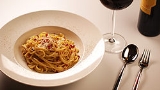
Carbonara

Overview
Pasta alla carbonara (usually spaghetti
Spaghetti
Spaghetti is a long, thin, cylindrical pasta of Italian origin. Spaghetti is made of semolina or flour and water. Italian dried spaghetti is made from durum wheat semolina, but outside of Italy it may be made with other kinds of flour...
, but also fettuccine
Fettuccine
Fettuccine is a type of pasta popular in Roman Cuisine. It is a flat thick noodle made of egg and flour wider than but similar to the tagliatelle typical of Bologna...
, rigatoni
Rigatoni
Rigatoni is a form of tube-shaped pasta of varying lengths and diameters. It is larger than penne and ziti and sometimes slightly curved. Rigatoni is usually ridged, and the tube's end is square-cut like ziti, not diagonal like penne....
or bucatini
Bucatini
Bucatini is a thick spaghetti-like pasta with a hole running through the center. The name comes from , meaning "hole", while bucato means "pierced"....
) is an Italian
Italy
Italy , officially the Italian Republic languages]] under the European Charter for Regional or Minority Languages. In each of these, Italy's official name is as follows:;;;;;;;;), is a unitary parliamentary republic in South-Central Europe. To the north it borders France, Switzerland, Austria and...
pasta
Pasta
Pasta is a staple food of traditional Italian cuisine, now of worldwide renown. It takes the form of unleavened dough, made in Italy, mostly of durum wheat , water and sometimes eggs. Pasta comes in a variety of different shapes that serve for both decoration and to act as a carrier for the...
dish based on egg
Egg (food)
Eggs are laid by females of many different species, including birds, reptiles, amphibians, and fish, and have probably been eaten by mankind for millennia. Bird and reptile eggs consist of a protective eggshell, albumen , and vitellus , contained within various thin membranes...
s, cheese (pecorino
Pecorino Romano
Pecorino Romano is a hard, salty Italian cheese, suitable primarily for grating, made out of sheep milk . Pecorino Romano was produced in Latium up to 1884 when, due to the prohibition issued by the city council of salting the cheese inside their shops in Rome, many producers moved to the island of...
or Parmigiano-Reggiano), bacon (guanciale
Guanciale
Guanciale is an unsmoked Italian bacon prepared with pig's jowl or cheeks. Its name is derived from guancia, Italian for cheek. Guanciale is similar to the jowl bacon of the United States....
or pancetta
Pancetta
Pancetta is Italian bacon, typically salt cured and seasoned with such spices as nutmeg, fennel, peppercorns, dried ground hot peppers and garlic, then dried for at least three months. Associated with Italy, pancetta varies by region. It is also produced broadly in Spain.-Styles:Pancetta can be...
), and black pepper
Black pepper
Black pepper is a flowering vine in the family Piperaceae, cultivated for its fruit, which is usually dried and used as a spice and seasoning. The fruit, known as a peppercorn when dried, is approximately in diameter, dark red when fully mature, and, like all drupes, contains a single seed...
. The dish was created in the middle of the 20th century.
The pork is fried in fat (olive oil
Olive oil
Olive oil is an oil obtained from the olive , a traditional tree crop of the Mediterranean Basin. It is commonly used in cooking, cosmetics, pharmaceuticals, and soaps and as a fuel for traditional oil lamps...
or lard
Lard
Lard is pig fat in both its rendered and unrendered forms. Lard was commonly used in many cuisines as a cooking fat or shortening, or as a spread similar to butter. Its use in contemporary cuisine has diminished because of health concerns posed by its saturated-fat content and its often negative...
), then hot pasta is dropped into the pan to finish cooking for a few seconds. A mixture of raw eggs, cheese, and a fat (butter, olive oil, or cream) is then combined with the hot pasta away from additional direct heat to avoid coagulating the egg, which must remain a liquid component of the sauce as it cooks.
