

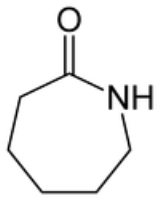
Caprolactam

Encyclopedia
Caprolactam is an organic compound
with the formula
(CH2)5C(O)NH. This colourless solid is a lactam
or a cyclic amide
of caproic acid. Approximately 2 billion kilograms are produced annually. Caprolactam is the precursor to Nylon 6
, a widely used synthetic polymer
.
, the product of the hydrolysis of caprolactam. Given the commercial significance of nylon-6, many methods have been developed for the production of caprolactam. Most of the caprolactam is synthesised from cyclohexanone
(1), which is first converted to its oxime
(2). Treatment of this oxime with acid induces the Beckmann rearrangement
to give caprolactam (3):
The immediate product of the acid-induced rearrangement is the bisulfate salt of caprolactam. This salt is neutralized with ammonia
to release the free lactam and cogenerate ammonium sulfate
. In optimizing the industrial practices, much attention is directed toward minimizing the production of ammonium salts.
The other major industrial route involves formation of the oxime from cyclohexane
using nitrosyl chloride
. The advantage of this method is that cyclohexane
is less expensive than cyclohexanone
. In earlier times, caprolactam was prepared by treatment of caprolactone
with ammonia.
:
Nylon-6 is widely used in fiber
s and plastic
s.
and is mildly toxic, with an of 1.1 g/kg (rat, oral). In 1991, it was included on the list of hazardous air pollutants by the U.S. Clean Air Act of 1990. It was subsequently removed from the list in 1993. In water, caprolactam hydrolyzes to aminocaproic acid
, which is used medicinally.
As of 2011 caprolactam had the unusual status of being the only chemical in the International Agency for Research on Cancer
's lowest hazard category, Group 4 "probably not carcinogenic to humans".
Organic compound
An organic compound is any member of a large class of gaseous, liquid, or solid chemical compounds whose molecules contain carbon. For historical reasons discussed below, a few types of carbon-containing compounds such as carbides, carbonates, simple oxides of carbon, and cyanides, as well as the...
with the formula
Chemical formula
A chemical formula or molecular formula is a way of expressing information about the atoms that constitute a particular chemical compound....
(CH2)5C(O)NH. This colourless solid is a lactam
Lactam
A lactam is a cyclic amide. Prefixes indicate how many carbon atoms are present in the ring: β-lactam , γ-lactam , δ-lactam...
or a cyclic amide
Amide
In chemistry, an amide is an organic compound that contains the functional group consisting of a carbonyl group linked to a nitrogen atom . The term refers both to a class of compounds and a functional group within those compounds. The term amide also refers to deprotonated form of ammonia or an...
of caproic acid. Approximately 2 billion kilograms are produced annually. Caprolactam is the precursor to Nylon 6
Nylon 6
Nylon 6 or polycaprolactam is a polymer developed by Paul Schlack at IG Farben to reproduce the properties of nylon 6,6 without violating the patent on its production. Unlike most other nylons, nylon 6 is not a condensation polymer, but instead is formed by ring-opening polymerization. This makes...
, a widely used synthetic polymer
Polymer
A polymer is a large molecule composed of repeating structural units. These subunits are typically connected by covalent chemical bonds...
.
Synthesis and production
Caprolactam was first described in the late 1800s when it was prepared by the cyclization of ε-aminocaproic acidAminocaproic acid
Aminocaproic acid is a derivative and analogue of the amino acid lysine, which makes it an effective inhibitor for enzymes that bind that particular residue. Such enzymes include proteolytic enzymes like plasmin, the enzyme responsible for fibrinolysis...
, the product of the hydrolysis of caprolactam. Given the commercial significance of nylon-6, many methods have been developed for the production of caprolactam. Most of the caprolactam is synthesised from cyclohexanone
Cyclohexanone
Cyclohexanone is the organic compound with the formula 5CO. The molecule consists of six-carbon cyclic molecule with a ketone functional group. This colorless oil has an odor reminiscent of peardrop sweets as well as acetone. Over time, samples assume a yellow color due to oxidation...
(1), which is first converted to its oxime
Oxime
An oxime is a chemical compound belonging to the imines, with the general formula R1R2C=NOH, where R1 is an organic side chain and R2 may be hydrogen, forming an aldoxime, or another organic group, forming a ketoxime. O-substituted oximes form a closely related family of compounds...
(2). Treatment of this oxime with acid induces the Beckmann rearrangement
Beckmann rearrangement
The Beckmann rearrangement, named after the German chemist Ernst Otto Beckmann , is an acid-catalyzed rearrangement of an oxime to an amide...
to give caprolactam (3):

The immediate product of the acid-induced rearrangement is the bisulfate salt of caprolactam. This salt is neutralized with ammonia
Ammonia
Ammonia is a compound of nitrogen and hydrogen with the formula . It is a colourless gas with a characteristic pungent odour. Ammonia contributes significantly to the nutritional needs of terrestrial organisms by serving as a precursor to food and fertilizers. Ammonia, either directly or...
to release the free lactam and cogenerate ammonium sulfate
Ammonium sulfate
Ammonium sulfate , 2SO4, is an inorganic salt with a number of commercial uses. The most common use is as a soil fertilizer. It contains 21% nitrogen as ammonium cations, and 24% sulfur as sulfate anions...
. In optimizing the industrial practices, much attention is directed toward minimizing the production of ammonium salts.
The other major industrial route involves formation of the oxime from cyclohexane
Cyclohexane
Cyclohexane is a cycloalkane with the molecular formula C6H12. Cyclohexane is used as a nonpolar solvent for the chemical industry, and also as a raw material for the industrial production of adipic acid and caprolactam, both of which being intermediates used in the production of nylon...
using nitrosyl chloride
Nitrosyl chloride
Nitrosyl chloride is the chemical compound NOCl. It is a yellow gas that is most commonly encountered as a decomposition product of aqua regia, a mixture of hydrochloric acid and nitric acid...
. The advantage of this method is that cyclohexane
Cyclohexane
Cyclohexane is a cycloalkane with the molecular formula C6H12. Cyclohexane is used as a nonpolar solvent for the chemical industry, and also as a raw material for the industrial production of adipic acid and caprolactam, both of which being intermediates used in the production of nylon...
is less expensive than cyclohexanone
Cyclohexanone
Cyclohexanone is the organic compound with the formula 5CO. The molecule consists of six-carbon cyclic molecule with a ketone functional group. This colorless oil has an odor reminiscent of peardrop sweets as well as acetone. Over time, samples assume a yellow color due to oxidation...
. In earlier times, caprolactam was prepared by treatment of caprolactone
Caprolactone
ε-Caprolactone or simply caprolactone is a cyclic ester, a member of the lactone family, with a seven-membered ring with the formula 5CO2. This colorless liquid is miscible with most organic solvents...
with ammonia.
Uses
Caprolactam is the precursor to Nylon-6. The conversion entails a ring-opening polymerizationRing-opening polymerization
In polymer chemistry, ring-opening polymerization is a form of chain-growth polymerization, in which the terminal end of a polymer acts as a reactive center, where further cyclic monomers join to form a larger polymer chain through ionic propagation...
:
- n (CH2)5C(O)NH → [(CH2)5C(O)NH]n
Nylon-6 is widely used in fiber
Fiber
Fiber is a class of materials that are continuous filaments or are in discrete elongated pieces, similar to lengths of thread.They are very important in the biology of both plants and animals, for holding tissues together....
s and plastic
Plastic
A plastic material is any of a wide range of synthetic or semi-synthetic organic solids used in the manufacture of industrial products. Plastics are typically polymers of high molecular mass, and may contain other substances to improve performance and/or reduce production costs...
s.
Safety
Caprolactam is an irritantIrritation
Irritation or exacerbation, in biology and physiology, is a state of inflammation or painful reaction to allergy or cell-lining damage. A stimulus or agent which induces the state of irritation is an irritant...
and is mildly toxic, with an of 1.1 g/kg (rat, oral). In 1991, it was included on the list of hazardous air pollutants by the U.S. Clean Air Act of 1990. It was subsequently removed from the list in 1993. In water, caprolactam hydrolyzes to aminocaproic acid
Aminocaproic acid
Aminocaproic acid is a derivative and analogue of the amino acid lysine, which makes it an effective inhibitor for enzymes that bind that particular residue. Such enzymes include proteolytic enzymes like plasmin, the enzyme responsible for fibrinolysis...
, which is used medicinally.
As of 2011 caprolactam had the unusual status of being the only chemical in the International Agency for Research on Cancer
International Agency for Research on Cancer
The International Agency for Research on Cancer is an intergovernmental agency forming part of the World Health Organisation of the United Nations....
's lowest hazard category, Group 4 "probably not carcinogenic to humans".