
The genus
Thryonomys, also known as
cane rats,
grass cutters, or
cutting grass, is a genus of
rodentRodentia is an order of mammals also known as rodents, characterised by two continuously growing incisors in the upper and lower jaws which must be kept short by gnawing....
found throughout
AfricaAfrica is the world's second largest and second most populous continent, after Asia. At about 30.2 million km² including adjacent islands, it covers 6% of the Earth's total surface area and 20.4% of the total land area...
south of the
SaharaThe Sahara is the world's second largest desert, after Antarctica. At over , it covers most of Northern Africa, making it almost as large as Europe or the United States. The Sahara stretches from the Red Sea, including parts of the Mediterranean coasts, to the outskirts of the Atlantic Ocean...
, the only members of the
familyIn biological classification, family is* a taxonomic rank. Other well-known ranks are life, domain, kingdom, phylum, class, order, genus, and species, with family fitting between order and genus. As for the other well-known ranks, there is the option of an immediately lower rank, indicated by the...
Thyronomyidae. They are eaten in some African countries and are a pest species on many crops.
Characteristics
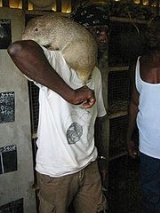
Cane rats range in body length from 35 to 60 centimetres. They commonly weigh 6-7 kilograms in captivity, and can obtain weights up to 10 kilograms in the wild. They are heavily-built rodents, with bristly brown fur speckled with yellow or grey. They live in
marshIn geography, a marsh, or morass, is a type of wetland that is subject to frequent or continuous flood. Typically the water is shallow and features grasses, rushes, reeds, typhas, sedges, other herbaceous plants, and moss....
y areas and along river and lake banks, and are
herbivoreHerbivores are organisms that are anatomically and physiologically adapted to eat plant-based foods. Herbivory is a form of consumption in which an organism principally eats autotrophs such as plants, algae and photosynthesizing bacteria. More generally, organisms that feed on autotrophs in...
s, feeding on aquatic grasses in the wild. In agricultural areas they will also, as the name suggests, feed on the crops in
caneSugarcane refers to any of six to 37 species of tall perennial grasses of the genus Saccharum . Native to the warm temperate to tropical regions of South Asia, they have stout, jointed, fibrous stalks that are rich in sugar, and measure two to six metres tall...
plantationA plantation is a long artificially established forest, farm or estate, where crops are grown for sale, often in distant markets rather than for local on-site consumption...
s, making them a significant pest.
Females give birth to litters of two to four young at least once a year, and more frequently in some areas. Cane rats are sexually mature and able to reproduce at 6 months of age.
Relationship with humans
Cane rats are widely distributed and valued as a source of "bush meat" in West and Central
AfricaAfrica is the world's second largest and second most populous continent, after Asia. At about 30.2 million km² including adjacent islands, it covers 6% of the Earth's total surface area and 20.4% of the total land area...
. Farmers also expend substantial energy fencing the rodents out of their fields. Like the
guinea pigThe guinea pig , also called the cavy, is a species of rodent belonging to the family Caviidae and the genus Cavia. Despite their common name, these animals are not in the pig family, nor are they from Guinea...
, the meat is of a higher protein but lower fat content than domesticated farm meat and it is also appreciated for its tenderness and taste. In the past this animal was hunted extensively although, in the
savannaA savanna, or savannah, is a grassland ecosystem characterized by the trees being sufficiently small or widely spaced so that the canopy does not close. The open canopy allows sufficient light to reach the ground to support an unbroken herbaceous layer consisting primarily of C4 grasses.Some...
area of
West AfricaWest Africa or Western Africa is the westernmost region of the African continent. Geopolitically, the UN definition of Western Africa includes the following 16 countries and an area of approximately 5 million square km:-Flags of West Africa:...
, people have traditionally captured wild cane rats and fattened them in captivity. More recently, intensive production of cane rats has been undertaken in countries such as
BeninBenin , officially the Republic of Benin, is a country in West Africa. It borders Togo to the west, Nigeria to the east and Burkina Faso and Niger to the north. Its small southern coastline on the Bight of Benin is where a majority of the population is located...
and
TogoTogo, officially the Togolese Republic , is a country in West Africa bordered by Ghana to the west, Benin to the east and Burkina Faso to the north. It extends south to the Gulf of Guinea, on which the capital Lomé is located. Togo covers an area of approximately with a population of approximately...
and agricultural extension services in
CameroonCameroon, officially the Republic of Cameroon , is a country in west Central Africa. It is bordered by Nigeria to the west; Chad to the northeast; the Central African Republic to the east; and Equatorial Guinea, Gabon, and the Republic of the Congo to the south. Cameroon's coastline lies on the...
,
Côte d'IvoireThe Republic of Côte d'Ivoire or Ivory Coast is a country in West Africa. It has an area of , and borders the countries Liberia, Guinea, Mali, Burkina Faso and Ghana; its southern boundary is along the Gulf of Guinea. The country's population was 15,366,672 in 1998 and was estimated to be...
,
GabonGabon , officially the Gabonese Republic is a state in west central Africa sharing borders with Equatorial Guinea to the northwest, Cameroon to the north, and with the Republic of the Congo curving around the east and south. The Gulf of Guinea, an arm of the Atlantic Ocean is to the west...
,
GhanaGhana , officially the Republic of Ghana, is a country located in West Africa. It is bordered by Côte d'Ivoire to the west, Burkina Faso to the north, Togo to the east, and the Gulf of Guinea to the south...
,
NigeriaNigeria , officially the Federal Republic of Nigeria, is a federal constitutional republic comprising 36 states and its Federal Capital Territory, Abuja. The country is located in West Africa and shares land borders with the Republic of Benin in the west, Chad and Cameroon in the east, and Niger in...
,
SenegalSenegal , officially the Republic of Senegal , is a country in western Africa. It owes its name to the Sénégal River that borders it to the east and north...
, and
ZaireThe Republic of Zaire was the name of the present Democratic Republic of the Congo between 27 October 1971 and 17 May 1997. The name of Zaire derives from the , itself an adaptation of the Kongo word nzere or nzadi, or "the river that swallows all rivers".-Self-proclaimed Father of the Nation:In...
have also encouraged farmers to rear these rodents in rural and peri-urban areas. Research carried out over the last two decades has allowed the selection and improvement of stock for captivity and much of the knowledge and techniques for cane rat breeding has been determined from work carried out at the Benin-Germany breeding station, which was established in the mid-1980s. Practical information is now more readily available for farmers interested in cane rat breeding, but training is still advised.
Unlike other rodent species, the high exploitation of cane rats in the wild has not had a serious effect on its numbers. Some researchers postulate that their populations may actually be increasing due to deforestation and changing land use patterns in West Africa. Regardless, they have adapted to deforested areas and occur in close proximity to farmlands and people. However, there are areas where the species has been over-hunted and savanna habitat is often at risk during the dry season from bushfires, which are lit during
bushmeatBushmeat initially referred to the hunting of wild animals in West and Central Africa and is a calque from the French viande de brousse. Today the term is commonly used for meat of terrestrial wild animals, killed for subsistence or commercial purposes throughout the humid tropics of the Americas,...
hunting expeditions. Cane rats are not the most prolific of rodent species, but the high demand, attractive market price, and the small amount of investment required makes cane rats a suitable mini-
livestockLivestock refers to one or more domesticated animals raised in an agricultural setting to produce commodities such as food, fiber and labor. The term "livestock" as used in this article does not include poultry or farmed fish; however the inclusion of these, especially poultry, within the meaning...
activity for income generation in many parts of West and Central Africa.
External links