

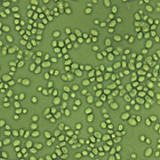
Candida glabrata

Encyclopedia
Candida glabrata is a haploid yeast
of the genus Candida
, previously known as Torulopsis glabrata. This species of yeast is non-dimorphic
and no mating activity has been observed. Until recently, C. glabrata was thought to be a primarily non-pathogenic organism. However, with the ever increasing population of immunocompromised individuals, trends have shown C. glabrata to be a highly opportunistic pathogen of the urogenital tract, and of the bloodstream (Candidemia). It is especially prevalent in HIV
positive people, and the elderly.
There are two widely cited potential virulence factors that contribute to the pathogenicity of C. glabrata. The first is a series of adhesins coded by the EPA (epithelial adhesin
) genes. These genes, located in the subtelomeric region, can respond to environmental cues that allow them to be expressed en masse so the organism can adhere to biotic and abiotic surfaces in microbial mats. This is also the suspected mechanism by which C. glabrata forms microbial "biofilm
s" on urinary catheters, and less commonly in-dwelling IV catheters. It also causes problems with dental devices, such as dentures.
drugs, which are the most commonly prescribed antifungal (antimycotic) drugs. These drugs, including fluconazole
and ketoconazole
, are "not effective in 15-20% of cases" against C. glabrata. While some have said that the organism possesses an "innate" immunity to the drugs, it is more accurate to say that the organism possesses an evolved resistance to the drugs. It is still highly vulnerable to polyene drugs such as amphotericin B
and nystatin
, along with variable vulnerability to flucytosine
and caspofungin
. However doctors asked about amphotericin B indicate that this is a drug of last resort, in that this drug can often kill the patient while "curing" the fungal infection.
A first-line treatment for vaginal infections may be the use of Terconazole 7-day cream. Several courses may be needed. The cure-rate for this treatment is approximately 40%. Recurrences are common, causing chronic infections and spread to other areas such as skin and scalp. Blood infections might well be best assessed per symptoms if other areas are involved.
An experimental, but effective second-line treatment for chronic infections, is the use of boric acid. Compounding pharmacies can create boric acid vaginal suppositories. Use of Vitamin E oil may be used in conjunction to combat irritation. Amphotericin B vaginal suppositories have also been used in case studies to treat chronic infections, both symptomatic and asymptomatic. Borax and boric acid may be used for persistent scalp and skin infections. Very little information is available regarding treatment for Tortulosis glabrata.
Yeast
Yeasts are eukaryotic micro-organisms classified in the kingdom Fungi, with 1,500 species currently described estimated to be only 1% of all fungal species. Most reproduce asexually by mitosis, and many do so by an asymmetric division process called budding...
of the genus Candida
Candida (genus)
Candida is a genus of yeasts. Many species are harmless commensals or endosymbionts of animal hosts including humans, but other species, or harmless species in the wrong location, can cause disease. Candida albicans can cause infections in humans and other animals, especially in immunocompromised...
, previously known as Torulopsis glabrata. This species of yeast is non-dimorphic
Phenotypic switching
Phenotypic switching is switching between two cell-types. An example is Candida albicans, which, when it infects host tissue, switches from the usual unicellular yeast-like form of into an invasive, multicellular filamentous form. This switching between two cell-types is known as...
and no mating activity has been observed. Until recently, C. glabrata was thought to be a primarily non-pathogenic organism. However, with the ever increasing population of immunocompromised individuals, trends have shown C. glabrata to be a highly opportunistic pathogen of the urogenital tract, and of the bloodstream (Candidemia). It is especially prevalent in HIV
HIV
Human immunodeficiency virus is a lentivirus that causes acquired immunodeficiency syndrome , a condition in humans in which progressive failure of the immune system allows life-threatening opportunistic infections and cancers to thrive...
positive people, and the elderly.
There are two widely cited potential virulence factors that contribute to the pathogenicity of C. glabrata. The first is a series of adhesins coded by the EPA (epithelial adhesin
Adhesin
Adhesins are cell-surface components or appendages of bacteria that facilitate bacterial adhesion or adherence to other cells or to inanimate surfaces. Adhesins are a type of virulence factor....
) genes. These genes, located in the subtelomeric region, can respond to environmental cues that allow them to be expressed en masse so the organism can adhere to biotic and abiotic surfaces in microbial mats. This is also the suspected mechanism by which C. glabrata forms microbial "biofilm
Biofilm
A biofilm is an aggregate of microorganisms in which cells adhere to each other on a surface. These adherent cells are frequently embedded within a self-produced matrix of extracellular polymeric substance...
s" on urinary catheters, and less commonly in-dwelling IV catheters. It also causes problems with dental devices, such as dentures.
Diagnosis
Cultures are an effective method for identifying non-albicans vaginal infections. Urinalyses are less accurate in this process. The culture may take several days to grow, but the identification of the yeast species is quick once the yeast is isolated. Skin disease diagnosis is difficult, as cultures collected from swabs and biopsies will test negative for fungus and a special assessment is required. Listed under the 'Rare Diseases' database on the NIH web site, torulopsis glabrata, or candida glabrata can also be found on the CDC's web site. Although listed as the second most virulent yeast after Candida Albicans, almost no information is available regarding treatment and identification. Although high mortality rates are listed, assessment of the critical nature of a glabrata infection is a gray area.Treatment
A major phenotype and potential virulence factor that C. glabrata possesses is low-level intrinsic resistance to the azoleAzole
An azole is a class of five-membered nitrogen heterocyclic ring compounds containing at least one other non-carbon atom of either nitrogen, sulfur, or oxygen. The parent compounds are aromatic and have two double bonds; there are successively reduced analogs with fewer...
drugs, which are the most commonly prescribed antifungal (antimycotic) drugs. These drugs, including fluconazole
Fluconazole
Fluconazole is a triazole antifungal drug used in the treatment and prevention of superficial and systemic fungal infections. In a bulk powder form, it appears as a white crystalline powder, and it is very slightly soluble in water and soluble in alcohol. It is commonly marketed under the trade...
and ketoconazole
Ketoconazole
Ketoconazole is a synthetic antifungal drug used to prevent and treat fungal skin infections, especially in immunocompromised patients such as those with AIDS or those on chemotherapy. Ketoconazole is sold commercially as an anti-dandruff shampoo, topical cream, and oral tablet.Ketoconazole is...
, are "not effective in 15-20% of cases" against C. glabrata. While some have said that the organism possesses an "innate" immunity to the drugs, it is more accurate to say that the organism possesses an evolved resistance to the drugs. It is still highly vulnerable to polyene drugs such as amphotericin B
Amphotericin B
Amphotericin B is a polyene antifungal drug, often used intravenously for systemic fungal infections...
and nystatin
Nystatin
Nystatin is a polyene antifungal medication to which many molds and yeast infections are sensitive, including Candida. Due to its toxicity profile, there are currently no injectable formulations of this drug on the US market...
, along with variable vulnerability to flucytosine
Flucytosine
Flucytosine, or 5-fluorocytosine, a fluorinated pyrimidine analogue, is a synthetic antimycotic drug.It is structurally related to the cytostatic fluorouracil and to floxuridine. It is available in oral and in some countries also in injectable form. A common brand name is Ancobon. Flucytosine was...
and caspofungin
Caspofungin
Caspofungin is an antifungal drug, the first of a new class termed the echinocandins from Merck & Co., Inc. It shows activity against infections with Aspergillus and Candida, and works by inhibiting the enzyme β-D-Glucan synthase and thereby disturbing the integrity of the fungal cell wall...
. However doctors asked about amphotericin B indicate that this is a drug of last resort, in that this drug can often kill the patient while "curing" the fungal infection.
A first-line treatment for vaginal infections may be the use of Terconazole 7-day cream. Several courses may be needed. The cure-rate for this treatment is approximately 40%. Recurrences are common, causing chronic infections and spread to other areas such as skin and scalp. Blood infections might well be best assessed per symptoms if other areas are involved.
An experimental, but effective second-line treatment for chronic infections, is the use of boric acid. Compounding pharmacies can create boric acid vaginal suppositories. Use of Vitamin E oil may be used in conjunction to combat irritation. Amphotericin B vaginal suppositories have also been used in case studies to treat chronic infections, both symptomatic and asymptomatic. Borax and boric acid may be used for persistent scalp and skin infections. Very little information is available regarding treatment for Tortulosis glabrata.