
All Topics  
Canadian War Museum

 
Canadian War Museum

   Email Print
   Bookmark   Link


Canadian War Museum


The Canadian War Museum (CWM) is Canada
Canada

Canada is a country occupying most of northern North America, extending from the Atlantic Ocean in the east to the Pacific Ocean in the west and northward into the Arctic Ocean....
’s national museum of military history. Located in Ottawa
Ottawa

Ottawa is the Capital of Canada. The city has population of 812,000, the List of the 100 largest municipalities in Canada by population municipality in the country and second largest in Ontario....
, Ontario
Ontario

Ontario is a Provinces and territories of Canada located in the Central Canada part of Canada, the largest by population and second largest, after Quebec, in total area....
, the museum focuses on military conflicts that occurred on Canadian soil, involved Canadian forces, or had a significant effect on the country and its people. The conflicts range from early warfare among First Peoples to today’s “war on terror.”

Much of the museum’s public exhibition space is devoted to its .


Discussion
Ask a question about 'Canadian War Museum'
Start a new discussion about 'Canadian War Museum'
Answer questions from other users
Full Discussion Forum


Encyclopedia


The Canadian War Museum (CWM) is Canada
Canada

Canada is a country occupying most of northern North America, extending from the Atlantic Ocean in the east to the Pacific Ocean in the west and northward into the Arctic Ocean....
’s national museum of military history. Located in Ottawa
Ottawa

Ottawa is the Capital of Canada. The city has population of 812,000, the List of the 100 largest municipalities in Canada by population municipality in the country and second largest in Ontario....
, Ontario
Ontario

Ontario is a Provinces and territories of Canada located in the Central Canada part of Canada, the largest by population and second largest, after Quebec, in total area....
, the museum focuses on military conflicts that occurred on Canadian soil, involved Canadian forces, or had a significant effect on the country and its people. The conflicts range from early warfare among First Peoples to today’s “war on terror.”

Much of the museum’s public exhibition space is devoted to its . These permanent exhibitions underline the profound effect war has had on Canada’s development and the significant role Canadians have played in international conflicts. The galleries also devote much attention to war’s impact on individuals: to what it calls the “devastating human experience” of war. Complementing the permanent galleries is a changing program of temporary or .

The CWM also houses , a large collection of , and extensive collection of military vehicles and artillery.

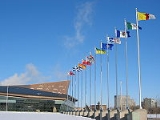
The CWM was first built in 1880. Its current building opened in May 2005 is located less than 2 km west of Canada’s Parliament Buildings. The building's has received professional and public acclaim.

Although the museum promotes remembrance of past conflicts and the sacrifices made by those in uniform, it is a public history museum, not a national war memorial or a museum of the Canadian Forces
Canadian Forces

The Canadian Forces , officially the Canadian Armed Forces , are the unified armed forces of Canada, as constituted by the National Defence Act, which states: "The Canadian Forces are the armed forces of Her Majesty raised by Canada and consist of one Service called the Canadian Armed Forces." This singular institution consists of thre...
. The CWM is part of the Canadian Museum of Civilization Corporation, which also operates the Canadian Museum of Civilization
Canadian Museum of Civilization

The Canadian Museum of Civilization is Canada?s national museum of human history and the most popular and most-visited museum in Canada.It is located in Gatineau, Quebec, directly across the Ottawa River from Canada?s Parliament Hill....
, the Canadian Children's Museum
Canadian Children's Museum

The Canadian Children's Museum is located inside the Canadian Museum of Civilization, in Gatineau, Quebec. The CCM is among the most popular museums in the country, attracting about half a million visitors each year....
, the Canadian Postal Museum
Canadian Postal Museum

The Canadian Postal Museum is housed within the Canadian Museum of Civilization in Gatineau, Quebec. It has been described as one of the largest postal museums in the world, ranking second in annual attendance....
, and the .

History

Old Canadian War Museum Ottawa 3jun2004
The museum originated in 1880 as a collection of military artifacts in the possession of the Canadian federal government, organized by militia officers of the Ottawa garrison. Its first facility was a series of rooms in the Cartier Square Drill Hall
Cartier Square Drill Hall

The Drill Hall at Cartier Square has been an Ottawa landmark and dedicated military training facility since its construction in 1879. The drill hall is seventy metres long and has two forty-three metre tall mansard towers....
. The collection was later adopted by the Public Archives of Canada
Library and Archives Canada

Library and Archives Canada is a Government of Canada department responsible for the collection and preservation of the documentary heritage of Canada through writings, pictures and other documents relevant to the history of Canada, culture of Canada and the politics of Canada....
. The Canadian War Museum was officially established in 1942. The collection of war artifacts gained its own dedicated facility in 1967 when it moved to the former Public Archives building on Sussex Drive
Sussex Drive

Sussex Drive is a major street in Ottawa, Ontario, Canada, which is one of the city's major ceremonial and institutional routes.Running roughly parallel to the Ottawa River, Sussex Drive begins at Rideau Street at the north end of Colonel By Drive, running north and then bending northeast until MacKay Street, where it becomes the Rockclif...
 in Ottawa. That location was considered to small for the museum's growing collection which had to mostly be stored at a west-end Ottawa warehouse known as Vimy House
Vimy House

Vimy House is a warehouse in western Ottawa, Canada, that used to store most of the collection of the Canadian War Museum. Originally built as Ottawa's streetcar garage, it was turned over to the war museum when its Sussex Drive building ran out of storage and office space....
.

New building

In the 1990s, the government made plans to relocate the War Museum to a new site east of central Ottawa, however the proposed site was criticized for its distance from downtown core and a more prominent location on the Ottawa River
Ottawa River

The Ottawa River is a river in the Canadian provinces of Ontario and Quebec. It defines for most of its length the border between these two provinces....
 was selected and west of Parliament Hill
Parliament Hill

File:Model of Parliament Hill.jpgParliament Hill is an area of Crown land on the southern banks of the Ottawa River in downtown Ottawa, Ontario....
. The new location also allowed for ceremonial processions between the National War Memorial
National War Memorial (Canada)

The National War Memorial , is a tall granite cenotaph with acreted bronze sculptures, that stands in Confederation Square, Ottawa, and serves as the federal war memorial for Canada....
 and the new War Museum.

The new facility, designed by a joint venture of Moriyama & Teshima Architects of Toronto
Toronto

Toronto is the List of the 100 largest municipalities in Canada by population in Canada and the Provinces and territories of Canada Provincial and territorial capitals of Canada of Ontario....
 and Griffiths Rankin Cook Architects of Ottawa
Ottawa

Ottawa is the Capital of Canada. The city has population of 812,000, the List of the 100 largest municipalities in Canada by population municipality in the country and second largest in Ontario....
, was opened in May 2005. The new, modern building emerges eastward from the ground, with textured concrete reminiscent of a bunker, but with rooftop gardens consistent with the museum's theme of regeneration. The building rises to a large fin, clad in copper that matches the rooftops of other prominent public buildings in the capital. The small windows on the fin spell out in Morse code
Morse code

Morse code is a type of character encoding that transmits telegraphic information using rhythm. Morse code uses a standardized sequence of short and long elements to represent the alphanumeric, punctuation and special characters of a given message....
 Lest we forget (in English) and N'oublions jamais (in French). The copper used on the interior of the building is the replaced copper roof from the Library of Parliament
Library of Parliament

File:LibraryReadingRoom.jpgThe Library of Parliament is the main information repository and research resource for the Parliament of Canada. The main branch of the library, which is the focus of this article, sits at the rear of the Centre Block, on Parliament Hill, in Ottawa, Ontario, and is the last untouched part of that larger building'...
, which itself was refurbished in 2004.

Controversy


May 2005
Two paintings displayed in the Canadian War Museum depicted wartime atrocities committed by Canadian soldiers. One involved the torture of Somalian teenager Shidane Arone
Shidane Arone

Shidane Arone was a Somalia teenager who was beaten to death by Canada soldiers from the Canadian Airborne Regiment.Arone was caught on March 16 attempting to steal supplies from the Canadian base....
 in 1993 by a member of the Canadian Airborne Regiment, Master Corporal Clayton Matchee
Clayton Matchee

Master Corporal Clayton Matchee is a former Canada soldier and a central figure in the Somalia Affair.A member of the Cree Flying Dust First Nation reserve, Matchee is one of five children....
. The other painting was one of Private Kyle Brown
Kyle Brown (Canadian soldier)

Private Kyle Brown was a Canadian Forces implicated in the death in custody of Somali teenager Shidane Arone.The Canadian supply depot in Somalia was being looted and Arone was suspected of being one of the looters....
, convicted for his role in the same event. The paintings were considered inappropriate as part of the nation's historical museum by the head of one of the country's veterans associations. Other veterans disagreed and said it was more important that the Canadian War Museum play its proper role in portraying the realities of the war in which Canadians were involved. The Museum stated it did not intend on changing the display despite the disapproval of some war veterans.

August 2007

The text displayed on the Bomber Command exhibit was the source of another controversy, some veterans group felt Canadian veterans were portrayed as war criminals who needlessly killed thousands of civilians in Germany through a bombing campaign. The exhibit's plaque - which specifically refers to the Bombing Campaign of German cities such as Dresden, reads as follows:

"The value and morality of the strategic bomber offensive against Germany remains bitterly contested. Bomber Command's aim was to crush civilian morale and force Germany to surrender by destroying its cities and industrial installations. Although Bomber Command and American attacks left 600,000 Germans dead and more than five million homeless, the raids resulted in only small reductions of German war production until late in the war."

The veterans group demanded the text be changed so that it would read as follows:

"Thousands perished in the raids and millions were left homeless. While these numbers are very large, they pale in comparison to the genocide perpetrated...by the Germans and their proxies."

People against altering the plaque charged that the veterans' suggested replacement text proves that they had a political agenda, and not a historical one.

The veterans group using political pressure were successful in having the text changed. This move has generated outrage among historians, educators, and some war veterans, who say the exhibit was factually accurate.

Photos


Main exhibit galleries

Most of the museum’s main floor is devoted to the Canadian Experience Galleries.

Gallery 1: Battleground — to 1885
This gallery looks at the earliest wars of Canada, many of which were pre-Confederation. Beginning with First Peoples Warfare, it highlights the New Alliances between the Natives and Europeans, and the resultant Clash of Empires. Other events that impacted Canada and also exhibited are The American Revolution
American Revolution

The American Revolution refers to the political upheaval during the last half of the 18th century in which the Thirteen Colonies of North America overthrew the governance of the British Empire and then rejected the British monarchy to become the sovereign United States of America....
, The War of 1812. The gallery ends with the Conflict and Confederation
Canadian Confederation

Canadian Confederation was the process by which the federalism Dominion of Canada was formed beginning July 1, 1867 from the provinces, colony and Territory of British North America....
.

Gallery 2: For Crown and Country — 1885–1931
The museum progresses chronologically into the period from 1885 to 1931, beginning with The South African War
Second Boer War

The Second Boer War , commonly referred to as The Boer War and also known as the South African War , the Anglo-Boer War and in Afrikaans as the Boereoorlog or Tweede Vryheidsoorlog , was fought from 11 October 1899 until 31 May 1902, between the British Empire and the two independent Boer republics of the Orange Fre...
. The First World War
World War I

World War I, or the First World War , was a global military conflict which involved the Great powers, organized into two opposing military alliances: the Allies of World War I and the Central Powers....
 and its battles that Canadian soldiers were involved in, including the The Western Front
Western Front (World War I)

Following the outbreak of World War I in 1914, the German Empire army opened the Western Front by first invading Luxembourg and Belgium, then gaining military control of important industrial regions in France....
, In the Trenches, Vimy
Battle of Vimy Ridge

The Battle of Vimy Ridge was a military engagement fought as part of the Battle of Arras , in the Nord-Pas-de-Calais region of France, during the First World War....
, and Passchendaele. other exhibits are the Costly Victory, and Aftermath.

Gallery 3: Forged in Fire — 1931–1945
This gallery looks at Adolf Hitler (whose personal limousine is on display and labeled "a symbol of evil"), also on display is information regarding Benito Mussolini
Benito Mussolini

Benito Amilcare Andrea Mussolini, Order of the Bath Sovereign Military Order of Malta Order of the Tower and Sword was an Italy politician who led the National Fascist Party and is credited with being one of the key figures in the creation of Fascism....
, and Tojo
Tojo

Tojo may refer to:*Tojo, Hyogo , a town in Japan*Tojo, Hiroshima , a town in Japan*Tojo , a character from a Norwegian The Lion King comic...
. Continuing through the gallery, visitors will find the displays of the Battle of the Atlantic, Japan Strikes in the Pacific, The Home Front, Dieppe
Dieppe Raid

The Dieppe Raid, also known as The Battle of Dieppe or Operation Jubilee, during the World War II, was an Allies of World War II attack on the German-occupied port of Dieppe, Seine-Maritime on the Northern coast of France on 19 August 1942....
, The Air War, Italy
Italy

Italy , officially the Italian Republic , is a country located on the Italian Peninsula in Southern Europe and on the two largest islands in the Mediterranean Sea, Sicily and Sardinia....
 and Normandy
Normandy

Normandy is a geographical region corresponding to the former Duchy of Normandy. It is situated along the coast of France south of the English Channel between Brittany and Picardy and comprises territory in northern France and the Channel Islands....
, Liberation and Victory. Homecoming is the final exhibit of the gallery.

Gallery 4: A Violent Peace — 1945–present
Following World War II Canada's peace time efforts are described in gallery 4. The exhibits include A Violent Peace beginning with Welcome Home, showing the rise of suburban Canada. The exhibits also include From World War to Cold War, Korea, NATO
NATO

The North Atlantic Treaty Organization , also called the Atlantic Alliance, is a military alliance established by the signing of the North Atlantic Treaty on 4 April 1949....
, NORAD, U.N. Peacekeeping, The Cold War at Home, Cold War Twilight, and The Savage Wars of Peace.

Royal Canadian Legion Hall of Honour

Displayed in this exhibition hall are military honours, certificates of service, works of art, Remembrance Day
Remembrance Day

Remembrance Day – also known as Poppy Day, Armistice Day or Veterans Day – is a day to commemorate the sacrifices of members of the armed forces and of civilians in times of war, specifically since the World War I....
 poppies
Poppy

A poppy is any of a number of showy flowers, typically withone per Plant stem, belonging to the Papaveraceae. They include a number of attractive wildflower species with showy flowers found growing singularly or in large groups; many species are also grown in gardens....
, and other material objects used by Canadians to remember and commemorate their military past and to honour those who have worn a Canadian uniform. Among the highlights is the original plaster model for the National War Memorial
National War Memorial (Canada)

The National War Memorial , is a tall granite cenotaph with acreted bronze sculptures, that stands in Confederation Square, Ottawa, and serves as the federal war memorial for Canada....
 in Ottawa.

Regeneration Hall

These rooms feature the plaster casts (maquettes)
Maquette

A maquette is a small scale model or rough draft of an unfinished architectural work or a sculpture. It is used to visualize and test shapes and ideas without incurring the cost and effort of producing a full scale product....
 of the constructs which were incorporated into the design of the Canadian National Vimy Memorial of the Canadian forces attacking and taking Vimy Ridge during World War I.

LeBreton Gallery

Weather Station Kurt
On display in this exhibit is a large collection of vehicles used in wars or conflicts in which Canada had a presence. The display includes:
  • M109 Howitzer
    M109 howitzer

    The M109 is an United States-made Self-propelled artillery 155 mm howitzer, first introduced in the early 1960s. It has been continually upgraded and improved to today's current version, the M109A6 Paladin, currently only used by the United States Army....
  • BMP infantry fighting vehicle
    BMP-1

    BMP-1 is a Soviet Union amphibious tracked infantry fighting vehicle. BMP stands for Boyevaya Mashina Pekhoty , meaning "fighting vehicle of infantry") ....
  • CF-101 Voodoo
    CF-101 Voodoo

    The CF-101 Voodoo was an all-weather interceptor aircraft operated by the Royal Canadian Air Force and Canadian Forces between 1961 and 1984. They were manufactured by the McDonnell Aircraft Corporation of St....
     mounted above the hall on a pedestal
  • Chieftain tank
    Chieftain tank

    The FV 4201 Chieftain was the main battle tank of the United Kingdom during the 1960s and 1970s. It was one of the most advanced tanks of its era, and at the time of its introduction in 1966 had the most powerful main gun and heaviest armour of any tank in the world ....
  • Iltis
    Volkswagen Iltis

    The Volkswagen Type 183, more commonly known as the Iltis is a military vehicle built by Volkswagen for use by the Germany military and under licence by Bombardier for the Canadian Forces and Belgian Army....
     'battlefield taxi' in which Canadian peacekeeper
    Peacekeeper

    Peacekeeper may refer to:* A person involved in peacekeeping* Peace officer* Conservator of the Peace* Peacekeepers In vehicles:* The LGM-118A Peacekeeper, a land-based nuclear ICBM...
    s were wounded
  • Jagdpanzer IV
    Jagdpanzer IV

    The Jagdpanzer IV, Sd.Kfz. 162, was a tank destroyer based on the Panzer IV chassis built in three main variants. It was developed against the wishes of Heinz Guderian, the inspector general of the Panzertruppen, as a replacement for the Sturmgesch?tz III....
  • M3 Lee
    M3 Lee

    The Medium Tank M3 was an United States tank used during World War II. In United Kingdom the tank was called "General Lee" named after General Robert E....
  • M114
    M114

    The M114 Command and Reconnaissance Carrier is a Vietnam War-era tracked armored fighting vehicle, used by the United States Army. It was manufactured by the Cadillac Division of General Motors in the early 1960s....
     armoured personnel carrier
  • Panther tank
    Panther tank

    The Panther was a tank fielded by Germany in World War II that served from mid-1943 to the end of the European war in 1945. It was intended as a counter to the T-34, and to replace the Panzer IV and Panzer III, though it served along with them and the heavy tanks until the end of the war....
  • Panzer II
    Panzer II

    Panzer II is the common name of a Nazi Germany tank used in World War II. The official German designation was Panzerkampfwagen II . Designed as a stopgap while other tanks were developed, it played an important role in the early years of World War II, during the Invasion of Poland and Battle of France....
  • Leopard tank
    Leopard tank

    The Leopard is a tank designed and produced in Germany that first entered service in 1965. It was used as the main battle tank by over a dozen countries worldwide....
  • Sherman tank
    M4 Sherman

    The M4 Sherman, formally Medium Tank, M4, was the primary tank used by the United States during World War II. It was also distributed to the Allies via lend lease....
    , several variants
  • Numerous assorted artillery
    Artillery

    Artillery is a military Combat Arms which employs any apparatus, machine, an assortment of tools or instruments, a system or systems used as weapons for the discharge of large projectiles in combat as a major contribution of fire power within the overall military capability of an armed force....
     pieces, including pieces from the Boer War
    Second Boer War

    The Second Boer War , commonly referred to as The Boer War and also known as the South African War , the Anglo-Boer War and in Afrikaans as the Boereoorlog or Tweede Vryheidsoorlog , was fought from 11 October 1899 until 31 May 1902, between the British Empire and the two independent Boer republics of the Orange Fre...
    , First World War, Second World War, and naval artillery
    Naval artillery

    Naval artillery or naval rifles refers to warship-mounted guns used in naval warfare for attacking enemy vessels, bombardment targets on shore , or for anti-structural demolition....
  • submarine
    Submarine

    A submarine is a watercraft capable of independent operation below water. It differs from a submersible, which has only limited underwater capability....
     (German mini)
  • T-34
    T-34

    The T-34 was a Soviet Union Tank classification produced from 1940 to 1958. It is widely regarded as having been the world's best tank when the Soviet Union became involved in World War II, and although its armoured fighting vehicle and armament were surpassed by later tanks of the era, it has been often credited as the war's most effective,...
  • Valentine tank
    Valentine tank

    The most numerous United Kingdom manufactured tank of World War II, the Tank, Infantry, Mk III, Valentine was known mainly for its low cost and high reliability....
    , recovered from a bog in Ukraine
    Ukraine

    Ukraine is a country in Eastern Europe. It is bordered by Russia to the east; Belarus to the north; Poland, Slovakia, and Hungary to the west; Romania and Moldova to the southwest; and the Black Sea and Sea of Azov to the south....
    , where it lay from 1944 to 1990
  • Weather Station Kurt
    Weather Station Kurt

    Weather Station Kurt, officially Wetter-Funkger?t Land-26, was a weather station erected by a Germany U-boat crew in northern Labrador, Newfoundland and Labrador in 1943....
    , an automated weather station planted by a German U-boat
    U-boat

    U-boat is the anglicized#Loanwords version of the German language word , itself an abbreviation of Unterseeboot , and refers to military submarines operated by Germany, particularly in World War I and World War II....
     on the coast of Labrador
    Labrador

    Labrador is a region of Atlantic Canada. Together with the island of Newfoundland from which it is separated by the Strait of Belle Isle, it constitutes the province of Newfoundland and Labrador....
     in World War II
    World War II

    World War II, or the Second World War , was a global military conflict which involved a Participants in World War II, including all of the great powers, organised into two opposing military alliances: the Allies of World War II and the Axis powers....
    .


This list is non-exhaustive; some of the vehicles and equipment on display lack descriptive signage, and are therefore difficult to identify.

Memorial Hall

Located outside the ticketed exhibition area. The museum describes the Memorial Hall as "a space for quiet remembrance". It contains a single artifact: the headstone of the Unknown Soldier
Canadian Tomb of the Unknown Soldier

File:Unknown.Soldier Ott.JPGThe Canadian Tomb of the Unknown Soldier is located at the National War Memorial in Confederation Square, Ottawa. The Tomb of the Tomb of the Unknown Soldier was added to the war memorial in 2000, and holds the remains of an unidentified Canadian soldier who died in France during World War I....
 from the First World War. Sunlight through the Hall’s only window directly illuminates the headstone every Remembrance Day, November 11, at precisely 11:00 a.m.— the moment the Great War ended in 1918.

Military History Research Centre

While not part of the main tourist experience, the Research Centre provides a wealth of information for those wanting to study Canadian warfare in greater depth.

Museum directors

The three most recent directors of the War Museum are:
  • Victor Suthren
    Victor Suthren

    Victor Suthren is a Canadian writer and historian. He served as Director General of the Canadian War Museum in Ottawa from 1986 to 1998, having joined the museum in 1975, and was appointed an Honorary Captain in the Canadian Navy upon his retirement....
     1986–1998
  • Jack Granatstein
    Jack Granatstein

    Jack Lawrence Granatstein, Order of Canada, Fellow of the Royal Society of Canada is a Canada historian who specializes in political and military history....
     1998–2000
  • Joe Geurts 2000–2007


The current director:
  • Mark O'Neill 2007–Present


Affiliations

The Museum is affiliated with: Canadian Museums Association
Canadian Museums Association

The Canadian Museums Association is a national organization for the promotion of museums in Canada.The Association was established in 1947 by a group of people from Quebec City....
, Canadian Heritage Information Network
Canadian Heritage Information Network

The Canadian Heritage Information Network is a Canada government-supported organization that provides a networked interface to Canada's cultural heritage, largely through the World Wide Web....
, Organization of Military Museums of Canada
Organization of Military Museums of Canada

The Organization of Military Museums of Canada is a national organization for the promotion of military museums in Canada.The OMMC was established in 1967 by a group of military museums, historians, and military history enthusiasts....
 and Virtual Museum of Canada
Virtual Museum of Canada

The Virtual Museum of Canada is Canada's national virtual museum. With over 2,500 Canadian museums, the VMC brings together Canada's museums regardless of size or geographical location ....
.

See also

  • Military history of Canada
    Military history of Canada

    The military history of Canada comprises hundreds of years of armed actions in the territory encompassing modern Canada, and the role of the Canadian Forces in conflicts and peacekeeping worldwide....
  • Organization of Military Museums of Canada
    Organization of Military Museums of Canada

    The Organization of Military Museums of Canada is a national organization for the promotion of military museums in Canada.The OMMC was established in 1967 by a group of military museums, historians, and military history enthusiasts....


Sources

  • Moriyama, Raymond. In Search of a Soul: Designing and Realizing the Canadian War Museum, (Douglas & McIntyre: Vancouver, 2006). (ISBN 1-55365-207-X)


External links

  • Photos of exhibits in the Canadian War Museum