
|
|
|
|
Canadian Military Engineers
|
| |
|
| |
The Canadian Military Engineers (CME) is the military engineer branch of the Canadian Forces.
mission of the Canadian Military Engineers is to contribute to the survival, mobility, and combat effectiveness of the Canadian Forces. Their roles are to conduct combat operations, support the Canadian Forces in war and peace, support national development, provide assistance to civil authorities, and support international aid programs. Engineers serve wherever the need arises.
Military engineers’ responsibilities encompass the use of demolitions and land mines, the design, construction and maintenance of defensive works and fortifications, lines of communications, and bridges.

Discussion
Ask a question about 'Canadian Military Engineers'
Start a new discussion about 'Canadian Military Engineers'
Answer questions from other users
|
Encyclopedia
The Canadian Military Engineers (CME) is the military engineer branch of the Canadian Forces.
Mission
The mission of the Canadian Military Engineers is to contribute to the survival, mobility, and combat effectiveness of the Canadian Forces. Their roles are to conduct combat operations, support the Canadian Forces in war and peace, support national development, provide assistance to civil authorities, and support international aid programs. Engineers serve wherever the need arises.
Military engineers’ responsibilities encompass the use of demolitions and land mines, the design, construction and maintenance of defensive works and fortifications, lines of communications, and bridges. They also provide water, power and other utilities, provide fire, aircraft crash and rescue services, hazardous material operations, and develop maps and other engineering intelligence. In addition, military engineers are experts in deception and concealment, as well as the design and development of equipment necessary to carry out these operations.
History
Creation
Following the Boer War the Canadian Government realized that the defence of Canada required more than just a single infantry battalion and a few artillery batteries as part of the permanent defence force. In 1903 The Royal Canadian Engineers were founded as the basis of the permanent military engineers, while the militia had the Canadian Engineer Corps created.
World War I
One of the first tasks completed by the engineers after the declaration of war upon Germany in 1914 was for the rapid development of the Valcartier training site in Quebec. At its peak size 30,000 men where stationed here before the 1st Canadian Division was deployed to England.
When the 1st Division arrived on the front in Belgium they were accompanied by field companies of the Canadian Engineer Corps (men recruited into the service after the start of the war were part of the Militia branch and not the regulars). These troops were responsible for construction of defences, sanitation systems, water supplies, bridging, and assisting with trench raids.
One of the most important functions of the Sappers during the war was to dig tunnels underneath enemy trenches, with which to plant explosives to destroy them. At the Battle of Vimy Ridge, several such mines were used to win the battle.
During the war the only Victoria Cross the Royal Canadian Engineers ever received was earned by Captain C. N. Mitchell for actions on 8 October, 1918.
In total, more than 40 000 Canadians served as Engineers during the war, 14 000 on the front on the last day of the war.
Between Wars
Upon demobilization, the permanent force of Engineers was changed to 38 officers and 249 other ranks.
On 29 April,1936, the Militia and Permanent components were joined to form the Corps of Royal Canadian Engineers. On this date the Militia adopted the cap badge used by the regulars.
World War II
Korea
Unification and the Cold War
On 1 February, 1968, the Canadian Army, Royal Canadian Navy, and Royal Canadian Air Force were officially unified as the Canadian Armed forces (now Canadian Forces). As such the Royal Canadian Engineers, Royal Canadian Navy Civil Engineers and Royal Canadian Air Force Construction Division were amalgamated. However, the new branch went under the name Royal Canadian Engineers until 1973. At that point the branch was officially named as the Canadian Military Engineers.
21st century and beyond
The role of the Canadian Military Engineers has been expanding. The regular force component has been expanding the size of their units, due to the current missions of the Canadian Forces.
The reserve component of the CME has just completed a reorganization. Until recently the reserves had a Combat Engineer Regiment, three Field Engineer Regiments, and seven independent Field Engineer Squadrons. Three Canadian Brigade Groups had more than one engineer unit, and one (38 Canadian Brigade Group) did not have one at all. Now the Field Engineer Regiments have been re-designated and/or amalgamated to become Combat Engineer Regiments, and the Field Engineer Squadrons have either been amalgamated to make new Combat Engineer Regiments or re-rolled as generic Engineer Squadrons.
At the present all but 36 Canadian Brigade Group, 37 Canadian Brigade Group, and 38 Canadian Brigade Group are without a Combat Engineer Regiment to support it. Both 36 CBG and 37 CBG have an independent Engineer Squadron to support them with hopes of eventually creating a second squadron and eventually a regiment for each of the brigades.
38 Canadian Brigade Group previously had a Field Engineer Squadron in Flin Flon, Manitoba which was disbanded in the late 1990s. In 2003, the Fort Garry Horse in Winnipeg began recruiting to establish a new squadron. When capable of being fully functional it is planned to have this new squadron become 31 Engineer Squadron. The eventual hope is to start another squadron in Saskatchewan so that 38 CBG can have its own Combat Engineer Regiment.
Customs and Traditions
Colonel-in-Chief
HM Queen Elizabeth II is the Colonel-in-Chief of the CME. She had previously been Colonel-in-Chief of the Royal Canadian Engineers unit unification in 1967. On the occasion of her Silver Jubilee she was re-affirmed as Colonel-in-Chief.
King George V, Edward VIII (albeit briefly), and George VI have all served as previous Colonels-in-Chief of the Royal Canadian Engineers.
Mottos
Due to their association with the Royal Engineers, King George V granted the RCE the same mottoes as the Royal Engineers.
Ubique (Latin, "Everywhere") serves as a substitution for the battle honours the Corps would have obtained if they were a line regiment.
Quo fas et gloria ducunt (Latin, "Whither right and glory lead")
Cap Badge
From shortly after their creation until 1967, the Royal Canadian Engineers had a nearly identical cap badge as that of the Royal Engineers. This consisted of the Cipher of the Reigning monarch, surrounded by the Garter, surrmounted by the crown with the words Royal Canadian Engineers on the scroll at the bottom, and surrounded by maple leaves instead of laurels.
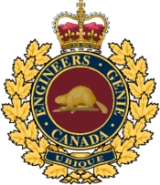
The current cap badge came to its current form after unification. Since the Royal Canadian Engineer cap badge was representative only of the army, a new one was developed. In bilingual format, the words Engineers and Genie appear on the current cap badge indicating the bilingual nature of the CME. The word Ubique also appears, confirming that the Engineers are present everywhere the Canadian Forces goes.
CHIMO
The CME greeting, toast and battlecry is "CHIMO" - pronounced CHEE-mo. This expression is also often used as a closing on correspondence between Engineers. The word itself is derived from the Inuktitut greeting saimo, and roughly translates as "hello," "goodbye," "peace be with you". The current spelling and pronunciation is based on a Caucasian adaptation of the native language.
The greeting was introduced during the time of unification to create a common tradition to the CME. As well, the corps was also heavy involved with the development of Canada's North at the time.
Engineer Prayer
The Engineer Prayer was created for 2 Field Engineer Regiment by Major Hugh Macdonald, the unit's Padre. It goes as follows:
Almighty God, we pray thee to bless the Canadian Military Engineers. May our bridges always stand, and our charges never fail, our members be ever loyal, and our officers worthy of their loyalty. May we work diligently in all our purposes and be skilled in our trades; steadfast for Queen and Country everywhere. Amen.
Patron Saint
The Canadian Military Engineers have no patron saint but Engineers often participate in artillery celebrations honouring St. Barbara, the patron saint of the artillery. Engineers, along with the Artillery and miners, celebrate her feast day on December 4th.
Training
Canadian Forces School of Military Engineering
The Canadian Forces School of Military Engineering (CFSME), located at CFB Gagetown in Gagetown, New Brunswick is responsible for the conduct of 85 different courses that span all ranks and occupations within the Field, Construction and Airfield Engineer organizations. CFSME is the Canadian Forces Centre of Excellence in Engineer Training and home of the Engineers.
Canadian Forces School of Aerospace Technology and Engineering
The Canadian Forces School of Aerospace Technology and Engineering (CFSATE), located in Borden, Ontario delivers Aerospace Engineering Officers and conducts apprentice level training for various trades, including Avionics, Aviation, Aircraft Structures and Imagery technicians. The role of CFSATE is to provide the Air Force with qualified personnel to ensure Aircraft serviceability. CFSATE develops and carries out individual aerospace engineering training in accordance with approved doctrine and standards.
Units
Regular Force Units
- 1 Combat Engineer Regiment (CFB Edmonton, Alberta)
- 11 Field Squadron
- 12 Field Squadron
- 13 Light Squadron
- 14 Field Squadron
- 18 Administration Squadron
- 2 Combat Engineer Regiment (CFB Petawawa, Ontario)
- 23 Field Squadron
- 24 Light Squadron
- 25 Support Squadron
- 28 Administration Squadron
- 4 Engineer Support Regiment (CFB Gagetown, New Brunswick)
- 22 Field Squadron
- 41 Construction Squadron
- 42 General Support Squadron
- 48 Administration Squadron
- 5 Régiment du Genie de Combat (5 Combat Engineer Regiment) (CFB Valcartier, Quebec)
- 51 Escadron de campagne (51 Field Squadron)
- 52 Escadron de campagne (52 Field Squadron)
- 53 Escadron de campagne Legere (53 Light Field Squadron)
- 55 Escadron de Soutien (55 Support Squadron)
- 58 Escadron de commandement et des services. (58 Administration Squadron)
- 4 Construction Engineer Squadron (CFB Cold Lake, Alberta)
- 8 Construction Engineer Squadron (CFB Trenton, Ontario)
- 1 Engineering Support Unit (Moncton, New Brunswick)
- Canadian Forces School of Military Engineering (CFB Gagetown, New Brunswick)
- Mapping And Charting Establishment (Ottawa, Ontario)
- Canadian Forces Fire Academy (CFB Borden, Ontario)
Reserve Force Units
- 34 Combat Engineer Regiment (34e Régiment du Genie de Combat) (Westmount, Quebec)
- 4 Engineer Squadron (Westmount, Quebec)
- 9 Escadron du Génie (9 Engineer Squadron) (Noranda, Quebec)
- 16 Engineer Squadron (Training and Recruiting) (Westmount, Quebec)
- 35e Régiment du Genie de Combat (35 Combat Engineer Regiment) (Quebec City, Quebec)
- 10 Escadron du Génie (10 Engineer Squadron)
- 15 Escadron du Génie (15 Engineer Squadron)
- 41 Combat Engineer Regiment (Edmonton, Alberta)
- 25 Engineer Squadron (Edmonton, Alberta)
- 33 Engineer Squadron (Calgary, Alberta)
- Administration Squadron
- 31 Engineer Squadron (Winnipeg, Manitoba) (Currently integrated with the Fort Garry Horse)
- 45 Engineer Squadron (Sydney, Nova Scotia)
- 56 Engineer Squadron (St. John's, Newfoundland)
Order of Precedence
External links
|
| |
|
|