

Canadian Aboriginal Syllabics

Encyclopedia
Canadian Aboriginal syllabic writing, or simply syllabics, is a family of abugida
s (consonant-based alphabets) used to write a number of Aboriginal
Canadian
languages of the Algonquian
, Inuit, and (formerly) Athabaskan
language families.
Canadian syllabics are currently used to write all of the Cree
dialects from Naskapi
(spoken in Quebec
) to the Rocky Mountains
, including Eastern Cree, Woods Cree
, Swampy Cree
and Plains Cree
. They are also used to write Inuktitut
in the eastern Canadian Arctic; there they are co-official with the Latin alphabet
in the territory of Nunavut
. They are used regionally for the other large Canadian Algonquian language, Ojibwe
in Western Canada
, as well as for Blackfoot
, where they are obsolete. Among the Athabaskan languages
further to the west, syllabics have been used at one point or another to write Dakelh
(Carrier), Chipewyan
, Slavey
, Tli Cho
(Dogrib), Tasttine (Beaver). Syllabics have occasionally been used in the United States
by communities that straddle the border, but are principally a Canadian phenomenon.
, in which every consonant-vowel sequence has a separate glyph, but abugidas, in which consonants are modified in order to indicate an associated vowel—in this case through a change in orientation, which is unique to Canadian syllabics. In Cree, for example, the consonant p has the shape of a chevron. In an upward orientation, ᐱ, it represents the syllable pi. Inverted, so that it points downwards, ᐯ, it indicates pe. Pointing to the left, ᐸ, it is pa, and to the right, ᐳ, po. The consonant forms and the vowels so represented vary from language to language, but generally approximate their Cree origins.

Because the script is presented in syllabic charts and learned as a syllabary, it is often considered to be such. Computer fonts also have separate codes for each orientation of each consonant, and the Unicode Consortium
considers syllabics to be a "featural syllabary" along with such scripts as hangul
. Unlike a true syllabary, in syllabics consonants and vowels are indicated separately: the consonant by the shape of a glyph, and the vowel by its orientation.
, and finally a blended form, now obsolete, for the consonant cluster sp-. All were written with a light line to show the vowel was short and a heavier line to show the vowel was long: ᑲ ka, ᑲ kâ. (A hand-written variant, a superscript dot for vowel length, is now used in printing as well.) One consonant, w, had no letter form of its own but was indicated by a diacritic on another syllable; this is because it could combine with any of the consonants, as in ᑿ kwa, as well as existing on its own, as in ᐘ wa.
There were distinct superscript letters for the nine consonants -p, -t, -c, -k, -m, -n, -s, -y, and w,, which were used when the consonant occurred at the end of a syllable. In addition, four "final" consonants had no syllabic forms: -h, -l, -r, and the sequence -hk. (The glyph for -hk represents the most common final sequence of the language, and so became -nk in Ojibwe.) The consonants -l and -r were marginal, only found in borrowings, baby talk, and the like. These and -h could occur before vowels, but were nonetheless written as finals. (-L and -r are now written the size of full letters when they occur before vowels, or in some syllabics scripts have been replaced with full rotating syllabic forms; -h only occurs before a vowel in joined morphemes and in a couple grammatical words. Final -hk is a common grammatical ending.)
s -a and -o, and the front vowel
s -e and -i. Each set consists of a lower vowel, -a or -e, and a higher vowel, -o or -i. In all cases, back-vowel syllables are related through left-right reflection: that is, they are mirror images of each other. How they relate to front-vowel syllables depends on the graphic form of the consonants. These follow two patterns. Symmetrical, vowel, p-, t-, sp-, are rotated 90 degrees (a quarter turn) counter-clockwise, while those that are asymmetrical top-to-bottom, c-, k-, m-, n-, s-, y-, are rotated 180 degrees (a half turn). The lower front-vowel (-e) syllables are derived this way from the low back-vowel (a) syllables, and the high front-vowel (-i) syllables are derived this way from the higher back-vowel (-o) syllables.
The symmetrical letter forms can be illustrated by arranging them into a diamond:
| || ᐃ || || || || i || ||
| || ᐱ || || || || pi || ||
| || ᑎ || || || || ti ||
|-
| ᐊ || || ᐅ || || a || || o ||
| ᐸ || || ᐳ || || pa || || po ||
| ᑕ || || ᑐ || || ta || || to
|-
| || ᐁ || || || || e || ||
| || ᐯ || || || || pe || ||
| || ᑌ || || || || te ||
|}
And the asymmetrical letter forms can be illustrated by arranging them into a square:
| ᑭ || ᑫ || || ki || ke ||
| ᒋ || ᒉ || || ci || ce ||
| ᒥ || ᒣ || || mi || me ||
| ᓂ || ᓀ || || ni || ne ||
| ᓯ || ᓭ || || si || se ||
| ᔨ || ᔦ || || yi || ye ||
|-
| ᑲ || ᑯ || || ka || ko ||
| ᒐ || ᒍ || || ca || co ||
| ᒪ || ᒧ || || ma || mo ||
| ᓇ || ᓄ || || na || no ||
| ᓴ || ᓱ || || sa || so ||
| ᔭ || ᔪ || || ya || yo ||
|}
These forms are present in most syllabics scripts with sounds values that approach their Swampy Cree origins. For example, all scripts except the one for Blackfoot use the triangle for vowel-initial syllables.
By 1841, when Evans cast the first movable type for syllabics, he found that he could not satisfactorily maintain the distinction between light and heavy typeface for short and long vowels. He instead filed across the raised lines of the type, leaving gaps in the printed letter for long vowels. This can be seen in early printings. Later still a dot diacritic, originally used for vowel length only in handwriting, was extended to print: Thus today ᐊ a contrasts with ᐋ â, and ᒥ mi contrasts with ᒦ mî. Although Cree ê only occurs long, the script made length distinctions for all four vowels. Not all writers then or now indicate length, or do not do so consistently; since there is no contrast, no one today writes ê as a long vowel.
rather than morphophonemic syllables. That is, when one morpheme
(word element) ends in a consonant and the next begins with a vowel, the intermediate consonant is written as a syllable with the following vowel. For example, the Plains Cree word pīhc-āyi-hk "indoors" has pīhc as its first morpheme, and āyi as its second, but is written ᐲᐦᒑᔨᕽ pīh-cā-yihk.
In other cases, a "syllable" may in fact represent only a consonant, again due to the underlying structure of the language. In Plains Cree, ᑖᓂᓯ tānisi "hello" or "how are you?" is written as if it had three syllables. Because the first syllable has the stress and the syllable that follows has a short /i/, the vowel is dropped. As a result, the word is pronounced "tānsi" with only two syllables.
Syllabication is important to determining stress in Algonquian languages, and vice-versa, so this ambiguity in syllabics is relatively important in Algonquian languages.
The use of diacritics to write consonants is unusual in abugidas. However, it also occurs (independently) in the Lepcha script
.
Finals are commonly employed in the extension of syllabics to languages it was not initially designed for. In some of the Athabaskan alphabets, finals have been extended to appear at mid height after a syllable, lowered after a syllable, and at mid height before a syllable. For example, Chipewyan and Slavey use the final ᐟ in the latter position to indicate the initial consonant dl (/ɮ/).
In Naskapi, a small raised letter based on sa is used for consonant cluster
s that begin with /s/: ᔌ spwa, ᔍ stwa, ᔎ skwa, and ᔏ scwa. The Cree languages the script was initially designed for had no such clusters.
In Inuktitut, something similar is used not to indicate sequences, but to represent additional consonants, rather as the digraphs
ch, sh, th were used to extend the Latin letters c, s, t to represent additional consonants in English. In Inuktitut, a raised na-ga is placed before the g- series, ᖏ ᖑ ᖓ, to form an ng- (/ŋ/) series, and a raised ra (uvular /ʁ/) is placed before syllables of the k- series, ᕿ ᖁ ᖃ, to form a uvular q- series.
Although the forms of these series have two parts, each is encoded into the Unicode standard as a single character.
Diacritics used by other languages languages include a circle above, two dots before, and a variety of other marks. Such diacritics may or may not be separately encoded into Unicode. There is no systematic way to distinguish elements that are parts of syllables from diacritics, or diacritics from finals, and academic discussions of syllabics are often inconsistent in their terminology.
"pointed" text; one without such marks is said to be "unpointed".
However, although may be the case for Mi'kmaq (Micmac), the lack of preserved written material in syllabics before 1840, the well-documented history of partially missionary-driven expansion of syllabic writing immediately after this date, and the resemblance to writing systems of the Old World all weigh in favor of a missionary derivation for syllabics, which the remainder of this section explains.
, was placed in charge of the Wesleyan
mission at Rice Lake, Ontario
. Here, he began to learn the eastern Ojibwe language
spoken in the area and was part of a committee to devise a Roman orthography for it. By 1837 he had prepared the Speller and Interpreter in English and Indian, but was unable to get its printing sanctioned by the British and Foreign Bible Society
. At the time, many missionary societies were opposed to the development of native literacy in their own languages, believing that their situation would be bettered by linguistic assimilation into colonial society.
Evans continued to use his Ojibwe orthography in his work in Ontario. However, his students appear to have had conceptual difficulties using the same alphabet for two different languages with very different sounds, and Evans himself found this approach awkward. Furthermore, the Ojibwe language was polysynthetic but had few distinct syllables, meaning that most words had a large number of syllables; this made them quite long when spelled with the Roman alphabet. He began to think that a syllabic
writing system might be less awkward for his students to use.
In 1840, Evans was relocated to Norway House
in northern Manitoba
. Here he began learning the local Swampy Cree
dialect. Like Ojibwe
, to which it was quite closely related, it was full of long polysyllabic words.
As an amateur linguist, Evans was acquainted with the Devanagari
script used in British India; in Devanagari, each letter stands for a syllable, and is modified to represent the vowel of that syllable. Such a system, now called an abugida
, readily lent itself to writing a language such as Swampy Cree, which had a simple syllable structure of only eight consonants and four long or short vowels. Evans was also familiar with British shorthand, presumably Samuel Taylor's Universal Stenography, from his days as a merchant in England; and now he acquired familiarity with the newly published Pitman shorthand
of 1837.
In the original Evans script, there were ten syllabic forms: eight for the consonants p, t, c, k, m, n, s, y; a ninth for vowel-initial syllables or vowels following one of the incidental consonants; and a tenth, which is no longer in use, for the consonant cluster sp. There were four incidental consonants, r, l, w, h, which did not have syllabic forms. Except for sp, these can all be traced to the cursive combining forms of the corresponding Devanagari akshara; the Devanagari combining form is somewhat abbreviated (the right-side stroke is dropped), and in handwriting the running horizontal line may be left off as well, as has been standardized in Gujarati
. (The sequence sp appears to be a conflation of the shape of s with the angularity of p, along the conceptual lines of the more contracted ligatures of Devanagari such as क्ष.)
The likeness is stronger if one allows the symbols to rotate to give a similar direction of writing for each vowel; for example, Devanagari n has the orientation of ne rather than of na.
The motivation for the change of orientation appears to have been to allow the pen to trace the same direction when writing syllables with the same vowels: The reflection class ka, ca, ma, sa, ya (that is, the consonants that are flipped to distinguish the front i, e vowels) all follow an L-like path, whereas the rotation class a, pa, ta, na (those rotated for the front vowels) all follow a C-like path. The orientation of Devanagari g- (for k-), n-, y-, and possibly s- had to be flipped for this to happen. (Sp- does not follow this generalization, reflecting its hybrid origin.)
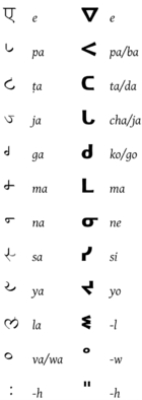
Because Cree consonants can be either voiced or voiceless, depending on their environment, each corresponds to two Devanagari letters, and Cree ka/ga, for example, resembles Devanagari g rather than k. Note also that h, which only occurs as a final in syllabics, appears to derive from the Devanagari visarga
, ः , which also occurs only as a final, rather than from syllabic ह ha.

It is possible that -l and -r were derived through rotation from one Devanagari glyph, in the spirit of Pitman, where l and r are related in this way, rather than from the two different glyphs suggested by the table.
In contrast, the final consonants p t c k m n s and y (which Evans called "final i"), which are now only used for Western Cree, derive from Pitman shorthand. The linear glyphs ᑊ ᐟ ᐨ ᐠ p t c k are rotated 45° from Pitman ᐠ ᑊ ᐟ ᐨ p t c k, but keep their relative orientations intact; the lunate glyphs ᒼ ᐣ ᐢ m n s are rotated 90° from Pitman ᐢ ᓑ ᐣ m n s. The Cree "final i" was originally a dot, as was the diacritic for the vowel i in Pitman.
The final hk, however, is ᕽ, a small version of the logogram
for Christ, from Greek Χ
kh.
The use of rotation to change the vowel of a syllable is unique to Canadian syllabics, but had its antecedent in shorthand. Pitman used rotation to change place of articulation
: plosives p t ch k, nasals m n, and fricatives h s sh f th were all related through rotation, as can be partially seen in the table of finals above.
Initially, Evans indicated vowel length with light versus heavy lines – the feature used to indicate voicing in Pitman; – but this proved awkward in print, and by 1841 it was changed to broken lines for long vowels versus solid lines for short vowels. Later Evans introduced the current practice of writing a dot above the syllable to indicate vowel length.
that he was familiar with. He claimed that "with some slight alterations" it could be used to write "every language from the Atlantic to the Rocky Mountains."
Evans attempted to secure a printing press
and new type
to publish materials in this writing system. Here, he began to face resistance from colonial and European authorities. The Hudson's Bay Company
, which had a monopoly on foreign commerce in western Canada, refused to import a press for him, believing that native literacy was something to be discouraged. Evans, with immense difficulty, constructed his own press and type and began publishing in syllabics.
Evans left Canada in 1846 and died shortly thereafter. However, the ease and utility of syllabic writing ensured its continued survival, despite European resistance to supporting it. In 1849, the Anglican bishop of Rupert's Land
reported that "a few of the Indians can read by means of these syllabic characters; but if they had only been taught to read their own language in our letters, it would have been one step towards the acquisition of the English tongue." But syllabics had taken root among the Cree,—indeed, their rate of literacy was greater than English and French Canadians,—and in 1861, fifteen years after Evans had died, the British and Foreign Bible Society
published a Bible
in Cree syllabics
. By then, both Protestant and Catholic
missionaries were using and actively propagating syllabic writing.
Missionary work in the 1850s and 1860s spread syllabics to western Canadian Ojibwe
dialects (Plains Ojibwe and Saulteaux
), but it was not often used over the border by Ojibwe in the United States
. Missionaries who had learned Evans’ system spread it east across Ontario
and into Quebec
, reaching all Cree language
areas as far east as the Naskapi
. Attikamekw, Montagnais and Innu
people in eastern Quebec
and Labrador
use Roman alphabet writing schemes.
In 1856, John Horden
, an Anglican missionary at Moose Factory, Ontario
, who adapted syllabics to the local James Bay Cree dialect, met a group of Inuit
from the region of Grande Rivière de la Baleine in northern Quebec. They were very interested in adapting Cree syllabics
to their language. He prepared a few based on their pronunciation of Inuktitut
, but it quickly became obvious that the number of basic sounds and the simple model of the syllable in the Evans system was inadequate to the language. With the assistance of Edwin Arthur Watkins, he dramatically modified syllabics to reflect these needs.
In 1876, the Anglican church hired Edmund Peck
to work full time in their mission at Great Whale River
, teaching syllabics to the Inuit
and translating materials into syllabics. His work across the arctic
is usually credited with the establishment of syllabics among the Inuit. With the support of both Anglican and Catholic
missionary societies, by the beginning of the 20th century the Inuit were propagating syllabics themselves.
In the 1880s, John William Tims, an Anglican missionary from Great Britain
, invented a number of new forms to write the Blackfoot language
.
French
Roman Catholic missionaries were the primary force for expanding syllabics to Athabaskan languages
in the late 19th century. The Oblate
missionary order was particularly active in using syllabics in missionary work. Oblate father Adrien-Gabriel Morice
adapted syllabics to Dakelh
, inventing a large number of new basic characters to support the radically more complicated phonetics of Athabaskan languages. Father Émile Petitot
developed syllabic schemes for many of the Athabaskan languages of the Northwest Territories
, including Slavey
and Chipewyan
.
Cree influenced the design of the Pollard script
in China.
, Inuit
and Algonquian languages
ensured that the syllabics used to write them also varied. In the main, we can distinguish four major variants of Canadian syllabics: Central Algonquian, Inuktitut, Blackfoot
, and Athabaskan. Each reflects a historical expansion of the writing system. More information may be available on individual pages for each language.
| ᖋ || ᖊ || || ri || re || || (final ᙆ)
|-
| ᖍ || ᖌ || || ra || ro ||
|}
| || || || || || li || ||
|-
| ᕍ || || ᕊ || || la || || lo || || (final ᔆ)
|-
| || ᕃ || || || || le || ||
|}
Series were added for l-, r-, sh- (š-) and f- in most eastern Cree dialects. R- is an inversion of the form of western l-, but now it is re that has the unexpected orientation. L- and f- are regular asymmetric and symmetric forms; although f- is actually asymmetric in form, it is derived from p- and therefore rotates 90° as p- does. Here is where the two algorithms to derive vowel orientations, which are equivalent for the symmetrical forms of the original script, come to differ: For the ᕙ f- series, as well as a rare ᕦ th- series derived from ᑕ t-, vowels of like height are derived via counter-clockwise rotation; however, an eastern sh- series, which perhaps not coincidentally resembles a Latin s, is rotated clockwise with the opposite vowel derivations: high -i from low -a and lower (mid
) -e from higher (mid) -o. The obsolete sp- series shows this to be the original design of the script, but Inuktitut, perhaps generalizing from the ᕙ series, which originated as ᐸ plus a circle at the start of the stroke used to write the letters, but as an independent form must be rotated in the opposite (counter-clockwise) direction, is consistently counter-clockwise. (The eastern Cree r- series can be seen as both of these algorithms applied to ro (bold), whereas western Cree l- can be seen as both applied to la (bold).)
| ᓕ || ᓓ || || li || le
|-
| ᓚ || ᓗ || || la || lo
|}
| || ᕆ || || || || ri || ||
| || || ᔑ || || || || ši || ||
| || || ᕕ || || || || fi || ||
| || || ᕠ || || || || ði ||
|-
| ᕋ || || ᕈ || || ra || || ro || ||
| ᔕ || || ᔓ || || ša || || šo || ||
| ᕙ || || ᕗ || || fa || || fo || ||
| ᕦ || || ᕤ || || ða || || ðo ||
|-
| || || || || || re || ||
| || || ᔐ || || || || še || ||
| || || ᕓ || || || || fe || ||
| || || ᕞ || || || || ðe ||
|}
There are minor variants within both eastern and western Cree. Woods Cree, for example, uses western Cree conventions, but has lost the e series, and has an additional consonant series, th- (ð-), which is a barred form of the y- series, with a non-Unicode-supported final ⟨‡⟩.
| ᖨ || || || thi ||
|-
| ᖬ || ᖪ || || tha || tho
|}
Moose Cree, which uses eastern Cree conventions, has an -sk final that is composed of -s and -k, as in ᐊᒥᔉ amisk "beaver", and final -y is written with a superscript ring, °, rather than a superscript ya, which preserves, in a more salient form, the distinct final form otherwise found only in the west: ᐋᔕ̊ āshay "now".
The Eastern Cree dialect has distinct labialized finals, ⟨ᒄ⟩ -kw and ⟨ᒽ⟩ -mw; these are written with raised versions of the o-series rather than the usual a-series, as in ᒥᔅᑎᒄ mistikw "tree". This is motivated by the fact that the vowel o labializes the preceding consonant.
Although in most respects Naskapi
follows eastern Cree conventions, it does not mark vowel length at all and uses two dots, either placed above or before a syllable, to indicate a w: ᐛ wa, ᐖ wo, ᑥ twa, ᒂ kwa, ᒠ cwa (/tswa/), ᒺ mwa, ᓏ nwa, ᔄ swa, ᔽ ywa. Since Naskapi s- consonant clusters are all labialized, sCw-, these also have the two dots: ᔌ spwa, etc. There is also a labialized final sequence, ᔊ -skw, which is a raised so-ko.
See also:
dialects of Nunavut
(except for the extreme west, including Kugluktuk
and Cambridge Bay
) and Nunavik
in northern Quebec
. In other Inuit areas, various Roman alphabet-based schemes are used.
Inuktitut has only three vowels, and thus only needs the a-, i-, and o-series of Cree, the latter used for /u/. The e-series was originally used for the common diphthong
/ai/, but this was officially dropped in the 1960s so that Inuktitut wouldn’t have more characters than could be moulded onto an IBM Selectric typewriter
ball, with -ai written as an a-series syllable followed by ᐃ i. Recently the Inuit Tapiriit Kanatami
decided to restore the ai-series, and the Makivik Corporation
has adopted this use in Nunavik
; it has not been restored in Nunavut
.
Inuktitut has more consonants than Cree, fifteen in its standardised form. As Inuktitut has no /ts/, the c series has been reassigned to the value g (/ɡ ~ ɣ/). The y series is used for either y- or j-, since the difference is one of dialect; similarly with the s series, which stands for either s- or h-, depending on the dialect. The eastern Cree l series is used: ᓚ la, ᓗ lu, ᓕ li, ᓓ lai; a stroke is added to these to derive the voiceless lh (/ɬ/) series: ᖤ lha, etc. The eastern Cree f series is used for Inuktitut v-: ᕙ va, etc. The eastern Cree r series is used for the very different Inuktitut sound, /ɢ ~ ʁ/, which is also spelled r in Roman orthography. However, this has been regularized in form, with vowels of like height consistently derived through counter-clockwise rotation, and therefore rai the inversion of ri:
| || ᕆ || || || || ri ||
|-
| ᕋ || || ᕈ || || ra || || ru
|-
| || ᕂ || || || || rai ||
|}
The remaining sounds are written with digraphs
. A raised ra is prefixed to the k-series to create a digraph for q: ᖃ qa, etc.; the final is ᖅ -q. A raised na-ga is prefixed to the g-series to create an ng (/ŋ/) series: ᖓ nga, etc., and the na is doubled for geminate nng (/ŋː/): ᙵ nnga.
The finals are ᖕ and ᖖ.
In Nunavut, the h final has been replaced with Roman ᕼ, which does not rotate, but in Nunavik a new series is derived by adding a stroke to the k-series: ᕹ ha, etc.
In the early years, Roman Catholic and Anglican missionaries used slightly different forms of syllabics for Inuktitut. In modern times, however, these differences have disappeared. Dialectical variation across the syllabics-using part of the Inuit world has promoted an implicit diversity in spelling, but for the most part this has not had any impact on syllabics itself.
, another Algonquian language, uses a syllabary that is quite different from the Cree and Inuktitut versions. Blackfoot has eleven consonants and three vowels, most of which can occur long or short. It has nine basic consonant forms, only two of which are identical to their Cree equivalents. Three Cree series are retained with unrelated sound values, while for others the e series were created by modifying letters of the Latin alphabet. The new forms, given in the o series (which corresponds graphically to the a series of Cree), are ᖲ o, ᖶ wo, ᖺ no, ᖾ ko, and ᗂ ho. Old forms with new sound values are ᑲ po (from ka), ᒐ mo (from ca), and ᒪ to (from ma). Forms with the same consonantal values are ᓴ so and ᔭ yo (here only the vowels have changed). There are also a number of distinct final forms.
The four vowel positions are used for the three vowels and one of the diphthongs of Blackfoot. The script is now obsolescent.
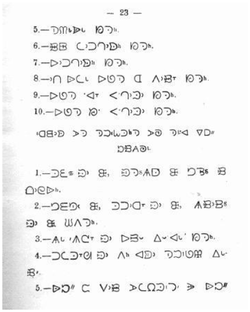 Athabaskan syllabic writing systems were developed in the late 19th century by French Roman Catholic missionaries who adapted this originally Protestant writing scheme to languages radically different from the Algonquian languages. Most Athabaskan languages
have more than four distinct vowels, and all have many more distinct consonants than Cree. This has meant the invention of a number of new consonant forms. Whereas most Athabaskan scripts, such as those for Slavey
and Chipewyan, bear a reasonably close resemblance to Cree syllabics, the Carrier
(Dakelh
) variant is highly divergent, and only one series – the series for vowels alone – resembles the original Cree form.
To accommodate six distinctive vowels, Dakelh supplements the four vowel orientations with a dot and a horizontal line in the rightward pointing forms: ᐊ a, ᐅ /ʌ/, ᐈ e, ᐉ i, ᐃ o, and ᐁ u.
One of the Chipewyan scripts is more faithful to western Cree. (Sayisi Chipewyan
is substantially more divergent.) It has the nine forms plus the western l and r series, though the rotation of the l- series has been made consistently counter-clockwise. The k- and n- series are more angular than in Cree: ki resembles Latin "P". The c series has been reassigned to dh. There are additional series: a regular ch series, unsupported by Unicode, but graphically a doubled t (something like Ɛ for cha, Ɯ for che, 3 for cho, etc.); and an irregular z series, where ze is derived by counter-clockwise rotation of za, but zi by clockwise rotation of zo:
| || ᘛ || || || || zi ||
|-
| ᘔ || || ᘕ || || za || || zo ||
|-
| || ᘚ || || || || ze ||
|}
Other series are formed from dh or t. A mid-line final Cree t preceding dh forms th, a raised Cree final p following t forms tt, a stroke inside t forms tth (ᕮ ttha), and a small t inside t forms ty (ᕳ tya). Nasal vowels are indicated by a following Cree final k.
All Athabaskan syllabic scripts are now obsolescent.
In Nunavut
and Nunavik
, Inuktitut syllabics have official status. In Nunavut, laws, legislative debates and many other government documents must be published in Inuktitut in both syllabics and Roman alphabet form. The rapid growth in the scope and quantity of material published in syllabics has, by all appearances, ended any immediate prospect of marginalisation for this writing scheme.
Within the Cree and Ojibwe language communities, the situation is less confident.
Cree syllabics use is vigorous in most communities where it has taken root. In many dialect areas, there are now standardised syllabics spellings. Nonetheless, there are now linguistically adequate standardised Roman writing systems for most if not all dialects.
Ojibwe speakers in the US have never been heavy users of either Canadian Aboriginal syllabics or the Great Lakes Aboriginal syllabics
and have now essentially ceased to use either of them at all. The “double vowel” Roman orthography developed by Charles Fiero and further developed by John Nichols is increasingly the standard in the USA and is beginning to penetrate into Canada, in part to prevent further atomisation of what is already a minority language. Nonetheless, Ojibwe syllabics are still in vigorous use in some parts of Canada.
Use in other communities is moribund.
Blackfoot syllabics have, for all intents and purposes, disappeared. Present day Blackfoot speakers use a Roman alphabet writing scheme, and very few Blackfoot can still read – much less write – the syllabic system.
Among the Athabaskan languages with syllabic writing schemes, none is in vigorous use. In some cases, the languages they represent are on the brink of extinction. In other cases, syllabics have been replaced by Roman letters. Many people – linguists and speakers of Athabaskan languages alike – feel that these languages are ill-suited to syllabic writing. The government of the Northwest Territories does not use syllabic writing for any of the Athabaskan languages on its territory and native churches have generally stopped using them as well. Among Dakelh users, a well-developed Roman alphabet has effectively replaced syllabics, which are now understood almost exclusively by elderly members of the community.
In the past, government policy towards syllabics has varied from indifference to open hostility. Until quite recently, government policy in Canada openly undermined native languages, and church organisations were often the only organised bodies using syllabics. Later, as governments became more accommodating of native languages, and in some cases even encouraged their use, it was widely believed that moving to a Roman alphabet writing scheme was better, both for linguistic reasons and to reduce the cost of supporting alternative writing schemes.
At present, at least for Inuktitut and Algonquian languages, Canadian government tolerates, and in some cases encourages, the use of syllabics. The growth of Aboriginal nationalism in Canada and the devolution of many government activities to native communities has changed attitudes towards syllabics. In many places there are now standardisation bodies for syllabic spelling, and the Unicode standard supports a fairly complete set of Canadian syllabic characters for digital exchange. Syllabics are now taught in schools in Inuktitut-speaking areas, and are often taught in traditionally syllabics-using Cree and Ojibwe communities as well.
Although there are limitations to syllabic writing, and in many cases a Roman alphabet scheme would be less costly to use and quite possibly easier to learn, many native communities are strongly attached to syllabics. Even though it was originally the invention of European missionaries, many people consider syllabics a writing system that belongs to them, and link Roman letters to linguistic assimilation. As Canada redefines itself in terms of ethnolinguistic diversity and multiculturalism, it is increasingly difficult to justify neglecting the only writing system that is truly unique to Canada.
standard, where the script is also called 'Canadian syllabics':
These characters can be rendered with any appropriate font, including the freely available fonts listed below.
Abugida
An abugida , also called an alphasyllabary, is a segmental writing system in which consonant–vowel sequences are written as a unit: each unit is based on a consonant letter, and vowel notation is obligatory but secondary...
s (consonant-based alphabets) used to write a number of Aboriginal
Aboriginal peoples in Canada
Aboriginal peoples in Canada comprise the First Nations, Inuit and Métis. The descriptors "Indian" and "Eskimo" have fallen into disuse in Canada and are commonly considered pejorative....
Canadian
Canada
Canada is a North American country consisting of ten provinces and three territories. Located in the northern part of the continent, it extends from the Atlantic Ocean in the east to the Pacific Ocean in the west, and northward into the Arctic Ocean...
languages of the Algonquian
Algonquian languages
The Algonquian languages also Algonkian) are a subfamily of Native American languages which includes most of the languages in the Algic language family. The name of the Algonquian language family is distinguished from the orthographically similar Algonquin dialect of the Ojibwe language, which is a...
, Inuit, and (formerly) Athabaskan
Athabaskan languages
Athabaskan or Athabascan is a large group of indigenous peoples of North America, located in two main Southern and Northern groups in western North America, and of their language family...
language families.
Canadian syllabics are currently used to write all of the Cree
Cree language
Cree is an Algonquian language spoken by approximately 117,000 people across Canada, from the Northwest Territories and Alberta to Labrador, making it the aboriginal language with the highest number of speakers in Canada. It is also spoken in the U.S. state of Montana...
dialects from Naskapi
Naskapi
The Naskapi are the indigenous Innu inhabitants of an area they refer to as Nitassinan, which comprises most of what other Canadians refer to as eastern Quebec and Labrador, Canada....
(spoken in Quebec
Quebec
Quebec or is a province in east-central Canada. It is the only Canadian province with a predominantly French-speaking population and the only one whose sole official language is French at the provincial level....
) to the Rocky Mountains
Rocky Mountains
The Rocky Mountains are a major mountain range in western North America. The Rocky Mountains stretch more than from the northernmost part of British Columbia, in western Canada, to New Mexico, in the southwestern United States...
, including Eastern Cree, Woods Cree
Woods Cree language
Woods Cree is an Algonquian language spoken in Manitoba and Saskatchewan, Canada.It only has 14 letters in the alphabet. There are marked and unmarked letters...
, Swampy Cree
Swampy Cree language
Swampy Cree is a dialect of the Cree language complex. Swampy Cree is spoken in a series of communities in northern Manitoba, central northeast of Saskatchewan along the Saskatchewan River and along the Hudson Bay coast and adjacent inland areas to the south and west, and Ontario along the coast...
and Plains Cree
Plains Cree language
Plains Cree is a dialect of the Algonquian language, Cree, which is the most common Canadian indigenous language. Plains Cree is sometimes considered a dialect of the Cree-Montagnais language, or sometimes a dialect of the Cree language, distinct from the Montagnais language...
. They are also used to write Inuktitut
Inuktitut
Inuktitut or Eastern Canadian Inuktitut, Eastern Canadian Inuit language is the name of some of the Inuit languages spoken in Canada...
in the eastern Canadian Arctic; there they are co-official with the Latin alphabet
Latin alphabet
The Latin alphabet, also called the Roman alphabet, is the most recognized alphabet used in the world today. It evolved from a western variety of the Greek alphabet called the Cumaean alphabet, which was adopted and modified by the Etruscans who ruled early Rome...
in the territory of Nunavut
Nunavut
Nunavut is the largest and newest federal territory of Canada; it was separated officially from the Northwest Territories on April 1, 1999, via the Nunavut Act and the Nunavut Land Claims Agreement Act, though the actual boundaries had been established in 1993...
. They are used regionally for the other large Canadian Algonquian language, Ojibwe
Ojibwe language
Ojibwe , also called Anishinaabemowin, is an indigenous language of the Algonquian language family. Ojibwe is characterized by a series of dialects that have local names and frequently local writing systems...
in Western Canada
Western Canada
Western Canada, also referred to as the Western provinces and commonly as the West, is a region of Canada that includes the four provinces west of the province of Ontario.- Provinces :...
, as well as for Blackfoot
Blackfoot language
Blackfoot, also known as Siksika , Pikanii, and Blackfeet, is the Algonquian language spoken by the Blackfoot tribes of Native Americans, who currently live in the northwestern plains of North America...
, where they are obsolete. Among the Athabaskan languages
Athabaskan languages
Athabaskan or Athabascan is a large group of indigenous peoples of North America, located in two main Southern and Northern groups in western North America, and of their language family...
further to the west, syllabics have been used at one point or another to write Dakelh
Carrier language
The Carrier language is a Northern Athabaskan language. It is named after the Dakelh people, a First Nations people of the Central Interior of British Columbia, Canada, for whom Carrier is the usual English name. People who are referred to as Carrier speak two related languages. One,...
(Carrier), Chipewyan
Chipewyan
The Chipewyan are a Dene Aboriginal people in Canada, whose ancestors were the Taltheilei...
, Slavey
Slavey language
Slavey is an Athabaskan language spoken among the Slavey First Nations of Canada in the Northwest Territories where it also has official status....
, Tli Cho
Tli Cho
The Tłįchǫ or Tåîchô First Nation, formerly known as the Dogrib, are a Dene Aboriginal Canadian people living in the Northwest Territories , Canada....
(Dogrib), Tasttine (Beaver). Syllabics have occasionally been used in the United States
United States
The United States of America is a federal constitutional republic comprising fifty states and a federal district...
by communities that straddle the border, but are principally a Canadian phenomenon.
Basic principles
Canadian "syllabic" scripts are not syllabariesSyllabary
A syllabary is a set of written symbols that represent syllables, which make up words. In a syllabary, there is no systematic similarity between the symbols which represent syllables with the same consonant or vowel...
, in which every consonant-vowel sequence has a separate glyph, but abugidas, in which consonants are modified in order to indicate an associated vowel—in this case through a change in orientation, which is unique to Canadian syllabics. In Cree, for example, the consonant p has the shape of a chevron. In an upward orientation, ᐱ, it represents the syllable pi. Inverted, so that it points downwards, ᐯ, it indicates pe. Pointing to the left, ᐸ, it is pa, and to the right, ᐳ, po. The consonant forms and the vowels so represented vary from language to language, but generally approximate their Cree origins.
| C | -e | -ē | -i | -ī | -o | -ō | -a | -ā | final | rotation |
|---|---|---|---|---|---|---|---|---|---|---|
| (none) | ᐁ | ᐁ | ᐃ | ᐃ | ᐅ | ᐅ | ᐊ | ᐊ | symmetric | |
| p- | ᐯ | ᐯ | ᐱ | ᐱ | ᐳ | ᐳ | ᐸ | ᐸ | ᑊ | symmetric |
| t- | ᑌ | ᑌ | ᑎ | ᑎ | ᑐ | ᑐ | ᑕ | ᑕ | ᐟ | symmetric |
| k- | ᑫ | ᑫ | ᑭ | ᑭ | ᑯ | ᑯ | ᑲ | ᑲ | ᐠ | asymmetric |
| c- | ᒉ | ᒉ | ᒋ | ᒋ | ᒍ | ᒍ | ᒐ | ᒐ | ᐨ | asymmetric |
| m- | ᒣ | ᒣ | ᒥ | ᒥ | ᒧ | ᒧ | ᒪ | ᒪ | ᒼ | asymmetric |
| n- | ᓀ | ᓀ | ᓂ | ᓂ | ᓄ | ᓄ | ᓇ | ᓇ | ᐣ | asymmetric |
| s- | ᓭ | ᓭ | ᓯ | ᓯ | ᓱ | ᓱ | ᓴ | ᓴ | ᐢ | asymmetric |
| y- | ᔦ | ᔦ | ᔨ | ᔨ | ᔪ | ᔪ | ᔭ | ᔭ | ᐧ | asymmetric |
| sp- | Z | Z | (*) | (*) | N | N | И | И | * | |
| -w- | (a dot after the syllable) | ᐤ | ||||||||
| -h | ᐦ | |||||||||
| -hk | ᕽ | |||||||||
| -l | ᓫ | |||||||||
| -r | ᕑ | |||||||||
-
* The obsolete sp- series, which is not supported by Unicode, is here represented by Latin and Cyrillic letters; there is no good substitution for spi. (It can be seen in the 1841 version at right.) The clockwise 90° rotation relates vowels as the later series sh- does, but unlike later Inuktitut consonants.
Because the script is presented in syllabic charts and learned as a syllabary, it is often considered to be such. Computer fonts also have separate codes for each orientation of each consonant, and the Unicode Consortium
Unicode Consortium
The Unicode Consortium is a non-profit organization that coordinates the development of the Unicode standard. Its stated goal is to eventually replace existing character encoding schemes with Unicode and its standard Unicode Transformation Format schemes, claiming that many of the existing...
considers syllabics to be a "featural syllabary" along with such scripts as hangul
Hangul
Hangul,Pronounced or ; Korean: 한글 Hangeul/Han'gŭl or 조선글 Chosŏn'gŭl/Joseongeul the Korean alphabet, is the native alphabet of the Korean language. It is a separate script from Hanja, the logographic Chinese characters which are also sometimes used to write Korean...
. Unlike a true syllabary, in syllabics consonants and vowels are indicated separately: the consonant by the shape of a glyph, and the vowel by its orientation.
Syllabic and final consonant forms
The original script, which was designed for Swampy Cree, had ten such letter forms: Eight for syllables based on the consonants p-, t-, c-, k-, m-, n-, s-, y- , another for vowel-initial syllablesZero consonant
A zero consonant, silent initial, or null-onset letter is a consonant-like letter that is not pronounced, but indicates that a word or syllable starts with a vowel...
, and finally a blended form, now obsolete, for the consonant cluster sp-. All were written with a light line to show the vowel was short and a heavier line to show the vowel was long: ᑲ ka, ᑲ kâ. (A hand-written variant, a superscript dot for vowel length, is now used in printing as well.) One consonant, w, had no letter form of its own but was indicated by a diacritic on another syllable; this is because it could combine with any of the consonants, as in ᑿ kwa, as well as existing on its own, as in ᐘ wa.
There were distinct superscript letters for the nine consonants -p, -t, -c, -k, -m, -n, -s, -y, and w,, which were used when the consonant occurred at the end of a syllable. In addition, four "final" consonants had no syllabic forms: -h, -l, -r, and the sequence -hk. (The glyph for -hk represents the most common final sequence of the language, and so became -nk in Ojibwe.) The consonants -l and -r were marginal, only found in borrowings, baby talk, and the like. These and -h could occur before vowels, but were nonetheless written as finals. (-L and -r are now written the size of full letters when they occur before vowels, or in some syllabics scripts have been replaced with full rotating syllabic forms; -h only occurs before a vowel in joined morphemes and in a couple grammatical words. Final -hk is a common grammatical ending.)
Vowel transformations
The vowels fall into two sets, the back vowelBack vowel
A back vowel is a type of vowel sound used in spoken languages. The defining characteristic of a back vowel is that the tongue is positioned as far back as possible in the mouth without creating a constriction that would be classified as a consonant. Back vowels are sometimes also called dark...
s -a and -o, and the front vowel
Front vowel
A front vowel is a type of vowel sound used in some spoken languages. The defining characteristic of a front vowel is that the tongue is positioned as far in front as possible in the mouth without creating a constriction that would be classified as a consonant. Front vowels are sometimes also...
s -e and -i. Each set consists of a lower vowel, -a or -e, and a higher vowel, -o or -i. In all cases, back-vowel syllables are related through left-right reflection: that is, they are mirror images of each other. How they relate to front-vowel syllables depends on the graphic form of the consonants. These follow two patterns. Symmetrical, vowel, p-, t-, sp-, are rotated 90 degrees (a quarter turn) counter-clockwise, while those that are asymmetrical top-to-bottom, c-, k-, m-, n-, s-, y-, are rotated 180 degrees (a half turn). The lower front-vowel (-e) syllables are derived this way from the low back-vowel (a) syllables, and the high front-vowel (-i) syllables are derived this way from the higher back-vowel (-o) syllables.
The symmetrical letter forms can be illustrated by arranging them into a diamond:
| || ᐃ || || || || i || ||
| || ᐱ || || || || pi || ||
| || ᑎ || || || || ti ||
|-
| ᐊ || || ᐅ || || a || || o ||
| ᐸ || || ᐳ || || pa || || po ||
| ᑕ || || ᑐ || || ta || || to
|-
| || ᐁ || || || || e || ||
| || ᐯ || || || || pe || ||
| || ᑌ || || || || te ||
|}
And the asymmetrical letter forms can be illustrated by arranging them into a square:
| ᑭ || ᑫ || || ki || ke ||
| ᒋ || ᒉ || || ci || ce ||
| ᒥ || ᒣ || || mi || me ||
| ᓂ || ᓀ || || ni || ne ||
| ᓯ || ᓭ || || si || se ||
| ᔨ || ᔦ || || yi || ye ||
|-
| ᑲ || ᑯ || || ka || ko ||
| ᒐ || ᒍ || || ca || co ||
| ᒪ || ᒧ || || ma || mo ||
| ᓇ || ᓄ || || na || no ||
| ᓴ || ᓱ || || sa || so ||
| ᔭ || ᔪ || || ya || yo ||
|}
These forms are present in most syllabics scripts with sounds values that approach their Swampy Cree origins. For example, all scripts except the one for Blackfoot use the triangle for vowel-initial syllables.
By 1841, when Evans cast the first movable type for syllabics, he found that he could not satisfactorily maintain the distinction between light and heavy typeface for short and long vowels. He instead filed across the raised lines of the type, leaving gaps in the printed letter for long vowels. This can be seen in early printings. Later still a dot diacritic, originally used for vowel length only in handwriting, was extended to print: Thus today ᐊ a contrasts with ᐋ â, and ᒥ mi contrasts with ᒦ mî. Although Cree ê only occurs long, the script made length distinctions for all four vowels. Not all writers then or now indicate length, or do not do so consistently; since there is no contrast, no one today writes ê as a long vowel.
Punctuation
The only punctuation found in many texts is spacing between words and ᙮ for a full stop. Punctuation from the Latin alphabet, other than the period (.), may also be used."Syllables", or full-size letters
The full-sized characters, whether standing for consonant-vowel combinations or vowels alone, are usually called "syllables". They may be phonemicPhoneme
In a language or dialect, a phoneme is the smallest segmental unit of sound employed to form meaningful contrasts between utterances....
rather than morphophonemic syllables. That is, when one morpheme
Morpheme
In linguistics, a morpheme is the smallest semantically meaningful unit in a language. The field of study dedicated to morphemes is called morphology. A morpheme is not identical to a word, and the principal difference between the two is that a morpheme may or may not stand alone, whereas a word,...
(word element) ends in a consonant and the next begins with a vowel, the intermediate consonant is written as a syllable with the following vowel. For example, the Plains Cree word pīhc-āyi-hk "indoors" has pīhc as its first morpheme, and āyi as its second, but is written ᐲᐦᒑᔨᕽ pīh-cā-yihk.
In other cases, a "syllable" may in fact represent only a consonant, again due to the underlying structure of the language. In Plains Cree, ᑖᓂᓯ tānisi "hello" or "how are you?" is written as if it had three syllables. Because the first syllable has the stress and the syllable that follows has a short /i/, the vowel is dropped. As a result, the word is pronounced "tānsi" with only two syllables.
Syllabication is important to determining stress in Algonquian languages, and vice-versa, so this ambiguity in syllabics is relatively important in Algonquian languages.
Series
The word "series" is used for either a set of syllables with the same vowel, or a set with the same initial consonant. Thus the n-series is the set of syllables that begin with n, and the o-series is the set of syllables that have o as their vowel regardless of their initial consonant."Finals", or reduced letters
A series of small raised letters are called "finals". They are usually placed after a syllable to indicate a final consonant, as the ᕽ -hk in ᔨᕽ yihk above. However, the Cree consonant h,, which only has a final form, begins a small number of function words such as ᐦᐋᐤ hāw. In such cases the "final" ᐦ represents an initial consonant and therefore precedes the syllable.The use of diacritics to write consonants is unusual in abugidas. However, it also occurs (independently) in the Lepcha script
Lepcha script
The Lepcha script, or Róng script is an abugida used by the Lepcha people to write the Lepcha language. Unusually for an abugida, syllable-final consonants are written as diacritics.-History:...
.
Finals are commonly employed in the extension of syllabics to languages it was not initially designed for. In some of the Athabaskan alphabets, finals have been extended to appear at mid height after a syllable, lowered after a syllable, and at mid height before a syllable. For example, Chipewyan and Slavey use the final ᐟ in the latter position to indicate the initial consonant dl (/ɮ/).
In Naskapi, a small raised letter based on sa is used for consonant cluster
Consonant cluster
In linguistics, a consonant cluster is a group of consonants which have no intervening vowel. In English, for example, the groups and are consonant clusters in the word splits....
s that begin with /s/: ᔌ spwa, ᔍ stwa, ᔎ skwa, and ᔏ scwa. The Cree languages the script was initially designed for had no such clusters.
In Inuktitut, something similar is used not to indicate sequences, but to represent additional consonants, rather as the digraphs
Digraph (orthography)
A digraph or digram is a pair of characters used to write one phoneme or a sequence of phonemes that does not correspond to the normal values of the two characters combined...
ch, sh, th were used to extend the Latin letters c, s, t to represent additional consonants in English. In Inuktitut, a raised na-ga is placed before the g- series, ᖏ ᖑ ᖓ, to form an ng- (/ŋ/) series, and a raised ra (uvular /ʁ/) is placed before syllables of the k- series, ᕿ ᖁ ᖃ, to form a uvular q- series.
Although the forms of these series have two parts, each is encoded into the Unicode standard as a single character.
Diacritics
Other marks placed above or beside the syllable are called "diacritics". These include the dot placed above a syllable to mark a long vowel, as in ᒦ mî, and the dot placed at mid height after the syllable (in western Cree dialects) or before the syllable (in eastern Cree dialects) to indicate a medial w, as in ᑿ kwa. These are all encoded as single characters in Unicode.Diacritics used by other languages languages include a circle above, two dots before, and a variety of other marks. Such diacritics may or may not be separately encoded into Unicode. There is no systematic way to distinguish elements that are parts of syllables from diacritics, or diacritics from finals, and academic discussions of syllabics are often inconsistent in their terminology.
Points and pointing
The diacritic mark used to indicate vowel length is often referred to as a "point". Syllabics users do not always consistently mark vowel length, w, or h. A text with these marked is called a"pointed" text; one without such marks is said to be "unpointed".
History
Cree legend maintains that syllabics was a divine gift to two Cree elders on opposite sides of Canada. The Native Languages of the Americas website states that,- "A few North American tribes do have traditions of literacy they claim predate Columbus, however, and coincidentally enough, the writing systems in those tribes are drastically different from European languages—pictographs in the case of Mi'kmaq, and a syllabary with rotating vowels in the case of Ojibway and Cree. It's theoretically possible that those tribes just happened to have been visited by very creative, iconoclastic missionaries, but it's more likely that the missionaries simply recorded and adapted an existing Native American writing system to serve their purposes (teaching Indians prayers, primarily.)"
However, although may be the case for Mi'kmaq (Micmac), the lack of preserved written material in syllabics before 1840, the well-documented history of partially missionary-driven expansion of syllabic writing immediately after this date, and the resemblance to writing systems of the Old World all weigh in favor of a missionary derivation for syllabics, which the remainder of this section explains.
James Evans
In 1827, James Evans, a missionary from Kingston upon Hull, EnglandKingston upon Hull
Kingston upon Hull , usually referred to as Hull, is a city and unitary authority area in the ceremonial county of the East Riding of Yorkshire, England. It stands on the River Hull at its junction with the Humber estuary, 25 miles inland from the North Sea. Hull has a resident population of...
, was placed in charge of the Wesleyan
Methodism
Methodism is a movement of Protestant Christianity represented by a number of denominations and organizations, claiming a total of approximately seventy million adherents worldwide. The movement traces its roots to John Wesley's evangelistic revival movement within Anglicanism. His younger brother...
mission at Rice Lake, Ontario
Rice Lake (Ontario)
Rice Lake is a lake located in south-eastern Ontario, in Northumberland County, south of Peterborough and the Kawartha lakes and north of Cobourg. The lake is part of the Trent-Severn Waterway, which flows into the lake by the Otonabee and out via the Trent. The lake is 32 km long and...
. Here, he began to learn the eastern Ojibwe language
Ojibwe language
Ojibwe , also called Anishinaabemowin, is an indigenous language of the Algonquian language family. Ojibwe is characterized by a series of dialects that have local names and frequently local writing systems...
spoken in the area and was part of a committee to devise a Roman orthography for it. By 1837 he had prepared the Speller and Interpreter in English and Indian, but was unable to get its printing sanctioned by the British and Foreign Bible Society
British and Foreign Bible Society
The British and Foreign Bible Society, often known in England and Wales as simply as Bible Society, is a non-denominational Christian Bible society with charity status whose purpose is to make the Bible available throughout the world....
. At the time, many missionary societies were opposed to the development of native literacy in their own languages, believing that their situation would be bettered by linguistic assimilation into colonial society.
Evans continued to use his Ojibwe orthography in his work in Ontario. However, his students appear to have had conceptual difficulties using the same alphabet for two different languages with very different sounds, and Evans himself found this approach awkward. Furthermore, the Ojibwe language was polysynthetic but had few distinct syllables, meaning that most words had a large number of syllables; this made them quite long when spelled with the Roman alphabet. He began to think that a syllabic
Syllable
A syllable is a unit of organization for a sequence of speech sounds. For example, the word water is composed of two syllables: wa and ter. A syllable is typically made up of a syllable nucleus with optional initial and final margins .Syllables are often considered the phonological "building...
writing system might be less awkward for his students to use.
In 1840, Evans was relocated to Norway House
Norway House, Manitoba
- Treaty and York Boat Days :Held annually each summer, the York Boat events serve as the main attraction.-External links:* * * *...
in northern Manitoba
Manitoba
Manitoba is a Canadian prairie province with an area of . The province has over 110,000 lakes and has a largely continental climate because of its flat topography. Agriculture, mostly concentrated in the fertile southern and western parts of the province, is vital to the province's economy; other...
. Here he began learning the local Swampy Cree
Swampy Cree language
Swampy Cree is a dialect of the Cree language complex. Swampy Cree is spoken in a series of communities in northern Manitoba, central northeast of Saskatchewan along the Saskatchewan River and along the Hudson Bay coast and adjacent inland areas to the south and west, and Ontario along the coast...
dialect. Like Ojibwe
Ojibwe language
Ojibwe , also called Anishinaabemowin, is an indigenous language of the Algonquian language family. Ojibwe is characterized by a series of dialects that have local names and frequently local writing systems...
, to which it was quite closely related, it was full of long polysyllabic words.
As an amateur linguist, Evans was acquainted with the Devanagari
Devanagari
Devanagari |deva]]" and "nāgarī" ), also called Nagari , is an abugida alphabet of India and Nepal...
script used in British India; in Devanagari, each letter stands for a syllable, and is modified to represent the vowel of that syllable. Such a system, now called an abugida
Abugida
An abugida , also called an alphasyllabary, is a segmental writing system in which consonant–vowel sequences are written as a unit: each unit is based on a consonant letter, and vowel notation is obligatory but secondary...
, readily lent itself to writing a language such as Swampy Cree, which had a simple syllable structure of only eight consonants and four long or short vowels. Evans was also familiar with British shorthand, presumably Samuel Taylor's Universal Stenography, from his days as a merchant in England; and now he acquired familiarity with the newly published Pitman shorthand
Pitman Shorthand
Pitman shorthand is a system of shorthand for the English language developed by Englishman Sir Isaac Pitman , who first presented it in 1837. Like most systems of shorthand, it is a phonetic system; the symbols do not represent letters, but rather sounds, and words are, for the most part, written...
of 1837.
Origins
Both Devanagari and Pitman played a role in the development of Cree syllabics. Devanagari provided the glyphs for the syllables, whereas Pitman provided the glyphs for the final consonants, as well as the idea of rotation and line weight to modify the syllables.In the original Evans script, there were ten syllabic forms: eight for the consonants p, t, c, k, m, n, s, y; a ninth for vowel-initial syllables or vowels following one of the incidental consonants; and a tenth, which is no longer in use, for the consonant cluster sp. There were four incidental consonants, r, l, w, h, which did not have syllabic forms. Except for sp, these can all be traced to the cursive combining forms of the corresponding Devanagari akshara; the Devanagari combining form is somewhat abbreviated (the right-side stroke is dropped), and in handwriting the running horizontal line may be left off as well, as has been standardized in Gujarati
Gujarati script
The Gujarati script , which like all Nāgarī writing systems is strictly speaking an abugida rather than an alphabet, is used to write the Gujarati and Kutchi languages...
. (The sequence sp appears to be a conflation of the shape of s with the angularity of p, along the conceptual lines of the more contracted ligatures of Devanagari such as क्ष.)
The likeness is stronger if one allows the symbols to rotate to give a similar direction of writing for each vowel; for example, Devanagari n has the orientation of ne rather than of na.
The motivation for the change of orientation appears to have been to allow the pen to trace the same direction when writing syllables with the same vowels: The reflection class ka, ca, ma, sa, ya (that is, the consonants that are flipped to distinguish the front i, e vowels) all follow an L-like path, whereas the rotation class a, pa, ta, na (those rotated for the front vowels) all follow a C-like path. The orientation of Devanagari g- (for k-), n-, y-, and possibly s- had to be flipped for this to happen. (Sp- does not follow this generalization, reflecting its hybrid origin.)
Because Cree consonants can be either voiced or voiceless, depending on their environment, each corresponds to two Devanagari letters, and Cree ka/ga, for example, resembles Devanagari g rather than k. Note also that h, which only occurs as a final in syllabics, appears to derive from the Devanagari visarga
Visarga
Visarga is a Sanskrit word meaning "sending forth, discharge". In Sanskrit phonology , is the name of a phone, , written as IAST , Harvard-Kyoto , Devanagari . Visarga is an allophone of and in pausa...
, ः , which also occurs only as a final, rather than from syllabic ह ha.
| Devanagari, with combing form on ठ | |Cree | |||
|---|---|---|---|---|
| Syllables | ||||
| प | pa | प्ठ | ᐸ | pa/ba |
| ट | ţa | टठ | ᑕ | ta/da |
| ज | ja | ज्ठ | ᒐ | cha/ja |
| ग | ga | ग्ठ | ᑯ | ko/go |
| म | ma | म्ठ | ᒪ | ma |
| न | na | न्ठ | ᓂ | ne |
| स | sa | स्ठ | ᓴ | sa* |
| य | ya | य्ठ | ᔪ | yo |
| Incidental consonants | ||||
| ल | la | ल्ठ | ᓫ | -l |
| र | ra | – | ᕑ | -r |
| व | va/wa | व्ठ | ᐤ | -w |
| ः | -h | ठः | ᐦ | -h |
* Cursive स is more similar to ᓴ, looking rather like म m.
It is possible that -l and -r were derived through rotation from one Devanagari glyph, in the spirit of Pitman, where l and r are related in this way, rather than from the two different glyphs suggested by the table.
In contrast, the final consonants p t c k m n s and y (which Evans called "final i"), which are now only used for Western Cree, derive from Pitman shorthand. The linear glyphs ᑊ ᐟ ᐨ ᐠ p t c k are rotated 45° from Pitman ᐠ ᑊ ᐟ ᐨ p t c k, but keep their relative orientations intact; the lunate glyphs ᒼ ᐣ ᐢ m n s are rotated 90° from Pitman ᐢ ᓑ ᐣ m n s. The Cree "final i" was originally a dot, as was the diacritic for the vowel i in Pitman.
| Final | Pitman | Cree |
|---|---|---|
| -p | ᐠ | ᑊ |
| -t | ᑊ | ᐟ |
| -c | ᐟ | ᐨ |
| -k | ᐨ | ᐠ |
| -m | ᐢ | ᒼ |
| -n | ᐡ | ᐣ |
| -s | ᐣ | ᐢ |
| -i (-y) | ˙ | ˙ |
The final hk, however, is ᕽ, a small version of the logogram
Logogram
A logogram, or logograph, is a grapheme which represents a word or a morpheme . This stands in contrast to phonograms, which represent phonemes or combinations of phonemes, and determinatives, which mark semantic categories.Logograms are often commonly known also as "ideograms"...
for Christ, from Greek Χ
Chi (letter)
Chi is the 22nd letter of the Greek alphabet, pronounced as in English.-Greek:-Ancient Greek:Its value in Ancient Greek was an aspirated velar stop .-Koine Greek:...
kh.
The use of rotation to change the vowel of a syllable is unique to Canadian syllabics, but had its antecedent in shorthand. Pitman used rotation to change place of articulation
Place of articulation
In articulatory phonetics, the place of articulation of a consonant is the point of contact where an obstruction occurs in the vocal tract between an articulatory gesture, an active articulator , and a passive location...
: plosives p t ch k, nasals m n, and fricatives h s sh f th were all related through rotation, as can be partially seen in the table of finals above.
Initially, Evans indicated vowel length with light versus heavy lines – the feature used to indicate voicing in Pitman; – but this proved awkward in print, and by 1841 it was changed to broken lines for long vowels versus solid lines for short vowels. Later Evans introduced the current practice of writing a dot above the syllable to indicate vowel length.
Adoption and use
The local Cree community quickly took to this new writing scheme. Cree people began to use it write messages on tree bark using burnt sticks, leaving messages out on hunting trails far from the mission. Evans believed that it was well adapted to Native Canadian languages, particularly the Algonquian languagesAlgonquian languages
The Algonquian languages also Algonkian) are a subfamily of Native American languages which includes most of the languages in the Algic language family. The name of the Algonquian language family is distinguished from the orthographically similar Algonquin dialect of the Ojibwe language, which is a...
that he was familiar with. He claimed that "with some slight alterations" it could be used to write "every language from the Atlantic to the Rocky Mountains."
Evans attempted to secure a printing press
Printing press
A printing press is a device for applying pressure to an inked surface resting upon a print medium , thereby transferring the ink...
and new type
Typesetting
Typesetting is the composition of text by means of types.Typesetting requires the prior process of designing a font and storing it in some manner...
to publish materials in this writing system. Here, he began to face resistance from colonial and European authorities. The Hudson's Bay Company
Hudson's Bay Company
The Hudson's Bay Company , abbreviated HBC, or "The Bay" is the oldest commercial corporation in North America and one of the oldest in the world. A fur trading business for much of its existence, today Hudson's Bay Company owns and operates retail stores throughout Canada...
, which had a monopoly on foreign commerce in western Canada, refused to import a press for him, believing that native literacy was something to be discouraged. Evans, with immense difficulty, constructed his own press and type and began publishing in syllabics.
Evans left Canada in 1846 and died shortly thereafter. However, the ease and utility of syllabic writing ensured its continued survival, despite European resistance to supporting it. In 1849, the Anglican bishop of Rupert's Land
Rupert's Land
Rupert's Land, or Prince Rupert's Land, was a territory in British North America, consisting of the Hudson Bay drainage basin that was nominally owned by the Hudson's Bay Company for 200 years from 1670 to 1870, although numerous aboriginal groups lived in the same territory and disputed the...
reported that "a few of the Indians can read by means of these syllabic characters; but if they had only been taught to read their own language in our letters, it would have been one step towards the acquisition of the English tongue." But syllabics had taken root among the Cree,—indeed, their rate of literacy was greater than English and French Canadians,—and in 1861, fifteen years after Evans had died, the British and Foreign Bible Society
British and Foreign Bible Society
The British and Foreign Bible Society, often known in England and Wales as simply as Bible Society, is a non-denominational Christian Bible society with charity status whose purpose is to make the Bible available throughout the world....
published a Bible
Bible
The Bible refers to any one of the collections of the primary religious texts of Judaism and Christianity. There is no common version of the Bible, as the individual books , their contents and their order vary among denominations...
in Cree syllabics
Cree syllabics
Cree syllabics, found in two primary variants, are the versions of Canadian Aboriginal syllabics used to write Cree dialects, including the original syllabics system created for Cree and Ojibwe. Syllabics were later adapted to several other languages...
. By then, both Protestant and Catholic
Catholic
The word catholic comes from the Greek phrase , meaning "on the whole," "according to the whole" or "in general", and is a combination of the Greek words meaning "about" and meaning "whole"...
missionaries were using and actively propagating syllabic writing.
Missionary work in the 1850s and 1860s spread syllabics to western Canadian Ojibwe
Ojibwe language
Ojibwe , also called Anishinaabemowin, is an indigenous language of the Algonquian language family. Ojibwe is characterized by a series of dialects that have local names and frequently local writing systems...
dialects (Plains Ojibwe and Saulteaux
Saulteaux
The Saulteaux are a First Nation in Ontario, Manitoba, Saskatchewan, Alberta and British Columbia, Canada.-Ethnic classification:The Saulteaux are a branch of the Ojibwe nations. They are sometimes also called Anihšināpē . Saulteaux is a French term meaning "people of the rapids," referring to...
), but it was not often used over the border by Ojibwe in the United States
United States
The United States of America is a federal constitutional republic comprising fifty states and a federal district...
. Missionaries who had learned Evans’ system spread it east across Ontario
Ontario
Ontario is a province of Canada, located in east-central Canada. It is Canada's most populous province and second largest in total area. It is home to the nation's most populous city, Toronto, and the nation's capital, Ottawa....
and into Quebec
Quebec
Quebec or is a province in east-central Canada. It is the only Canadian province with a predominantly French-speaking population and the only one whose sole official language is French at the provincial level....
, reaching all Cree language
Cree language
Cree is an Algonquian language spoken by approximately 117,000 people across Canada, from the Northwest Territories and Alberta to Labrador, making it the aboriginal language with the highest number of speakers in Canada. It is also spoken in the U.S. state of Montana...
areas as far east as the Naskapi
Naskapi
The Naskapi are the indigenous Innu inhabitants of an area they refer to as Nitassinan, which comprises most of what other Canadians refer to as eastern Quebec and Labrador, Canada....
. Attikamekw, Montagnais and Innu
Innu
The Innu are the indigenous inhabitants of an area they refer to as Nitassinan , which comprises most of the northeastern portions of the provinces of Quebec and some western portions of Labrador...
people in eastern Quebec
Quebec
Quebec or is a province in east-central Canada. It is the only Canadian province with a predominantly French-speaking population and the only one whose sole official language is French at the provincial level....
and Labrador
Labrador
Labrador is the distinct, northerly region of the Canadian province of Newfoundland and Labrador. It comprises the mainland portion of the province, separated from the island of Newfoundland by the Strait of Belle Isle...
use Roman alphabet writing schemes.
In 1856, John Horden
John Horden
John Horden was the first Anglican Bishop of Moosonee. He is commemorated in the Calendar of Saints of the Episcopal Church and in the Calendar of Saints of the Anglican Church of Canada.-Early life:...
, an Anglican missionary at Moose Factory, Ontario
Moose Factory, Ontario
Moose Factory is a community in the Cochrane District, Ontario, Canada. It is on Moose Factory Island, near the mouth of the Moose River, which is at the southern end of James Bay. It was the first English-speaking settlement in Ontario and the second Hudson's Bay Company post to be set up in North...
, who adapted syllabics to the local James Bay Cree dialect, met a group of Inuit
Inuit
The Inuit are a group of culturally similar indigenous peoples inhabiting the Arctic regions of Canada , Denmark , Russia and the United States . Inuit means “the people” in the Inuktitut language...
from the region of Grande Rivière de la Baleine in northern Quebec. They were very interested in adapting Cree syllabics
Cree syllabics
Cree syllabics, found in two primary variants, are the versions of Canadian Aboriginal syllabics used to write Cree dialects, including the original syllabics system created for Cree and Ojibwe. Syllabics were later adapted to several other languages...
to their language. He prepared a few based on their pronunciation of Inuktitut
Inuktitut
Inuktitut or Eastern Canadian Inuktitut, Eastern Canadian Inuit language is the name of some of the Inuit languages spoken in Canada...
, but it quickly became obvious that the number of basic sounds and the simple model of the syllable in the Evans system was inadequate to the language. With the assistance of Edwin Arthur Watkins, he dramatically modified syllabics to reflect these needs.
In 1876, the Anglican church hired Edmund Peck
Edmund Peck
Edmund James Peck , known in as Inuktitut as Uqammaq , was an Anglican missionary in Canada...
to work full time in their mission at Great Whale River
Kuujjuarapik, Quebec
Kuujjuarapik is the southernmost Inuit village at the mouth of the Great Whale River on the coast of Hudson Bay in Nunavik, Quebec, Canada. About 800 people, mostly Cree, live in the adjacent village of Whapmagoostui. The community is only accessible by air and, in late summer, by boat...
, teaching syllabics to the Inuit
Inuit
The Inuit are a group of culturally similar indigenous peoples inhabiting the Arctic regions of Canada , Denmark , Russia and the United States . Inuit means “the people” in the Inuktitut language...
and translating materials into syllabics. His work across the arctic
Arctic
The Arctic is a region located at the northern-most part of the Earth. The Arctic consists of the Arctic Ocean and parts of Canada, Russia, Greenland, the United States, Norway, Sweden, Finland, and Iceland. The Arctic region consists of a vast, ice-covered ocean, surrounded by treeless permafrost...
is usually credited with the establishment of syllabics among the Inuit. With the support of both Anglican and Catholic
Catholic
The word catholic comes from the Greek phrase , meaning "on the whole," "according to the whole" or "in general", and is a combination of the Greek words meaning "about" and meaning "whole"...
missionary societies, by the beginning of the 20th century the Inuit were propagating syllabics themselves.
In the 1880s, John William Tims, an Anglican missionary from Great Britain
Great Britain
Great Britain or Britain is an island situated to the northwest of Continental Europe. It is the ninth largest island in the world, and the largest European island, as well as the largest of the British Isles...
, invented a number of new forms to write the Blackfoot language
Blackfoot language
Blackfoot, also known as Siksika , Pikanii, and Blackfeet, is the Algonquian language spoken by the Blackfoot tribes of Native Americans, who currently live in the northwestern plains of North America...
.
French
French people
The French are a nation that share a common French culture and speak the French language as a mother tongue. Historically, the French population are descended from peoples of Celtic, Latin and Germanic origin, and are today a mixture of several ethnic groups...
Roman Catholic missionaries were the primary force for expanding syllabics to Athabaskan languages
Athabaskan languages
Athabaskan or Athabascan is a large group of indigenous peoples of North America, located in two main Southern and Northern groups in western North America, and of their language family...
in the late 19th century. The Oblate
Oblate (religion)
An oblate in Christian monasticism is a person who is specifically dedicated to God or to God's service. Currently, oblate has two meanings:...
missionary order was particularly active in using syllabics in missionary work. Oblate father Adrien-Gabriel Morice
Adrien-Gabriel Morice
Adrien-Gabriel Morice was a missionary priest belonging to the Oblates of Mary Immaculate. He served as a missionary in Canada, and created a writing system for the Carrier language.-Early life:...
adapted syllabics to Dakelh
Dakelh
The Dakelh or Carrier are the indigenous people of a large portion of the Central Interior of British Columbia, Canada.Most Carrier call themselves Dakelh, meaning "people who go around by boat"...
, inventing a large number of new basic characters to support the radically more complicated phonetics of Athabaskan languages. Father Émile Petitot
Émile Petitot
Father Émile-Fortuné Petitot Father Émile-Fortuné Petitot (also known as Émile-Fortuné-Stanislas-Joseph Petitot) Father Émile-Fortuné Petitot (also known as Émile-Fortuné-Stanislas-Joseph Petitot) (Inuk name, Mitchi Pitchitork Tchikraynarm iyoyé, meaning "Mr...
developed syllabic schemes for many of the Athabaskan languages of the Northwest Territories
Northwest Territories
The Northwest Territories is a federal territory of Canada.Located in northern Canada, the territory borders Canada's two other territories, Yukon to the west and Nunavut to the east, and three provinces: British Columbia to the southwest, and Alberta and Saskatchewan to the south...
, including Slavey
Slavey language
Slavey is an Athabaskan language spoken among the Slavey First Nations of Canada in the Northwest Territories where it also has official status....
and Chipewyan
Chipewyan
The Chipewyan are a Dene Aboriginal people in Canada, whose ancestors were the Taltheilei...
.
Cree influenced the design of the Pollard script
Pollard script
The Pollard script, also known as Pollard Miao, is an abugida loosely based on the Latin alphabet and invented by Methodist missionary Sam Pollard. Pollard invented the script for use with A-Hmao, one of several dialects of the Hmong language. The script underwent a series of revisions until 1936,...
in China.
Variations
The phonological differences between the AthabaskanAthabaskan languages
Athabaskan or Athabascan is a large group of indigenous peoples of North America, located in two main Southern and Northern groups in western North America, and of their language family...
, Inuit
Inuktitut
Inuktitut or Eastern Canadian Inuktitut, Eastern Canadian Inuit language is the name of some of the Inuit languages spoken in Canada...
and Algonquian languages
Algonquian languages
The Algonquian languages also Algonkian) are a subfamily of Native American languages which includes most of the languages in the Algic language family. The name of the Algonquian language family is distinguished from the orthographically similar Algonquin dialect of the Ojibwe language, which is a...
ensured that the syllabics used to write them also varied. In the main, we can distinguish four major variants of Canadian syllabics: Central Algonquian, Inuktitut, Blackfoot
Blackfoot language
Blackfoot, also known as Siksika , Pikanii, and Blackfeet, is the Algonquian language spoken by the Blackfoot tribes of Native Americans, who currently live in the northwestern plains of North America...
, and Athabaskan. Each reflects a historical expansion of the writing system. More information may be available on individual pages for each language.
Central Algonquian
The various Cree and Ojibwe dialects were the original languages for which syllabics were designed, and they are the closest to the original pattern described by James Evans. The dialects differ slightly in their consonants, but where dialects share a sound, they generally have the same syllable for it. Where they do not, a new syllable may have been invented or adapted from another series. Several Cree dialects have only three vowels – ê has merged with the î in some places, – and they use only three of the four orientations of syllables.Eastern vs western syllabics
When syllabics spread to Ojibwe and to those Cree dialects east of the Manitoba-Ontario border, a few changes occurred. For one, the diacritic used to mark non-final w moved from its position after the syllable to before it; thus western Cree ᒷ is equivalent to the eastern Cree ᒶ – both are pronounced mwa. Secondly, the special final forms of the consonants with full syllabic forms were replaced with superscript variants of the a series of those forms, so that ᐊᒃ is ak and ᓴᑉ sap (graphically "sapa"). Cree dialects of the western provinces preserve the Pitman-derived finals of the original script, though final y has become ᐩ, more salient than a simple dot. Additional consonant series are also far more pervasive in the east.| 'Finals' | ||
|---|---|---|
| West | East | |
| p | ᑊ | ᑉ |
| t | ᐟ | ᑦ |
| c | ᐨ | ᒡ |
| k | ᐠ | ᒃ |
| m | ᒼ | ᒻ |
| n | ᐣ | ᓐ |
| s | ᐢ | ᔅ |
| š | ᐡ | ᔥ |
| y | ᐩ | ᔾ |
| l | ᓫ (ᔆ) | ᓪ |
| r | ᕑ (ᙆ) | ᕐ |
| w | ᐤ | ᐤ |
| h | ᐦ | ᐦ |
| ð | ‡ | ᕪ |
Additional consonant series
A few western charts show full l- and r- series, used principally for loan words. In a Roman Catholic variant, r- is a normal asymmetric form, derived by adding a stroke to c-, but l- shows an irregular pattern: Despite being asymmetrical, the forms are rotated only 90°, and li is a mirror image of what would be expected; it is neither an inversion nor a reflection of le, as in the other series, but rather a 180° rotation.- Some western additions
- {|
| ᖋ || ᖊ || || ri || re || || (final ᙆ)
|-
| ᖍ || ᖌ || || ra || ro ||
|}
| || || || || || li || ||
|-
| ᕍ || || ᕊ || || la || || lo || || (final ᔆ)
|-
| || ᕃ || || || || le || ||
|}
Series were added for l-, r-, sh- (š-) and f- in most eastern Cree dialects. R- is an inversion of the form of western l-, but now it is re that has the unexpected orientation. L- and f- are regular asymmetric and symmetric forms; although f- is actually asymmetric in form, it is derived from p- and therefore rotates 90° as p- does. Here is where the two algorithms to derive vowel orientations, which are equivalent for the symmetrical forms of the original script, come to differ: For the ᕙ f- series, as well as a rare ᕦ th- series derived from ᑕ t-, vowels of like height are derived via counter-clockwise rotation; however, an eastern sh- series, which perhaps not coincidentally resembles a Latin s, is rotated clockwise with the opposite vowel derivations: high -i from low -a and lower (mid
Mid vowel
A mid vowel is a vowel sound used in some spoken languages. The defining characteristic of a mid vowel is that the tongue is positioned mid-way between an open vowel and a close vowel...
) -e from higher (mid) -o. The obsolete sp- series shows this to be the original design of the script, but Inuktitut, perhaps generalizing from the ᕙ series, which originated as ᐸ plus a circle at the start of the stroke used to write the letters, but as an independent form must be rotated in the opposite (counter-clockwise) direction, is consistently counter-clockwise. (The eastern Cree r- series can be seen as both of these algorithms applied to ro (bold), whereas western Cree l- can be seen as both applied to la (bold).)
- {|
| ᓕ || ᓓ || || li || le
|-
| ᓚ || ᓗ || || la || lo
|}
| || ᕆ || || || || ri || ||
| || || ᔑ || || || || ši || ||
| || || ᕕ || || || || fi || ||
| || || ᕠ || || || || ði ||
|-
| ᕋ || || ᕈ || || ra || || ro || ||
| ᔕ || || ᔓ || || ša || || šo || ||
| ᕙ || || ᕗ || || fa || || fo || ||
| ᕦ || || ᕤ || || ða || || ðo ||
|-
| || || || || || re || ||
| || || ᔐ || || || || še || ||
| || || ᕓ || || || || fe || ||
| || || ᕞ || || || || ðe ||
|}
There are minor variants within both eastern and western Cree. Woods Cree, for example, uses western Cree conventions, but has lost the e series, and has an additional consonant series, th- (ð-), which is a barred form of the y- series, with a non-Unicode-supported final ⟨‡⟩.
| ᖨ || || || thi ||
|-
| ᖬ || ᖪ || || tha || tho
|}
Moose Cree, which uses eastern Cree conventions, has an -sk final that is composed of -s and -k, as in ᐊᒥᔉ amisk "beaver", and final -y is written with a superscript ring, °, rather than a superscript ya, which preserves, in a more salient form, the distinct final form otherwise found only in the west: ᐋᔕ̊ āshay "now".
The Eastern Cree dialect has distinct labialized finals, ⟨ᒄ⟩ -kw and ⟨ᒽ⟩ -mw; these are written with raised versions of the o-series rather than the usual a-series, as in ᒥᔅᑎᒄ mistikw "tree". This is motivated by the fact that the vowel o labializes the preceding consonant.
Although in most respects Naskapi
Naskapi
The Naskapi are the indigenous Innu inhabitants of an area they refer to as Nitassinan, which comprises most of what other Canadians refer to as eastern Quebec and Labrador, Canada....
follows eastern Cree conventions, it does not mark vowel length at all and uses two dots, either placed above or before a syllable, to indicate a w: ᐛ wa, ᐖ wo, ᑥ twa, ᒂ kwa, ᒠ cwa (/tswa/), ᒺ mwa, ᓏ nwa, ᔄ swa, ᔽ ywa. Since Naskapi s- consonant clusters are all labialized, sCw-, these also have the two dots: ᔌ spwa, etc. There is also a labialized final sequence, ᔊ -skw, which is a raised so-ko.
See also:
- Ojibwe syllabics
- Oji-Cree languageOji-Cree languageThe Severn Ojibwa or the Oji-Cree language is the indigenous name for a dialect of the Ojibwe language spoken in a series of Oji-Cree communities in northern Ontario and at Island Lake, Manitoba, Canada...
Inuktitut
The eastern form of Cree syllabics was adapted to write the InuktitutInuktitut
Inuktitut or Eastern Canadian Inuktitut, Eastern Canadian Inuit language is the name of some of the Inuit languages spoken in Canada...
dialects of Nunavut
Nunavut
Nunavut is the largest and newest federal territory of Canada; it was separated officially from the Northwest Territories on April 1, 1999, via the Nunavut Act and the Nunavut Land Claims Agreement Act, though the actual boundaries had been established in 1993...
(except for the extreme west, including Kugluktuk
Kugluktuk, Nunavut
Kugluktuk is a hamlet located at the mouth of the Coppermine River in the Kitikmeot Region of Nunavut, Canada, on Coronation Gulf, southwest of Victoria Island...
and Cambridge Bay
Cambridge Bay, Nunavut
Cambridge Bay, named for Prince Adolphus, Duke of Cambridge, is a hamlet located in the Kitikmeot Region of Nunavut, Canada...
) and Nunavik
Nunavik
Nunavik comprises the northern third of the province of Quebec, Canada. Covering a land area of 443,684.71 km² north of the 55th parallel, it is the homeland of the Inuit of Quebec...
in northern Quebec
Quebec
Quebec or is a province in east-central Canada. It is the only Canadian province with a predominantly French-speaking population and the only one whose sole official language is French at the provincial level....
. In other Inuit areas, various Roman alphabet-based schemes are used.
Inuktitut has only three vowels, and thus only needs the a-, i-, and o-series of Cree, the latter used for /u/. The e-series was originally used for the common diphthong
Diphthong
A diphthong , also known as a gliding vowel, refers to two adjacent vowel sounds occurring within the same syllable. Technically, a diphthong is a vowel with two different targets: That is, the tongue moves during the pronunciation of the vowel...
/ai/, but this was officially dropped in the 1960s so that Inuktitut wouldn’t have more characters than could be moulded onto an IBM Selectric typewriter
IBM Selectric typewriter
The IBM Selectric typewriter was a highly successful model line of electric typewriters introduced by IBM on July 31, 1961.Instead of the "basket" of individual typebars that swung up to strike the ribbon and page in a traditional typewriter, the Selectric had a type element that rotated and...
ball, with -ai written as an a-series syllable followed by ᐃ i. Recently the Inuit Tapiriit Kanatami
Inuit Tapiriit Kanatami
The Inuit Tapiriit Kanatami is a nonprofit organization in Canada that represents over 50,400 Inuit. It was founded in 1971 by Tagak Curley as the Inuit Tapirisat of Canada...
decided to restore the ai-series, and the Makivik Corporation
Makivik Corporation
The Makivik Corporation is the legal representative of Quebec's Inuit people, established in 1978 under the terms of the James Bay and Northern Quebec Agreement, the agreement that established the institutions of Nunavik...
has adopted this use in Nunavik
Nunavik
Nunavik comprises the northern third of the province of Quebec, Canada. Covering a land area of 443,684.71 km² north of the 55th parallel, it is the homeland of the Inuit of Quebec...
; it has not been restored in Nunavut
Nunavut
Nunavut is the largest and newest federal territory of Canada; it was separated officially from the Northwest Territories on April 1, 1999, via the Nunavut Act and the Nunavut Land Claims Agreement Act, though the actual boundaries had been established in 1993...
.
Inuktitut has more consonants than Cree, fifteen in its standardised form. As Inuktitut has no /ts/, the c series has been reassigned to the value g (/ɡ ~ ɣ/). The y series is used for either y- or j-, since the difference is one of dialect; similarly with the s series, which stands for either s- or h-, depending on the dialect. The eastern Cree l series is used: ᓚ la, ᓗ lu, ᓕ li, ᓓ lai; a stroke is added to these to derive the voiceless lh (/ɬ/) series: ᖤ lha, etc. The eastern Cree f series is used for Inuktitut v-: ᕙ va, etc. The eastern Cree r series is used for the very different Inuktitut sound, /ɢ ~ ʁ/, which is also spelled r in Roman orthography. However, this has been regularized in form, with vowels of like height consistently derived through counter-clockwise rotation, and therefore rai the inversion of ri:
| || ᕆ || || || || ri ||
|-
| ᕋ || || ᕈ || || ra || || ru
|-
| || ᕂ || || || || rai ||
|}
The remaining sounds are written with digraphs
Digraph (orthography)
A digraph or digram is a pair of characters used to write one phoneme or a sequence of phonemes that does not correspond to the normal values of the two characters combined...
. A raised ra is prefixed to the k-series to create a digraph for q: ᖃ qa, etc.; the final is ᖅ -q. A raised na-ga is prefixed to the g-series to create an ng (/ŋ/) series: ᖓ nga, etc., and the na is doubled for geminate nng (/ŋː/): ᙵ nnga.
The finals are ᖕ and ᖖ.
In Nunavut, the h final has been replaced with Roman ᕼ, which does not rotate, but in Nunavik a new series is derived by adding a stroke to the k-series: ᕹ ha, etc.
In the early years, Roman Catholic and Anglican missionaries used slightly different forms of syllabics for Inuktitut. In modern times, however, these differences have disappeared. Dialectical variation across the syllabics-using part of the Inuit world has promoted an implicit diversity in spelling, but for the most part this has not had any impact on syllabics itself.
Blackfoot
BlackfootBlackfoot language
Blackfoot, also known as Siksika , Pikanii, and Blackfeet, is the Algonquian language spoken by the Blackfoot tribes of Native Americans, who currently live in the northwestern plains of North America...
, another Algonquian language, uses a syllabary that is quite different from the Cree and Inuktitut versions. Blackfoot has eleven consonants and three vowels, most of which can occur long or short. It has nine basic consonant forms, only two of which are identical to their Cree equivalents. Three Cree series are retained with unrelated sound values, while for others the e series were created by modifying letters of the Latin alphabet. The new forms, given in the o series (which corresponds graphically to the a series of Cree), are ᖲ o, ᖶ wo, ᖺ no, ᖾ ko, and ᗂ ho. Old forms with new sound values are ᑲ po (from ka), ᒐ mo (from ca), and ᒪ to (from ma). Forms with the same consonantal values are ᓴ so and ᔭ yo (here only the vowels have changed). There are also a number of distinct final forms.
The four vowel positions are used for the three vowels and one of the diphthongs of Blackfoot. The script is now obsolescent.
Carrier and other Athabaskan
Athabaskan languages
Athabaskan or Athabascan is a large group of indigenous peoples of North America, located in two main Southern and Northern groups in western North America, and of their language family...
have more than four distinct vowels, and all have many more distinct consonants than Cree. This has meant the invention of a number of new consonant forms. Whereas most Athabaskan scripts, such as those for Slavey
Slavey language
Slavey is an Athabaskan language spoken among the Slavey First Nations of Canada in the Northwest Territories where it also has official status....
and Chipewyan, bear a reasonably close resemblance to Cree syllabics, the Carrier
Carrier language
The Carrier language is a Northern Athabaskan language. It is named after the Dakelh people, a First Nations people of the Central Interior of British Columbia, Canada, for whom Carrier is the usual English name. People who are referred to as Carrier speak two related languages. One,...
(Dakelh
Dakelh
The Dakelh or Carrier are the indigenous people of a large portion of the Central Interior of British Columbia, Canada.Most Carrier call themselves Dakelh, meaning "people who go around by boat"...
) variant is highly divergent, and only one series – the series for vowels alone – resembles the original Cree form.
To accommodate six distinctive vowels, Dakelh supplements the four vowel orientations with a dot and a horizontal line in the rightward pointing forms: ᐊ a, ᐅ /ʌ/, ᐈ e, ᐉ i, ᐃ o, and ᐁ u.
One of the Chipewyan scripts is more faithful to western Cree. (Sayisi Chipewyan
Sayisi Dene
The Sayisi Dene, , are Chipewyan, a Dene First Nation Aboriginal peoples of Canada group living in northern Manitoba. They are members of the "Sayisi Dene First Nation " and are notable for living a nomadic caribou-hunting and gathering existence.-Origin:The Chipewyan's ancestral homeland...
is substantially more divergent.) It has the nine forms plus the western l and r series, though the rotation of the l- series has been made consistently counter-clockwise. The k- and n- series are more angular than in Cree: ki resembles Latin "P". The c series has been reassigned to dh. There are additional series: a regular ch series, unsupported by Unicode, but graphically a doubled t (something like Ɛ for cha, Ɯ for che, 3 for cho, etc.); and an irregular z series, where ze is derived by counter-clockwise rotation of za, but zi by clockwise rotation of zo:
| || ᘛ || || || || zi ||
|-
| ᘔ || || ᘕ || || za || || zo ||
|-
| || ᘚ || || || || ze ||
|}
Other series are formed from dh or t. A mid-line final Cree t preceding dh forms th, a raised Cree final p following t forms tt, a stroke inside t forms tth (ᕮ ttha), and a small t inside t forms ty (ᕳ tya). Nasal vowels are indicated by a following Cree final k.
All Athabaskan syllabic scripts are now obsolescent.
Current usage
At present, Canadian syllabics seems reasonably secure within the Cree, Oji-Cree, and Inuit communities, somewhat more at risk among the Ojibwe, seriously endangered for Athabaskan languages and Blackfoot.In Nunavut
Nunavut
Nunavut is the largest and newest federal territory of Canada; it was separated officially from the Northwest Territories on April 1, 1999, via the Nunavut Act and the Nunavut Land Claims Agreement Act, though the actual boundaries had been established in 1993...
and Nunavik
Nunavik
Nunavik comprises the northern third of the province of Quebec, Canada. Covering a land area of 443,684.71 km² north of the 55th parallel, it is the homeland of the Inuit of Quebec...
, Inuktitut syllabics have official status. In Nunavut, laws, legislative debates and many other government documents must be published in Inuktitut in both syllabics and Roman alphabet form. The rapid growth in the scope and quantity of material published in syllabics has, by all appearances, ended any immediate prospect of marginalisation for this writing scheme.
Within the Cree and Ojibwe language communities, the situation is less confident.
Cree syllabics use is vigorous in most communities where it has taken root. In many dialect areas, there are now standardised syllabics spellings. Nonetheless, there are now linguistically adequate standardised Roman writing systems for most if not all dialects.
Ojibwe speakers in the US have never been heavy users of either Canadian Aboriginal syllabics or the Great Lakes Aboriginal syllabics
Great Lakes Aboriginal Syllabics
Great Lakes Algonquian syllabary is the name given to a writing system that emerged during the nineteenth century and whose existence was first noted in 1880...
and have now essentially ceased to use either of them at all. The “double vowel” Roman orthography developed by Charles Fiero and further developed by John Nichols is increasingly the standard in the USA and is beginning to penetrate into Canada, in part to prevent further atomisation of what is already a minority language. Nonetheless, Ojibwe syllabics are still in vigorous use in some parts of Canada.
Use in other communities is moribund.
Blackfoot syllabics have, for all intents and purposes, disappeared. Present day Blackfoot speakers use a Roman alphabet writing scheme, and very few Blackfoot can still read – much less write – the syllabic system.
Among the Athabaskan languages with syllabic writing schemes, none is in vigorous use. In some cases, the languages they represent are on the brink of extinction. In other cases, syllabics have been replaced by Roman letters. Many people – linguists and speakers of Athabaskan languages alike – feel that these languages are ill-suited to syllabic writing. The government of the Northwest Territories does not use syllabic writing for any of the Athabaskan languages on its territory and native churches have generally stopped using them as well. Among Dakelh users, a well-developed Roman alphabet has effectively replaced syllabics, which are now understood almost exclusively by elderly members of the community.
In the past, government policy towards syllabics has varied from indifference to open hostility. Until quite recently, government policy in Canada openly undermined native languages, and church organisations were often the only organised bodies using syllabics. Later, as governments became more accommodating of native languages, and in some cases even encouraged their use, it was widely believed that moving to a Roman alphabet writing scheme was better, both for linguistic reasons and to reduce the cost of supporting alternative writing schemes.
At present, at least for Inuktitut and Algonquian languages, Canadian government tolerates, and in some cases encourages, the use of syllabics. The growth of Aboriginal nationalism in Canada and the devolution of many government activities to native communities has changed attitudes towards syllabics. In many places there are now standardisation bodies for syllabic spelling, and the Unicode standard supports a fairly complete set of Canadian syllabic characters for digital exchange. Syllabics are now taught in schools in Inuktitut-speaking areas, and are often taught in traditionally syllabics-using Cree and Ojibwe communities as well.
Although there are limitations to syllabic writing, and in many cases a Roman alphabet scheme would be less costly to use and quite possibly easier to learn, many native communities are strongly attached to syllabics. Even though it was originally the invention of European missionaries, many people consider syllabics a writing system that belongs to them, and link Roman letters to linguistic assimilation. As Canada redefines itself in terms of ethnolinguistic diversity and multiculturalism, it is increasingly difficult to justify neglecting the only writing system that is truly unique to Canada.
Unified Canadian Aboriginal Syllabics in Unicode
The bulk of the characters, including all that are found in official documents, are encoded into the two blocks in the UnicodeUnicode
Unicode is a computing industry standard for the consistent encoding, representation and handling of text expressed in most of the world's writing systems...
standard, where the script is also called 'Canadian syllabics':
- Unified Canadian Aboriginal syllabics (U+1400–U+167F)
- Unified Canadian Aboriginal syllabics Extension (U+18B0–U+18FF)
These characters can be rendered with any appropriate font, including the freely available fonts listed below.
See also
- Cree syllabicsCree syllabicsCree syllabics, found in two primary variants, are the versions of Canadian Aboriginal syllabics used to write Cree dialects, including the original syllabics system created for Cree and Ojibwe. Syllabics were later adapted to several other languages...
- Inuktitut syllabicsInuktitut syllabicsInuktitut syllabics is a writing system used by the Inuit in Nunavut and in Nunavik, Quebec...
- Inuktitut writingInuktitut writingThe Inuktitut language is written in different ways in different places. In Greenland, Alaska, Labrador, the Inuvik Region of the Northwest Territories and in the western part of the Kitikmeot Region of Nunavut, it is written with the Latin alphabet...
- Kamloops WawaKamloops WawaThe Kamloops Wawa was a publication of the Roman Catholic Diocese of Kamloops in British Columbia, Canada, in the 1890s and 1900s. The contents of the Kamloops Wawa were near-entirely written using an adaptation of the French Duployan shorthand writing system...
- Ojibwe syllabics
External links
- Language Geek: All About Syllabics
- Carrier Writing Systems
- Paper on Carrier Syllabics Cree legend describing origins of syllabics Description of Evans' manner of casting type at the Rossville mission Methodist Bible in Cree syllabics
Free font downloads
- Tiro Typeworks. Syllabics fonts for several languages.
- Language Geek. Syllabics fonts for several languages.
- Eastern James Bay syllabic fonts and typing packages. Includes links to free Unicode fonts compatible for East Cree spelling, a talking syllabic chart (complete with sounds) and more information about fonts in use in Eastern James Bay Cree communities.