


Camillo Filippo Ludovico Borghese

Encyclopedia
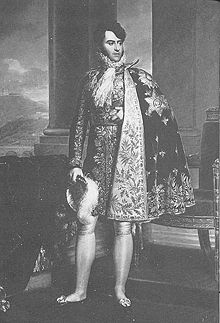
- Camillo Borghese redirects here. Camillo Borghese was also the birth name of Pope Paul VPope Paul V-Theology:Paul met with Galileo Galilei in 1616 after Cardinal Bellarmine had, on his orders, warned Galileo not to hold or defend the heliocentric ideas of Copernicus. Whether there was also an order not to teach those ideas in any way has been a matter for controversy...
.
Don Camillo Filippo Ludovico Borghese, Prince of Sulmona
Prince of Sulmona
The Prince of Sulmona is a noble title in Italy held by the House of Borghese. The title derives its name from Sulmona, a town in Abruzzo. Originally it was created in 1529, during Charles V, Holy Roman Emperor's reign as King of Naples for Philip de Lannoy, Prince of Sulmona...
and of Rossano, Duke and Prince of Guastalla (19 July 1775 – 9 May 1832) was a member of the Borghese family
Borghese
Borghese is the surname of a family of Italian noble and papal background, originating as the Borghese or Borghesi in Siena, where they came to prominence in the 13th century holding offices under the commune. The head of the family, Marcantonio, moved to Rome in the 16th century and there,...
, best known for being brother-in-law to Napoleon.
Biography
Camillo Borghese was born in RomeRome
Rome is the capital of Italy and the country's largest and most populated city and comune, with over 2.7 million residents in . The city is located in the central-western portion of the Italian Peninsula, on the Tiber River within the Lazio region of Italy.Rome's history spans two and a half...
, the son of the pro-Napoleon Marcantonio IV Borghese
Marcantonio IV Borghese
Marcantonio III Borghese, 5th Prince of Sulmona was the head of the Borghese family of Rome. Pro-Bonaparte in sympathies, he was the father of Camillo Filippo Ludovico Borghese....
and brother of Francesco (1776–1839), Prince Aldobrandini
Aldobrandini
The Aldobrandini are an Italian noble family from Florence, with close ties to the Vatican. Its Roman fortunes were made when Ippolito Aldobrandini became pope under the name Pope Clement VIII. He arranged the marriage that linked the Aldobrandini with the Roman family of Pamphili...
, and entered France's service in 1796. He became the second husband of Napoleon's sister Pauline Bonaparte
Pauline Bonaparte
Pauline Bonaparte was the first sovereign Duchess of Guastalla, an imperial French Princess and the Princess consort of Sulmona and Rossano. She was the sixth child of Letizia Ramolino and Carlo Buonaparte, Corsica's representative to the court of King Louis XVI of France. Her elder brother,...
in 1803 (after the death of her first husband Charles Leclerc
Charles Leclerc
Charles Victoire Emmanuel Leclerc was a French Army general and husband to Pauline Bonaparte, sister to Napoleon Bonaparte.-To 1801:...
). He was made a prince of France in 1804; a troop-commander in the Imperial Guard
Imperial Guard
The Imperial Guard was originally a small group of elite soldiers of the French Army under the direct command of Napoleon I, but grew considerably over time. It acted as his bodyguard and tactical reserve, and he was careful of its use in battle...
in 1805 and soon afterwards oberst
Oberst
Oberst is a military rank in several German-speaking and Scandinavian countries, equivalent to Colonel. It is currently used by both the ground and air forces of Austria, Germany, Switzerland, Denmark and Norway. The Swedish rank överste is a direct translation, as are the Finnish rank eversti...
(and late division general
Major General
Major general or major-general is a military rank used in many countries. It is derived from the older rank of sergeant major general. A major general is a high-ranking officer, normally subordinate to the rank of lieutenant general and senior to the ranks of brigadier and brigadier general...
) and duke of Guastalla; and in 1809 commander of 27th and 28th Division of the French Army.
Initially passionate (he commissioned a nude portrait of her
Venus Victrix (Canova)
"Pauline Bonaparte as Venus Victrix" is a semi-nude life-size reclining neo-Classical portrait sculpture by the Italian sculptor Antonio Canova...
from Canova), the marriage later foundered due to her taking a series of lovers and showing eccentricities such as being carried to her baths by her huge African slaves and using her ladies-in-waiting for footstools. They led separate lives but did not divorce, and Pauline convinced her brother to give Camillo the governorship of Piedmont
Piedmont
Piedmont is one of the 20 regions of Italy. It has an area of 25,402 square kilometres and a population of about 4.4 million. The capital of Piedmont is Turin. The main local language is Piedmontese. Occitan is also spoken by a minority in the Occitan Valleys situated in the Provinces of...
in 1808 (with the words "Camillo is an imbecile, no one knows that better than I do. But what does that matter, when we're talking about governing a territory?") and guardianship of Napoleon's prisoner Pope Pius VII
Pope Pius VII
Pope Pius VII , born Barnaba Niccolò Maria Luigi Chiaramonti, was a monk, theologian and bishop, who reigned as Pope from 14 March 1800 to 20 August 1823.-Early life:...
.
Napoleon also forced him to sell 344 pieces from the family art collection
Borghese collection
The Borghese Collection is a collection of Roman sculptures, old masters and modern art collected by the Roman Borghese family, especially Cardinal Scipione Borghese, from the 17th century on. It includes major collections of Caravaggio, Raphael, and Titian, and of ancient Roman art...
to the French state, which Camillo made up with new pieces from excavations on his estates. Camillo also took an interest in the family villa
Villa Borghese
Villa Borghese may refer to:*The Villa Borghese Pinciana , the villa built by the architect Flaminio Ponzio , developing sketches by Scipione Borghese, who used it as a villa suburbana, a party villa, at the edge of Rome, and to house his art collection.**The Galleria...
at Porta Pinciana
Porta Pinciana
Porta Pinciana is a gate of the Aurelian Walls in Rome.The name derives from the gens Pincia, who owned the epponymous hill...
, rearranging the display of the collection within it and giving it a new new monumental entrance at Piazza del Popolo
Piazza del Popolo
Piazza del Popolo is a large urban square in Rome. The name in modern Italian literally means "People's Square", but historically it derives from the poplars after which the church of Santa Maria del Popolo, in the northeast corner of the piazza, takes its name.The piazza lies inside the northern...
.
After Napoleon's fall, Camillo's alliance with him proved awkward and he moved to Florence
Florence
Florence is the capital city of the Italian region of Tuscany and of the province of Florence. It is the most populous city in Tuscany, with approximately 370,000 inhabitants, expanding to over 1.5 million in the metropolitan area....
to distance himself from it and her, managing to avoid any of his lands being sequestered by the popes (a usual punishment for pro-Bonaparte tendencies). After 10 years there with a long-term mistress, he was reluctantly convinced by the pope into receiving Pauline back, only 3 months before she died of cancer. He then continued in secret and futile Bonapartist plots until his own death, which occurred at Florence in 1832. He was succeeded by his brother Francesco.