
|
|
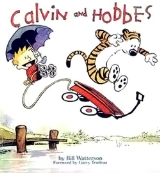
Calvin and HobbesCalvin and Hobbes was a daily comic strip written and illustrated by American cartoonist Bill Watterson, following the humorous antics of Calvin, an imaginative six-year old boy and Hobbes, his energetic and sardonic albeit stuffed tiger. The strip was syndicated from November 18, 1985 to December 31, 1995. At its height, Calvin and Hobbes was carried by over 2,400 newspapers worldwide. To date, more than 30 million copies of the 18 Calvin and Hobbes books have been printed, and popular culture is still replete with references to the strip.
Discussions
|
Discussion
Features
|
|
 |
Ask a
question about 'Calvin and Hobbes' |
|
|
 |
|
 |
Start a new
discussion about 'Calvin and Hobbes' |
|
|
 |
|
 |
Answer
questions about 'Calvin and Hobbes' |
|
|
 |
|
 |
'Calvin and Hobbes' discussion
forum |
|
|
Timeline
|
|
1985 The first Calvin and Hobbes comic strip, drawn by Bill Watterson, is printed in a handful of newspapers.
1995 Bill Watterson, author of the comic strip ''Calvin and Hobbes'', announces his retirement in a brief letter to newspaper editors.
1995 The last new ''Calvin and Hobbes'' cartoon strip is published.
|
Encyclopedia
Calvin and Hobbes was a daily comic strip written and illustrated by American cartoonist Bill Watterson, following the humorous antics of Calvin, an imaginative six-year old boy and Hobbes, his energetic and sardonic — albeit stuffed — tiger. The strip was syndicated from November 18, 1985 to December 31, 1995. At its height, Calvin and Hobbes was carried by over 2,400 newspapers worldwide. To date, more than 30 million copies of the 18 Calvin and Hobbes books have been printed, and popular culture is still replete with references to the strip. The strip is vaguely set in the contemporary Midwestern United States, on the outskirts of suburbia, a location probably inspired by Watterson's home town of Chagrin Falls, Ohio. Calvin and Hobbes themselves appear in most of the strips, though several have focused instead upon Calvin's family. The broad themes of the strip deal with Calvin's flights of fantasy, his friendship with Hobbes, his misadventures, his views on a diverse range of political and cultural issues and his relationships and interactions with his parents, classmates, educators, and other members of society. A number of cartoons feature Calvin polling his dad as a political figure. The dual nature of Hobbes is also a recurring motif; Calvin sees Hobbes as alive, while other characters see him as a stuffed animal, a point discussed more fully in Hobbes' main article. Unlike political strips such as Garry Trudeau's Doonesbury is a comic strip [i] by Garry Trudeau [i], popular in the United States [i] and other par... , the series does not mention specific political figures, but does examine broad issues like environmentalism and the flaws of opinion polls. Because of Watterson's strong anti-merchandising sentiments and his reluctance to return to the spotlight, almost no legitimate Calvin and Hobbes licensed merchandise exists outside of the book collections. Some officially approved items were created for marketing purposes and are now sought by collectors. Two notable exceptions to the licensing embargo were the publication of two 16-month wall calendars and the textbook Teaching with Calvin and Hobbes. However, the strip's immense popularity has led to the appearance of various " bootleg" items, including T-shirts, keychains, bumper stickers, and window decals, sometimes including obscene language, religious imagery, and other references contradicting or parodying the whimsical spirit of Watterson's work. HistoryCalvin and Hobbes was first conceived when Watterson, having worked in an advertising job he detested, began devoting his spare time to cartooning, his true love. He explored various strip ideas but all were rejected by the syndicates to which he sent them. However, he did receive a positive response on one strip, which featured a side character who had a stuffed tiger. Told that these characters were the strongest, Watterson began a new strip centered around them. The syndicate which gave him this advice actually rejected the new strip, and Watterson endured a few more rejections before Universal Press Syndicate decided to take it. Syndication and Watterson's artistic standardsFrom the outset, Watterson found himself at odds with the syndicate, which urged him to begin merchandising the characters and touring the country to promote the first collections of comic strips; Watterson refused. To him, the integrity of the strip and its artist would be undermined by commercialization, which he saw as a major negative influence in the world of cartoon art. Watterson also grew increasingly frustrated by the gradual shrinking of available space for comics in the newspapers. He lamented that without space for anything more than simple dialogue or spare artwork, comics as an art form were becoming dilute, bland, and unoriginal.ng Watterson's first sabbatical from the strip, Universal Press Syndicate continued to charge newspapers full price to re-run old Calvin and Hobbes strips. Few editors approved of the move, but the strip was so popular that they had little choice but to continue to run it for fear that competing newspapers might pick it up and draw its fans away. Then, upon Watterson's return, Universal Press announced that Watterson had decided to sell his Sunday strip as an unbreakable half of a newspaper or tabloid page. Many editors and even a few cartoonists, such as Bil Keane , criticized him for what they perceived as arrogance and an unwillingness to abide by the normal practices of the cartoon business—a charge that Watterson ignored. Watterson had negotiated the deal to allow himself more creative freedom in the Sunday comics. Prior to the switch, he had to have a certain number of panels with little freedom as to layout ; afterwards, he was free to go with whatever graphic layout he wanted, however unorthodox. His frustration with the standard space division requirements is evident in strips before the change; for example, a 1988 Sunday strip published before the deal is one large panel, but with all the action and dialogue in the bottom part of the panel so editors could crop the top part if they wanted to fit the strip into a smaller space. Watterson's explanation for the switch: Despite the change, Calvin and Hobbes remained extremely popular and thus Watterson was able to expand his style and technique for the more spacious Sunday strips without losing carriers. Since ending the strip, Watterson has kept aloof from the public eye and has given no indication of resuming the strip, creating new works based on the characters, or embarking on other projects. He refuses to sign autographs or license his characters, staying true to his stated principles. In previous years, he was known to sneak autographed copies of his books onto the shelves of a family-owned bookstore near his home in Chagrin Falls, Ohio. However, after discovering that some people were selling the autographed books on eBay for high prices, he ended this practice as well. MerchandisingBill Watterson is notable for his insistence that cartoon strips should stand on their own as an art form, and he has resisted the use of Calvin and Hobbes in merchandising of any sort.uote|Actually, I wasn't against all merchandising when I started the strip, but each product I considered seemed to violate the spirit of the strip, contradict its message, and take me away from the work I loved. If my syndicate had let it go at that, the decision would have taken maybe 30 seconds of my life.}} Watterson did ponder animating Calvin and Hobbes, and has expressed admiration for the art form. In a 1989 interview in The Comics Journal, often abbreviated TCJ, is a US [i] magazine of news and ... , Watterson states: In a comic strip, you just show the highlights of action — you can't show the buildup and release... or at least not without slowing down the pace of everything to the point where it's like looking at individual frames of a movie, in which case you've probably lost the effect you were trying to achieve. In a comic strip, you can suggest motion and time, but it's very crude compared to what an animator can do. I have a real awe for good animation.r this he was asked if it was "a little scary to think of hearing Calvin's voice." He responded that it was "very scary," and although he loved the visual possibilities animation had, the thought of casting voice actors to play his characters was something he felt uncomfortable doing. Plus, he wasn't sure he wanted to work with an animation team, as he'd done all previous work by himself. Ultimately, Calvin and Hobbes was never made into an animated series. Except for the books, two 16-month calendars , and Teaching with Calvin and Hobbes,yle and influences Calvin and Hobbes strips are characterized by sparse but careful draftsmanship, intelligent humor, poignant observations, witty social and political commentary, and well-developed characters that are full of personality. Precedents to Calvin's fantasy world can be found in Charles M. Schulz's Peanuts was a syndicated [i] daily comic strip [i] written and drawn by American [i] ...
, Percy Crosby's Skippy, Berkeley Breathed's Bloom County was a popular American comic strip [i] by Berke Breathed [i] which ran from December 8 [i] ...
, and George Herriman's Krazy Kat is a comic strip [i] created by George Herriman [i] that appeared in U.S. ...
, while Watterson's use of comics as sociopolitical commentary reaches back to Walt Kelly's Pogo was the title of a long-running daily comic strip [i] created by Walt Kelly [i], as well as the ...
. Schulz and Kelly in particular influenced Watterson's outlook on comics during his formative years.ble elements of Watterson's artistic style are his characters' diverse and often exaggerated expressions , elaborate and bizarre backgrounds for Calvin's flights of imagination, well-captured kinetics, and frequent visual jokes and metaphors. In the later years of the strip, with more space available for his use, Watterson experimented more freely with different panel layouts, stories without dialogue, and greater use of whitespace. He also made a point of not showing certain things explicitly: the "Noodle Incident" and the children's book Hamster Huey and the Gooey Kablooie were left to the reader's imagination, where Watterson was sure they would be "more outrageous" than he could portray.
Watterson's technique started with minimal pencil sketches ; he then would use a small sable brush and India ink to complete most of the remaining drawing. He was careful in his use of color, often spending a great deal of time in choosing the right colors to employ for the weekly Sunday strip.
Art and academiaWatterson has used the strip to criticize the artistic world, principally through Calvin's unconventional creations of snowmen. When Miss Wormwood complains that he is wasting class time drawing incomprehensible things , Calvin proclaims himself "on the cutting edge of the avant-garde". He begins exploring the medium of snow when a warm day melts his snowman. His next sculpture "speaks to the horror of our own mortality, inviting the viewer to contemplate the evanescence of life", much in the vein of Ecclesiastes. Over the years, Calvin's creative instincts diversify into sidewalk drawings .
Watterson also directed criticism toward the academic world. Calvin writes a "revisionist autobiography", giving himself a flame thrower. In another strip, he carefully crafts an "artist's statement", knowing that such essays convey more messages than artworks themselves ever do . He indulges in what Watterson calls "pop psychobabble" to justify his destructive rampages and shift blame to his parents, citing "toxic codependency." Once, he pens a book report entitled, "The dynamics of interbeing and monological imperatives in Dick and Jane were the main characters in popular basal reader [i]s written by Zerna Sharp [i] that ...
: a study in psychic transrelational gender modes." Displaying his creation to Hobbes, he remarks, "Academia, here I come!" Watterson explains that he adapted this jargon from an actual book of art criticism.all, Watterson's satirical essays serve to attack both sides, criticizing both the commercial mainstream and the artists who are supposed to be "outside" it. Walking contemplatively through the woods, not long after he began drawing his "Dinosaurs in Rocket Ships Series", Calvin tells Hobbes, The hard part for us avant-garde post-modern artists is deciding whether or not to embrace commercialism. Do we allow our work to be hyped and exploited by a market that's simply hungry for the next new thing? Do we participate in a system that turns high art into low art so it's better suited for mass consumption? Of course, when an artist goes commercial, he makes a mockery of his status as an outsider and free thinker. He buys into the crass and shallow values art should transcend. He trades the integrity of his art for riches and fame. Oh, what the heck. I'll do it. Such sentiments echo Watterson's own struggles with his Syndicate over merchandising issues.
Distorted realityOn several occasions, Watterson began a strip with a distorted view of reality: inverted colors, all objects turning "neo-Cubist", or the world turning to black-and-white without outlines, for example. Only Calvin and Hobbes are able to perceive these changes, which the reader can interpret as their way of seeing certain situations, issues and subjects which he has difficulty understanding or accepting.
In the Tenth Anniversary Book, Watterson acknowledges that most of these strips were metaphors for his own conflicts, typically against his syndicate's desire to produce Calvin and Hobbes merchandise. Accused of only seeing issues in "black and white" —e.g., crass commercialism versus artistic integrity, with nothing in between—Watterson chose to illustrate the situation literally, dropping Calvin into a world where everything had lost shades of grey. Conversely, the "neo-Cubist" strip emerged from the way Watterson found himself "paralyzed by being able to see all sides of an issue".
Passage of timeWhen the strips were originally published, Calvin's settings were seasonally appropriate for the Northern hemisphere. Calvin would be seen building snowmen or sledding during the wintertime, and outside activities such as water balloon fights would replace school during the summer. Christmas and Halloween strips were run during those approximate times of year.
Although Watterson depicts several years' worth of holidays, school years, summer vacations, and camping trips, Calvin is never shown to age nor have any birthday celebrations . This is fairly common among comic strips; consider the children in Charles Schulz's Peanuts was a syndicated [i] daily comic strip [i] written and drawn by American [i] ...
, most of whom existed without aging for decades. Likewise, the characters in George Herriman's Krazy Kat is a comic strip [i] created by George Herriman [i] that appeared in U.S. ...
celebrate the New Year but never grow old, and young characters like Ignatz Mouse's offspring never seem to grow up. Since this is such a common phenomenon, readers are likely to suspend disbelief, as most of them do about Calvin's precocious vocabulary, accepting that he "was never a literal six-year-old".ocial criticisms
In addition to his criticisms of art and academia, Watterson often used the strip to comment on American culture and society. As the strip avoids reference to actual people or events , Watterson's commentary is necessarily generalized. He expresses frustration with public decadence and apathy, with commercialism, and with the pandering nature of the mass media. Calvin is often seen "glued" to the television, while his father speaks with the voice of the author, struggling to impart his values on Calvin.
Hobbes also speaks on Calvin's unwholesome habits, but from a more cynical perspective; he is more likely to make a wry observation than actually intervene. Sometimes he merely looks on as Calvin inadvertently makes the point himself. In one instance, Calvin tells Hobbes about a story in which machines turn humans into zombie slaves. He then exclaims, "My TV show is on!" and sprints from the room in a panic to watch it.
Contrariwise, at times Calvin is the one doing the criticizing of culture. For example, when Calvin and Hobbes stumble onto a heap of litter, they get angered at the people who pollute the world. Calvin had once said, in response to man's exploitation and destruction of nature, "I think the surest sign that intelligent life exists elsewhere in the universe is that none of it has tried to contact us," and "I wonder if you can refuse to inherit the world."
Calvin is also slightly misanthropic, given how some of the people in the world cruelly treat him. Calvin admires how Hobbes isn't human, a sentiment which Hobbes shares.
The main characters Calvin
Named after 16th century theologian John Calvin , Calvin is an impulsive, imaginative, energetic, curious, intelligent, and often selfish six-year-old, whose last name the strip never gives. Despite his low grades, Calvin has a wide vocabulary range that rivals that of an adult as well as an emerging philosophical mind. "You know how Einstein got bad grades as a kid?" he says. "Well, mine are even worse!" He commonly wears his distinctive striped shirt. Watterson has described Calvin thus:
- "Calvin is pretty easy to do because he is outgoing and rambunctious and there's not much of a filter between his brain and his mouth."
- "I guess he's a little too intelligent for his age. The thing that I really enjoy about him is that he has no sense of restraint, he doesn't have the experience yet to know the things that you shouldn't do."
On many occasions, Calvin sees himself in one of his many alternate guises: as the superhero Stupendous Man, the astronaut and explorer Spaceman Spiff, the private eye Tracer Bullet, and many others .
Hobbes
In classic comic tradition of sidekicks, Hobbes represents Calvin's potential maturity, and externalized conscience. A comic about a young boy throwing slush-balls into a neighbor girl's head would be sad and trite without Hobbes there to wisely tease him, "You think she's cute, right?"
From most characters' point of view, Hobbes is Calvin's stuffed tiger. However, from Calvin's perspective, Hobbes is as alive and real as anyone in the strip. He is named after 17th century philosopher Thomas Hobbes, who had what Watterson described as "a dim view of human nature." Calvin's point of view, Hobbes is an anthropomorphic tiger, much larger than Calvin and full of his own attitudes and ideas. But when the perspective shifts to any other character, readers see merely a little stuffed tiger. This is, of course, an odd dichotomy, and Watterson explains it thus:
- When Hobbes is a stuffed toy in one panel and alive in the next, I'm juxtaposing the "grown-up" version of reality with Calvin's version, and inviting the reader to decide which is truer.ough the first strips clearly show Calvin capturing Hobbes by means of a snare , a later comic seems to imply that Hobbes is, in fact, older than Calvin, and has been around his whole life. Watterson eventually decided that it was not important to establish how Calvin and Hobbes had first met.pporting characters
Calvin's familyCalvin's mother and father are for the most part typical Middle American middle-class parents; like many other characters in the strip, their relatively down-to-earth and sensible attitudes serve primarily as a foil for Calvin's outlandish behavior. Both parents go through the entire strip unnamed, except as "Mom" and "Dad", or such pet names as "hon" and "dear." Watterson has never given Calvin's parents names "because as far as the strip is concerned, they are important only as Calvin's mom and dad." This ended up being somewhat problematic when Calvin's Uncle Max was in the strip for a week and couldn't refer to the parents by name, and was one of the main reasons that Max never again appeared.Susie Derkins
Susie Derkins, the only character with both first and last names, is a classmate of Calvin who lives in his neighborhood. She first appeared early in the strip as a new student in Calvin's class. In contrast with Calvin, she is polite and diligent in her studies, and her imagination usually seems mild-mannered and civilized, consisting of stereotypical young girl games such as playing house or having tea parties with her stuffed animals. Her approach to these games is arguably more modern, however, some might say even cynical. "Derkins" was the nickname of Watterson's wife's family beagle, and he liked the name so much he named this character after it. As much as either of them hate to admit, Calvin and Susie have quite a bit in common.
Watterson admits that Calvin and Susie have a bit of a nascent crush on each other , and that Susie is inspired by the type of women Watterson himself finds attractive . Her relationship with Calvin, though, is frequently conflicted, and never really becomes sorted out, and the closest things are times when Calvin sends dead flowers and hate-mail as Valentine's Day gifts for his own enjoyment.
On occasion, Hobbes takes action to attract Susie's romantic attention, often with success, and much to Calvin's chagrin. Although on the surface these scenarios take the form of Hobbes teasing Calvin and showing off his charms, they may be Calvin's way to disguise his own crush on Susie, by pretending that it is Hobbes' crush instead.
Miss Wormwood
Miss Wormwood is Calvin's world-weary teacher, named after the apprentice devil in C.S. Lewis's The Screwtape Letters. She perpetually wears polka-dotted dresses, and serves like others as a foil to Calvin's mischief. Calvin's response to the tedium of schoolwork is endless flights of imagination. His teacher is waiting to retire, takes a lot of medication, and is apparently a heavy smoker and drinker.
Although there is a definite progression of time in the Calvin and Hobbes universe, mainly exhibited by the changing seasons, Calvin returns to Ms. Wormwood's first-grade class every fall.
As usual, for an adult entering Calvin's world, Miss Wormwood sees it differently from Calvin. When she confronts Calvin regarding missing homework, for example, Calvin's Spaceman Spiff persona perceives a large slimy threatening snarling alien. "Slowly, carefully, Spiff draws his death-ray blaster".
Rosalyn
Rosalyn is a teen-age high-school senior and Calvin's official babysitter, whenever Calvin's parents need a night out. She is the only babysitter able to tolerate Calvin's antics, which she uses to demand raises and advances from Calvin's desperate parents. She is also, according to Watterson, the only person Calvin truly fears— certainly she is his equal in cunning, and doesn't hesitate to play as dirty as he does. Originally she was created as a nameless, one-shot character with no plans to appear again; however, Watterson decided he wanted to retain her unique ability to intimidate Calvin, which, ultimately, led to many more appearances.
Moe
Moe is the archetypical bully character in Calvin & Hobbes, "a six-year-old who shaves" who is always shoving Calvin against walls, demanding his lunch money and calling him "Twinky." Moe is the only regular character who speaks in an unusual font: his dialogue is shown in crude, lower-case letters. Watterson describes Moe as "every jerk I've ever known." And while Moe is not smart, he is, as Calvin puts it, streetwise. "That means he knows what street he lives on."
Recurring subject matterThere are several repeating themes in the work, a few involving Calvin's real life, and many stemming from his incredible imagination. Some of the latter are clearly flights of fancy, while others, like Hobbes, are of an apparently dual nature and don't quite work when presumed real or unreal.
Mealtimes
Lunchtime and dinnertime find Calvin eager to share his thoughts about the food he is eating. Those eating with him are generally repulsed by his colorful descriptions of the cuisine, , which is one of the reasons his parents seldom take him to restaurants. During dinnertime at home, Calvin's meals are often depicted as unidentifiable blobs of green goo. Calvin is often repulsed, though his mother occasionally coaxes him to eat his dinner by informing him that they are in fact serving some outlandish or stomach-turning dish — e.g., toxic waste , stewed monkey heads, spider pie , soup with maggots in it — which Calvin then eats with relish, though his other parent usually no longer has an appetite. On occasion, once his parents are out of the room, his meals even become animate , usually resulting in an epic fight with said food that leaves a large mess that strains his mother's patience.
He also gives interesting commentary on his food during lunchtime at school, infuriating Susie. In one case these descriptions — specifically referring to the contents of Calvin's school lunch as "a thermos full of phlegm" — provoked a newspaper to cancel the strip. One time during lunchtime at school, Calvin sits down next to Susie and said, "Mmm mmm, lunchtime! And today's lunch is extra special! Ever since the weather got warm I've been swatting flies and saving them in a jar. Finally I got enough bugs to mash them into a gooey paste with a spoon." Calvin then takes out his sandwich and holds it up to Susie, grinning and saying, "I call it 'bug butter.' Care for a taste?" Susie, exasperated, leans her head on one hand and asks, "Tell me, Calvin, do you have any friends at all?"
Calvin's favorite food is "Chocolate Frosted Sugar Bombs", which is a chocolate-flavored breakfast cereal that exceeds the FDA's sugar limit and provides "one-hundred percent of the daily allowance of caffeine". Calvin eats this cereal every morning before school and every Saturday morning while he watches cartoons with Hobbes . Calvin says once that sometimes he eats "two or three bowls of this", to which Hobbes replies, "I can hear your heart racing from here." One strip shows that Calvin is fully aware that the combination of sugary cereals and overstimulating cartoons renders him "hyperactive and incoherent", which he credits for his parents' decision to not have more children.
Bathtime
To Calvin, bathtime is somewhat of a paradox. Trying to get Calvin into the bath on a nightly basis is a nearly impossible task for his mother; however, once in the water, Calvin often makes an imaginative game of it. He may envision himself as an underwater explorer , an exotic or deadly sea creature , or merely a diver enjoying a leisurely descent along a reef. Imitating a deadly creature is often a foil to his mother's attempts to instill a value of cleanliness in Calvin: while a shark, he may leap out of the water and snap viciously at his mother, . At other times, Calvin's behavior in the bath is merely implied: for instance when a naked and wet Calvin streaks past his father and moments later his mother appears, her clothes are soaking wet. He also has climbed out of his bath and walked down the stairs, claiming to be a 'nude descending a staircase' . Calvin has also tried alternative methods of bathing, such as standing in the toilet bowl and pulling the handle .
The Monsters Under the Bed
At night, Calvin is occasionally terrorized by monster/nightmare creatures apparently living under his bed. Only Calvin and Hobbes are aware of them . There appears to be no continuing theme to their appearance except that they are very intimidating, but none too bright , and they probably want to "squeeze" Calvin. The monsters are not always frightening: upon occasion, when frightened by something even scarier than monsters, Calvin and Hobbes turn on the lights and kill the monsters or fire a few rounds with the dart gun .
G.R.O.S.S.
G.R.O.S.S. is Calvin's anti-girl secret club. The name is an acronym that stands for Get Rid Of Slimy girlS . The name is also similar to Valerie Solanas' Society for Cutting Up Men . Based in a treehouse , the main objective of G.R.O.S.S. is to exclude girls, chiefly Calvin's neighbor Susie Derkins. Calvin and Hobbes are its only members, and wear newspaper chapeaux during meetings. Calvin and Hobbes spend most of their time in the club reworking its constitution and arguing about their bureaucratic roles and titles. Because the club exists specifically to harass girls, they sometimes plan missions to do so. After a mission they award themselves medals and promotions, regardless of their success. Calvin is G.R.O.S.S.'s "Supreme Dictator for Life", and Hobbes is "President and First Tiger." They also dub themselves different various ranks for the appropriate situation . Their anthem is generally unknown, but begins: "Oh Ghroooss, Best Club in the Cosmos".
Cardboard boxes
Over the years Calvin has had quite a few adventures involving corrugated cardboard boxes, which he adapts for many different uses. His inventions include a Transmogrifier, a flying time machine and a duplicator.
Building a transmogrifier is accomplished by turning a cardboard box upside-down, attaching an arrow to the side and writing a list of choices on the box. Upon turning the arrow to a particular choice and pushing a button, the transmogrifier instantaneously rearranges the subject's "chemical configuration" . Calvin makes his first foray into the world of transmogrification when he temporarily turns himself into a tiger, but he finds the experience disappointing. Calvin re-uses some of this technology when he cleverly converts an ordinary water gun into a portable transmogrifier gun, a device which saves his life when he finds himself falling to earth after a balloon carries him high into the sky.
The Duplicator was also made from a cardboard box, except this time it was turned on its side. The "Zap" heard after a person was successfully transmogrified was replaced with a "Boink", coining the title of one of of the collections after Hobbes remarks "Scientific progress goes 'boink'?" Calvin intended to clone himself and let the clone do his work for him. However, the clone, being just like Calvin, refuses to do any work. The clone then uses the Duplicator to make five more clones, which proceed to run off and get Calvin into even more trouble. To finally get rid of them, Calvin tricked them into hiding under the Duplicator box, which he then converted into the Transmogrifier and used to transmogrify the clones into worms. He dug a hole in the backyard and released them there.
Calvin tries this new technology again but this time using an ethicator. He made this copy 'good' resulting in Susie, his parents, and Miss Wormwood realizing something was different about him. Receiving negative comments about 'him' from Susie made the Calvin clone angry. The clone eventually started to fight him but couldn't throw a single punch. Since he had an evil thought, he instantaneously evaporated. This nice manifestation of him constantly got jokes about "If you are a duplicate of Calvin's good side, wouldn't you be a lot smaller?"
The Time Machine was made from the same box, this time right-side up. Passengers climb into the open top, and must be wearing protective goggles while inside time-warp. Calvin first intends to travel to the future and obtain future technology which he could use to become rich in the present time. Unfortunately, he turns the time machine the wrong way and ends up in prehistoric times. Later on, he returns to prehistoric times to take photographs of the dinosaurs, but his parents only see them as pictures of plastic dinosaur figures in the backyard. Calvin used the time machine once more to attempt to avoid a creative writing assignment. He planned to travel to the near future, when the paper was already done , and return to the present with the finished paper. While he argued with his future selves about who would write the paper, Hobbes and his future self wrote a story ridiculing Calvin's efforts. Calvin turned it in without reading it first, and was infuriated upon learning of the subject matter, despite it earning an A+ grade.
A later story involved Calvin developing a "cerebral enhance-o-tron" to help him write a school paper. He again utilizes an upside-down cardboard box, but with three Tinkertoy rods attached to the top, which are connected to a colander by three strings. When the colander is placed on Calvin's head and the machine is activated, he becomes incredibly intelligent, and his brain and head grow to enormous size. His parents, however, do not see a difference. Calvin finds that the cerebral enhancement is only temporary when his head shrinks back to normal size, shortly after he determines his paper's subject matter. Bedtime arrives soon after, and Calvin doesn't get the chance to write his paper.
On another occasion, Calvin covers himself in a cardboard box, with various controls drawn on, presenting himself to Hobbes and to his mother as "the World's Most Powerful Computer," able to answer any question.
There is another occasion where Calvin covers the box with a robotic mouth, eyes, and nose and says he is a robot from outer space that needs some cookies for analysis.
Wagon and sled
Calvin and Hobbes frequently ride downhill in a wagon, sled, or toboggan and ponder the meaning of life, death, God, and a variety of other weighty subjects as they hurtle downhill. The wagon and sled were conceived because of Bill Watterson's aversion to "talking heads" comic strips, as a way of making them visually exciting. The course of the vehicle and the obstacles that the characters negotiate as they travel also frequently serve as metaphors for and parallel to the subject of conversation , and the rides almost always end in a spectacular crash.
The wagon temporarily served as a spacecraft when Calvin and Hobbes realized that the human race was laying waste to Earth by polluting it. They decided to go live on Mars, but returned soon after when they realized that the native Martians were terrified of Earthlings. This may have been a case of rumor preceding them; the prospect of terrestrial life polluting Mars as well as Earth was a bleak one. Although this particular wagon ride did not end in a crash, it once again served as an outlet for a subject matter of importance.
Snowballs and snowmen
During winter, Calvin often engages in snowball fights , usually throwing them at Susie but always resulting in Calvin getting buried in the snow as retaliation. He sometimes teams up with Hobbes for snowball fights, but Calvin can't seem to resist also sneaking up on Hobbes, who always seems to get the drop on him instead.
Calvin also builds snowmen; but these are usually grotesque, monstrous deformed creatures In one storyline, Calvin builds a snowman and brings it to life using the power "invested in him by the mighty and awful snow demons". The snowman immediately turns evil and becomes a "deranged mutant killer monster snow goon" by giving itself two heads and three arms. The snow goon then makes copies of itself, which Calvin eventually defeats by spraying water on them while they slept and freezing them solid. However, Calvin was caught by his parents and had to explain why he was outside when he should've been asleep .
Calvin, unlike Hobbes, thinks of snowmen as fine art. Bill Watterson has said that this is a parody of art's "pretentious blowhards".
The Noodle Incident
The Noodle Incident was an event alluded to in many Calvin and Hobbes strips, which Watterson said that he preferred to leave to the readers' imaginations. Although the event was never shown and the characters never discussed the exact details, the many references made to it reveal some information. For one, we can be sure that it happened in school, as Calvin was worried about whether Miss Wormwood had told his mom about it. Watterson frequently alluded to the Noodle Incident in comics around Christmas time. Hobbes typically mentions the incident when Calvin talks about Santa Claus's view of his behavior. When asked about the incident Calvin would usually answer, very loudly and defensively, "No one can prove I did that!!" Calvin claims he was framed for whatever the incident actually was. The only other unknown incident was the Salamander Incident, which was only mentioned once in the "Yukon Ho!" book.
Learning to ride a bike
Throughout the series, Calvin unsuccessfully attempts to master the art of cycling. His utter fear of riding is reflected in the bike being portrayed as a savage and untameable beast which stalks and attempts to injure him. One would have to assume that Calvin's fear of learning to ride is his fear of falling off and hurting himself. This is somewhat a contradiction for Calvin given his willing acceptance to hurtle down hills in his wagon resulting in constant injury. And there are several strips that portray Calvin's father's love for riding his bike, adding to the irony. One time, the bike rushed into the house after Calvin, which resulted in him hiding on the roof, with the oil and tire marks throughout the house, Calvin responds "One day, people will look up and ask why there's a grown man wearing kids clothes on the roof".
Hamster Huey and the Gooey Kablooie
Hamster Huey and the Gooey Kablooie is Calvin's favorite bedtime story, read by his father, whose attempts to read Calvin a different story are met with outrage. The plotline of the story is never revealed; the most insight the reader gets into the story is when Calvin asks his father to perform "the squeaky voices, the gooshy sound effects, and the happy hamster hop." At one point, Calvin's father becomes so irritated by the frequent reading requests, he substantialy alters the story, leaving a wide eyed Calvin and Hobbes to wonder if "the townsfolk will ever find Hamster Huey's head". Watterson has said that he'd prefer to leave the plotline to the reader's imagination. In a 1993 strip, Calvin also reveals the author's name, Mabel Syrup, and the existence of a sequel to the book entitled Commander Coriander Salamander and 'er Singlehander Bellylander.
Calvin and Hobbes books- For the complete list of books, see List of Calvin and Hobbes books.
There are eighteen Calvin and Hobbes books, published from 1987 to 2005. These include eleven collections, which form a complete archive of the newspaper strips, except for a single daily strip from November 28, 1985. "Treasuries" usually combine the two preceding collections with bonus material, and include color reprints of Sunday comics.
A complete collection of Calvin and Hobbes strips, in three hardcover volumes, with a total 1440 pages, was released on October 4, 2005, by Andrews McMeel Publishing. It also includes color prints of the art used on paperback covers, the Treasuries' extra illustrated stories and poems, and a new introduction by Bill Watterson, who is now happily teaching himself to paint. It is notable, however, that the alternate 1985 strip is still omitted, and two other strips have altered dialogue.
To celebrate the release, Calvin and Hobbes reruns were made available to newspapers from Sunday, September 4, 2005, through Saturday, December 31, 2005, and Bill Watterson answered a select dozen questions submitted by readers. Like current contemporary strips, weekday Calvin and Hobbes strips now appear in color print when available, instead of black and white as in their first run.
Early books were printed in smaller format in black and white that were later reproduced in twos in color in the "Treasuries" — except for the contents of Attack of the Deranged Mutant Killer Monster Snow Goons. Those Sunday strips were never reprinted in color until the Complete collection was finally published in 2005. Every book since Snow Goons has been printed in a larger format with Sundays in color and weekday and Saturday strips larger than they appeared in most newspapers.
Remaining books do contain some additional content; for instance, The Calvin and Hobbes Lazy Sunday Book contains a long watercolor Spaceman Spiff epic not seen elsewhere until Complete, and The Calvin and Hobbes Tenth Anniversary Book contains much original commentary from Watterson. Calvin and Hobbes: Sunday Pages 1985-1995 contains 36 Sunday strips in color alongside Watterson's original sketches, prepared for an exhibition at The Ohio State University Cartoon Research Library.
An officially licensed children's textbook entitled Teaching with Calvin and Hobbes was published in a limited single print-run in 1993.ferences
External links
- The following links were last verified August 27 2006.
Official websites
Fan websites
Articles/Misc.
|