

Calne

Encyclopedia
Calne is a town in Wiltshire
, southwestern England. It is situated at the northwestern extremity of the North Wessex Downs hill range, a designated Area of Outstanding Natural Beauty
.
The town lies on the River Marden
, the Wilts & Berks Canal and the A4 road 19 miles (30.6 km) east of Bath, 6 miles (9.7 km) east of Chippenham
and 13 miles (20.9 km) west of Marlborough. Wiltshire's county town of Trowbridge
is 15 miles (24.1 km) to the southwest, with London
some 90 miles (144.8 km) to the east. According to the 2001 Census
, Calne's population numbered 13,606 inhabitants (15,000 est. 2009).
met the Witenagemot
in order to justify his controversial Church reforms, which involved the secular priests being replaced by Benedictine
monk
s and the influence of landowners over churches on their lands being taken away. According to legend, at one point Dunstan called upon God to support his cause, at which point the floor collapsed killing most of his opponents, whilst Dunstan and his supporters were in the part that remained standing. This was claimed as a miracle by Dunstan's supporters.
 Calne had a significant woollen broadcloth
industry in the 18th century, and evidence of this can be seen on The Green, where many buildings remain, such as Georgian era
clothiers' houses and some of the 20 original cloth mills along the River Marden. St Mary's parish church
was built by the generous donations of rich clothiers and wool merchants in the 15th century.
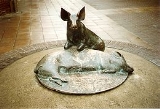
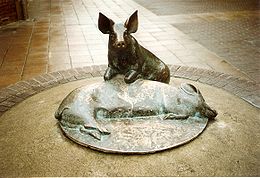
Subsequently, Calne's best known industry was the Harris pork
processing factory that dominated the town architecturally and provided employment directly and indirectly to many of the residents until the early 1980s - at its closure in 1983 for example it employed over 2000 people out of a town population of 10,000. It is said that the pork curing industry developed because pigs reared in Ireland were landed at Bristol
and then herded across England on drovers' roads to Smithfield, London
, passing through Calne. The factory started in the second half of the 18th century when brothers John and Henry Harris started businesses which merged in 1888 as C. & T. Harris & Co. The factory has now been fully demolished and its site redeveloped as shops, housing and a library. As a result of the closure, unemployment in the town increased considerably and during much of the 1980s Calne suffered many of the economic restructuring
problems more usually associated with large cities.
The Porte Marsh Industrial Estate on the north side of the town now provides the bulk of the town's internal employment. It is home to around 100 companies in predominantly light industries
and information technology
. The Belgian company Deceuninck has invested considerably in this area and operates two large facilities at Porte Marsh, notably a modern production and distribution centre which now dominates the industrial area. Another significant employer is the Exception Group, a large electronics company. In 2006 plans to build a sizeable cement production plant on the Porte Marsh site were vigorously opposed by local residents and planning permission was refused by the council.
region, with a population projected to peak at around 16,000 by 2012. The Lansdowne Park housing development (completed in late 2008) has substantially increased the physical scale of the town, creating an entirely new northwestern suburb, including a new primary school, a medical centre and a small shopping area. This area in particular has attracted professional workers from traditionally more expensive areas such as Bath, Bristol
, Marlborough and as far afield as the 'silicon valley' towns of central Berkshire
. Lansdowne Park's name reflects the development's proximity to the seat of the Marquess of Lansdowne
, whose family have resided at the nearby Bowood House
country estate since 1784.
Aside from the final completion of Lansdowne Park, there are pockets of new housing, but on a far smaller scale. In October 2007, the go-ahead was given for the creation of a major new £1m Football Foundation
outdoor facility at Beversbrook on Calne's northern edge, which was officially opened in April 2009.
The draft South West Regional Spatial Strategy, published in 2008, recommended the building of 13,700 additional dwellings within the District of North Wiltshire during the period 2006 – 2026. Of these, some are designated for Calne. In a survey conducted for the 'Calne Connection' in early 2010, some 90% of respondents agreed that the town should remain as a market town rather than expand significantly beyond 20,000 inhabitants.
However, since the demolition of the Harris pork factory and the completion of the first phase of redevelopment/regeneration in 2001, Calne has, in general, been successfully transformed into an attractive setting compared to its run-down image of the 1980s and 1950s. A substantial amount of scaffolding materialised across Calne town centre throughout 2007-2008 with a view to the renovation of several prominent buildings.
opened in 1863, the terminus of a branch line
of the Great Western Railway
from Chippenham. There was initially one intermediate stop: Stanley Bridge Halt
. The opening of another quite late in the line's history - Black Dog Halt
- was not enough to slow the inevitable decline of the line. The branch closed as a result of the Beeching Axe
in September 1965, having achieved the dubious distinction of making the biggest loss per mile of track of any line in the country.
The town centre suffers from heavy traffic congestion with large queues stretching along Wood Street, Curzon Street, Oxford Road and The Pippin most of the day. This is caused by North Wiltshire Council's decision to allow only single-file traffic between Curzon Street and Wood Street, with traffic heading towards Wood Street having priority. The A4 through the town is usually close to gridlock during rush hours because of this.
A northern bypass road (part of the A3102 road) was completed in 2001 and an eastern bypass is under consideration for possible construction in 2014.
Calne is equidistant (12 miles/19 km) from the M4 motorway
at Junction 16 (Wootton Bassett/Swindon West) to the north east of Calne, and the westbound M4 junction 17 just north of Chippenham to the northwest. The closest main passenger airport is Bristol Airport
, 38 miles (61.2 km) to the south west. Calne is also one the largest UK towns not served by a rail station, nor does it have a bus station, though in March 2007 it was designated as a National Express
stop on route 403 from Bath to London via Heathrow Airport once a day. This service runs with wheelchair-accessible coaches.
supermarkets. The town has witnessed a number of transient enterprises in recent years and several units on the dated Phelps Parade remain empty. However, an expansion of the Somerfield
(Now Co-operative) store in the town centre was completed in September 2007 and a Tesco Express store opened in the Lansdowne Park district in December that year, replacing the former One Stop outlet.
As part of the 'New Heart of Calne' initiative, a section of Phelps Parade was redeveloped in 2009 and new mixed-use building constructed in its place, part Cotswold stone
and part red brick. This was originally intended as a Woolworths
outlet but during Summer 2011 became home to fashion retailer M&Co. A new glass roof section and roof lining was installed at Phelps Parade in 2009 to improve its appearance, and although a future large-scale redevelopment/replacement is anticipated (which may include the complete removal of the existing buildings), no firm plans have been confirmed.
is an independent school for girls. The John Bentley School is the local comprehensive high school on the southern periphery of Calne, and is a noted languages centre. Its history goes back to the original Bentley's School, opened in 1664 using an endowment left by John Bentley in 1662. In 1901 this was amalgamated with Calne Technical School as a school of science for boys aged 9–17. This became known as Calne County School and later Calne County Secondary School. Girls were admitted from 1903 and in 1908-9 new buildings were added to the nucleus of buildings dating from 1842. The school was later called the Bentley Grammar School. In 1957 it moved to a new building in the angle of the London and Melksham Roads. In 1974 the grammar school merged with Fynemore School in Silver Street, and to form the John Bentley Comprehensive School, later the John Bentley School. Until 1998 both sites were used. After the buildings in Silver Street were given up new buildings were erected in the angle of the London and Melksham roads and existing ones improved.
Historically, Calne had a number of other small schools, some based in houses (eg one in Curzon Street in which girls were trained for domestic service). Another example was a small boarding school for boys open in 1842 on the site of a former factory in Silver Street. Notably, this school was attended by Reg Birkett
, the dual-code international sportsman, who played football and rugby for England in the 1870s.
The closest further education
institution is the Wiltshire College
site in Chippenham 6 miles (9.7 km) away), although the college also has a small centre at The Green in Calne.
The closest higher education
institution is the University of Bath
campus at Claverton Down in Bath, 18 miles (29 km) to the west. The university's Oakridge campus in east Swindon is 20 miles (32.2 km) to the north west. Bath Spa University
lies 24 miles (38.6 km) away at its Newton Park campus, west of Bath.
Television - Local news programmes - BBC Points West
& ITV West Country.
Radio - BBC Wiltshire
, Heart Wiltshire, and locally based Community Radio station - Eartunes http://www.eartunes.co.uk. The town was served by Brunel FM, before the station went into liquidation. The frequency has since been taken over by Total Star.
Calne is listed under British Telecom's 01249 STD prefix, which includes Chippenham. It is within the Bath & West Wiltshire BT Phonebook area and lies just inside the Swindon Yellow Pages area.
, currently held by Conservative James Gray
, at the 2010 General Election. It is the constituency's largest town and lies at its southern edge.
The town was previously in the Devizes constituency
, with former Conservative Party Chairman and Northern Ireland Minister Michael Ancram
serving as the local Member of Parliament
until May 2010.
Civic and local governance is through Calne Town Council http://www.calne.gov.uk/ and Wiltshire Council
http://www.wiltshire.gov.uk (formerly Wiltshire County Council
until April 2009).
, John Pym
and the athlete Walter Goodall George
who held the world record for the mile from 1886 to 1915. George also held more than 13 world records for running at the time and still holds a world record simply for holding the mile record longer than anyone else. There are two plaques in Calne to commemorate his life, one in front of the Town Hall and one at ground level just inside the recreation grounds.
The country estate of Bowood House
lies near Calne. It was here that Joseph Priestley
discovered oxygen
in 1774; there is a plaque in the town centre commemorating this. Jan Ingenhousz
repeated Joseph Priestley's experiments and found it was sunlight which acted upon the plants to create oxygen. There is a pavement display outside the Millennium library in Calne in his honour.
There is also a plaque on the wall of the house where Samuel Taylor Coleridge
stayed from 1814 to 1816 as part of the Morgan household whilst writing his Biographia Literaria.
The singer-songwriter-author Julian Cope
resided in a small village 7 kilometres (4.3 mi) east of Calne, towards Avebury
, until 2006, and lived in Calne itself for some years before he moved with his family to the village.
The actor David Hemmings
lived in the Old Mill in Calne for many years up until his death in December 2003. His funeral was held at St. Mary's Church.
Isaac Nichols
, a transported
convict
who became the first postmaster
of Sydney
, New South Wales was born here in 1770.
Clive Farahar
, the books and manuscripts expert on the BBC
s Antiques Roadshow
lives in the town and has a business there.
In 2008 the singer-songwriter Robbie Williams
purchased a £7 million property in the nearby Parish of Compton Bassett
. Compton Basset House came complete with gamekeeper lodgings, tennis court, helipad and extensive grounds. The property is approximately 3 miles (4.8 km) to the east of central Calne. Compton Basset House was also previously owned by the famous architect Sir Norman Foster (now Baron Foster of Thames Bank) of "Gherkin" fame, but was sold by him in 1992.
The family seat of the 9th Marquess of Lansdowne, Bowood House is approximately 3 miles (4.8 km) southwest of the town.
Blackland Lakes is a large camping site on the southern edge of Calne which is popular with anglers and tourists alike. The 'lakes' themselves are in fact large angling pools.
Founded in 1886, Calne Town F.C.
play in the Western Football League
Premier Division and finished in 5th position (of 20 teams) in the league table at the end of the 2005-2006 season. Their Bremhill View ground is located on the north side of the town close to the A3102 bypass.
Calne R.F.C.
According to the club website http://www.calnerfc.co.uk/history.htm the rugby club is rumoured to have been formed in the late 1920s, in part due to the influx of Welsh to the area during the depression. The Junior Imperial League, forerunners of the Young Conservatives formed the club under the presidency of either Mr Drewett or Mr L. Taylor.
The team's first match was probably in Drewett’s field where now stands Braemor Road. Their inaugural game against a Bath XV team was played on the Recreation Ground to which Calne returned in the late 1970s as a permanent home, which despite ground disputes and uncertainty - remains their home to date.
It appears that a lack of local interest forced the club to fold in the late 1930s however, in 1960 the club was re-formed as “Old Bentlians”, though it was not exclusively an “old boys” club it did use the pitches at Bentley Grammar School.
The club currently fields a 1st and 2nd XV, alternating home games on Saturday's, and also a junior team who play on Sunday's.
Founded at the beginning of 2008, Calne Divers was formed by a group of local divers to provide training to local people. The club is a member of the Sub-Aqua Association
and offer try-dives to all that are interested. Training is available up to Dive Supervisor level, and all training fees are included in the club membership. The group is partly funded by the National Lottery
.
In 2007 Calne divers found the lost village of Mannings Hill at the bottom of the lake at Bowood.
Wiltshire
Wiltshire is a ceremonial county in South West England. It is landlocked and borders the counties of Dorset, Somerset, Hampshire, Gloucestershire, Oxfordshire and Berkshire. It contains the unitary authority of Swindon and covers...
, southwestern England. It is situated at the northwestern extremity of the North Wessex Downs hill range, a designated Area of Outstanding Natural Beauty
Area of Outstanding Natural Beauty
An Area of Outstanding Natural Beauty is an area of countryside considered to have significant landscape value in England, Wales or Northern Ireland, that has been specially designated by the Countryside Agency on behalf of the United Kingdom government; the Countryside Council for Wales on...
.
The town lies on the River Marden
River Marden
The River Marden is a small tributary of the River Avon in England. It flows from the hills surrounding Calne and meets the River Avon about a mile upstream of Chippenham. The river has a mean flow of .-Course:...
, the Wilts & Berks Canal and the A4 road 19 miles (30.6 km) east of Bath, 6 miles (9.7 km) east of Chippenham
Chippenham, Wiltshire
Chippenham is a market town in Wiltshire, England, located east of Bath and west of London. In the 2001 census the population of the town was recorded as 28,065....
and 13 miles (20.9 km) west of Marlborough. Wiltshire's county town of Trowbridge
Trowbridge
Trowbridge is the county town of Wiltshire, England, situated on the River Biss in the west of the county, approximately 12 miles southeast of Bath, Somerset....
is 15 miles (24.1 km) to the southwest, with London
London
London is the capital city of :England and the :United Kingdom, the largest metropolitan area in the United Kingdom, and the largest urban zone in the European Union by most measures. Located on the River Thames, London has been a major settlement for two millennia, its history going back to its...
some 90 miles (144.8 km) to the east. According to the 2001 Census
United Kingdom Census 2001
A nationwide census, known as Census 2001, was conducted in the United Kingdom on Sunday, 29 April 2001. This was the 20th UK Census and recorded a resident population of 58,789,194....
, Calne's population numbered 13,606 inhabitants (15,000 est. 2009).
History
In AD 978 Anglo Saxon Calne was the site of a two-storey building with a hall on the first floor. It was here that St Dunstan, Archbishop of CanterburyArchbishop of Canterbury
The Archbishop of Canterbury is the senior bishop and principal leader of the Church of England, the symbolic head of the worldwide Anglican Communion, and the diocesan bishop of the Diocese of Canterbury. In his role as head of the Anglican Communion, the archbishop leads the third largest group...
met the Witenagemot
Witenagemot
The Witenagemot , also known as the Witan was a political institution in Anglo-Saxon England which operated from before the 7th century until the 11th century.The Witenagemot was an assembly of the ruling class whose primary function was to advise the king and whose membership was...
in order to justify his controversial Church reforms, which involved the secular priests being replaced by Benedictine
Benedictine
Benedictine refers to the spirituality and consecrated life in accordance with the Rule of St Benedict, written by Benedict of Nursia in the sixth century for the cenobitic communities he founded in central Italy. The most notable of these is Monte Cassino, the first monastery founded by Benedict...
monk
Monk
A monk is a person who practices religious asceticism, living either alone or with any number of monks, while always maintaining some degree of physical separation from those not sharing the same purpose...
s and the influence of landowners over churches on their lands being taken away. According to legend, at one point Dunstan called upon God to support his cause, at which point the floor collapsed killing most of his opponents, whilst Dunstan and his supporters were in the part that remained standing. This was claimed as a miracle by Dunstan's supporters.
Broadcloth
Broadcloth is a dense woollen cloth. Modern broadcloth can be composed of cotton, silk, or polyester, but traditionally broadcloth was made solely of wool. The dense weave lends sturdiness to the material....
industry in the 18th century, and evidence of this can be seen on The Green, where many buildings remain, such as Georgian era
Georgian era
The Georgian era is a period of British history which takes its name from, and is normally defined as spanning the reigns of, the first four Hanoverian kings of Great Britain : George I, George II, George III and George IV...
clothiers' houses and some of the 20 original cloth mills along the River Marden. St Mary's parish church
Parish church
A parish church , in Christianity, is the church which acts as the religious centre of a parish, the basic administrative unit of episcopal churches....
was built by the generous donations of rich clothiers and wool merchants in the 15th century.
Subsequently, Calne's best known industry was the Harris pork
Pork
Pork is the culinary name for meat from the domestic pig , which is eaten in many countries. It is one of the most commonly consumed meats worldwide, with evidence of pig husbandry dating back to 5000 BC....
processing factory that dominated the town architecturally and provided employment directly and indirectly to many of the residents until the early 1980s - at its closure in 1983 for example it employed over 2000 people out of a town population of 10,000. It is said that the pork curing industry developed because pigs reared in Ireland were landed at Bristol
Bristol
Bristol is a city, unitary authority area and ceremonial county in South West England, with an estimated population of 433,100 for the unitary authority in 2009, and a surrounding Larger Urban Zone with an estimated 1,070,000 residents in 2007...
and then herded across England on drovers' roads to Smithfield, London
Smithfield, London
Smithfield is an area of the City of London, in the ward of Farringdon Without. It is located in the north-west part of the City, and is mostly known for its centuries-old meat market, today the last surviving historical wholesale market in Central London...
, passing through Calne. The factory started in the second half of the 18th century when brothers John and Henry Harris started businesses which merged in 1888 as C. & T. Harris & Co. The factory has now been fully demolished and its site redeveloped as shops, housing and a library. As a result of the closure, unemployment in the town increased considerably and during much of the 1980s Calne suffered many of the economic restructuring
Economic restructuring
Economic restructuring refers to the phenomenon of Western urban areas shifting from a manufacturing to a service sector economic base. This transformation has affected demographics including income distribution, employment, and social hierarchy; institutional arrangements including the growth of...
problems more usually associated with large cities.
The Porte Marsh Industrial Estate on the north side of the town now provides the bulk of the town's internal employment. It is home to around 100 companies in predominantly light industries
Light industry
Light industry is usually less capital intensive than heavy industry, and is more consumer-oriented than business-oriented...
and information technology
Information technology
Information technology is the acquisition, processing, storage and dissemination of vocal, pictorial, textual and numerical information by a microelectronics-based combination of computing and telecommunications...
. The Belgian company Deceuninck has invested considerably in this area and operates two large facilities at Porte Marsh, notably a modern production and distribution centre which now dominates the industrial area. Another significant employer is the Exception Group, a large electronics company. In 2006 plans to build a sizeable cement production plant on the Porte Marsh site were vigorously opposed by local residents and planning permission was refused by the council.
Modern Calne
During the late 1990s and early 2000s, Calne was considered one of the fastest-expanding towns in the South West EnglandSouth West England
South West England is one of the regions of England defined by the Government of the United Kingdom for statistical and other purposes. It is the largest such region in area, covering and comprising Bristol, Gloucestershire, Somerset, Dorset, Wiltshire, Devon, Cornwall and the Isles of Scilly. ...
region, with a population projected to peak at around 16,000 by 2012. The Lansdowne Park housing development (completed in late 2008) has substantially increased the physical scale of the town, creating an entirely new northwestern suburb, including a new primary school, a medical centre and a small shopping area. This area in particular has attracted professional workers from traditionally more expensive areas such as Bath, Bristol
Bristol
Bristol is a city, unitary authority area and ceremonial county in South West England, with an estimated population of 433,100 for the unitary authority in 2009, and a surrounding Larger Urban Zone with an estimated 1,070,000 residents in 2007...
, Marlborough and as far afield as the 'silicon valley' towns of central Berkshire
Berkshire
Berkshire is a historic county in the South of England. It is also often referred to as the Royal County of Berkshire because of the presence of the royal residence of Windsor Castle in the county; this usage, which dates to the 19th century at least, was recognised by the Queen in 1957, and...
. Lansdowne Park's name reflects the development's proximity to the seat of the Marquess of Lansdowne
Marquess of Lansdowne
Marquess of Lansdowne, in the County of Somerset, is a title in the Peerage of Great Britain held by the head of the Petty-Fitzmaurice family. This branch of the family descends from the Hon...
, whose family have resided at the nearby Bowood House
Bowood House
Bowood is a grade I listed Georgian country house with interiors by Robert Adam and a garden designed by Lancelot "Capability" Brown. It is adjacent to the village of Derry Hill, halfway between Calne and Chippenham in Wiltshire, England...
country estate since 1784.
Aside from the final completion of Lansdowne Park, there are pockets of new housing, but on a far smaller scale. In October 2007, the go-ahead was given for the creation of a major new £1m Football Foundation
Football Foundation
The Football Foundation is the United Kingdom’s largest sports charity, investing £40m into communities each year thanks to money provided by its funding partners the Premier League, The FA and the Government...
outdoor facility at Beversbrook on Calne's northern edge, which was officially opened in April 2009.
The draft South West Regional Spatial Strategy, published in 2008, recommended the building of 13,700 additional dwellings within the District of North Wiltshire during the period 2006 – 2026. Of these, some are designated for Calne. In a survey conducted for the 'Calne Connection' in early 2010, some 90% of respondents agreed that the town should remain as a market town rather than expand significantly beyond 20,000 inhabitants.
Notable architecture
Notable buildings in the town include St Mary's Church, an array of houses on The Green and the Town Hall. Of particular note is the new Library which has won awards for its innovative design and was opened by HM Queen Elizabeth II in 2001.However, since the demolition of the Harris pork factory and the completion of the first phase of redevelopment/regeneration in 2001, Calne has, in general, been successfully transformed into an attractive setting compared to its run-down image of the 1980s and 1950s. A substantial amount of scaffolding materialised across Calne town centre throughout 2007-2008 with a view to the renovation of several prominent buildings.
Transport and infrastructure
Calne's former railway stationCalne railway station
Calne railway station was opened on 3 November 1863 by the Great Western Railway as a terminus for the branch line from the Great Western mainline . It was situated a short distance from Calne town centre and was equipped with only one platform...
opened in 1863, the terminus of a branch line
Branch line
A branch line is a secondary railway line which branches off a more important through route, usually a main line. A very short branch line may be called a spur line...
of the Great Western Railway
Great Western Railway
The Great Western Railway was a British railway company that linked London with the south-west and west of England and most of Wales. It was founded in 1833, received its enabling Act of Parliament in 1835 and ran its first trains in 1838...
from Chippenham. There was initially one intermediate stop: Stanley Bridge Halt
Stanley Bridge Halt railway station
Stanley Bridge Halt was a railway station on the Great Western Railway's branch line from Chippenham to Calne. It closed in 1965.-External links:* *...
. The opening of another quite late in the line's history - Black Dog Halt
Black Dog Halt railway station
Black Dog Halt was opened 1863-11-03 by the Great Western Railway for Lord Lansdowne of Bowood House. Lord Lansdowne had a special compartment in one of the Calne line's autocoaches. Eventually, Lord Lansdowne was persuaded to allow the halt to be used by the public...
- was not enough to slow the inevitable decline of the line. The branch closed as a result of the Beeching Axe
Beeching Axe
The Beeching Axe or the Beeching Cuts are informal names for the British Government's attempt in the 1960s to reduce the cost of running British Railways, the nationalised railway system in the United Kingdom. The name is that of the main author of The Reshaping of British Railways, Dr Richard...
in September 1965, having achieved the dubious distinction of making the biggest loss per mile of track of any line in the country.
The town centre suffers from heavy traffic congestion with large queues stretching along Wood Street, Curzon Street, Oxford Road and The Pippin most of the day. This is caused by North Wiltshire Council's decision to allow only single-file traffic between Curzon Street and Wood Street, with traffic heading towards Wood Street having priority. The A4 through the town is usually close to gridlock during rush hours because of this.
A northern bypass road (part of the A3102 road) was completed in 2001 and an eastern bypass is under consideration for possible construction in 2014.
Calne is equidistant (12 miles/19 km) from the M4 motorway
M4 motorway
The M4 motorway links London with South Wales. It is part of the unsigned European route E30. Other major places directly accessible from M4 junctions are Reading, Swindon, Bristol, Newport, Cardiff and Swansea...
at Junction 16 (Wootton Bassett/Swindon West) to the north east of Calne, and the westbound M4 junction 17 just north of Chippenham to the northwest. The closest main passenger airport is Bristol Airport
Bristol Airport
Bristol Airport may refer to:* Bristol Airport, serving Bristol, England, United Kingdom ** Bristol Airport , a docu-soap based on events at Bristol Airport...
, 38 miles (61.2 km) to the south west. Calne is also one the largest UK towns not served by a rail station, nor does it have a bus station, though in March 2007 it was designated as a National Express
National Express
National Express Coaches, more commonly known as National Express, is a brand and company, owned by the National Express Group, under which the majority of long distance bus and coach services in Great Britain are operated,...
stop on route 403 from Bath to London via Heathrow Airport once a day. This service runs with wheelchair-accessible coaches.
Shopping
Calne hosts Sainsbury's, Co-operative and IcelandIceland (supermarket)
Iceland is a supermarket chain in the United Kingdom and Ireland. Iceland's primary product lines include frozen foods, such as frozen prepared meals and frozen vegetables - hence the name of the company...
supermarkets. The town has witnessed a number of transient enterprises in recent years and several units on the dated Phelps Parade remain empty. However, an expansion of the Somerfield
Somerfield
Somerfield was a chain of small to medium sized supermarkets operating in the United Kingdom. The company was taken over by the Co-operative Group on 2 March 2009 in a £1.57 billion deal, creating the UK's fifth largest food retailer. The name is currently being phased out and replaced by the...
(Now Co-operative) store in the town centre was completed in September 2007 and a Tesco Express store opened in the Lansdowne Park district in December that year, replacing the former One Stop outlet.
As part of the 'New Heart of Calne' initiative, a section of Phelps Parade was redeveloped in 2009 and new mixed-use building constructed in its place, part Cotswold stone
Cotswold stone
Cotswold stone is a yellow oolitic limestone quarried in many places in the Cotswold Hills in the south midlands of England. When weathered, the colour of buildings made or faced with this stone is often described as 'honey' or 'golden'....
and part red brick. This was originally intended as a Woolworths
Woolworths Group
Woolworths Group plc was a listed British company that owned the high-street retail chain, Woolworths, as well as other brands such as the entertainment distributor Entertainment UK and book and resource distributor Bertram Books...
outlet but during Summer 2011 became home to fashion retailer M&Co. A new glass roof section and roof lining was installed at Phelps Parade in 2009 to improve its appearance, and although a future large-scale redevelopment/replacement is anticipated (which may include the complete removal of the existing buildings), no firm plans have been confirmed.
Education
Many schools have been associated with Calne over its history. St Mary's, CalneSt Mary's School (Calne)
St Mary's Calne, is an academically selective independent school at Calne, Wiltshire, for girls aged eleven to eighteen, with about 320 on roll. Most girls are boarders...
is an independent school for girls. The John Bentley School is the local comprehensive high school on the southern periphery of Calne, and is a noted languages centre. Its history goes back to the original Bentley's School, opened in 1664 using an endowment left by John Bentley in 1662. In 1901 this was amalgamated with Calne Technical School as a school of science for boys aged 9–17. This became known as Calne County School and later Calne County Secondary School. Girls were admitted from 1903 and in 1908-9 new buildings were added to the nucleus of buildings dating from 1842. The school was later called the Bentley Grammar School. In 1957 it moved to a new building in the angle of the London and Melksham Roads. In 1974 the grammar school merged with Fynemore School in Silver Street, and to form the John Bentley Comprehensive School, later the John Bentley School. Until 1998 both sites were used. After the buildings in Silver Street were given up new buildings were erected in the angle of the London and Melksham roads and existing ones improved.
Historically, Calne had a number of other small schools, some based in houses (eg one in Curzon Street in which girls were trained for domestic service). Another example was a small boarding school for boys open in 1842 on the site of a former factory in Silver Street. Notably, this school was attended by Reg Birkett
Reg Birkett
Reginald Halsey Birkett was an English football player who played for Clapham Rovers, as well as the English national side. He also played international rugby union for England in 1871, in the first ever international rugby match. In this match he scored England's first ever try.-Early...
, the dual-code international sportsman, who played football and rugby for England in the 1870s.
The closest further education
Further education
Further education is a term mainly used in connection with education in the United Kingdom and Ireland. It is post-compulsory education , that is distinct from the education offered in universities...
institution is the Wiltshire College
Wiltshire College
Wiltshire College is a tertiary college of education founded in 2002 by the merger of Chippenham Technical College, Lackham College and Trowbridge College. Consolidation will be completed with the merger of Salisbury College, which commenced in January 2008...
site in Chippenham 6 miles (9.7 km) away), although the college also has a small centre at The Green in Calne.
The closest higher education
Higher education
Higher, post-secondary, tertiary, or third level education refers to the stage of learning that occurs at universities, academies, colleges, seminaries, and institutes of technology...
institution is the University of Bath
University of Bath
The University of Bath is a campus university located in Bath, United Kingdom. It received its Royal Charter in 1966....
campus at Claverton Down in Bath, 18 miles (29 km) to the west. The university's Oakridge campus in east Swindon is 20 miles (32.2 km) to the north west. Bath Spa University
Bath Spa University
Bath Spa University is a university based in, and around, Bath, England. The institution was previously known as Bath College of Higher Education, and later Bath Spa University College...
lies 24 miles (38.6 km) away at its Newton Park campus, west of Bath.
Media & Communications
The town is covered by several different media providers, on a number of formats.Television - Local news programmes - BBC Points West
BBC Points West
BBC Points West is the BBC's regional news programme for the West of England, covering Bristol, Gloucestershire, Somerset and Wiltshire...
& ITV West Country.
Radio - BBC Wiltshire
BBC Wiltshire
BBC Wiltshire is the BBC Local Radio station and BBC Online service for the English county of Wiltshire. The station marked its 20th anniversary in 2009.-BBC Wiltshire Sound :...
, Heart Wiltshire, and locally based Community Radio station - Eartunes http://www.eartunes.co.uk. The town was served by Brunel FM, before the station went into liquidation. The frequency has since been taken over by Total Star.
Calne is listed under British Telecom's 01249 STD prefix, which includes Chippenham. It is within the Bath & West Wiltshire BT Phonebook area and lies just inside the Swindon Yellow Pages area.
Representatives
As a result of boundary changes, Calne has become part of the North Wiltshire constituencyNorth Wiltshire (UK Parliament constituency)
North Wiltshire is a county constituency represented in the House of Commons of the Parliament of the United Kingdom. Until 1983, it was known as Chippenham.- Boundaries :As the name suggests, the constituency covers most of north Wiltshire...
, currently held by Conservative James Gray
James Gray
James Gray may refer to:* Sir James Gray, 1st Baronet , armiger and merchant-Burgess of Edinburgh* Sir James Gray, 2nd Baronet , diplomat and antiquary* The male pseudonym of Hannah Snell...
, at the 2010 General Election. It is the constituency's largest town and lies at its southern edge.
The town was previously in the Devizes constituency
Devizes (UK Parliament constituency)
Devizes is a parliamentary constituency in Wiltshire, England, which is now represented in the House of Commons of the Parliament of the United Kingdom, and before 1707 in the House of Commons of England....
, with former Conservative Party Chairman and Northern Ireland Minister Michael Ancram
Michael Ancram
Michael Andrew Foster Jude Kerr, 13th Marquess of Lothian, PC, QC , known as Michael Ancram, is a United Kingdom Conservative Party politician. He is a member of the House of Lords, former Member of Parliament, and a former member of the Shadow Cabinet...
serving as the local Member of Parliament
Member of Parliament
A Member of Parliament is a representative of the voters to a :parliament. In many countries with bicameral parliaments, the term applies specifically to members of the lower house, as upper houses often have a different title, such as senate, and thus also have different titles for its members,...
until May 2010.
Civic and local governance is through Calne Town Council http://www.calne.gov.uk/ and Wiltshire Council
Wiltshire Council
Wiltshire Council is the unitary authority for most of the county of Wiltshire, in the West of England, the successor authority to Wiltshire County Council and to four districts—Kennet, North Wiltshire, Salisbury, and West Wiltshire—all of which had been created in 1973 and were...
http://www.wiltshire.gov.uk (formerly Wiltshire County Council
Wiltshire County Council
Wiltshire County Council was the county council of Wiltshire in the South West of England, an elected local Government body responsible for most local government services in the county....
until April 2009).
Notable inhabitants
Notable people from Calne include Saint EdmundEdmund Rich
Edmund Rich was a 13th century Archbishop of Canterbury in England...
, John Pym
John Pym
John Pym was an English parliamentarian, leader of the Long Parliament and a prominent critic of James I and then Charles I.- Early life and education :...
and the athlete Walter Goodall George
Walter George (athlete)
Walter Goodall George was a nineteenth century British runner from Calne who after setting numerous world records as an amateur, went professional in part to challenge the mile record-holder William Cummings, defeating him in several highly publicized races...
who held the world record for the mile from 1886 to 1915. George also held more than 13 world records for running at the time and still holds a world record simply for holding the mile record longer than anyone else. There are two plaques in Calne to commemorate his life, one in front of the Town Hall and one at ground level just inside the recreation grounds.
The country estate of Bowood House
Bowood House
Bowood is a grade I listed Georgian country house with interiors by Robert Adam and a garden designed by Lancelot "Capability" Brown. It is adjacent to the village of Derry Hill, halfway between Calne and Chippenham in Wiltshire, England...
lies near Calne. It was here that Joseph Priestley
Joseph Priestley
Joseph Priestley, FRS was an 18th-century English theologian, Dissenting clergyman, natural philosopher, chemist, educator, and political theorist who published over 150 works...
discovered oxygen
Oxygen
Oxygen is the element with atomic number 8 and represented by the symbol O. Its name derives from the Greek roots ὀξύς and -γενής , because at the time of naming, it was mistakenly thought that all acids required oxygen in their composition...
in 1774; there is a plaque in the town centre commemorating this. Jan Ingenhousz
Jan Ingenhousz
Jan Ingenhousz or Ingen-Housz FRS was a Dutch physiologist, biologist and chemist. He is best known for showing that light is essential to photosynthesis and thus having discovered photosynthesis. He also discovered that plants, like animals, have cellular respiration...
repeated Joseph Priestley's experiments and found it was sunlight which acted upon the plants to create oxygen. There is a pavement display outside the Millennium library in Calne in his honour.
There is also a plaque on the wall of the house where Samuel Taylor Coleridge
Samuel Taylor Coleridge
Samuel Taylor Coleridge was an English poet, Romantic, literary critic and philosopher who, with his friend William Wordsworth, was a founder of the Romantic Movement in England and a member of the Lake Poets. He is probably best known for his poems The Rime of the Ancient Mariner and Kubla...
stayed from 1814 to 1816 as part of the Morgan household whilst writing his Biographia Literaria.
The singer-songwriter-author Julian Cope
Julian Cope
Julian Cope is a British rock musician, author, antiquary, musicologist, poet and cultural commentator...
resided in a small village 7 kilometres (4.3 mi) east of Calne, towards Avebury
Avebury
Avebury is a Neolithic henge monument containing three stone circles which is located around the village of Avebury in Wiltshire, south west England. Unique amongst megalithic monuments, Avebury contains the largest stone circle in Europe, and is one of the best known prehistoric sites in Britain...
, until 2006, and lived in Calne itself for some years before he moved with his family to the village.
The actor David Hemmings
David Hemmings
David Edward Leslie Hemmings was an English film, theatre and television actor as well as a film and television director and producer....
lived in the Old Mill in Calne for many years up until his death in December 2003. His funeral was held at St. Mary's Church.
Isaac Nichols
Isaac Nichols
Isaac Nichols was a convict on the Third Fleetwho became a successful businessman and was appointed the first Postmaster of New South Wales in 1809. The mayhem that could occur when supply ships arrived, which was said to include unscrupulous people taking other people's mail and selling it back...
, a transported
Penal transportation
Transportation or penal transportation is the deporting of convicted criminals to a penal colony. Examples include transportation by France to Devil's Island and by the UK to its colonies in the Americas, from the 1610s through the American Revolution in the 1770s, and then to Australia between...
convict
Convict
A convict is "a person found guilty of a crime and sentenced by a court" or "a person serving a sentence in prison", sometimes referred to in slang as simply a "con". Convicts are often called prisoners or inmates. Persons convicted and sentenced to non-custodial sentences often are not termed...
who became the first postmaster
Postmaster
A postmaster is the head of an individual post office. Postmistress is not used anymore in the United States, as the "master" component of the word refers to a person of authority and has no gender quality...
of Sydney
Sydney
Sydney is the most populous city in Australia and the state capital of New South Wales. Sydney is located on Australia's south-east coast of the Tasman Sea. As of June 2010, the greater metropolitan area had an approximate population of 4.6 million people...
, New South Wales was born here in 1770.
Clive Farahar
Clive Farahar
Clive Farahar is a British dealer and expert on books and manuscripts. He is best known as an expert on the BBC's Antiques Roadshow, which he joined in 1986....
, the books and manuscripts expert on the BBC
BBC
The British Broadcasting Corporation is a British public service broadcaster. Its headquarters is at Broadcasting House in the City of Westminster, London. It is the largest broadcaster in the world, with about 23,000 staff...
s Antiques Roadshow
Antiques Roadshow
Antiques Roadshow is a British television show in which antiques appraisers travel to various regions of the United Kingdom to appraise antiques brought in by local people. It has been running since 1979...
lives in the town and has a business there.
In 2008 the singer-songwriter Robbie Williams
Robbie Williams
Robert Peter "Robbie" Williams is an English singer-songwriter, vocal coach and occasional actor. He is a member of the pop group Take That. Williams rose to fame in the band's first run in the early- to mid-1990s. After many disagreements with the management and certain group members, Williams...
purchased a £7 million property in the nearby Parish of Compton Bassett
Compton Bassett
Compton Bassett is a village in Wiltshire between Calne and Cherhill with a population of approximately 250. It is a largely rural village with several farms, a church, a pub and a shop.-Midge Mather Incident:...
. Compton Basset House came complete with gamekeeper lodgings, tennis court, helipad and extensive grounds. The property is approximately 3 miles (4.8 km) to the east of central Calne. Compton Basset House was also previously owned by the famous architect Sir Norman Foster (now Baron Foster of Thames Bank) of "Gherkin" fame, but was sold by him in 1992.
The family seat of the 9th Marquess of Lansdowne, Bowood House is approximately 3 miles (4.8 km) southwest of the town.
Local places of interest
- Cherhill White HorseCherhill White HorseThe Cherhill White Horse is a hill figure on Cherhill Down, 3.5 miles east of Calne in Wiltshire, England. Dating from the late 18th century, it is the third oldest of several such white horses in Great Britain, with only the Uffington White Horse and the Westbury White Horse being older...
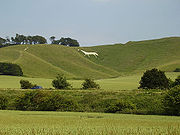
- 5.5 kilometres (3.4 mi) east of central Calne, carved into the south face of Cherhill Down in 1780, situated south of CherhillCherhillCherhill is a village in Wiltshire, England located on the A4 road between Calne and Marlborough and about west of London.- Overview :Cherhill is known for the Cherhill White Horse cut into the chalk hillside in 1780, the Landsdowne obelisk on the Cherhill Downs, and the crop circles that appeared...
village and clearly visible from the A4 Calne - Marlborough road. Cherhill Down rises to 262 metres (860 ft).
- Lansdowne Monument - situated close to the summit of Cherhill Down, the 38 m high (125 ft) stone needle provides views of Calne and the surrounding landscape. The mountains of South Wales and Cleeve HillCleeve HillCleeve Hill is the highest point both in the Cotswolds hill range and in the county of Gloucestershire, at . It commands a clear view to the west, over Cheltenham and the racecourse, over the River Severn and into Wales; and to the north over Winchcombe. It is a conspicuous outcrop on the edge of...
in the western CotswoldsCotswoldsThe Cotswolds are a range of hills in west-central England, sometimes called the Heart of England, an area across and long. The area has been designated as the Cotswold Area of Outstanding Natural Beauty...
can be seen on exceptionally clear days. - Bowood HouseBowood HouseBowood is a grade I listed Georgian country house with interiors by Robert Adam and a garden designed by Lancelot "Capability" Brown. It is adjacent to the village of Derry Hill, halfway between Calne and Chippenham in Wiltshire, England...
(including the 1 km long Bowood Lake) - an English HeritageEnglish HeritageEnglish Heritage . is an executive non-departmental public body of the British Government sponsored by the Department for Culture, Media and Sport...
site, is 5 kilometres (3.1 mi) to the west of Calne, accessible via the village of Derry HillDerry HillDerry Hill is a village in the English county of Wiltshire, belonging to the civil parish of Calne Without.-Geography:Derry Hill is located to the south of the A4 road, east of Chippenham and to the west of Calne...
. - AveburyAveburyAvebury is a Neolithic henge monument containing three stone circles which is located around the village of Avebury in Wiltshire, south west England. Unique amongst megalithic monuments, Avebury contains the largest stone circle in Europe, and is one of the best known prehistoric sites in Britain...
stone circleStone circleA stone circle is a monument of standing stones arranged in a circle. Such monuments have been constructed across the world throughout history for many different reasons....
& Avenue (UNESCOUNESCOThe United Nations Educational, Scientific and Cultural Organization is a specialized agency of the United Nations...
World Heritage Site) - Europe's largest neolithic stone circle site is 12 kilometres (7.5 mi) east of Calne on the A4361 route towards WroughtonWroughtonWroughton is a large village in Wiltshire, England. It is part of the Borough of Swindon and is south of Swindon.-History:The earliest evidence of human presence in the area is from the Mesolithic period, although this is fairly limited...
.
- Silbury HillSilbury HillSilbury Hill is a prehistoric artificial chalk mound near Avebury in the English county of Wiltshire. It is part of the Stonehenge, Avebury and Associated Sites UNESCO World Heritage Site, and lies at ....
, the largest neolithic structure in Europe, is situated 12 kilometres (7.5 mi) east of the town on the A4 route near Beckhampton. - North Wessex Downs AONBNorth Wessex Downs AONBThe North Wessex Downs Area of Outstanding Natural Beauty is located in the English counties of Berkshire, Hampshire, Oxfordshire and Wiltshire...
- the range's highest summit is the Tan HillTan Hill, WiltshireTan Hill is a hill which lies just to the north of the village of Allington in the parish of All Cannings, Wiltshire, England.Its summit is 294 metres above sea level and is the second highest point of the North Wessex Downs AONB hill range and of Wiltshire. It is also the third highest point...
-Milk HillMilk HillMilk Hill, located near Alton Priors east of Devizes, is the highest point in the county of Wiltshire, southwest England, at some 295 m / 968 ft above sea level...
ridge near AllingtonAll CanningsAll Cannings pr Allcannings is a village and civil parish in the Vale of Pewsey in the English county of Wiltshire. The parish includes the nearby smaller settlement of Allington.-History:...
, at 295 m (968 ft) above sea level, 14.5 kilometres (9 mi) southeast of Calne. This area is popular with hill walkers, and several hills over 250 m (820 ft) high are situated adjacent to Calne. - Salisbury PlainSalisbury PlainSalisbury Plain is a chalk plateau in central southern England covering . It is part of the Southern England Chalk Formation and largely lies within the county of Wiltshire, with a little in Hampshire. The plain is famous for its rich archaeology, including Stonehenge, one of England's best known...
- the northernmost point of the plain is 19 kilometres (11.8 mi) to the southeast of Calne, slightly to the southeast of DevizesDevizesDevizes is a market town and civil parish in Wiltshire, England. The town is about southeast of Chippenham and about east of Trowbridge.Devizes serves as a centre for banks, solicitors and shops, with a large open market place where a market is held once a week...
. - A little further afield, StonehengeStonehengeStonehenge is a prehistoric monument located in the English county of Wiltshire, about west of Amesbury and north of Salisbury. One of the most famous sites in the world, Stonehenge is composed of a circular setting of large standing stones set within earthworks...
is located 39 kilometres (24.2 mi) south of the town.
Blackland Lakes is a large camping site on the southern edge of Calne which is popular with anglers and tourists alike. The 'lakes' themselves are in fact large angling pools.
Sports Clubs
Calne Town F.C.Founded in 1886, Calne Town F.C.
Calne Town F.C.
Calne Town F.C. is a football club based in Calne, Wiltshire, England.-Club history:Calne Town FC was established in 1886 and joined the Western Football League Division One in 1986. They earned promotion to the Premier Division with a runner-up effort in 1992–93, but returned to Division One...
play in the Western Football League
Western Football League
The Western Football League is a football league in the south west of England, covering Bristol, Cornwall, Devon, Somerset, western Dorset, parts of Gloucestershire and Wiltshire and parts of South Wales...
Premier Division and finished in 5th position (of 20 teams) in the league table at the end of the 2005-2006 season. Their Bremhill View ground is located on the north side of the town close to the A3102 bypass.
Calne R.F.C.
According to the club website http://www.calnerfc.co.uk/history.htm the rugby club is rumoured to have been formed in the late 1920s, in part due to the influx of Welsh to the area during the depression. The Junior Imperial League, forerunners of the Young Conservatives formed the club under the presidency of either Mr Drewett or Mr L. Taylor.
The team's first match was probably in Drewett’s field where now stands Braemor Road. Their inaugural game against a Bath XV team was played on the Recreation Ground to which Calne returned in the late 1970s as a permanent home, which despite ground disputes and uncertainty - remains their home to date.
It appears that a lack of local interest forced the club to fold in the late 1930s however, in 1960 the club was re-formed as “Old Bentlians”, though it was not exclusively an “old boys” club it did use the pitches at Bentley Grammar School.
The club currently fields a 1st and 2nd XV, alternating home games on Saturday's, and also a junior team who play on Sunday's.
Founded at the beginning of 2008, Calne Divers was formed by a group of local divers to provide training to local people. The club is a member of the Sub-Aqua Association
Sub-Aqua Association
The Sub-Aqua Association or SAA is a diver training organization for scubadivers in the United Kingdom. The association and some other UK-based diving groups have traditionally used a club-based system with unpaid instructors, while the other principal training agency, PADI, organises most of its...
and offer try-dives to all that are interested. Training is available up to Dive Supervisor level, and all training fees are included in the club membership. The group is partly funded by the National Lottery
National Lottery (United Kingdom)
The National Lottery is the state-franchised national lottery in the United Kingdom and the Isle of Man.It is operated by Camelot Group, to whom the licence was granted in 1994, 2001 and again in 2007. The lottery is regulated by the National Lottery Commission, and was established by the then...
.
In 2007 Calne divers found the lost village of Mannings Hill at the bottom of the lake at Bowood.
Twin towns
Calne is twinned with the towns of :- CharlieuCharlieuCharlieu is a commune in the Loire department at the northern end of the Rhône-Alpes region of France. It is home to Charlieu Abbey.-External links:* *...
in France - EningenEningenEningen is a municipality in the district of Reutlingen, Baden-Württemberg, Germany. It is situated at the foot of the Swabian Alps and near the big cities of Reutlingen and Stuttgart. Although it has a considerable population with around 10,800 inhabitants, its structure is considered to be more...
in Germany - Caln TownshipCaln Township, PennsylvaniaCaln Township is a township in Chester County, Pennsylvania, United States. The population was 13,817 at the 2010 census. The township was founded by settlers from Calne, Wiltshire in England in 1714. The relationship with Calne, Wiltshire, continues today as the two towns are sister cities. Caln...
in PennsylvaniaPennsylvaniaThe Commonwealth of Pennsylvania is a U.S. state that is located in the Northeastern and Mid-Atlantic regions of the United States. The state borders Delaware and Maryland to the south, West Virginia to the southwest, Ohio to the west, New York and Ontario, Canada, to the north, and New Jersey to...
, USA, was so named because it was established by people from Calne in the early eighteenth century.
Nearest towns & cities (centre to centre)
- LynehamLyneham-Village:* Lyneham, Wiltshire is a village located in Wiltshire* RAF Lyneham is a Royal Air Force based in Wiltshire, England-Suburb:* Lyneham, Australian Capital Territory is a suburb of Canberra, Australia...
(9.5 km / 6 miles) - ChippenhamChippenhamChippenham may be:* Chippenham, Wiltshire* Chippenham * Chippenham, Cambridgeshire-See also:* Virginia State Route 150, also known as Chippenham Parkway, USA* Cippenham, Berkshire, UK...
(10 km / 6 miles) - DevizesDevizesDevizes is a market town and civil parish in Wiltshire, England. The town is about southeast of Chippenham and about east of Trowbridge.Devizes serves as a centre for banks, solicitors and shops, with a large open market place where a market is held once a week...
(13 km / 8 miles) - MelkshamMelkshamMelksham is a medium-sized English town, lying on the River Avon. It lies in the county of Wiltshire.It is situated southeast of the city of Bath, south of Chippenham, west of Devizes and north of Warminster on the A350 national route. The 2001 UK census cited Melksham as having 20,000...
(14 km / 9 miles) - Royal Wootton Bassett (16 km / 10 miles)
- CorshamCorshamCorsham is a historic market town and civil parish in north west Wiltshire, England. It is at the south western extreme of the Cotswolds, just off the A4 which was formerly the main turnpike road from London to Bristol, between Bath and Chippenham ....
(17 km / 10.5 miles) - Marlborough (21 km / 13 miles)
- TrowbridgeTrowbridgeTrowbridge is the county town of Wiltshire, England, situated on the River Biss in the west of the county, approximately 12 miles southeast of Bath, Somerset....
(24 km / 15 miles) - SwindonSwindonSwindon is a large town within the borough of Swindon and ceremonial county of Wiltshire, in South West England. It is midway between Bristol, west and Reading, east. London is east...
(27 km / 17 miles) - Bath (30 km / 19 miles)
- BristolBristolBristol is a city, unitary authority area and ceremonial county in South West England, with an estimated population of 433,100 for the unitary authority in 2009, and a surrounding Larger Urban Zone with an estimated 1,070,000 residents in 2007...
(47 km / 29 miles) - SalisburySalisburySalisbury is a cathedral city in Wiltshire, England and the only city in the county. It is the second largest settlement in the county...
(55 km / 34 miles) - Welsh border at Chepstow (63 km / 39 miles)