

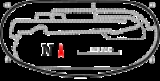
California Speedway

Encyclopedia
Auto Club Speedway is a two-mile (3 km), low-banked, D-shaped oval superspeedway in Fontana, California
which has hosted NASCAR
racing annually since 1997. The track was also used for open wheel racing events until 2005. The racetrack is located near the former locations of Ontario Motor Speedway
and Riverside International Raceway
. The track is currently owned and operated by International Speedway Corporation
and is the only track owned by ISC to have naming rights sold. The speedway is served by the nearby Interstate 10
and Interstate 15
freeways as well as a Metrolink
station located behind the backstretch.
Construction of the track, on the site of the former Kaiser Steel Mill, began in 1995 and was completed in late 1996. The speedway has a grandstand capacity of 91,200 and 28 skyboxes. In 2006, a fanzone was added behind the main grandstand. Lights were added to the speedway in 2004 with the addition of a second annual NASCAR weekend. In 2011 the track hosted only one NASCAR weekend.
and Kaiser
announced the construction of a racetrack on the site of the abandoned Kaiser Steel mill
in Fontana, CA. A day after the announcement CART
announced it would hold an annual race at the speedway. Three months later NASCAR
President Bill France, Jr.
agreed to sanction Winston Cup Series races at the speedway upon completion, marking the first time NASCAR has made a commitment to run a race at a track that had yet to be built. Community meetings were held to discuss issues related to the construction of the track and the local effects of events held. The local community largely supported construction of the speedway citing potentially increased land values and rejuvenation of the community. In April 1995, after having toured the sister track Michigan International Speedway, the San Bernardino County Board of Supervisors unanimously approved the project. The California Environmental Protection Agency
gave Penske permission to begin construction after Kaiser agreed to pay $6 million to remove hazardous waste from the site. Construction on the site began on November 22, 1995 with the demolition of the Kaiser Steel Mill. The 100-foot water tower, a landmark of the Kaiser property, was preserved in the center of the track to be used as a scoreboard. 3000 cubic yards (2,293.7 m³) of contaminated dirt was removed and transported to a toxic waste landfill. To prevent remaining impurities from rising to the surface, a cap of non-porous polyethylene
was put down and covered with 2 foot (0.6096 m) of clean soil. Construction of the track was completed in late 1996.
On January 10, 1997 Marlboro Team Penske’s driver Paul Tracy
became the first driver to test on the new speedway. NASCAR held its first open test session on at the track from May 5–7. The official opening and ribbon cutting ceremony was held on June 20, 1997 with the first race, a NASCAR West Series race, being held the next day.
, when the track returned to a single annual race weekend.
In 2006 the speedway's midway, located behind the main grandstand, was overhauled. The new midway, called Discover IE FanZone, includes the addition of Apex (a Wolfgang Puck
restaurant), additional shade and lounge areas, a new retail store and an entertainment stage.
, the nation's second-largest media market. Weather had also become a concern with either extremely hot days or with rain threatening the races. All of this factored into NASCAR's decision to strip the track of one race with the realignment of the 2011 NASCAR schedule. Former track owner Roger Penske
said the track may be located in a one-race market. Track president Gillian Zucker cited bad weather windows and fans having other entertainment options as reasons for the attendance decline.
became the title sponsor of the raceway, renaming the official name Auto Club Speedway. The naming rights
deal will last for ten years and is worth an estimated $50 to $75 million. In addition to naming rights, the ACSC will also have use of the facility for road tests for Westways Magazine and other consumer tests. The money will be used for capital improvements.
were filmed at the speedway, and in 2004, portions of Herbie: Fully Loaded
were filmed there. In 2007, The Bucket List
saw Jack Nicholson
and Morgan Freeman
drive a vintage Shelby Mustang and Dodge Challenger around the 2 miles (3.2 km) speedway.
CART race, Canadian driver Greg Moore
was killed in a crash along the backstretch of the track. It was determined that after sliding along the infield grass, Moore's car hit the edge of oncoming pavement, which caused the car to flip into a concrete retaining wall. The incident prompted the track owners, ISC, to pave the backstretch of both Auto Club Speedway and its sister track Michigan International Speedway
in an attempt to prevent a similar accident. Shortly after the crash, CART mandated the use of a head-and-neck restraint system on all ovals. The rule eventually became mandatory on all tracks.
On October 15, 2010, a 24 year old woman was killed while participating in a driving school at the track. The woman was driving a replica Indycar
as part of the Mario Andretti Racing Experience when she lost control and hit the inside wall of the track.
set the track record for fastest lap at 241.426 mi/h. This is considered by some as the world speed record for fastest lap on a closed course, however, some debate whether or not it was an official record as recognized by the FIA. The 2003 Indycar race was the fastest circuit race ever in motorsport history, with an average speed of 207.151 mph(333.306 km/h) over 400 miles (643.7 km).
Fontana, California
Fontana is a city of 196,069 residents in San Bernardino County, California. Founded in 1913, it remained essentially rural until World War II, when entrepreneur Henry J. Kaiser built a large steel mill in the area...
which has hosted NASCAR
NASCAR
The National Association for Stock Car Auto Racing is a family-owned and -operated business venture that sanctions and governs multiple auto racing sports events. It was founded by Bill France Sr. in 1947–48. As of 2009, the CEO for the company is Brian France, grandson of the late Bill France Sr...
racing annually since 1997. The track was also used for open wheel racing events until 2005. The racetrack is located near the former locations of Ontario Motor Speedway
Ontario Motor Speedway
The Ontario Motor Speedway, located in Ontario, California, east of Los Angeles, was the first and only automobile racing facility built to accommodate major races sanctioned by all of the four dominant racing sanctioning bodies: IndyCar Series and USAC for open-wheel oval car races; NASCAR for a ...
and Riverside International Raceway
Riverside International Raceway
Riverside International Raceway was a race track or road course in Riverside, California. The track was in operation from September 22, 1957, to July 2, 1989...
. The track is currently owned and operated by International Speedway Corporation
International Speedway Corporation
International Speedway Corporation is a corporation whose primary business is the ownership and management of NASCAR race tracks. ISC was founded by NASCAR founder Bill France, Sr. in 1953 for the construction of Daytona International Speedway and in 1999 they merged with Penske Motorsports to...
and is the only track owned by ISC to have naming rights sold. The speedway is served by the nearby Interstate 10
Interstate 10
Interstate 10 is the fourth-longest Interstate Highway in the United States, after I-90, I-80, and I-40. It is the southernmost east–west, coast-to-coast Interstate Highway, although I-4 and I-8 are further south. It stretches from the Pacific Ocean at State Route 1 in Santa Monica,...
and Interstate 15
Interstate 15
Interstate 15 is the fourth-longest north–south Interstate Highway in the United States, traveling through the states of California, Nevada, Arizona, Utah, Idaho, and Montana from San Diego to the Canadian border...
freeways as well as a Metrolink
Metrolink (Southern California)
Metrolink is a commuter rail system serving Los Angeles and the surrounding area of Southern California; it currently consists of six lines and 55 stations using of track....
station located behind the backstretch.
Construction of the track, on the site of the former Kaiser Steel Mill, began in 1995 and was completed in late 1996. The speedway has a grandstand capacity of 91,200 and 28 skyboxes. In 2006, a fanzone was added behind the main grandstand. Lights were added to the speedway in 2004 with the addition of a second annual NASCAR weekend. In 2011 the track hosted only one NASCAR weekend.
Early history and construction
On April 20, 1994, Roger PenskeRoger Penske
Roger S. Penske is the owner of the automobile racing team Penske Racing, the Penske Corporation, and other automotive related businesses. A winning racer in the late 1950s, Penske was named 1961's Sports Car Club of America Driver of the Year by Sports Illustrated...
and Kaiser
Kaiser Steel
Kaiser Ventures is an American corporation, headquartered in Ontario, California. It was founded by Henry J. Kaiser to provide steel plate for the Pacific Coast shipbuilding industry, which expanded during World War II, then shrank, then expanded again during the Korean War...
announced the construction of a racetrack on the site of the abandoned Kaiser Steel mill
Kaiser Steel
Kaiser Ventures is an American corporation, headquartered in Ontario, California. It was founded by Henry J. Kaiser to provide steel plate for the Pacific Coast shipbuilding industry, which expanded during World War II, then shrank, then expanded again during the Korean War...
in Fontana, CA. A day after the announcement CART
Champ Car
Champ Car was the name for a class and specification of open wheel cars used in American Championship Car Racing for many decades, primarily for use in the Indianapolis 500 auto race...
announced it would hold an annual race at the speedway. Three months later NASCAR
NASCAR
The National Association for Stock Car Auto Racing is a family-owned and -operated business venture that sanctions and governs multiple auto racing sports events. It was founded by Bill France Sr. in 1947–48. As of 2009, the CEO for the company is Brian France, grandson of the late Bill France Sr...
President Bill France, Jr.
Bill France, Jr.
William Clifton France , nicknamed "Bill Jr." and "Little Bill," was an American motorsports executive who served from 1972 to 2000 as the head of NASCAR, the sanctioning body of United States-based stock car racing. He succeeded the founder of NASCAR, his father Bill France, Sr., as its head...
agreed to sanction Winston Cup Series races at the speedway upon completion, marking the first time NASCAR has made a commitment to run a race at a track that had yet to be built. Community meetings were held to discuss issues related to the construction of the track and the local effects of events held. The local community largely supported construction of the speedway citing potentially increased land values and rejuvenation of the community. In April 1995, after having toured the sister track Michigan International Speedway, the San Bernardino County Board of Supervisors unanimously approved the project. The California Environmental Protection Agency
California Environmental Protection Agency
The California Environmental Protection Agency is a state cabinet-level agency within the government of California. Cal/EPA is composed of six departments, boards and offices responsible for environmental research, regulating and administering the state's environmental protection programs, and...
gave Penske permission to begin construction after Kaiser agreed to pay $6 million to remove hazardous waste from the site. Construction on the site began on November 22, 1995 with the demolition of the Kaiser Steel Mill. The 100-foot water tower, a landmark of the Kaiser property, was preserved in the center of the track to be used as a scoreboard. 3000 cubic yards (2,293.7 m³) of contaminated dirt was removed and transported to a toxic waste landfill. To prevent remaining impurities from rising to the surface, a cap of non-porous polyethylene
Polyethylene
Polyethylene or polythene is the most widely used plastic, with an annual production of approximately 80 million metric tons...
was put down and covered with 2 foot (0.6096 m) of clean soil. Construction of the track was completed in late 1996.
On January 10, 1997 Marlboro Team Penske’s driver Paul Tracy
Paul Tracy
Paul Tracy is a professional automobile racer who has competed in CART, the ChampCar World Series and the IndyCar Series...
became the first driver to test on the new speedway. NASCAR held its first open test session on at the track from May 5–7. The official opening and ribbon cutting ceremony was held on June 20, 1997 with the first race, a NASCAR West Series race, being held the next day.
Expansion and additions
With early success following the opening of the track, the speedway began to expand reserved grandstand seating along the front stretch with an additional 15,777 seats. In May 1999 an additional 28 skyboxes were added to the top of the main grandstand. In 2001 the Auto Club Dragway, a 1/4 mile dragstrip, was built outside of the backstretch of the main speedway. That same year, the infield of the speedway was reconfigured to hold a multipurpose road course. On April 24, 2003 The San Bernardino County Planning Commission approved the changing of the speedway’s conditional use permit to allow the installation of lights around the track. Later that year NASCAR announced a second annual Sprint Cup Series race at the track for the 2004 season, with the second race being run “under the lights”. NASCAR ran two weekends of racing annually until the 2011 season2011 in NASCAR
The following NASCAR national series are scheduled to be held in 2011:*2011 NASCAR Sprint Cup Series – The top racing series in NASCAR*2011 NASCAR Nationwide Series – The second-highest racing series in NASCAR...
, when the track returned to a single annual race weekend.
In 2006 the speedway's midway, located behind the main grandstand, was overhauled. The new midway, called Discover IE FanZone, includes the addition of Apex (a Wolfgang Puck
Wolfgang Puck
Wolfgang Johannes Puck is an Austrian-American celebrity chef, restaurateur, businessman and occasional actor. Wolfgang Puck restaurants, catering services, cookbooks and licensed products are run by Wolfgang Puck Companies, with three divisions...
restaurant), additional shade and lounge areas, a new retail store and an entertainment stage.
Attendance problems
Upon the addition of a second NASCAR weekend at the track in 2004, attendance at the races dropped off dramatically, by as much as 20,000. With such a large attendance swing, drivers and media began to doubt if the track deserved two dates, even if the track was near Los AngelesLos Ángeles
Los Ángeles is the capital of the province of Biobío, in the commune of the same name, in Region VIII , in the center-south of Chile. It is located between the Laja and Biobío rivers. The population is 123,445 inhabitants...
, the nation's second-largest media market. Weather had also become a concern with either extremely hot days or with rain threatening the races. All of this factored into NASCAR's decision to strip the track of one race with the realignment of the 2011 NASCAR schedule. Former track owner Roger Penske
Roger Penske
Roger S. Penske is the owner of the automobile racing team Penske Racing, the Penske Corporation, and other automotive related businesses. A winning racer in the late 1950s, Penske was named 1961's Sports Car Club of America Driver of the Year by Sports Illustrated...
said the track may be located in a one-race market. Track president Gillian Zucker cited bad weather windows and fans having other entertainment options as reasons for the attendance decline.
Name change
On February 21, 2008, the Automobile Club of Southern CaliforniaAutomobile Club of Southern California
The Automobile Club of Southern California is the Southern California affiliate of the American Automobile Association federation of motor clubs...
became the title sponsor of the raceway, renaming the official name Auto Club Speedway. The naming rights
Naming rights
In the private sector, naming rights are a financial transaction whereby a corporation or other entity purchases the right to name a facility, typically for a defined period of time. For properties like a multi-purpose arena, performing arts venue or an athletic field, the term ranges from three...
deal will last for ten years and is worth an estimated $50 to $75 million. In addition to naming rights, the ACSC will also have use of the facility for road tests for Westways Magazine and other consumer tests. The money will be used for capital improvements.
In pop culture
The facility is often used for filming television shows, commercials, and films. In 2000, portions of Charlie's AngelsCharlie's Angels (film)
Charlie's Angels is a 2000 American action comedy film directed by McG, starring Cameron Diaz, Drew Barrymore, and Lucy Liu as three women working for a private investigation agency...
were filmed at the speedway, and in 2004, portions of Herbie: Fully Loaded
Herbie: Fully Loaded
Herbie: Fully Loaded is a 2005 American comedy film directed by Angela Robinson and produced by Robert Simonds for Walt Disney Pictures. It stars Lindsay Lohan as the youngest member of an automobile-racing family, Michael Keaton as her father, Matt Dillon as a competing racer, Breckin Meyer as...
were filmed there. In 2007, The Bucket List
The Bucket List
The Bucket List is a 2007 comedy-drama film directed by Rob Reiner, written by Justin Zackham, and starring Academy Award-winners Jack Nicholson and Morgan Freeman...
saw Jack Nicholson
Jack Nicholson
John Joseph "Jack" Nicholson is an American actor, film director, producer and writer. He is renowned for his often dark portrayals of neurotic characters. Nicholson has been nominated for an Academy Award twelve times, and has won the Academy Award for Best Actor twice: for One Flew Over the...
and Morgan Freeman
Morgan Freeman
Morgan Freeman is an American actor, film director, aviator and narrator. He is noted for his reserved demeanor and authoritative speaking voice. Freeman has received Academy Award nominations for his performances in Street Smart, Driving Miss Daisy, The Shawshank Redemption and Invictus and won...
drive a vintage Shelby Mustang and Dodge Challenger around the 2 miles (3.2 km) speedway.
Fatalities
During the 1999 Marlboro 5001999 Marlboro 500
The 1999 Marlboro 500 Presented by Toyota was held on October 31, 1999, at Auto Club Speedway in Fontana, California and it was the final race of the 1999 CART World Series season but mostly remembered of the fatal accident of Greg Moore. Scott Pruett won the pole of the event with the time of...
CART race, Canadian driver Greg Moore
Greg Moore (race car driver)
Greg Moore was a racecar driver who competed in the Indy Lights and CART World Series, where he had great success with several wins in both series and a championship in the 1995 Indy Lights series...
was killed in a crash along the backstretch of the track. It was determined that after sliding along the infield grass, Moore's car hit the edge of oncoming pavement, which caused the car to flip into a concrete retaining wall. The incident prompted the track owners, ISC, to pave the backstretch of both Auto Club Speedway and its sister track Michigan International Speedway
Michigan International Speedway
Michigan International Speedway is a two-mile moderate-banked D-shaped superspeedway located off U.S. Highway 12 on more than in Brooklyn, in the scenic Irish Hills area of southeastern Michigan. The track is used primarily for NASCAR events. It is sometimes known as a "sister track" to Texas...
in an attempt to prevent a similar accident. Shortly after the crash, CART mandated the use of a head-and-neck restraint system on all ovals. The rule eventually became mandatory on all tracks.
On October 15, 2010, a 24 year old woman was killed while participating in a driving school at the track. The woman was driving a replica Indycar
IndyCar
IndyCar is the trade name of an American-based open-wheel auto racing sanctioning body. IndyCar sanctions three racing series, the premier IZOD IndyCar Series with its centerpiece Indianapolis 500, and developmental series Firestone Indy Lights and the U.S...
as part of the Mario Andretti Racing Experience when she lost control and hit the inside wall of the track.
Current races
- NASCAR Sprint Cup Series:
- Auto Club 400
- NASCAR Nationwide Series:
- Royal Purple 300
- Shell Eco-marathonEco-marathonThe Eco-Marathon is an annual competition sponsored by Shell, in which participants build special vehicles to achieve the highest possible fuel efficiency. The Eco-Marathon is held around the world with events in Finland, France, Germany, The Netherlands, Japan, and the USA...
Americas - IZOD IndyCar Series
- Race TBA in 2012Toyota Indy 400The Toyota Indy 400 was an Indy Racing League IndyCar Series, USAC, and CART Champ Car race held from 1970 until 1980, and again from 1997 until 2005 at the California Speedway in Fontana, California. The race will be revived in 2012....
(had been run from 2002-05, will return in 2012)
- Race TBA in 2012
Former races
- NASCARNASCARThe National Association for Stock Car Auto Racing is a family-owned and -operated business venture that sanctions and governs multiple auto racing sports events. It was founded by Bill France Sr. in 1947–48. As of 2009, the CEO for the company is Brian France, grandson of the late Bill France Sr...
Sprint Cup Series: Pepsi Max 400 (2004–2010) - NASCARNASCARThe National Association for Stock Car Auto Racing is a family-owned and -operated business venture that sanctions and governs multiple auto racing sports events. It was founded by Bill France Sr. in 1947–48. As of 2009, the CEO for the company is Brian France, grandson of the late Bill France Sr...
Nationwide Series: CampingWorld.com 300 (2004–2010) - NASCAR Camping World Truck Series: San Bernardino County 200 (1997–2009)
- NASCAR West Series (1997–2006)
- CARTChamp CarChamp Car was the name for a class and specification of open wheel cars used in American Championship Car Racing for many decades, primarily for use in the Indianapolis 500 auto race...
: Marlboro 500 (1997–2002) - Rolex Sports Car SeriesRolex Sports Car SeriesThe Rolex Sports Car Series is the premier series run by the Grand American Road Racing Association. It is a North American-based sports car series that was founded in 2000 under the name Grand American Road Racing Championship to replace the failed United States Road Racing Championship...
: Grand American 400 (Sports Car Course) (2002–2005) - IROC (1997, 1998, 2002)
Other events
- Red, White & Cruise — A 4th of JulyIndependence Day (United States)Independence Day, commonly known as the Fourth of July, is a federal holiday in the United States commemorating the adoption of the Declaration of Independence on July 4, 1776, declaring independence from the Kingdom of Great Britain...
festival consisting of a car show, various family-friendly entertainment and a fireworks show. - Epicenter 2010Epicenter (music festival)Epicenter is an annual music festival in Southern California presented by Right Arm Entertainment and features acts on multiple stages.-External links:** at MySpace* at Twitter*...
at the speedway's midway
Track records
On October 28, 2000, during CART qualifying, Gil de FerranGil de Ferran
Gil de Ferran , is a professional racing driver and team owner. De Ferran was the 2000 and 2001 Champ Car champion driving for the Penske Honda Team and the winner of the 2003 Indianapolis 500.Inspired by the success of fellow Brazilian Emerson Fittipaldi, de Ferran began his career in kart racing...
set the track record for fastest lap at 241.426 mi/h. This is considered by some as the world speed record for fastest lap on a closed course, however, some debate whether or not it was an official record as recognized by the FIA. The 2003 Indycar race was the fastest circuit race ever in motorsport history, with an average speed of 207.151 mph(333.306 km/h) over 400 miles (643.7 km).
| Record | Year | Date | Driver | Time | Speed/Avg. Speed | |
|---|---|---|---|---|---|---|
| NASCAR Sprint Cup Series | ||||||
| Qualifying (one lap) | 2005 | February 26 | Kyle Busch Kyle Busch Kyle Thomas Busch, is an American NASCAR driver and team owner. He currently drives the No. 18 Mars/Interstate Batteries Toyota Camry for Joe Gibbs Racing in the Sprint Cup Series, the No. 18 Z-Line Designs/NOS Energy Drink Toyota Camry for Joe Gibbs in the Nationwide Series, and the No... |
38.248 | 188.245 mi/h | |
| Race (500 miles) | 1997 | June 27 | Jeff Gordon Jeff Gordon Jeffery Michael "Jeff" Gordon is a professional NASCAR driver. He is the driver of the #24 Drive to End Hunger/DuPont/Pepsi Chevrolet Impala. He is a four-time Sprint Cup Series champion and a three-time Daytona 500 winner. He is third on the all-time wins list, with 85 career wins, and has the... |
3:13:32 | 155.012 mi/h | |
| Race (400 miles) | 2011 | March 27 | Kevin Harvick Kevin Harvick Kevin Michael Harvick is an American stock car auto racing race car driver and car owner currently competing in the NASCAR Sprint Cup Series for Richard Childress Racing, driving the No. 29 Budweiser/Jimmy John's/Rheem/Okuma/Realtree Outdoors/Bad Boy Buggies Chevrolet Impala... |
2:39:06 | 150.849 mi/h | |
| NASCAR Nationwide Series | ||||||
| Qualifying (one lap) | 2005 | September 3 | Tony Stewart Tony Stewart Anthony Wayne "Tony" Stewart is an American auto racing driver and owner. Throughout his racing career, Stewart has won titles in Indy cars and stock cars as well as midget, sprint and USAC Silver Crown cars, giving him the recognition of "one of the finest racers of his generation."Stewart... |
38.722 | 185.941 mi/h | |
| Race (300 miles) | 2001 | April 28 | Hank Parker, Jr. | 1:55:25 | 155.957 mi/h | |
| NASCAR Camping World Truck Series | ||||||
| Qualifying (one lap) | 2006 | February 24 | David Reutimann David Reutimann Emil David Reutimann is the driver the #00 Aaron's Dream Machine/Tums/Best Western Toyota Camry for Michael Waltrip Racing in the NASCAR Sprint Cup Series... |
40.228 | 178.98 mi/h | |
| Race (200 miles) | 2003 | September 20 | Ted Musgrave Ted Musgrave Theodore Musgrave is an American race car driver.-Pre-NASCAR:Musgrave's father, Elmer, was a famous short-track racer in the Midwest who raced for over 25 years at Soldier Field, O'Hare, Waukegan, and Wilmot, Wisconsin before moving into asphalt late models in the American Speed Association and... |
1:22:14 | 145.926 mi/h | |
| NASCAR West Series | ||||||
| Qualifying (one lap) | 2001 | April 28 | Mark Reed | 39.649 | 181.593 mi/h | |
| Race (200 miles) | 2001 | April 28 | Brendan Gaughan Brendan Gaughan Brendan Gaughan is an American stock car driver. Gaughan is the grandson of Vegas gaming pioneer Jackie Gaughan and son of Michael Gaughan, a hotel and casino magnate. Gaughan currently drives the #62 South Point Hotel & Casino Toyota Tundra for Germain Racing in the NASCAR Camping World Truck... |
1:28:47 | 152.316 mi/h | |
| CART | ||||||
| Qualifying (one lap) | 2000 | October 28 | Gil de Ferran Gil de Ferran Gil de Ferran , is a professional racing driver and team owner. De Ferran was the 2000 and 2001 Champ Car champion driving for the Penske Honda Team and the winner of the 2003 Indianapolis 500.Inspired by the success of fellow Brazilian Emerson Fittipaldi, de Ferran began his career in kart racing... |
241.426 mi/h | ||
| Race (500 miles) | 2002 | November 3 | Jimmy Vasser Jimmy Vasser Jimmy Vasser is a retired American racing driver and current co-owner of KV Racing Technology. Vasser won the 1996 IndyCar season championship with Chip Ganassi Racing, and scored ten victories in the series... |
2:33:42 | 197.995 mi/h | |
| IndyCar Series | ||||||
| Qualifying (one lap) | 2003 | September 20 | Helio Castroneves Hélio Castroneves Hélio Castroneves is a Brazilian auto racing driver currently competing in the North American IndyCar Series. In IndyCar competition, Castroneves has 14 wins and 28 poles, and has never placed lower than sixth in the standings in a complete season of racing... |
31.752 | 226.757 mi/h | |
| Race (400 miles) | 2003 | September 21 | Sam Hornish, Jr. Sam Hornish, Jr. Racing League]] championships. He currently drives the #12 Alliance Truck Parts Dodge Challenger for Penske Racing part-time in the NASCAR Nationwide Series. He also drives the #38 Front Row Motorsports Ford when Travis Kvapil is unable to drive the car.... |
1:55:51 | 207.151 mi/h | |
External links
- Auto Club Speedway Official Site
- Auto Club Speedway Page on NASCAR.com
- GNEXTINC.com: Auto Club Speedway Page – Local area information, track specs, mapping, news and more.
- Jayski's Auto Club Speedway Page – Current and Past California Speedway News
- Trackpedia guide to driving this track
- Auto Club Speedway Page on Ballparks by Munsey & Suppes
- Super High Resolution image from Windows Live Local