
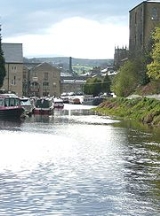
The
Calder and Hebble Navigation is a Broad (i.e. with 14 feet (4.3 m) locks and bridgeholes) inland
waterwayA waterway is any navigable body of water. Waterways can include rivers, lakes, seas, oceans, and canals. In order for a waterway to be navigable, it must meet several criteria:...
in
West YorkshireWest Yorkshire is a metropolitan county within the Yorkshire and the Humber region of England with a population of 2.2 million. West Yorkshire came into existence as a metropolitan county in 1974 after the passage of the Local Government Act 1972....
, England, which has remained navigable since it was opened.
History
By the beginning of the 18th century, the
Aire and Calder NavigationThe Aire and Calder Navigation is a river and canal system of the River Aire and the River Calder in the metropolitan county of West Yorkshire, England. The first improvements to the rivers above Knottingley were completed in 1704 when the Aire was made navigable to Leeds and the Calder to...
had made the
River CalderThe River Calder is a river in West Yorkshire, in Northern England.The Calder rises on the green eastern slopes of the Pennines flows through alternating green countryside, former woollen-mill villages, and large and small towns before joining the River Aire near Castleford.The river's valley is...
navigable as far upstream as
WakefieldWakefield is the main settlement and administrative centre of the City of Wakefield, a metropolitan district of West Yorkshire, England. Located by the River Calder on the eastern edge of the Pennines, the urban area is and had a population of 76,886 in 2001....
. The aim of the Calder and Hebble Navigation was to extend navigation west (upstream) from Wakefield to
Sowerby BridgeSowerby Bridge is a market town that lies within the Upper Calder Valley in the district of Calderdale in the county of West Yorkshire, in northern England.-Geography:Sowerby Bridge is situated on the edge of Halifax, about three miles from its centre...
near
HalifaxHalifax is a minster town, within the Metropolitan Borough of Calderdale in West Yorkshire, England. It has an urban area population of 82,056 in the 2001 Census. It is well-known as a centre of England's woollen manufacture from the 15th century onward, originally dealing through the Halifax Piece...
.
The first attempt to obtain an
Act of ParliamentAn Act of Parliament is a statute enacted as primary legislation by a national or sub-national parliament. In the Republic of Ireland the term Act of the Oireachtas is used, and in the United States the term Act of Congress is used.In Commonwealth countries, the term is used both in a narrow...
was made in 1740, as a result of a petition by the people of Halifax, Ripponden and Elland. John Eyes of Liverpool surveyed the route, and presented a scheme for a navigation which would use the River Calder from Wakefield to its junction with the
River HebbleHebble Brook is the body of water passing from Ogden Reservoir south, at Ogden, Halifax. The reservoir itself is sourced from water draining off Skirden Edge, through Skirden Clough, to the west and from the north the reservoir takes in water from Deep Gulf and Spa Flat, above the now disused Fly...
, follow the Hebble to Salterhebble bridge, and then follow the Halifax Brook to reach Halifax. It included the construction of 24 locks, 21 on the Calder and three on the Hebble, and nearly 10 miles (16.1 km) of cuts, including one of 2 miles (3.2 km) at
Horbury-Demography:In 2008 Horbury had a largely white population compared with Yorkshire and the Humber.-Population change:The population of Horbury in 2001 was 10,002-Transport:...
. The bill was defeated, due to opposition from local landowners who feared that it would cause flooding, from millers, who thought that navigation would disrupt their water supply, and from the promoters of several
Turnpike BillsTurnpike trusts in the United Kingdom were bodies set up by individual Acts of Parliament, with powers to collect road tolls for maintaining the principal highways in Britain from the 17th but especially during the 18th and 19th centuries...
, who were intending to build roads which would follow a similar route.
The second attempt followed a meeting of the Union Club in Halifax on 2 September 1756, which considered how to improve the import of wool and corn to the town. They invited the
civil engineerA civil engineer is a person who practices civil engineering; the application of planning, designing, constructing, maintaining, and operating infrastructures while protecting the public and environmental health, as well as improving existing infrastructures that have been neglected.Originally, a...
John SmeatonJohn Smeaton, FRS, was an English civil engineer responsible for the design of bridges, canals, harbours and lighthouses. He was also a capable mechanical engineer and an eminent physicist...
to make a new survey, which he did in late 1757, and produced a scheme which involved dredging shoals, making 5.7 miles (9.2 km) of cuts, the building of 26 locks, to overcome the rise of 178 feet (54.3 m) between Wakefield and the Halifax Brook, and the construction of a reservoir at Salterhebble bridge. A committee raising subscriptions for the project in Rochdale insisted that the plans should be amended to include an extension to Sowerby Bridge, despite opposition from the Halifax committee. An Act was obtained on 9 June 1758, for this extended route, and created Commissioners, who must own an estate valued at more than £100, or have a personal fortune of more than £3,000. Any nine of the Commissioners could make decisions.
Construction
Construction started in November 1759, with Smeaton acting as engineer. By November 1764, the navigation was open as far as
BrighouseBrighouse is a town within the Metropolitan Borough of Calderdale, in West Yorkshire, England. It is situated on the River Calder, east of Halifax in the Pennines. It is served by Junction 25 of the M62 motorway and Brighouse railway station on the Caldervale Line and Huddersfield Line. In the...
, some 16 miles (25.7 km) from Wakefield. Having borrowed £56,000, factions arose within the Commissioners, with some wanting to stop at Brooksmouth, where the Rivers Hebble and Calder meet, and others wanting to raise more money and complete the scheme. The second option gained most support, and a new committee was set up, who asked
James BrindleyJames Brindley was an English engineer. He was born in Tunstead, Derbyshire, and lived much of his life in Leek, Staffordshire, becoming one of the most notable engineers of the 18th century.-Early life:...
to take over from Smeaton in 1765. The work was nearly completed by 1767, but serious floods in October caused some damage, with further damage caused by more floods in February 1768. Brindley appears to have left by mid-1766, and the Commissioners re-appointed Smeaton in 1768, to complete the work. Banks were repaired and floodgates built at the start of some of the cuts. The work was just complete when a further flood caused so much damage that the only option was to close the navigation again.
By this time, £64,000 had been spent on the scheme, of which £8,100 had come from tolls and the rest had been borrowed. The Commissioners felt unable to borrow more money, and so a second Act of Parliament was obtained on 21 April 1769, which formally created the Company of Proprietors of the Calder and Hebble Navigation. This consisted of all of the 81 people who had loaned money to the original scheme, and these loans were converted into £100 shares. Additional shares could be issued, and the Company could borrow up to £20,000, with the future tolls used as security. Before the Act, the scheme had been known as the Calder Navigation or Upper Calder Navigation, and this was the first use of the Calder and Hebble title. The Act was the first navigation act to include a clause which limited dividends, insisting that tolls should be reduced if the dividend exceeded ten per cent. Construction of the initial phase was finished in 1770, at a total cost of around £75,000.
There were initial problems with the water supply to the Sowerby Bridge pound, which Smeaton was asked to address. He suggested a tunnel from Hollins Mill, similar to those used for draining collieries. Construction began in June 1772, and was completed in March 1794. Other improvements followed, with a new cut between Shepley bridge and Mirfield started in December 1775 supervised by William Jessop, and the raising of water levels in 1776 to allow boats to carry additional cargo. A new cut at Brighouse was added in 1780, while the two staircase locks at Salterhebble and the single lock at Brooksmouth were replaced at Smeaton's suggestion by three new locks in 1782.
Development
The Navigation prospered, with dividends rising steadily from 5 per cent in 1771 to 13 per cent in 1792. Under the terms of the Act of Parliament, tolls were reduced when the dividend exceeded 10 per cent, and the first such reduction occurred in 1791. Improvements continued, and were funded by making calls on the original shareholders. This provided a way to increase their income without exceeding the 10 per cent dividend limit. In 1798 a long cut at Thornhill was made, bypassing the town of Dewsbury. Trade with the town was maintained by the construction of a new branch from
ThornhillThornhill, is a village in Kirklees, West Yorkshire, England. Thornhill was absorbed into Dewsbury County Borough in 1910. It is located on a hill on the south side of the River Calder, and has extensive views of Dewsbury, Ossett and Wakefield...
to
DewsburyDewsbury is a minster town in the Metropolitan Borough of Kirklees, in West Yorkshire, England. It is to the west of Wakefield, east of Huddersfield and south of Leeds...
. Another stimulus to trade was provided by the
Rochdale CanalThe Rochdale Canal is a navigable "broad" canal in northern England, part of the connected system of the canals of Great Britain. The "Rochdale" in its name refers to the town of Rochdale, Greater Manchester, through which the canal passes....
, which opened up a through route from Sowerby Bridge to Manchester from 1804. A new cut and a lock were constructed at Brookfoot near Brighouse between 1805 and 1808, while the Elland cut was extended to link up with the Sowerby cut in 1815. There were further reductions in the tolls in 1801, 1804 and 1808.
In 1806, the Company agreed with the Aire and Calder Canal to replace the lock at Fall Ing with a new cut and a pair of locks, the work to be jointly funded. Legal challenges from millers resulted in some delay, but the cut was opened in 1812. By 1823, as a result of pressure from carriers, boats were allowed to use the navigation at any time during the week, but the company refrained from authorising use on Sundays as they could not
"consent to so great a Deviation from established Custom".
A new Act of Parliament was obtained on 31 March 1825, which authorised the raising of £50,000 for the purpose of constructing a 1.75 miles (2.8 km) branch along the route of the River Hebble, from
SalterhebbleSalterhebble is an area of Halifax, a town within the Metropolitan Borough of Calderdale, in West Yorkshire, England. Salterhebble is located where the Hebble Brook flows into the River Calder...
to the centre of
HalifaxHalifax is a minster town, within the Metropolitan Borough of Calderdale in West Yorkshire, England. It has an urban area population of 82,056 in the 2001 Census. It is well-known as a centre of England's woollen manufacture from the 15th century onward, originally dealing through the Halifax Piece...
, teminating near the railway station at Bailey Hall. The terminus was 100 feet (30.5 m) above the level of the canal at Salterhebble, and the branch required a total of fourteen locks. In order to avoid disputes with the mill owners along the length of the River Hebble, water supply was obtained by building a tunnel from the basin at Salterhebble to a pit near the top lock. The tunnel was 1170 yards (1,069.8 m) long, and the water was pumped from the pit to the top pound by a steam engine. The branch was opened in 1828, at a cost of £58,741, of which £20,000 was raised by loans, rather than calls to the shareholders, and was abandoned in 1942.
In later improvements, ever-longer cuts bypassed more and more sections of river. The mill owners prevented some of the more ambitious plans, but in many cases, the navigation company bought out the mills in order to remove the obstacles. With the Aire and Calder Canal rebuilding its main line, the Calder and Hebble sought an Act of Parliament to effectively abandon the river, but this was modified, as the needs of mill owners and others who owned property on the river banks were recognised. Nevertheless, the Act, when it was passed in 1834, authorised the construction of major new cuts and the building of new locks, which would be 70 by as far at Brighouse. The
Huddersfield CanalThe Huddersfield Narrow Canal is an inland waterway in northern England. It runs just under from Lock 1E at the rear of the University of Huddersfield campus, near Aspley Basin at Huddersfield to the junction with the Ashton Canal at Whitelands Basin in Ashton-under-Lyne...
pressed for the remaining locks to be extended to a similar length. A new cut between broad cut and the figure of eight locks, which included two large locks, and a new large lock beside the old one at Thorne were opened in 1838, but little more was done, despite the
Rochdale CanalThe Rochdale Canal is a navigable "broad" canal in northern England, part of the connected system of the canals of Great Britain. The "Rochdale" in its name refers to the town of Rochdale, Greater Manchester, through which the canal passes....
pressing for longer locks.
Competition
The
Manchester and Leeds RailwayThe Manchester and Leeds Railway was a railway company in the United Kingdom which opened in 1839, connecting Manchester with Leeds via the North Midland Railway which it joined at Normanton....
company, which had approached the Calder and Hebble in 1836, but had been rebuffed, opened their line between 1839 and 1841. It followed the line of the canal and that of the Rochdale Canal. A year later, with canal shares having lost 66 per cent of their value, the canal company approached the railway, who agreed to lease the canal for £40,000 per year for 14 years, commencing on 25 March 1843. The Aire and Calder Navigation objected to the lease, and in April 1847, the Attorney General and the Solicitor General ruled that it was illegal, and must cease. Soon afterwaards, the Aire and Calder offered to lease the canal itself, and the agreement started in September. After the Aire and Calder's lease expired in 1885, the Navigation Company again took charge, rebuilt many of the bridges, and established the Calder Carrying Company. Shareholders continued to receive dividends until the canal was nationalized in 1948, and the canal was used by commercial traffic until 1981.
Current route
The Navigation starts in Wakefield, where there is an end-on junction with the
Aire and Calder NavigationThe Aire and Calder Navigation is a river and canal system of the River Aire and the River Calder in the metropolitan county of West Yorkshire, England. The first improvements to the rivers above Knottingley were completed in 1704 when the Aire was made navigable to Leeds and the Calder to...
and runs upstream through
MirfieldMirfield is a small town and civil parish within the Metropolitan Borough of Kirklees, in West Yorkshire, England. It is located on the A644 road between Brighouse and Dewsbury...
, after which there is a junction with the
Huddersfield Broad CanalThe Huddersfield Broad Canal is a wide-locked navigable canal in Yorkshire in northern England.The waterway is 3¾ miles long and has 9 wide locks...
, to arrive at Sowerby Bridge, where there is another end-on junction, this time with the
Rochdale CanalThe Rochdale Canal is a navigable "broad" canal in northern England, part of the connected system of the canals of Great Britain. The "Rochdale" in its name refers to the town of Rochdale, Greater Manchester, through which the canal passes....
. Other towns on the navigation are Horbury,
DewsburyDewsbury is a minster town in the Metropolitan Borough of Kirklees, in West Yorkshire, England. It is to the west of Wakefield, east of Huddersfield and south of Leeds...
, Brighouse, and
EllandElland is a market town in Calderdale, in the county of West Yorkshire, England, south of Halifax, by the River Calder and the Calder and Hebble Navigation. The area of Elland was called Elant in the Domesday Book...
. The former branch to Halifax is no longer navigable, except for a stub now known as the Salterhebble Arm.
Current use
The navigation is used almost entirely by leisure boaters, to whom it represents both an attractive cruising ground in it own right, and also a vital four-way link.
- The Rochdale Canal
The Rochdale Canal is a navigable "broad" canal in northern England, part of the connected system of the canals of Great Britain. The "Rochdale" in its name refers to the town of Rochdale, Greater Manchester, through which the canal passes....
leads to RochdaleRochdale is a large market town in Greater Manchester, England. It lies amongst the foothills of the Pennines on the River Roch, north-northwest of Oldham, and north-northeast of the city of Manchester. Rochdale is surrounded by several smaller settlements which together form the Metropolitan...
and ManchesterManchester is a city and metropolitan borough in Greater Manchester, England. According to the Office for National Statistics, the 2010 mid-year population estimate for Manchester was 498,800. Manchester lies within one of the UK's largest metropolitan areas, the metropolitan county of Greater...
- The Huddersfield Broad
The Huddersfield Broad Canal is a wide-locked navigable canal in Yorkshire in northern England.The waterway is 3¾ miles long and has 9 wide locks...
and Huddersfield NarrowThe Huddersfield Narrow Canal is an inland waterway in northern England. It runs just under from Lock 1E at the rear of the University of Huddersfield campus, near Aspley Basin at Huddersfield to the junction with the Ashton Canal at Whitelands Basin in Ashton-under-Lyne...
canals lead to UppermillUppermill is a village in Saddleworth—a civil parish of the Metropolitan Borough of Oldham, in Greater Manchester, England, historically a part of the West Riding of Yorkshire. It lies on the River Tame in a valley amongst the South Pennines, east of Oldham, and east-northeast of Manchester...
and Ashton-under-LyneAshton-under-Lyne is a market town in the Metropolitan Borough of Tameside, Greater Manchester, England. Historically a part of Lancashire, it lies on the north bank of the River Tame, on undulating land at the foothills of the Pennines...
, and on towards the MidlandsThe Midlands, or the English Midlands, is the traditional name for the area comprising central England that broadly corresponds to the early medieval Kingdom of Mercia. It borders Southern England, Northern England, East Anglia and Wales. Its largest city is Birmingham, and it was an important...
and Wales
- The Aire and Calder Navigation carries boats to Leeds
Leeds is a city and metropolitan borough in West Yorkshire, England. In 2001 Leeds' main urban subdivision had a population of 443,247, while the entire city has a population of 798,800 , making it the 30th-most populous city in the European Union.Leeds is the cultural, financial and commercial...
, and (via the Leeds and Liverpool CanalThe Leeds and Liverpool Canal is a canal in Northern England, linking the cities of Leeds and Liverpool. Over a distance of , it crosses the Pennines, and includes 91 locks on the main line...
), to LancashireLancashire is a non-metropolitan county of historic origin in the North West of England. It takes its name from the city of Lancaster, and is sometimes known as the County of Lancaster. Although Lancaster is still considered to be the county town, Lancashire County Council is based in Preston...
- East to Selby
Selby is a town and civil parish in North Yorkshire, England. Situated south of the city of York, along the course of the River Ouse, Selby is the largest and, with a population of 13,012, most populous settlement of the wider Selby local government district.Historically a part of the West Riding...
and YorkYork is a walled city, situated at the confluence of the Rivers Ouse and Foss in North Yorkshire, England. The city has a rich heritage and has provided the backdrop to major political events throughout much of its two millennia of existence...
, GooleGoole is a town, civil parish and port located approximately inland on the confluence of the rivers Don and Ouse in the East Riding of Yorkshire, England...
and the HumberThe Humber is a large tidal estuary on the east coast of Northern England. It is formed at Trent Falls, Faxfleet, by the confluence of the tidal River Ouse and the tidal River Trent. From here to the North Sea, it forms part of the boundary between the East Riding of Yorkshire on the north bank...
, KeadbyKeadby is a small village lying just off the A18, west of Scunthorpe, in North Lincolnshire, England. It lies on the West bank of the River Trent. It is pronounced "Kidby"....
and the River TrentThe River Trent is one of the major rivers of England. Its source is in Staffordshire on the southern edge of Biddulph Moor. It flows through the Midlands until it joins the River Ouse at Trent Falls to form the Humber Estuary, which empties into the North Sea below Hull and Immingham.The Trent...
, and SheffieldSheffield is a city and metropolitan borough of South Yorkshire, England. Its name derives from the River Sheaf, which runs through the city. Historically a part of the West Riding of Yorkshire, and with some of its southern suburbs annexed from Derbyshire, the city has grown from its largely...
, RotherhamRotherham is a town in South Yorkshire, England. It lies on the River Don, at its confluence with the River Rother, between Sheffield and Doncaster. Rotherham, at from Sheffield City Centre, is surrounded by several smaller settlements, which together form the wider Metropolitan Borough of...
and DoncasterDoncaster is a town in South Yorkshire, England, and the principal settlement of the Metropolitan Borough of Doncaster. The town is about from Sheffield and is popularly referred to as "Donny"...
The importance of the Calder and Hebble as a through route makes one notorious feature of the canal very significant: its short locks. The canal is a "wide" navigation, meaning that its
locksA lock is a device for raising and lowering boats between stretches of water of different levels on river and canal waterways. The distinguishing feature of a lock is a fixed chamber in which the water level can be varied; whereas in a caisson lock, a boat lift, or on a canal inclined plane, it is...
are wide enough for 14 feet (4.3 m) wide-beamed boats, but its shortest locks are amongst the shortest on the connected network of English and Welsh inland waterways, with only the
Ripon CanalThe Ripon Canal is located in North Yorkshire, England. It was built by the canal engineer William Jessop to link the city of Ripon with the navigable section of the River Ure at Oxclose lock, from where boats could reach York and Hull. It opened in 1773, and was a moderate success. It was sold to...
having locks of a similarly restricted length. The canal was built to accept 57 by
Yorkshire KeelsThe Humber Keel was a type of sail craft used for inshore and inland cargo transport around Hull and the Humber Estuary, in the United Kingdom, particularly through the late 19th and early 20th centuries....
coming up the
Aire and Calder NavigationThe Aire and Calder Navigation is a river and canal system of the River Aire and the River Calder in the metropolitan county of West Yorkshire, England. The first improvements to the rivers above Knottingley were completed in 1704 when the Aire was made navigable to Leeds and the Calder to...
. The locks on the Aire and Calder and the lower Calder and Hebble (below Broad Cut Locks at Calder Grove) have since been lengthened, and can accommodate boats which are 120 ft by 17.5 ft (36.6m x 5.3m), but the shortest locks on the upper Calder and Hebble force boats longer than about 57 ft (17.4 m) to lie diagonally in the locks. This is only possible for narrowboats, so 57 ft (17.4 m) is the maximum length for a wide-beamed barge on the C&H. Even for a narrowboat (less than 7 feet (2.1 m) beam) the maximum possible length is about 60 ft (18.3 m) (which is 12 ft (3.7 m) shorter than a full-length English narrowboat). Narrowboats approaching 60 ft (18.3 m) can only be squeezed through the shorter locks, even when lying diagonally, by expedients such as removing fenders, having shore parties pole the boat into position, and going down locks backwards. In particular, an inexperienced crew of any boat longer than about 57 ft (17.4 m) might find it impossible to negotiate the middle lock of the "Salterhebble Three", which is the shortest of all. The C&H Navigation, and the Salterhebble locks in particular, thus define the maximum length of a go-anywhere English narrowboat. (Note that other factors can restrict the places to which a boat can reach: for instance, boats with a high cabin top, or with insufficient
tumblehomeIn ship designing, the tumblehome is the narrowing of a ship's hull with greater distance above the water-line. Expressed more technically, it is present when the beam at the uppermost deck is less than the maximum beam of the vessel....
may not be able to fit into Standedge Tunnel at the summit of the Huddersfield Narrow Canal).
It was the disparity in boat sizes between the Calder and Hebble and the Rochdale canal which made Sowerby Bridge (at the junction of the two canals) so important: long boats coming over from Lancashire had to have their cargoes unloaded, stored, and transferred to shorter boats at Sowerby Bridge Wharf.
Another quirk of the Calder and Hebble locks is the
handspikeA handspike is a metal bar or pipe that is used as a lever for prying or leverage, similar to a crowbar.Handspike is also an archaic term for a bar or lever, generally of wood, used in a windlass or capstan, for heaving anchor, and, in modified forms, for various other purposes....
, a length of 2 by timber shaped at one end to provide a comfortable two-handed grip. Calder and Hebble boaters have to carry these in addition to the more usual windlass, in order to lever open the simple lock gear which lifts the lock paddles to allow a full lock to empty or an empty one to fill.
See also
- Canals of the United Kingdom
The canals of the United Kingdom are a major part of the network of inland waterways in the United Kingdom. They have a colourful history, from use for irrigation and transport, through becoming the focus of the Industrial Revolution, to today's role for recreational boating...
- History of the British canal system
The British canal system of water transport played a vital role in the United Kingdom's Industrial Revolution at a time when roads were only just emerging from the medieval mud and long trains of pack horses were the only means of "mass" transit by road of raw materials and finished products The...