
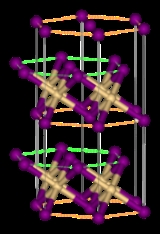
Cadmium iodide, CdI
2, is a chemical compound of
cadmiumCadmium is a chemical element with the symbol Cd and atomic number 48. This soft, bluish-white metal is chemically similar to the two other stable metals in group 12, zinc and mercury. Similar to zinc, it prefers oxidation state +2 in most of its compounds and similar to mercury it shows a low...
and
iodineIodine is a chemical element with the symbol I and atomic number 53. The name is pronounced , , or . The name is from the , meaning violet or purple, due to the color of elemental iodine vapor....
. It is notable for its
crystal structureIn mineralogy and crystallography, crystal structure is a unique arrangement of atoms or molecules in a crystalline liquid or solid. A crystal structure is composed of a pattern, a set of atoms arranged in a particular way, and a lattice exhibiting long-range order and symmetry...
, which is typical for compounds of the form MX
2 with strong
polarizationIn chemistry, polarity refers to a separation of electric charge leading to a molecule or its chemical groups having an electric dipole or multipole moment. Polar molecules interact through dipole–dipole intermolecular forces and hydrogen bonds. Molecular polarity is dependent on the difference in...
effects.
Uses
Cadmium iodide is used in
lithographyLithography is a method for printing using a stone or a metal plate with a completely smooth surface...
,
photographyPhotography is the art, science and practice of creating durable images by recording light or other electromagnetic radiation, either electronically by means of an image sensor or chemically by means of a light-sensitive material such as photographic film...
,
electroplatingElectroplating is a plating process in which metal ions in a solution are moved by an electric field to coat an electrode. The process uses electrical current to reduce cations of a desired material from a solution and coat a conductive object with a thin layer of the material, such as a metal...
and the manufacturing of phosphors.
Preparation
Cadmium iodide is prepared by the addition of cadmium metal, or its oxide, hydroxide or carbonate to hydroiodic acid.
Also, the compound can be made by heating cadmium with iodine.
Crystal structure
In cadmium iodide the
iodideAn iodide ion is the ion I−. Compounds with iodine in formal oxidation state −1 are called iodides. This page is for the iodide ion and its salts. For information on organoiodides, see organohalides. In everyday life, iodide is most commonly encountered as a component of iodized salt,...
anions form a hexagonal close packed arrangement while the cadmium cations fill all of the octahedral sites in alternate layers. The resultant structure consists of a layered lattice. This same basic structure is found in many other
saltIn chemistry, salts are ionic compounds that result from the neutralization reaction of an acid and a base. They are composed of cations and anions so that the product is electrically neutral...
s and
mineralA mineral is a naturally occurring solid chemical substance formed through biogeochemical processes, having characteristic chemical composition, highly ordered atomic structure, and specific physical properties. By comparison, a rock is an aggregate of minerals and/or mineraloids and does not...
s. Cadmium iodide is mostly
ionically bondedAn ionic bond is a type of chemical bond formed through an electrostatic attraction between two oppositely charged ions. Ionic bonds are formed between a cation, which is usually a metal, and an anion, which is usually a nonmetal. Pure ionic bonding cannot exist: all ionic compounds have some...
but with partial
covalentA covalent bond is a form of chemical bonding that is characterized by the sharing of pairs of electrons between atoms. The stable balance of attractive and repulsive forces between atoms when they share electrons is known as covalent bonding....
character.
Cadmium iodide's crystal structure is the prototype on which the crystal structures many other compounds can be considered to be based. Compounds with any of the following characteristics tend to adopt the CdI
2 structure:
- Iodide
An iodide ion is the ion I−. Compounds with iodine in formal oxidation state −1 are called iodides. This page is for the iodide ion and its salts. For information on organoiodides, see organohalides. In everyday life, iodide is most commonly encountered as a component of iodized salt,...
s of moderately polarising cationsAn ion is an atom or molecule in which the total number of electrons is not equal to the total number of protons, giving it a net positive or negative electrical charge. The name was given by physicist Michael Faraday for the substances that allow a current to pass between electrodes in a...
; bromideA bromide is a chemical compound containing bromide ion, that is bromine atom with effective charge of −1. The class name can include ionic compounds such as caesium bromide or covalent compounds such as sulfur dibromide.-Natural occurrence:...
s and chlorideThe chloride ion is formed when the element chlorine, a halogen, picks up one electron to form an anion Cl−. The salts of hydrochloric acid HCl contain chloride ions and can also be called chlorides. The chloride ion, and its salts such as sodium chloride, are very soluble in water...
s of strongly polarising cations
- Hydroxide
Hydroxide is a diatomic anion with chemical formula OH−. It consists of an oxygen and a hydrogen atom held together by a covalent bond, and carrying a negative electric charge. It is an important but usually minor constituent of water. It functions as a base, as a ligand, a nucleophile, and a...
s of dications, i.e. compounds with the general formula M(OH)2
- Sulfide
A sulfide is an anion of sulfur in its lowest oxidation state of 2-. Sulfide is also a slightly archaic term for thioethers, a common type of organosulfur compound that are well known for their bad odors.- Properties :...
s, selenideA selenide is a chemical compound in which selenium serves as an anion with oxidation number of −2 , much as sulfur does in a sulfide. The chemistry of the selenides and sulfides are similar....
s and tellurideThe telluride ion is Te2−. It is the final stable member of the series of dianions O2−, S2−, and Se2− ....
s (chalcogenThe chalcogens are the chemical elements in group 16 of the periodic table. This group is also known as the oxygen family...
ides) of tetracations, i.e. compounds with the general formula MX2, where X = S, Se, Te
Compounds with the CdI2 crystal structure
Iodides
MgI2Magnesium iodide is the name for the chemical compounds with the formulas MgI2 and its various hydrates MgI2x. These salts are typical ionic halides, being highly soluble in water...
, TiI
2, VI
2, MnI
2, FeI
2,
CoI2Cobalt iodide or cobaltous iodide is the inorganic compound composed with the formula Co I2. The two forms of CoI2 and the hydrated form are the principal iodides of cobalt.-Synthesis and structure:...
,
CaI2Calcium iodide is the inorganic compound with the formula CaI2. This colourless deliquescent solid is highly soluble in water. Its properties are similar to those for related salts, such as calcium chloride...
,
PdI2Palladium iodide is an inorganic compound of palladium and iodine. It is a commercially available, though less common than palladium chloride, the usual entry point to palladium chemistry....
,
PbI2Lead iodide or plumbous iodide is a bright yellow solid at room temperature, that reversibly becomes brick red by heating. In its crystalline form it is used as a detector material for high energy photons including x-rays and gamma rays....
.
Chlorides and bromides
TiCl2Titanium chloride is the chemical compound with the formula TiCl2. The black solid has been studied only moderately, probably because of its high reactivity. Ti is a strong reducing agent: it has a high affinity for oxygen and reacts irreversibly with water to produce H2. The usual preparation is...
,
VCl2Vanadium chloride is the inorganic compound with the formula VCl2. This purple solid is the most reduced vanadium chloride. Like other metal dihalides, it is a polymer...
;
MgBr2Magnesium bromide is a chemical compound of magnesium and bromine that is white and deliquescent. It is often used as a mild sedative and as an anticonvulsant for treatment of nervous disorders. It is water soluble and somewhat soluble in alcohol...
, TiBr
2, VBr
2,
MnBr2Manganese bromide is the chemical compound composed of manganese and bromine with the formula MnBr2.It can be used in place of palladium in the Stille reaction, which couples two carbon atoms using an organotin compound....
,
FeBr2Iron bromide is the chemical compound FeBr2. This brownish-colored solid is a useful synthetic intermediate; for example it is employed to insert Fe into porphyrins.-Structure:...
,
CoBr2Cobalt bromide is an inorganic compound used primarily as a catalyst in some processes.-Properties:When anhydrous, cobalt bromide appears as green crystals. The hexahydrate loses four waters of crystallization molecules at 100°C forming the dihydrate:Further heating to 130°C Produces the anhydrous...
.
Hydroxides of M2+
Mg(OH)2Magnesium hydroxide is an inorganic compound with the chemical formula Mg2. As a suspension in water, it is often called milk of magnesia because of its milk-like appearance. The solid mineral form of magnesium hydroxide is known as brucite....
,
Ni(OH)2Nickel hydroxide Ni2 is an insoluble compound commonly used in rechargeable battery electrodes. When charged these electrodes form nickel oxide-hydroxide. Nickel hydroxide is a precipitate formed when the hexaaquanickel ion is mixed with aqueous alkali...
,
Ca(OH)2Calcium hydroxide, traditionally called slaked lime, is an inorganic compound with the chemical formula Ca2. It is a colourless crystal or white powder and is obtained when calcium oxide is mixed, or "slaked" with water. It has many names including hydrated lime, builders lime, slack lime, cal, or...
.
Chalcogenides of M4+
TiS
2,
ZrS2Zirconium sulfide is a chemical compound....
,
SnS2,
α-TaS2Tantalum sulfide is the inorganic compound with the formula TaS2. It is a layered compound with three-coordinate sulfide centres and trigonal prismatic metal centres. It is structurally similar to the more famous material MoS2...
, PtS
2;
TiSe
2, ZrSe
2, SnSe
2, PtSe
2;
SiTe
2, TiTe
2, CoTe
2,
NiTe2Melonite is a telluride of nickel; it is a metallic mineral. Its chemical formula is NiTe2. It is opaque and white to reddish-white in color, oxidizing in air to a brown tarnish....
, PdTe
2, PtTe
2.