
All Topics  
Cadillac V8 engine

 
Cadillac V8 Engine

   Email Print
   Bookmark   Link


Cadillac V8 engine


Cadillac was the first automobile
Automobile

An automobile or motor car is a wheeled motor vehicle for transportation passengers, which also carries its own car engine or motor. Most definitions of the term specify that automobiles are designed to run primarily on roads, to have seating for one to eight people, to typically have four wheels, and to be constructed principally f...
 maker to mass produce a V8 engine. The company has produced eight generations of V8s since 1914, and today is the only General Motors division to retain its own V8 design.

Type 51 was the first Cadillac V8. Introduced in 1914, it was the standard engine for 1915 Cadillac models. It was a 90° design with an L-head (sidevalve) configuration and was water cooled.


Discussion
Ask a question about 'Cadillac V8 engine'
Start a new discussion about 'Cadillac V8 engine'
Answer questions from other users
Full Discussion Forum


Recent Posts


Encyclopedia


Cadillac was the first automobile
Automobile

An automobile or motor car is a wheeled motor vehicle for transportation passengers, which also carries its own car engine or motor. Most definitions of the term specify that automobiles are designed to run primarily on roads, to have seating for one to eight people, to typically have four wheels, and to be constructed principally f...
 maker to mass produce a V8 engine. The company has produced eight generations of V8s since 1914, and today is the only General Motors division to retain its own V8 design.

L-Head

The Type 51 was the first Cadillac V8. Introduced in 1914, it was the standard engine for 1915 Cadillac models. It was a 90° design with an L-head (sidevalve) configuration and was water cooled. Bore was 3.125 in and stroke was 5.125 in, for a total of of displacement. Output was .

The engine was refined for 1923 with a new split crankshaft
Crankshaft

The crankshaft, sometimes casually abbreviated to crank , is the part of an engine which translates reciprocation linear piston motion into rotation....
 that introduced the (now standard) 90° offset for each pair of cylinders. Power was up to .

The L-Head was on the Ward's 10 Best Engines of the 20th century
Ward's 10 Best Engines

World's 10 Best Engines is an annual list of the ten "best" internal combustion engine available in the U.S. market that are selected by Ward's AutoWorld magazine....
 list.

L-Head applications:
  • Cadillac Type 51
    Cadillac Type 51

    The Cadillac Type 51 was a large, luxurious automobile introduced in September 1914. The similar Types Cadillac Type 53, 55, 57, 59, and 61 lasted through 1923, when the design was substantially updated as the Cadillac Type V-63....
  • Cadillac Type 53
    Cadillac Type 53

    The Cadillac Type 53 was the first car to use the same control layout as modern automobiles- with the gear lever and hand brake in the middle of the front two seats, a key started ignition, and three pedals for the clutch, throttle, and brake in the modern order....
  • Cadillac Type 55
  • Cadillac Type 57
  • Cadillac Type 59
  • Cadillac Type 61
  • Cadillac V-63
  • Cadillac Series 341


Cadillac created a new V8, the 341, for 1928. It was a 341 in³ engine and produced . The same year saw the introduction of the synchromesh transmission. This engine was used in the Series 341 and 341B cars of 1928 and 1929.

From 1930 through 1935, Cadillac produced a version with an increased displacement of . This used a bore and stroke. This engine was used in the Series 353/355/355B/355C/355D and Series 10.

Monobloc

A "monobloc" engine was used in 1936's Series 60
Cadillac Series 60

The Cadillac Series 60 was the company's mid-priced vehicle line when it appeared in 1936. It was replaced by the Cadillac Series 61 in 1940, but the offshoot Cadillac Sixty Special continued through 1993....
. It was designed to be the company's next-generation powerplant at reduced cost from the 353 and Cadillac V12
Cadillac V16 engine

The Cadillac V16 engine was a type of automobile engine produced in the 1930s. Cadillac produced two of only three production, gasoline-fueled V16 engine models in history....
. The monobloc's cylinders and crankcase were cast as a single unit , and it used hydraulic valve lifters for durability. This design allowed the creation of the mid-priced Series 60 line.

Bore was and stroke was . This engine was modified with a bore for the 1936-1948 engine. This was used in the Series 60/60S/61/62/63/65/67
Cadillac Series 60

The Cadillac Series 60 was the company's mid-priced vehicle line when it appeared in 1936. It was replaced by the Cadillac Series 61 in 1940, but the offshoot Cadillac Sixty Special continued through 1993....
 and 70/72/75
Cadillac Series 70

The Series 70 was Cadillac 's full-size V8-powered car from the 1930s through 1950s. It replaced the 1935 Cadillac 355 as the company's mainstream car just as the much less expensive Cadillac Series 60 was introduced....
. It was also used in tank
Tank

A tank is a Continuous track, armoured fighting vehicle designed for front-line combat which combines operational mobility and Military tactics Offensive and defence capabilities....
s in World War II
World War II

World War II, or the Second World War , was a global military conflict which involved a Participants in World War II, including all of the great powers, organised into two opposing military alliances: the Allies of World War II and the Axis powers....
.

LaSalle

In 1937, the new Monobloc
Monobloc

Monobloc may refer to:* Monobloc * Monoblock LNB* Monobloc, in engineering, refers to a casting or forging which is made in a single piece, rather than being Fabrication ...
 Flathead
Flathead

Flathead may refer to:* Flathead , by The Fratellis* Flathead EP, by The Fratellis* Flathead engine, a valve configuration* Confederated Salish and Kootenai Tribes of the Flathead Nation, a Native American group...
 gained 24 in³ in Cadillac
Cadillac

Cadillac is a luxury vehicle marque owned by General Motors. Cadillac vehicles are sold in over 50 countries and territories, mainly in the United States, Canada, and Mexico....
 V-8 models to , while the LaSalle
LaSalle

The LaSalle was an automobile product of General Motors and sold as a companion marque of Cadillac from 1927 to 1940. The two were linked by similarly-themed names, both being named for explorers — Antoine Laumet de La Mothe, sieur de Cadillac and Ren?-Robert Cavelier, Sieur de La Salle, respectively....
 Straight-8 of 1934–1936 that was an Oldsmobile
Oldsmobile

Oldsmobile was a brand name of automobile produced for most of its existence by General Motors. It was founded by Ransom E. Olds in 1897. In its 107-year history, it produced 35.2 million cars, including at least 14 million built at its Lansing, Michigan factory....
 engine actually was replaced with the 1936 smaller version at . In 1941, the LaSalle
LaSalle

The LaSalle was an automobile product of General Motors and sold as a companion marque of Cadillac from 1927 to 1940. The two were linked by similarly-themed names, both being named for explorers — Antoine Laumet de La Mothe, sieur de Cadillac and Ren?-Robert Cavelier, Sieur de La Salle, respectively....
 nameplate was phased out along with the 322 in³, and Cadillacs, all 346 in³ powered, were available with the new Hydramatic
Hydramatic

Hydramatic was an automatic transmission developed by both General Motors Corporation' Cadillac and Oldsmobile divisions. Introduced in 1939 for the 1940 model year vehicles, the Hydramatic was the first fully automatic mass-produced transmission developed for passenger automobile use....
 automatic transmission
Automatic transmission

An automatic transmission is an automobile gearbox that can change gear ratios automatically as the vehicle moves, freeing the driver from having to shift gears manual transmission....
 which debuted in Oldsmobile the previous year. These engines were produced through 1948.

OHV

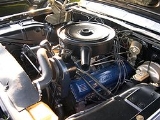
1962 Cadillac Series 62 390 Engine

331

For 1949, Cadillac and Oldsmobile
Oldsmobile

Oldsmobile was a brand name of automobile produced for most of its existence by General Motors. It was founded by Ransom E. Olds in 1897. In its 107-year history, it produced 35.2 million cars, including at least 14 million built at its Lansing, Michigan factory....
 each produced a new V8 design (the Oldsmobile engine was the 303
Oldsmobile V8 engine

The Oldsmobile Rocket V8 was the first post-war Overhead valve V8 at General Motors Corporation. Production started in 1949, with a new generation introduced in 1964....
). Both of the engines were Overhead valve
Overhead valve

An overhead valve engine, also called pushrod engine or I-head engine is a type of piston engine that places the camshaft in the cylinder block and uses pushrods or rods to actuate rocker arm above the cylinder head to actuate the poppet valve....
 designs. The Cadillac 331 engine featured a "dry" (coolant exited through an assembly attached directly to the cylinder heads), open runner (requiring the use of a tappet valley cover) intake manifold, rear-mounted distributor, and shaft-mounted rockers. An untrained eye could mistake this engine for the GEN 1 AMC V8 engine
AMC V8 engine

American Motors Corporation produced a series of widely-used V8 engines from the mid-1950s before being absorbed into Chrysler Corporation. Some continued well after the 1991 merger with Jeep....
 whereas the AMC counterpart uses two wing nuts per cover in its centerline, the Cadillac parts are secured through screws in its gasket perimeter. This engine also featured an oiling scheme that used a cast-in passage above and between the lifter galleries. This fed oil to the cam and crank by grooves machined into the cam bores. A single drilled passage per bearing saddle fed both cam and crank journals. This design was used in the Chevrolet Small-Block engine
Chevrolet Small-Block engine

Chevrolet's small-block V8 is a not a single engine but a series of famous automobile engines built on the same basic small engine block. Retroactively referred to as the "Generation I" small-block, it is distinct from subsequent GM "Generation II" GM LT engine and "Generation III" GM LS engine engines....
, GEN 1 AMC V8 engine
AMC V8 engine

American Motors Corporation produced a series of widely-used V8 engines from the mid-1950s before being absorbed into Chrysler Corporation. Some continued well after the 1991 merger with Jeep....
, and the 'top oiler' Ford FE engine
Ford FE engine

The Ford FE engine was a Ford Motor Company V8 engine used in vehicles sold in the North American market between 1958 and 1976. A related engine, the Ford FT engine, was used in medium and heavy trucks from 1964 through 1978....
 and the Ford MEL V8
Ford MEL engine

Ford Motor Company developed the MEL engine series for use in their line of Mercury models from 1958 through 1967. The MEL also replaced Lincoln 's unique Lincoln V8 engine....
. A design that it shares with the Oldsmobile Rocket V8 is a skirtless block where the oil pan flange does not descend appreciably below the crankshaft centerline.

365

Displacement was up to for 1956, and the 1958 Eldorado 3-2bbl version produced .

390

A longer stroke pushed displacement to for 1959, yielding , while the Eldorado six-pack reached .

Redesigned OHV

For the 1963 model year Cadillac updated their V8 engine, modernizing the tooling used in the production line while optimizing the engine's design. Although it shared the same layout and architecture with the 1949-vintage engine, the revised engine had shorter connecting rod
Connecting rod

In a reciprocating piston engine, the connecting rod or conrod connects the piston to the crank or crankshaft. The connecting rod was invented sometime between 1174 and 1200 when a Inventions in medieval Islam, Timeline of Islamic science and engineering and Artisan named al-Jazari built five machines to pump water for the kings of t...
s and was lower, narrower, and shorter. The accessories (water pump, power steering
Power steering

Power steering is a system for reducing the steering effort on vehicles by using an external power source to assist in turning the wheel.The earliest known patent related to power steering was filed on August 30, 1932, by Francis W....
 pump, distributor
Distributor

A distributor is a device in the ignition system of an internal combustion engine that routes high voltage from the ignition coil to the spark plugs in the correct firing order....
) mounted on a die-cast aluminum housing at the front of the engine for improved accessibility. An alternator
Alternator

An alternator is an generator that converts mechanical energy to alternating current electrical energy. Most alternators use a rotating magnetic field but linear alternators are occasionally used....
 replaced the former generator
Electrical generator

In electricity generation, an electrical generator is a device that converts mechanical energy to electrical energy, generally using electromagnetic induction....
. The crankshaft
Crankshaft

The crankshaft, sometimes casually abbreviated to crank , is the part of an engine which translates reciprocation linear piston motion into rotation....
 was cored out to make it both lighter and stronger. The revised engine was lighter than its predecessor, for a total dry weight of .

390

For 1963 the revised engine shared the same bore and stroke of its predecessor, for an unchanged displacement of . Power was unchanged at , as was torque at .

429

For 1964 the engine had a bore and a stroke, raising displacement to . Power rose to and torque to . The 429 was used through the 1967 model year.

World's largest

Although the modernized engine was compact and light for its displacement and output, represented the limit of the original architecture's expansion, and it had been surpassed by Chrysler's 440
Chrysler RB engine

The RB engine is a big-block V8 engine from Chrysler. It first appeared in 1959 and was a raised-deck version of the Chrysler B engine. The big-block RB lasted until 1978....
 and Lincoln
Lincoln (automobile)

Lincoln is a brand of Ford Motor Company. Founded in 1917 by Henry M. Leland and acquired by Ford in 1922, Lincoln has manufactured vehicles since the 1920s....
's 462
Ford MEL engine

Ford Motor Company developed the MEL engine series for use in their line of Mercury models from 1958 through 1967. The MEL also replaced Lincoln 's unique Lincoln V8 engine....
. As a result Cadillac introduced an all-new engine for 1968.

472

At introduction, the new engine had a bore and a stroke for a displacement of . It delivered @ 4400 rpm, and a massive torque, produced at just 3000 rpm. The new engine was about heavier than its predecessor. It was used through 1974. It was designed with potential for a 500-cubic inch displacement.

500

For 1970 Cadillac fitted a crankshaft with a stroke, increasing total displacement on the engine to . At introduction it was rated at , SAE gross, and of torque. For 1971 compression was reduced from 10:1 to 8.5:1, the lowered compression ratio dropped the 500's gross output
Horsepower

Horsepower is the name of several non-International System of Units units of power . It was originally defined to allow the output of steam engines to be measured and compared with the power output of draft horses....
 from to , or in the new SAE net
Horsepower

Horsepower is the name of several non-International System of Units units of power . It was originally defined to allow the output of steam engines to be measured and compared with the power output of draft horses....
 ratings. By 1976, its final year, it had fallen to . However, a new Bendix
Bendix Corporation

The Bendix Corporation was an United States manufacturing and engineering company which during various times in its 60 year existence made brake systems, aeronautical hydraulics, avionics, radios, televisions and computers, and which licensed its name for use on home washing machines....
 electronic fuel injection system was offered as an option, and it increased power output to . The 500 was exclusive to the Eldorado until 1975 where the powerplant was available in all Cadillacs except for the Seville, which was powered by a fuel-injected Oldsmobile 350
Oldsmobile V8 engine

The Oldsmobile Rocket V8 was the first post-war Overhead valve V8 at General Motors Corporation. Production started in 1949, with a new generation introduced in 1964....
.

Year Engine Vin Code Engine Letter Code Cubic Inch Rated Horsepower Rated Torque Bore & Stroke Compression Ratio Oil Pressure PSI
1968-1969NoneNone472375 hp @ 4400 rpm525 lb·ft @ 3000 rpm4.300 X 4.06010.5:133
1970NoneNone472375 hp @ 4400 rpm525 lb·ft @ 3000 rpm4.300 X 4.06010.0:135-40
1970NoneNone500400 hp @ 4400 rpm550 lb·ft @ 3000 rpm4.300 X 4.30410.0:135-40
1971R61E,Q472345 hp @ 4400 rpm500 lb·ft @ 2800 rpm4.300 X 4.0608.5:135-40
1971S61E,Q500365 hp @ 4400 rpm535 lb·ft @ 2800 rpm4.300 X 4.3048.5:135-40
1972R62E,Q472220 hp @ 4400 rpm365 lb·ft @ 2400 rpm4.300 X 4.0608.5:135
1972S62E,Q500235 hp @ 4400 rpm385 lb·ft @ 2400 rpm4.300 X 4.3048.5:135
1973R63E,Q472220 hp @ 4400 rpm365 lb·ft @ 2400 rpm4.300 X 4.0608.5:135
1973S63E,Q500235 hp @ 4400 rpm385 lb·ft @ 2400 rpm4.300 X 4.3048.5:135
1974R64E,Q472205 hp @ 4400 rpm365 lb·ft @ 2400 rpm4.300 X 4.0608.5:135
1974S64E,Q500210 hp @ 3600 rpm380 lb·ft @ 2000 rpm4.300 X 4.3048.5:135
1975S65E,Q500210 hp @ 3600 rpm380 lb·ft @ 2000 rpm4.300 X 4.3048.5:135
1976S66E,Q500190 hp @ 3600 rpm360 lb·ft @ 2000 rpm4.300 X 4.3048.5:135


Downsized OHV

The market of the 1970s forced Cadillac to downsize its vehicles and engines. While the Cadillac Seville
Cadillac Seville

The Cadillac Seville is a luxury car that was manufactured by the Cadillac division of United States automaker General Motors as a limited production specialty model in the 1950s and 60s....
 used a Oldsmobile V8, Cadillac also began work on smaller proprietary engines.

425

In 1977 Cadillac introduced a new V8, based on the architecture of the 472, but with a smaller, bore and the same stroke. The new engine was also lighter.

The 425 was offered in L33 form, with a four-barrel carburetor, producing at 4000 rpm and of torque at 2000 rpm, and L35 with electronic port fuel injection
Fuel injection

Fuel injection is a system for mixing fuel with air in an internal combustion engine. It has become the primary fuel delivery system used in gasoline Automobile engines, having almost completely replaced carburetors in the late 1980s....
 for ; torque was the same, but peaked at 2400 rpm.

The 425 was used through 1979 on all Cadillacs except the Seville.

368 and V8-6-4

In 1980 the 425 was replaced with the L61, which was the same basic 472 family engine de-bored to but retaining the 472 and 425 engines' 4.06" stroke for a total displacement of . The reduction in displacement was largely an effort to meet CAFE
Corporate Average Fuel Economy

The Corporate Average Fuel Economy regulations in the United States, first enacted by Congress in 1975, are federal regulations intended to improve the average Fuel economy in automobiles of automobile and light trucks sold in the US in the wake of the 1973 Arab Oil Embargo....
 requirements for fuel economy. Throttle-body fuel injection was now standard except for Commercial Chassis for hearse and ambulance builders.

Cadillac referred to this new TBI (throttle body injection) fuel system as Digital Fuel Injection (DFI); this particular induction system was later adopted by other GM divisions, except on Oldsmobile V8s, and was used well into the 1990s on GM trucks.

Power output dropped to at 3600 rpm and torque to at 2000 rpm in DEFI forms as used on the front wheel drive Seville and Eldorado but on the 4-barrel Quadrajet-equipped RWD models. This engine was standard on all Cadillacs except the redesigned Seville
Cadillac Seville

The Cadillac Seville is a luxury car that was manufactured by the Cadillac division of United States automaker General Motors as a limited production specialty model in the 1950s and 60s....
, in which it was optional.

For 1981 Cadillac introduced a new engine that would become notorious for its unreliability (the electronic systems, not the robust mechanical design), the V8-6-4 (L62). The L61 had not provided a significant improvement in the company's CAFE numbers, so Cadillac and Eaton Corporation
Eaton Corporation

Eaton Corporation is a diversified industrial manufacturer with 2008 sales of $15.4 billion . Eaton is a global leader in electrical systems and components for power quality, distribution and control; fluid power systems and services for industrial, mobile and aircraft equipment; intelligent truck drivetrain systems for safety and fuel econo...
 devised a cylinder deactivation system called Modulated Displacement that would shut off two or four cylinders in low-load conditions such as highway cruising, then reactivate them when more power was needed. When deactivated, solenoids mounted to those cylinders' rocker-arm studs would disengage the fulcrums, allowing the rockers to "float" and leave the valves closed despite the continued action of the pushrods. These engines are easily identified by their rocker covers, which each have elevated sections over 2 cylinders with electrical connectors on top... With the valves closed the cylinders acted as air-springs, which both eliminated the feel of "missing" and kept the cylinders warm for instant combustion upon reactivation. Simultaneously, the engine control module would reduce the amount of fuel metered through the TBI unit. On the dashboard, an "MPG Sentinel" digital display could show the number of cylinders in operation, average or instantaneous fuel consumption (in miles per gallon) or estimated range based on the amount of fuel remaining in the tank and the average mileage since the last reset.

Another rare and advanced feature introduced with DFI was Cadillac's truly "on-board" diagnostics. For all those mechanics who had to deal with the 368's, the cars contained diagnostics that didn't require the use of any special external computer scan-tool... The new Electronic Climate Control display, along with the MPG Sentinel, provided on-board readout of any stored trouble codes, instantaneous readings from all the various engine sensors, forced cycling of the underhood solenoids and motors, and on the V8-6-4 motors, manual cylinder-pair control. The L62 produced at 3800 rpm and at 1400 rpm. Cadillac hailed the L62 as a technological masterpiece, and made it standard equipment across the whole Cadillac line.

While cylinder deactivation would make a comeback some 20 years later with modern computing power (and using oil pressure to deactivate the valves by collapsing the lifters) Cadillac's 1981 V8-6-4 proved to have insurmountable teething problems, both mechanically and electronically. The biggest issue was that the engine control computer simply lacked the power to efficiently manage the number of cylinders in operation. In an effort to increase reliability, Cadillac issued 13 updated PROM chips for the engine control modules, but many of these engines simply had their Modulated Displacement function disabled by dealers, leaving them with permanent eight-cylinder operation (it actually only required disconnecting a single wire.) The 368 was dropped for most Cadillac passenger cars after the 1981 model year, although the V8-6-4 remained the standard engine for Fleetwood Limousines and the carbureted 368 remained in the Commercial Chassis through 1984.

The 368 (essentially a reduced-bore 472 and even sharing the same timing chain) has the distinction of being the last 'big-block' traditional cast-iron pushrod V8 engine available in production cars - it lasted until 1984 in the limousines. All rival big blocks disappeared between 1976 and 1978. In the RWD models it was always coupled with the heavy duty THM400 transmission, the last factory-produced GM car to come with this.

HT-4100

A new engine was introduced for 1982, the HT-4100 (option code LT8). It was a 4100 cc V8, designed for transverse
Transverse engine

A transverse engine is an engine in which the crankshaft is oriented side-to-side relative to the length of the vehicle. This is also sometimes called an east-west engine....
, front wheel drive applications. It was originally slated for 1983 and a new line of downsized Cadillac sedans. Delays in the downsizing program (shared with Buick
Buick

Buick is a marque of automobile sold in the United States, Canada, China, Taiwan, Qatar, Kuwait, and Israel by General Motors Corporation. Since the demise of Oldsmobile in 2004, it is GM's only North America-based entry-level luxury brand....
 and Oldsmobile
Oldsmobile

Oldsmobile was a brand name of automobile produced for most of its existence by General Motors. It was founded by Ransom E. Olds in 1897. In its 107-year history, it produced 35.2 million cars, including at least 14 million built at its Lansing, Michigan factory....
) postponed the introduction of those models until 1985, and the new V8 was rushed into production for the 1982 model year.

Design Features
HT stood for High Technology. For its time, the engine and its electronic control module (ECM) were quite sophisticated. Despite having a throttle body injection system (as opposed to port fuel injection), the HT4100 used an ECM that for the first time incorporated a detailed on-board computer. Every parameter of engine performance could be displayed on the heater control while the car was being driven. The HT4100 also pioneered other design features including removable cylinder sleeves, high operating temperature for emission control (210 degrees, compared to 180 in earlier engines), free circulation of coolant between the block and the heads, and bimetal construction that mounted heat-tolerant cast-iron heads onto a weight-saving aluminum block. The engine had a bore of and stroke of , for a total displacement of . It initially was equipped with throttle-body fuel injection
Fuel injection

Fuel injection is a system for mixing fuel with air in an internal combustion engine. It has become the primary fuel delivery system used in gasoline Automobile engines, having almost completely replaced carburetors in the late 1980s....
, with output of at 4400 rpm and of torque at 2000 rpm.

In 1982 the HT4100 was the standard engine for the front-wheel-drive Eldorado and Seville. It was also placed in many rear-wheel-drive DeVilles, and was available for the Fleetwood.

The HT4100 was prone to failure of the intake manifold gasket. It may not have been the most successful engine to sit under the hood of a Cadillac, but potential buyers were no more satisfied with the other two engines available at the time, the V8-6-4 and the Oldsmobile 5.7 L Diesel. Reliability issues soiled the reputation of the HT4100. Kits were sold to retrofit the cars with Chevrolet engines (Buick and Oldsmobile V6s would also fit, but were much harder to install). Sales remained strong, exceeding 100,000 in 1984. Cadillac's share of the luxury car market diminished rapidly after 1985.

For 1987 a more powerful version of the 4.1 L engine was introduced in the Cadillac Allante
Cadillac Allanté

The Allant? was Cadillac 's first venture into the ultra-luxury roadster market. The vehicle was sold from 1987 through 1993, with roughly 21,000 models built over its 7-year model run....
, using a different camshaft
Camshaft

The camshaft is an apparatus often used in piston engines to operate poppet valves. It consists of a cylindrical rod running the length of the cylinder bank with a number of oblong lobes or cams protruding from it, one for each valve....
 profile and roller rocker arm
Rocker arm

Generally referred to within the internal combustion engine of automotive, marine, motorcycle and reciprocating aviation engines, the rocker arm is a reciprocating lever that conveys radial movement from the cam lobe into linear movement at the poppet valve to open it....
s to reduce valvetrain friction, in addition to multiport fuel injection
Fuel injection

Fuel injection is a system for mixing fuel with air in an internal combustion engine. It has become the primary fuel delivery system used in gasoline Automobile engines, having almost completely replaced carburetors in the late 1980s....
. This engine was rated at at 4300 rpm and of torque at 3200 rpm. The 4.1 was superseded by larger-displacement engines, and ceased production after the 1988 model year.

4.5


Although it was an improved and enlarged version of the HT4100, the 4.5 L engine was never called HT4500 by Cadillac.

Engineering allowed the company to begin increasing displacement and output again. A bored-out (to ) 4.5 version was introduced in 1988 with and throttle body injection. Various versions of this engine were built from this introduction to the end of production in 1992 including a high-output LW2 version with multiport fuel injection
Fuel injection

Fuel injection is a system for mixing fuel with air in an internal combustion engine. It has become the primary fuel delivery system used in gasoline Automobile engines, having almost completely replaced carburetors in the late 1980s....
 which produced and for the Allante
Cadillac Allanté

The Allant? was Cadillac 's first venture into the ultra-luxury roadster market. The vehicle was sold from 1987 through 1993, with roughly 21,000 models built over its 7-year model run....
. Outside of the Allante, Cadillac introduced a port fuel injected 4.5 L V8 engine in 1990 with and across their car line up.

L26 4.9


Although an improved and enlarged version of the HT4100, it was never called HT4900 by Cadillac.

A larger version, the L26 4.9, debuted in 1991 at 4.9 L with a square bore and stroke. Despite the fact that it had similar output to Allante's 4.5 L port fuel injected V-8, the 4.9 L engine represented a significant upgrade for the remainder of the Cadillac lineup. Horsepower output was up from the previous 1990 4.5L engine and torque was up by , to and . Both the 4.9 and 4.5 port fuel injected engines required premium fuel due to a 9.5:1 compression ratio. The 4.9 produces its maximum horsepower at 4100 rpm.

The 4.9 was used throughout the Cadillac line. It was phased out in favor of the newer Cadillac Northstar engine; production ended in 1995.

Cadillac use of non-Cadillac V8s


Seville

The first Cadillac use of a non-Cadillac V8 was the 1975 Seville
Cadillac Seville

The Cadillac Seville is a luxury car that was manufactured by the Cadillac division of United States automaker General Motors as a limited production specialty model in the 1950s and 60s....
, which used an Oldsmobile 350 in3 engine
Oldsmobile V8 engine

The Oldsmobile Rocket V8 was the first post-war Overhead valve V8 at General Motors Corporation. Production started in 1949, with a new generation introduced in 1964....
. It featured Cadillac-exclusive Bendix electronic fuel injection (as distinct from computerized "digital" injection.) It was rated at , and the conventional Oldsmobile Rocket 350 had . Starting with the second generation Seville, Cadillac powerplants were optioned (L62 and the HT4100); from the third generation (1986), all Sevilles were Cadillac-powered.

Fleetwood (RWD)/Deville (RWD)/Brougham (RWD)

From 1982 to 1985, all rear-wheel drive Cadillacs (except for the limousines) could be ordered with the Oldsmobile LF9
Oldsmobile V8 engine

The Oldsmobile Rocket V8 was the first post-war Overhead valve V8 at General Motors Corporation. Production started in 1949, with a new generation introduced in 1964....
 Diesel
Diesel

Diesel or diesel fuel in general is any fuel used in diesel engines. The most common is a specific fractional distillation of petroleum fuel oil, but alternatives that are not derived from petroleum, such as biodiesel, biomass to liquid or gas to liquid diesel, are increasingly being developed and adopted....
 V8. In fact, for most of its life, the 1980-1985 version of Cadillac's Seville came standard with Oldsmobile's V8 diesel, with the gas engine being a no-cost option.

From 1986 to 1990, the rear-wheel drive Cadillac Brougham
Cadillac Brougham

Cadillac has used the Brougham name since 1916. In the 1950s, the name appeared as the four-door designation for the Cadillac Eldorado. The Eldorado Brougham protoype model appeared in 1955, then as a limited production model from 1957 through 1960....
 used a Oldsmobile
Oldsmobile V8 engine

The Oldsmobile Rocket V8 was the first post-war Overhead valve V8 at General Motors Corporation. Production started in 1949, with a new generation introduced in 1964....
 carbureted
Carburetor

A carburetor or carburettor , is a device that blends Earth's atmosphere and fuel for an internal combustion engine. It was invented by Karl Benz before 1885 and patented in 1886....
 V8 (replacing the Cadillac HT-4100).

In 1990 a , fuel-injected Chevrolet small-block
Chevrolet Small-Block engine

Chevrolet's small-block V8 is a not a single engine but a series of famous automobile engines built on the same basic small engine block. Retroactively referred to as the "Generation I" small-block, it is distinct from subsequent GM "Generation II" GM LT engine and "Generation III" GM LS engine engines....
 V8 (RPO
RPO

The abbreviation RPO could refer to:* Railway Post Office - a mobile Post Office set up in a railway car* Recovery Point Objective - a Disaster Recovery concept in IT...
 LO5) became optional when the towing package is selected.

In 1991 the Oldsmobile 307 was replaced with a throttle body fuel-injected Chevrolet
Chevrolet Small-Block engine

Chevrolet's small-block V8 is a not a single engine but a series of famous automobile engines built on the same basic small engine block. Retroactively referred to as the "Generation I" small-block, it is distinct from subsequent GM "Generation II" GM LT engine and "Generation III" GM LS engine engines....
 V8 (RPO LO3 - same powerplant used in Chevrolet's Caprice and C/K light trucks).

In 1993 the V8 became standard in the newly-renamed Cadillac Fleetwood
Cadillac Fleetwood

The Fleetwood Metal Body Company began business in Fleetwood, Pennsylvania on April 1, 1909 and continued as an independent automobile body builder until acquired in 1925 by the Fisher Body Company, a division of General Motors....
.

In 1994 this was replaced with an iron headed Chevrolet
Chevrolet Corvette

The Chevrolet Corvette is a sports car that has been manufactured by General Motors since 1953. The car was originally designed by Harley Earl, and named by Myron Scott after the fast corvette....
 LT1
GM LT engine

General Motors Corporation' Generation II LT is a small block V8 engine. Making its debut in the 1992 Chevrolet Corvette, the new LT sought to draw upon the heritage of the ultimate small-block, the 1970 Chevrolet GM Small-Block engine#LT-1....
 V8 with , which the Fleetwood would use until it was discontinued at the end of the 1996 model year.

With the introduction of the Escalade to the Cadillac lineup, the L31 was used, as it was part of the Chevy truck line on which the Escalade was based. In 2001, the new redesigned Escalade picked up the performance version of the 6.0 L LS series engine RPO LQ9. Currently this engine is still in use in Cadillac Escalades. All Escalades are AWD. Beginning in 2007 all Cadillac Escalades are equipped with Generation IV 6.2 L engines. This new engine option is shared with the GMC Denali.

CTS-V

The 2003 to 2005 CTS-V's used the previous generation Corvette Z06
Corvette Z06

Corvette Z06 refers to a high-performance version of the Chevrolet Corvette.There are two iterations of the Z06:*Chevrolet Corvette C5 Z06 - Based on the C5 Platform from 2001 - 2004...
's 5.7 L LS6 V8.

The 2006 and 2007 Cadillac CTS-V uses the 6.0 L LS2 V8, similar to that used in the standard Corvette C6.

The 2009 CTS-V carries a supercharged 6.2 L LSA variant, producing at least (in preliminary ratings). This is similar to the LS9 used in the high-performance 2009 Corvette ZR1
Chevrolet Corvette C6 ZR1

The ZR1 is a high performance version of the Chevrolet Corvette. More powerful than the Chevrolet Corvette C6#Z06 model, it is now the most powerful Corvette currently in production ....
, but uses a different model of supercharger (the LS9 produces ).

Northstar

Cadillac's most technologically advanced engine since the original arrived in 1992 is the DOHC Northstar unit. Although Oldsmobile
Oldsmobile

Oldsmobile was a brand name of automobile produced for most of its existence by General Motors. It was founded by Ransom E. Olds in 1897. In its 107-year history, it produced 35.2 million cars, including at least 14 million built at its Lansing, Michigan factory....
, Pontiac
Pontiac

Pontiac is a brand of automobiles, produced by General Motors Corporation that has been sold in the United States, Canada and Mexico since 1926....
, and Buick
Buick

Buick is a marque of automobile sold in the United States, Canada, China, Taiwan, Qatar, Kuwait, and Israel by General Motors Corporation. Since the demise of Oldsmobile in 2004, it is GM's only North America-based entry-level luxury brand....
 have borrowed the Northstar architecture for their V8 (and even V6) engines, it was not until the 2004 Pontiac Bonneville
Pontiac Bonneville

The Pontiac Bonneville was an automobile built by the Pontiac division of General Motors from 1957 to 2005. It was introduced as a limited production performance convertible during the 1957 model year....
 that a non-Cadillac used the Northstar name.

The Northstar is broken up into different versions depending on model usage and model year.

4.6 L

The version was available starting in 1994 on all models except Seville STS and Eldorado ESC and the rear-drive Fleetwood. These models,including the Allante had versions of the Northstar.

300hp (citation needed) on 2000-2005

on 2005-present

4.4 L

The 4.4 L versions were all supercharged, exclusive to Cadillac's V-series. The present STS-V engine, since 2006, produces and under the SAE certified rating system.

The 2006 - 2008 XLR-V uses the same supercharged Northstar V8 as the STS-V, though output is down somewhat due to design changes made to accommodate the model's more limited underhood space. For the XLR-V, the SAE certified output is and . The supercharger and four intercoolers are built into the intake manifold.

The bores were reduced in size to increase block strength, increasing the safety margin under boost.

4.0 L

This is the Oldsmobile Aurora variant, never installed in a Cadillac. The Aurora's cylinder heads had lower flow characteristics to match the engine's reduced size. The 4.0 L engine produces .

See also

From the 1950s through the 1970s, each GM division had its own V8 engine family. Some were shared among other divisions, but each respective design was engineered and developed by its own division:
  • Buick V8 engine
    Buick V8 engine

    Like its sister General Motors Corporation divisions, Buick produced its own family of V8 engines to replace Buick Straight-8 engine. These engines came in many of the same displacements as those from other divisions, but were entirely different....
  • Chevrolet Small-Block engine
    Chevrolet Small-Block engine

    Chevrolet's small-block V8 is a not a single engine but a series of famous automobile engines built on the same basic small engine block. Retroactively referred to as the "Generation I" small-block, it is distinct from subsequent GM "Generation II" GM LT engine and "Generation III" GM LS engine engines....
  • Chevrolet Big-Block engine
    Chevrolet Big-Block engine

    The Chevrolet big block is a series of large displacement V8 engines that were developed in the USA during the 1950s and 1960s. As American automobiles grew in size and weight following the Second World War the engines powering them had to keep pace....
  • Oldsmobile V8 engine
    Oldsmobile V8 engine

    The Oldsmobile Rocket V8 was the first post-war Overhead valve V8 at General Motors Corporation. Production started in 1949, with a new generation introduced in 1964....
  • Pontiac V8 engine
    Pontiac V8 engine

    From 1955 to 1981 the Pontiac Division of General Motors Corporation manufactured its own V8 engines, distinct from Buick, Cadillac, Chevrolet, or Oldsmobile....


GM later standardized on the later generations of the Chevrolet design:
  • GM LT engine
    GM LT engine

    General Motors Corporation' Generation II LT is a small block V8 engine. Making its debut in the 1992 Chevrolet Corvette, the new LT sought to draw upon the heritage of the ultimate small-block, the 1970 Chevrolet GM Small-Block engine#LT-1....
     — Generation II small-block
  • GM LS engine
    GM LS engine

    The LS series is a new design intended as the only V-8 engine utilized in General Motors Corporation' line of RWD cars and trucks. The LS series was a clean sheet design with little in common with the classic Chevrolet Small-Block engine....
     — Generation III/IV small-block
  • List of GM engines
    List of GM engines

    This is a list of GM engines, or more specifically a list of engine designs that General Motors Corporation has used in its various products....