
Home      Discussion      Topics      Dictionary      Almanac
Signup       Login
Cadillac Eldorado

Cadillac Eldorado

Overview
The 1953 Eldorado was a special-bodied, low-production convertible (532 units in total). It was the production version of the 1952 El Dorado "Golden Anniversary" concept car
Concept car
A concept vehicle or show vehicle is a car made to showcase new styling and or new technology. They are often shown at motor shows to gauge customer reaction to new and radical designs which may or may not have a chance of being produced....

, and borrowed bumper bullets (aka dagmars) from the 1951 GM Le Sabre
Le Sabre concept car
The General Motors Le Sabre was a 1951 concept car. Possibly the most important show car of the 1950s, it introduced aircraft-inspired design elements such as the wrap-around windshield and tail fins, which became common on automotive designs during the second half of the decade.-History:The Le...

 show car. Available in four unique colors (Aztec Red, Alpine White, Azure Blue and Artisan Ochre — the latter is a yellow hue, although it was shown erroneously as black in the color folder issued on this rare model). Convertible tops were available in either black or white Orlon. There was no special badging on the car, other than the "Eldorado" nameplate, in "gold", in the center of the dash. A hard tonneau cover, flush with the rear deck, hid the top in the open car version. Although technically a subseries of the Cadillac Series 62
Cadillac Series 62
The Series 62 was a series of cars produced by Cadillac, designed to replace the Series 61 in 1940. It remained in production through 1964, having been renamed Series 6200, when it was replaced by the Cadillac Calais name.-1940–1941:...

 and based on the regular Series 62 convertible, sharing its engine, it was nearly twice as expensive at US$7,750. This car was 220.8 inches (5,608.3 mm) long and 80.1 inches (2,034.5 mm) wide. It had windshield washers, a signal seeking radio, power windows, and a heater were standard.
Discussion
Ask a question about 'Cadillac Eldorado'
Start a new discussion about 'Cadillac Eldorado'
Answer questions from other users
Full Discussion Forum
 
Unanswered Questions
Encyclopedia
The 1953 Eldorado was a special-bodied, low-production convertible (532 units in total). It was the production version of the 1952 El Dorado "Golden Anniversary" concept car
Concept car
A concept vehicle or show vehicle is a car made to showcase new styling and or new technology. They are often shown at motor shows to gauge customer reaction to new and radical designs which may or may not have a chance of being produced....

, and borrowed bumper bullets (aka dagmars) from the 1951 GM Le Sabre
Le Sabre concept car
The General Motors Le Sabre was a 1951 concept car. Possibly the most important show car of the 1950s, it introduced aircraft-inspired design elements such as the wrap-around windshield and tail fins, which became common on automotive designs during the second half of the decade.-History:The Le...

 show car. Available in four unique colors (Aztec Red, Alpine White, Azure Blue and Artisan Ochre — the latter is a yellow hue, although it was shown erroneously as black in the color folder issued on this rare model). Convertible tops were available in either black or white Orlon. There was no special badging on the car, other than the "Eldorado" nameplate, in "gold", in the center of the dash. A hard tonneau cover, flush with the rear deck, hid the top in the open car version. Although technically a subseries of the Cadillac Series 62
Cadillac Series 62
The Series 62 was a series of cars produced by Cadillac, designed to replace the Series 61 in 1940. It remained in production through 1964, having been renamed Series 6200, when it was replaced by the Cadillac Calais name.-1940–1941:...

 and based on the regular Series 62 convertible, sharing its engine, it was nearly twice as expensive at US$7,750. This car was 220.8 inches (5,608.3 mm) long and 80.1 inches (2,034.5 mm) wide. It had windshield washers, a signal seeking radio, power windows, and a heater were standard.

This first Eldorado had a wraparound windshield and a cut-down beltline, the latter signifying a dip in the sheetmetal at the bottom of the side windows. These two touches were especially beloved by General Motors
General Motors
General Motors Company , commonly known as GM, formerly incorporated as General Motors Corporation, is an American multinational automotive corporation headquartered in Detroit, Michigan and the world's second-largest automaker in 2010...

 Styling Chief Harley Earl
Harley Earl
Harley J. Earl was first Vice President of Design at General Motors. He was an industrial designer and a pioneer of modern transportation design. A coachbuilder by trade, Earl pioneered the use of freeform sketching and hand sculpted clay models as design techniques...

 and subsequently were widely copied by other marques. In fact, throughout 1950s, Eldorado was General Motors' styling leader, and since GM led the industry, where the Eldorado went, everyone else would tend to follow. It made up only .50% of Cadillac's sales in 1953.

1954–1956


In 1954, Eldorado lost its unique sheet metal, sharing its basic body shell with standard Cadillacs. Distinguished now mainly by trim pieces, this allowed GM to lower the price and see a substantial increase in sales.For 1955, the Eldorado's body gained its own rear end styling with high, slender, pointed tailfin
Tailfin
The tailfin era of automobile styling encompassed the 1950s and 1960s, peaking between 1957 and 1960. It was a style that spread worldwide, as car designers picked up styling trends from the US automobile industry where it was the golden epoch of American autodesign.General Motors design chief...

s. These contrasted with the rather thick, bulbous fins which were common at the time and were an example of Eldorado once again pointing the way forward. For 1956, a two-door hardtop coupe
Coupé
A coupé or coupe is a closed car body style , the precise definition of which varies from manufacturer to manufacturer, and over time...

 version appeared, called the Eldorado Seville.

1957-1958


1957 saw the Eldorado (in both Biarritz convertible and Seville hardtop bodystyles) with a revised rear-end design featuring a low, downswept fenderline capped by a pointed, in-board fin. The rear fenders were commonly referred to as "chipmunk cheeks". This concept was used for two years, but did not spawn any imitators.

1957 was chiefly notable for the introduction of one of GM's most memorable designs, the Eldorado Brougham. This four-door hardtop with rear-hinged rear doors was an ultra-luxury car that cost an astonishing $13,074 — twice the price of any other 1957 Eldorado and more than the Rolls-Royce Silver Cloud
Rolls-Royce Silver Cloud
The Rolls-Royce Silver Cloud was the core model of the Rolls-Royce Motor Cars range from April 1955 until March 1966. It replaced the Silver Dawn and was, in turn, replaced by the Silver Shadow.The J. P...

 of the same year. It featured a stainless steel roof, air suspension
Air suspension
Air suspension is a type of vehicle suspension powered by an engine driven or electric air pump or compressor. This pump pressurizes the air, using compressed air as a spring. Air suspension replaces conventional steel springs. If the engine is left off for an extended period, the car will settle...

, the first memory power seat
Power seat
A power seat in an automobile is a front seat which can be adjusted by using a switch or joystick and a set of small electric motors. Most cars with this feature have controls for the driver's seat only, though almost all luxury cars also have power controls for the front passenger seat.In addition...

s, automatic starting for the engine and every other comfort and convenience feature available at GM at the time, even small bottles of perfume. There were serious difficulties with the air suspension. Some owners found it cheaper to have the system removed and replaced with conventional coil springs. The 1957-58 Eldorado Brougham also marked the return of the Cadillac Series 70
Cadillac Series 70
The Series 70 was one of Cadillac's full-size V8-powered cars produced from the 1930s through 1970s. It replaced the 1935 355-D as the company's mainstream car just as the much less expensive Series 60 was introduced. The Series 67 was similar to the Series 75 but produced on a longer wheelbase ...

, if only briefly.

1959–1960


A different Eldorado Brougham was sold for 1959 and 1960. These cars were not quite so extravagantly styled but were very unusual pieces in themselves. Priced at $13,075, they cost $1 more, each, than their older siblings. The design was 100% Cadillac but the company contracted out the assembly to Pininfarina
Pininfarina
Pininfarina S.p.A. is an Italian car design firm and coachbuilder in Cambiano, Italy.Founded as Società anonima Carrozzeria Pinin Farina in 1930 by automobile designer and builder Battista "Pinin" Farina, Pininfarina has been employed by a wide variety of high-end automobile manufacturers,...

 of Italy, with whom the division has had a long-running relationship, and these Eldorados were essentially hand-built in Italy. Discreet, narrow taillights integrated into modest tailfins, and a squared-off rear roof line caused the Italian-built Brougham to contrast sharply to the rounded roof lines, and especially the new "rocketship" taillights and flamboyant fins of the standard 1959 Cadillacs, which are a feature only of that year. The Brougham's styling cues would prove to indicate where standard Cadillac styling would head from 1960 through the early-mid 1960s. The Brougham build-quality was not nearly to the standard of the Detroit hand-built 1957–1958 models, and thus the 1959–1960 Broughams did not sell as well as their forebears. However, collector interest and values for these cars remain high. The Eldorado Brougham was moved to its own unique Series 6900 for its remaining two years.

Both the Eldorado Biarritz and Eldorado Seville were their own separate Series 6400 for 1959 and 1960. The last Eldorado Seville was built in 1960.

1961–1964


An Eldorado convertible would remain in the Cadillac line through 1966, but its differences from the rest of the line were generally modest. In 1964, probably the most distinctive year during this period, the main visual cue indicating an Eldorado was simply the lack of fender skirts
Fender skirts
Fender skirts, known in Australia and the United Kingdom as spats, are pieces of bodywork on the fender that cover the upper portions of the rear tires of an automobile.-Functions:...

.

In 1963 Eldorado joined the Cadillac Sixty Special
Cadillac Sixty Special
The Sixty Special name has been used at Cadillac to denote a special model since the 1938 Bill Mitchell-designed Series 60 derivative. Although the 1938 model began in Cadillac's lowest price range, soon the Sixty Special name would be synonymous for some of Cadillac's most luxurious...

 and the Cadillac Series 75
Cadillac Series 70
The Series 70 was one of Cadillac's full-size V8-powered cars produced from the 1930s through 1970s. It replaced the 1935 355-D as the company's mainstream car just as the much less expensive Series 60 was introduced. The Series 67 was similar to the Series 75 but produced on a longer wheelbase ...

 as the only Cadillac models with Fleetwood bodies and immediately acquired Fleetwood crests on its rear quarters and Fleetwood rocker panel moldings. The 1963 Eldorado was also the first Fleetwood bodied convertible since the Cadillac Series 75 stopped offering 4-door and 2-door convertible body styles and production of the Cadillac Series 90 ceased in 1941.

1965–1966


1967–1970


The Eldorado was radically redesigned in 1967. Intended for the burgeoning personal luxury car
Personal luxury car
A personal luxury car is a highly styled, luxury vehicle with an emphasis on image over practicality. Accenting the comfort and satisfaction of its owner and driver above all else, the personal luxury car sometimes sacrifices passenger capacity, cargo room, and fuel economy in favor of style and...

 market, it was a "personal" Cadillac sharing the E-body
GM E platform
The General Motors E platform or E-Body was the automobile platform designation used for a number of personal luxury cars produced from 1963 to 2002...

 with the Oldsmobile Toronado
Oldsmobile Toronado
The original Toronado began as a design painting by Oldsmobile stylist David North in 1962. His design, dubbed the "Flame Red Car," was for a compact sports/personal car never intended for production...

 and Buick Riviera, which had been introduced the previous year. Cadillac adopted the Toronado's Unified Powerplant Package and front-wheel drive
Front-wheel drive
Front-wheel drive is a form of engine/transmission layout used in motor vehicles, where the engine drives the front wheels only. Most modern front-wheel drive vehicles feature a transverse engine, rather than the conventional longitudinal engine arrangement generally found in rear-wheel drive and...

. (Contrary to popular belief, the similar Buick Riviera
Buick Riviera
The Riviera by Buick is an automobile produced by Buick in the United States from the 1963 to 1999 model years, with 1,127,261 produced.A full-size coupé or personal luxury car, the early models of the Riviera in particular have been highly praised by automotive journalists and writers.A common...

 did not use the front-wheel drive setup until 1979.) The Eldorado used a standard Cadillac 429 V8
Cadillac V8 engine
Cadillac was the first automobile maker to mass produce a V8 engine. The company has produced eight generations of V8s since 1914, and was the last General Motors division to retain its own V8 design.-L-Head:...

 with a modified Turbo-Hydramatic
Turbo-Hydramatic
Turbo-Hydramatic is the registered tradename of a family of automatic transmissions developed and produced by General Motors. These transmissions mate a three-element torque converter to a Simpson planetary geartrain, providing three forward speeds plus reverse.The Turbo-Hydramatic series was...

 automatic transmission
Automatic transmission
An automatic transmission is one type of motor vehicle transmission that can automatically change gear ratios as the vehicle moves, freeing the driver from having to shift gears manually...

 (THM425, based on the Turbo-Hydramatic
Turbo-Hydramatic
Turbo-Hydramatic is the registered tradename of a family of automatic transmissions developed and produced by General Motors. These transmissions mate a three-element torque converter to a Simpson planetary geartrain, providing three forward speeds plus reverse.The Turbo-Hydramatic series was...

 400) with the torque converter
Torque converter
In modern usage, a torque converter is generally a type of hydrodynamic fluid coupling that is used to transfer rotating power from a prime mover, such as an internal combustion engine or electric motor, to a rotating driven load...

 mounted next to the planetary gearbox
Epicyclic gearing
Epicyclic gearing or planetary gearing is a gear system consisting of one or more outer gears, or planet gears, revolving about a central, or sun gear. Typically, the planet gears are mounted on a movable arm or carrier which itself may rotate relative to the sun gear...

, driving it through a metal chain.

Despite sharing underpinnings with the Toronado, the Eldorado's crisp styling, initiated by GM styling chief Bill Mitchell, was distinctive and unique, appearing more angular than the rounded Toronado. Performance was 0–60 mph (0–96 km/h) in less than nine seconds and a top speed of 120 mph (192 km/h). Roadability and handling were highly praised by contemporary reviews, and its sales, 17,930 units, helped give Cadillac its best year ever. Disc brake
Disc brake
The disc brake or disk brake is a device for slowing or stopping the rotation of a wheel while it is in motion.A brake disc is usually made of cast iron, but may in some cases be made of composites such as reinforced carbon–carbon or ceramic matrix composites. This is connected to the wheel and/or...

s were optional in 1967 and became standard in 1968. The new Eldorado was a great departure from the previous generation, which had become little more than a dressed-up version of Cadillac's Series 62. Sales were excellent despite high list prices.

In 1968, the Eldorado gained slight exterior changes to comply with new federal safety and emissions legislation, and as with the rest of the Cadillac lineup, a new 472 cid V8 rated at 375 hp (SAE gross). In 1969 it lost its hidden headlamps and picked up as options a halo vinyl roof
Vinyl roof
Vinyl roof refers to a vinyl covering for an automobile's top. This covering was originally designed to give the appearance of a convertible to models with a fixed roof, but eventually it evolved into a styling statement in its own right. Vinyl roofs were most popular in the American market, and...

 and later in the model year a power sunroof
Sunroof
An automotive sunroof is a fixed or operable opening in an automobile roof which allows light and/or fresh air to enter the passenger compartment. Sunroofs may be manually operated or motor driven, and are available in many shapes, sizes and styles...

 option. For the 1970 model year, the Eldorado introduced the new 500 cid V8 engine, the largest-ever production V8, rated SAE gross 400 hp and 550 ft.lbf in 1970, that would be a Eldorado exclusive until it became standard on all full size Cadillacs in the 1975 model year
Model year
The model year of a product is a number used worldwide, but with a high level of prominence in North America, to describe approximately when a product was produced, and indicates the coinciding base specification of that product....

.

1971–1978


When GM's full-size cars were redesigned for 1971, the Eldorado regained both a convertible model and its fender skirts
Fender skirts
Fender skirts, known in Australia and the United Kingdom as spats, are pieces of bodywork on the fender that cover the upper portions of the rear tires of an automobile.-Functions:...

. The 126.3 inches (3,208 mm) wheelbase version of the Eldorado would run through 1978, receiving facelifts in 1973 and 1975. As before, the Eldorado and Toronado shared the front-wheel drive E-body chassis, while the Riviera (which would temporarily switch to the "B" platform for 1977) remained rear-wheel drive.

Although the door glass on all Eldorados remained frameless, the hardtop rear quarter windows vanished, replaced by a fixed "opera window" in the widened "C" pillar. This was likely done to conform to threatened Federal rollover safety standards that were scheduled to take effect by the mid-1970s.

The Cadillac Eldorado was chosen as the pace car for the Indianapolis 500 Mile Race in 1973. All in all, Cadillac produced 566 of these special pace car convertibles. 33 were used at the track during the race week and the remaining 513 cars were distributed to the U.S. Cadillac dealers (one for each dealership), which were then sold to the general public.

A redesigned instrument cluster was phased in during the 1974 model year (known as the 'space age' instrument panel from Cadillac literature), also shared with Calais, DeVilles and Fleetwoods.

For 1977, the Eldorado received a new grille with a finer crosshatch pattern. The convertible was canceled (although Custom Coach of Lima, Ohio took a few brand-new 1977 and 1978 Eldorados into their coachbuilder facilities and converted into coach convertible
Coach convertible
Coach convertibles are convertibles built by independent shops, or coachbuilders, by converting closed cars into open ones. This practice filled, and to a small extent continues to fill a small void left by the auto industry...

s using salvaged parts from 1971-76 Eldorados; Cadillac did not produce convertibles after 1976). The 8.2L V8 of 1970-76 gave way to a new 7L V8 with 180 bhp. Minor changes followed in 1978.

This generation of Eldorados produced between 1971 and 1978 were sometimes customized as seen in films like Dolemite
Dolemite
Dolemite is a 1975 blaxploitation feature film, and is also the name of its principal character, played by Rudy Ray Moore, who co-wrote the film and its soundtrack...

, Superfly
Superfly
The term Superfly or Super fly may refer to:*Super Fly , a landmark 1972 blaxploitation film**Super Fly , a Curtis Mayfield soundtrack to the film**"Superfly" , the album's title track...

, Highwaymen (film)
Highwaymen (film)
Highwaymen is a 2004 action-thriller filmed in Canada.It was directed by Robert Harmon, and stars Jim Caviezel and Rhona Mitra, and features Frankie Faison and Colm Feore...

, The Mack
The Mack
The Mack is a 1973 blaxploitation film starring Max Julien and Richard Pryor. Although the movie was produced during the era of such blaxploitation movies as Dolemite, its producers do not label it a true blaxploitation picture...

, Willie Dynamite
Willie Dynamite
Willie Dynamite is a 1974 blaxploitation film starring Roscoe Orman, Joyce Walker, Thalmus Rasulala, and Diana Sands. Willie Dynamite is a pimp in NYC who strives to be number one in the city...

, (the customized Eldorado seen in Willie Dynamite is similar to the one seen in Magnum Force
Magnum Force
Magnum Force is a 1973 American police thriller film and the second to feature Clint Eastwood as maverick cop Harry Callahan after the 1971 film Dirty Harry. Ted Post, who also directed Eastwood in TV's Rawhide and the feature film Hang 'Em High, directed the second film in the Dirty Harry series...

) and even the James Bond
James Bond
James Bond, code name 007, is a fictional character created in 1953 by writer Ian Fleming, who featured him in twelve novels and two short story collections. There have been a six other authors who wrote authorised Bond novels or novelizations after Fleming's death in 1964: Kingsley Amis,...

 film Live and Let Die
Live and Let Die (film)
Live and Let Die is the eighth spy film in the James Bond series, and the first to star Roger Moore as the fictional MI6 agent James Bond. The film was produced by Albert R. Broccoli and Harry Saltzman...

. An Eldorado was also used in Rob Zombie's second film, The Devil's Rejects
The Devil's Rejects
The Devil's Rejects is a 2005 American horror film written and directed by Rob Zombie, and the sequel to his 2003 film House of 1000 Corpses. The film is about the family of psychopathic killers from the previous film now on the run...

 as the car that the character Charlie drove. Customizers such as Les Dunham Coachworks have modified brand-new Eldorados with headlight covers (commonly known as Superfly headlights), grille caps, a 1941 goddess hood ornament, lake pipes, and thick-padded vinyl tops, usually with circular porthole windows.

Eldorado convertible for 1976


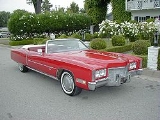
In 1976, when all other domestic convertibles had vanished, GM heavily promoted the American industry's only remaining convertible as "the last American convertible". 14,000 would be sold, many purchased as investments. The final 200 convertibles produced were designated as "Bicentennial Edition" commemorating America's 200th birthday. These cars were white with a dual-color red/blue pinstripe along the upper bodyside. In 1983, when GM reintroduced convertibles, 1976 Eldorado owners, who felt they had been deceived, launched an unsuccessful class action lawsuit.

Eldorado Biarritz


Unlike the Sixty Special and de Ville models, Eldorado didn't have a unique luxury package to provide it with a title change (such as the "d'Elegance" package). This was rectified in mid-year 1976 with the Biarritz package. The most unique feature of Biarritz, a name that hadn't been used since 1963, (the Fleetwood designation was used for all Eldorados produced from 1964 through late 1976) was a brushed stainless steel roof covering the front passenger compartment for model years 1979-1985. This was a styling cue reminiscent of the 1957/58 Eldorado Brougham. The rear half of the roof was covered with a heavily padded landau vinyl top accented with large "opera" lights. The interior featured "pillowed"-style, ("tufted") velour or leather seating, with contrasting piping, along with an array of other options available.

For example, the 1978 Biarritz option packages consisted of the Eldorado Custom Biarritz ($1,865.00); w/Astroroof ($2,946.00); w/Sunroof ($2,746.00) and Eldorado Custom Biarritz Classic ($2,466.00); w/Astroroof ($3,547.00); w/Sunroof ($3,347.00).

For the 1978 Eldorado model year only, there were 2,000 Eldorado Custom Biarritz Classics produced in Two-Tone Arizona Beige/Demitasse Brown consisting of 1,499 with no Astroroofs or no Sunroofs; 475 with Astroroofs; 25 with Sunroofs and only One (1) was produced with Power Sliding T-Tops.

The Biarritz option stayed with the Eldorado through the 1991 model year. Some of the original styling cues vanished after the 1985 model year, such as the brushed stainless steel roofing and the interior seating designs, but Biarritz remained unique just the same.

1978 Cadillac Eldorado with Power Sliding T-Tops


The 1978 Cadillac Eldorado was the only American luxury car in its class (or any car class) to be offered with Power Sliding T-Tops that folded neatly inside the center-front roof. In this regard, only seven 1978 Cadillac Eldorados were known to have been produced with Power Sliding T-Tops customized and manufactured by American Sunroof Company under the direction of General Motor’s Cadillac Motor Division. There are seven known 1978 Cadillac Eldorados with Power Sliding T-Tops remaining: One (1) Black Eldorado Cabriolet; One (1) Carmine Red Eldorado Cabriolet; One (1) Cotillion White Eldorado Cabriolet; One (1) Colonial Yellow Eldorado Custom Biarritz; Two (2) Cotillion White Eldorado Custom Biarritz and One (1) Two-Tone Arizona Beige/Demitasse Brown Eldorado Custom Biarritz Classic.

1979–1985


For 1979, a new, trimmer Eldorado was introduced, and for the first time the car shared its chassis with the Buick Riviera
Buick Riviera
The Riviera by Buick is an automobile produced by Buick in the United States from the 1963 to 1999 model years, with 1,127,261 produced.A full-size coupé or personal luxury car, the early models of the Riviera in particular have been highly praised by automotive journalists and writers.A common...

 as well as the Toronado. Smaller 350 and 368 in³ (5.7 and 6.0 L) V8's replaced the 500 and 425 in³ (8.2 and 7.0 L) of the preceding model, giving better fuel efficiency. For 1979, it was offered only with the Oldsmobile 350 as standard, with the diesel 350 available as an option. In 1980, the gas 350 was replaced with the Cadillac 368 except in California, where the Olds 350 was retained for that year. In both the 1980 Seville and Eldorado (which shared their frames), the 368s in 1980 came with DEFI, whereas for the larger RWD Cadillacs, the 368 only came with a 4-barrel Quadrjet carburetor. Independent rear suspension
Independent suspension
Independent suspension is a broad term for any automobile suspension system that allows each wheel on the same axle to move vertically independently of each other. This is contrasted with a beam axle, live axle or deDion axle system in which the wheels are linked – movement on one side affects...

 was adopted, helping retain rear-seat and trunk room in the smaller body. The most notable styling touch was an extreme notchback roofline, making the rear window almost vertical. The Eldorado Biarritz model resurrected the stainless-steel roof concept from the first Brougham. Although downsized, these Eldorados were still substantial-sized cars with good room and power. Contrary to the current body design of the time, the Eldorado continued to feature frameless door glass, and the rear quarter windows re-appeared as they did before 1971, without a thick "B" pillar. However, these cars were not true hardtops, as the rear quarter windows were fixed and could not be rolled down. Most people probably didn't even notice, since air conditioning was de rigueur for all the cars, and the coupe featured "hospital zone" quietness with the windows closed.

For 1981, Cadillac began offering the V8-6-4 variable displacement
Variable displacement
Variable displacement is an automobile engine technology that allows the engine displacement to change, usually by deactivating cylinders, for improved fuel economy. The technology is primarily used in large, multi-cylinder engines...

 variant of the 368 engine, which was designed to deactivate some cylinders when full power was not needed, helping meet GM's obligations under the government fuel economy ("CAFE") standards
Corporate Average Fuel Economy
The Corporate Average Fuel Economy are regulations in the United States, first enacted by the U.S. Congress in 1975, and intended to improve the average fuel economy of cars and light trucks sold in the US in the wake of the 1973 Arab Oil Embargo...

. Unfortunately, it did not work as planned, and sometimes did not work at all. It was a reduced bore version of the 1968 model-year 472, sharing that engine's stroke and also that of the model-year 1977–1979 425. The engine itself was extremely rugged and durable, but its complex electronics were the source of customer complaints.

Another problem with the 1981 model year was an unexplained balancing problem that affected the vehicle's overall handling. GM corrected this issue by installing a large, heavy steel plate under the driver's seat, a fact made popular by 1995's film Casino
Casino (film)
Casino is a 1995 crime drama film directed by Martin Scorsese. It is based on the non-fiction book of the same name by Nicholas Pileggi, who also co-wrote the screenplay for the film with Scorsese...

. The film's leading man Robert De Niro
Robert De Niro
Robert De Niro, Jr. is an American actor, director and producer. His first major film roles were in Bang the Drum Slowly and Mean Streets, both in 1973...

 survives a bomb explosion, where the explosive had been attached to his 1981 Eldorado's undercarriage, on the driver's side, with that steel plate effectively shielding his driver seat from the blast beneath; the steel plate is credited with saving his life. The film, including the Eldorado explosion incident, is based upon Frank Rosenthal's
Frank Rosenthal
Frank Lawrence "Lefty" Rosenthal was a professional sports bettor, former Las Vegas casino executive and organized crime associate. The film Casino is loosely based on his life.-Early years:...

 life story.

Another problematic engine was introduced for 1982. The 4.1 L HT-4100 was an in-house design that mated cast-iron heads to an aluminum block. HT-4100s failed in large numbers and many were replaced under warranty.

Nevertheless, the Eldorado's reputation was not permanently hurt, and sales rose to unprecedented heights, nearly 100,000 units by 1984, an astonishing volume for one of the most expensive models available.

In 1984, Cadillac also introduced a convertible version of Eldorado Biarritz. It was 200 pounds (91 kg) heavier, but featured the same interior as other Biarritz versions. The model year of 1985 was the last year for the ASC, Inc., aftermarket conversion Eldorado convertible. Because of its limited edition (around 3000 total), the convertible models are now highly sought after by numerous collectors.

1984 was also the first year electronic "digital" instrumentation was an available option. In addition to the digital electronic climate control that was standard on all Eldorados, the standard analog speedometer and fuel gauges could be replaced with a digital display showing speed in a single, precise, and instant number and a fuel gauge that would read the number of gallons of fuel remaining in the gas tank and another gauge showing approximately how many miles can be driven on it.

Prior to the 'official' 1984 and 1985 Eldorado convertibles marketed by Cadillac, some 1979-83 Eldorados were made into coach convertible
Coach convertible
Coach convertibles are convertibles built by independent shops, or coachbuilders, by converting closed cars into open ones. This practice filled, and to a small extent continues to fill a small void left by the auto industry...

s by independent coachbuilders e.g. American Sunroof Corporation, Custom Coach (Lima, Ohio - this coachbuilder turned a few 1977 and 1978 Eldorados into convertibles), Hess & Eisenhardt. The same coachbuilders also converted the Oldsmobile Toronado and Buick Riviera into a ragtop.

The very limited edition Commemorative Edition was produced in 1985. These are identified by special emblems on the trunk lid and sail panels as well as gold color door lock knobs and keys.

1986–1991


For 1986, yet another downsizing occurred, and it was fairly extreme. The Eldorado lost about 16" in length, and some 350 pounds in weight. The convertible was discontinued. Just like in previous generations, the Eldorado shared its chassis with the Oldsmobile Toronado
Oldsmobile Toronado
The original Toronado began as a design painting by Oldsmobile stylist David North in 1962. His design, dubbed the "Flame Red Car," was for a compact sports/personal car never intended for production...

 and Buick Riviera
Buick Riviera
The Riviera by Buick is an automobile produced by Buick in the United States from the 1963 to 1999 model years, with 1,127,261 produced.A full-size coupé or personal luxury car, the early models of the Riviera in particular have been highly praised by automotive journalists and writers.A common...

, as well as Eldorado's four-door companion, the Cadillac Seville
Cadillac Seville
The Cadillac Seville is a luxury-type car that was manufactured by the Cadillac division of American automaker General Motors from 1975 to 2004, as a smaller-sized top-of-the-line Cadillac...

. However, the coupes from Buick and Oldsmobile both utilized Buick's 3.8 liter V6 engine, while Cadillac continued to use their exclusive 4.1 liter V8. The $24,251 Eldorado was now the same size that GM's own compact cars had been only a few years earlier, and considerably smaller than Lincoln's competing Mark VII. Its styling seemed stubby, and in a final unfortunate flourish, for the first time the Eldorado abandoned its "hardtop" heritage and featured framed door glass. News reports later indicated that GM had been led astray by a consultant's prediction that gasoline would be at $3 per gallon in the U.S. by 1986, and that small luxury cars would be in demand. In fact, gasoline prices were less than half that. With a sales drop of 60%, seldom has any model experienced a more precipitous fall. Production was only about a fifth of what it had been just two years earlier.

Aside from a longer, 5 year/50,000 mile warranty, Eldorado received very few changes for 1987. A price drop, to $23,740, did not raise sales any, as only 17,775 were made this year (21,342 for 1986). The standard suspension, with new taller 75 series (previously 70) tires and hydro-elastic engine mounts, was slightly retuned for a softer ride, while the optional ($155) Touring Suspension, with deflected-disc strut valves and 15" alloy wheels, remained for those desiring a firmer ride. As part of a federal requirement to discourage "chop-shop" thieves, major body panels were etched with the VIN
Vin
Vin may refer to:*Voltage input, an alternative form for Vin-People:*Vin Diesel*Vin Scully*Vin Suprynowicz*Vin, the name of a character from the video games Jak II and Jak 3*a diminutive of the name "Vincent"...

. Also new, a combination cashmere cloth with leather upholstery, and locking inertia seat belt reels for rear seat passengers, which allowed for child-seat installation in the outboard seating positions in back. The formal cabriolet roof was added this year. Available for $495 on the base Eldorado, it featured a padded covering over the rear half of the roof, and turned the rear side glass into smaller opera windows. One of Eldorado's most expensive singluar options was the Motorola
Motorola
Motorola, Inc. was an American multinational telecommunications company based in Schaumburg, Illinois, which was eventually divided into two independent public companies, Motorola Mobility and Motorola Solutions on January 4, 2011, after losing $4.3 billion from 2007 to 2009...

 cellular telephone mounted inside the locking center arm rest. Priced at $2,850, it had been reworked this year for easier operation, and featured a hidden microphone mounted between the sun visors for hands-free operation. Additionally, the telephone featured a clever radio mute control: activated when the telephone and radio were in use at the same time, it automatically decreased the rear speaker's audio volume, and over-rode the front music speakers to be used for the hands-free telephone. On an interesting note, the square marker lamp, located on the bumper extension molding just behind the rear wheel well on 1986 and '87 Eldorado models, would suddenly re-appear on the 1990 & '91 Seville (base models only) and Eldorado Touring Coupe.

1988 was met with an extensive restyle, and sales nearly doubled from the previous year, up to 33,210. While the wheelbase, doors, roof, and glass remained relatively unchanged, new body panels gave the 1988 model a more identifiable "Eldorado" appearance. Now available in just 17 exterior colors (previously 19), the new Eldorado was 3" longer than last year. Underneath the restyled hood was Cadillac's new 155 horsepower 4.5 liter V8. A comprehensive anti-lock braking system, developed by Teves, was newly available. Longer front fenders held "bladed" tips, and a new grill above the revamped front bumper. In back, new three-sided tail lamps - reminiscent of the 1987 Deville - appeared along with a new bumper and trunk lid. Bladed 14" aluminum wheels remained standard, while an optional 15" snowflake-pattern alloy wheel was included with the Touring Suspension option. The interior held wider front seat headrests and swing-away door pull handles (replacing the former door pull straps). New upholstery patterns, along with shoulder belts for outboard rear-seat passengers, appeared for both base and Biarritz models, with the latter bringing back the tufted-button design - last seen in the 1985 Eldorado Biarritz. A new vinyl roof option, covering the full roof top, featured a band of body color above the side door and windows - similar to the style used until 1978. This replaced the "cabriolet roof" option, which covered the rear half of the roof, introduced just a year earlier. With the Biarritz option package, the padded vinyl roof covered just the rear quarter of the roof top, behind the rear side windows. Biarritz also included slender vertical opera lamps, as in 1986 and '87, but now added a spear molding (similar to the style used on the 1976 - 1985 Eldorado Biarritz) that ran from the base of the roof top, continuing horizontally along the door, and down to the front fender tip. The standard power antenna was moved from the front passenger fender to the rear passenger fender. Pricing went up this year - to $24,891. This 1988 restyle would be the last, until the model was replaced by an all-new Eldorado for 1992.
With such big changes for Eldorado just a year earlier, 1989 saw little that was new. The optional automatic rearview mirror went from a electrically-operated mechanical tilting mechanism to the new electrochromic style, using a clear fluid filled between the mirror and a thin sheet of glass, which tints upon activation. A new exterior color, White Diamond, brought the color choices up to 18. Gone were the 14" wheels, as the previously-optional 15" "snowflake" style aluminum wheel, introduced last year, was made standard for the base Eldorado. A compact disc player, available only with the Delco Bose
Bose
Bose may refer to:* Amar Gopal Bose, the chairman and founder of Bose Corporation* Baise City, or Bose, a prefecture-level city in Guangxi Zhuang Autonomous Region, China* Bose Corporation, an audio company* Bose , a lunar crater...

 Gold Series music system, was a new option this year, as was reversible floor mats, and gold-plated ornamentation ("Cadillac" grille and trunk scripts, sail panel ornaments, deck lid engine plaque, trunk lock cover, tail lamp emblems, and available wire wheel cover wreath and crest). New standard items include an express-down module for the driver's window, electronic oil-life indicator, a more powerful Delco Freedom II battery, a revised factory warranty, and GM's PASS (Passive Automotive Security System) KEY theft-deterrent system, which activated the fuel system based upon a coded pellet within the ignition key. Previously optional items that were now added as standard equipment included a cassette player with graphic equalizer, remote fuel filler door release, and a front license plate mounting. In an effort to use up existing warehouse stock, the brushed chrome lower bodyside accent molding, optional through last year, was added as standard equipment for 1989 (revamped moldings would appear in 1990). New high-gloss Birdseye Maple trim (replacing the satin-finished American Walnut used from 1986–1988) on the instrument panel and console was standard on Eldorado Biarritz, and available (for $245) on the base Eldorado. The optional full cabriolet roof, which re-created the dashing look of a convertible top, was offered this year in limited colors. Pricing rose again, now at $26,738. Production slipped slightly, down to 27,807 (including 7,174 Biarritz models). The dip in sales was partly due to competition from GM's own Buick Riviera
Buick Riviera
The Riviera by Buick is an automobile produced by Buick in the United States from the 1963 to 1999 model years, with 1,127,261 produced.A full-size coupé or personal luxury car, the early models of the Riviera in particular have been highly praised by automotive journalists and writers.A common...

, which grew 11" this year in a dramatic restyle, and had a production increase from 8,625 units in 1988 to 21,189 in 1989.

Aside from the new-for-1990 Touring Coupe model (see entry below) introduced later in the model year, it was a year of enhancement for Eldorado. A driver's side airbag was introduced as standard equipment, but as a result, the telescoping steering column was discontinued (although the tilt feature remained). Cruise control buttons were mounted on the center of the previous steering wheel, but with the advent of the air bag (mounted on a smaller diameter steering wheel), they were now moved to the turn signal stalk. A new multi-point fuel injection replaced the throttle-body style from last year, and horsepower jumped from 155 to 180, although the new system required the use of premium fuel. A new cast aluminum wheel design (not available with the Touring Suspension package) was optional for those customers who desired something different than the standard "snowflake" alloy wheel on the base Eldorado. Seating received numerous enhancements, including new molded trim panels, additional lateral and lumbar support, French seams, and revised front headrests. Full leather upholstery (formerly leather and cloth) was now standard on the Biarritz model, but the base model lost the seat-back map pockets. The cellular telephone disappeared from the option list, and the vinyl center armrest was revamped. The electronic climate control received an update in the form of three automatic and two manual settings. The optional leather upholstery package on the base model now included a power passenger seat recliner. Last year's "Eldorado Option Package" (which included new-style carpeted floor mats, body-color door edge guards, illuminated driver and passenger visor vanity mirrors, luggage compartment mat, and the illuminated entry system) was now standard. Additionally, previously optional items that were added as standard equipment this year included the rear window defogger with heated outside mirrors, and bodyside accent striping. New options for 1990 included a central-unlocking feature (from the outside door locks using the key) added to the automatic door locks. A revised deck-lid engine plaque now mentioned the port fuel injection, and the deck-lid itself held a chromed handle above the license plate opening. Also, the rear safety reflectors moved from the bumper onto the panel below the decklid this year. A new charcoal-colored vinyl strip accented the chrome bumper and bodyside moldings this year, while the front bumper guards changed from body-color to charcoal. In the front suspension, the stabilizer shaft was revised for ride and handling, while the tire jack located in the trunk had a new carpeted storage container. Price for 1990 was $28,885, with the Biarritz model an additional $3,180. Production dropped to 20,874 units, about 1/3 of which were the Biarritz model. An additional 1,507 Eldorado Touring Coupe models were made.

1991, the last year for this body style, was also the first year for Cadillac's new 4.9 liter V-8 engine with port fuel injection, teamed up with GM's 4T60-E electronically-controlled 4-speed transmission. Cadillac set apart the GM transmission from other corporate models it was shared with by the Cadillac-exclusive viscous converter clutch, which provided even smoother shifting under hard acceleration. Engine controls were monitored by the GMP4 Powertrain Control Module (PCM), an on-board 64-kilobyte computer. A new exhaust set-up with a wider catalytic converter reduced restriction by 38% from last year, while the 0-60 mph speed went from 9 seconds in 1990 to 8.2 for '91. Revised engine mounts prevented engine noise and vibration from affecting the cabin, while new the Computer Command Ride (CCR) system, optional on most other Cadillac models, was standard on Eldorado. CCR would automatically adapt the suspension mode with regard to vehicle speed for better handling and ride comfort. A $309 electrically-heated windshield was new to the option list this year, as was the available ($480 on base Eldorado, no charge on Biarritz or Touring Coupe) "Security Package" which now included remote keyless entry along with automatic door locks with central unlocking, and the theft-deterrent system. The Bosch II anti-lock braking system, previously a $925 option, was made standard this year, as well as a more powerful 140-amp alternator. A revised windshield washer system rounded out the changes for 1991. Base price was $31,245, almost $2,400 up from 1990, but the jump was not nearly as dramatic when considering the new powertrain and sophisticated suspension system, and that anti-lock brakes were now standard equipment, as well as other previously optional items that were now available at no-charge. In an effort to exhaust parts inventory - and to make Eldorado appear to be a better value in its last year of current style production, several optional items were available at no-charge on the base Eldorado, including choice of full vinyl roof covering or full-cabriolet (convertible-look) roof (an otherwise $1,095 option), leather upholstery with power passenger recliner, and the Delco-Bose sound system - with choice of CD or cassette. Additionally, both the $2,050 Touring Coupe and the $3,180 Biarritz packages included the power moon roof and Delco-BOSE stereo at no additional charge. This would be the last year for the Eldorado Biarritz. Production dropped to just 16,212 (including 2,249 Touring Coupe models), the lowest output seen since 1966.

1990–1991 Eldorado Touring Coupe


Although a touring suspension option had been available on Eldorado since 1980, there was an Eldorado Touring Coupe model introduced in mid-1982, and continued through 1985. In 1990, the Eldorado Touring Coupe (ETC), the 2-door version of the Seville Touring Sedan (STS), re-appeared. The car had a special handling and suspension package, quicker steering than the standard Eldorado, and a higher final drive ratio of 3.33:1 in contrast to the base model's 2.97:1. Badging was restricted to ETC badges on both C-pillars, a Cadillac crest on the grille along with the Cadillac script logo and a special "Cadillac Motor Car Company" badge on the trunk, which it shared with the STS. Available in Sable Black, Cotillion White, Medium Slate Gray Metallic, Black Sapphire Metallic (Dark Blue), and Crimson (Bright Red), all with a special beechwood interior. An additional color, Polo Green Metallic, was added for '91. The driver's outside rearview mirror held glass with a blue-tint to reduce glare from following vehicles. The model also featured body-colored door handles, wider side rocker panels, an additional marker lamp behind the rear wheel well, and dual rectangular exhausts. The international-theme tail lights, which were Touring Coupe specific, featured a distinct split-style with "amber above red" lenses.

Eldorado Touring Coupe production for 1990 was 1,507, with an additional 2,249 in 1991.

1992–2002


For 1992, Cadillac introduced a new, significantly larger Eldorado, approximately 11" longer than its predecessor. Window glass was once again frameless, and shortly after introduction Cadillac's new Northstar V8 became available in both 270 and 295 hp variants, replacing the 200 hp 4.9 L. Sales were up, though never again at record heights.

The Eldorado continued for the rest of the decade with incremental changes and tapering sales. A passenger side airbag was added as standard equipment in 1993. Fresh exterior styling - in the form of updated bumpers front and rear, side cladding, and a new grille - arrived for '95. 1996 featured a slightly revamped interior with a new upholstery sew style, larger analog gauge cluster, relocated climate control system, and updated stereo faces. In the wake of declining sales, circulating reports that the Eldorado would get a redesign for 1999 — similar to that which its Seville platform mate underwent for 1998 — would prove false as the car soldiered on largely unchanged into the new millennium, although it did get some upgrades from the 1999 Seville sister.

The car was also sold under the badge Cadillac ETC (Eldorado Touring Coupe) and ESC (Eldorado Sport Coupe).

Having lost its only remaining 2-door platform mate, the Buick Riviera
Buick Riviera
The Riviera by Buick is an automobile produced by Buick in the United States from the 1963 to 1999 model years, with 1,127,261 produced.A full-size coupé or personal luxury car, the early models of the Riviera in particular have been highly praised by automotive journalists and writers.A common...

, after the 1999 model year, rumors of the Eldorado's imminent demise began to circulate. GM showed a lowered, customized Eldorado-based concept at the 2000 North American International Auto Show
North American International Auto Show
The North American International Auto Show is an annual auto show held in Detroit, Michigan at Cobo Center, usually in January. It is among the largest auto shows in North America.-History:...

, which was called EldoRODo, to little media or public interest.

Not long after, GM announced that the Eldorado's 50th model year, 2002, would be its last.
To mark the end of the historic name, a limited production run 1,596 of cars in red or white - the colors available on the original 1953 convertible - were produced in three batches of 532, signifying the Eldorado's first year of production. These last cars had exhausts that were specially tuned to imitate the note of their illustrious forerunners from a half-century earlier, and a dash-mounted plaque indicating each car's sequence in production. The last Eldorado was delivered to the Cadillac Museum, in honor of Don Massey of Don Massey Cadillac - one of the largest Cadillac dealers in the United States. The second-to-last production Eldorado was sold to Nicola Bulgari
Bulgari
Bulgari is an Italian jeweler and luxury goods retailer which has been owned by the French firm LVMH since October 2011. The trademark is usually written "BVLGARI" in the classical Latin alphabet , and is derived from the surname of the company's Greek founder, Sotirio Voulgaris...

, the Italian jeweler and avid automotive aficionado. The car will reside with his collection in Rome, Italy. Production ended on April 22, 2002, with the Lansing Craft Centre
Lansing Craft Centre
The Lansing Craft Centre was a specialized General Motors automobile assembly factory in Lansing Township, Michigan. The plant started production in 1987 and closed in 2006...

 retooled to build the Chevrolet SSR
Chevrolet SSR
The Chevrolet SSR is a retractable hardtop convertible pickup truck manufactured by Chevrolet between 2003 and 2006....

.

External links


Product information on: