

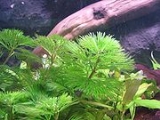
Cabombaceae

Encyclopedia
Cabombaceae is the botanical name
of a family of flowering plants. The family has been recognised as distinct by at least some taxonomists and by APG III
(2009). The family consists of two genera of aquatic plant
s, (Brasenia
and Cabomba
), totalling half-a-dozen species.
The APG system
of 1998 included this family in the water lily family Nymphaeaceae
, as did the APG II system
, of 2003 (optionally). The family is part of the order Nymphaeales
, which is one of the most basal flowering plant
lineages.
Botanical name
A botanical name is a formal scientific name conforming to the International Code of Botanical Nomenclature and, if it concerns a plant cultigen, the additional cultivar and/or Group epithets must conform to the International Code of Nomenclature for Cultivated Plants...
of a family of flowering plants. The family has been recognised as distinct by at least some taxonomists and by APG III
APG III system
The APG III system of flowering plant classification is the third version of a modern, mostly molecular-based, system of plant taxonomy...
(2009). The family consists of two genera of aquatic plant
Aquatic plant
Aquatic plants are plants that have adapted to living in aquatic environments. They are also referred to as hydrophytes or aquatic macrophytes. These plants require special adaptations for living submerged in water, or at the water's surface. Aquatic plants can only grow in water or in soil that is...
s, (Brasenia
Brasenia
Brasenia is a genus belonging to the family Cabombaceae, consisting of one extant species widely distributed in warm temperate and tropical regions of the world. Brasenia is an aquatic perennial plant with floating, peltate leaves and rhizomatous stems...
and Cabomba
Cabomba
Cabomba is an aquatic plant genus, one of two belonging to the family Cabombaceae. It has divided submerged leaves in the shape of a fan and is much favoured by aquarists as an ornamental and oxygenating plant for fishtanks...
), totalling half-a-dozen species.
The APG system
APG system
The APG system of plant classification is the first, now obsolete, version of a modern, mostly molecular-based, system of plant taxonomy that was published in 1998 by the Angiosperm Phylogeny Group. It was superseded in 2003 by a revision, the APG II system, and then in 2009 by a further...
of 1998 included this family in the water lily family Nymphaeaceae
Nymphaeaceae
Nymphaeaceae is a family of flowering plants. Members of this family are commonly called water lilies and live in freshwater areas in temperate and tropical climates around the world. The family contains eight genera. There are about 70 species of water lilies around the world. The genus...
, as did the APG II system
APG II system
The APG II system of plant classification is the second, now obsolete, version of a modern, mostly molecular-based, system of plant taxonomy that was published in April 2003 by the Angiosperm Phylogeny Group. It was a revision of the first APG system, published in 1998, and was superseded in 2009...
, of 2003 (optionally). The family is part of the order Nymphaeales
Nymphaeales
Nymphaeales is an order of plants, which consists of water lilies and other aquatic plants.This order is considered to be a basal, or early diverging, group of angiosperms...
, which is one of the most basal flowering plant
Flowering plant
The flowering plants , also known as Angiospermae or Magnoliophyta, are the most diverse group of land plants. Angiosperms are seed-producing plants like the gymnosperms and can be distinguished from the gymnosperms by a series of synapomorphies...
lineages.
External links
- Cabombaceae in L. Watson and M.J. Dallwitz (1992 onwards). The families of flowering plants: descriptions, illustrations, identification, information retrieval. Version: 3 May 2006. http://delta-intkey.com
- Cabombaceae in the Flora of North America
- Cabombaceae in the Flora of China
- NCBI Taxonomy Browser