
Home      Discussion      Topics      Dictionary      Almanac
Signup       Login
Butte

Butte

Overview
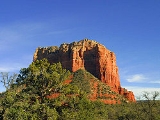
A butte is a conspicuous isolated hill with steep, often vertical sides and a small, relatively flat top; it is smaller than mesas, plateaus, and table landform tables. In some regions, such as the north central and northwestern United States, the word is used for any hill. The word butte comes from a French
French language
French is a Romance language spoken as a first language in France, the Romandy region in Switzerland, Wallonia and Brussels in Belgium, Monaco, the regions of Quebec and Acadia in Canada, and by various communities elsewhere. Second-language speakers of French are distributed throughout many parts...

 word meaning "small hill"; its use is prevalent in the western United States, including the southwest
Southwestern United States
The Southwestern United States is a region defined in different ways by different sources. Broad definitions include nearly a quarter of the United States, including Arizona, California, Colorado, Nevada, New Mexico, Oklahoma, Texas and Utah...

, where "mesa" is also used. Because of their distinctive shapes, buttes are frequently key landmarks in both plains and mountainous areas.
Discussion
Ask a question about 'Butte'
Start a new discussion about 'Butte'
Answer questions from other users
Full Discussion Forum
 
Recent Discussions
Encyclopedia
A butte is a conspicuous isolated hill with steep, often vertical sides and a small, relatively flat top; it is smaller than mesas, plateaus, and table landform tables. In some regions, such as the north central and northwestern United States, the word is used for any hill. The word butte comes from a French
French language
French is a Romance language spoken as a first language in France, the Romandy region in Switzerland, Wallonia and Brussels in Belgium, Monaco, the regions of Quebec and Acadia in Canada, and by various communities elsewhere. Second-language speakers of French are distributed throughout many parts...

 word meaning "small hill"; its use is prevalent in the western United States, including the southwest
Southwestern United States
The Southwestern United States is a region defined in different ways by different sources. Broad definitions include nearly a quarter of the United States, including Arizona, California, Colorado, Nevada, New Mexico, Oklahoma, Texas and Utah...

, where "mesa" is also used. Because of their distinctive shapes, buttes are frequently key landmarks in both plains and mountainous areas.

In differentiating mesas and buttes, geographers use the rule that a mesa has a top wider than its height, while a butte's top is narrower.

Three classic buttes are Scotts Bluff
Scotts Bluff National Monument
Scotts Bluff National Monument in western Nebraska includes an important 19th century landmark on the Oregon Trail and Mormon Trail. The National Monument contains multiple bluffs located on the south side of the North Platte River; it is named for one prominent bluff called Scotts Bluff, which...

 (actually a collection of five bluffs) in Nebraska
Nebraska
Nebraska is a state on the Great Plains of the Midwestern United States. The state's capital is Lincoln and its largest city is Omaha, on the Missouri River....

, Crested Butte
Crested Butte
Crested Butte is a mountain peak butte of the Elk Mountains in the U.S. State of Colorado. It is also a town with a population of about 2000 people. The greater area includes Crested Butte, Mt. Crested Butte, Riverland, Riverbend, and Crested Butte South....

 in Colorado
Colorado
Colorado is a U.S. state that encompasses much of the Rocky Mountains as well as the northeastern portion of the Colorado Plateau and the western edge of the Great Plains...

, and Elephant Butte
Elephant Butte Dam
Elephant Butte Dam or Elephant Butte Dike is a concrete gravity dam on the Rio Grande near Truth or Consequences, New Mexico. The river was dammed here, impounding the Elephant Butte Reservoir for recreation and agriculture, lessening the downstream flow from a Rio Bravo to a stream a foot deep.The...

 in New Mexico
New Mexico
New Mexico is a state located in the southwest and western regions of the United States. New Mexico is also usually considered one of the Mountain States. With a population density of 16 per square mile, New Mexico is the sixth-most sparsely inhabited U.S...

.

Among the well-known non-flat-topped buttes in the United States are Bear Butte
Bear Butte
Bear Butte is a geological butte feature located in western South Dakota, United States, that was established as a State Park in 1961. An important landmark and religious site for the Plains Indians tribes long before Europeans reached South Dakota, Bear Butte is called Mathó Pahá, or Bear...

, South Dakota
South Dakota
South Dakota is a state located in the Midwestern region of the United States. It is named after the Lakota and Dakota Sioux American Indian tribes. Once a part of Dakota Territory, South Dakota became a state on November 2, 1889. The state has an area of and an estimated population of just over...

, and Black Butte
Black Butte (Oregon)
Black Butte is a cinder cone butte located in Deschutes National Forest, northwest of the town of Sisters, Oregon. An extinct volcano, it is composed of basaltic andesite. The cone rises over the surrounding plateau. Black Butte is a striking feature just north of US Highway 20, which descends...

, Oregon
Oregon
Oregon is a state in the Pacific Northwest region of the United States. It is located on the Pacific coast, with Washington to the north, California to the south, Nevada on the southeast and Idaho to the east. The Columbia and Snake rivers delineate much of Oregon's northern and eastern...

. In many cases, buttes have been given other names that do not use the word butte, for example, Courthouse Rock, Nebraska. Also, some large hills that are technically not buttes have names using butte, an example of which is Kamiak Butte
Kamiak Butte
Kamiak Butte County Park is located in Whitman County, Washington between the towns of Palouse and Pullman in Eastern Washington, near the border of Idaho. It is named after Chief Kamiakin of the Yakama tribe....

 in Washington State.

Formation


Buttes are formed by erosion
Erosion
Erosion is when materials are removed from the surface and changed into something else. It only works by hydraulic actions and transport of solids in the natural environment, and leads to the deposition of these materials elsewhere...

 when hard caprock
Caprock
The Caprock is a region in the Panhandle of Texas . It is the land to the west of the Caprock Escarpment, which separates it from plains stretching to the east at a much lower elevation....

 covers a layer of softer rock
Rock (geology)
In geology, rock or stone is a naturally occurring solid aggregate of minerals and/or mineraloids.The Earth's outer solid layer, the lithosphere, is made of rock. In general rocks are of three types, namely, igneous, sedimentary, and metamorphic...

 that is eventually worn away. The hard rock thus resists erosion
Erosion
Erosion is when materials are removed from the surface and changed into something else. It only works by hydraulic actions and transport of solids in the natural environment, and leads to the deposition of these materials elsewhere...

. On a much smaller scale, the same process forms hoodoo
Hoodoo (geology)
A hoodoo is a tall, thin spire of rock that protrudes from the bottom of an arid drainage basin or badland. Hoodoos consist of relatively soft rock topped by harder, less easily eroded stone that protects each column from the elements...

s. The caprock provides protection for the less resistant rock below from wind abrasion which leaves it standing isolated. As the top is further eroded by abrasion and weathering the excess material that falls away builds up the base.

See also


  • Caprock
    Caprock
    The Caprock is a region in the Panhandle of Texas . It is the land to the west of the Caprock Escarpment, which separates it from plains stretching to the east at a much lower elevation....

  • Caprock Escarpment
    Caprock Escarpment
    The Caprock Escarpment is a term used in Texas and Eastern New Mexico to describe the geographical transition point between the level elevated plains of the Llano Estacado and the surrounding rolling terrain. In Texas, the escarpment stretches around 320 km south-southwest from the northeast...

  • Megalith
    Megalith
    A megalith is a large stone that has been used to construct a structure or monument, either alone or together with other stones. Megalithic describes structures made of such large stones, utilizing an interlocking system without the use of mortar or cement.The word 'megalith' comes from the Ancient...

  • Monadnock
    Monadnock
    A monadnock or inselberg is an isolated rock hill, knob, ridge, or small mountain that rises abruptly from a gently sloping or virtually level surrounding plain...

  • Monolith
    Monolith
    A monolith is a geological feature such as a mountain, consisting of a single massive stone or rock, or a single piece of rock placed as, or within, a monument...

  • Potrero
    Potrero (landform)
    A potrero is a long mesa that at one end slopes upward to higher terrain. This landform commonly occurs on the flanks of a mountain, as part of a dissected plateau....

  • Table mountain
    Table Mountain
    Table Mountain is a flat-topped mountain forming a prominent landmark overlooking the city of Cape Town in South Africa, and is featured in the flag of Cape Town and other local government insignia. It is a significant tourist attraction, with many visitors using the cableway or hiking to the top...

  • Tepui
    Tepui
    A tepui , or tepuy, is a table-top mountain or mesa found in the Guiana Highlands of South America, especially in Venezuela. The word tepui means "house of the gods" in the native tongue of the Pemon, the indigenous people who inhabit the Gran Sabana....

  • Tuya
    Tuya
    A tuya is a type of distinctive, flat-topped, steep-sided volcano formed when lava erupts through a thick glacier or ice sheet. They are somewhat rare worldwide, being confined to regions which were covered by glaciers and also had active volcanism during the same time period.-Formation:Tuyas are...


External links