


Bumper

Encyclopedia
An automobile's bumper is the front-most or rear-most part, ostensibly designed to allow the car to sustain an impact without damage to the vehicle's safety systems. They are not capable of reducing injury to vehicle occupants in high-speed impacts, but are increasingly being designed to mitigate injury
to pedestrian
s struck by cars.
(NHTSA) issued the country's first regulation applicable to passenger car bumpers. Federal Motor Vehicle Safety Standard No. 215 (FMVSS 215), "Exterior Protection," took effect on 1 September 1972 — when most automakers would begin producing their model year
1973 vehicles. The standard prohibited functional damage to specified safety-related components such as headlamp
s and fuel system components when the vehicle is subjected to barrier crash tests at 5 miles per hour (8 km/h) for front and 2.5 miles per hour (4 km/h) for rear bumper systems. In October 1972, the U.S. Congress
enacted the Motor Vehicle Information and Cost Saving Act (MVICS), which required NHTSA to issue a bumper standard that yields the "maximum feasible reduction of cost to the public and to the consumer". Factors considered included the costs and benefits of implementation, the standard's effect on insurance costs and legal fees, savings in consumer time and inconvenience, and health and safety considerations.
The 1973 model year passenger cars sold in the U.S. used a variety designs. They ranged from non-dynamic versions with solid rubber guards, to "recoverable" designs with oil and nitrogen filled telescoping shock-absorbers.
The standards were further beefed up for the 1974 model year passenger cars with standardized height front and rear bumpers that could take angle impacts at 5 miles per hour (2 m/s) with no damage to the car's lights, safety equipment, and engine. This often meant additional overall vehicle length, as well as new front and rear designs to incorporate the stronger energy absorbing bumpers.
at 49CFR581, separate from the Federal Motor Vehicle Safety Standards at 49CFR571. The new requirements, applicable to 1979-model passenger cars, were called the Phase I standard. At the same time, a zero-damage requirement, Phase II, was enacted for bumper systems on 1980 and newer cars. The most rigorous requirements applied to 1980 through 1982 model vehicles; 5 miles per hour (8 km/h) front and rear barrier and pendulum crash tests were required, and no damage was allowed to the bumper beyond a 3/8 in dent and 3/4 in displacement from the bumper's original position.
pledge to reduce regulatory burdens on industry, NHTSA most recently amended the bumper standard in May 1982, halving the front and rear crash test speeds for 1983 and newer car bumpers from 5 miles per hour (8 km/h) to 2.5 miles per hour (4 km/h), and the corner crash test speeds from 3 miles per hour (5 km/h) to 1.5 miles per hour (2 km/h). In addition, the zero-damage Phase II requirement was rolled back to the damage allowances of Phase I. At the same time, a passenger car bumper height requirements of 16 to 20 in (40.6 to 50.8 cm) was established for passenger cars. At that time, NHTSA promised to conduct research and testing to provide consumers with accurate information on the quality of new car bumpers, but no such information has been provided.
Consumer and insurance groups have decried the weakened bumper standard, saying it has increased consumer costs without any attendant benefits except to automakers.
In 1986, Consumers Union
petitioned NHTSA to return to the Phase II standard and disclose bumper strength information to consumers. In 1990, NHTSA rejected that petition.
The weakened regulations permitted automakers to design bumpers with emphasis on style and low cost; protection dropped substantially and repair costs rose. In 1990, IIHS conducted four crash tests on three different-year examples of the Plymouth Horizon
. The results illustrated the effect of the changes to the U.S. bumper regulations (repair costs quoted in 1990 United States dollar
s):
In early 2009, Canada's regulation shifted to harmonize with U.S. Federal standards and international ECE regulations
. Consumer groups are upset with the change, but Canadian regulators assert that the 4 km/h (2.5 mph) test speed is used worldwide and is more compatible with improved pedestrian protection
in vehicle-pedestrian crashes.
Cars were equipped with bulky, massive, heavy, protruding bumpers to comply with the bumper standards of the 1970s and early 1980s. By the late 1980s most bumpers were concealed by a painted thermoplastic fascia
.
Pedestrian safety through vehicle design
Almost two-thirds of the 1.2 million people killed annually in road traffic crashes worldwide are pedestrians. Despite the magnitude of the problem, most attempts at reducing pedestrian deaths have focused solely on education and traffic regulation...
to pedestrian
Pedestrian
A pedestrian is a person traveling on foot, whether walking or running. In some communities, those traveling using roller skates or skateboards are also considered to be pedestrians. In modern times, the term mostly refers to someone walking on a road or footpath, but this was not the case...
s struck by cars.
Presence
In most jurisdictions, bumpers are legally required on all vehicles. The height and placement of bumpers may be legally specified as well, to ensure that when vehicles of different heights are in an accident, the smaller vehicle will not slide under the larger vehicle.North America
| Front and rear bumpers on Chrysler A platform Chrysler A platform Chrysler's A platform was the basis for smaller rear wheel drive cars in the 1960s. These cars are sometimes referred to as A-body cars.Cars using the A platform in various markets around the world include:* 1960-1976 Plymouth Valiant... cars before (left, 1971) and after (right, 1974) the U.S. 5-mph bumper standard took effect. The 1974 bumpers are larger, heavier, and mounted farther away from the body, and they no longer contain the taillamps Automotive lighting The lighting system of a motor vehicle consists of lighting and signalling devices mounted or integrated to the front, sides, rear, and in some cases the top of the motor vehicle... . |
|
USA
First standards
In 1971, the U.S. National Highway Traffic Safety AdministrationNational Highway Traffic Safety Administration
The National Highway Traffic Safety Administration is an agency of the Executive Branch of the U.S. government, part of the Department of Transportation...
(NHTSA) issued the country's first regulation applicable to passenger car bumpers. Federal Motor Vehicle Safety Standard No. 215 (FMVSS 215), "Exterior Protection," took effect on 1 September 1972 — when most automakers would begin producing their model year
Model year
The model year of a product is a number used worldwide, but with a high level of prominence in North America, to describe approximately when a product was produced, and indicates the coinciding base specification of that product....
1973 vehicles. The standard prohibited functional damage to specified safety-related components such as headlamp
Headlamp
A headlamp is a lamp, usually attached to the front of a vehicle such as a car or a motorcycle, with the purpose of illuminating the road ahead during periods of low visibility, such as darkness or precipitation. Headlamp performance has steadily improved throughout the automobile age, spurred by...
s and fuel system components when the vehicle is subjected to barrier crash tests at 5 miles per hour (8 km/h) for front and 2.5 miles per hour (4 km/h) for rear bumper systems. In October 1972, the U.S. Congress
United States Congress
The United States Congress is the bicameral legislature of the federal government of the United States, consisting of the Senate and the House of Representatives. The Congress meets in the United States Capitol in Washington, D.C....
enacted the Motor Vehicle Information and Cost Saving Act (MVICS), which required NHTSA to issue a bumper standard that yields the "maximum feasible reduction of cost to the public and to the consumer". Factors considered included the costs and benefits of implementation, the standard's effect on insurance costs and legal fees, savings in consumer time and inconvenience, and health and safety considerations.
The 1973 model year passenger cars sold in the U.S. used a variety designs. They ranged from non-dynamic versions with solid rubber guards, to "recoverable" designs with oil and nitrogen filled telescoping shock-absorbers.
The standards were further beefed up for the 1974 model year passenger cars with standardized height front and rear bumpers that could take angle impacts at 5 miles per hour (2 m/s) with no damage to the car's lights, safety equipment, and engine. This often meant additional overall vehicle length, as well as new front and rear designs to incorporate the stronger energy absorbing bumpers.
Strengthening standards
The requirements promulgated under MVICS were consolidated with the requirements of Federal Motor Vehicle Safety Standard Number 215 (FMVSS 215, "Exterior Protection of Vehicles") and promulgated in March 1976. This new bumper standard was placed in the United States Code of Federal RegulationsCode of Federal Regulations
The Code of Federal Regulations is the codification of the general and permanent rules and regulations published in the Federal Register by the executive departments and agencies of the Federal Government of the United States.The CFR is published by the Office of the Federal Register, an agency...
at 49CFR581, separate from the Federal Motor Vehicle Safety Standards at 49CFR571. The new requirements, applicable to 1979-model passenger cars, were called the Phase I standard. At the same time, a zero-damage requirement, Phase II, was enacted for bumper systems on 1980 and newer cars. The most rigorous requirements applied to 1980 through 1982 model vehicles; 5 miles per hour (8 km/h) front and rear barrier and pendulum crash tests were required, and no damage was allowed to the bumper beyond a 3/8 in dent and 3/4 in displacement from the bumper's original position.
Weakening standards
Facing pressure from automakers, and operating under the Reagan administration'sRonald Reagan
Ronald Wilson Reagan was the 40th President of the United States , the 33rd Governor of California and, prior to that, a radio, film and television actor....
pledge to reduce regulatory burdens on industry, NHTSA most recently amended the bumper standard in May 1982, halving the front and rear crash test speeds for 1983 and newer car bumpers from 5 miles per hour (8 km/h) to 2.5 miles per hour (4 km/h), and the corner crash test speeds from 3 miles per hour (5 km/h) to 1.5 miles per hour (2 km/h). In addition, the zero-damage Phase II requirement was rolled back to the damage allowances of Phase I. At the same time, a passenger car bumper height requirements of 16 to 20 in (40.6 to 50.8 cm) was established for passenger cars. At that time, NHTSA promised to conduct research and testing to provide consumers with accurate information on the quality of new car bumpers, but no such information has been provided.
Consumer and insurance groups have decried the weakened bumper standard, saying it has increased consumer costs without any attendant benefits except to automakers.
In 1986, Consumers Union
Consumers Union
Consumers Union is a non-profit organization best known as the publisher of Consumer Reports, based in the United States. Its mission is to "test products, inform the public, and protect consumers."...
petitioned NHTSA to return to the Phase II standard and disclose bumper strength information to consumers. In 1990, NHTSA rejected that petition.
The weakened regulations permitted automakers to design bumpers with emphasis on style and low cost; protection dropped substantially and repair costs rose. In 1990, IIHS conducted four crash tests on three different-year examples of the Plymouth Horizon
Dodge Omni
The Dodge Omni and the similar Plymouth Horizon were front wheel drive cars introduced by the Dodge and Plymouth divisions of the Chrysler Corporation in North America in 1978, and were based on a European Simca-based design of the same name...
. The results illustrated the effect of the changes to the U.S. bumper regulations (repair costs quoted in 1990 United States dollar
United States dollar
The United States dollar , also referred to as the American dollar, is the official currency of the United States of America. It is divided into 100 smaller units called cents or pennies....
s):
- 1983 Horizon with Phase-II 5-mph bumpers: $287
- 1983 Horizon with Phase-I 2.5-mph bumpers: $918
- 1990 Horizon: $1,476
Canada
Canada's bumper standard, first enacted at the same time as that of the United States, was generally similar to the U.S. regulation. However, the Canadian standard was not weakened from 8 km/h (5 mph) to 4 km/h (2.5 mph) in accord with the weakened U.S. standard of 1983. Some automakers chose to provide stronger Canadian-specification bumpers throughout the North American market, while others chose to provide weaker bumpers in the U.S. market, which hampered private importation of vehicles from the U.S. to Canada.In early 2009, Canada's regulation shifted to harmonize with U.S. Federal standards and international ECE regulations
World Forum for Harmonization of Vehicle Regulations
The World Forum for Harmonization of Vehicle Regulations is a working party of the United Nations Economic Commission for Europe...
. Consumer groups are upset with the change, but Canadian regulators assert that the 4 km/h (2.5 mph) test speed is used worldwide and is more compatible with improved pedestrian protection
Pedestrian safety through vehicle design
Almost two-thirds of the 1.2 million people killed annually in road traffic crashes worldwide are pedestrians. Despite the magnitude of the problem, most attempts at reducing pedestrian deaths have focused solely on education and traffic regulation...
in vehicle-pedestrian crashes.
Regulatory effect on design
 |
 |
 |
|
| Front bumpers on BMW E28 BMW E28 The BMW E28 BMW 5-Series was made between 1981 and 1988. It replaced the BMW E12 in 1981 and was replaced by the BMW E34 in 1989.E28 Production started in July 1981 and ended in December 1987... 5-series (top) and Audi 90 (bottom): U.S. (left) and rest-of-world (right). The U.S. bumpers are more massive and protrude farther from the bodywork. |
|
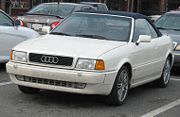
Cars were equipped with bulky, massive, heavy, protruding bumpers to comply with the bumper standards of the 1970s and early 1980s. By the late 1980s most bumpers were concealed by a painted thermoplastic fascia
Fascia (car)
Confusingly, fascia is used for several different things in the automotive world. Many of these meanings are related to the appearance of the car....
.