
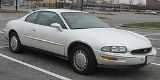
The Riviera by Buick is an
automobileAn automobile, autocar, motor car or car is a wheeled motor vehicle used for transporting passengers, which also carries its own engine or motor...
produced by
BuickBuick is a premium brand of General Motors . Buick models are sold in the United States, Canada, Mexico, China, Taiwan, and Israel, with China being its largest market. Buick holds the distinction as the oldest active American make...
in the
United StatesThe United States of America is a federal constitutional republic comprising fifty states and a federal district...
from the 1963 to 1999
model yearThe model year of a product is a number used worldwide, but with a high level of prominence in North America, to describe approximately when a product was produced, and indicates the coinciding base specification of that product....
s, with 1,127,261 produced.
A full-size
coupéA coupé or coupe is a closed car body style , the precise definition of which varies from manufacturer to manufacturer, and over time...
or
personal luxury carA personal luxury car is a highly styled, luxury vehicle with an emphasis on image over practicality. Accenting the comfort and satisfaction of its owner and driver above all else, the personal luxury car sometimes sacrifices passenger capacity, cargo room, and fuel economy in favor of style and...
, the early models of the Riviera in particular have been highly praised by automotive journalists and writers.
A common misconception is that all Rivieras produced after the 1965 model are front wheel drive cars; this is true only of the 1979-1999 models. The Riviera's stablemate, the
Oldsmobile ToronadoThe original Toronado began as a design painting by Oldsmobile stylist David North in 1962. His design, dubbed the "Flame Red Car," was for a compact sports/personal car never intended for production...
, was always front wheel drive, however, as was the
Cadillac EldoradoThe 1953 Eldorado was a special-bodied, low-production convertible . It was the production version of the 1952 El Dorado "Golden Anniversary" concept car, and borrowed bumper bullets from the 1951 GM Le Sabre show car...
beginning in 1967.
Origin of the name
The Riviera name first entered the
BuickBuick is a premium brand of General Motors . Buick models are sold in the United States, Canada, Mexico, China, Taiwan, and Israel, with China being its largest market. Buick holds the distinction as the oldest active American make...
line in 1949 as the designation for the new two-door pillarless
hardtopA hardtop is a term for a rigid, rather than canvas, automobile roof. It has been used in several contexts: detachable hardtops, retractable hardtop roofs, and the so-called pillarless hardtop body style....
, which was described in advertising as "stunningly smart." The Buick Roadmaster Riviera coupe (along with the
Cadillac Coupe de VilleThe Coupe de Ville was a model of the Cadillac marque of General Motors from 1949 through 1993.- Early History :The name "de Ville" is from the French de la ville or de ville meaning "of the town"...
and
Oldsmobile 98The Oldsmobile 98 was a full-size automobile and the flagship model of the Oldsmobile division of General Motors. The name first appeared in 1941 and was used again after American consumer automobile production resumed post-World War II...
Holiday coupe) constituted the first mass production use of this body style, which was to become extremely popular over the next 30 years.
From 1950 to 1953 the "Riviera" designation was also used on versions of the 4-door Buick Roadmaster and Super sedans. The 1950-53 Buick Roadmaster and Super Riviera 4-door sedan featured more standard features, more plush interior trim and, most significantly, a wheelbase (and overall length) that was 4 inches (102 mm) longer than a regular Buick Roadmaster or Super 4-door sedan. The 1950-53 Buick Super Riviera 4-door sedan was still 0.75 inches shorter in wheelbase and length than the regular Buick Roadmaster and 4.75 inches shorter than the Roadmaster Riviera 4-door sedan.
Starting in 1955
GMGeneral Motors Company , commonly known as GM, formerly incorporated as General Motors Corporation, is an American multinational automotive corporation headquartered in Detroit, Michigan and the world's second-largest automaker in 2010...
also offered a four-door pillarless hardtop body style, and the "Riviera" designation was also applied to these models. Riviera
hardtopA hardtop is a term for a rigid, rather than canvas, automobile roof. It has been used in several contexts: detachable hardtops, retractable hardtop roofs, and the so-called pillarless hardtop body style....
bodies were offered on all Buick lines in the next few years, including the
Buick RoadmasterThe Roadmaster was an automobile built by the Buick division of General Motors. Roadmasters produced between 1936 and 1958 were built on Buick's longest non-limousine wheelbase and shared their basic structure with senior Oldsmobiles. Between 1946 and 1957 the Roadmaster was Buick's top of the line...
,
Buick SuperThe Buick Super is a full-sized automobile produced from 1940–1958 ; it was built on Buick's larger body shared with the Roadmaster. It and the Roadmaster were replaced by the new Electra in 1959....
,
Buick CenturyBuick Century is the model name used by the Buick division of General Motors for a line of full-size performance vehicles from 1936 to 1942 and 1954 to 1958, and from 1973 to 2005 for a mid-size car....
, and
Buick SpecialIn 1962, the Special was the first American car to use a V6 engine in volume production; it earned Motor Trends Car of the Year for 1962. This 198 in³ Fireball was engineered down from the 215 and used many of the same design parameters, but was cast in iron. Output was 135 hp at...
. Since it was a body style designation and not a model, however, the Riviera name did not usually appear on the car. The last usage of the term "Riviera" to describe hardtops was 1963, as the formal designation of the #4829 Electra 225 Riviera four-door hardtop. Coincidentally, this was the same year the Riviera would become a separate model in its own right.
Origins of the personal luxury car
In the late 1950s, GM began to feel the need for a
personal luxury carA personal luxury car is a highly styled, luxury vehicle with an emphasis on image over practicality. Accenting the comfort and satisfaction of its owner and driver above all else, the personal luxury car sometimes sacrifices passenger capacity, cargo room, and fuel economy in favor of style and...
to compete with the highly successful
Ford ThunderbirdThe Thunderbird , is an automobile manufactured by the Ford Motor Company in the United States over eleven model generations from 1955 through 2005...
— a uniquely styled, two-door, four-passenger car with an image of both comfort and performance. The design that became the first Riviera was created as a Cadillac model, the XP-715, possibly to be called LaSalle, after
CadillacCadillac is an American luxury vehicle marque owned by General Motors . Cadillac vehicles are sold in over 50 countries and territories, but mostly in North America. Cadillac is currently the second oldest American automobile manufacturer behind fellow GM marque Buick and is among the oldest...
's smaller "companion" car of the 1930s. Its styling was reportedly inspired by GM styling chief Bill Mitchell's visit to
LondonLondon is the capital city of :England and the :United Kingdom, the largest metropolitan area in the United Kingdom, and the largest urban zone in the European Union by most measures. Located on the River Thames, London has been a major settlement for two millennia, its history going back to its...
during the period, when he was struck by the sight of an elegant, custom-bodied Rolls Royce in the fog. He later said that "knife-edged" styling was what he wanted for the new model, but with a lower profile and a bit of
FerrariFerrari S.p.A. is an Italian sports car manufacturer based in Maranello, Italy. Founded by Enzo Ferrari in 1929, as Scuderia Ferrari, the company sponsored drivers and manufactured race cars before moving into production of street-legal vehicles as Ferrari S.p.A. in 1947...
thrown in for performance. The design itself was penned by stylist Ned Nickles.
The management of
CadillacCadillac is an American luxury vehicle marque owned by General Motors . Cadillac vehicles are sold in over 50 countries and territories, but mostly in North America. Cadillac is currently the second oldest American automobile manufacturer behind fellow GM marque Buick and is among the oldest...
was not particularly interested, since the division was very successful at the time and needed all their production capacity for their existing models. In an unusual move, in 1960 the project was thrown open for competition by the other divisions. Buick, which was desperate to revive its flagging sales, enlisted the aid of the McCann-Erickson advertising agency, with which it had just signed, to create its presentation. Buick won, and the finished design was adapted to a shortened version of Buick's
cruciform frameA chassis consists of an internal framework that supports a man-made object. It is analogous to an animal's skeleton. An example of a chassis is the underpart of a motor vehicle, consisting of the frame with the wheels and machinery.- Vehicles :In the case of vehicles, the term chassis means the...
. The design was substantially the same as the original, although the hidden headlights — originally concealed in the fender grilles — were initially omitted for cost reasons.
First generation (1963–1965)
The production Riviera shared its bodyshell with no other model, which was unusual for a GM product. It rode a cruciform frame similar to the standard Buick frame, but shorter and narrower, with a 2 in (50.8 mm) narrower track. Its
wheelbaseIn both road and rail vehicles, the wheelbase is the distance between the centers of the front and rear wheels.- Road :In automobiles, the wheelbase is the horizontal distance between the center of the front wheel and the center of the rear wheel...
of 117 in (2,971.8 mm) and overall length of 208 in (5,283.2 mm) were 6 inches (152.4 mm) and 7.7 in (195.6 mm) shorter, respectively, than a
Buick LeSabre1959LeSabre and all other 1959 Buicks not only got new names, but all-new styling as well, adopting the new GM B- and C-body used on all of the corporation's full-sized cars...
, but slightly longer than a contemporary Thunderbird. At 3998 lb (1,813.5 kg), it was about 390 pounds (176.9 kg) lighter than either. It shared the standard
Buick V8 engineLike its sister General Motors divisions, Buick produced its own family of V8 engines to replace its straight-8 engines. These engines came in many of the same displacements as those from other divisions, but were entirely different.-Buick "Nailhead V8":...
s, with a displacement of either 401 cu in (6.6 l) or 425 cu in (7 l), and the unique continuously-variable design
Twin TurbineDynaflow was the trademark name for a type of automatic transmission developed and built by General Motors' Buick Motor Division from the late 1940s to the mid 1963...
automatic transmissionAn automatic transmission is one type of motor vehicle transmission that can automatically change gear ratios as the vehicle moves, freeing the driver from having to shift gears manually...
. Power brakes were standard, using Buick's massive "Al-Fin" (aluminum finned) drums of 12 in (304.8 mm) diameter.
Power steeringPower steering helps drivers steer vehicles by augmenting steering effort of the steering wheel.Hydraulic or electric actuators add controlled energy to the steering mechanism, so the driver needs to provide only modest effort regardless of conditions. Power steering helps considerably when a...
was standard equipment, with an overall
steering ratioSteering ratio refers to the ratio between the turn of the steering wheel or handlebars and the turn of the wheels .The steering ratio, is the amount of degrees you have to turn the steering wheel, for the wheels to turn an amount of degrees.In motorcycles and bicycles, the steering ratio is...
of 20.5:1, giving 3.5 turns lock-to-lock.
The Riviera's
suspensionSuspension is the term given to the system of springs, shock absorbers and linkages that connects a vehicle to its wheels. Suspension systems serve a dual purpose — contributing to the car's roadholding/handling and braking for good active safety and driving pleasure, and keeping vehicle occupants...
used the same basic design as standard Buicks, with
double wishbonesIn automobiles, a double wishbone suspension is an independent suspension design using two wishbone-shaped arms to locate the wheel. Each wishbone or arm has two mounting points to the chassis and one joint at the knuckle. The shock absorber and coil spring mount to the wishbones to control...
front and a
live axleA live axle, sometimes called a solid axle, is a type of beam axle suspension system that uses the driveshafts that transmit power to the wheels to connect the wheels laterally so that they move together as a unit....
located by
trailing armthumb|220px|Trailing arm rear suspension of [[Front-engine, front-wheel drive layout|FF]] carsA trailing-arm suspension is an automobile suspension design in which one or more arms are connected between the axle and the chassis. It is usually used on rear axles...
s and a lateral
track barA Panhard rod is a component of a car suspension system that provides lateral location of the axle...
, but the
roll centerThe roll center of a vehicle is the notional point at which the cornering forces in the suspension are reacted to the vehicle body.-Theory:There are two definitions of roll center...
s were raised to reduce body lean. Although its
coil springA Coil spring, also known as a helical spring, is a mechanical device, which is typically used to store energy and subsequently release it, to absorb shock, or to maintain a force between contacting surfaces...
s were actually slightly softer than other Buicks, with the lighter overall weight, the net effect was to make the Riviera somewhat firmer. Although still biased towards
understeerUndersteer and oversteer are vehicle dynamics terms used to describe the sensitivity of a vehicle to steering. Simply put, oversteer is what occurs when a car turns by more than the amount commanded by the driver...
, contemporary testers considered it one of the most roadable American cars, with an excellent balance of comfort and agility.
The Riviera was introduced on October 4, 1962 as a 1963 model, with the 325 hp 401 cu in (6.6 l) "Nailhead" V-8 as the only available engine, fitted with dual exhaust as standard equipment, and the Turbine Drive the only transmission, at a base price of $4,333; typical delivered prices with options ran upwards of $5,000. Buick announced in December, 1962, the availability of a 340 hp 425 cu in (7 l) version of the Nailhead as an option. Total production was deliberately limited to 40,000 vehicles to increase demand; only 2,601 of them were delivered with the 425 cu in (7 l) engine in the 1963 model year.
With the same power as the larger Buicks and less weight, the Riviera had sparkling all-around performance:
Motor TrendMotor Trend is an American automobile magazine. It first appeared in September 1949, issued by Petersen Publishing Company in Los Angeles, and bearing the tag line "The Magazine for a Motoring World". Petersen Publishing was sold to British publisher EMAP in 1998, who sold the former Petersen...
found it capable of running 0–60 mph (0–96.6 km/h) in 8 seconds or less, the standing quarter mile in about 16 seconds, and an observed top speed of 115 miles per hour (185.1 km/h), although 125 miles per hour (201.2 km/h) was feasible with a longer run. Fuel economy was a meager 13.2 mpgus . Front leg room was 40.1 inches.
Inside, the Riviera featured a four-place cabin with front bucket seats separated by a center console with floor shifter and storage compartment that was built into the instrument panel, and bucket-style seats in the rear. Upholstery choices included all-vinyl, cloth and vinyl, or optional leather. A deluxe interior option included real walnut inserts on the doors and below the rear side windows. Popular extra-cost options included a tilt steering wheel, power windows, power driver's seat, air conditioning, a remote-control side view mirror, and white sidewall tires.
The Riviera continued with minimal trim changes for 1964 including the discontinuation of leather upholstery from the option list, differing mainly in substitution of the old Dynaflow-based Twin Turbine for the new three-speed Super Turbine 400, which was marketed as Turbo Hydra-Matic by other GM divisions. This was the first year that the
Stylized "R" emblem was used on the Riviera, a trademark that would continue throughout the remainder of Riviera's 36-year production run. Under the hood, the 401 cu in (6.6 l) was dropped in favor of the 340 hp 425 cu in (7 l) V8. A 'Super Wildcat' version was optionally available, with dual Carter AFB four-barrel
carburetorA carburetor , carburettor, or carburetter is a device that blends air and fuel for an internal combustion engine. It is sometimes shortened to carb in North America and the United Kingdom....
s, rated at 360 hp.
Changes for 1965 included the introduction of the Gran Sport option, which included the dual-quad Super Wildcat 425 V8, a numerically higher 3.42 axle ratio, and stiffer, heavy-duty suspension. The stock dual exhaust pipes were increased from 2 inches (50.8 mm) to 2.25 inches (57.2 mm) inside diameter and had less turns to reduce backpressure. The 401 cu in (6.6 l) V8 returned as the standard Riviera engine and the Super Turbine 400 transmission now had a variable pitch torque converter like the old Twin Turbine Dynaflow had two years before. Externally, the headlamps were concealed behind clamshell doors in the leading edges of each fender, as in the original design. Further back, the non-functional side scoops between the doors and rear wheel arches were removed, and the taillights were moved from the body into the rear bumper. A
vinyl roofVinyl roof refers to a vinyl covering for an automobile's top. This covering was originally designed to give the appearance of a convertible to models with a fixed roof, but eventually it evolved into a styling statement in its own right. Vinyl roofs were most popular in the American market, and...
became available as an option, initially offered only in black, and the tilt steering wheel optional in previous years was now standard equipment.
Total sales for the three model years was a respectable 112,244. All in all, the Riviera was extremely well received and considered a great success, giving the Thunderbird its first real competition.
The first-generation Riviera is considered a styling landmark, and is quite collectible today.
The 1963-1965 Riviera met with approval from all quarters, and has since earned Milestone status from the Milestone Car Society. Jaguar founder and designer Sir William Lyons said that Mitchell had done "a very wonderful job," and Sergio Pininfarina declared it "one of the most beautiful American cars ever built; it has marked a very impressive return to simplicity of American car design." At its debut at the Paris Auto Show, Raymond Loewy said the Riviera was the handsomest American production car -- apart from his own Studebaker Avanti, that is, the Riviera's only real competition for 1963.
Second generation (1966–1970)
The Riviera was redesigned for the 1966 model year. It retained its cruciform frame, powertrain, and brakes, but it wore a longer, wider, more curvaceous body, a shell it now shared with the
Oldsmobile ToronadoThe original Toronado began as a design painting by Oldsmobile stylist David North in 1962. His design, dubbed the "Flame Red Car," was for a compact sports/personal car never intended for production...
, and, a year later, with the
Cadillac EldoradoThe 1953 Eldorado was a special-bodied, low-production convertible . It was the production version of the 1952 El Dorado "Golden Anniversary" concept car, and borrowed bumper bullets from the 1951 GM Le Sabre show car...
. A notable styling point was the absence of vent windows, a feature GM had introduced with a flourish in the 1930s. Headlamps remained concealed, but they now pivoted up above the grille when not in use. Unlike the Toronado and Eldorado, the Riviera retained a conventional rear wheel drive layout. It was now some 200 pounds (90.7 kg) heavier, so acceleration with the unchanged 425 engine was slightly slower. The Gran Sport package remained available as an option.
Inside, the four-place cabin with front and rear bucket seats and center console was replaced by a choice of bucket seats or conventional bench seats as standard equipment, making the Riviera a full six-passenger car for the first time. Optionally available was a Strato-bench seat with armrest or Strato bucket seats with either a short consolette or a full-length operating console with a "horseshoe" shaped floor shifter and storage compartment. Both the buckets and Strato-bench seat were available with a reclining seat option for the passenger's side. Sales for 1966 rebounded to 45,308, a new record.
The most significant change for 1967 was the adoption of Buick's entirely new
V8Like its sister General Motors divisions, Buick produced its own family of V8 engines to replace its straight-8 engines. These engines came in many of the same displacements as those from other divisions, but were entirely different.-Buick "Nailhead V8":...
of 430 cu in (7.1 l) displacement, 360 hp and 475 lbft of torque to replace the old 425 "nailhead". The new engine, with greater power and torque on hand, represented a significant performance improvement. Gasoline mileage improved slightly with the new engine, though it remained gas-thirsty compared to modern cars. Powerful
Disc brakeThe disc brake or disk brake is a device for slowing or stopping the rotation of a wheel while it is in motion.A brake disc is usually made of cast iron, but may in some cases be made of composites such as reinforced carbon–carbon or ceramic matrix composites. This is connected to the wheel and/or...
s with Bendix 4 piston calipers became optional for the front wheels but most Riviera continued to be ordered with Buick's aluminum brake drums which were almost as good. Cosmetically, changes were few, and were limited to the addition of a wide, full-width, center-mounted horizontal chrome grille bar that stretched over the headlight doors and outboard parking lights. Sales eased to 42,799 for the 1967 model year. The Riviera had full instramentation.
1968 models had reshaped front and rear loop-type bumpers that encased the vehicle's (recessed crosshatch) grille and tail lamps, respectively. Hidden wiper arms were also new. Federally-mandated side marker lights were of an inverted trapezoidal shape on the lower leading edges of the front fenders. Rear marker lights were circular. The interior was restyled and, unlike the 1966-67 models, shared its instrument panel with the other full-size Buick models. There were very few mechanical changes in 1968 but the transmission lost its variable pitch torque converter. Sales set another new record in 1968, as 49,284 units were sold.
For 1969, minor styling changes took place. Grilles changed from the crosshatch pattern seen in '68 to a pattern of finely-spaced, slim vertical bars overlaid by two wider horizontal bars, which jutted forward at their inboard edges. Front marker lights became far shorter, and square in shape. Chrome side trim was revised, as well. At the rear, the reverse lights were move from the rear bumper into the '69 Riviera's new 3-section tail light lenses. Sales for 1969 improved again, to 52,872. A new front suspension system was used.
The 1970 Riviera was restyled. Exposed quad headlamps were nearly flush-mounted, while the new front bumper wrapped around and over the new vertical bar grille, set between the headlamp pods. A newly optional side trim feature accented the large coupe's flowing lines. Skirted rear wheels became standard, with exposed wheels an option. At the rear, a new rear bumper/taillight motif was seen. The engine was upgraded to 455 cu in (7.5 l), the largest engine Buick offered to date, rated at 370 hp gross, 245 hp net, and over 500 lbft of torque. Despite the fact that '70 sales dropped to 37,366, the second-generation Riviera proved more successful than the first, with 227,669 units sold over five seasons.
Third generation (1971–1973)
The Riviera was radically redesigned for the 1971 model year with flowing and dramatic "
boat-tail" styling. Designed under Bill Mitchell's direction, it was penned by Jerry Hirshberg, future head of design for Nissan, mating the two-piece vee-butted
fastbackA fastback is a car body style whose roofline slopes continuously down at the back. The word can also designate the car itself. The style is seen on two-door coupés as well as four-door sedans.-History:...
rear window, inspired by the 1963
Corvette Sting RayThe Chevrolet Corvette , also known as the Corvette Sting Ray, is a sports car produced by the Chevrolet division of General Motors for the 1963 through 1967 model years.-Origin and development:...
split window coupe, to the Riviera's platform. The design was originally intended for the smaller
GM A platformThe General Motors A platform was a mid-size car automobile platform. The A-bodies evolved from rear wheel drive compacts, to rear wheel drive mid-size cars, to front wheel drive mid-size cars over the course of 32 years. The switch in drive layout in 1982 spawned the G-body...
, and the use of the Riviera's body—expanded for 1971 by 3 in (76.2 mm) in wheelbase and more than 120 lb (54.4 kg) heavier—produced controversial looks. (Collectible Automobile ran an article about 1971-76 full-sized Buicks where one sketch design for their 2-door coupes which was rejected resembled the 1971-73 Riviera.) The 455 engine had a lower
compression ratioThe 'compression ratio' of an internal-combustion engine or external combustion engine is a value that represents the ratio of the volume of its combustion chamber from its largest capacity to its smallest capacity...
to meet
EPAThe U.S. Environmental Protection Agency is an agency of the federal government of the United States charged with protecting human health and the environment, by writing and enforcing regulations based on laws passed by Congress...
emissions requirements, reducing power to 255 hp, with 265 hp in the Gran Sport. Performance remained reasonably brisk, with a 0-60 time of 8.1 seconds for the GS, but the Riviera's sporty image was rapidly fading. One noteworthy advance was Buick's Max Trac, a
traction control systemA traction control system , also known as anti-slip regulation , is typically a secondary function of the anti-lock braking system on production motor vehicles, designed to prevent loss of traction of driven road wheels...
that prevented wheelspin during acceleration on slippery surfaces. The 1971 Riviera also features GM's "Full-Flo" ventilation system and two large deck lid louvers are prominent on the trunk lid. (Unfortunately, under certain conditions a vacuum was created that sucked rain and exhaust back into the car and the "Full-Flo" ventilation was redesigned and the louvers were removed from trunk lid for the 1972 model year.)
Despite these features, Riviera sales for 1971 dropped to 33,810, the lowest to date. The 1972 Riviera was little changed, with the 455 engine switching to net power ratings, 225 hp or 250 hp with the Gran Sport, although the actual drop in net power was only 5 hp. Sales remained moribund at 33,728. For 1973, the 250 hp engine became standard, with 260 hp with the Stage One package, which also included a limited slip differential and a chrome-plated air cleaner. The "Gran Sport" package was still available as a separate option package consisting of a ride-and-handling package that included a rear stabilizer bar, JR78-15 whitewall steel-belted radial tires, a specially tuned "radial roadability" suspension, additional sound insulation and special "Gran Sport" badging. The 1973 model is also distinguished from the 1972 models in that the rear "boat-tail" is somewhat less pronounced than on the 1972 model, resulting in a flatter rear bumper.
1971 mint green Rivieras can be extensively seen in the television show
Due SouthDue South is a Canadian crime drama series with elements of comedy. The series was created by Paul Haggis, produced by Alliance Communications, and stars Paul Gross, David Marciano, and latterly Callum Keith Rennie...
, as they are an obsession of lead character
Detective VecchioDetective First Grade Raymond "Ray" Vecchio is a fictional character in the television series Due South. He is a detective with the Chicago Police Department, serving with the 27th Precinct. The character is portrayed by actor David Marciano.-Character:...
.
Special site about the
Buick Riviera Boattail click here.
Fourth generation (1974–1976)
Although carrying over the same platform, mechanicals, and some body panels seen on the "Third Generation" Riviera, Buick replaced its distinctive 'boat tail' roofline with a more conventional-looking "Colonnade" treatment. This turned the car from a
hardtop coupeA hardtop is a term for a rigid, rather than canvas, automobile roof. It has been used in several contexts: detachable hardtops, retractable hardtop roofs, and the so-called pillarless hardtop body style....
into a
pillared coupeA coupé or coupe is a closed car body style , the precise definition of which varies from manufacturer to manufacturer, and over time...
, as it featured wide B pillars and fixed quarter opera windows. A
landau half-vinyl roofVinyl roof refers to a vinyl covering for an automobile's top. This covering was originally designed to give the appearance of a convertible to models with a fixed roof, but eventually it evolved into a styling statement in its own right. Vinyl roofs were most popular in the American market, and...
option was available. The car did retain its forward-jutting grille, albeit in slightly modified form. Thus modified, the car looked far less distinctive than its predecessors, and even its platform mates, the
Oldsmobile ToronadoThe original Toronado began as a design painting by Oldsmobile stylist David North in 1962. His design, dubbed the "Flame Red Car," was for a compact sports/personal car never intended for production...
and
Cadillac EldoradoThe 1953 Eldorado was a special-bodied, low-production convertible . It was the production version of the 1952 El Dorado "Golden Anniversary" concept car, and borrowed bumper bullets from the 1951 GM Le Sabre show car...
. The tamer-looking Riviera was no lighter, and its standard 455 V8 lost more power, dropping to 230 hp and 245 hp for standard and Stage One models, respectively. Max Trac was dropped from the option list after 1974 due lack of buyer interest. The revised styling did nothing for sales, which plummeted to 20,129 in 1974.
For 1975, the Riviera received an updated front fascia, which lost its forward-jutting theme through the redesign of the fiberglass front end cap. Quad rectangular headlights were mounted horizontally. The new vertical-bar grille echoed the "stand-up" theme that many GM cars of the day incorporated. Parking lights wrapped around the fender sides. The Stage One performance package was dropped for 1975, though the Gran Sport handling package would continue to be offered. The standard engine's output dipped to 205 hp. Sales for 1975 were 17,306.
Minor changes greeted 1976 models, the most notable of which was a new crosshatch grille insert. The Gran Sport handling package was replaced by an 'S/R' package that had similar sporting pretensions. Sales rallied slightly to 20,082 for 1976.
Fifth generation (1977–1978)
Buick downsized the Riviera for 1977 (unlike Cadillac and Oldsmobile, which downsized a couple of years later), sharing the new smaller
GM B platformThe B platform, or B-body, was General Motors' full-size rear-wheel drive automobile platform. It was closely related to the C-body and D-body and was used for coupés, sedans, and station wagons....
. While the other E-bodies were front wheel drive since 1966 (1967 for Cadillac's Eldorado), the Buick E platform used a B-body undercarriage (along with the cruciform frame of pre-1965 GMs for the 1966-70 generation). All B-bodies (including C and D platform GM RWDs) were downsized for the 1977 model year which prompted the short-lived 1977/78 generation.
It was, in most respects, a
Buick LeSabre1959LeSabre and all other 1959 Buicks not only got new names, but all-new styling as well, adopting the new GM B- and C-body used on all of the corporation's full-sized cars...
coupe with unique styling (with quarter windows mimicking the 1975-78 Cadillac Eldorado). Unlike its LeSabre counterpart, the front fascia is vertical as opposed to slanted. It was reduced to a wheelbase of 115.9 in (2,943.9 mm), down 6.1 in (154.9 mm), and an overall length of 218.2 in (5,542.3 mm), down 4.8 in (121.9 mm). Weight dropped some 660 pounds (299.4 kg). The 455 was gone, replaced by a 350 cu in (5.7 l)
Buick V8 engineLike its sister General Motors divisions, Buick produced its own family of V8 engines to replace its straight-8 engines. These engines came in many of the same displacements as those from other divisions, but were entirely different.-Buick "Nailhead V8":...
with 155 hp or
Oldsmobile-built 403 cu in (6.6 l)The Oldsmobile Rocket V8 was the first post-war OHV V8 at General Motors. Production started in 1949, with a new generation introduced in 1964. Like Pontiac, Olds continued building its own V8 engine family for decades, finally adopting the corporate Chevrolet 350 small-block and Cadillac Northstar...
with 185 hp. California models had a 170 hp Oldsmobile 350.
Sales were up modestly to 26,138 for 1977 and then fell to 20,535 for 1978, although this was strictly a stopgap model until the all-new
E-bodyThe General Motors E platform or E-Body was the automobile platform designation used for a number of personal luxury cars produced from 1963 to 2002...
cars would be ready for 1979. To date, 1977 and 1978 Rivieras are considered a rare find since it was only produced for two model years on the downsized GM B platform before the 1979 redesign on the FWD E-platform (there are two reasons why the B-platform was used - the existing 1976 B-platform was phased out for the downsized variant where RWD E-platform vehicles were produced on the B-chassis. Buick could have continued production although the frame stamping facilities and undercarriage/chassis components were being retooled in late 1976 for downsized B-platform production where the FWD E-platform did not downsize since they were produced on a separate assembly line.
Also, with Buick dropping its 455 V8 after 1976, continuing the '77-78 Riviera on the old E-body platform would have forced Buick to either downsize its engine compartment to their 350 V8, which was too small and underpowered for a 5,000-pound car - or "import" larger engines from other GM divisions including 400s from Chevrolet and Pontiac, Oldsmobile's 403 or Cadillac's 425 - each of which would have limited sales and production as each division gave first priority to its own vehicles before selling engines to other divisions.
Buick Riviera: 75th Anniversary Package
For 1978, a special "LXXV" edition was released to commemorate Buick's 75th anniversary on the market. Production total was 2,889 and included special silver & black paint with gray leather seats with black trim, brushed chrome trim, deep pile carpeting and special LXXV name plates.
Sixth generation (1979–1985)
1979 saw the debut of the first front wheel drive Riviera on a trimmer, 114 in (2,895.6 mm) wheelbase, once again sharing its mechanical design and
platformThe General Motors E platform or E-Body was the automobile platform designation used for a number of personal luxury cars produced from 1963 to 2002...
with the
Cadillac EldoradoThe 1953 Eldorado was a special-bodied, low-production convertible . It was the production version of the 1952 El Dorado "Golden Anniversary" concept car, and borrowed bumper bullets from the 1951 GM Le Sabre show car...
and
Oldsmobile ToronadoThe original Toronado began as a design painting by Oldsmobile stylist David North in 1962. His design, dubbed the "Flame Red Car," was for a compact sports/personal car never intended for production...
. The Olds 403 and Buick 350 were dropped, but the Olds 350 remained, as did a new
turbochargedA turbocharger, or turbo , from the Greek "τύρβη" is a centrifugal compressor powered by a turbine that is driven by an engine's exhaust gases. Its benefit lies with the compressor increasing the mass of air entering the engine , thereby resulting in greater performance...
BuickThe Buick V6, initially marketed as Fireball at its introduction in 1962, was a large V6 engine used by General Motors. The block is made of cast iron and all use two-valve-per-cylinder iron heads, actuated by pushrods....
V6 of 231 cu in (3.8 l) displacement with 185 hp. The
Riviera became
Motor TrendMotor Trend is an American automobile magazine. It first appeared in September 1949, issued by Petersen Publishing Company in Los Angeles, and bearing the tag line "The Magazine for a Motoring World". Petersen Publishing was sold to British publisher EMAP in 1998, who sold the former Petersen...
s
Car of the YearCar of the Year is a phrase usually considered to have been invented by Motor Trend magazine in the 1950s for their annual award for best American automobile...
. Sales more than doubled, to 52,181 for 1979 and 48,621 for the very similar 1980 models.
1981 saw the Turbo renamed T-Type and the demise of the 350 engine in favor of the
Oldsmobile-built 307 cu in (5 l)The Oldsmobile Rocket V8 was the first post-war OHV V8 at General Motors. Production started in 1949, with a new generation introduced in 1964. Like Pontiac, Olds continued building its own V8 engine family for decades, finally adopting the corporate Chevrolet 350 small-block and Cadillac Northstar...
with 140 hp (phased in during the 1980 MY). The standard engine was now Buick's 125 hp 252 cu in (4.1 l) V6, and a new option was an Oldsmobile
diesel engineA diesel engine is an internal combustion engine that uses the heat of compression to initiate ignition to burn the fuel, which is injected into the combustion chamber...
with a mere 105 hp. offered through 1985.
1982 also saw the first-ever Riviera
convertibleA convertible is a type of automobile in which the roof can retract and fold away having windows which wind-down inside the doors, converting it from an enclosed to an open-air vehicle...
, although relatively few were built, owing to very high prices-US$23,944. Riviera convertible was available in only two color choices-white or red firemist with the only interior color of red leather. A
turbocharged Riviera convertible was chosen to be the pace car at the 1983
Indianapolis 500The Indianapolis 500-Mile Race, also known as the Indianapolis 500, the 500 Miles at Indianapolis, the Indy 500 or The 500, is an American automobile race, held annually, typically on the last weekend in May at the Indianapolis Motor Speedway in Speedway, Indiana...
, although most convertible Rivieras had the
V8 engineA V8 engine is a V engine with eight cylinders mounted on the crankcase in two banks of four cylinders, in most cases set at a right angle to each other but sometimes at a narrower angle, with all eight pistons driving a common crankshaft....
, which saw an increase in rated SAE net horse power to 150 for both convertibles and coupes fitted with it from 1982 through the 1985 model year.
Overall sales made the 1980s Riviera a great success, reaching 65,305 for the 1985 model year.
Seventh generation (1986–1993)
The
E-bodyThe General Motors E platform or E-Body was the automobile platform designation used for a number of personal luxury cars produced from 1963 to 2002...
coupes were converted to
unibody constructionMonocoque is a construction technique that supports structural load by using an object's external skin, as opposed to using an internal frame or truss that is then covered with a non-load-bearing skin or coachwork...
and further downsized for 1986, to a 108 in (2,743.2 mm) wheelbase shared with the
Buick RegalThe Buick Regal is a mid-size car introduced by General Motors for the 1973 model year. North American production ended in 2004 and began again in 2011. For the 2011 model year, Buick re-introduced the Regal to the North American market, positioned as an upscale sport sedan...
. The V6 was now the only engine, rated initially at 142 hp SAE and 200 lbft of torque. It used the Turbo-Hydramatic 440-T4
automaticAn automatic transmission is one type of motor vehicle transmission that can automatically change gear ratios as the vehicle moves, freeing the driver from having to shift gears manually...
with a 2.84:1 final drive ratio. This generation was noted for advanced electronic instrumentation, including the first automotive
touchscreenA touchscreen is an electronic visual display that can detect the presence and location of a touch within the display area. The term generally refers to touching the display of the device with a finger or hand. Touchscreens can also sense other passive objects, such as a stylus...
controls, which were on a dash-mounted 9 inches (228.6 mm) CRT display. Four-wheel disc brakes were standard. With a choice of three suspension packages available, up to the performance oriented FE3 setting, handling was notably improved. The Riviera placed fourth for
Motor TrendMotor Trend is an American automobile magazine. It first appeared in September 1949, issued by Petersen Publishing Company in Los Angeles, and bearing the tag line "The Magazine for a Motoring World". Petersen Publishing was sold to British publisher EMAP in 1998, who sold the former Petersen...
's 1986 Car of the Year contest.
Fuel economy was notably improved for the 1986 Riviera, but the substantial investment in the downsized, transverse engine front wheel drive platform resulted in a substantial price increase, to $19,831 to the base model and $21,577 for the new T-Type. Downsizing also resulted in a dimensional similarity to smaller, less expensive offerings from GM, with shared styling cues reinforcing the unfortunate resemblance.
The smaller dimensions, generic styling, and lack of V8 power soured buyers, and sales plummeted to 22,138 for 1986, only 15,223 for 1987, and a dismal 8,625 for 1988. A restyle for 1989 that added 11 inches (279.4 mm) to the overall length (on an unchanged wheelbase) helped, but only incrementally, boosting sales to 21,189 for 1989, but dropping to a low of 4,555 for 1993, the shortened final year of that model. The last 1993 Riviera rolled off the
Detroit/Hamtramck AssemblyDetroit/Hamtramck Assembly is a General Motors automobile factory straddling the border between Detroit and Hamtramck, Michigan. It is located about three miles from corporate headquarters and has been used for production of Chevrolet, Buick, Oldsmobile, and Cadillac products.-History:The site...
plant line on December 10, 1992.
Sales in the personal luxury coupe segment were in decline from 1986 onward, although it is unclear whether the general market trend was initiated by the poor public reception of GM's newly downsized offerings or an inevitable shift in the tastes of the buying public.
Eighth generation (1995–1999)
There was no 1994 Riviera, but a restyled, larger model returned for 1995, now with the option of a
superchargedA supercharger is an air compressor used for forced induction of an internal combustion engine.The greater mass flow-rate provides more oxygen to support combustion than would be available in a naturally aspirated engine, which allows more fuel to be burned and more work to be done per cycle,...
version of the 3800 V6 rated at 225 hp and 275 ft·lbf (373 N·m). Also available was the standard 205 hp naturally aspirated 3800 V6. The new Rivieras were built in
Lake Orion, MichiganLake Orion is a village in Oakland County in the U.S. state of Michigan. The population was 2,973 at the 2010 census. "Lake Orion" is often used to describe both the village and the much larger Orion Township, of which the village is a part....
, riding the same Cadillac-derived
G platformThe General Motors G platform automobile platform designation was used for front-wheel drive full-sized luxury cars between 1995 and 2003. It is related to the C, H, and K platforms....
as the 4-door
Oldsmobile AuroraThe Oldsmobile Aurora was a full-size sports sedan made by the Oldsmobile division of General Motors and launched in 1995. The Aurora rode on the same Cadillac-derived G platform as the 2-door Buick Riviera....
. The very first of 41,422 Rivieras made for 1995 rolled off the assembly line on May 23, 1994.
1996 brought an increase in power on the supercharged versions to 240 hp and 280 ft·lbf (380 N·m). 18,036 Rivieras were manufactured for 1996.
1997 saw revisions to the suspension which lightened the car and gave it more nimble handling, and also an upgraded 4T65E-HD transmission featuring a larger 258 mm
torque converterIn modern usage, a torque converter is generally a type of hydrodynamic fluid coupling that is used to transfer rotating power from a prime mover, such as an internal combustion engine or electric motor, to a rotating driven load...
and heavy-duty gearbox. 18,827 were made for 1997.
For 1998, the 240 hp supercharged V6 became standard. GM's
OnStarOnStar Corporation is a subsidiary of General Motors that provides subscription-based communications, in-vehicle security, hands free calling, turn-by-turn navigation, and remote diagnostics systems throughout the United States, Canada and China. A similar service is known as ChevyStar in Latin...
service was added as an option, and a few interior changes were made. 10,953 units were produced for 1998.
1999 was the last model year for the Riviera, a very short one, with production of 1,956 cars ceasing on November 25, 1998. The final 200 cars had special silver paint and trim, and were denoted "
Silver Arrow" models, a designation which hearkened back to several Silver Arrow show cars that had been built off Riviera bodies by Bill Mitchell.
The 1995-1999 Rivieras received the most powerful Buick engine since the legendary Grand Nationals of the 1980s. The supercharged
OHVAn overhead valve engine, also informally called pushrod engine or I-head engine, is a type of piston engine that places the camshaft within the cylinder block , and uses pushrods or rods to actuate rocker arms above the cylinder...
V6 gave impressive
torqueTorque, moment or moment of force , is the tendency of a force to rotate an object about an axis, fulcrum, or pivot. Just as a force is a push or a pull, a torque can be thought of as a twist....
and acceleration, pushing the car from 0 to 60 miles per hour (96.6 km/h) in under 8 seconds, and turning the 1/4 mile in 15.5 seconds. These numbers, combined with the Riviera's large size and unassuming looks, qualified it as a
sleeperA sleeper or Q-car is a car that has high performance and an unassuming exterior. Sleeper cars are termed such because their exterior looks little or no different from a standard or economy-class car. In some cases the car appears worse due to seeming neglect on the owner's part, typically...
, a car with not-so-obvious yet potent performance potential. Additionally, supercharged Rivieras achieved a respectable fuel efficiency figure of 18/27 (city/highway mpg).
Engines
| Model |
Year |
Engine |
Power |
Torque |
| Riviera |
1995 |
3.8 L L67 3800 Series I Supercharged V6 |
225 hp @ 5000 rpm |
275 lbft @ 3200 rpm |
| Riviera |
1995–1997 |
3.8 L L36 3800 Series II V6 |
205 hp @ 5200 rpm |
230 lbft @ 4000 rpm |
| Riviera |
1996–1999 |
3.8 L L67 3800 Series II Supercharged V6 |
240 hp @ 5200 rpm |
280 lbft @ 3600 rpm |
2007 Concept
At the 2007 Shanghai Motor Show, Buick debuted a
concept carA concept vehicle or show vehicle is a car made to showcase new styling and or new technology. They are often shown at motor shows to gauge customer reaction to new and radical designs which may or may not have a chance of being produced....
coupe named Riviera, based on the GM Epsilon II platform. The concept was later shown at the 2008
North American International Auto ShowThe North American International Auto Show is an annual auto show held in Detroit, Michigan at Cobo Center, usually in January. It is among the largest auto shows in North America.-History:...
.
It was designed by the Pan Asia Technical Automotive Center (PATAC). The design was inspired by classic Buicks, ancient Chinese artifacts, and modern electronic icons. It includes "icy green" backlighting, Shell Blue body,
gull-wing doorGull-wing door is an automotive industry term describing car doors that are hinged at the roof rather than the side, as pioneered by the 1952 Mercedes-Benz 300SL race car and its road-legal version introduced in 1954....
s, a 2+2 seating configuration, and 21-inch 10-spoke forged aluminum wheels.
Currently, no announcement has been made concerning a revival of the Riviera as a production model.
External links
- Riviera Owners Association has many helpful links for Riviera information, including more in depth articles on the Riviera History, production figures and dimensions.
- Riviera Performance is a discussion board & compilation of Riviera info, mostly focusing on the last generation ('95-99); includes maintenance tips, known issues, FAQ, and write-ups for DIY vehicle improvements.