
|
|
|
|
Bugatti Veyron
|
| |
|
| |
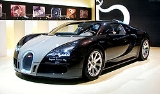
The Bugatti Veyron EB 16.4 is a mid-engine grand touring car produced by Volkswagen Group subsidiary Bugatti Automobiles SAS and was introduced in 2005 as the fastest production car in the world. It is currently one of the fastest accelerating and decelerating production cars in the world, with a 0 -100- 0 time of 8.6 seconds and, at 1.1 million Euro (1.5 million USD), it is also one of the most expensive cars in the world.
Powered by a W16 engine, it can reach .

Discussion
Ask a question about 'Bugatti Veyron'
Start a new discussion about 'Bugatti Veyron'
Answer questions from other users
|
Encyclopedia
The Bugatti Veyron EB 16.4 is a mid-engine grand touring car produced by Volkswagen Group subsidiary Bugatti Automobiles SAS and was introduced in 2005 as the fastest production car in the world. It is currently one of the fastest accelerating and decelerating production cars in the world, with a 0 -100- 0 time of 8.6 seconds and, at 1.1 million Euro (1.5 million USD), it is also one of the most expensive cars in the world.
Powered by a W16 engine, it can reach . The car reached full production in September 2005, and is handcrafted in a factory Volkswagen built near the former Bugatti headquarters in Château St Jean in Molsheim (Alsace, France). It is named after French racing driver Pierre Veyron, who won the 24 hours of Le Mans in 1939 while racing for the original Bugatti company. Two examples of the Veyron are known to have been wrecked since production began.
History Development of this vehicle began with the 1999 EB 18/4 "Veyron" concept car which itself had a chassis based on that of the Bugatti 18/3 Chiron concept car. Introduced at the Tokyo Motor Show, it was similar in design and appearance to the final Veyron production car. One major difference was the EB 18/4's use of a W18 engine with three banks of six cylinders. The Veyron's chief designer was Hartmut Warkuss with exterior designed by Jozef Kaban of Volkswagen rather than Giorgetto Giugiaro of ItalDesign who had handled the three prior Bugatti concepts too.
The then Volkswagen Group chairman Ferdinand Piëch announced the Veyron at the 2000 Geneva Motor Show. It was promised to be the fastest, most powerful and most expensive car in history. Instead of the W18, it would use a VR6/WR8-style W16 engine. First seen in the 1999 Bentley Hunaudières concept car, the W16 would have four turbochargers and produce a quoted (metric) 1001 horsepower (see engine section for details on the power output). Top speed was promised at , and the price was announced at €1 million.
Development continued throughout 2001 and the EB 16/4 Veyron was promoted to "advanced concept" status. In late 2001, Bugatti announced that the car, officially called the "Bugatti Veyron 16.4", would go into production in 2003.
Piëch retired that year as chairman of the Volkswagen Group and was replaced by Bernd Pischetsrieder. The new chairman promptly sent the Veyron back to the drawing board for major revisions. Neumann was replaced as Bugatti president by Thomas Bscher in December 2003, and substantial modifications were made to the Veyron under the guidance of former VW engineer, Bugatti Engineering head, Wolfgang Schreiber.
The Veyron costs €1,100,000 (net price without taxes); prices vary by exchange rates and local taxes (like value added taxes). Prices for the UK or the US are over £880,000, or around $1,400,000, and at a production cost of around £2 million are sold at a great loss to Bugatti. However, the car is often compared to Concorde as a feat of technology.
Special editions
Pur Sang
On 10 September 2007, a special version of the Veyron called the "Pur Sang" (French for "thoroughbred", literally "pure blood") was unveiled at the Frankfurt Motor Show. The only difference from the standard Veyron is the body finishing: the Pur Sang has none, revealing the Veyron's pure aluminium-carbon fibre body. Production of the Pur Sang will be limited to five cars, which will have high-gloss aluminium wheels with a diamond cut finish.
Fbg par Hermès
At the Geneva motor show in 2008 Bugatti announced a partnership with the French fashion house Hermès, resulting in the "Fbg Par Hermès" trim. This has several new features as well as a redesigned front end. The interior is trimmed in Hermès leather and it comes with a specially designed Hermès suitcase to fit in the trunk. Built for Rodrigo Cañizares, Bugatti later made four new color schemes available for order with the Hermès Veyron: called "Indigo Blue and Vermilion", "Indigo Blue and Lime Green", "Black and Garance Red", and "Prussian Blue and Blue Jean". The cars will also come with the bespoke luggage, special 8-spoke rims, and an H-pattern grille.
Sang Noir
It is a version that pays homage to the original Bugatti Atlantique 57S of the 1930s. Exterior styling blends an all-black colour palette with raw carbon-fibre panels and blacked-out headlamps whilst aluminium highlights are added to the grille surround and side mirrors. The production run was 15 vehicles.
Grand Sport
Bugatti announced the production of a targa top version, called Grand Sport. The car was unveiled at Pebble Beach Concours d'Elegance on August 15, 2008, with production set to begin in spring 2009. The Grand Sport comes with small tweaks to the windshield and running lights, and two removable tops. The second is a temporary roof fashioned after an umbrella and inspired by pictures of classic Bugatti racers with umbrellas in hand. The Grand Sport can reach with the hardtop in place, the same top speed as the coupé version. With no roof the top speed is limited to , and to with the temporary soft roof. The Grand Sport has extensive reinforcement beyond the standard Veyron.
The First Grand Sport (Code named Chassis 001) was sold at the 2008 Gooding & Company Pebble Beach Auction with a winning bid price of $2.9 million. Approximately $900,000 of the auction price went to charity.
Bleu Cenetaire
A new edition created to celebrate the 100th anniversary of the Bugatti brand, the Bleu Cenetaire was unveiled at the Geneva Motor show in 2009. It was coloured blue on the whole body, and the middle section between the two wings on the bonnet was expanded and a strip up the middle was chromed. It is rumored to have increased performance, including an increased top speed to beyond 250 miles per hour, but this has not been confirmed. The car is also more expensive than the standard Veyron, costing in excess of £1,000,000.
Specifications and performance
The Veyron features a W16 engine — 16 cylinders in two banks of eight cylinders, or the equivalent of two narrow-angle V8 engines mated in a "W" configuration. Each cylinder has 4 valves for a total of 64, but the narrow staggered 8 configuration allows two camshafts to drive two banks of cylinders so only 4 camshafts are needed. The engine is fed by four turbochargers and displaces 8.0 L (7,993 cc/488 cu in) with a square 86 mm by 86 mm (3.4 in × 3.4 in) bore and stroke.
The transmission consists of a dual-clutch Direct-Shift Gearbox computer-controlled manual gearbox with seven gear ratios, with red paddles behind the steering wheel boasting an <150 ms shift time. This is designed and manufactured by Ricardo of England (and not Borg-Warner who designed the 6-speed DSG used in the mainstream marques of the Volkswagen Group). The Veyron can be driven as a full automatic transmission. It also features full-time four-wheel drive, utilising the Haldex Traction system. It uses special Michelin run-flat tyres, designed specifically for the Veyron to accommodate its top speed, which reportedly cost $25,000 US per set. Curb weight is . This gives the car a power to weight ratio of /.
The car's wheelbase is . Overall length is , width and height .
The Bugatti Veyron has a total of 10 radiators.
- 3 radiators for the engine cooling system.
- 1 heat exchanger for the air-to-liquid intercoolers.
- 2 for the air conditioning system.
- 1 transmission oil radiator.
- 1 differential oil radiator.
- 1 engine oil radiator.
- 1 hydraulic oil radiator for the spoiler
It has a drag coefficient of 0.36, and a frontal area of . This gives it a CdA ft² value of 8.02.
Power
According to Volkswagen (and approved by TÜV Süddeutschland), the final production Veyron engine produces and of torque. The horsepower figure is believed by some to actually be conservative, with the real total being 1001 or more.
Top speed
Top speed was initially promised to be , but test versions were unstable at that speed, forcing a redesign of the aerodynamics. In May 2005, a prototype Veyron tested at a Volkswagen track near Wolfsburg, Germany recorded an electronically limited top speed of . In October 2005, Car and Driver magazine's editor Csaba Csere test drove the final production version of the Veyron for the November 2005 issue. This test, at Volkswagen's Ehra-Lessien test track, reached a top speed of . The top speed was verified once again by James May on Top Gear, again at Volkswagen's private test track, when the car hit , which equated to precisely one-third of the speed of sound at sea level. When getting close to the top speed during the test, May said that "the tyres will only last for about fifteen minutes, but it's okay because the fuel runs out in twelve minutes." He also gave an indication of the power requirements, at constant the Veyron is using approximately , but to get to its rated top speed required far more from the engine. Once back in the Top Gear studio James was asked by co - presenter Jeremy Clarkson what the Veyron felt like to drive at , James replied that it was "completely undramatic", and very stable at speed.
Aerodynamic friction or drag is proportional to the square of the speed; for example doubling speed quadruples drag. Work is a product of force applied over a distance travelled. Comparing a vehicle travelling at with one travelling at , over a given time (e.g. 1 second), the faster vehicle must overcome 4 times the aerodynamic drag, and travel twice the distance of the slower one. Thus it does 8 times the work of the slower vehicle in that time. As power is work done in time taken it follows that the swifter vehicle, travelling at twice the speed requires 8 times the power of the slower one. German inspection officials recorded an average top speed of during test sessions on the Ehra Lessien test track on 2005-04-19.
The car's everyday top speed is listed at . When the car reaches , hydraulics lower the car until it has a ground clearance of about 8.9 cm (3½ inches). At the same time, the wing and spoiler deploy. This is the "handling mode", in which the wing helps provide 3425 newtons (770 pounds) of downheft, holding the car to the road. The driver must, using a special key (the "Top Speed Key"), toggle the lock to the left of his seat in order to attain the maximum (average) speed of . The key functions only when the vehicle is at a stop, when a checklist then establishes whether the car—and its driver—are ready to enable 'top speed' mode. If all systems are go, the rear spoiler retracts, the front air diffusers shut and the ground clearance, normally 12.5 cm (4.9 in), drops to 6.5 cm (2.6 in).
Acceleration
The Bugatti Veyron has the greatest acceleration of any production car to date, reaching in approximately 3.2 seconds., which equates to an average acceleration of around 1.18g. It is the first production car with an average acceleration greater than 1 g when going from 0 to flat out. The car is greatly aided in achieving such times by a four-wheel drive system that enables the transmission of such great amounts of power in the initial stages of acceleration.
The Veyron reaches and in 7.0 and 16.2 seconds respectively. According to the February 2007 issue of Road & Track magazine, the Veyron accomplished the quarter mile (~400 m) in 10.2 seconds at an exit speed of .
Fuel consumption
The Veyron consumes more fuel than any other production car, using in city driving and in combined cycle. At full throttle, it uses more than , which would empty its fuel tank in just 12 minutes.[BBCWorldwide, YouTube. (April 14, 2008)]
Braking
The Veyron's brakes use cross-drilled, radially-vented Carbon fibre-reinforced Silicon Carbide (C/SiC) composite discs, manufactured by SGL Carbon, which have a much greater resistance to brake fade when compared with conventional cast iron discs. The aluminium alloy monobloc brake calipers are made by AP Racing; the fronts have eight titanium pistons and the rear calipers have six pistons. Bugatti claims maximum deceleration of 1.3 Gs on road tyres.
Prototypes have been subjected to repeated 1.0G braking from 194 to 50 MPH (312 to 80 km/h) without fade. With the car's acceleration from 50 to 194 mph (80 to 312 km/h), that test can be performed every 22 seconds. At speeds above 124 mph (200 km/h), the rear wing also acts as an airbrake, snapping to a 55-degree angle in 0.4 seconds once brakes are applied, providing 0.68 Gs (4.9 m/s²) of deceleration (equivalent to the stopping power of an ordinary hatchback). Bugatti claims the Veyron will brake from to a standstill in less than 10 seconds.
Final numbers
Statistics and specifications | Basic stats |
|---|
| Vehicle | Mid-engine, 4-wheel drive 2-door coupe | Base price | €1,100,000 (£899,000/$1,500,000) |
|---|
| Engine | Quad-turbocharged DOHC 64-valve W16 | Engine displacement | 7993 cc (488 cu in) |
|---|
| Performance |
|---|
| Top speed | | | 2.46 seconds |
|---|
| 5.2 seconds | | 8.6 seconds |
|---|
| 24.0 seconds | | 50 seconds |
|---|
| Standing quarter-mile (402 m) | 10.0 seconds at |
|---|
| Fuel economy |
|---|
| EPA city driving | | EPA highway driving | |
|---|
| Top speed fuel economy | 1.8 gallons per minute |
|---|
Production figures
- 2005: 5
- 2006: 44
- 2007: 83
Criticisms and comments
Previews
Gordon Murray, designer of the McLaren F1 (which for many years was the fastest production car ever built) said the following about the Bugatti Veyron in UK auto magazine evo during its development period:
However, Murray was impressed with the Veyron after he test drove one although still apprehensive about it in an article he wrote for Road and Track magazine.
Reviews
After the car had reached production, Murray went on to write an article for another UK auto magazine, Top Gear, retracting a lot of his past criticism of the car.
He also declared in the article that "The braking is phenomenal. ... And the primary ride and body control are impressive too" and "It's a huge achievement."
The trend of backtracking on negative comments about the Veyron continued when prominent UK car show host Jeremy Clarkson declared on Top Gear that it was "The best car ever made" after initially saying it was ridiculous and would never exist. In his Times Online review, his conclusion is that "[The Bugatti Veyron] is a triumph for lunacy over common sense, a triumph for man over nature and a triumph for Volkswagen over absolutely every other car maker in the world".
The Veyron was proclaimed the Top Gear Magazine Car of the Year for 2005, along with the Toyota Aygo. The Veyron was also declared the Grand Award winner for the Autotech category of 2006 by Popular Science magazine.
Top Gear also managed to get it on the track for a power lap in 2008. Surprisingly, it was only fifth on the Power Lap board, getting round the track in 1.18.3, slower than the Gumpert Apollo. The track time might be attributed to its weight (the Veyron has a listed curb weight 750 kg higher than any of the cars that posted a faster lap time and 930 kg more than the Gumpert)
Citations
External links
|
| |
|
|