

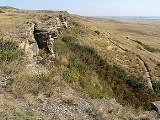
Buffalo jump

Encyclopedia

Cliff
In geography and geology, a cliff is a significant vertical, or near vertical, rock exposure. Cliffs are formed as erosion landforms due to the processes of erosion and weathering that produce them. Cliffs are common on coasts, in mountainous areas, escarpments and along rivers. Cliffs are usually...
formation which North American Indians historically used in mass killings of plains bison
American Bison
The American bison , also commonly known as the American buffalo, is a North American species of bison that once roamed the grasslands of North America in massive herds...
. Hunters herded the bison and drove them over the cliff, breaking their legs and rendering them immobile. Tribe members waiting below closed in with spears and bows to finish the kills. The Blackfeet
Blackfeet
The Piegan Blackfeet are a tribe of Native Americans of the Algonquian language family based in Montana, having lived in this area since around 6,500 BC. Many members of the tribe live as part of the Blackfeet Nation in northwestern Montana, with population centered in Browning...
Indians called the buffalo jumps "pishkun", which loosely translates as "deep blood kettle". This type of hunting was a communal event which occurred as early as 12,000 years ago and lasted until at least 1500 AD, around the time of the introduction of horses. The broader term game
Game (food)
Game is any animal hunted for food or not normally domesticated. Game animals are also hunted for sport.The type and range of animals hunted for food varies in different parts of the world. This will be influenced by climate, animal diversity, local taste and locally accepted view about what can or...
jumps includes buffalo jumps and cliffs used for similarly hunting other herding animals, such as reindeer.
Buffalo jump sites are often identified by rock cairn
Cairn
Cairn is a term used mainly in the English-speaking world for a man-made pile of stones. It comes from the or . Cairns are found all over the world in uplands, on moorland, on mountaintops, near waterways and on sea cliffs, and also in barren desert and tundra areas...
s, which were markers designating "drive lanes", by which bison would be funneled over the cliff. These drive lanes would often stretch for several miles.
Buffalo jump sites yield significant archaeological evidence because processing sites and camps were always nearby. The sites yield information as to how the Native Americans used the bison for food, clothing and shelter. Plains Indians in particular depended on the bison for their very survival. Every part of the animal could be used in some way: hides for clothes and shelter, bones for tools, sinews for bowstrings and laces. Hooves could be ground for glue, and the brains could be used in the tanning process for the hides. The extra meat was preserved as pemmican
Pemmican
Pemmican is a concentrated mixture of fat and protein used as a nutritious food. The word comes from the Cree word pimîhkân, which itself is derived from the word pimî, "fat, grease". It was invented by the native peoples of North America...
.
Sites of interest include Head-Smashed-In
Head-Smashed-In Buffalo Jump
Head-Smashed-In Buffalo Jump is a buffalo jump located where the foothills of the Rocky Mountains begin to rise from the prairie 18 km northwest of Fort Macleod, Alberta, Canada on highway 785...
, Bonfire Shelter
Bonfire Shelter
Bonfire Shelter is an archaeological site located in a southwest Texas rock shelter, near Langtry, Texas. This archaeological site contains evidence of mass bison hunts, a phenomenon that is usually associated with the Great Plains hundreds of miles to the north. This site is the southernmost...
, Ulm Pishkun, Madison Buffalo Jump
Madison Buffalo Jump State Park
Madison Buffalo Jump State Park is a Montana state park in Gallatin County, Montana in the United States. The park is and sits at an elevation of . The park is named for a canyon cliff used by Native Americans as a buffalo jump, where herds of bison were stampeded over the cliff as an efficient...
, Dry Island
Dry Island Buffalo Jump Provincial Park
Dry Island Buffalo Jump Provincial Park is a provincial park in Central Alberta, Canada, located about southeast of Red Deer and east of Trochu. The park is situated along the Red Deer River and features badlands topography...
, Glenrock, Big Goose Creek, Vore
Vore Buffalo Jump
The Vore Buffalo Jump is an archeological site in Crook County, Wyoming. A sinkhole, formed where gypsum soil was eroded, leaving a steep-sided pit about deep and in diameter. Native American hunters could stampede bison in the direction of the pit, which was deep enough to kill or disable the...
, and Olsen-Chubbuck Bison Kill Site
Olsen-Chubbuck Bison Kill Site
The Olsen-Chubbuck Bison kill site is located southeast of Kit Carson, Colorado. The Paleo-Indian site dates back to an estimated 8000-6500 B.C. and provides evidence for bison hunting long before the use of the bow and arrow or horses. The site was named Olsen-Chubbuck after the amateur...
.
In one of his journals, Meriwether Lewis
Meriwether Lewis
Meriwether Lewis was an American explorer, soldier, and public administrator, best known for his role as the leader of the Lewis and Clark Expedition also known as the Corps of Discovery, with William Clark...
describes how a buffalo jump was practiced during the Lewis and Clark Expedition
Lewis and Clark Expedition
The Lewis and Clark Expedition, or ″Corps of Discovery Expedition" was the first transcontinental expedition to the Pacific Coast by the United States. Commissioned by President Thomas Jefferson and led by two Virginia-born veterans of Indian wars in the Ohio Valley, Meriwether Lewis and William...
:
"one of the most active and fleet young men is selected and disguised in a robe of buffalo skin... he places himself at a distance between a herd of buffalo and a precipice proper for the purpose; the other Indians now surround the herd on the back and flanks and at a signal agreed on all show themselves at the same time moving forward towards the buffalo; the disguised Indian or decoy has taken care to place himself sufficiently near the buffalo to be noticed by them when they take to flight and running before them they follow him in full speed to the precipice; the Indian (decoy) in the mean time has taken care to secure himself in some cranny in the cliff... the part of the decoy I am informed is extremely dangerous."
See also
- Ulm Pishkun Buffalo JumpFirst Peoples Buffalo Jump State ParkFirst Peoples Buffalo Jump State Park is a Montana state park in Cascade County, Montana in the United States. The park is and sits at an elevation of .It is located about northwest of the small town of Ulm, which is near the city of Great Falls...
is likely the largest buffalo jump in the world. It was used by the Native Americans in the area between 900 and 1500 AD. The cliffs themselves stretch for more than a mile and the site below has compacted bison bones nearly 13 feet (4 m) deep. Ulm Pishkun Buffalo Jump is located in First Peoples Buffalo Jump State ParkFirst Peoples Buffalo Jump State ParkFirst Peoples Buffalo Jump State Park is a Montana state park in Cascade County, Montana in the United States. The park is and sits at an elevation of .It is located about northwest of the small town of Ulm, which is near the city of Great Falls...
in Cascade County, MontanaCascade County, Montana-National protected areas:*Benton Lake National Wildlife Refuge*Lewis and Clark National Forest -Economy:Malmstrom Air Force Base is a driving force in the regional economy...
, north-northwest of the community of UlmUlm, MontanaUlm is a census-designated place in Cascade County, Montana, United States. It was originally a large ranch owned by Indiana-born cattleman William Ulm. The population was 750 at the 2000 census...
.
- Madison Buffalo Jump State ParkMadison Buffalo Jump State ParkMadison Buffalo Jump State Park is a Montana state park in Gallatin County, Montana in the United States. The park is and sits at an elevation of . The park is named for a canyon cliff used by Native Americans as a buffalo jump, where herds of bison were stampeded over the cliff as an efficient...
is a Montana state park in Gallatin CountyGallatin County, Montana-National protected areas:* Gallatin National Forest * Yellowstone National Park -Demographics:As of the census of 2000, there were 67,831 people, 26,323 households, and 16,188 families residing in the county. The population density was 26 people per square mile . There were 29,489 housing units...
, MontanaMontanaMontana is a state in the Western United States. The western third of Montana contains numerous mountain ranges. Smaller, "island ranges" are found in the central third of the state, for a total of 77 named ranges of the Rocky Mountains. This geographical fact is reflected in the state's name,...
in the United States. The park is 638 acres (258.2 ha) and sits at an elevation of 4554 feet (1,388.1 m). The park is named for a canyon cliff used by Native AmericansNative Americans in the United StatesNative Americans in the United States are the indigenous peoples in North America within the boundaries of the present-day continental United States, parts of Alaska, and the island state of Hawaii. They are composed of numerous, distinct tribes, states, and ethnic groups, many of which survive as...
as a buffalo jump, where herds of bisonAmerican BisonThe American bison , also commonly known as the American buffalo, is a North American species of bison that once roamed the grasslands of North America in massive herds...
were stampeded over the cliff as an efficient means of slaughterAnimal slaughterSlaughter is the term used to describe the killing and butchering of animals, usually for food. Commonly it refers to killing and butchering of domestic livestock ....
. Madison Buffalo Jump State Park is a day use-only park. It is open year-round for hikingHikingHiking is an outdoor activity which consists of walking in natural environments, often in mountainous or other scenic terrain. People often hike on hiking trails. It is such a popular activity that there are numerous hiking organizations worldwide. The health benefits of different types of hiking...
, wildlife observation, and some picnicPicnicIn contemporary usage, a picnic can be defined simply as a pleasure excursion at which a meal is eaten outdoors , ideally taking place in a beautiful landscape such as a park, beside a lake or with an interesting view and possibly at a public event such as before an open air theatre performance,...
king.