

Buddhism in Japan

Encyclopedia
The history of Buddhism in Japan can be roughly divided into three periods, namely the Nara period
(710-794), the Heian period
(794–1185) and the post-Heian period (1185 onwards). Each period saw the introduction of new doctrines and upheavals in existing schools. See Sōhei
(warrior monks).
In modern times, the main paths of Buddhism
are Amidist
(Pure Land) schools, Nichiren Buddhism
, Shingon Buddhism
and Zen Buddhism.
The root of the Japanese word for Buddhism, comes from 仏 (butsu, “buddha”) + 教 (kyō, “teaching”).
About 91 million people in Japan claim to be Buddhist practitioners.
in Japan
is ultimately a consequence of the first contacts between China
and Central Asia which occurred with the opening of the Silk Road
in the 2nd century BC, following the travels of Zhang Qian
between 138
and 126 BC
, which culminated with the official introduction of Buddhism in China
in 67 AD. Historians generally agree that by the middle of the 1st century, the religion had penetrated to areas north of the Huai River
.
 In 467 CE, according to the Chinese historic
treatise Liang Shu, five monks from Gandhara
traveled to the country of Fusang
, where they introduced Buddhism:
 Although it is possible that Buddhism was known to the Japanese previously, the "official" introduction of Buddhism
to Japan
is dated to 552 in Nihon Shoki
(otherwise 538 according to the History of Gangōji monastery), when Seong of Baekje
sent a mission to Nara
including some Buddhist monks or nuns, together with an image of Buddha, and numbers of sutras
to introduce Buddhism. The powerful Soga clan
played a key role in the early spread of Buddhism in the country. Initial uptake of the new faith was slow, and Buddhism only started to spread some years later when Empress Suiko
openly encouraged the acceptance of Buddhism among all Japanese people.
In 607
, in order to obtain copies of sutras, an imperial envoy was dispatched to the Sui Dynasty
in China
. As time progressed and the number of Buddhist clergy increased, the offices of Sojo (archbishop) and Sozu (bishop) were created. By 627
, there were 46 Buddhist temples, 816 Buddhist priests, and 569 Buddhist nuns in Japan.
The initial period saw the six great Chinese schools, called in Japanese, introduced to the Japanese Archipelago
including the Ritsu
(Vinaya
), Jōjitsu (Satyasiddhi), Kusha
(Abhidharma
) Sanron (Madhyamika), Hossō (Yogacara
), and Kegon
(Hua-yen), centered around the ancient capitals of Asuka
and Nara
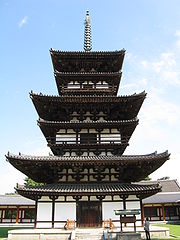
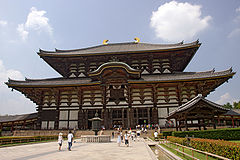
, where great temples such as the Hōryū-ji
and Tōdai-ji
were erected respectively. These were not exclusive schools, and temples were apt to have scholars versed in several of the schools. It has been suggested that they can best be thought of as "study groups". The Buddhism of these periods, known as the Asuka period
and Nara period
– was not a practical religion, being more the domain of learned priests whose official function was to pray for the peace and prosperity of the state and imperial house. This kind of Buddhism had little to offer the illiterate and uneducated masses, and led to the growth of "people’s priests" who were not ordained and had no formal Buddhist training. Their practice was a combination of Buddhist and Taoist
elements, and the incorporation of shamanistic
features of the indigenous religion. Some of these figures became immensely popular, and were a source of criticism towards the sophisticated academic and bureaucratic Buddhism of the capital.
Ritsu
Founded by Dàoxuān (道宣, Jp. Dosen), China, c.
AD 650
First Introduction to Japan: Ganjin (鑑真), AD 753. The Ritsu school specialized in the Vinaya
(the monastic rules in the Tripitaka
). They used the Dharmagupta version of the vinaya which is known in Japanese as Shibunritsu 四分律)
school is considered to be an offshoot of the Sautrantika school, one of the Nikaya schools
of Indian Buddhism (see early Buddhist schools
). They were distinguished by a rejection of the Abhidharma as not being the "word of the Buddha". The name means literally, "Ends with the Sutras", which refers to the traditional order of texts in the Tripitaka
—vinaya, sutra, abhidharma.

Kusha
Introduced into Japan from China during the Nara period (710–784). The school takes its name from its authoritative text, the Abidatsuma-kusha-ron(Sanskrit:Abhidharma-kosa), by the 4th- or 5th-century Indian philosopher Vasubandhu
. The Kusha school is considered to be an offshoot of the Indian Sarvastivada
school.
and one by Aryadeva
. This school was transmitted to Japan in the 7th century. Madhyamika is one of the two most important Mahayana
philosophies, and reemphasizes the original Buddhist teachings that phenomena are neither truly existent or absolutely non-existent, but are characterized by impermanence and insubstantiality.
(瑜伽行派 Yugagyōha) schools are based on early Indian Buddhist thought by masters such as Vasubandhu
, and are also known as "consciousness only" since they teach a form of idealism
which posits that all phenomena are phenomena of the mind. The Hossō school was founded by Xuanzang
(玄奘, Jp. Genjo), China, c. AD 630, and introduced to Japan in AD 654. The Discourse on the Theory of Consciousness-Only (Jo yuishikiron 成唯識論) is an important text for the Hosso school.
Kegon
 Also known by its Chinese
pronunciation Huayen (華厳), the Kegon school was founded by Dushun
(杜順, Jp. Dojun), China, c. AD 600
, and introduced to Japan by the Indian monk Bodhisena
in AD 736
. The Avatamsaka Sutra
(Kegonkyō 華厳経) is the central text for the Kegon school. The Shin'yaku Kegonkyō Ongi Shiki
is an early Japanese annotation of this sūtra.
and Saichō
, who founded the Shingon and Tendai
schools. The later Heian period saw the formation of the first truly Japanese school of Buddhism, that of Nichiren
.
Tendai
Known as Tiantai
(天台) in China, the Tendai
school was founded by Zhiyi
(智顗, Jp Chigi) in China, c. AD 550. In 804 Saichō
(最澄) traveled to China to study at the Tiantai teachings, at Mount Tiantai. However, before his return he also studied, and was initiated into, the practice of the Vajrayana, with emphasis on the Mahavairocana Sutra. The primary text of Tiantai is Lotus Sutra
(Hokkekyō 法華経), but when Saichō established his school in Japan he incorporated the study and practice of Vajrayana as well.
Shingon
Kūkai
traveled to China in 804 as part of the same expedition as Saichō. In the T'ang
capital he studied esoteric Buddhism, Sanskrit
and received initiation from Huikuo. On returning to Japan Kūkai eventually managed to establish Shingon (真言) as a school in its own right. Kūkai received two lineages of teaching—one based on the Mahavairocana Sutra (Dainichikyō 大日経), and the other based on the Vajrasekhara Sutra
(Kongōchōkyō 金剛頂経).
See also Shinnyo-en.
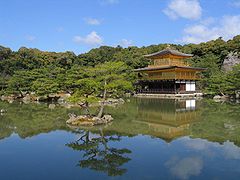 The Kamakura period
saw the introduction of the two schools that had perhaps the greatest impact on the country: (1) the Amidist Pure Land
schools, promulgated by evangelists such as Genshin
and articulated by monks such as Hōnen, which emphasize salvation through faith in Amitabha
and remain the largest Buddhist sect in Japan (and throughout Asia); and (2) the more philosophical Zen
schools, promulgated by monks such as Eisai
and Dogen
, which emphasize liberation through the insight of meditation, which were equally rapidly adopted by the upper classes and had a profound impact on Japanese culture.
In Muromachi period
, the Zen school, particularly Rinzai
, obtained help of the Muromachi shogunate and the Emperor
, and accomplished considerable development.
With the Meiji Restoration
in 1868, the new government adopted a strong anti-Buddhist attitude, and a movement to eradicate Buddhism
and bring Shinto
to ascendancy arose throughout the country due to the strong connections of Buddhism to the Shoguns.
During World War II
, most Buddhist schools (with the exception of the Sōka Gakkai), strongly supported Japan's remilitarization. Post World War II, there was a high demand for Buddhist priests who glorified fallen soldiers, and gave funerals and posthumous names, causing a strong revival. However, due to secularization and materialism, Buddhism and religion in general, have declined.
Japan has seen a minor decline in Buddhist practice in the 21st century, with roughly 100 temples a year closing. However 70% of Japanese people still follow Buddhism
in some form, and 90% of Japanese funerals are conducted according to Buddhist rites.
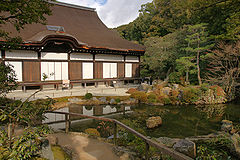 Founder: Hōnen (法然), AD 1175
Japanese name: 浄土, "Pure Land"
Major Influences: Chinese Jingtu (浄土 "Pure Land
"), Tendai
Doctrine: nembutsu (念仏, "prayer to Buddha")
Primary Text: Infinite Life Sutra
(Muryojukyo 無量壽経)
Jōdo Shinshū
Founder: Shinran
(親鸞), AD 1224
Japanese name: 浄土真, "True Pure Land"
Major Influences: Jōdō
, Tendai
Doctrine: nembutsu no shinjin ("nembutsu of true entrusting", that is, saying nembutsu is a declaration of faith in Amida's salvation plan for the individual rather than a plan for salvation.)
Primary Text: Infinite Life Sutra
(Muryojukyo 無量壽経)
(一遍), AD 1270
Japanese name: 時宗 or 時衆, "Time"
Major Influences: Jōdō
Doctrine: nenbutsu (念仏, "mindfulness of the Buddha")
Primary Text:
Japanese name: 融通念仏
Doctrine: sokushitsu ōjō (速疾往生,)
Primary Text: Avatamsaka Sutra
(Kegonkyo 華厳経)・Lotus Sutra
(Hokekyo 法華経)
's practice and experiential wisdom (禅宗) were separately brought to Japan. Note that Zen influences are identifiable earlier in Japanese Buddhism, esp. cross-fertilization with Hosso and Kegon, but the independent schools were formed quite late.
Sōtō
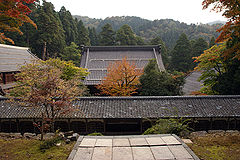
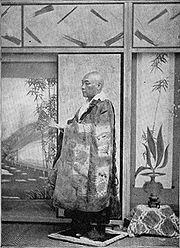 Founders: Caoshan (曹山, Jp. Sosan) and Dongshan (洞山, Jp. Tosan), China, c. 850
Chinese name: Caodong
(曹洞), named after its founders
First Introduction to Japan: Dogen
(道元), AD 1227
Major Influences: Tendai
, Hosso, Kegon
Doctrine: zazen
(坐禅, "sitting meditation"), especially shikantaza
Primary Texts: Transcendental Wisdom Sutras aka Prajnaparamita
Sutras (般若波羅蜜経), incl. Heart Sutra
Rinzai
Founder: Linji
(臨済), China, c. 850
Chinese name: Linji
(臨済), named after founder
First Introduction to Japan: Eisai
(栄西), AD 1191
Major Influences: Hosso, Kegon
Doctrine: zazen
(坐禅, "sitting meditation"), especially koan (公案, "public matter") practice
Primary Texts: Transcendental Wisdom Sutras aka Prajnaparamita
Sutras (般若波羅蜜経), incl. Heart Sutra
(隠元), Japan, AD 1654
Japanese name: 黄檗, named for the mountain where the founder had lived in China
Major Influences: Rinzai
Doctrine: kyozen itchi (経禅一致, "Unity of Sutras and Zen")
Primary Texts: Transcendental Wisdom Sutras aka Prajnaparamita
Sutras (般若波羅蜜経), incl. Heart Sutra
First introduction to Japan: Shinchin Kakushin (心地覚心), AD 1254
Major Influences: Rinzai
Abolished: 1871
trace themselves to the monk Nichiren
(日蓮: "Sun-Lotus") and the proclamation of his teachings in AD 1253. Doctrinally the schools focus on the Lotus Sutra
(妙法蓮華經: Myōhō Renge Kyō; abbrev. 法華經: Hokkekyō), but practice centers on the mantra
Nam(u) Myōhō Renge Kyō
(南無妙法蓮華經). Nichiren Buddhism split into several denominations after the death of Nichiren, typically represented by tradition-oriented schools such as Nichiren-shū and Nichiren Shōshū
and "new religions"
such as Sōka Gakkai, Risshō Kōsei Kai
, and Reiyūkai
. See Nichiren Buddhism for a more complete list.
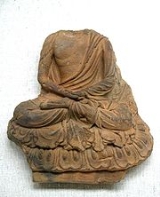
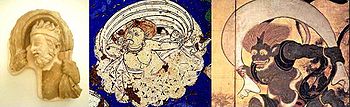 In Japan, Buddhist art started to develop as the country converted to Buddhism in AD 548. Some tiles from the Asuka period
(shown above), the first period following the conversion of the country to Buddhism, display a strikingly classical style, with ample Hellenistic dress and realistically rendered body shape characteristic of Greco-Buddhist art
.
Buddhist became extremely varied in its expression. Many elements of Greco-Buddhist art remain to this day however, such as the Hercules
inspiration behind the Nio
guardian deities in front of Japanese Buddhist temples, or representations of the Buddha reminiscent of Greek art such as the Buddha in Kamakura
.
 Various other Greco-Buddhist artistic influences can be found in the Japanese Buddhist pantheon, the most striking of which being that of the Japanese wind god Fujin
. In consistency with Greek iconography for the wind god Boreas, the Japanese wind god holds above his head with his two hands a draping or "wind bag" in the same general attitude. The abundance of hair have been kept in the Japanese rendering, as well as exaggerated facial features.
Another Buddhist deity, named Shukongoshin, one of the wrath-filled protector deities of Buddhist temples in Japan, is also an interesting case of transmission of the image of the famous Greek god Herakles to the Far-East along the Silk Road
. Herakles was used in Greco-Buddhist art to represent Vajrapani
, the protector of the Buddha, and his representation was then used in China and Japan to depict the protector gods of Buddhist temples.
 The artistic inspiration from Greek floral scrolls is found quite literally in the decoration of Japanese roof tiles, one of the only remaining element of wooden architecture throughout centuries. The clearest one are from 7th century Nara
temple building tiles, some of them exactly depicting vines and grapes. These motifs have evolved towards more symbolic representations, but essentially remain to this day in many Japanese traditional buildings.
festival is celebrated primarily in Japan and in communities with large Japanese diasporic communities. It is believed that the spirits of the dead return to earth for three days and visit the family shrines or graves. Similar to Mexico
's Day of the Dead
, it is customary to clean the graves and to hold family reunions.
Nara period
The of the history of Japan covers the years from AD 710 to 794. Empress Gemmei established the capital of Heijō-kyō . Except for 5 years , when the capital was briefly moved again, it remained the capital of Japanese civilization until Emperor Kammu established a new capital, Nagaoka-kyō, in 784...
(710-794), the Heian period
Heian period
The is the last division of classical Japanese history, running from 794 to 1185. The period is named after the capital city of Heian-kyō, or modern Kyōto. It is the period in Japanese history when Buddhism, Taoism and other Chinese influences were at their height...
(794–1185) and the post-Heian period (1185 onwards). Each period saw the introduction of new doctrines and upheavals in existing schools. See Sōhei
Sohei
were Buddhist warrior monks of feudal Japan. At certain points of history they held considerable power, obliging the imperial and military governments to collaborate....
(warrior monks).
In modern times, the main paths of Buddhism
Buddhism
Buddhism is a religion and philosophy encompassing a variety of traditions, beliefs and practices, largely based on teachings attributed to Siddhartha Gautama, commonly known as the Buddha . The Buddha lived and taught in the northeastern Indian subcontinent some time between the 6th and 4th...
are Amidist
Pure Land Buddhism
Pure Land Buddhism , also referred to as Amidism in English, is a broad branch of Mahāyāna Buddhism and currently one of the most popular traditions of Buddhism in East Asia. Pure Land is a branch of Buddhism focused on Amitābha Buddha...
(Pure Land) schools, Nichiren Buddhism
Nichiren Buddhism
Nichiren Buddhism is a branch of Mahāyāna Buddhism based on the teachings of the 13th century Japanese monk Nichiren...
, Shingon Buddhism
Shingon Buddhism
is one of the mainstream major schools of Japanese Buddhism and one of the few surviving Esoteric Buddhist lineages that started in the 3rd to 4th century CE that originally spread from India to China through traveling monks such as Vajrabodhi and Amoghavajra...
and Zen Buddhism.
The root of the Japanese word for Buddhism, comes from 仏 (butsu, “buddha”) + 教 (kyō, “teaching”).
About 91 million people in Japan claim to be Buddhist practitioners.
Arrival along the Silk Road
The arrival of BuddhismBuddhism
Buddhism is a religion and philosophy encompassing a variety of traditions, beliefs and practices, largely based on teachings attributed to Siddhartha Gautama, commonly known as the Buddha . The Buddha lived and taught in the northeastern Indian subcontinent some time between the 6th and 4th...
in Japan
Japan
Japan is an island nation in East Asia. Located in the Pacific Ocean, it lies to the east of the Sea of Japan, China, North Korea, South Korea and Russia, stretching from the Sea of Okhotsk in the north to the East China Sea and Taiwan in the south...
is ultimately a consequence of the first contacts between China
China
Chinese civilization may refer to:* China for more general discussion of the country.* Chinese culture* Greater China, the transnational community of ethnic Chinese.* History of China* Sinosphere, the area historically affected by Chinese culture...
and Central Asia which occurred with the opening of the Silk Road
Silk Road
The Silk Road or Silk Route refers to a historical network of interlinking trade routes across the Afro-Eurasian landmass that connected East, South, and Western Asia with the Mediterranean and European world, as well as parts of North and East Africa...
in the 2nd century BC, following the travels of Zhang Qian
Zhang Qian
Zhang Qian was an imperial envoy to the world outside of China in the 2nd century BCE, during the time of the Han Dynasty...
between 138
138 BC
Year 138 BC was a year of the pre-Julian Roman calendar. At the time it was known as the Year of the Consulship of Serapio and Callaicus...
and 126 BC
126 BC
Year 126 BC was a year of the pre-Julian Roman calendar. At the time it was known as the Year of the Consulship of Lepidus and Orestes...
, which culminated with the official introduction of Buddhism in China
Buddhism in China
Chinese Buddhism refers collectively to the various schools of Buddhism that have flourished in China since ancient times. Buddhism has played an enormous role in shaping the mindset of the Chinese people, affecting their aesthetics, politics, literature, philosophy and medicine.At the peak of the...
in 67 AD. Historians generally agree that by the middle of the 1st century, the religion had penetrated to areas north of the Huai River
Huai River
The Huai River is a major river in China. The Huai River is located about mid-way between the Yellow River and Yangtze River, the two largest rivers in China, and like them runs from west to east...
.
Early Chinese accounts
History of China
Chinese civilization originated in various regional centers along both the Yellow River and the Yangtze River valleys in the Neolithic era, but the Yellow River is said to be the Cradle of Chinese Civilization. With thousands of years of continuous history, China is one of the world's oldest...
treatise Liang Shu, five monks from Gandhara
Gandhara
Gandhāra , is the name of an ancient kingdom , located in northern Pakistan and eastern Afghanistan. Gandhara was located mainly in the vale of Peshawar, the Potohar plateau and on the Kabul River...
traveled to the country of Fusang
Fusang
Fusang or Fousang refers to several different entities in ancient Chinese literature, often either a mythological tree or a mysterious land to the East....
, where they introduced Buddhism:
Asuka and Nara periods
Buddhism
Buddhism is a religion and philosophy encompassing a variety of traditions, beliefs and practices, largely based on teachings attributed to Siddhartha Gautama, commonly known as the Buddha . The Buddha lived and taught in the northeastern Indian subcontinent some time between the 6th and 4th...
to Japan
Japan
Japan is an island nation in East Asia. Located in the Pacific Ocean, it lies to the east of the Sea of Japan, China, North Korea, South Korea and Russia, stretching from the Sea of Okhotsk in the north to the East China Sea and Taiwan in the south...
is dated to 552 in Nihon Shoki
Nihon Shoki
The , sometimes translated as The Chronicles of Japan, is the second oldest book of classical Japanese history. It is more elaborate and detailed than the Kojiki, the oldest, and has proven to be an important tool for historians and archaeologists as it includes the most complete extant historical...
(otherwise 538 according to the History of Gangōji monastery), when Seong of Baekje
Seong of Baekje
Seong of Baekje was the 26th king of Baekje, one of the Three Kingdoms of Korea. He was a son of Muryeong of Baekje. He made Buddhism the state religion, moved the national capital, and succeeded in reclaiming the center of the Korean Peninsula, only to be betrayed by an ally.-Foreign relations...
sent a mission to Nara
Nara, Nara
is the capital city of Nara Prefecture in the Kansai region of Japan. The city occupies the northern part of Nara Prefecture, directly bordering Kyoto Prefecture...
including some Buddhist monks or nuns, together with an image of Buddha, and numbers of sutras
Sutra
Sūtra is an aphorism or a collection of such aphorisms in the form of a manual. Literally it means a thread or line that holds things together and is derived from the verbal root siv-, meaning to sew , as does the medical term...
to introduce Buddhism. The powerful Soga clan
Soga clan
The was one of the most powerful clans in Yamato Japan and played a major role in the spread of Buddhism. For many generations, in the 5th and 7th centuries, the Soga monopolized the position of Great Royal Chieftain and was the first of many families to dominate the Imperial House of Japan by...
played a key role in the early spread of Buddhism in the country. Initial uptake of the new faith was slow, and Buddhism only started to spread some years later when Empress Suiko
Empress Suiko
was the 33rd emperor of Japan, according to the traditional order of succession.Suiko's reign spanned the years from 593 until her death in 628....
openly encouraged the acceptance of Buddhism among all Japanese people.
In 607
607
Year 607 was a common year starting on Sunday of the Julian calendar. The denomination 607 for this year has been used since the early medieval period, when the Anno Domini calendar era became the prevalent method in Europe for naming years.- Asia :* August 1 – Prince Shotoku of Japan...
, in order to obtain copies of sutras, an imperial envoy was dispatched to the Sui Dynasty
Sui Dynasty
The Sui Dynasty was a powerful, but short-lived Imperial Chinese dynasty. Preceded by the Southern and Northern Dynasties, it ended nearly four centuries of division between rival regimes. It was followed by the Tang Dynasty....
in China
China
Chinese civilization may refer to:* China for more general discussion of the country.* Chinese culture* Greater China, the transnational community of ethnic Chinese.* History of China* Sinosphere, the area historically affected by Chinese culture...
. As time progressed and the number of Buddhist clergy increased, the offices of Sojo (archbishop) and Sozu (bishop) were created. By 627
627
Year 627 was a common year starting on Thursday of the Julian calendar. The denomination 627 for this year has been used since the early medieval period, when the Anno Domini calendar era became the prevalent method in Europe for naming years.- Byzantine Empire :* December 12 – Battle of...
, there were 46 Buddhist temples, 816 Buddhist priests, and 569 Buddhist nuns in Japan.
The initial period saw the six great Chinese schools, called in Japanese, introduced to the Japanese Archipelago
Japanese Archipelago
The , which forms the country of Japan, extends roughly from northeast to southwest along the northeastern coast of the Eurasia mainland, washing upon the northwestern shores of the Pacific Ocean...
including the Ritsu
Ritsu
The Ritsu school of Buddhism is one of the six schools of Nara Buddhism in Japan, noted for its use of the Vinaya textual framework of the Dharmaguptaka, one of the early schools of Buddhism...
(Vinaya
Vinaya
The Vinaya is the regulatory framework for the Buddhist monastic community, or sangha, based in the canonical texts called Vinaya Pitaka. The teachings of the Buddha, or Buddhadharma can be divided into two broad categories: 'Dharma' or doctrine, and 'Vinaya', or discipline...
), Jōjitsu (Satyasiddhi), Kusha
Kusha (Buddhism)
Kusha was one of the 13 Chinese Buddhist schools and one of the 6 Japanese Buddhism schools , introduced to Japan during Asuka and Nara period. Along with Jōjitsu and Ritsu, it was initially based on Nikaya schools, sometimes known derisively as Hinayana. Kusha was never considered to be an...
(Abhidharma
Abhidharma
Abhidharma or Abhidhamma are ancient Buddhist texts which contain detailed scholastic and scientific reworkings of doctrinal material appearing in the Buddhist Sutras, according to schematic classifications...
) Sanron (Madhyamika), Hossō (Yogacara
Yogacara
Yogācāra is an influential school of Buddhist philosophy and psychology emphasizing phenomenology and ontology through the interior lens of meditative and yogic practices. It developed within Indian Mahāyāna Buddhism in about the 4th century CE...
), and Kegon
Kegon
Kegon is the name of the Japanese transmission of the Huayan school of Chinese Buddhism.Huayan studies were founded in Japan when, in 736, the scholar-priest Rōben originally a monk of the Hossō tradition invited Shinshō to give lectures on the Avatamsaka Sutra at...
(Hua-yen), centered around the ancient capitals of Asuka
Asuka, Nara
is a village located in Takaichi District, Nara, Japan.As of September 1, 2007, the village has an estimated population of 6,146 and a density of 255.23 persons per km². The total area is 24.08 km².Asuka is the land where ancient palaces were located...
and Nara
Nara, Nara
is the capital city of Nara Prefecture in the Kansai region of Japan. The city occupies the northern part of Nara Prefecture, directly bordering Kyoto Prefecture...
, where great temples such as the Hōryū-ji
Hōryū-ji
is a Buddhist temple in Ikaruga, Nara Prefecture, Japan. Its full name is Hōryū Gakumonji , or Learning Temple of the Flourishing Law, the complex serving as seminary and monastery both....
and Tōdai-ji
Todai-ji
, is a Buddhist temple complex located in the city of Nara, Japan. Its Great Buddha Hall , the largest wooden building in the world, houses the world's largest bronze statue of the Buddha Vairocana, known in Japanese simply as Daibutsu . The temple also serves as the Japanese headquarters of the ...
were erected respectively. These were not exclusive schools, and temples were apt to have scholars versed in several of the schools. It has been suggested that they can best be thought of as "study groups". The Buddhism of these periods, known as the Asuka period
Asuka period
The , was a period in the history of Japan lasting from 538 to 710 , although its beginning could be said to overlap with the preceding Kofun period...
and Nara period
Nara period
The of the history of Japan covers the years from AD 710 to 794. Empress Gemmei established the capital of Heijō-kyō . Except for 5 years , when the capital was briefly moved again, it remained the capital of Japanese civilization until Emperor Kammu established a new capital, Nagaoka-kyō, in 784...
– was not a practical religion, being more the domain of learned priests whose official function was to pray for the peace and prosperity of the state and imperial house. This kind of Buddhism had little to offer the illiterate and uneducated masses, and led to the growth of "people’s priests" who were not ordained and had no formal Buddhist training. Their practice was a combination of Buddhist and Taoist
Taoism
Taoism refers to a philosophical or religious tradition in which the basic concept is to establish harmony with the Tao , which is the mechanism of everything that exists...
elements, and the incorporation of shamanistic
Shamanism
Shamanism is an anthropological term referencing a range of beliefs and practices regarding communication with the spiritual world. To quote Eliade: "A first definition of this complex phenomenon, and perhaps the least hazardous, will be: shamanism = technique of ecstasy." Shamanism encompasses the...
features of the indigenous religion. Some of these figures became immensely popular, and were a source of criticism towards the sophisticated academic and bureaucratic Buddhism of the capital.
RitsuRitsuThe Ritsu school of Buddhism is one of the six schools of Nara Buddhism in Japan, noted for its use of the Vinaya textual framework of the Dharmaguptaka, one of the early schools of Buddhism...
Founded by Dàoxuān (道宣, Jp. Dosen), China, c.Circa
Circa , usually abbreviated c. or ca. , means "approximately" in the English language, usually referring to a date...
AD 650
First Introduction to Japan: Ganjin (鑑真), AD 753. The Ritsu school specialized in the Vinaya
Vinaya
The Vinaya is the regulatory framework for the Buddhist monastic community, or sangha, based in the canonical texts called Vinaya Pitaka. The teachings of the Buddha, or Buddhadharma can be divided into two broad categories: 'Dharma' or doctrine, and 'Vinaya', or discipline...
(the monastic rules in the Tripitaka
Tripiṭaka
' is a traditional term used by various Buddhist sects to describe their various canons of scriptures. As the name suggests, a traditionally contains three "baskets" of teachings: a , a and an .-The three categories:Tripitaka is the three main categories of texts that make up the...
). They used the Dharmagupta version of the vinaya which is known in Japanese as Shibunritsu 四分律)
Jōjitsu
The SatyasiddhiSatyasiddhi
The Satyasiddhi school of Buddhism is based on the text known as the Satyasiddhi-Shastra , authored by the Indian master Harivarman...
school is considered to be an offshoot of the Sautrantika school, one of the Nikaya schools
Nikaya Buddhism
The term Nikāya Buddhism was coined by Dr. Masatoshi Nagatomi, in order to find a more acceptable term than Hinayana to refer to the early Buddhist schools. Examples of these schools are pre-sectarian Buddhism and the early Buddhist schools...
of Indian Buddhism (see early Buddhist schools
Early Buddhist schools
The early Buddhist schools are those schools into which, according to most scholars, the Buddhist monastic saṅgha initially split, due originally to differences in vinaya, and later also due to doctrinal differences and geographical separation of groups of monks.The original saṅgha split into the...
). They were distinguished by a rejection of the Abhidharma as not being the "word of the Buddha". The name means literally, "Ends with the Sutras", which refers to the traditional order of texts in the Tripitaka
Tripiṭaka
' is a traditional term used by various Buddhist sects to describe their various canons of scriptures. As the name suggests, a traditionally contains three "baskets" of teachings: a , a and an .-The three categories:Tripitaka is the three main categories of texts that make up the...
—vinaya, sutra, abhidharma.
KushaKusha (Buddhism)Kusha was one of the 13 Chinese Buddhist schools and one of the 6 Japanese Buddhism schools , introduced to Japan during Asuka and Nara period. Along with Jōjitsu and Ritsu, it was initially based on Nikaya schools, sometimes known derisively as Hinayana. Kusha was never considered to be an...
Introduced into Japan from China during the Nara period (710–784). The school takes its name from its authoritative text, the Abidatsuma-kusha-ron(Sanskrit:Abhidharma-kosa), by the 4th- or 5th-century Indian philosopher VasubandhuVasubandhu
Vasubandhu was an Indian Buddhist monk, and along with his half-brother Asanga, one of the main founders of the Indian Yogācāra school. However, some scholars consider Vasubandhu to be two distinct people. Vasubandhu is one of the most influential figures in the entire history of Buddhism...
. The Kusha school is considered to be an offshoot of the Indian Sarvastivada
Sarvastivada
The Sarvāstivāda were an early school of Buddhism that held to 'the existence of all dharmas in the past, present and future, the 'three times'. Vasubandhu's states:-Name:...
school.
Sanron
Literally: Three-Discourse School; a Madhyamika school which developed in China based on two discourses by NagarjunaNagarjuna
Nāgārjuna was an important Buddhist teacher and philosopher. Along with his disciple Āryadeva, he is credited with founding the Mādhyamaka school of Mahāyāna Buddhism...
and one by Aryadeva
Aryadeva
Aryadeva , was a disciple of Nagarjuna and author of several important Mahayana Madhyamaka Buddhist texts. He is also known as Kanadeva the 15th patriarch in the Zen tradition and Bodhisattva Deva in Sri Lanka where he was born as the son of a king. Some Chinese sources however, suggest he was...
. This school was transmitted to Japan in the 7th century. Madhyamika is one of the two most important Mahayana
Mahayana
Mahāyāna is one of the two main existing branches of Buddhism and a term for classification of Buddhist philosophies and practice...
philosophies, and reemphasizes the original Buddhist teachings that phenomena are neither truly existent or absolutely non-existent, but are characterized by impermanence and insubstantiality.
Hossō
The YogacaraYogacara
Yogācāra is an influential school of Buddhist philosophy and psychology emphasizing phenomenology and ontology through the interior lens of meditative and yogic practices. It developed within Indian Mahāyāna Buddhism in about the 4th century CE...
(瑜伽行派 Yugagyōha) schools are based on early Indian Buddhist thought by masters such as Vasubandhu
Vasubandhu
Vasubandhu was an Indian Buddhist monk, and along with his half-brother Asanga, one of the main founders of the Indian Yogācāra school. However, some scholars consider Vasubandhu to be two distinct people. Vasubandhu is one of the most influential figures in the entire history of Buddhism...
, and are also known as "consciousness only" since they teach a form of idealism
Idealism
In philosophy, idealism is the family of views which assert that reality, or reality as we can know it, is fundamentally mental, mentally constructed, or otherwise immaterial. Epistemologically, idealism manifests as a skepticism about the possibility of knowing any mind-independent thing...
which posits that all phenomena are phenomena of the mind. The Hossō school was founded by Xuanzang
Xuanzang
Xuanzang was a famous Chinese Buddhist monk, scholar, traveler, and translator who described the interaction between China and India in the early Tang period...
(玄奘, Jp. Genjo), China, c. AD 630, and introduced to Japan in AD 654. The Discourse on the Theory of Consciousness-Only (Jo yuishikiron 成唯識論) is an important text for the Hosso school.
KegonKegonKegon is the name of the Japanese transmission of the Huayan school of Chinese Buddhism.Huayan studies were founded in Japan when, in 736, the scholar-priest Rōben originally a monk of the Hossō tradition invited Shinshō to give lectures on the Avatamsaka Sutra at...
Chinese language
The Chinese language is a language or language family consisting of varieties which are mutually intelligible to varying degrees. Originally the indigenous languages spoken by the Han Chinese in China, it forms one of the branches of Sino-Tibetan family of languages...
pronunciation Huayen (華厳), the Kegon school was founded by Dushun
Dushun
Dushun was the First Patriarch in Hua-yen school of Chinese Buddhism. The Indian Avatamsaka Sutra is its central scripture. This school originated in China. It is known as Kegon in Japan. The Avatamsaka's seminal chapter once circulated separately and is known as The Gandavyhua Sutra. Each...
(杜順, Jp. Dojun), China, c. AD 600
600
Year 600 was a leap year starting on Friday of the Julian calendar. The denomination 600 for this year has been used since the early medieval period, when the Anno Domini calendar era became the prevalent method in Europe for naming years.- Europe :* Smallpox arrives in Europe for the first...
, and introduced to Japan by the Indian monk Bodhisena
Bodhisena
Bodhisena was an Indian Buddhist scholar and monk, known for traveling to Japan and establishing the Kegon school, the Japanese transmission of the Huayan school of Chinese Buddhism....
in AD 736
736
Year 736 was a leap year starting on Sunday of the Julian calendar. The denomination 736 for this year has been used since the early medieval period, when the Anno Domini calendar era became the prevalent method in Europe for naming years.- Asia :* The scholar-priest Rōben invites Shinshō to give...
. The Avatamsaka Sutra
Avatamsaka Sutra
The is one of the most influential Mahayana sutras of East Asian Buddhism. The title is rendered in English as Flower Garland Sutra, Flower Adornment Sutra, or Flower Ornament Scripture....
(Kegonkyō 華厳経) is the central text for the Kegon school. The Shin'yaku Kegonkyō Ongi Shiki
Shin'yaku Kegonkyo Ongi Shiki
The is a Japanese annotation of the Avatamsaka Sūtra. Dated to 794, it is the oldest Japanese ongi, or collection of difficult to interpret words showing their pronunciation and meaning, and is a National Treasure of Japan.-Background:...
is an early Japanese annotation of this sūtra.
Heian Period
The Late Nara period saw the introduction of Esoteric Buddhism (密教, Jp. mikkyō) to Japan from China, by KūkaiKukai
Kūkai , also known posthumously as , 774–835, was a Japanese monk, civil servant, scholar, poet, and artist, founder of the Shingon or "True Word" school of Buddhism. Shingon followers usually refer to him by the honorific titles of and ....
and Saichō
Saicho
was a Japanese Buddhist monk credited with founding the Tendai school in Japan, based around the Chinese Tiantai tradition he was exposed to during his trip to China beginning in 804. He founded the temple and headquarters of Tendai at Enryaku-ji on Mt. Hiei near Kyoto. He is also said to have...
, who founded the Shingon and Tendai
Tendai
is a Japanese school of Mahayana Buddhism, a descendant of the Chinese Tiantai or Lotus Sutra school.Chappell frames the relevance of Tendai for a universal Buddhism:- History :...
schools. The later Heian period saw the formation of the first truly Japanese school of Buddhism, that of Nichiren
Nichiren
Nichiren was a Buddhist monk who lived during the Kamakura period in Japan. Nichiren taught devotion to the Lotus Sutra, entitled Myōhō-Renge-Kyō in Japanese, as the exclusive means to attain enlightenment and the chanting of Nam-Myōhō-Renge-Kyō as the essential practice of the teaching...
.
TendaiTendaiis a Japanese school of Mahayana Buddhism, a descendant of the Chinese Tiantai or Lotus Sutra school.Chappell frames the relevance of Tendai for a universal Buddhism:- History :...
Known as TiantaiTiantai
Tiantai is an important school of Buddhism in China, Japan, Korea, and Vietnam. In Japan the school is known as Tendai, and in Korea it is known as Cheontae. Tiantai is also called the "Lotus School", due to its emphasis on the Lotus Sūtra as its doctrinal basis...
(天台) in China, the Tendai
Tendai
is a Japanese school of Mahayana Buddhism, a descendant of the Chinese Tiantai or Lotus Sutra school.Chappell frames the relevance of Tendai for a universal Buddhism:- History :...
school was founded by Zhiyi
Zhiyi
Zhiyi is traditionally listed as the fourth patriarch, but is generally considered the founder of the Tiantai tradition of Buddhism in China. His standard title was Śramaṇa Zhiyi , linking him to the broad tradition of Indian asceticism...
(智顗, Jp Chigi) in China, c. AD 550. In 804 Saichō
Saicho
was a Japanese Buddhist monk credited with founding the Tendai school in Japan, based around the Chinese Tiantai tradition he was exposed to during his trip to China beginning in 804. He founded the temple and headquarters of Tendai at Enryaku-ji on Mt. Hiei near Kyoto. He is also said to have...
(最澄) traveled to China to study at the Tiantai teachings, at Mount Tiantai. However, before his return he also studied, and was initiated into, the practice of the Vajrayana, with emphasis on the Mahavairocana Sutra. The primary text of Tiantai is Lotus Sutra
Lotus Sutra
The Lotus Sūtra is one of the most popular and influential Mahāyāna sūtras, and the basis on which the Tiantai and Nichiren sects of Buddhism were established.-Title:...
(Hokkekyō 法華経), but when Saichō established his school in Japan he incorporated the study and practice of Vajrayana as well.
ShingonShingon Buddhismis one of the mainstream major schools of Japanese Buddhism and one of the few surviving Esoteric Buddhist lineages that started in the 3rd to 4th century CE that originally spread from India to China through traveling monks such as Vajrabodhi and Amoghavajra...
KūkaiKukai
Kūkai , also known posthumously as , 774–835, was a Japanese monk, civil servant, scholar, poet, and artist, founder of the Shingon or "True Word" school of Buddhism. Shingon followers usually refer to him by the honorific titles of and ....
traveled to China in 804 as part of the same expedition as Saichō. In the T'ang
Tang Dynasty
The Tang Dynasty was an imperial dynasty of China preceded by the Sui Dynasty and followed by the Five Dynasties and Ten Kingdoms Period. It was founded by the Li family, who seized power during the decline and collapse of the Sui Empire...
capital he studied esoteric Buddhism, Sanskrit
Sanskrit
Sanskrit , is a historical Indo-Aryan language and the primary liturgical language of Hinduism, Jainism and Buddhism.Buddhism: besides Pali, see Buddhist Hybrid Sanskrit Today, it is listed as one of the 22 scheduled languages of India and is an official language of the state of Uttarakhand...
and received initiation from Huikuo. On returning to Japan Kūkai eventually managed to establish Shingon (真言) as a school in its own right. Kūkai received two lineages of teaching—one based on the Mahavairocana Sutra (Dainichikyō 大日経), and the other based on the Vajrasekhara Sutra
Vajrasekhara Sutra
The Vajrasekhara Sutra is an important Buddhist tantra used in the Vajrayana schools of Buddhism, particularly the Japanese Shingon school. It is also known as the...
(Kongōchōkyō 金剛頂経).
See also Shinnyo-en.
Kamakura, Muromachi to modern period
Kamakura period
The is a period of Japanese history that marks the governance by the Kamakura Shogunate, officially established in 1192 in Kamakura by the first shogun Minamoto no Yoritomo....
saw the introduction of the two schools that had perhaps the greatest impact on the country: (1) the Amidist Pure Land
Pure land
A pure land, in Mahayana Buddhism, is the celestial realm or pure abode of a Buddha or Bodhisattva. The various traditions that focus on Pure Lands have been given the nomenclature Pure Land Buddhism. Pure lands are also evident in the literature and traditions of Taoism and Bön.The notion of 'pure...
schools, promulgated by evangelists such as Genshin
Genshin
Genshin , also known as Eshin Sozu, was the most influential of a number of Tendai scholars active during the tenth and eleventh centuries in Japan...
and articulated by monks such as Hōnen, which emphasize salvation through faith in Amitabha
Amitabha
Amitābha is a celestial buddha described in the scriptures of the Mahāyāna school of Buddhism...
and remain the largest Buddhist sect in Japan (and throughout Asia); and (2) the more philosophical Zen
Zen
Zen is a school of Mahāyāna Buddhism founded by the Buddhist monk Bodhidharma. The word Zen is from the Japanese pronunciation of the Chinese word Chán , which in turn is derived from the Sanskrit word dhyāna, which can be approximately translated as "meditation" or "meditative state."Zen...
schools, promulgated by monks such as Eisai
Eisai
Myōan Eisai was a Japanese Buddhist priest, credited with bringing the Rinzai school of Zen Buddhism and green tea from China to Japan. He is often known simply as Eisai Zenji , literally "Zen master Eisai"....
and Dogen
Dogen
Dōgen Zenji was a Japanese Zen Buddhist teacher born in Kyōto, and the founder of the Sōtō school of Zen in Japan after travelling to China and training under the Chinese Caodong lineage there...
, which emphasize liberation through the insight of meditation, which were equally rapidly adopted by the upper classes and had a profound impact on Japanese culture.
In Muromachi period
Muromachi period
The is a division of Japanese history running from approximately 1336 to 1573. The period marks the governance of the Muromachi or Ashikaga shogunate, which was officially established in 1338 by the first Muromachi shogun, Ashikaga Takauji, two years after the brief Kemmu restoration of imperial...
, the Zen school, particularly Rinzai
Rinzai school
The Rinzai school is , one of three sects of Zen in Japanese Buddhism.Rinzai is the Japanese line of the Chinese Linji school, which was founded during the Tang Dynasty by Linji Yixuan...
, obtained help of the Muromachi shogunate and the Emperor
Emperor
An emperor is a monarch, usually the sovereign ruler of an empire or another type of imperial realm. Empress, the female equivalent, may indicate an emperor's wife or a woman who rules in her own right...
, and accomplished considerable development.
With the Meiji Restoration
Meiji Restoration
The , also known as the Meiji Ishin, Revolution, Reform or Renewal, was a chain of events that restored imperial rule to Japan in 1868...
in 1868, the new government adopted a strong anti-Buddhist attitude, and a movement to eradicate Buddhism
Haibutsu kishaku
is a term that indicates a current of thought continuous in Japan's history which advocates the expulsion of Buddhism from Japan...
and bring Shinto
Shinto
or Shintoism, also kami-no-michi, is the indigenous spirituality of Japan and the Japanese people. It is a set of practices, to be carried out diligently, to establish a connection between present day Japan and its ancient past. Shinto practices were first recorded and codified in the written...
to ascendancy arose throughout the country due to the strong connections of Buddhism to the Shoguns.
During World War II
World War II
World War II, or the Second World War , was a global conflict lasting from 1939 to 1945, involving most of the world's nations—including all of the great powers—eventually forming two opposing military alliances: the Allies and the Axis...
, most Buddhist schools (with the exception of the Sōka Gakkai), strongly supported Japan's remilitarization. Post World War II, there was a high demand for Buddhist priests who glorified fallen soldiers, and gave funerals and posthumous names, causing a strong revival. However, due to secularization and materialism, Buddhism and religion in general, have declined.
Japan has seen a minor decline in Buddhist practice in the 21st century, with roughly 100 temples a year closing. However 70% of Japanese people still follow Buddhism
Buddhism
Buddhism is a religion and philosophy encompassing a variety of traditions, beliefs and practices, largely based on teachings attributed to Siddhartha Gautama, commonly known as the Buddha . The Buddha lived and taught in the northeastern Indian subcontinent some time between the 6th and 4th...
in some form, and 90% of Japanese funerals are conducted according to Buddhist rites.
Jōdo-shū
Japanese name: 浄土, "Pure Land"
Major Influences: Chinese Jingtu (浄土 "Pure Land
Pure land
A pure land, in Mahayana Buddhism, is the celestial realm or pure abode of a Buddha or Bodhisattva. The various traditions that focus on Pure Lands have been given the nomenclature Pure Land Buddhism. Pure lands are also evident in the literature and traditions of Taoism and Bön.The notion of 'pure...
"), Tendai
Tendai
is a Japanese school of Mahayana Buddhism, a descendant of the Chinese Tiantai or Lotus Sutra school.Chappell frames the relevance of Tendai for a universal Buddhism:- History :...
Doctrine: nembutsu (念仏, "prayer to Buddha")
Primary Text: Infinite Life Sutra
Infinite Life Sutra
The Infinite Life Sūtra, or Longer Sukhāvatīvyūha Sūtra is a Mahāyāna Buddhist sūtra, and the primary text of Pure Land Buddhism. It is the longest of the three major texts of Pure Land Buddhism...
(Muryojukyo 無量壽経)
Jōdo ShinshūJodo Shinshu, also known as Shin Buddhism, is a school of Pure Land Buddhism. It was founded by the former Tendai Japanese monk Shinran. Today, Shin Buddhism is considered the most widely practiced branch of Buddhism in Japan.-Shinran :...
Founder: ShinranShinran
was a Japanese Buddhist monk, who was born in Hino at the turbulent close of the Heian Period and lived during the Kamakura Period...
(親鸞), AD 1224
Japanese name: 浄土真, "True Pure Land"
Major Influences: Jōdō
Jodo
, meaning "the way of the jō", or is a Japanese martial art using short staffs called jō. The art is similar to bōjutsu, and is strongly focused upon defense against the Japanese sword. The jō is a short staff, usually about 3 to 5 feet long...
, Tendai
Tendai
is a Japanese school of Mahayana Buddhism, a descendant of the Chinese Tiantai or Lotus Sutra school.Chappell frames the relevance of Tendai for a universal Buddhism:- History :...
Doctrine: nembutsu no shinjin ("nembutsu of true entrusting", that is, saying nembutsu is a declaration of faith in Amida's salvation plan for the individual rather than a plan for salvation.)
Primary Text: Infinite Life Sutra
Infinite Life Sutra
The Infinite Life Sūtra, or Longer Sukhāvatīvyūha Sūtra is a Mahāyāna Buddhist sūtra, and the primary text of Pure Land Buddhism. It is the longest of the three major texts of Pure Land Buddhism...
(Muryojukyo 無量壽経)
Ji Shū
Founder: IppenIppen
Ippen Shonin , also known as Zuien, was a Japanese Buddhist itinerant preacher who founded the Ji branch of Pure Land Buddhism....
(一遍), AD 1270
Japanese name: 時宗 or 時衆, "Time"
Major Influences: Jōdō
Jodo
, meaning "the way of the jō", or is a Japanese martial art using short staffs called jō. The art is similar to bōjutsu, and is strongly focused upon defense against the Japanese sword. The jō is a short staff, usually about 3 to 5 feet long...
Doctrine: nenbutsu (念仏, "mindfulness of the Buddha")
Primary Text:
Yuzunenbutsu Shū
Founder: Ryōnin (良忍), AD 1117Japanese name: 融通念仏
Doctrine: sokushitsu ōjō (速疾往生,)
Primary Text: Avatamsaka Sutra
Avatamsaka Sutra
The is one of the most influential Mahayana sutras of East Asian Buddhism. The title is rendered in English as Flower Garland Sutra, Flower Adornment Sutra, or Flower Ornament Scripture....
(Kegonkyo 華厳経)・Lotus Sutra
Lotus Sutra
The Lotus Sūtra is one of the most popular and influential Mahāyāna sūtras, and the basis on which the Tiantai and Nichiren sects of Buddhism were established.-Title:...
(Hokekyo 法華経)
Zen Schools
Several variants of ZenZen
Zen is a school of Mahāyāna Buddhism founded by the Buddhist monk Bodhidharma. The word Zen is from the Japanese pronunciation of the Chinese word Chán , which in turn is derived from the Sanskrit word dhyāna, which can be approximately translated as "meditation" or "meditative state."Zen...
's practice and experiential wisdom (禅宗) were separately brought to Japan. Note that Zen influences are identifiable earlier in Japanese Buddhism, esp. cross-fertilization with Hosso and Kegon, but the independent schools were formed quite late.
SōtōSotoSōtō Zen , or is, with Rinzai and Ōbaku, one of the three most populous sects of Zen in Japanese Buddhism.The Sōtō sect was first established as the Caodong sect during the Tang Dynasty in China by Dongshan Liangjie in the 9th century, which Dōgen Zenji then brought to Japan in the 13th century...
Chinese name: Caodong
Caodong
Cáodòng is a Chinese Zen Buddhist sect founded by Dongshan Liangjie and his Dharma-heirs in the 9th century. Some attribute the name "Cáodòng" as a union of "Dongshan" and "Caoshan" from one of his Dharma-heirs, Caoshan Benji; however, the "Cao" much more likely came from Cáoxī , the...
(曹洞), named after its founders
First Introduction to Japan: Dogen
Dogen
Dōgen Zenji was a Japanese Zen Buddhist teacher born in Kyōto, and the founder of the Sōtō school of Zen in Japan after travelling to China and training under the Chinese Caodong lineage there...
(道元), AD 1227
Major Influences: Tendai
Tendai
is a Japanese school of Mahayana Buddhism, a descendant of the Chinese Tiantai or Lotus Sutra school.Chappell frames the relevance of Tendai for a universal Buddhism:- History :...
, Hosso, Kegon
Kegon
Kegon is the name of the Japanese transmission of the Huayan school of Chinese Buddhism.Huayan studies were founded in Japan when, in 736, the scholar-priest Rōben originally a monk of the Hossō tradition invited Shinshō to give lectures on the Avatamsaka Sutra at...
Doctrine: zazen
Zazen
In Zen Buddhism, zazen is a meditative discipline practitioners perform to calm the body and the mind, and be able to concentrate enough to experience insight into the nature of existence and thereby gain enlightenment .- Significance :Zazen is considered the heart of Zen Buddhist practice...
(坐禅, "sitting meditation"), especially shikantaza
Shikantaza
is a Japanese term for zazen introduced by Rujing and associated most with the Soto school of Zen Buddhism. Ford cites on p. 224 an opinion that it is "the base of all Zen disciplines." Some people claim that according to Dōgen Zenji, shikantaza i.e...
Primary Texts: Transcendental Wisdom Sutras aka Prajnaparamita
Prajnaparamita
Prajñāpāramitā in Buddhism, means "the Perfection of Wisdom." The word Prajñāpāramitā combines the Sanskrit words prajñā with pāramitā . Prajñāpāramitā is a central concept in Mahāyāna Buddhism and its practice and understanding are taken to be indispensable elements of the Bodhisattva Path...
Sutras (般若波羅蜜経), incl. Heart Sutra
Heart Sutra
The Heart Sūtra is a Mahāyāna Buddhist sūtra. Its Sanskrit name literally translates to "Heart of the Perfection of Transcendent Wisdom." The Heart Sūtra is often cited as the best known and most popular of all Buddhist scriptures.-Introduction:The Heart Sūtra is a member of the Perfection of...
RinzaiRinzai schoolThe Rinzai school is , one of three sects of Zen in Japanese Buddhism.Rinzai is the Japanese line of the Chinese Linji school, which was founded during the Tang Dynasty by Linji Yixuan...
Founder: LinjiLinji
Línjì Yìxuán was the founder of the Linji school of Chán Buddhism during Tang Dynasty China. Linji was born into a family named Xing in Caozhou , which he left at a young age to study Buddhism in many places....
(臨済), China, c. 850
Chinese name: Linji
Linji
Línjì Yìxuán was the founder of the Linji school of Chán Buddhism during Tang Dynasty China. Linji was born into a family named Xing in Caozhou , which he left at a young age to study Buddhism in many places....
(臨済), named after founder
First Introduction to Japan: Eisai
Eisai
Myōan Eisai was a Japanese Buddhist priest, credited with bringing the Rinzai school of Zen Buddhism and green tea from China to Japan. He is often known simply as Eisai Zenji , literally "Zen master Eisai"....
(栄西), AD 1191
Major Influences: Hosso, Kegon
Kegon
Kegon is the name of the Japanese transmission of the Huayan school of Chinese Buddhism.Huayan studies were founded in Japan when, in 736, the scholar-priest Rōben originally a monk of the Hossō tradition invited Shinshō to give lectures on the Avatamsaka Sutra at...
Doctrine: zazen
Zazen
In Zen Buddhism, zazen is a meditative discipline practitioners perform to calm the body and the mind, and be able to concentrate enough to experience insight into the nature of existence and thereby gain enlightenment .- Significance :Zazen is considered the heart of Zen Buddhist practice...
(坐禅, "sitting meditation"), especially koan (公案, "public matter") practice
Primary Texts: Transcendental Wisdom Sutras aka Prajnaparamita
Prajnaparamita
Prajñāpāramitā in Buddhism, means "the Perfection of Wisdom." The word Prajñāpāramitā combines the Sanskrit words prajñā with pāramitā . Prajñāpāramitā is a central concept in Mahāyāna Buddhism and its practice and understanding are taken to be indispensable elements of the Bodhisattva Path...
Sutras (般若波羅蜜経), incl. Heart Sutra
Heart Sutra
The Heart Sūtra is a Mahāyāna Buddhist sūtra. Its Sanskrit name literally translates to "Heart of the Perfection of Transcendent Wisdom." The Heart Sūtra is often cited as the best known and most popular of all Buddhist scriptures.-Introduction:The Heart Sūtra is a member of the Perfection of...
Ōbaku
Founder: IngenIngen
Ingen Ryūki was a Chinese Linji Chán Buddhist monk, poet, and calligrapher....
(隠元), Japan, AD 1654
Japanese name: 黄檗, named for the mountain where the founder had lived in China
Major Influences: Rinzai
Doctrine: kyozen itchi (経禅一致, "Unity of Sutras and Zen")
Primary Texts: Transcendental Wisdom Sutras aka Prajnaparamita
Prajnaparamita
Prajñāpāramitā in Buddhism, means "the Perfection of Wisdom." The word Prajñāpāramitā combines the Sanskrit words prajñā with pāramitā . Prajñāpāramitā is a central concept in Mahāyāna Buddhism and its practice and understanding are taken to be indispensable elements of the Bodhisattva Path...
Sutras (般若波羅蜜経), incl. Heart Sutra
Heart Sutra
The Heart Sūtra is a Mahāyāna Buddhist sūtra. Its Sanskrit name literally translates to "Heart of the Perfection of Transcendent Wisdom." The Heart Sūtra is often cited as the best known and most popular of all Buddhist scriptures.-Introduction:The Heart Sūtra is a member of the Perfection of...
Fuke
Founder: Puhua Chanshi (普化禅師)First introduction to Japan: Shinchin Kakushin (心地覚心), AD 1254
Major Influences: Rinzai
Abolished: 1871
Nichiren Buddhism
The schools of Nichiren BuddhismNichiren Buddhism
Nichiren Buddhism is a branch of Mahāyāna Buddhism based on the teachings of the 13th century Japanese monk Nichiren...
trace themselves to the monk Nichiren
Nichiren
Nichiren was a Buddhist monk who lived during the Kamakura period in Japan. Nichiren taught devotion to the Lotus Sutra, entitled Myōhō-Renge-Kyō in Japanese, as the exclusive means to attain enlightenment and the chanting of Nam-Myōhō-Renge-Kyō as the essential practice of the teaching...
(日蓮: "Sun-Lotus") and the proclamation of his teachings in AD 1253. Doctrinally the schools focus on the Lotus Sutra
Lotus Sutra
The Lotus Sūtra is one of the most popular and influential Mahāyāna sūtras, and the basis on which the Tiantai and Nichiren sects of Buddhism were established.-Title:...
(妙法蓮華經: Myōhō Renge Kyō; abbrev. 法華經: Hokkekyō), but practice centers on the mantra
Mantra
A mantra is a sound, syllable, word, or group of words that is considered capable of "creating transformation"...
Nam(u) Myōhō Renge Kyō
Nam Myoho Renge Kyo
Nam Myōhō Renge Kyō is a mantra that is chanted as the central practice of all forms of Nichiren Buddhism...
(南無妙法蓮華經). Nichiren Buddhism split into several denominations after the death of Nichiren, typically represented by tradition-oriented schools such as Nichiren-shū and Nichiren Shōshū
Nichiren Shōshū
Nichiren Shōshū is a branch of Nichiren Buddhism based on the teachings of the 13th-century Japanese monk Nichiren . Nichiren Shōshū claims Nichiren as its founder through his disciple Nikkō , the founder of the school's Head Temple Taiseki-ji...
and "new religions"
Shinshukyo
is a Japanese term used to describe domestic new religious movements. They are also known as in Japanese, and are most often called simply Japanese new religions in English. Japanese theologians classify all religious organizations founded since the middle of the 19th century as Shinshūkyō. Thus,...
such as Sōka Gakkai, Risshō Kōsei Kai
Rissho Kosei Kai
is a Japanese Buddhist lay movement founded in 1938 by Nikkyo Niwano and Myoko Naganuma.-History:Rissho Kosei-kai was founded on March 5, 1938 by Nikkyo Niwano and Myoko Naganuma, both former members of the Buddhist sect Reiyūkai. Rev. Niwano met Ms. Naganuma while he was engaged in missionary work...
, and Reiyūkai
Reiyukai
is an organization founded in 1920 by Kakutarō Kubo and Kimi Kotani. It is a lay organization—meaning that there are no priests—associated with Nichiren Buddhism...
. See Nichiren Buddhism for a more complete list.
Silk Road artistic influences
Asuka period
The , was a period in the history of Japan lasting from 538 to 710 , although its beginning could be said to overlap with the preceding Kofun period...
(shown above), the first period following the conversion of the country to Buddhism, display a strikingly classical style, with ample Hellenistic dress and realistically rendered body shape characteristic of Greco-Buddhist art
Greco-Buddhist art
Greco-Buddhist art is the artistic manifestation of Greco-Buddhism, a cultural syncretism between the Classical Greek culture and Buddhism, which developed over a period of close to 1000 years in Central Asia, between the conquests of Alexander the Great in the 4th century BCE, and the Islamic...
.
Buddhist became extremely varied in its expression. Many elements of Greco-Buddhist art remain to this day however, such as the Hercules
Hercules
Hercules is the Roman name for Greek demigod Heracles, son of Zeus , and the mortal Alcmene...
inspiration behind the Nio
Nio
Kongōrikishi or Niō are two wrath-filled and muscular guardians of the Buddha, standing today at the entrance of many Buddhist temples in China, Japan and Korea in the form of frightening wrestler-like statues. They are manifestations of the Bodhisattva ' protector deity and are part of the...
guardian deities in front of Japanese Buddhist temples, or representations of the Buddha reminiscent of Greek art such as the Buddha in Kamakura
Kamakura, Kanagawa
is a city located in Kanagawa Prefecture, Japan, about south-south-west of Tokyo. It used to be also called .Although Kamakura proper is today rather small, it is often described in history books as a former de facto capital of Japan as the seat of the Shogunate and of the Regency during the...
.
Deities
Fujin
is the Japanese god of the wind and one of the eldest Shinto gods.He is portrayed as a terrifying dark demon, resembling a red headed black humanoid wearing a leopard skin, carrying a large bag of winds on his shoulders....
. In consistency with Greek iconography for the wind god Boreas, the Japanese wind god holds above his head with his two hands a draping or "wind bag" in the same general attitude. The abundance of hair have been kept in the Japanese rendering, as well as exaggerated facial features.
Another Buddhist deity, named Shukongoshin, one of the wrath-filled protector deities of Buddhist temples in Japan, is also an interesting case of transmission of the image of the famous Greek god Herakles to the Far-East along the Silk Road
Silk Road
The Silk Road or Silk Route refers to a historical network of interlinking trade routes across the Afro-Eurasian landmass that connected East, South, and Western Asia with the Mediterranean and European world, as well as parts of North and East Africa...
. Herakles was used in Greco-Buddhist art to represent Vajrapani
Vajrapani
' is one of the earliest bodhisattvas of Mahayana Buddhism. He is the protector and guide of the Buddha, and rose to symbolize the Buddha's power. Vajrapani was used extensively in Buddhist iconography as one of the three protective deities surrounding the Buddha...
, the protector of the Buddha, and his representation was then used in China and Japan to depict the protector gods of Buddhist temples.
Artistic motifs
Nara, Nara
is the capital city of Nara Prefecture in the Kansai region of Japan. The city occupies the northern part of Nara Prefecture, directly bordering Kyoto Prefecture...
temple building tiles, some of them exactly depicting vines and grapes. These motifs have evolved towards more symbolic representations, but essentially remain to this day in many Japanese traditional buildings.
Timeline
- 654: Dosho introduces the Hosso (Faxiang) school to Japan.
- 736: BodhisenaBodhisenaBodhisena was an Indian Buddhist scholar and monk, known for traveling to Japan and establishing the Kegon school, the Japanese transmission of the Huayan school of Chinese Buddhism....
introduces the KegonKegonKegon is the name of the Japanese transmission of the Huayan school of Chinese Buddhism.Huayan studies were founded in Japan when, in 736, the scholar-priest Rōben originally a monk of the Hossō tradition invited Shinshō to give lectures on the Avatamsaka Sutra at...
(Avatamsaka) school to Japan. - 753: Ganjin introduces the RitsuRitsuThe Ritsu school of Buddhism is one of the six schools of Nara Buddhism in Japan, noted for its use of the Vinaya textual framework of the Dharmaguptaka, one of the early schools of Buddhism...
(Lü, VinayaVinayaThe Vinaya is the regulatory framework for the Buddhist monastic community, or sangha, based in the canonical texts called Vinaya Pitaka. The teachings of the Buddha, or Buddhadharma can be divided into two broad categories: 'Dharma' or doctrine, and 'Vinaya', or discipline...
) school to Japan. - 807: SaichōSaichowas a Japanese Buddhist monk credited with founding the Tendai school in Japan, based around the Chinese Tiantai tradition he was exposed to during his trip to China beginning in 804. He founded the temple and headquarters of Tendai at Enryaku-ji on Mt. Hiei near Kyoto. He is also said to have...
introduces the TendaiTendaiis a Japanese school of Mahayana Buddhism, a descendant of the Chinese Tiantai or Lotus Sutra school.Chappell frames the relevance of Tendai for a universal Buddhism:- History :...
(TiantaiTiantaiTiantai is an important school of Buddhism in China, Japan, Korea, and Vietnam. In Japan the school is known as Tendai, and in Korea it is known as Cheontae. Tiantai is also called the "Lotus School", due to its emphasis on the Lotus Sūtra as its doctrinal basis...
) school to Japan. - 816: KūkaiKukaiKūkai , also known posthumously as , 774–835, was a Japanese monk, civil servant, scholar, poet, and artist, founder of the Shingon or "True Word" school of Buddhism. Shingon followers usually refer to him by the honorific titles of and ....
founds the ShingonShingon Buddhismis one of the mainstream major schools of Japanese Buddhism and one of the few surviving Esoteric Buddhist lineages that started in the 3rd to 4th century CE that originally spread from India to China through traveling monks such as Vajrabodhi and Amoghavajra...
(ZhenyanShingon Buddhismis one of the mainstream major schools of Japanese Buddhism and one of the few surviving Esoteric Buddhist lineages that started in the 3rd to 4th century CE that originally spread from India to China through traveling monks such as Vajrabodhi and Amoghavajra...
) school. - 1175: Hōnen introduces the JōdōJodo, meaning "the way of the jō", or is a Japanese martial art using short staffs called jō. The art is similar to bōjutsu, and is strongly focused upon defense against the Japanese sword. The jō is a short staff, usually about 3 to 5 feet long...
(Pure LandPure landA pure land, in Mahayana Buddhism, is the celestial realm or pure abode of a Buddha or Bodhisattva. The various traditions that focus on Pure Lands have been given the nomenclature Pure Land Buddhism. Pure lands are also evident in the literature and traditions of Taoism and Bön.The notion of 'pure...
) school to Japan. - 1191: EisaiEisaiMyōan Eisai was a Japanese Buddhist priest, credited with bringing the Rinzai school of Zen Buddhism and green tea from China to Japan. He is often known simply as Eisai Zenji , literally "Zen master Eisai"....
introduces the Rinzai (LinjiLinjiLínjì Yìxuán was the founder of the Linji school of Chán Buddhism during Tang Dynasty China. Linji was born into a family named Xing in Caozhou , which he left at a young age to study Buddhism in many places....
) school to Japan. - 1227: DogenDogenDōgen Zenji was a Japanese Zen Buddhist teacher born in Kyōto, and the founder of the Sōtō school of Zen in Japan after travelling to China and training under the Chinese Caodong lineage there...
introduces the SōtōSotoSōtō Zen , or is, with Rinzai and Ōbaku, one of the three most populous sects of Zen in Japanese Buddhism.The Sōtō sect was first established as the Caodong sect during the Tang Dynasty in China by Dongshan Liangjie in the 9th century, which Dōgen Zenji then brought to Japan in the 13th century...
(CaodongCaodongCáodòng is a Chinese Zen Buddhist sect founded by Dongshan Liangjie and his Dharma-heirs in the 9th century. Some attribute the name "Cáodòng" as a union of "Dongshan" and "Caoshan" from one of his Dharma-heirs, Caoshan Benji; however, the "Cao" much more likely came from Cáoxī , the...
) school to Japan. - 1253: NichirenNichirenNichiren was a Buddhist monk who lived during the Kamakura period in Japan. Nichiren taught devotion to the Lotus Sutra, entitled Myōhō-Renge-Kyō in Japanese, as the exclusive means to attain enlightenment and the chanting of Nam-Myōhō-Renge-Kyō as the essential practice of the teaching...
founds the Nichiren school. - 1282: Nichiren schoolNichiren BuddhismNichiren Buddhism is a branch of Mahāyāna Buddhism based on the teachings of the 13th century Japanese monk Nichiren...
begins to split into several schools. - 1654: IngenIngenIngen Ryūki was a Chinese Linji Chán Buddhist monk, poet, and calligrapher....
introduces the ObakuObakuŌbaku is the Amur Corktree. It may refer to:*Mount Huangbo , a mountain in China's Fujian province, noted for its Buddhist temples*Mount Ōbaku , a mountain in the city of Uji in Japan...
(Huangbo) school to Japan.
Obon (お盆)
Though its date and practices vary region to region, the Buddhist ObonObón
Obón is a municipality located in the province of Teruel, Aragon, Spain. According to the 2004 census , the municipality has a population of 75 inhabitants....
festival is celebrated primarily in Japan and in communities with large Japanese diasporic communities. It is believed that the spirits of the dead return to earth for three days and visit the family shrines or graves. Similar to Mexico
Mexico
The United Mexican States , commonly known as Mexico , is a federal constitutional republic in North America. It is bordered on the north by the United States; on the south and west by the Pacific Ocean; on the southeast by Guatemala, Belize, and the Caribbean Sea; and on the east by the Gulf of...
's Day of the Dead
Day of the Dead
Day of the Dead is a Mexican holiday celebrated throughout Mexico and around the world in many cultures. The holiday focuses on gatherings of family and friends to pray for and remember friends and family members who have died. It is particularly celebrated in Mexico, where it attains the quality...
, it is customary to clean the graves and to hold family reunions.
See also
- BodhisenaBodhisenaBodhisena was an Indian Buddhist scholar and monk, known for traveling to Japan and establishing the Kegon school, the Japanese transmission of the Huayan school of Chinese Buddhism....
- Buddhist philosophyBuddhist philosophyBuddhist philosophy deals extensively with problems in metaphysics, phenomenology, ethics, and epistemology.Some scholars assert that early Buddhist philosophy did not engage in ontological or metaphysical speculation, but was based instead on empirical evidence gained by the sense organs...
- History of BuddhismHistory of BuddhismThe History of Buddhism spans the 6th century BCE to the present, starting with the birth of Buddha Siddhartha Gautama on the Indian subcontinent, in what is now Lumbini, Nepal. This makes it one of the oldest religions practiced today. The religion evolved as it spread from the northeastern region...
- Ichibata Yakushi KyodanIchibata Yakushi KyodanIchibata Yakushi Kyōdan is an independent school of Buddhism in Japan which places great importance on what they term genze riyaku in Yakushi . Previously affiliated with the Tendai and then the Myoshinji branch of Rinzai, today the school is still considered a part of the Rinzai despite having...
- kaichoKaichoFrom the Edo period of Japan onwards, kaichō was the public exhibition of religious objects from Buddhist temples, usually relics or statuary, that were normally not on display. Such exhibitions were often the bases for public fairs, which would involve outdoor entertainment activities,...
- Nara National MuseumNara National MuseumThe is one of the pre-eminent national art museums in Japan.-Introduction:The Nara National Museum is located in Nara, which was the capital of Japan from 710 to 784. Katayama Tōkuma designed the original building, which is a representative Western-style building of the Meiji period and has been...
- Religion in JapanReligion in JapanMost Japanese people do not exclusively identify themselves as adherents of a single religion; rather, they incorporate elements of various religions in a syncretic fashion known as . Shinbutsu Shūgō officially ended with the Shinto and Buddhism Separation Order of 1886, but continues in practice...
- Shinbutsu ShugoShinbutsu Shugo, literally "syncretism of kami and buddhas" is the syncretism of Buddhism and kami worship which was Japan's religion until the Meiji period...
- Shinnyo-en
- Zen at WarZen at WarZen at War is a book written by Brian Daizen Victoria, first published in 1997. The second edition appeared in 2006. The book focuses on the history of Zen Buddhism and Japanese militarism from the time of the Meiji Restoration through the Second World War and the post-War period...
Further reading
- Asakawa, K., and Henry Cabot Lodge (Ed.). Japan From the Japanese Government History.
- Eliot, Sir CharlesCharles Eliot (diplomat)Sir Charles Norton Edgecumbe Eliot GCMG, PC was a British knight diplomat, colonial administrator and botanist. He served as Commissioner of British East Africa in 1900-1904. He was British Ambassador to Japan in 1919-1925.He was also known as a malacologist and marine biologist...
. Japanese Buddhism. London: Kegan Paul International, 2005. ISBN 0-7103-0967-8. Reprint of the 1935 original edition. - Kawanami, Hiroko: Japanese Nationalism and the Universal Dharma, in: Ian Harris (ed.): Buddhism and Politics in Twentieth-Century Asia. London/New York: Continuum, 1999, pp. 105–126. ISBN 978-0826451781