

Bucculatricidae

Encyclopedia
Bucculatricidae or is a family of moth
s. This small family has representatives in all parts of the world. Some authors place the group as a subfamily of the family Lyonetiidae
.
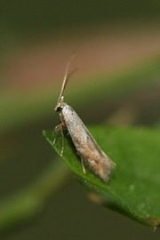
Adults of this family are easily overlooked, being very small with narrow wings wrapped around the body at rest. When small, the larva
e are leaf-miners, forming distinctive brown blotches on leaves. When larger, they usually feed on the leaves externally. Many species have specific host plants. The pupa
l cases have distinctive longitudinal ridges, leading to members of the family commonly being called ribbed cocoon makers.
Most authors recognize just a single large genus, Bucculatrix, although two Australia
n species, Cryphioxena notosema
and the Scribbly Gum Moth, Ogmograptis scribula are sometimes placed in this family rather than in Elachistidae
.
Moth
A moth is an insect closely related to the butterfly, both being of the order Lepidoptera. Moths form the majority of this order; there are thought to be 150,000 to 250,000 different species of moth , with thousands of species yet to be described...
s. This small family has representatives in all parts of the world. Some authors place the group as a subfamily of the family Lyonetiidae
Lyonetiidae
Lyonetiidae is a family of moths. These are small, slender moths, the wingspan rarely exceeding 1 cm. The very narrow forewings, held folded backwards covering the hindwings and abdomen, often have pointed apices noticeably up- or down-turned. The larvae are leaf miners.The families Bucculatricidae...
.
Adults of this family are easily overlooked, being very small with narrow wings wrapped around the body at rest. When small, the larva
Larva
A larva is a distinct juvenile form many animals undergo before metamorphosis into adults. Animals with indirect development such as insects, amphibians, or cnidarians typically have a larval phase of their life cycle...
e are leaf-miners, forming distinctive brown blotches on leaves. When larger, they usually feed on the leaves externally. Many species have specific host plants. The pupa
Pupa
A pupa is the life stage of some insects undergoing transformation. The pupal stage is found only in holometabolous insects, those that undergo a complete metamorphosis, going through four life stages; embryo, larva, pupa and imago...
l cases have distinctive longitudinal ridges, leading to members of the family commonly being called ribbed cocoon makers.
Most authors recognize just a single large genus, Bucculatrix, although two Australia
Australia
Australia , officially the Commonwealth of Australia, is a country in the Southern Hemisphere comprising the mainland of the Australian continent, the island of Tasmania, and numerous smaller islands in the Indian and Pacific Oceans. It is the world's sixth-largest country by total area...
n species, Cryphioxena notosema
Cryphioxena notosema
Cryphioxena notosema is a moth of the Bucculatricidae family. It is found in Australia.-External links:*...
and the Scribbly Gum Moth, Ogmograptis scribula are sometimes placed in this family rather than in Elachistidae
Elachistidae
| image = Elachista rufocinerea 2.jpg| image_width = 240px| image_caption = Adult Elachista rufocinerea,demonstrating its tiny size versus an aphid and a spider mite | regnum = Animalia| phylum = Arthropoda| classis = Insecta...
.
Species
Species include:- B. absinthii
- Food plant: Artemisia
- B. acrogramma
- B. adelpha
- B. agilis
- Food plant: Acacia horridaAcaciaAcacia is a genus of shrubs and trees belonging to the subfamily Mimosoideae of the family Fabaceae, first described in Africa by the Swedish botanist Carl Linnaeus in 1773. Many non-Australian species tend to be thorny, whereas the majority of Australian acacias are not...
- B. agnella
- Food plant: Ambrosia artemisiifoliaAmbrosia artemisiifoliaAmbrosia artemisiifolia, Common Ragweed, is the most widespread plant of the genus Ambrosia in North America. It has also been called Annual Ragweed, Bitterweed, Blackweed, Carrot Weed, Hay Fever Weed, Roman Wormwood, Stammerwort, Stickweed, Tassel Weed, and American Wormwood...
- B. ainsliellaBucculatrix ainsliellaThe Oak Leaf Skeletonizer or Oak Skeletonizer is a moth of the Bucculatricidae family. It is found in the northern part of the United States, down to North Carolina and Mississippi and the Southern parts of Canada, including British Columbia.The wingspan is 7-8 mm...
http://www.origins.tv/entomology/moths/300/0572/0572.htm
- B. ainsliella
- Food plant: QuercusOakAn oak is a tree or shrub in the genus Quercus , of which about 600 species exist. "Oak" may also appear in the names of species in related genera, notably Lithocarpus...
- B. alaternella
- Food plant: Rhamnus alaternusBuckthornThe Buckthorns are a genus of about 100 species of shrubs or small trees from 1-10 m tall , in the buckthorn family Rhamnaceae...
- B. albaciliella
- B. albedinella
- Food plant: UlmusElmElms are deciduous and semi-deciduous trees comprising the genus Ulmus in the plant family Ulmaceae. The dozens of species are found in temperate and tropical-montane regions of North America and Eurasia, ranging southward into Indonesia. Elms are components of many kinds of natural forests...
- B. albella
- Food plant: Paliurus spina-christiPaliurus spina-christiPaliurus spina-christi, commonly known as Jerusalem Thorn, Garland Thorn, Christ's Thorn, or Crown of Thorns, is a species of Paliurus native to the Mediterranean region and southwest and central Asia, from Morocco and Spain east to Iran and Tajikistan.It is a deciduous shrub or small tree growing...
- B. albertiellaBucculatrix albertiellaThe Oak-ribbed Skeletonizer is a moth of the Bucculatricidae family. It is found along the west coast of the United States.The wingspan is 8-9 mm.The larvae feed on Quercus species....
- B. albertiella
- Food plant: QuercusOakAn oak is a tree or shrub in the genus Quercus , of which about 600 species exist. "Oak" may also appear in the names of species in related genera, notably Lithocarpus...
- B. albiguttella
- Food plant: AchilleaAchilleaAchillea is a genus of about 85 flowering plants, in the family Asteraceae, commonly referred to as yarrow. They occur in Europe and temperate areas of Asia. A few grow in North America. These plants typically have frilly, hairy, aromatic leaves....
- B. alpina
- B. ambrosiaefoliella
- Recorded food plants: AmbrosiaRagweedRagweeds are flowering plants in the genus Ambrosia in the sunflower family Asteraceae. Common names include bitterweeds and bloodweeds....
, Parthenium hysterophorusPartheniumParthenium is a genus of flowering plants in the aster family, Asteraceae. The name is derived from either the Greek word παρθένος , meaning "virgin," or παρθένιον , an ancient name for a plant. Members of the genus are commonly known as feverfew. Notable species include Guayule and P...
- B. amiculella
- Food plant: QuercusOakAn oak is a tree or shrub in the genus Quercus , of which about 600 species exist. "Oak" may also appear in the names of species in related genera, notably Lithocarpus...
- B. anaticula
- Food plant: Ceanothus americanusCeanothusCeanothus L. is a genus of about 50–60 species of shrubs or small trees in the buckthorn family Rhamnaceae. The genus is confined to North America, the center of its distribution in California, with some species in the eastern United States and southeast Canada, and others extending as far south...
- B. andalusica
- Food plant: Artemisia
- Food plants: Aster, ErigeronErigeronErigeron is a genus of about 390 species of flowering plants in the family Asteraceae. The genus has a cosmopolitan distribution with the highest species diversity in North America, where 173 species occur....
, SolidagoGoldenrodSolidago, commonly called goldenrods, is a genus of about 100 species of flowering plants in the family Asteraceae. Most are herbaceous perennial species found in the meadows and pastures, along roads, ditches and waste areas in North America. There are also a few species native to Mexico, South...
- B. angustisquamella
- B. anthemidella
- Food plant: Anthemis tinctoriaAnthemis tinctoriaCota tinctoria, or Golden Marguerite and Yellow Chamomile, is a species in the genus Anthemis of the Sunflower family ....
- B. argentisignella
- Food plant: Leucanthemum vulgare
- B. armeniaca
- B. arnicella
- Food plants: Arnica cordifoliaArnicaArnica is a genus with about 30 perennial, herbaceous species, belonging to the sunflower family . The genus name Arnica may be derived from the Greek arna, "lamb", in reference to the soft, hairy leaves....
, Artemisia tridentataSagebrushSagebrush is a common name of a number of shrubby plant species in the genus Artemisia native to western North America;Or, the sagebrush steppe ecoregion, having one or more kinds of sagebrush, bunchgrasses and others;...
- Food plant: Artemisia
- B. aspyctella
- B. atagina
- Food plant: Artemisia campestris
- B. atrosignata
- B. bechsteinella http://ukmoths.org.uk/show.php?bf=275
- Food plants: CrataegusCrataegusCrataegus , commonly called hawthorn or thornapple, is a large genus of shrubs and trees in the rose family, Rosaceae, native to temperate regions of the Northern Hemisphere in Europe, Asia and North America. The name hawthorn was originally applied to the species native to northern Europe,...
, Cydonia oblongaQuinceThe quince , or Cydonia oblonga, is the sole member of the genus Cydonia and native to warm-temperate southwest Asia in the Caucasus region...
, MalusMalusMalus , the apples, are a genus of about 30–35 species of small deciduous trees or shrubs in the family Rosaceae. Other studies go as far as 55 species including the domesticated Orchard Apple, or Table apple as it was formerly called...
, PyrusPearThe pear is any of several tree species of genus Pyrus and also the name of the pomaceous fruit of these trees. Several species of pear are valued by humans for their edible fruit, but the fruit of other species is small, hard, and astringent....
, SorbusSorbusSorbus is a genus of about 100–200 species of trees and shrubs in the subfamily Maloideae of the Rose family Rosaceae. Species of Sorbus are commonly known as whitebeam, rowan, service tree, and mountain ash...
- B. benacicolella
- Food plant: Artemisia alba
- B. benenotata
- B. bicolorella
- B. bicristata
- B. brunnescens
- B. callistricha
- Food plant: CorylusHazelThe hazels are a genus of deciduous trees and large shrubs native to the temperate northern hemisphere. The genus is usually placed in the birch family Betulaceae, though some botanists split the hazels into a separate family Corylaceae.They have simple, rounded leaves with double-serrate margins...
- B. canadensisellaBucculatrix canadensisellaThe Birch Skeletonizer is a moth of the Bucculatricidae family. It is found in the northern part of the United States and Canada.Adults are on wing between June and July depending on the location....
- B. canadensisella
- Food plant: BetulaBirchBirch is a tree or shrub of the genus Betula , in the family Betulaceae, closely related to the beech/oak family, Fagaceae. The Betula genus contains 30–60 known taxa...
- B. canariensis
- Food plant: Artemisia canariensis
- B. cantabricella
- Food plant: Convolvulus cantabricusBindweedBindweed may refer to:* Convolvulaceae , a family including about 60 genera and more than 1,650 species** Calystegia , a genus of about 25 species of flowering plants...
- B. capreella
- Food plant: Achillea millefoliumYarrowAchillea millefolium or yarrow is a flowering plant in the family Asteraceae, native to the Northern Hemisphere. In New Mexico and southern Colorado, it is called plumajillo, or "little feather", for the shape of the leaves. In antiquity, yarrow was known as herbal militaris, for its use in...
- B. caribbea
- Food plant: CordiaCordiaCordia is a genus of flowering plants in the borage family, Boraginaceae. It contains about 300 species of shrubs and trees, which are found worldwide mostly in warmer regions. Many of the species are commonly called manjack, while bocote may refer to several Central American species in Spanish...
- B. carolinae
- B. caspica
- B. ceanothiella
- Food plant: CeanothusCeanothusCeanothus L. is a genus of about 50–60 species of shrubs or small trees in the buckthorn family Rhamnaceae. The genus is confined to North America, the center of its distribution in California, with some species in the eastern United States and southeast Canada, and others extending as far south...
- B. ceibae
- Food plant: CeibaCeibaCeiba is the name of a genus of many species of large trees found in tropical areas, including Mexico, Central America, South America, The Bahamas, Belize and the Caribbean, West Africa, and Southeast Asia...
- B. centaureae
- Food plant: Centaurea triniifoliaCentaureaCentaurea is a genus of between 350 and 600 species of herbaceous thistle-like flowering plants in the family Asteraceae. Members of the genus are found only north of the equator, mostly in the Eastern Hemisphere; the Middle East and surrounding regions are particularly species-rich...
- B. centroptila
- Food plant: Firmiana colorataFirmianaFirmiana is a genus of flowering plant in the Sterculiaceae family.It contains 12 or more the following species, including:* Firmiana hainanensis* Firmiana major* Firmiana simplex...
- B. cerina
- Food plant: QuercusOakAn oak is a tree or shrub in the genus Quercus , of which about 600 species exist. "Oak" may also appear in the names of species in related genera, notably Lithocarpus...
- B. chrysanthemella
- Food plants: Argyranthemum frutescensArgyranthemumArgyranthemum is a genus of flowering plants belonging to the family Asteraceae. Members of this genus are sometimes also placed in the genus Chrysanthemum....
, ChrysanthemumChrysanthemumChrysanthemums, often called mums or chrysanths, are of the genus constituting approximately 30 species of perennial flowering plants in the family Asteraceae which is native to Asia and northeastern Europe.-Etymology:...
, GonospermumGonospermumGonospermum is a genus of flowering plants in the daisy family....
- B. cidarella
- Food plants: AlnusAlderAlder is the common name of a genus of flowering plants belonging to the birch family . The genus comprises about 30 species of monoecious trees and shrubs, few reaching large size, distributed throughout the North Temperate Zone and in the Americas along the Andes southwards to...
, Myrica galeMyrica galeMyrica gale is a species of flowering plant in the genus Myrica, native to northern and western Europe and parts of northern North America. It is a deciduous shrub growing to 1–2 m tall. Common names include Bog Myrtle and Sweet Gale...
- B. clavenae
- Food plant: Achillea millefoliumYarrowAchillea millefolium or yarrow is a flowering plant in the family Asteraceae, native to the Northern Hemisphere. In New Mexico and southern Colorado, it is called plumajillo, or "little feather", for the shape of the leaves. In antiquity, yarrow was known as herbal militaris, for its use in...
- B. columbiana
- Food plant: Iva axillaris
- B. coniforma
- B. copeuta
- Food plant: Prunus pensylvanicaPrunusPrunus is a genus of trees and shrubs, which includes the plums, cherries, peaches, apricots and almonds. There are around 430 species spread throughout the northern temperate regions of the globe. Many members of the genus are widely cultivated for fruit and ornament.-Botany:Members of the genus...
- B. cordiaella
- Food plant: CordiaCordiaCordia is a genus of flowering plants in the borage family, Boraginaceae. It contains about 300 species of shrubs and trees, which are found worldwide mostly in warmer regions. Many of the species are commonly called manjack, while bocote may refer to several Central American species in Spanish...
- B. coronatella
- Food plant: BetulaBirchBirch is a tree or shrub of the genus Betula , in the family Betulaceae, closely related to the beech/oak family, Fagaceae. The Betula genus contains 30–60 known taxa...
- B. crataegi
- Food plants: CrataegusCrataegusCrataegus , commonly called hawthorn or thornapple, is a large genus of shrubs and trees in the rose family, Rosaceae, native to temperate regions of the Northern Hemisphere in Europe, Asia and North America. The name hawthorn was originally applied to the species native to northern Europe,...
, PyrusPearThe pear is any of several tree species of genus Pyrus and also the name of the pomaceous fruit of these trees. Several species of pear are valued by humans for their edible fruit, but the fruit of other species is small, hard, and astringent....
- B. crateracma
- Food plant: Bombax ceibaBombax ceibaBombax ceiba, like other trees of the genus Bombax, is commonly known as cotton tree or tree cotton. This tropical tree has a straight tall trunk and its leaves are deciduous in winter. Red flowers with 5 petals appear in the spring before the new foliage. It produces a capsule which, when ripe,...
- B. cretica
- B. cristatella
- Food plant: Achillea millefoliumYarrowAchillea millefolium or yarrow is a flowering plant in the family Asteraceae, native to the Northern Hemisphere. In New Mexico and southern Colorado, it is called plumajillo, or "little feather", for the shape of the leaves. In antiquity, yarrow was known as herbal militaris, for its use in...
- B. criticopa
- B. cuneigera
- Food plant: Aster shortii
- B. demaryella
- Food plants: AcerMapleAcer is a genus of trees or shrubs commonly known as maple.Maples are variously classified in a family of their own, the Aceraceae, or together with the Hippocastanaceae included in the family Sapindaceae. Modern classifications, including the Angiosperm Phylogeny Group system, favour inclusion in...
, BetulaBirchBirch is a tree or shrub of the genus Betula , in the family Betulaceae, closely related to the beech/oak family, Fagaceae. The Betula genus contains 30–60 known taxa...
, CastaneaCastaneaCastanea can mean:* Castanea , a plant genus including the chestnuts and chinkapins* Castanea, Pennsylvania, a census-designated place * Castanea Township, Pennsylvania, which surrounds the CDP of the same name...
, CorylusHazelThe hazels are a genus of deciduous trees and large shrubs native to the temperate northern hemisphere. The genus is usually placed in the birch family Betulaceae, though some botanists split the hazels into a separate family Corylaceae.They have simple, rounded leaves with double-serrate margins...
- B. diffusella
- Food plant: Artemisia maritimaArtemisia maritimaArtemisia maritima is a species of wormwood known as sea wormwood and old woman.In its many variations of form it has an extremely wide distribution in the northern hemisphere of the Old World, occurring mostly in saltish soils...
- B. disjuncta
- B. divisa
- Food plant: Balsamorhiza sagittataBalsamorhizaBalsamorhiza is a genus of plants in the sunflower family known commonly as balsamroots. These are perennials with fleshy taproots and caudices bearing erect stems and large, basal leaves. Atop the tall stems are showy yellow sunflower-like blooms. Balsamroots are native to western North America...
- B. domicola
- Food plant: Quercus palustrisPin oakQuercus palustris, the Pin oak or Swamp Spanish oak, is an oak in the red oak section Quercus sect. Lobatae.-Distribution:...
- B. dominatrix
- Food plant: Baccharis pilularisBaccharisBaccharis is a genus of perennials and shrubs in the aster family . They are commonly known as baccharises but sometimes referred to as "brooms", because many members have small thin leaves resembling the true brooms. They are not at all related to these however, but belong to an entirely...
- B. eclecta
- Food plant: Ulmus pumilaElmElms are deciduous and semi-deciduous trees comprising the genus Ulmus in the plant family Ulmaceae. The dozens of species are found in temperate and tropical-montane regions of North America and Eurasia, ranging southward into Indonesia. Elms are components of many kinds of natural forests...
- B. enceliae
- Food plant: Encelia farinosaEncelia farinosaEncelia farinosa, or Brittlebush, is a common desert shrub of northwestern Mexico through California and the southwestern United States. Its common name comes from the brittleness of its stems....
- B. epibathra
- Food plant: Grewia tiliaefoliaGrewiaThe large flowering plant genus Grewia is today placed by most authors in the mallow family Malvaceae, in the expanded sense as proposed by in the APG. Formerly, it was placed in either the linden family or the Sparrmanniaceae...
- B. ericameriae
- Food plant: Ericameria arborescensEricameriaEricameria is a genus of shrubs in the Asteraceae or daisy family known by the common names rabbitbrush, rabbitbush, and goldenbush. These are semi-deciduous shrubs familiarly known as to sagebrush. They are distributed in the arid western United States and northern Mexico. Bright yellow flowers...
- B. errans
- Food plant: Aster
- B. eucalypti
- Food plant: EucalyptusEucalyptusEucalyptus is a diverse genus of flowering trees in the myrtle family, Myrtaceae. Members of the genus dominate the tree flora of Australia...
- B. eugrapha
- B. eupatoriella
- Food plant: Eupatorium perfoliatumEupatoriumEupatorium is a genus of flowering plants in the aster family, Asteraceae, containing from 36 to 60 species depending on the classification system. Most are herbaceous perennial plants growing to 0.5–3 m tall. A few are shrubs. The genus is native to temperate regions of the Northern Hemisphere....
- B. eurotiella
- Food plants: Krascheninnikovia lanataKrascheninnikoviaKrascheninnikovia is a genus of flowering plants in the amaranth family known generally as winterfat. They are known from Eurasia and western North America. These are hairy perennials or small shrubs which may be monoecious or dioecious...
, SenecioSenecioSenecio is a genus of the daisy family that includes ragworts and groundsels. The flower heads are normally rayed, completely yellow, and the heads are borne in branched clusters...
- B. evanescens
- B. exedra
- Food plant: Firmiana platanifoliaFirmianaFirmiana is a genus of flowering plant in the Sterculiaceae family.It contains 12 or more the following species, including:* Firmiana hainanensis* Firmiana major* Firmiana simplex...
- B. fatigatella
- Food plants: Artemisia campestris, Leucanthemopsis alpinaLeucanthemopsisLeucanthemopsis is a genus of flowering plants in the daisy family....
- B. firmianella
- Food plant: FirmianaFirmianaFirmiana is a genus of flowering plant in the Sterculiaceae family.It contains 12 or more the following species, including:* Firmiana hainanensis* Firmiana major* Firmiana simplex...
- B. flexuosa
- Food plant: Acacia niloticaAcaciaAcacia is a genus of shrubs and trees belonging to the subfamily Mimosoideae of the family Fabaceae, first described in Africa by the Swedish botanist Carl Linnaeus in 1773. Many non-Australian species tend to be thorny, whereas the majority of Australian acacias are not...
- B. floccosa
- B. flourensiae
- Food plant: Flourensia cernuaFlourensiaFlourensia is a genus of flowering plants in the daisy family....
- B. formosa
- B. frangutellaBucculatrix frangutellaBucculatrix frangutella is a moth of the Bucculatricidae family. It is found in Europe.The wingspan is about 8 mm. Adults are on wing between June and July depending on the location....
- Food plant: RhamnusBuckthornThe Buckthorns are a genus of about 100 species of shrubs or small trees from 1-10 m tall , in the buckthorn family Rhamnaceae...
- B. franseriae
- Food plant: Ambrosia deltoideaRagweedRagweeds are flowering plants in the genus Ambrosia in the sunflower family Asteraceae. Common names include bitterweeds and bloodweeds....
- B. frigida
- B. fugitans
- Food plant: CorylusHazelThe hazels are a genus of deciduous trees and large shrubs native to the temperate northern hemisphere. The genus is usually placed in the birch family Betulaceae, though some botanists split the hazels into a separate family Corylaceae.They have simple, rounded leaves with double-serrate margins...
- B. fusicola
- Food plant: HelianthusHelianthusHelianthus L. is a genus of plants comprising 52 species in the Asteraceae family, all of which are native to North America, with some species Helianthus L. is a genus of plants comprising 52 species in the Asteraceae family, all of which are native to North America, with some species Helianthus...
- B. gnaphaliella
- Food plant: Helichrysum arenariumHelichrysum arenariumHelichrysum arenarium is also known as dwarf everlast, and Immortelle -Description:An Perennial plant, it grows to be an average of 0.3 m tall....
- B. gossypiella
- Food plant: Gossypium
- B. gossypii
- Food plant: Gossypium
- B. helianthemi
- Food plant: Helianthemum sessiliflorumHelianthemumHelianthemum , known as rock rose, sunroses, or rushrose, is a genus of about 110 species of evergreen or semi-evergreen subshrubs in the family Cistaceae...
- B. helichrysella
- Food plant: Helichrysum italicum
- B. herbalbella
- Food plant: Artemisia herba-alba
- B. humiliella
- B. ilecella
- Food plant: IlexHollyIlex) is a genus of 400 to 600 species of flowering plants in the family Aquifoliaceae, and the only living genus in that family. The species are evergreen and deciduous trees, shrubs, and climbers from tropics to temperate zones world wide....
- B. illecebrosa
- Food plant: HelianthusHelianthusHelianthus L. is a genus of plants comprising 52 species in the Asteraceae family, all of which are native to North America, with some species Helianthus L. is a genus of plants comprising 52 species in the Asteraceae family, all of which are native to North America, with some species Helianthus...
- B. immaculatella
- B. improvisa
- Food plant: Tilia americanaTilia americanaTilia americana is a species of Tilia native to eastern North America, from southeast Manitoba east to New Brunswick, southwest to northeast Texas, and southeast to South Carolina, and west along the Niobrara River to Cherry County, Nebraska...
- B. infans
- B. insolita
- B. inusitata
- Food plant: Juniperus communisJuniperus communisJuniperus communis, the Common Juniper, is a species in the genus Juniperus, in the family Cupressaceae. It has the largest range of any woody plant, throughout the cool temperate Northern Hemisphere from the Arctic south in mountains to around 30°N latitude in North America, Europe and Asia.-...
- B. ivella
- Food plants: BaccharisBaccharisBaccharis is a genus of perennials and shrubs in the aster family . They are commonly known as baccharises but sometimes referred to as "brooms", because many members have small thin leaves resembling the true brooms. They are not at all related to these however, but belong to an entirely...
, Iva frutescens- B. jugicola
- Food plants: Achillea oxylobaAchilleaAchillea is a genus of about 85 flowering plants, in the family Asteraceae, commonly referred to as yarrow. They occur in Europe and temperate areas of Asia. A few grow in North America. These plants typically have frilly, hairy, aromatic leaves....
, Leucanthemopsis alpinaLeucanthemopsisLeucanthemopsis is a genus of flowering plants in the daisy family....
- B. kendalli
- Food plant: Colubrina texensisColubrinaColubrina is a genus of about 30 species of flowering plants in the buckthorn family, Rhamnaceae, native to warm temperate to tropical regions of Africa, the Americas, southern Asia, northern Australia, and the Indian Ocean islands. Common names include nakedwood, snakewood, greenheart and hogplum...
- B. kimballi
- B. koebelella
- Food plant: Artemisia californica
- B. laciniatella
- Food plant: Artemisia laciniata
- B. lassella
- B. latella
- B. latviaella
- B. lavaterella
- Food plant: LavateraLavateraLavatera is a genus of about 25 species of flowering plants in the family Malvaceae, native to the Mediterranean region, central and eastern Asia, and Australia. A number of species previously listed in this genus have now been transferred to the related genus Malva...
- B. leptalea
- Food plant: Artemisia dracunculusTarragonTarragon or dragon's-wort is a perennial herb in the family Asteraceae related to wormwood. Corresponding to its species name, a common term for the plant is "dragon herb". It is native to a wide area of the Northern Hemisphere from easternmost Europe across central and eastern Asia to India,...
- B. leucanthemella
- Food plants: ChrysanthemumChrysanthemumChrysanthemums, often called mums or chrysanths, are of the genus constituting approximately 30 species of perennial flowering plants in the family Asteraceae which is native to Asia and northeastern Europe.-Etymology:...
, LeucanthemumLeucanthemumLeucanthemum is a genus of about 70 flowering plants from the sunflower family . It occurs in Europe, Northern Africa and the temperate regions of Asia. Many species have been introduced into America, Australia and New Zealand.-Growth:...
, Staehelina dubiaStaehelinaStaehelina is a genus of flowering plants in the daisy family....
- B. litigiosella
- Food plant: QuercusOakAn oak is a tree or shrub in the genus Quercus , of which about 600 species exist. "Oak" may also appear in the names of species in related genera, notably Lithocarpus...
- B. locuples
- Food plant: Alnus serrulataAlderAlder is the common name of a genus of flowering plants belonging to the birch family . The genus comprises about 30 species of monoecious trees and shrubs, few reaching large size, distributed throughout the North Temperate Zone and in the Americas along the Andes southwards to...
- B. longula
- Food plant: Helianthus annuusSunflowerSunflower is an annual plant native to the Americas. It possesses a large inflorescence . The sunflower got its name from its huge, fiery blooms, whose shape and image is often used to depict the sun. The sunflower has a rough, hairy stem, broad, coarsely toothed, rough leaves and circular heads...
- B. loxoptila
- Food plant: Gossypium
- B. luteella
- Food plant: Quercus albaWhite oakQuercus alba, the white oak, is one of the pre-eminent hardwoods of eastern North America. It is a long-lived oak of the Fagaceae family, native to eastern North America and found from southern Quebec west to eastern Minnesota and south to northern Florida and eastern Texas. Specimens have been...
- B. magnella
- Food plant: SolidagoGoldenrodSolidago, commonly called goldenrods, is a genus of about 100 species of flowering plants in the family Asteraceae. Most are herbaceous perennial species found in the meadows and pastures, along roads, ditches and waste areas in North America. There are also a few species native to Mexico, South...
- B. maritima http://www.oekotec.uni-kiel.de/suppl7.htm
- Food plant: Aster tripolium
- B. mehadiensis
- B. mendax
- Food plant: Dalbergia sissooDalbergiaDalbergia is a large genus of small to medium-size trees, shrubs and lianas in the pea family, Fabaceae, subfamily Faboideae. The genus has a wide distribution, native to the tropical regions of Central and South America, Africa, Madagascar and southern Asia...
- B. mesoporphyra
- B. micropunctata
- B. montana
- B. myricae
- Food plant: Myrica galeMyrica galeMyrica gale is a species of flowering plant in the genus Myrica, native to northern and western Europe and parts of northern North America. It is a deciduous shrub growing to 1–2 m tall. Common names include Bog Myrtle and Sweet Gale...
- B. needhami
- Food plant: HelianthusHelianthusHelianthus L. is a genus of plants comprising 52 species in the Asteraceae family, all of which are native to North America, with some species Helianthus L. is a genus of plants comprising 52 species in the Asteraceae family, all of which are native to North America, with some species Helianthus...
- B. nigricomella http://ukmoths.org.uk/show.php?bf=266
- Food plant: Leucanthemum vulgare
- B. nigripunctella
- B. niveella
- Food plant: SolidagoGoldenrodSolidago, commonly called goldenrods, is a genus of about 100 species of flowering plants in the family Asteraceae. Most are herbaceous perennial species found in the meadows and pastures, along roads, ditches and waste areas in North America. There are also a few species native to Mexico, South...
- B. noltei
- Food plant: Artemisia vulgaris
- B. ochristrigella
- B. ochrisuffusa
- Food plant: Quercus albaWhite oakQuercus alba, the white oak, is one of the pre-eminent hardwoods of eastern North America. It is a long-lived oak of the Fagaceae family, native to eastern North America and found from southern Quebec west to eastern Minnesota and south to northern Florida and eastern Texas. Specimens have been...
- B. ochritincta
- B. orophilella
- B. packardella
- Food plants: FagusBeechBeech is a genus of ten species of deciduous trees in the family Fagaceae, native to temperate Europe, Asia and North America.-Habit:...
, QuercusOakAn oak is a tree or shrub in the genus Quercus , of which about 600 species exist. "Oak" may also appear in the names of species in related genera, notably Lithocarpus...
- B. paliuricola
- Food plant: PaliurusPaliurusPaliurus is a genus of flowering plants in the family Rhamnaceae. The eight species are native to warm, dry regions of Eurasia and North Africa from Morocco and Spain east to Japan and Taiwan.-Description:...
- B. pallidula
- B. pannonica
- Food plant: Artemisia maritima
- B. paroptila
- Food plants: Comptonia peregrinaComptoniaComptonia is a monotypic genus in the family Myricaceae, order Fagales. It is native to eastern North America, from southern Quebec south to the extreme north of Georgia, and west to Minnesota. The common name is Sweetfern or Sweet-fern, a confusing name as it is not a fern.It is a deciduous...
, Myrica galeMyrica galeMyrica gale is a species of flowering plant in the genus Myrica, native to northern and western Europe and parts of northern North America. It is a deciduous shrub growing to 1–2 m tall. Common names include Bog Myrtle and Sweet Gale...
- B. parthenica
- Food plant: Parthenium hysterophorusPartheniumParthenium is a genus of flowering plants in the aster family, Asteraceae. The name is derived from either the Greek word παρθένος , meaning "virgin," or παρθένιον , an ancient name for a plant. Members of the genus are commonly known as feverfew. Notable species include Guayule and P...
- B. parvinotata
- B. perficta
- B. phagnalella
- Food plant: Phagnalon saxatilePhagnalonPhagnalon is a genus of flowering plants in the daisy family, Asteraceae....
- B. platyphylla
- B. plucheae
- Food plant: Pluchea odorataPlucheaPluchea is a genus of flowering plant in the Asteraceae family. Members of this genus might be known as camphorweeds, plucheas, or less uniquely "fleabanes". Some are called sourbushes. There are at least 40 species in the genus. They are native to tropical and warm temperate areas...
- B. polymniae
- Food plant: Smallanthus uvedaliusSmallanthusSmallanthus is a genus of flowering plants in the Asteraceae . By 1997 there were at least 21 species.Species include:*Smallanthus apus*Smallanthus connatus*Smallanthus fruticosus*Smallanthus glabratus...
- B. polytita
- B. pomifoliella
- Food plants: AmbrosiaRagweedRagweeds are flowering plants in the genus Ambrosia in the sunflower family Asteraceae. Common names include bitterweeds and bloodweeds....
, Amelanchier laevisServiceberryAmelanchier , also known as shadbush, shadwood or shadblow, serviceberry or sarvisberry, wild pear, juneberry, saskatoon, sugarplum or wild-plum, and chuckley pear is a genus of about 20 species of deciduous-leaved shrubs and small trees in the Rose family .Amelanchier is native to temperate regions...
, Chaenomeles japonicaChaenomelesChaenomeles is a genus of three species of deciduous spiny shrubs, usually 1–3 m tall, in the family Rosaceae. They are native to eastern Asia in Japan, China and Korea...
, CrataegusCrataegusCrataegus , commonly called hawthorn or thornapple, is a large genus of shrubs and trees in the rose family, Rosaceae, native to temperate regions of the Northern Hemisphere in Europe, Asia and North America. The name hawthorn was originally applied to the species native to northern Europe,...
, Cydonia oblongaQuinceThe quince , or Cydonia oblonga, is the sole member of the genus Cydonia and native to warm-temperate southwest Asia in the Caucasus region...
, MalusMalusMalus , the apples, are a genus of about 30–35 species of small deciduous trees or shrubs in the family Rosaceae. Other studies go as far as 55 species including the domesticated Orchard Apple, or Table apple as it was formerly called...
, PrunusPrunusPrunus is a genus of trees and shrubs, which includes the plums, cherries, peaches, apricots and almonds. There are around 430 species spread throughout the northern temperate regions of the globe. Many members of the genus are widely cultivated for fruit and ornament.-Botany:Members of the genus...
, PyrusPearThe pear is any of several tree species of genus Pyrus and also the name of the pomaceous fruit of these trees. Several species of pear are valued by humans for their edible fruit, but the fruit of other species is small, hard, and astringent....
- B. pseudosylvella
- Food plant: Rhamnus saxatilisBuckthornThe Buckthorns are a genus of about 100 species of shrubs or small trees from 1-10 m tall , in the buckthorn family Rhamnaceae...
- B. ptochastis
- B. pyrivorella
- Food plants: Pisum sativumPeaA pea is most commonly the small spherical seed or the seed-pod of the pod fruit Pisum sativum. Each pod contains several peas. Peapods are botanically a fruit, since they contain seeds developed from the ovary of a flower. However, peas are considered to be a vegetable in cooking...
, PyrusPearThe pear is any of several tree species of genus Pyrus and also the name of the pomaceous fruit of these trees. Several species of pear are valued by humans for their edible fruit, but the fruit of other species is small, hard, and astringent....
- B. quadrigemina
- Food plants: AlceaHollyhockAlcea , commonly known as hollyhocks, is a genus of about 60 species of flowering plants in the mallow family Malvaceae. Most species are native to southwest and central Asia, although a few are native to southeast Europe or Egypt...
, AlthaeaAlthaea (genus)Althaea is a genus of 6-12 species of perennial herbs native to Europe and western Asia. It includes Althaea officinalis, also known as the marshmallow plant, whence the fluffy confection got its name. They are found on the banks of rivers and in salt marshes, preferring moist, sandy soils. The...
- B. quinquenotella
- Food plants: AmpelopsisAmpelopsisAmpelopsis is a genus of climbing shrubs, in the grape family Vitaceae. The name is derived from the Greek word ampelos, which means "vine"...
, Quercus rubraNorthern Red OakQuercus rubra, commonly called northern red oak or champion oak, , is an oak in the red oak group . It is a native of North America, in the northeastern United States and southeast Canada...
- B. ratisbonensis
- Food plant: Artemisia campestris
- B. recognita
- Food plant: Quercus macrocarpaBur oakQuercus macrocarpa, the Bur Oak, sometimes spelled Burr Oak, is a species of oak in the white oak section Quercus sect. Quercus, native to North America in the eastern and midwestern United States and south-central Canada...
- B. regaella
- Food plant: Helianthemum sessiliflorumHelianthemumHelianthemum , known as rock rose, sunroses, or rushrose, is a genus of about 110 species of evergreen or semi-evergreen subshrubs in the family Cistaceae...
- B. rhamniella
- Food plant: RhamnusBuckthornThe Buckthorns are a genus of about 100 species of shrubs or small trees from 1-10 m tall , in the buckthorn family Rhamnaceae...
- B. ruficoma
- Food plants: Gossypium, Ipomoea batatasSweet potatoThe sweet potato is a dicotyledonous plant that belongs to the family Convolvulaceae. Its large, starchy, sweet-tasting, tuberous roots are an important root vegetable. The young leaves and shoots are sometimes eaten as greens. Of the approximately 50 genera and more than 1,000 species of...
- B. salutatoria
- Food plant: Artemisia tridentataSagebrushSagebrush is a common name of a number of shrubby plant species in the genus Artemisia native to western North America;Or, the sagebrush steppe ecoregion, having one or more kinds of sagebrush, bunchgrasses and others;...
- B. santolinella
- Food plant: Santolina chamaecyparissusSantolinaSantolina is a genus of flowering plants in the family Asteraceae, native to the Mediterranean region. Between five and 24 species are accepted by different authorities....
- B. seneciensis
- Food plant: SenecioSenecioSenecio is a genus of the daisy family that includes ragworts and groundsels. The flower heads are normally rayed, completely yellow, and the heads are borne in branched clusters...
- B. seorsa
- Food plant: Artemisia tridentataSagebrushSagebrush is a common name of a number of shrubby plant species in the genus Artemisia native to western North America;Or, the sagebrush steppe ecoregion, having one or more kinds of sagebrush, bunchgrasses and others;...
- B. seperabilis
- Food plant: Baccharis pilularisBaccharisBaccharis is a genus of perennials and shrubs in the aster family . They are commonly known as baccharises but sometimes referred to as "brooms", because many members have small thin leaves resembling the true brooms. They are not at all related to these however, but belong to an entirely...
- B. sexnotata
- Food plant: Aster
- B. simulans
- Food plant: Helianthus annuusSunflowerSunflower is an annual plant native to the Americas. It possesses a large inflorescence . The sunflower got its name from its huge, fiery blooms, whose shape and image is often used to depict the sun. The sunflower has a rough, hairy stem, broad, coarsely toothed, rough leaves and circular heads...
- B. solidaginiella
- Food plant: SolidagoGoldenrodSolidago, commonly called goldenrods, is a genus of about 100 species of flowering plants in the family Asteraceae. Most are herbaceous perennial species found in the meadows and pastures, along roads, ditches and waste areas in North America. There are also a few species native to Mexico, South...
- B. sororcula
- B. speciosa
- Food plant: SolidagoGoldenrodSolidago, commonly called goldenrods, is a genus of about 100 species of flowering plants in the family Asteraceae. Most are herbaceous perennial species found in the meadows and pastures, along roads, ditches and waste areas in North America. There are also a few species native to Mexico, South...
- B. spectabilis
- B. sphaeralceae
- B. sporobolella
- Food plant: Sporobolus airoidesSporobolusSporobolus is a genus of grasses in the family Poaceae. They are usually called dropseed grasses or sacaton grasses. They are typical prairie and savanna plants, and they occur in other types of open habitat in warmer climates....
- B. staintonella
- Food plant: PopulusPoplarPopulus is a genus of 25–35 species of deciduous flowering plants in the family Salicaceae, native to most of the Northern Hemisphere. English names variously applied to different species include poplar , aspen, and cottonwood....
- B. subnitens
- B. taeniola
- Food plant: Salvia apianaWhite sageSalvia apiana is an evergreen perennial shrub that is native to the southwestern United States and northwestern Mexico, found mainly in the coastal sage scrub habitat of Southern California and Baja California, on the western edges of the Mojave and Sonoran deserts.-Description :S...
- B. telavivella
- B. tenebricosa
- B. tetradymiae
- Food plant: Tetradymia axillarisTetradymiaTetradymia is a genus of flowering plants in the daisy family, Asteraceae.The ten species are all shrubs native to western North America....
- B. thoracella
- Food plants: AcerMapleAcer is a genus of trees or shrubs commonly known as maple.Maples are variously classified in a family of their own, the Aceraceae, or together with the Hippocastanaceae included in the family Sapindaceae. Modern classifications, including the Angiosperm Phylogeny Group system, favour inclusion in...
, TiliaTiliaTilia is a genus of about 30 species of trees native throughout most of the temperate Northern Hemisphere. The greatest species diversity is found in Asia, and the genus also occurs in Europe and eastern North America, but not western North America...
- B. thurberiellaBucculatrix thurberiellaThe Cotton Leaf Perforator is a moth of the Bucculatricidae family. It is native to the south-western United States and northern Mexico. It is an introduced species in Hawaii....
http://juniper.tamu.edu/Entomology/lfperf2.htm
- B. thurberiella
- Food plants: Cienfuegosia thespesioides, Gossypium
- B. transversata
- Food plant: Ambrosia psilostachyaRagweedRagweeds are flowering plants in the genus Ambrosia in the sunflower family Asteraceae. Common names include bitterweeds and bloodweeds....
- B. tridenticola
- Food plant: Artemisia tridentataSagebrushSagebrush is a common name of a number of shrubby plant species in the genus Artemisia native to western North America;Or, the sagebrush steppe ecoregion, having one or more kinds of sagebrush, bunchgrasses and others;...
- B. trifasciella
- Food plants: CastaneaCastaneaCastanea can mean:* Castanea , a plant genus including the chestnuts and chinkapins* Castanea, Pennsylvania, a census-designated place * Castanea Township, Pennsylvania, which surrounds the CDP of the same name...
, Quercus rubraNorthern Red OakQuercus rubra, commonly called northern red oak or champion oak, , is an oak in the red oak group . It is a native of North America, in the northeastern United States and southeast Canada...
- B. turatii
- Food plant: Paliurus aculeatusPaliurusPaliurus is a genus of flowering plants in the family Rhamnaceae. The eight species are native to warm, dry regions of Eurasia and North Africa from Morocco and Spain east to Japan and Taiwan.-Description:...
- Food plants: Pinus sylvestrisScots PinePinus sylvestris, commonly known as the Scots Pine, is a species of pine native to Europe and Asia, ranging from Scotland, Ireland and Portugal in the west, east to eastern Siberia, south to the Caucasus Mountains, and as far north as well inside the Arctic Circle in Scandinavia...
, QuercusOakAn oak is a tree or shrub in the genus Quercus , of which about 600 species exist. "Oak" may also appear in the names of species in related genera, notably Lithocarpus...
, SorbusSorbusSorbus is a genus of about 100–200 species of trees and shrubs in the subfamily Maloideae of the Rose family Rosaceae. Species of Sorbus are commonly known as whitebeam, rowan, service tree, and mountain ash...
, UlmusElmElms are deciduous and semi-deciduous trees comprising the genus Ulmus in the plant family Ulmaceae. The dozens of species are found in temperate and tropical-montane regions of North America and Eurasia, ranging southward into Indonesia. Elms are components of many kinds of natural forests...
- B. ulmicola
- B. ulmifoliae
- Food plant: UlmusElmElms are deciduous and semi-deciduous trees comprising the genus Ulmus in the plant family Ulmaceae. The dozens of species are found in temperate and tropical-montane regions of North America and Eurasia, ranging southward into Indonesia. Elms are components of many kinds of natural forests...
- B. ulocarena
- B. univoca
- Food plant: Ipomoea aquaticaIpomoea aquaticaIpomoea aquatica is a semi-aquatic tropical plant grown as a leaf vegetable. It is known in English as Water Spinach, Water Morning Glory, Water Convolvulus, or by the more ambiguous names "Chinese spinach" and "swamp cabbage". It has many other names in other languages, such as "Phak bung" in Thai...
- B. variabilis
- Food plants: TidestromiaTidestromiaTidestromia is a genus with about seven species of annual or subshrub perennial plants native to desert and semi-arid regions of the western United States, Mexico and tropical America in the family Amaranthaceae. A common name of some species is Honeysweet. The stems are reddish and contrast...
, Baccharis pilularisBaccharisBaccharis is a genus of perennials and shrubs in the aster family . They are commonly known as baccharises but sometimes referred to as "brooms", because many members have small thin leaves resembling the true brooms. They are not at all related to these however, but belong to an entirely...
- B. verax
- Food plant: Trewia nudifloraTrewiaTrewia is a plant genus of the spurge family , comprising 2 species. It is found from the Himalaya to Hainan Island. These species have hard large fruits....
- B. viguierae
- Food plant: Heliomeris longifoliaHeliomerisHeliomeris is a small genus of flowering plants in the sunflower family known generally as false goldeneyes. These are annual and perennial herbs producing sunflower-like radiate flower heads. They are distinguished from related genera by the achenes, which are glabrous and lack a pappus, and by...
- B. xenaula
- Food plant: SterculiaSterculiaSterculia is a genus of flowering plants in the mallow family, Malvaceae. It was previously placed in the now obsolete Sterculiaceae. Members of the genus are colloquially known as tropical chestnuts...
- B. zizyphella
- Food plant: ZiziphusZiziphusZiziphus is a genus of about 40 species of spiny shrubs and small trees in the buckthorn family, Rhamnaceae, distributed in the warm-temperate and subtropical regions throughout the world. The leaves are alternate, entire, with three prominent basal veins, and long; some species are deciduous,...
- B. zophopasta
- Food plant: Quercus garryana
