
All Topics  
Buccaneer


   Email Print
   Bookmark   Link


Buccaneer


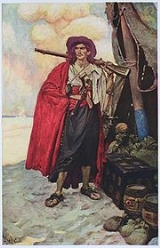
The buccaneers were pirates
Piracy

Piracy is a warlike act committed by a foreign nonstate actor, especially robbery or crime committed at sea, on a river, or sometimes on shore, either from a vessel flying no national flag, or one flying a national flag but without authorization from a nation....
 who attacked Spanish
Habsburg Spain

Habsburg Spain refers to the history of Spain over the 16th and 17th centuries , when Spain was ruled by the major branch of the Habsburg dynasty ....
 and French
France

France , officially the French Republic , is a country whose Metropolitan France is located in Western Europe and that also comprises various Overseas departments and territories of France....
 shipping in the Caribbean Sea
Caribbean Sea

The Caribbean Sea is a sea of the Atlantic Ocean situated in the mid-latitudes of the Western Hemisphere, bounded to the south and west by the Americas, with the North Atlantic Ocean proper to the northeast and the Gulf of Mexico to the northwest....
 during the late 17th century
17th century

As a means of recording the passage of time, the 17th Century was that century which lasted from 1601-1700 in the Gregorian calendar.The 17th Century falls into the Early Modern period of Europe and was characterized by the Baroque cultural movement, the French Grand Si?cle dominated by Louis XIV, and the Scientific Revolution, includ...
.

The term buccaneer is now used generally as a synonym for pirate. Originally, buccaneer crews were larger, more apt to attack coastal cities, and more localized to the Caribbean than later pirate crews who sailed to the Indian Ocean
Indian Ocean

The Indian Ocean is the third largest of the world's oceanic divisions, covering about 20% of the water on the Earth's surface. It is bounded on the north by Asia ; on the west by Africa; on the east by Indochina, the Sunda Islands, and Australia; and on the south by the Southern Ocean ....
 on the Pirate Round
Pirate Round

The Pirate Round was a sailing route followed by certain Anglo-American piracy, mainly during the late 17th century. The course led from the western Atlantic, around the southern tip of Africa, stopping at Madagascar, then on to targets such as the coast of Yemen and India....
 in the late 17th century.

term buccaneer derives from the Arawak
Arawakan languages

The Arawakan languages are an indigenous language family of South America and the Caribbean.Originally the name Arawak was used exclusively for a powerful tribe in Netherlands Antilles, Guyana and Suriname....
 word buccan
Buccan

A buccan is a native South American and Caribbean name for a wooden framework or hurdle on which meat was roasted or smoked over a fire, similar to the original meaning of a barbecue....
, a wooden frame for smoking meat, hence the French
French language

French is a Romance language spoken around the world by around 80 million people as first language, by 190 million as second language, and by about another 200 million people as an acquired tongue, with significant speakers in 54 countries....
 word boucane and the name boucanier for French hunters who used such frames to smoke meat from feral
Feral

A feral organism is one that has escaped from domestication and returned, partly or wholly, to its wildlife state. The introduction of feral animals or plants, like any introduced species, can disrupt ecosystems and may, in some cases, contribute to extinction of indigenous species....
 cattle
Cattle

Cattle, colloquially referred to as cows, are domestication ungulates, a member of the subfamily Bovinae of the family Bovidae. They are raised as livestock for meat , dairy products , leather and as draft animals ....
 and pigs
Razorback

The Razorback, also referred to as wild swine, feral hogs and feral swine, is a feral pig that was first introduced to North America and South America in the 16th century....
 on Hispaniola
Hispaniola

Hispaniola is the second-largest and most populous island of the Antilles, lying between the islands of Cuba to the west, and Puerto Rico to the east....
 (now Haiti
Haiti

Haiti , officially the Republic of Haiti , is a Haitian Creole language- and French language-speaking Caribbean country. Along with the Dominican Republic, it occupies the island of Hispaniola, in the Greater Antilles archipelago....
 and the Dominican Republic
Dominican Republic

The Dominican Republic is a nation on the island of Hispaniola, part of the Greater Antilles archipelago in the Caribbean region. The western third of the island is occupied by the nation of Haiti, making Hispaniola one of two Caribbean islands that are List of divided islands, Saint Martin being the other....
).


Discussion
Ask a question about 'Buccaneer'
Start a new discussion about 'Buccaneer'
Answer questions from other users
Full Discussion Forum


Recent Posts


Encyclopedia


The buccaneers were pirates
Piracy

Piracy is a warlike act committed by a foreign nonstate actor, especially robbery or crime committed at sea, on a river, or sometimes on shore, either from a vessel flying no national flag, or one flying a national flag but without authorization from a nation....
 who attacked Spanish
Habsburg Spain

Habsburg Spain refers to the history of Spain over the 16th and 17th centuries , when Spain was ruled by the major branch of the Habsburg dynasty ....
 and French
France

France , officially the French Republic , is a country whose Metropolitan France is located in Western Europe and that also comprises various Overseas departments and territories of France....
 shipping in the Caribbean Sea
Caribbean Sea

The Caribbean Sea is a sea of the Atlantic Ocean situated in the mid-latitudes of the Western Hemisphere, bounded to the south and west by the Americas, with the North Atlantic Ocean proper to the northeast and the Gulf of Mexico to the northwest....
 during the late 17th century
17th century

As a means of recording the passage of time, the 17th Century was that century which lasted from 1601-1700 in the Gregorian calendar.The 17th Century falls into the Early Modern period of Europe and was characterized by the Baroque cultural movement, the French Grand Si?cle dominated by Louis XIV, and the Scientific Revolution, includ...
.

The term buccaneer is now used generally as a synonym for pirate. Originally, buccaneer crews were larger, more apt to attack coastal cities, and more localized to the Caribbean than later pirate crews who sailed to the Indian Ocean
Indian Ocean

The Indian Ocean is the third largest of the world's oceanic divisions, covering about 20% of the water on the Earth's surface. It is bounded on the north by Asia ; on the west by Africa; on the east by Indochina, the Sunda Islands, and Australia; and on the south by the Southern Ocean ....
 on the Pirate Round
Pirate Round

The Pirate Round was a sailing route followed by certain Anglo-American piracy, mainly during the late 17th century. The course led from the western Atlantic, around the southern tip of Africa, stopping at Madagascar, then on to targets such as the coast of Yemen and India....
 in the late 17th century.

History

The term buccaneer derives from the Arawak
Arawakan languages

The Arawakan languages are an indigenous language family of South America and the Caribbean.Originally the name Arawak was used exclusively for a powerful tribe in Netherlands Antilles, Guyana and Suriname....
 word buccan
Buccan

A buccan is a native South American and Caribbean name for a wooden framework or hurdle on which meat was roasted or smoked over a fire, similar to the original meaning of a barbecue....
, a wooden frame for smoking meat, hence the French
French language

French is a Romance language spoken around the world by around 80 million people as first language, by 190 million as second language, and by about another 200 million people as an acquired tongue, with significant speakers in 54 countries....
 word boucane and the name boucanier for French hunters who used such frames to smoke meat from feral
Feral

A feral organism is one that has escaped from domestication and returned, partly or wholly, to its wildlife state. The introduction of feral animals or plants, like any introduced species, can disrupt ecosystems and may, in some cases, contribute to extinction of indigenous species....
 cattle
Cattle

Cattle, colloquially referred to as cows, are domestication ungulates, a member of the subfamily Bovinae of the family Bovidae. They are raised as livestock for meat , dairy products , leather and as draft animals ....
 and pigs
Razorback

The Razorback, also referred to as wild swine, feral hogs and feral swine, is a feral pig that was first introduced to North America and South America in the 16th century....
 on Hispaniola
Hispaniola

Hispaniola is the second-largest and most populous island of the Antilles, lying between the islands of Cuba to the west, and Puerto Rico to the east....
 (now Haiti
Haiti

Haiti , officially the Republic of Haiti , is a Haitian Creole language- and French language-speaking Caribbean country. Along with the Dominican Republic, it occupies the island of Hispaniola, in the Greater Antilles archipelago....
 and the Dominican Republic
Dominican Republic

The Dominican Republic is a nation on the island of Hispaniola, part of the Greater Antilles archipelago in the Caribbean region. The western third of the island is occupied by the nation of Haiti, making Hispaniola one of two Caribbean islands that are List of divided islands, Saint Martin being the other....
). English
Kingdom of England

The Kingdom of England was, from 927 to 1707, a state in North-West Europe. The Kingdom of England spanned the southern two-thirds of the island of Great Britain and a number of smaller outlying islands?what is today the legal unit of England and Wales....
 colonists anglicised
Anglicisation

Anglicisation or anglicization is a process of conversion of verbal or written elements of any other language into a more comprehensible English language for an English speaker....
 the word boucanier to buccaneer.

About 1630, some Frenchmen who were driven away from the island of Hispaniola fled to nearby Tortuga. The Spaniards tried to drive them out of Tortuga, but the buccaneers were joined by many other French, Dutch
Dutch Republic

The Republic of the Seven United Netherlands was a European republic between 1581 and 1795, in about the same location as the modern Kingdom of the Netherlands, which is the successor state....
 and English and turned to piracy against Spanish shipping, generally using small craft to attack galleon
Galleon

A galleon was a large, multi-decked sailing ship used primarily by the nations of Europe from the 16th to 18th centuries. Whether used for war or commerce, they were generally armed with demi-culverin....
s in the vicinity of the Windward Passage
Windward Passage

The Windward Passage is a strait in the Caribbean Sea, between the islands of Cuba and Hispaniola. The strait specifically lies between the easternmost region of Cuba and the northwest of Haiti....
. Finally they became so strong that they even sailed to the mainland of Spanish America
Spanish colonization of the Americas

The Spanish colonization of the Americas was Spain's conquest, settlement, and rule over much of the western hemisphere. Beginning with the arrival of Christopher Columbus in 1492, over three centuries the Spanish Empire expanded from early small settlements in the Caribbean to include Central America, most of South America, Mexico, what toda...
 and sacked cities.

English settlers occupying Jamaica
Jamaica

Jamaica is an island nation of the Greater Antilles, in length and as much as in width situated in the Caribbean Sea. It is about south of Cuba, and west of the island of Hispaniola, on which Haiti and the Dominican Republic are situated....
 began to spread the name buccaneers with the meaning of pirates. The name became universally adopted later in 1684 when the first English translation of Alexandre Exquemelin
Alexandre Exquemelin

Alexandre Olivier Exquemelin was a French writer most known as the author of one of the most important sourcebooks of seventeenth century pirate, first published in Dutch as De Americaensche Zee-Roovers, in Amsterdam, Jan ten Hoorn, in 1678....
's book The Buccaneers of America was published.

Viewed from London
London

London is the capital of both England and the United Kingdom, and the most populous municipality in the European Union. An important settlement for two millennia, History of London goes back to its founding by the Roman Empire....
, buccaneering was a low-budget way to wage war on England's rival, Spain. So, the English crown licensed buccaneers with letters of marque
Letter of marque

A letter of marque is an official warrant or Letters patent from a government authorizing the designated agent to search, seize, or destroy specified assets or personnel belonging to a foreign party which has committed some offense under the Public international law against the assets or citizens of the issuing nation, and has usually been...
, legalizing their operations in return for a share of their profits. The buccaneers were invited by Jamaica's Governor Thomas Modyford
Thomas Modyford

Colonel Sir Thomas Modyford, 1st Baronet, was a planter of Barbados and Governor of Jamaica, 1664-70.Modyford was the son of a mayor of Exeter with family connections to the Duke of Albemarle, who emigrated to Barbados as a young man with other family members in 1647, in the opening stages of the English Civil War....
 to base ships at Port Royal
Port Royal

Port Royal, Jamaica was the centre of shipping commerce in the islands of the Greater Antilles which make up the northeastern part of the outer ring of islands defining and enclosing the Caribbean Sea....
. The buccaneers robbed French and Spanish shipping and colonies, and returned to Port Royal with their plunder, making the city the most prosperous in the Caribbean
Caribbean

The Caribbean is a region consisting of the Caribbean Sea, its islands , and the surrounding coasts. The region is located southeast of the Gulf of Mexico and Northern America, east of Central America, and to the north of South America....
. There even were Navy Royal
Royal Navy

The Royal Navy of the United Kingdom is the oldest of the British Armed Forces . From the mid-18th century until well into the 20th century, it was the most powerful navy in the world, playing a key part in establishing the British Empire as the dominant world power from 1815 until the early 1940s....
 officers sent to lead the buccaneers, such as Christopher Myngs
Christopher Myngs

Sir Christopher Myngs , Kingdom of England admiral and pirate, came of a Norfolk family. Samuel Pepys' story of his humble birth, in explanation of his popularity, is said to be erroneous....
. Their activities went on irrespective of whether England happened to be at war with Spain or France.

Among the leaders of the buccaneers was a Frenchman named Daniel Montbars
Daniel Montbars

Daniel Montbars , better known as Montbars the Exterminator, was a 17th-century French buccaneer. For several years, he was known as one of the most violent buccaneers active against the Spanish during the mid-17th century....
, who destroyed so many Spanish ships and killed so many Spaniards that he was called "the Exterminator". Another noted leader was a Welshman
Wales

native_name = Cymru|conventional_long_name = Wales|common_name = Wales|image_flag = Flag of Wales 2.svg|national_motto = ...
 named Henry Morgan
Henry Morgan

Admiral Sir Henry Morgan , was a Wales privateer, who made a name in the Caribbean as a leader of privateers. He was one of the most notorious and successful privateers from Wales, and one of the most dangerous pirates that lurked in the Spanish Main....
, who sacked Maracaibo
Maracaibo

Maracaibo is the second-largest city in Venezuela after the national capital Caracas and is the capital of Zulia state. Based on the 2001 census information, the estimated population of Maracaibo in 2007 is 3,200,000 inhabitants....
, Portobello, and Panama City
Panama City

Panama City is the Capital and largest city of the Panama. It has a population of 708,738, with a total metro population of 1,063,000, and it is located at the Pacific entrance of the Panama Canal, at ....
, stealing a huge amount from the Spanish. Morgan became rich and went back to England, where he was knight
Knight

File:Gothic armor 2.jpgKnight is the term for a social position originating in the Middle Ages. In the Commonwealth of Nations, knighthood is a non-heritable form of gentry....
ed by Charles II
Charles II of England

Charles II was the Monarchy of Kingdom of England, Kingdom of Scotland, and Kingdom of Ireland.His father Charles I of England Regicide#The regicide of Charles I of England at Palace of Whitehall on 30 January 1649, at the climax of the English Civil War....
.

In the 1690s, the old buccaneering ways began to die out, as European governments began to discard the policy of "no peace beyond the Line." Buccaneers were hard to control and might embroil their colonies in unwanted wars. Notably, at the 1697 joint French-buccaneer siege of Cartagena
Raid on Cartagena (1697)

The Raid on Cartagena was a successful attack by the French on the fortified city of Cartagena, Colombia on May 6 1697, as part of the War of the Grand Alliance....
, led by Bernard Desjean, Baron de Pointis
Bernard Desjean, Baron de Pointis

Bernard Desjean, Baron de Pointis was a French admiral and privateer.He took part in naval operations in the 1680s under Abraham Duquesne, like the bombardment of Algiers and the punitive action against Genova....
, the buccaneers and the French regulars parted on extremely bitter terms. Less tolerated by local Caribbean officials, buccaneers increasingly turned to legal work or else joined regular pirate crews who sought plunder in the Indian Ocean, the east coast of North America, or West Africa
West Africa

West Africa or Western Africa is the westernmost region of the African continent. Geopolitically, the United Nations subregion of Western Africa includes the following 16 countries distributed over an area of approximately 5 million square km:...
 as well as in the Caribbean.

Legal status

The status of buccaneers as pirates or privateers was ambiguous. As a rule, the buccaneers called themselves pirates, but a few sailed under the protection of a letter of marque
Letter of marque

A letter of marque is an official warrant or Letters patent from a government authorizing the designated agent to search, seize, or destroy specified assets or personnel belonging to a foreign party which has committed some offense under the Public international law against the assets or citizens of the issuing nation, and has usually been...
 granted by British or French authorities. For example, Henry Morgan
Henry Morgan

Admiral Sir Henry Morgan , was a Wales privateer, who made a name in the Caribbean as a leader of privateers. He was one of the most notorious and successful privateers from Wales, and one of the most dangerous pirates that lurked in the Spanish Main....
 had some form of legal cover for all of his attacks.

Nevertheless, these rough men had little concern for legal niceties, and exploited every opportunity to pillage Spanish targets, whether or not a letter of marque was available. Many of the letters of marque used by buccaneers were legally invalid, and any form of legal paper in that illiterate age might be passed off as a letter of marque. Furthermore, even those buccaneers who had valid letters of marque often failed to observe their terms; Morgan's 1671 attack on Panama
Panama

Panama, officially the Republic of Panama , is the southernmost country of Central America and, in turn, North America. Situated on an isthmus connecting North and South America, some categorize it as a transcontinental nation....
, for instance, was not at all authorized by his commission from the governor of Jamaica
Jamaica

Jamaica is an island nation of the Greater Antilles, in length and as much as in width situated in the Caribbean Sea. It is about south of Cuba, and west of the island of Hispaniola, on which Haiti and the Dominican Republic are situated....
.

The legal status of buccaneers was still further obscured by the practice of the Spanish authorities, who regarded them as heretics and interlopers, and thus hanged or garrotted captured buccaneers entirely without regard to whether their attacks were licensed by French or English monarchs.

Simultaneously, French and English governors tended to turn a blind eye to the buccaneers' depredations against the Spanish, even when unlicensed. But as Spanish power waned toward the end of the 17th century, the buccaneers' attacks began to disrupt France and England's merchant traffic with Spanish America
Spanish Empire

The Spanish Empire was one of the largest empires in world history, and one of the first global empires. It included territories and colonies ruled by Spain in Europe, the Americas, Africa, Asia and Oceania between the 15th and late 19th centuries....
. Merchants who had previously regarded the buccaneers as a defense against Spain now saw them as a threat to commerce, and colonial authorities grew hostile. This change in political atmosphere, more than anything else, put an end to buccaneering.

Buccaneer Lifestyle

A hundred years before the French Revolution
French Revolution

The French Revolution was a period of political and social upheaval and radical change in the history of France, during which the French governmental structure, previously an absolute monarchy with feudalism for the aristocracy and Roman Catholic Church clergy, underwent radical change to forms based on Age of Enlightenment principles of cit...
, the buccaneer companies were run on lines in which liberty
Liberty

Liberty, the freedom to act or believe without being stopped by unnecessary force, is generally considered in modern time to be a concept of political philosophy and identifies the condition in which an individual has the right to act according to his or her own free will....
, equality
Social equality

Social equality is a society state of affairs in which all people within a specific society or isolated group have the same status in a certain respect....
 and fraternity
Fraternity

A fraternity is a brotherhood, though the term usually connotes a distinct or formal organization. An organization referred to as a fraternity may be a:...
 were the rule, although only for white members of the crew. In a buccaneer ship, the captain was elected and could be deposed by the votes of the crew. The crew, and not the captain, decided the destination of each voyage and whether to attack a particular ship. The buccaneers' democratic model was adopted by many later pirate crews.

Spoils were evenly divided into shares; the captain received an agreed amount for the ship, plus a portion of the share of the prize money
Prize money

Generally, prize money or purse is a money prize awarded for winning or coming a place in a competition. Prize money also has a distinct meaning in naval warfare; it was a monetary reward paid out to the crew of a ship for capturing an enemy vessel....
, usually five or six shares. Crews generally had no regular wages, being paid only from their shares of the plunder, a system called "no purchase, no pay" by Modyford or "no prey, no pay" by Exquemelin. There was a strong esprit de corps among buccaneers. This, combined with overwhelming numbers, allowed them to win sea battles and shore raids. There was also, for some time, a social insurance system guaranteeing compensation for battle wounds at a worked-out scale.

A common myth about buccaneers is that they were racially egalitarian
Egalitarianism

Egalitarianism or Equalism is a political doctrine that holds that all people should be treated as equals and have the same political freedom, economic freedom, social justice, and civil rights rights....
 and liberated slaves
Slavery

Slavery is a form of forced labor where a person is compelled to Labor for another . Slaves are held against their will from the time of their capture, purchase, or birth, and are deprived of the right to leave, to refuse to work, or to receive Remuneration in return for their labor....
 when capturing slave ships. In fact, buccaneers fully participated in the slave society of their time, selling slaves as captured booty
Booty

Booty may refer to:* A nautical term for treasure* American slang for buttocks...
 and even giving slaves to wounded buccaneers as compensation. Nevertheless, it is quite true that the relationship between officers and men among the buccaneers was much more egalitarian than that aboard merchant or naval vessels of the time.

Tortugan buccaneers also lived in lifelong male partnerships. This institution of male partnership was called matelotage and the partners matelots. Matelots shared their beds, property, food, and loot with one another. As yet, there is no evidence for matelotage existing among Jamaican buccaneers such as Henry Morgan, although Tortugan buccaneers certainly sailed with Morgan and could have brought the institution to Jamaica.

Warfare


Naval

Buccaneers initially used small boats to attack Spanish galleons surreptitiously, often at night, and climb aboard before the alarm could be raised. Buccaneers were expert marksmen
Marksman

A marksman is a person that is skilled in precision shooting, using projectile weapons, such as with a rifle but most commonly with a sniper rifle, to shoot at small long-range targets at a considerable distance away from the target....
 and would quickly kill the helmsman
Helmsman

A helmsman is a person who navigation a ship, sailboat, submarine, or other type of maritime vessel. In the merchant marine, the person at the helm is usually an Able Seaman , particularly during ship arrivals, departures, and while maneuvering in restricted waters or other conditions requiring precise steering....
 and any officers aboard. Buccaneers' reputation as cruel pirates grew until most victims would surrender, hoping they would not be killed.

Land

When buccaneers raided towns, they did not sail into port and bombard the defenses, as naval forces typically did. Instead, they secretly beached their ships out of sight of their target, marched overland, and attacked the towns from the landward side, which was usually less fortified. Their raids relied mainly on surprise and speed. One such example is of Sir Henry Morgan's raid on Portobello.

Sports

The "buccaneer" name is the namesake for the NFL's
National Football League

The National Football League is the Major North American professional sports leagues American football Sports league in the United States. It is an unincorporated 501#501.28c.29.286.29 association controlled by its members....
 Tampa Bay Buccaneers
Tampa Bay Buccaneers

The Tampa Bay Buccaneers are aprofessional American football team based in Tampa, Florida. They are currently members of the NFC South of the National Football Conference in the National Football League ....
. Two shortened variations, "Bucs" and "Buccos", are also commonly used for both the American football
American football

American football, known in the United States and Canada simply as football, is a competitive team sport known for mixing strategy with physical play....
 team and MLB's
Major League Baseball

Major League Baseball is the highest level of play in American professional baseball. Specifically, Major League Baseball refers to the organization that operates the National League and the American League, by means of a joint organizational structure that has developed gradually between them since 1903 ....
 Pittsburgh Pirates
Pittsburgh Pirates

The Pittsburgh Pirates are a Major League Baseball club based in Pittsburgh, Pennsylvania, Pennsylvania. They play in the National League Central of the National League, and are five-time World Series Champions and played in the first one....
.

See also

  • Piracy in the Caribbean
    Piracy in the Caribbean

    The era of piracy in the Caribbean Sea began in the 17th century and died out in the 1720s after the navies of the nations of Western Europe with colonies in the Caribbean began combating pirates....
  • Privateer
    Privateer

    A privateer was a private warship authorized by a country's government by letters of marque to attack foreign shipping. Strictly, a privateer was only entitled by its state to attack and rob enemy vessels during wartime....
  • Henry Morgan
    Henry Morgan

    Admiral Sir Henry Morgan , was a Wales privateer, who made a name in the Caribbean as a leader of privateers. He was one of the most notorious and successful privateers from Wales, and one of the most dangerous pirates that lurked in the Spanish Main....