
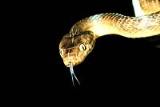
The
brown tree snake is an arboreal rear-fanged
colubridA colubrid is a member of the snake family Colubridae. This broad classification of snakes includes about two-thirds of all snake species on earth. The earliest species of the snake family date back to the Oligocene epoch. With 304 genera and 1,938 species, Colubridae is the largest snake family...
snakeSnakes are elongate, legless, carnivorous reptiles of the suborder Serpentes that can be distinguished from legless lizards by their lack of eyelids and external ears. Like all squamates, snakes are ectothermic, amniote vertebrates covered in overlapping scales...
native to eastern and northern coastal
AustraliaAustralia , officially the Commonwealth of Australia, is a country in the Southern Hemisphere comprising the mainland of the Australian continent, the island of Tasmania, and numerous smaller islands in the Indian and Pacific Oceans. It is the world's sixth-largest country by total area...
,
Papua New GuineaPapua New Guinea , officially the Independent State of Papua New Guinea, is a country in Oceania, occupying the eastern half of the island of New Guinea and numerous offshore islands...
, and a large number of islands in northwestern
MelanesiaMelanesia is a subregion of Oceania extending from the western end of the Pacific Ocean to the Arafura Sea, and eastward to Fiji. The region comprises most of the islands immediately north and northeast of Australia...
.
This snake is infamous for being an
invasive species"Invasive species", or invasive exotics, is a nomenclature term and categorization phrase used for flora and fauna, and for specific restoration-preservation processes in native habitats, with several definitions....
responsible for devastating the majority of the native bird population in
GuamGuam is an organized, unincorporated territory of the United States located in the western Pacific Ocean. It is one of five U.S. territories with an established civilian government. Guam is listed as one of 16 Non-Self-Governing Territories by the Special Committee on Decolonization of the United...
.
Diet
The brown tree snake preys upon birds, lizards, bats and small rodents in its native range. It preys on birds and
shrewA shrew or shrew mouse is a small molelike mammal classified in the order Soricomorpha. True shrews are also not to be confused with West Indies shrews, treeshrews, otter shrews, or elephant shrews, which belong to different families or orders.Although its external appearance is generally that of...
s on Guam.
Due to the availability of prey and lack of predators in introduced habitats such as
GuamGuam is an organized, unincorporated territory of the United States located in the western Pacific Ocean. It is one of five U.S. territories with an established civilian government. Guam is listed as one of 16 Non-Self-Governing Territories by the Special Committee on Decolonization of the United...
, they have been known to grow to larger sizes than their normal 1 to 2 metres (3.3 to 6.6 feet) in length. The longest recorded length of this species is one found on Guam measuring three metres (9.8 feet).
Reproduction
The reproductive characteristics of the brown tree snake have not been widely studied. The female is known to produce 4-12 oblong eggs, 42-47 mm (1⅝-1⅞ in.) long and 18-22 mm (⅝-⅞ in.) wide with leathery shells. Females may produce up to two clutches per year depending upon seasonal variations in climate and prey abundance. The female deposits the eggs in hollow logs, rock crevices, and other sites where they are likely protected from drying and high temperatures. Populations on Guam may reproduce year round.
Venom
The brown tree snake is a nocturnal snake that can be very aggressive when confronted. It is a rear-fanged
colubridA colubrid is a member of the snake family Colubridae. This broad classification of snakes includes about two-thirds of all snake species on earth. The earliest species of the snake family date back to the Oligocene epoch. With 304 genera and 1,938 species, Colubridae is the largest snake family...
, possessing two small, grooved fangs at the rear of the mouth. Due to the placement of the fangs and grooved rather than hollow fangs, the venom is difficult to convey into a bite on a human, thus is only given in small doses. The venom appears to be weakly neurotoxic and possibly cytotoxic with localized effects, but these effects are trivial for adult humans, and serious medical consequences have been limited to children due to their low mass. This snake is still not considered dangerous to an adult human. The venom seems to be primarily used to subdue lizards, which are more easily positioned in the rear of the mouth for venom delivery.
Invasive species
Shortly after
World War IIWorld War II, or the Second World War , was a global conflict lasting from 1939 to 1945, involving most of the world's nations—including all of the great powers—eventually forming two opposing military alliances: the Allies and the Axis...
, and before 1952, the brown tree snake was accidentally transported from its native range in the South Pacific to Guam, probably as a stowaway in ship cargo. As a result of abundant prey resources on Guam and the absence of natural predators outside of feral
pigsPIGS is a four letter acronym that can stand for:* PIGS , Phosphatidylinositol glycan anchor biosynthesis, class S, a human gene* PIGS , the economies of Portugal, Italy , Greece and Spain...
and Mangrove monitors, brown tree snake populations reached unprecedented numbers. Snakes caused the
extirpationLocal extinction, also known as extirpation, is the condition of a species which ceases to exist in the chosen geographic area of study, though it still exists elsewhere...
of most of the native forest vertebrate species; thousands of power outages affecting private, commercial, and military activities; widespread loss of domestic birds and pets; and considerable emotional trauma to residents and visitors alike when snakes invaded human habitats with the potential for
envenomationEnvenomation is the process by which venom is injected into some animal by the bite of a venomous animal. Many kinds of animals, including mammals , reptiles , spiders , insects , employ venom for hunting and for self defense...
of small children. Since Guam is a major transportation hub in the Pacific, numerous opportunities exist for the brown tree snakes on Guam to be introduced accidentally to other Pacific islands as passive stowaways in ship and air traffic from Guam. To minimize this threat, trained dogs are used to search, locate, and remove brown tree snakes prior to the departures of outbound military and commercial cargo and transportation vessels from the island. Numerous sightings of this species have been reported on other islands including
Wake IslandWake Island is a coral atoll having a coastline of in the North Pacific Ocean, located about two-thirds of the way from Honolulu west to Guam east. It is an unorganized, unincorporated territory of the United States, administered by the Office of Insular Affairs, U.S. Department of the Interior...
,
TinianTinian is one of the three principal islands of the Commonwealth of the Northern Mariana Islands.-Geography:Tinian is about 5 miles southwest of its sister island, Saipan, from which it is separated by the Saipan Channel. It has a land area of 39 sq.mi....
,
RotaRota also known as the "peaceful island", is the southernmost island of the United States Commonwealth of the Northern Mariana Islands and the second southernmost of the Marianas Archipelago. It lies approximately 40 miles north-northeast of the United States territory of Guam...
, Okinawa,
Diego GarciaDiego Garcia is a tropical, footprint-shaped coral atoll located south of the equator in the central Indian Ocean at 7 degrees, 26 minutes south latitude. It is part of the British Indian Ocean Territory [BIOT] and is positioned at 72°23' east longitude....
,
HawaiiHawaii is the newest of the 50 U.S. states , and is the only U.S. state made up entirely of islands. It is the northernmost island group in Polynesia, occupying most of an archipelago in the central Pacific Ocean, southwest of the continental United States, southeast of Japan, and northeast of...
, and even
TexasTexas is the second largest U.S. state by both area and population, and the largest state by area in the contiguous United States.The name, based on the Caddo word "Tejas" meaning "friends" or "allies", was applied by the Spanish to the Caddo themselves and to the region of their settlement in...
in the continental United States. An incipient population is probably established on
SaipanSaipan is the largest island of the United States Commonwealth of the Northern Mariana Islands , a chain of 15 tropical islands belonging to the Marianas archipelago in the western Pacific Ocean with a total area of . The 2000 census population was 62,392...
.
ParacetamolParacetamol INN , or acetaminophen USAN , is a widely used over-the-counter analgesic and antipyretic . It is commonly used for the relief of headaches and other minor aches and pains and is a major ingredient in numerous cold and flu remedies...
has been used to help eradicate the snake on Guam.
General Characteristics
The
brown tree snake (
Boiga irregularis) is a nocturnal, aboreal species that uses visual and chemical cues in hunting in the tropical rainforest canopy and/or on the ground . It is a member of the
ColubrinaeColubrinae is a subfamily of the Colubridae family of snakes. It includes numerous genera, and taxonomic sources often disagree on the exact number...
family, genus
BoigaBoiga is a large genus of mildly venomous, rear-fanged, colubrid snakes typically known as the cat-eyed snakes or just cat snakes. They are primarily found throughout southeast Asia, India and Australia, but due to their extremely hardy nature and adaptability have spread to many other suitable...
, which is a group of roughly twenty five species that are referred to as “cat-eyed” snakes due to their vertical pupil . The brown tree snake is generally between three and six feet in length in its native range. The snake is long and slender, which facilitates its climbing ability and allows it to pass through tiny spaces in buildings, logs and other shaded locations where it seeks
refugiaIn biology a refugium , sometimes termed simply a refuge, is a location of an isolated or relict population of a once more widespread species. This isolation can be due to climatic changes, geography, or human activities such as deforestation and over-hunting...
during daylight hours. Variations in coloration occur in the snake’s native range, ranging from a lightly patterned brown to yellowish/green or even beige with red saddle-shaped blotches . They are rear-fanged, have a large head in relation to their body, and can survive for extended periods of time without food. .
Reproductive Behaviour
The reproductive characteristics of the brown tree snake are not well known. On average the female produces 4-12 oblong eggs, 42-47mm long and 18-22mm wide. The eggs have a leathery shell and as such, female deposits the eggs in refugia such as hollow logs, rock crevices, and other sites where they are likely protected from drying and high temperatures . Females may produce two clutches per year, but the timing of said clutches may depend on seasonal variations in climate and prey abundance. If conditions for bearing eggs are not hospitable, the female brown tree snake is able to store sperm and produce the eggs several years after mating .
Predatory Behaviour
The brown tree snake is a
generalistGeneralist may refer to:* a person with a wide array of knowledge, the opposite of which is a specialist.* a physician who is focused on primary care and is not a specialist in a certain medical field...
feeder known to eat a wide variety of foods, when threatened is highly aggressive and tends to lunge and strike the aggressor repeatedly. The snake has numerous teeth but only the last two on each side of the upper jaw have groves, which inject venom as it bites. Therefore, the snake’s mouth must be opened as wide as possible to insert and expose their fangs.A chewing movement is used by the snake to inject the venom by means of
capillary actionCapillary action, or capilarity, is the ability of a liquid to flow against gravity where liquid spontanously rise in a narrow space such as between the hair of a paint-brush, in a thin tube, or in porous material such as paper or in some non-porous material such as liquified carbon fiber, or in a...
along the grooved fangs. The venom is used to subdue and kill prey on which the snake feeds however the venom is not considered dangerous to adult humans. In addition to subduing its victim with its venom, the brown tree snake often wraps its body around the prey, such as a
constrictorConstrictor may refer to:Biology:* Any snake that kills its prey by constriction* A boa constrictor, a large non-venomous boas found primarily in Central and South America.* A taxonomic synonym for Python, a.k.a...
, to immobilize the prey while chewing and consuming the animal .
Native Habitat
The brown tree snake is native to coastal
AustraliaAustralia , officially the Commonwealth of Australia, is a country in the Southern Hemisphere comprising the mainland of the Australian continent, the island of Tasmania, and numerous smaller islands in the Indian and Pacific Oceans. It is the world's sixth-largest country by total area...
,
Papua New GuineaPapua New Guinea , officially the Independent State of Papua New Guinea, is a country in Oceania, occupying the eastern half of the island of New Guinea and numerous offshore islands...
, and a large number of islands in northwestern
MelanesiaMelanesia is a subregion of Oceania extending from the western end of the Pacific Ocean to the Arafura Sea, and eastward to Fiji. The region comprises most of the islands immediately north and northeast of Australia...
. The species occurs on variably sized islands, extending from
SulawesiSulawesi is one of the four larger Sunda Islands of Indonesia and is situated between Borneo and the Maluku Islands. In Indonesia, only Sumatra, Borneo, and Papua are larger in territory, and only Java and Sumatra have larger Indonesian populations.- Etymology :The Portuguese were the first to...
in eastern Indonesia through Papua New Guinea and the
Solomon IslandsSolomon Islands is a sovereign state in Oceania, east of Papua New Guinea, consisting of nearly one thousand islands. It covers a land mass of . The capital, Honiara, is located on the island of Guadalcanal...
and into the wettest coastal areas of Northern Australia. The snakes on Guam represent the only documented reproductive population outside the native range.
Current Habitats
The brown tree snake is not restricted to forested habitats but can occur in grasslands and sparsely forested areas as well. In Papua New Guinea, it occupies a wide variety of habitats at elevations up to 1,200 m. It is most commonly found in trees, caves, and near limestone cliffs but frequently comes down to the ground to forage at night. It hides during the day in the crowns of palm trees, hollow logs, rock crevices, caves, and even the dark corners of thatched houses near the roof. Based on the frequency of sightings of this snake, in relation to buildings, poultry, and caged birds, the snake is considered to be common in human-disturbed habitats. Larger snakes have been found scavenging human garbage, especially in times of low prey concentration.
Physiological Evidence for Reproductive Suppression
Environmental stressors such as lack of shelter, climate change, overcrowding and loss of prey have been researched as primary causes of diminished snake density as they have been found to have direct correlation with the reproductive success of the snake. Current research on the breeding patterns of the brown tree snake is being conducted in hopes of further understanding how these environmental stressors are affecting the population density of the snake on Guam.
A study conducted by I.T. Moore, predicted that low body condition would correlate to high levels of stress hormones and low levels of sex steroids in free living brown tree snakes on Guam when compared with the native snake population in Australia and snakes held in
captivityCaptivity or Captive may refer to:*Imprisonment or hostage, the state of being confined to a space from which it is difficult or impossible to escape**Captive company...
on Guam. After extensive research, it was found that the body condition in the free living snakes was significantly different than the body conditions of native and captive snakes. The results determined that, “depressed body condition and elevated plasmacorticosteron levels in the free-living animals suggest that a lack of food resources was placing individuals under chronic stress resulting in suppression of the reproductive system.” The study suggested that snakes living under stressful conditions such as high population densities or low prey resources had suppressed reproduction at multiple stages including steroidogenesis and
gametogenesisGametogenesis is a biological process by which diploid or haploid precursor cells undergo cell division and differentiation to form mature haploid gametes. Depending on the biological life cycle of the organism, gametogenesis occurs by meiotic division of diploid gametocytes into various gametes,...
.
Current Status
Currently, the brown tree snake population on Guam is declining with an equilibrium population size predicted to be roughly 50 snakes per hectare. The decline in snake population may be identified as a result of depleted food resources, adult
mortalityMortality rate is a measure of the number of deaths in a population, scaled to the size of that population, per unit time...
and/or suppressed reproduction. That is, the brown tree snake population on Guam has exceeded the
carrying capacityThe carrying capacity of a biological species in an environment is the maximum population size of the species that the environment can sustain indefinitely, given the food, habitat, water and other necessities available in the environment...
of the island.
Effect of Early Introduction
The introduction of the brown tree snake on Guam after WWII has had a significant impact on the community dynamics of the island. Upon its introduction the brown tree snake population exploded and spread across the entirety of Guam. The brown tree snake population on the island has reached peak densities of greater than 100 snakes per
hectareThe hectare is a metric unit of area defined as 10,000 square metres , and primarily used in the measurement of land. In 1795, when the metric system was introduced, the are was defined as being 100 square metres and the hectare was thus 100 ares or 1/100 km2...
. This population spike was caused by the copious amount of resources newly available to the brown tree snake upon its introduction. The limitations on the snakes population in its native range is predominantly food based. The snake’s food source is far more limited in its native range than on the island of Guam as the prey in its natural range boasts significantly more natural defences to the snake than the prey on Guam .
The predominant population affected by the snake’s introduction was that of native bird species such as the
Mariana Fruit DoveThe Mariana Fruit Dove, Ptilinopus roseicapilla, also known locally as Mwee’mwe in the Carolinian language, Totot on Guam or Paluman Totut in Northern Mariana Islands, is a small, up to 24 cm long, green fruit dove native and endemic to Guam and the Northern Marianas Islands in the Pacific...
, the
Guam FlycatcherThe Guam Flycatcher or Guam Broadbill was a species of bird in the Monarchidae family. It was endemic to Guam, where it was known locally as the chuguangguang...
, the
Rufous FantailThe Rufous Fantail Rhipidura rufifrons inhabits the east coast of Australia. The base of its tail is bright orange-red in colour and their wings are greyish brown. They have a black and white breast that grades into a white colour on the chin and throat....
and the Cardinal Honeyeater.The introduction of the brown tree snake into Guam has resulted in
extinctionIn biology and ecology, extinction is the end of an organism or of a group of organisms , normally a species. The moment of extinction is generally considered to be the death of the last individual of the species, although the capacity to breed and recover may have been lost before this point...
of twelve-native bird species in total. Other species significantly affected by the invasion of these snakes were small lizards and small mammals. Research has indicated a direct correlation of the spread of these snakes across the island to the decrease in the populations of these native species. Furthermore, the introduction of the brown tree snake has had an indirect, negative impact on vegetative diversity as its intense predatory nature has decreased populations of vital pollinators including native birds and
fruit batsFruit Bats is an American rock band formed in 1997 in Chicago. Noted as an early entrant into the folk-rock boom of the early 2000s, the group has had many personnel changes but revolves around singer/songwriter Eric D. Johnson.-History:In 2000, Eric D...
. Data collected from nearby islands lacking brown tree snake populations depict a significant difference in vegetative
species richnessSpecies richness is the number of different species in a given area. It is represented in equation form as S.Species richness is the fundamental unit in which to assess the homogeneity of an environment. Typically, species richness is used in conservation studies to determine the sensitivity of...
, that is, islands close to and similar to Guam in which the brown tree snake has not been introduced have greater vegetative
species diversitySpecies diversity is an index that incorporates the number of species in an area and also their relative abundance. It is a more comprehensive value than species richness....
. Overall, the vertebrate
faunaFauna or faunæ is all of the animal life of any particular region or time. The corresponding term for plants is flora.Zoologists and paleontologists use fauna to refer to a typical collection of animals found in a specific time or place, e.g. the "Sonoran Desert fauna" or the "Burgess shale fauna"...
and native
floraFlora is the plant life occurring in a particular region or time, generally the naturally occurring or indigenous—native plant life. The corresponding term for animals is fauna.-Etymology:...
of Guam have suffered tremendously because of the introduction of the brown tree snake.
Predation on Brown Tree Snakes
An investigative study was performed to find predators of the brown tree snake that could possibly serve as a population control method. In this study two actual predators were identified and 55 potential predators were identified: the two actual predators identified were the
Red-bellied Black SnakeThe Red-bellied Black Snake, Pseudechis porphyriacus, is a species of elapid snake native to eastern Australia. Though its venom is capable of causing significant morbidity, it is not generally fatal and less venomous than other deadly Australian snakes. It is common in woodlands, forests and...
and the
cane toadThe Cane Toad , also known as the Giant Neotropical Toad or Marine Toad, is a large, terrestrial true toad which is native to Central and South America, but has been introduced to various islands throughout Oceania and the Caribbean...
. Actual predators were identified by evidence showing that they would actually prey upon and consume the brown tree snake in a natural habitat whereas potential predators were identified as species that were only physically capable of consuming the brown tree snake. The research collected in this study suggested that even with the introduction of brown tree snake predation, showed that it was unlikely that this would serve as an effective brown tree snake population control method. One reason being that the identified actual predators of the brown tree snake are generalist feeders and would cause further detriment to other native island species.
Another negative possible outcome of introducing species as a control method for the brown tree snake population is predation on juvenile cane toads and red-bellied snakes by brown tree snakes, because they are opportunistic and generalist feeders. This investigation determined that the environmental and ecological risk associated with the introduction of these predators was too high to implement. Lastly, red-bellied snakes could pose a threat to the health of humans within close contact. The cost of introduction of such predatory species outweighs the benefits and is not practical.
Capturing methods
Given the environmental impact of the brown tree snake, studies have attempted to provide a capturing methodology to alleviate the detrimental effects of the tree snake. The use of mice as bait has shown considerable reduction effects when combined with acetaminophen in a mark-recapture experiment leading to potential widespread application in Guam. When utilizing a precisely defined treated plot with results corrected for immigration and emigration, the additive effect of both amphetamine and mice usage shows a 0% survival rate of the brown tree snake. In the study, 80 mg of acetaminophen were placed into mice carrions. In addition, one study showed that increasing inter-trap spacing would not only increase efficiency, but also not compromise efficacy as 20, 30, and 40 tin long perimeter trap lines were compared and no difference was found. Another study echoed the aforementioned notion of increasing inter-trap spacing.
External Links