


Brown people

Encyclopedia
Brown people or brown race is a political, racial, ethnic
, societal
, and cultural
classification, similar to black people
and white people
. Like these, it is a metaphor for race based on human skin color
, reflecting the fact that there are shades of skin colour intermediate between "Mediterranean
" (skin type IV) and "black
" (skin type VI). Consequently, the term includes groups that have no connection other than their intermediate skin tone, especially but not limited to mixed race individuals.
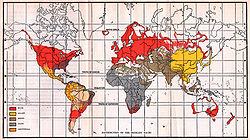 Carolus Linnaeus
's original model had just four races, white, yellow, red, and black. His protege, anthropology founder Johann Blumenbach, completed his mentor's color-coded race model by adding the brown race, "Malay", for both the Malay division of Austronesian (Thailand, Cambodia, Indonesia, Philippines, Malaysia, Brunei, Pattani, Sumatra Madagascar, Formosans, etc.) and Polynesians and Melanesians
of Pacific Islands, and for Papuans and Aborigines of Australia. Blumenbach characterized the racial classification scheme of John Hunter when he wrote, "John Hunter reckons seven varieties:... (6) &e., Turks, Abyssinians, Samoiedes and Lapps;" In 1775, "John Hunter of Edinburg included under the label light brown, Southern Europeans, Sicilians, Abyssinians, the Spanish, Persians, Turks and Laplanders, and under the label brown, Tartars, Africans on the Mediterranean and the Chinese."
Some anthropologists added the brown race back in as an Australoid
category (which includes Aboriginal peoples of Australia along with various peoples of southeast and south Asia, especially Melanesia and the Malay Archipelago), and viewed it as separate from Negroids (often lumping Australoids in with Caucasoids). Jean Baptiste Julien d'Omalius d'Halloy
differed from Blumenbach, including Ethiopia
ns in the brown race, as well as Oceanic peoples. Louis Figuier
adopted and adapted d'Omalius d'Halloy's classification and also included Egyptians
in the brown race.
As surmised by Carleton Coon in 1939, "He [ Giuseppe Sergi
] also made it clear that the so-called Brown Race, in its dolichocephalic and leptorrhine or mesorrhine forms, was for the most part an extension of the same Mediterranean family into southern Asia."
By the 19th century, the notion of a single "brown people" was being overthrown. Cust mentions Grammar in 1852 denying that there was one single "brown race", but in fact several raci speaking distinct languages. The 1858 Cyclopaedia of India and of eastern and southern Asia notes that Keane was dividing the "brown people" into quaternion: a western branch that he termed the Malay, a north-western group that he termed the Micronesian, and the peoples of the eastern archipelagoes that he termed the Maori and the Polynesian. Anthropologists and scholars were at the least dividing the people of the Pacific into the "dark people" and the "brown people". The "dark people" were the inhabitants of the Western Pacific as far as Fiji
. The "brown people" were the people inhabiting the islands to the east of Fiji, as far as Easter Island
.
In 1915, Donald Mackenzie conceived a "Mediterranean or Brown race, the eastern branch of which reaches to India and the western to the British Isles and Ireland... [and includes] predynastic Egypt
ians... [and some populations of] Neolithic man
".
Edward Telles is another academic in this field. He and Forbes both argue that this classification is biologically
invalid. However, as Telles notes, it is still of sociological significance. Irrespective of the actual biological differences amongst humans, and of the actual complexities of human skin colouration, people nonetheless self-identify as "brown" and identify other groups of people as "brown", using characteristics that include skin colour, hair strength, language, and culture, in order to classify them. Forbes remarks upon a process of "lumping", whereby characteristics other than skin colour, such as hair colour or curliness, act as "triggers" for colour categories "even when it may not be appropriate".
the "brown people" were the Coloureds, including those born of black-white sexual union out of wedlock. The Afrikaans
terms, which incorporate many subtleties of heritage, political agenda, and identity, are "bruin" ("brown") , "bruines" ("browns"), and "bruinmense" ("brown people"). Some South Africans prefer the appellation "bruinmense" to "Coloured".
The South African pencil test
is one example of a characteristic other than skin colour being used as a determiner. The pencil test, which distinguished either "black" from "Coloured" or "Coloured" from "white", relied upon curliness and strength of hair (i.e. whether it was capable of retaining a pencil under its own strength) rather than upon any colour factor at all. The pencil test could "trump skin colour".
Stephen Biko, in his trial in 1976, rejected the appellation "brown people" when it was put to him by Judge Boshoff:
Oakes characterizes Biko's argument as picking "black" over "brown" because for Biko it is "the most valid, meaningful and appropriate representation, even though in an individualistic decontextualized sense it might appear wrong" (Oakes' emphasis).
This contrasts with Piet Uithalder, fictional protagonist of the satirical column "Straatpraatjes" (whose actual author was never revealed but who is believed to have been Abdullah Abdurahman) that appeared in the Dutch-Afrikaans section of the newspaper APO between May 1909 and February 1922. Uithalder would self-identify as a Coloured person, with the column targeted at a Coloured readership, introducing himself as "een van de ras" ("a member of the race") and characterizing himself as a "bruine mens".
, the "brown people" are the pardos, one of the skin colour categories (branco, pardo, preto, amarelo, and indígena being Portuguese
for "white", "(grey) brown", "black", "yellow", and "indigenous", respectively) that have been used by the Brazilian Institute of Geography and Statistics since 1940. It is a broad classification that encompasses mestizos (caboclos), mulattoes (mulatos), zambos (cafuzos), etc. in short, multiracial Brazilians
and assimilated, westernized
Amerindians.
Pardo is a colour which can be translated from Portuguese as brown (properly called marrom [maˈʁõw]), grayish brown, beige (properly called bege [ˈbɛʒi]), of the color of the manila
(called in Brazil papel pardo). In Hispanic America, pardo is a racial casta
for people with European, Amerindian and Black African ancestries, possibly added with any others, which can not be called mestizos, blancos, zambos, mulatos or any other category because of their unique multiracial phenotype created by generations of miscegenation among the three main groups.
In popular use, Brazilians also use a category of moreno m. [moˈɾenu], morena f. [moˈɾenɐ], lit. 'swarthy', from mouro, Portuguese for 'Moor
', which were perceived as people with darker phenotypes than "Indigenous" Europeans, so a moreno or morena is a person with a "Moorish" phenotype), which is extremely ambiguous, as it can mean "dark-haired people", but is also used as a euphemism for pardo, and even "Black". In a 1995 survey, 32% of the population self-identified as moreno, with a further 6% self-identifying as moreno claro ("light moreno"). 7% self-identified as "pardo".
Note that despite moreno being commonly used by some persons as a racial classification (mainly in Brazil), moreno is, in fact, the Portuguese equivalent to the English word "brunet(te)". It is used to describe a brown, dark brown or black-haired person as opposed to a blond (loiro/loira/louro/loura) one. In Portugal, it is also used to refer to skin colour; it is used usually referring to a heavily tanned white person. It is often preceded by the adjectives more or less, and is used to compare one person's colour to another.
Pardo is not intended to classify neither only multiracial people nor all persons of mixed origins. Most of self-described White and Black Brazilians, according to genetic research, have considerable degree of ancestry of all three main groups present in Latin America (also, most of the people in the 4th generation of Japanese Brazilians since the immigrant ancestor has some degree of non-Japanese admixture). Although historically both Colonial
and Imperial Brazil had institutionalized discrimination against citizens which were deemed as people of color, contrary to the common sense in its population, it never had a casta classification like that of Hispanic America. White Brazilian people in the social status equivalent to the Hispanic criollo could have less than 80% of European (overwhelmingly Portuguese, seldom Spanish and much rarely other European ethnicities) ancestry. Aside some Amerindian and Black African descent which is knowly widespread among White populations in Brazil among all social classes in its five geographic regions
since historically early times (c. 16th to 17th centuries), Moorish, Jewish, Arab and Romani
mixed ancestry were also less significant to social status there than in Hispanic America.
It does not mean that social prestige of "fully non-whites" (people of color which are not mulattoes, mestizos, zambos, pardos, etc. in short, multiracial Brazilians
, with Caucasian features i.e. Black Africans, Amerindians, their direct descendants and "westernized" Brazilians with wholly or almost fully non-Caucasian phenotypes, which also would be >70% European in their ancestry, since genes that form racial phenotypes are distributed random among the descendants of intermixing couples) and people with knowable non-European ancestry was equal, comparable or even acceptable among Brazilians elites, but that in Portuguese America, people were less concerned with ancestry and Limpeza de Sangue than its Hispanic neighbours. Furthermore, the institution closest to the North American phenomena known as passing
in Brazil was quite different (the North American passing method was almost the rule in Brazil i.e. people with mixed origins and a Caucasian phenotypes are most of the White Brazilians). Generally, among different times (mostly in both Empire of and First Republic of Brazil), people with evident non-European ancestry (i.e. non-Caucasian features perceptible in a multiracial phenotype) were regarded as brancos ("whites") when social status of such person improves, and people from "fully non-white" categories were regarded as pardos ("browns"), trying to minimize their visible non-European ancestry to make them sound more "civilizated" and noble human beings and citizens.
The contemporary Brazilian society consider Jewish people from all North African, Middle Easterner and European origins and Middle Easterners of all faiths (the majority of those who came from Brazil were Lebanese and Syrian Christians) as White people, belong to the same group of European descendants.
A comprehensive study presented by the Brazilian Journal of Medical and Biological Research found that on average, 'white' Brazilians have >70% European genomic ancestry, whereas 'black' Brazilians have 37.1% European genomic ancestry. It concluded that "The high ancestral variability observed in Whites and Blacks suggests that each Brazilian has a singular and quite individual proportion of European, African and Amerindian ancestry in his/her mosaic genomes. Thus, the only possible basis to deal with genetic variation in Brazilians is not by considering them as members of color groups, but on a person-by-person basis, as 190 million human beings,with singular genome and life histories".
In the late 19th and early 20th century, the group that was called the Malay race
(the people now called Austronesians), were traditionally referred to as the brown race.
, some Hispanic Americans
, mainly mestizo
s, are referred to by some as "brown people", even though the traditional term for mestizos have used for themselves, dating from the 1920s, is the bronze race
. There is a strong division over this, however. At opposite ends of the spectrum are those that take pride in calling themselves "brown", and those who assert that there is no such scientific classification and totally reject the idea. In the middle are those that assert that the combination of Amerindian
and European heritage has led to a group of people who are, informally, "brown".
Judith Ortiz Cofer
notes that appellation varies according to geographical location, observing that in Puerto Rico
she is considered to be a white person, but in the United States she is considered to be a "brown person." This has often been the stereotype of White Anglo-American prejudices that Spanish-speakers within the U.S. are all of one specific color, i.e. dark skin, dark hair, and dark eyes, due to many past and present Latin American
migrants being of mestizo, Amerindian, or other non-caucasian race. Consequently, white Hispanics are often branded as non-white due to their cultural heritage being synonymized with brown race, as well as contrary instances where their heritage is questioned or disregarded because they "look white" or "act white," this is because the merits of blond
and blue-eyed Nordic race were described to be superior that the Southern Europeans, who include Spaniards, and their white Latin American
descendants were called to be inferior. The U.S. Census Bureau officially designates "Hispanic" as relating to ethnicity independent from race yet census forms asking for race may list "Hispanic or Latino" as an entity separate from white, Native American, two or more races, etc. In addition, Spanish-language media in both Latin America and within the U.S. identifies "Hispanic" as pertaining to Hispanophone
culture which includes different races, ethnicities, and ancestries.
The 1960s in the United States saw the creation of "brown pride" movements such as the Chicano Movement
and La Raza
. However, currently most Hispanic Americans do not refer to themselves as "brown people", but as hyphenated American
s of a certain national origin.
Non-white people have limited media visibility. The U.S. Hispanic media was accused of overlooking the brown-skinned indigenous and mixed-race Hispanic and black Hispanic populations and overrepresentation of white
, largely blond
and blue-eyed/green-eyed Hispanic and Latino Americans through the telenovela
s who resemble Scandinavians
and other northern Europe
ans more than they resemble the typical white Hispanics mostly of Southern European descent.
who wrote of the "Mediterranean race
". Sergi too spoke of a brown race although he discussed their distribution through Afro-Eurasia
.
Scientific racism often included the populations of South Asia
as blending from the Mediterranean (Europid) to the Australoid (Dravidian) race in a north-to-south gradient. The term 'Brown' was also used by British Empire
as a derogatory term for natives of the Indian subcontinent
, Southeast Asia
and Australia
. Later, the term 'Brown' began to be used as descriptor for British people of South Asian origin
.
Some Desi
or South Asian Americans will identify their race as brown which Sociologist A. Rajagopal thinks is a result of identifying with Hispanic Americans
who are more likely to identify as brown, although Indian Americans and Hispanic Americans who identify their race as brown may not identify each other as the same race.
Ethnic group
An ethnic group is a group of people whose members identify with each other, through a common heritage, often consisting of a common language, a common culture and/or an ideology that stresses common ancestry or endogamy...
, societal
Society
A society, or a human society, is a group of people related to each other through persistent relations, or a large social grouping sharing the same geographical or virtual territory, subject to the same political authority and dominant cultural expectations...
, and cultural
Culture
Culture is a term that has many different inter-related meanings. For example, in 1952, Alfred Kroeber and Clyde Kluckhohn compiled a list of 164 definitions of "culture" in Culture: A Critical Review of Concepts and Definitions...
classification, similar to black people
Black people
The term black people is used in systems of racial classification for humans of a dark skinned phenotype, relative to other racial groups.Different societies apply different criteria regarding who is classified as "black", and often social variables such as class, socio-economic status also plays a...
and white people
White people
White people is a term which usually refers to human beings characterized, at least in part, by the light pigmentation of their skin...
. Like these, it is a metaphor for race based on human skin color
Human skin color
Human skin color is primarily due to the presence of melanin in the skin. Skin color ranges from almost black to white with a pinkish tinge due to blood vessels underneath. Variation in natural skin color is mainly due to genetics, although the evolutionary causes are not completely certain...
, reflecting the fact that there are shades of skin colour intermediate between "Mediterranean
Mediterranean race
The Mediterranean race was one of the three sub-categories into which the Caucasian race and the people of Europe were divided by anthropologists in the late nineteenth and early twentieth centuries, following the publication of William Z. Ripley's book The Races of Europe...
" (skin type IV) and "black
Black people
The term black people is used in systems of racial classification for humans of a dark skinned phenotype, relative to other racial groups.Different societies apply different criteria regarding who is classified as "black", and often social variables such as class, socio-economic status also plays a...
" (skin type VI). Consequently, the term includes groups that have no connection other than their intermediate skin tone, especially but not limited to mixed race individuals.
Historical concepts
Carolus Linnaeus
Carl Linnaeus , also known after his ennoblement as , was a Swedish botanist, physician, and zoologist, who laid the foundations for the modern scheme of binomial nomenclature. He is known as the father of modern taxonomy, and is also considered one of the fathers of modern ecology...
's original model had just four races, white, yellow, red, and black. His protege, anthropology founder Johann Blumenbach, completed his mentor's color-coded race model by adding the brown race, "Malay", for both the Malay division of Austronesian (Thailand, Cambodia, Indonesia, Philippines, Malaysia, Brunei, Pattani, Sumatra Madagascar, Formosans, etc.) and Polynesians and Melanesians
Melanesians
Melanesians are an ethnic group in Melanesia. The original inhabitants of the group of islands now named Melanesia were likely the ancestors of the present-day Papuan-speaking people...
of Pacific Islands, and for Papuans and Aborigines of Australia. Blumenbach characterized the racial classification scheme of John Hunter when he wrote, "John Hunter reckons seven varieties:... (6) &e., Turks, Abyssinians, Samoiedes and Lapps;" In 1775, "John Hunter of Edinburg included under the label light brown, Southern Europeans, Sicilians, Abyssinians, the Spanish, Persians, Turks and Laplanders, and under the label brown, Tartars, Africans on the Mediterranean and the Chinese."
Some anthropologists added the brown race back in as an Australoid
Australoid
The Australoid race is a broad racial classification. The concept originated with a typological method of racial classification. They were described as having dark skin with wavy hair, in the case of Veddoids from South Asia and Aboriginal Australians, or hair ranging from straight to kinky in the...
category (which includes Aboriginal peoples of Australia along with various peoples of southeast and south Asia, especially Melanesia and the Malay Archipelago), and viewed it as separate from Negroids (often lumping Australoids in with Caucasoids). Jean Baptiste Julien d'Omalius d'Halloy
Jean Baptiste Julien d'Omalius d'Halloy
Jean Baptiste Julien d'Omalius d'Halloy was a Belgian geologist. He also wrote on races.- Early life and education :He was born at Liège, Belgium on February 16, 1783. He was the only son of an ancient and noble family, and his education was carefully directed...
differed from Blumenbach, including Ethiopia
Ethiopia
Ethiopia , officially known as the Federal Democratic Republic of Ethiopia, is a country located in the Horn of Africa. It is the second-most populous nation in Africa, with over 82 million inhabitants, and the tenth-largest by area, occupying 1,100,000 km2...
ns in the brown race, as well as Oceanic peoples. Louis Figuier
Louis Figuier
Louis Figuier was a French scientist and writer. He was the nephew of Pierre-Oscar Figuier and became Professor of chemistry at L'Ecole de...
adopted and adapted d'Omalius d'Halloy's classification and also included Egyptians
Egyptians
Egyptians are nation an ethnic group made up of Mediterranean North Africans, the indigenous people of Egypt.Egyptian identity is closely tied to geography. The population of Egypt is concentrated in the lower Nile Valley, the small strip of cultivable land stretching from the First Cataract to...
in the brown race.
As surmised by Carleton Coon in 1939, "He [ Giuseppe Sergi
Giuseppè Sergi
Giuseppe Sergi was an influential Italian anthropologist of the early twentieth century, best known for his opposition to Nordicism in his books on the racial identity of ancient Mediterranean peoples...
] also made it clear that the so-called Brown Race, in its dolichocephalic and leptorrhine or mesorrhine forms, was for the most part an extension of the same Mediterranean family into southern Asia."
By the 19th century, the notion of a single "brown people" was being overthrown. Cust mentions Grammar in 1852 denying that there was one single "brown race", but in fact several raci speaking distinct languages. The 1858 Cyclopaedia of India and of eastern and southern Asia notes that Keane was dividing the "brown people" into quaternion: a western branch that he termed the Malay, a north-western group that he termed the Micronesian, and the peoples of the eastern archipelagoes that he termed the Maori and the Polynesian. Anthropologists and scholars were at the least dividing the people of the Pacific into the "dark people" and the "brown people". The "dark people" were the inhabitants of the Western Pacific as far as Fiji
Fiji
Fiji , officially the Republic of Fiji , is an island nation in Melanesia in the South Pacific Ocean about northeast of New Zealand's North Island...
. The "brown people" were the people inhabiting the islands to the east of Fiji, as far as Easter Island
Easter Island
Easter Island is a Polynesian island in the southeastern Pacific Ocean, at the southeasternmost point of the Polynesian triangle. A special territory of Chile that was annexed in 1888, Easter Island is famous for its 887 extant monumental statues, called moai, created by the early Rapanui people...
.
In 1915, Donald Mackenzie conceived a "Mediterranean or Brown race, the eastern branch of which reaches to India and the western to the British Isles and Ireland... [and includes] predynastic Egypt
Predynastic Egypt
The Prehistory of Egypt spans the period of earliest human settlement to the beginning of the Early Dynastic Period of Egypt in ca. 3100 BC, starting with King Menes/Narmer....
ians... [and some populations of] Neolithic man
Neolithic Europe
Neolithic Europe refers to a prehistoric period in which Neolithic technology was present in Europe. This corresponds roughly to a time between 7000 BC and c. 1700 BC...
".
20th and 21st century concepts
The appellation "brown people" has been applied in the 20th and 21st centuries to several groups, usually mixed race ones. (Jack Forbes, an expert in the field, in pointing out the disconnection between the colour labels and actual skin colour, observes that "[b]lack and white when mixed as pigments may produce gray, but when 'black' and 'white' humans mix the result is usually some type of 'brown'".)Edward Telles is another academic in this field. He and Forbes both argue that this classification is biologically
Biology
Biology is a natural science concerned with the study of life and living organisms, including their structure, function, growth, origin, evolution, distribution, and taxonomy. Biology is a vast subject containing many subdivisions, topics, and disciplines...
invalid. However, as Telles notes, it is still of sociological significance. Irrespective of the actual biological differences amongst humans, and of the actual complexities of human skin colouration, people nonetheless self-identify as "brown" and identify other groups of people as "brown", using characteristics that include skin colour, hair strength, language, and culture, in order to classify them. Forbes remarks upon a process of "lumping", whereby characteristics other than skin colour, such as hair colour or curliness, act as "triggers" for colour categories "even when it may not be appropriate".
Coloureds in South Africa
In 1950s (and later) South AfricaSouth Africa
The Republic of South Africa is a country in southern Africa. Located at the southern tip of Africa, it is divided into nine provinces, with of coastline on the Atlantic and Indian oceans...
the "brown people" were the Coloureds, including those born of black-white sexual union out of wedlock. The Afrikaans
Afrikaans
Afrikaans is a West Germanic language, spoken natively in South Africa and Namibia. It is a daughter language of Dutch, originating in its 17th century dialects, collectively referred to as Cape Dutch .Afrikaans is a daughter language of Dutch; see , , , , , .Afrikaans was historically called Cape...
terms, which incorporate many subtleties of heritage, political agenda, and identity, are "bruin" ("brown") , "bruines" ("browns"), and "bruinmense" ("brown people"). Some South Africans prefer the appellation "bruinmense" to "Coloured".
The South African pencil test
Pencil test
Pencil test may refer to:* Pencil test , an early version of an animated scene* Pencil Test , a 1988 animated short by Apple Inc....
is one example of a characteristic other than skin colour being used as a determiner. The pencil test, which distinguished either "black" from "Coloured" or "Coloured" from "white", relied upon curliness and strength of hair (i.e. whether it was capable of retaining a pencil under its own strength) rather than upon any colour factor at all. The pencil test could "trump skin colour".
Stephen Biko, in his trial in 1976, rejected the appellation "brown people" when it was put to him by Judge Boshoff:
- Boshoff: But now why do you refer to you people as blacks? Why not brown people? I mean you people are more brown than black.
- Biko: In the same way as I think white people are more pink and yellow and pale than white.
- Boshoff: Quite ... but now why do you not use the word brown then?
- Biko: No, I think really, historically, we have been defined as black people, and when we reject the term non-white and take upon ourselves the right to call ourselves what we think we are, we have got available in front of us a whole number of alternatives ... and we choose this one precisely because we feel it is most accommodating.
Oakes characterizes Biko's argument as picking "black" over "brown" because for Biko it is "the most valid, meaningful and appropriate representation, even though in an individualistic decontextualized sense it might appear wrong" (Oakes' emphasis).
This contrasts with Piet Uithalder, fictional protagonist of the satirical column "Straatpraatjes" (whose actual author was never revealed but who is believed to have been Abdullah Abdurahman) that appeared in the Dutch-Afrikaans section of the newspaper APO between May 1909 and February 1922. Uithalder would self-identify as a Coloured person, with the column targeted at a Coloured readership, introducing himself as "een van de ras" ("a member of the race") and characterizing himself as a "bruine mens".
Pardos in Brazil
In BrazilBrazil
Brazil , officially the Federative Republic of Brazil , is the largest country in South America. It is the world's fifth largest country, both by geographical area and by population with over 192 million people...
, the "brown people" are the pardos, one of the skin colour categories (branco, pardo, preto, amarelo, and indígena being Portuguese
Portuguese language
Portuguese is a Romance language that arose in the medieval Kingdom of Galicia, nowadays Galicia and Northern Portugal. The southern part of the Kingdom of Galicia became independent as the County of Portugal in 1095...
for "white", "(grey) brown", "black", "yellow", and "indigenous", respectively) that have been used by the Brazilian Institute of Geography and Statistics since 1940. It is a broad classification that encompasses mestizos (caboclos), mulattoes (mulatos), zambos (cafuzos), etc. in short, multiracial Brazilians
Mixed-race Brazilian
Brazilian censuses do not use a "multiracial" category. Instead, the censuses use skin colour categories, with a Pardo one, that may include people of varied "mixed racial" ancestry, but probably also accounts for non-mixed acculturated Amerindians...
and assimilated, westernized
Westernization
Westernization or Westernisation , also occidentalization or occidentalisation , is a process whereby societies come under or adopt Western culture in such matters as industry, technology, law, politics, economics, lifestyle, diet, language, alphabet,...
Amerindians.
Pardo is a colour which can be translated from Portuguese as brown (properly called marrom [maˈʁõw]), grayish brown, beige (properly called bege [ˈbɛʒi]), of the color of the manila
Manila paper
Manila paper is a type of paper originally made from Manila hemp or abacá. It is buff in color and the fibers are usually visible to the naked eye. Because manila paper is generally inexpensive, it is commonly given to children for making child art....
(called in Brazil papel pardo). In Hispanic America, pardo is a racial casta
Casta
Casta is a Portuguese and Spanish term used in seventeenth and eighteenth centuries mainly in Spanish America to describe as a whole the mixed-race people which appeared in the post-Conquest period...
for people with European, Amerindian and Black African ancestries, possibly added with any others, which can not be called mestizos, blancos, zambos, mulatos or any other category because of their unique multiracial phenotype created by generations of miscegenation among the three main groups.
In popular use, Brazilians also use a category of moreno m. [moˈɾenu], morena f. [moˈɾenɐ], lit. 'swarthy', from mouro, Portuguese for 'Moor
Moor
-Ethnicity:*Moors, several historic and modern populations from North Africa*Sri Lankan Moor, a minority ethnic group of Sri Lanka*Marakkar, a Muslim minority ethnic group of India-Places:...
', which were perceived as people with darker phenotypes than "Indigenous" Europeans, so a moreno or morena is a person with a "Moorish" phenotype), which is extremely ambiguous, as it can mean "dark-haired people", but is also used as a euphemism for pardo, and even "Black". In a 1995 survey, 32% of the population self-identified as moreno, with a further 6% self-identifying as moreno claro ("light moreno"). 7% self-identified as "pardo".
Note that despite moreno being commonly used by some persons as a racial classification (mainly in Brazil), moreno is, in fact, the Portuguese equivalent to the English word "brunet(te)". It is used to describe a brown, dark brown or black-haired person as opposed to a blond (loiro/loira/louro/loura) one. In Portugal, it is also used to refer to skin colour; it is used usually referring to a heavily tanned white person. It is often preceded by the adjectives more or less, and is used to compare one person's colour to another.
Pardo is not intended to classify neither only multiracial people nor all persons of mixed origins. Most of self-described White and Black Brazilians, according to genetic research, have considerable degree of ancestry of all three main groups present in Latin America (also, most of the people in the 4th generation of Japanese Brazilians since the immigrant ancestor has some degree of non-Japanese admixture). Although historically both Colonial
Colonial Brazil
In the history of Brazil, Colonial Brazil, officially the Viceroyalty of Brazil comprises the period from 1500, with the arrival of the Portuguese, until 1815, when Brazil was elevated to kingdom alongside Portugal as the United Kingdom of Portugal, Brazil and the Algarves.During the over 300 years...
and Imperial Brazil had institutionalized discrimination against citizens which were deemed as people of color, contrary to the common sense in its population, it never had a casta classification like that of Hispanic America. White Brazilian people in the social status equivalent to the Hispanic criollo could have less than 80% of European (overwhelmingly Portuguese, seldom Spanish and much rarely other European ethnicities) ancestry. Aside some Amerindian and Black African descent which is knowly widespread among White populations in Brazil among all social classes in its five geographic regions
Regions of Brazil
Brazil is divided into five regions by the Instituto Brasileiro de Geografia e Estatística . These divisions are composed of states within them.-The five regions:-North Region: *Area: 3,869,637.,9 km²...
since historically early times (c. 16th to 17th centuries), Moorish, Jewish, Arab and Romani
Roma people
The Romani, who are known collectively in the Romani language as Romane or Rromane and also as Romany, Romanies, Romanis, Roma or Roms, are an ethnic group living mostly in Europe, who trace their origins to the Indian Subcontinent...
mixed ancestry were also less significant to social status there than in Hispanic America.
It does not mean that social prestige of "fully non-whites" (people of color which are not mulattoes, mestizos, zambos, pardos, etc. in short, multiracial Brazilians
Mixed-race Brazilian
Brazilian censuses do not use a "multiracial" category. Instead, the censuses use skin colour categories, with a Pardo one, that may include people of varied "mixed racial" ancestry, but probably also accounts for non-mixed acculturated Amerindians...
, with Caucasian features i.e. Black Africans, Amerindians, their direct descendants and "westernized" Brazilians with wholly or almost fully non-Caucasian phenotypes, which also would be >70% European in their ancestry, since genes that form racial phenotypes are distributed random among the descendants of intermixing couples) and people with knowable non-European ancestry was equal, comparable or even acceptable among Brazilians elites, but that in Portuguese America, people were less concerned with ancestry and Limpeza de Sangue than its Hispanic neighbours. Furthermore, the institution closest to the North American phenomena known as passing
Passing
Passing is the ability of a person to be regarded as a member of social groups other than his or her own, such as a different race, ethnicity, social class, gender, intelligence, age and/or disability status, generally with the purpose of gaining social acceptance...
in Brazil was quite different (the North American passing method was almost the rule in Brazil i.e. people with mixed origins and a Caucasian phenotypes are most of the White Brazilians). Generally, among different times (mostly in both Empire of and First Republic of Brazil), people with evident non-European ancestry (i.e. non-Caucasian features perceptible in a multiracial phenotype) were regarded as brancos ("whites") when social status of such person improves, and people from "fully non-white" categories were regarded as pardos ("browns"), trying to minimize their visible non-European ancestry to make them sound more "civilizated" and noble human beings and citizens.
The contemporary Brazilian society consider Jewish people from all North African, Middle Easterner and European origins and Middle Easterners of all faiths (the majority of those who came from Brazil were Lebanese and Syrian Christians) as White people, belong to the same group of European descendants.
A comprehensive study presented by the Brazilian Journal of Medical and Biological Research found that on average, 'white' Brazilians have >70% European genomic ancestry, whereas 'black' Brazilians have 37.1% European genomic ancestry. It concluded that "The high ancestral variability observed in Whites and Blacks suggests that each Brazilian has a singular and quite individual proportion of European, African and Amerindian ancestry in his/her mosaic genomes. Thus, the only possible basis to deal with genetic variation in Brazilians is not by considering them as members of color groups, but on a person-by-person basis, as 190 million human beings,with singular genome and life histories".
Austronesians
(19th century and early 20th century name for Austronesians)In the late 19th and early 20th century, the group that was called the Malay race
Malay race
The concept of a Malay race was proposed by the German scientist Johann Friedrich Blumenbach , and classified as the brown race. Since Blumenbach, many anthropologists have rejected his theory of five races, citing the enormous complexity of classifying races...
(the people now called Austronesians), were traditionally referred to as the brown race.
Hispanics in the United States
In the United StatesUnited States
The United States of America is a federal constitutional republic comprising fifty states and a federal district...
, some Hispanic Americans
Hispanic and Latino Americans
Hispanic or Latino Americans are Americans with origins in the Hispanic countries of Latin America or in Spain, and in general all persons in the United States who self-identify as Hispanic or Latino.1990 Census of Population and Housing: A self-designated classification for people whose origins...
, mainly mestizo
Mestizo
Mestizo is a term traditionally used in Latin America, Philippines and Spain for people of mixed European and Native American heritage or descent...
s, are referred to by some as "brown people", even though the traditional term for mestizos have used for themselves, dating from the 1920s, is the bronze race
Bronze race
Bronze race is a term used by early 20th century Latin American writers of the indigenista and americanista schools to refer to the mestizo population that arose in America with the arrival of European colonists and their intermingling with the New World's indigenous Native American...
. There is a strong division over this, however. At opposite ends of the spectrum are those that take pride in calling themselves "brown", and those who assert that there is no such scientific classification and totally reject the idea. In the middle are those that assert that the combination of Amerindian
Indigenous peoples of the Americas
The indigenous peoples of the Americas are the pre-Columbian inhabitants of North and South America, their descendants and other ethnic groups who are identified with those peoples. Indigenous peoples are known in Canada as Aboriginal peoples, and in the United States as Native Americans...
and European heritage has led to a group of people who are, informally, "brown".
Judith Ortiz Cofer
Judith Ortiz Cofer
Judith Ortiz Cofer is a Puerto Rican author. Her work spans a range of literary genres including poetry, short stories, autobiography, essays, and Young-adult fiction.-Early years:...
notes that appellation varies according to geographical location, observing that in Puerto Rico
Puerto Rico
Puerto Rico , officially the Commonwealth of Puerto Rico , is an unincorporated territory of the United States, located in the northeastern Caribbean, east of the Dominican Republic and west of both the United States Virgin Islands and the British Virgin Islands.Puerto Rico comprises an...
she is considered to be a white person, but in the United States she is considered to be a "brown person." This has often been the stereotype of White Anglo-American prejudices that Spanish-speakers within the U.S. are all of one specific color, i.e. dark skin, dark hair, and dark eyes, due to many past and present Latin American
Latin Americans
Latin Americans are the citizens of the Latin American countries and dependencies. Latin American countries are multi-ethnic, home to people of different ethnic and national backgrounds. As a result, some Latin Americans don't take their nationality as an ethnicity, but identify themselves with...
migrants being of mestizo, Amerindian, or other non-caucasian race. Consequently, white Hispanics are often branded as non-white due to their cultural heritage being synonymized with brown race, as well as contrary instances where their heritage is questioned or disregarded because they "look white" or "act white," this is because the merits of blond
Blond
Blond or blonde or fair-hair is a hair color characterized by low levels of the dark pigment eumelanin. The resultant visible hue depends on various factors, but always has some sort of yellowish color...
and blue-eyed Nordic race were described to be superior that the Southern Europeans, who include Spaniards, and their white Latin American
White Latin American
White Latin Americans are the people of Latin America who are white in the racial classification systems used in individual Latin American countries. Persons who are classified as White in one Latin American country may be classified differently in another country...
descendants were called to be inferior. The U.S. Census Bureau officially designates "Hispanic" as relating to ethnicity independent from race yet census forms asking for race may list "Hispanic or Latino" as an entity separate from white, Native American, two or more races, etc. In addition, Spanish-language media in both Latin America and within the U.S. identifies "Hispanic" as pertaining to Hispanophone
Hispanophone
Hispanophone or Hispanosphere denotes Spanish language speakers and the Spanish-speaking world. The word derives from the Latin political name of the Iberian Peninsula, Hispania, which comprised basically the territory of the modern states of Spain and Portugal.Hispanophones are estimated at...
culture which includes different races, ethnicities, and ancestries.
The 1960s in the United States saw the creation of "brown pride" movements such as the Chicano Movement
Chicano Movement
The Chicano Movement of the 1960s, also called the Chicano Civil Rights Movement, also known as El Movimiento, is an extension of the Mexican American Civil Rights Movement which began in the 1940s with the stated goal of achieving Mexican American empowerment.-Origins:The Chicano Movement...
and La Raza
La Raza
In the Spanish language the term Raza translates to "race". Its meaning varies amongst various Spanish-speaking peoples. For instance, in Spain, "Raza" may denote specifically Spanish and often of a something or someone of a European Christian heritage. The Francoist film Raza, from 1944, which...
. However, currently most Hispanic Americans do not refer to themselves as "brown people", but as hyphenated American
Hyphenated American
In the United States, the term hyphenated American is an epithet commonly used from 1890 to 1920 to disparage Americans who were of foreign birth or origin, and who displayed an allegiance to a foreign country. It was most commonly used to disparage German Americans or Irish Americans who called...
s of a certain national origin.
Non-white people have limited media visibility. The U.S. Hispanic media was accused of overlooking the brown-skinned indigenous and mixed-race Hispanic and black Hispanic populations and overrepresentation of white
White Hispanic and Latino Americans
White Hispanic and Latino Americans are citizens and residents of the United States who are racially White and ethnically Hispanic or Latino.White American, itself an official U.S...
, largely blond
Blond
Blond or blonde or fair-hair is a hair color characterized by low levels of the dark pigment eumelanin. The resultant visible hue depends on various factors, but always has some sort of yellowish color...
and blue-eyed/green-eyed Hispanic and Latino Americans through the telenovela
Telenovela
A telenovela is a limited-run serial dramatic programming popular in Latin American, Portuguese, and Spanish television programming. The word combines tele, short for televisión or televisão , and novela, a Spanish or Portuguese word for "novel"...
s who resemble Scandinavians
Scandinavians
Scandinavians are a group of Germanic peoples, inhabiting Scandinavia and to a lesser extent countries associated with Scandinavia, and speaking Scandinavian languages. The group includes Danes, Norwegians and Swedes, and additionally the descendants of Scandinavian settlers such as the Icelandic...
and other northern Europe
Northern Europe
Northern Europe is the northern part or region of Europe. Northern Europe typically refers to the seven countries in the northern part of the European subcontinent which includes Denmark, Estonia, Latvia, Lithuania, Norway, Finland and Sweden...
ans more than they resemble the typical white Hispanics mostly of Southern European descent.
South Asian populations
It is said that the racial qualities mentioned by Elliot Smith were exactly the same as those mentioned by Giuseppe SergiGiuseppè Sergi
Giuseppe Sergi was an influential Italian anthropologist of the early twentieth century, best known for his opposition to Nordicism in his books on the racial identity of ancient Mediterranean peoples...
who wrote of the "Mediterranean race
Mediterranean race
The Mediterranean race was one of the three sub-categories into which the Caucasian race and the people of Europe were divided by anthropologists in the late nineteenth and early twentieth centuries, following the publication of William Z. Ripley's book The Races of Europe...
". Sergi too spoke of a brown race although he discussed their distribution through Afro-Eurasia
Afro-Eurasia
Afro-Eurasia or less commonly Afrasia or Eurafrasia is the term used to describe the largest landmass on earth. It may be defined as a supercontinent, consisting of Africa and Eurasia...
.
Scientific racism often included the populations of South Asia
South Asia
South Asia, also known as Southern Asia, is the southern region of the Asian continent, which comprises the sub-Himalayan countries and, for some authorities , also includes the adjoining countries to the west and the east...
as blending from the Mediterranean (Europid) to the Australoid (Dravidian) race in a north-to-south gradient. The term 'Brown' was also used by British Empire
British Empire
The British Empire comprised the dominions, colonies, protectorates, mandates and other territories ruled or administered by the United Kingdom. It originated with the overseas colonies and trading posts established by England in the late 16th and early 17th centuries. At its height, it was the...
as a derogatory term for natives of the Indian subcontinent
Indian subcontinent
The Indian subcontinent, also Indian Subcontinent, Indo-Pak Subcontinent or South Asian Subcontinent is a region of the Asian continent on the Indian tectonic plate from the Hindu Kush or Hindu Koh, Himalayas and including the Kuen Lun and Karakoram ranges, forming a land mass which extends...
, Southeast Asia
Southeast Asia
Southeast Asia, South-East Asia, South East Asia or Southeastern Asia is a subregion of Asia, consisting of the countries that are geographically south of China, east of India, west of New Guinea and north of Australia. The region lies on the intersection of geological plates, with heavy seismic...
and Australia
Indigenous Australians
Indigenous Australians are the original inhabitants of the Australian continent and nearby islands. The Aboriginal Indigenous Australians migrated from the Indian continent around 75,000 to 100,000 years ago....
. Later, the term 'Brown' began to be used as descriptor for British people of South Asian origin
British Asian
British Asian is a term used to describe British citizens who descended from mainly South Asia, also known as South Asians in the United Kingdom...
.
Some Desi
Desi
Desi or Deshi refers to the people, cultures, and products of the Indian subcontinent and, increasingly, to the people, cultures, and products of their diaspora. Desi countries include India, Pakistan, Bangladesh...
or South Asian Americans will identify their race as brown which Sociologist A. Rajagopal thinks is a result of identifying with Hispanic Americans
Hispanic and Latino Americans
Hispanic or Latino Americans are Americans with origins in the Hispanic countries of Latin America or in Spain, and in general all persons in the United States who self-identify as Hispanic or Latino.1990 Census of Population and Housing: A self-designated classification for people whose origins...
who are more likely to identify as brown, although Indian Americans and Hispanic Americans who identify their race as brown may not identify each other as the same race.