


Brooks-Baxter War

Encyclopedia
The Brooks–Baxter War was an armed conflict in Little Rock, Arkansas
, in the United States, in 1874 between factions of the Republican Party over the disputed 1872 election for governor. It came at the end of a long and often violent struggle between white Republican residents in the state before the War, known as scalawags, and newer Republican arrivals called carpetbaggers, over power in the state government during Reconstruction after the Civil War.
The struggle began with the ratification of the 1868 Arkansas constitution, which had been rewritten to accommodate the Radical Republicans in the United States Congress
who had dissolved southern governments and turned them into military districts. The new constitution gave suffrage to freedmen (ex-slaves) while disenfranchising former Confederates. Democrats refused to participate in the writing of a constitution that disenfranchised ex-Confederates and stopping their participation in government. With no opposition, scalawag and carpetbagger Republicans, along with freedmen, formed a thin coalition that took take control of the state government. Eventually, extravagant government spending and widespread corruption caused the Republicans to split into two factions: the "Minstrels", who were mostly carpetbaggers, and the "Brindle Tails", who were mostly Scalawags. This led to a failed impeachment trial of the carpetbagger Republican Governor, Powell Clayton
; he was then elected a U.S. Senator by the General Assembly
.
The 1872 gubernatorial election resulted in a narrow victory for Minstrel Elisha Baxter
over Brindle Tail Joseph Brooks
in an election marked by fraud and intimidation. Brooks challenged the result through legal means, initially without success, but Baxter alienated much of his base by re-enfranchising former Confederates and in 1874, Brooks was declared governor by a judge who declared the results of the election to have been fraudulent. Brooks took control of the government by force, but Baxter refused to resign. Each side was supported by its own militia
of several hundred men and several bloody battles ensued between the two factions. Finally, President Ulysses S. Grant
reluctantly intervened and supported Governor Baxter, bringing the affair to an end.
The incident, followed by the new Arkansas Constitution
of 1874, marked an early end to Reconstruction in Arkansas, two years before it ended in the rest of the country. It was also followed by Democratic dominance of the Governorship for 90 years.
, many Northern
Republicans, whom Southerners called carpetbaggers, came to the defeated Southern states
to work in the rebuilding process. Some hoped to make their fortunes and leave, with little regard for the states themselves. The Radical Republicans in Congress were disturbed by what they saw in the south: the old elite had been reelected to government positions and things were returning to the way they had been before the war. Congress passed the Reconstruction Acts of 1867
, dissolving state governments and dividing the South into military districts. The Southern states could only be readmitted to the union after they wrote and ratified new constitutions that embodied the new Radical Republican platform.
The required constitutional convention for Arkansas was held in Little Rock in January 1868, and was dominated by carpetbagger Republicans, most of whom had been military officers in the Union army and had remained in Arkansas when the war ended. The most prominent were Joseph Brooks
, John McClure
, and Powell Clayton
. The new constitution required the state to grant suffrage to the emancipated slaves, now called Freedmen; it reapportioned the legislative districts to reflect the new status of freedmen as citizens, counting them as full members of the population. It conferred broad powers upon the state government, establishing universal public education for the first time, as well as welfare institutions, absent under the previous government, which were needed in the aftermath of the war. The governor was given wide-ranging powers of appointment without legislative approval, including the power to appoint such top state officials as Supreme Court Judges. The governor was also the president of virtually all state organizations, including the board of trustees of the state's newly created Technical University, the board for public printing, and even the railroad commission. It also disenfranchised the former Confederates, not just soldiers, but those who had participated in and were associated with the Confederate government, so that the disenfranchised made up the majority of the Democratic party and the state natives. The Constitution required them to pay taxes while also taking away their right to vote.
The Democratic Party was in disarray in Arkansas in 1868, as it was all over the country. It lacked the clarity of purpose that the Republican Party had, and its members were unable to unite under basic principles. Some party leaders had tried to profess their loyalty to the Union to gain power for the party, but had seen little success. Other party leaders opposed the Reconstruction in favor of continued military rule, which was far from what they wanted, but seemed like a better option than being disenfranchised and ruled by carpetbaggers. The more conservative wings of the party simply showed no interest in the new constitution and remained loyal to the ideas embodied in the Confederacy. During the constitutional convention, the Democrats convened their own party convention. They chose to simply boycott the elections on the grounds that the new constitution was illegal, because it disenfranchised them while giving suffrage to the Freedmen, whom they perceived as an inferior race. They also alienated the Freedmen who were now the largest block of voters in the state, by adopting resolutions against them: their first resolution of the convention was "Resolved, that we are in favor of a White Man's Government in a White Man's country." Only about ½ of the registered voters in the state cast ballots in the April 1868 elections, and ⅔ of those who voted approved the new constitution.
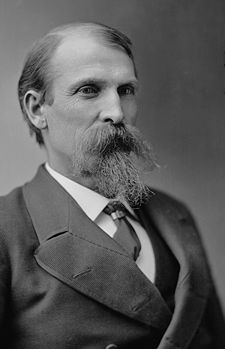 Powell Clayton, a 35-year-old former Brigadier General
in the Union Army and former Democrat, became the head of the Arkansas Republicans during Reconstruction. He was elected governor in April 1868, during the same election in which the voters ratified the new state constitution. The election was scarred with irregularities. For example, the return of votes in Pulaski County exceeded the number of registered voters there. Also, the registrar
s, who controlled the distribution of ballots, admitted that they had given ballots to voters from other counties if they could show a valid registration certificate. In addition to significant election fraud, both sides alleged voter intimidation: armed parties had been stationed on roads to keep voters away from the polls. General Gillem, commander of the military district that included Arkansas, wrote to General Grant that it would take months to sort out which side had committed the greater election fraud.
In July 1868, Arkansas rejoined the union and Clayton was inaugurated Governor. The Radical Republicans finalized their grip on the state. The new general assembly had already begun meeting back in April, but had been unable to do anything other than prepare legislation for the time when the state was readmitted. The current Governor, Isaac Murphy
, whose administration was not recognized by the Federal Government, continued to act as executive of the state during this time. Interestingly, both Clayton and Murphy managed to draw a paycheck as Governor at the same time. When Clayton took office, he appointed most of the key carpetbagger politicians to positions within the new state government; however, he failed to find a place for Joseph Brooks.
The rivalry between Brooks and Clayton predated the 1868 election. Clayton saw Brooks as his strongest competitor for preference and distinction and did not want him to become too entrenched with the party leadership. Brooks felt that his service and ability to the party were not being recognized or appreciated, and he grew bitter and resentful of the other carpetbaggers, including Clayton.
The Democrats in the state, who were now calling themselves "the Conservatives" to differentiate themselves from the Radical Republicans, were deeply disturbed by the irregularities in the election and the proposed political course of the Republicans now in power. The state was now controlled by former Union soldiers who had recently conquered them in a bloody war, and most of the natives of the state were disenfranchised from the machinery of the state government. Even though the Freedmen, whom they considered inherently inferior, were allowed to vote, the Democrats were not. This was especially infuriating since they were expected to pay for the newly proposed infrastructure changes without any ability to vote against it. They even saw this as an attempt by the Radicals to circumvent the will of God. Violence soon erupted throughout the state. Newly elected Congressmen James Hinds and Brooks were ambushed by gunmen while riding near the White River
, Brooks was severely wounded and Hinds was killed. The murder created national horror and disgust for the situation in the South. Clayton blamed the Ku Klux Klan
for the assassination, but no one was ever punished. As more violence spread throughout the state, Clayton declared martial law
in 14 counties. Many Democratic newspapers denied the existence of the secretive Ku Klux Klan
while still reporting on the violence. Twentieth-century research shows the Klan was responsible for most of the violence in the state at this time. A state militia was organized to put down the violence, although it was poorly equipped. With no uniforms and irregular weapons and mounts, the militia was often mistaken for wandering bands of plunderers, sparking a brief but long-remembered "Militia War", and causing terror throughout the state. This was similar to what was going on in North Carolina at the same time now referred to as the Kirk-Holden war
.
Fearing he could not guarantee the integrity of the polling places, Clayton canceled fall elections in counties where political violence had broken out. In doing so, however, he further reduced the Democratic vote, and the state ended up supporting the election of President Grant, the Republican candidate, despite the population being mostly Democratic.
. All of these tactics failed and drove up the state debt.
Introducing more taxes proved to be hugely unpopular among both Democrats and Republicans, and the people of the state simply did not have that much money to give. Bond issues generated controversy and were the source of scandals in the administration. All of the old railroad and infrastructure bonds, including the controversial Holford bonds
which had already been declared illegal by the Arkansas Supreme Court, were gathered into a funding act and passed by the legislature. Many bonds were issued for roads and railroads that were never built, or were constructed and then torn up and rebuilt in another direction. Some projects even received the same amount of funding from different bonds, such as embankments built for railroads where roads were funded to be built by a different bond. One of the most controversial bonds involved the purchase of slate
for a state penitentiary roof, which was diverted for the construction of a mansion of a Republican official J.L. Hodges, who eventually served jail time for the incident. Promissory notes, or scrip, were issued to raise money. The money was used for construction projects, and invested in public infrastructure. Article VI, Sec 10 of the new constitution stated that the credit of the state could not be loaned without the consent of the voters, making these promissory notes illegal. Their introduction also caused actual currency to go out of circulation.
The Radical Republicans did create some improvement within the state. Levees were constructed and railroads were built. Also, Arkansas' first public school system was created. The administration and its supporters formed the Arkansas Industrial University, the basis for the future University of Arkansas
in Fayetteville
; what would become the Arkansas School for the Deaf; and the Arkansas School for the Blind, which relocated from Arkadelphia to Little Rock. However, state debt increased dramatically. The state had a budget surplus when Clayton came to office, but by the end of his term, the state debt had increased to $5 million.
The scalawags met in convention and adopted the name the "Liberal Republicans" and a populist
platform for universal amnesty, universal suffrage, economic reforms, and an end to the so-called Clayton dictatorship. A small group of Claytonites, disgruntled with the extravagance of the administration, also defected to this group. Among them was Joseph Brooks
, who claimed to be the originator of Radicalism in Arkansas and became their natural leader. Brooks was a Northern Methodist preacher and had been a chaplain for the Union Army. He was known for his fiery speeches that united political and religious themes. He had been the chairman of the 1868 Republican state convention and was currently the State Senator from White County
and Pulaski County. Although he had been involved with the carpetbaggers since the beginning, Clayton had not given him a government position, seeing Brooks as a potential rival.
The Claytonites started calling the new faction "the Brindle Tails". This name can be traced back to Clayton supporter Jack Agery, who was a Freedman, contractor, and orator in the state. In a speech he gave in Eagle Township in Pulaski County, he said that Brooks reminded him of a "brindle tailed bull" he had known as a child that scared all the other cattle. The Claytonist then began mockingly referring to Joseph Brooks and his supporters as "Brindle Tails", and this is how they were referred to from then on. The Brindle Tails' platform included a proposal for a new constitution that would re-enfranchise ex-Confederates, which appealed to Democrats and pre-war Whigs. They began gaining support among the disenfranchised and the Liberal Republicans.
For their part, the Brindle Tails mockingly referred to the Carpetbaggers and Claytonist Republicans as "the Minstrels", and that name stuck as well. This moniker can probably be traced to John G. Price, the editor of the Little Rock Republican and a staunch Clayton supporter. Price was known to be a good musician and comedian and had even once filled in for a sick performer in a minstrel show
, complete with blackface
.
The Brindle Tails desperately wanted Clayton out of the Governor's office. Conveniently, Lieutenant Governor
James M. Johnson
was a Brindle Tail, so the natural course of action was to try and get rid of Clayton and let Johnson succeed him. Clayton was well aware of their plans, and when he left the state briefly for New York on business concerning the Holford Bonds, he informed no one. When Johnson, who was at home some distance from the capital, found out he tried to head to the capital to take control and have Clayton arrested and impeached. He arrived too late. Subsequently, after Johnson made a speech demanding changes in the administration, the Minstrels started to target Johnson. On January 30, 1871, they introduced articles of impeachment in the General Assembly against him. The chief charge was that Johnson, acting as the President of the Senate, had administered the oath of office to Joseph Brooks, who had recently been elected as state senator, and then recognized him on the floor. Although this was legitimately within his powers as the Lieutenant Governor to do, he escaped impeachment by only two votes. The scrutiny of the proceedings seriously damaged his reputation, even though he had done nothing wrong, and his political career never recovered.
In 1871, Clayton was accused of deliberately tampering with the results of the U.S. house election between Thomas Boles
and John Edwards
in the third congressional district
. According to Arkansas law, the results were to be certified and given to the Secretary of State, then Robert J.T. White. After that, the Governor and Secretary of State would take up and arrange the results and the Governor would issue a proclamation declaring the winner and deliver the Seal of the State to the him. Clayton was accused of adding around a hundred votes to the final count for Edwards, and declaring him the winner. Boles successfully contested the election and Clayton was indicted by the federal Circuit Court. Although the Court found that Clayton did in fact falsify his proclamation and delivered the seal to Edwards knowing full well that he had not won, this was in fact not illegal. His actions were in no way binding to the Congress and under federal law of the time, state governors were not considered election officials. Boles became a congressman.
To sequester Clayton from the affairs in the state, the Brindles and the Democrats decided the only thing they could do was elect him to the US Senate. However, even though he won unanimously, he refused to take his seat, which would mean letting Johnson become governor. In 1871, the state House of Representatives drafted articles of impeachment against Clayton, charging him with a wide variety of impeachable actions, including depriving Johnson and several other state officials of offices to which they had been fairly elected, removing state officials and judges from offices to which they had been fairly elected, aiding in fraudulent elections, taking bribes for state railroad bonds, and various other high crimes and misdemeanors. The members of the House then tried to suspend Clayton from his duties as Governor by force. They even apparently tried locking him in his office and nailing the door shut. However, Clayton responded that they had no right by the state constitution to deprive him of his office. At the same time, the House also brought impeachment charges against Chief Justice John McClure for his part in trying to deny Johnson the privileges of his office of Lieutenant Governor.
Two successive inquiries failed to find evidence against Clayton. The legislature refused to continue, all charges were dropped, and Clayton was exonerated. In fact, he was never found guilty of any wrongdoing while Governor. Finally a deal was reached. Johnson, now politically badly damaged by his impeachment ordeal and willing to take any position he could get, resigned as Lieutenant Governor, was appointed Secretary of State, and was given a compensation of several thousand dollars for his loss of power and prestige, since he would not become governor. A staunch Clayton supporter, O.A. Hadley, was then appointed Lieutenant Governor. Three days later, Clayton left the state for Washington, D.C., to join the US Senate, and Hadley succeeded him as Governor.
The Democrats' paper, the Arkansas Daily Gazette crowed:
Although no longer a state official, Clayton remained the leader of the state Republicans and was controlling now not only appointments within the state, but also the flow of federal money and positions. He began purging Brindles from federal office, including Joseph Brooks, who was at this point an Internal Revenue Assessor.
as their candidate. Baxter was a lawyer, politician, and merchant from North Carolina who had settled in Batesville
, and a life long Whig. He was elected Mayor of Batesville in 1853 and elected to the state legislature in 1858. At the outbreak of the Civil War, he had been conflicted about which side he supported. When General Samuel Curtis
and the 2nd Iowa Infantry occupied Batesville in the Spring of 1862, the General recognized Baxter as a loyal Unionist, and tried to bestow upon him the title of "Regt. of loyal Arkansians" which he refused. When Curtis left Batesville, Baxter was forced to flee to Missouri
. He was captured, brought back to Little Rock, and charged with treason, only to escape later before his trial could take place. He describes this episode in his life in his autobiography:
When Baxter returned to Batesville, he organized the 4th Arkansas Mounted Infantry for the Union and commanded it until he was named a State Supreme Court judge by Governor Murphy
in the Spring 1864. Shortly after being named a judge, he was elected to the U.S. Senate by the legislature along with Rev. Andrew Hunter
, but they were not seated in the Senate as the senate did not recognize the Murphy Administration. In 1867, he was appointed by Governor Clayton judge of the 3rd Judicial circuit. In 1868 he was appointed the 1st Congressional district of Arkansas. He held these two positions until he was nominated for Governor in 1872. Baxter was virtually unknown and privately clean of scandals, unlike most of the Minstrels. They believed he could attract votes from Unionists and Northerners, their core base, as well as natives of the state.
Joseph Brooks
ran for governor representing the Brindle Tails. Brooks was a very vocal supporter of civil rights for former slaves, but also a supporter of re-enfranchisement for ex-Confederates, which was the sentiment nationally of Liberal Republicans. When the Democrats met, they agreed not only to not run a candidate, but even to support Joseph Brooks, as long as the election was fair and legal, since elections in the state had been wrought with fraud for five years. The issue of re-enfranchisement of Confederates was central to the election.
In the days before the election and the days afterward, predictions and reports of fraud were printed daily in the Gazette. Because of the relatively slow communications, messages from other counties were often delayed up to a week. There were numerous reports of anomalies in state polling centers, including names being inexplicably stricken from the voter registration lists and persons voting without proof of registration. The Gazette wrote:
On November 6, 1872, the day after the general election, the Gazette reported: "The election was one of the most quiet in Little Rock we ever witnessed. The returns on that day were too small to report with any certainty who had won, and the newspaper reported fraud. Rumors flew about claiming that registration had been cut short or extended in many counties to suit the needs of whoever controlled the polling places. The following Monday, the Gazette published incomplete tallies from the various counties, showing a small majority for Baxter. They also reported more forms of attempted fraud. Some unofficial polling places had apparently been set up, but only those votes cast at the regular polls had been certified.
By November 15, the Gazette claimed victory for Brooks. By the next day, because of the irregularities and votes that would be thrown out, the projected winner was Baxter, by only 3,000 votes. The General Assembly met on January 6 for a special joint session to declare Baxter, who by their count had received the most votes, the legal winner of the election. After a short address he was sworn in by Chief Justice John McClure. He then assumed the duties of Governor of the State of Arkansas.
Brooks supporters immediately claimed that the election had been dishonest. The Democrats, the Brindle Tails, and all non-Republican newspapers openly and vocally denounced the election as fraudulent, and insisted that Brooks had in fact received the most votes. The general citizenry of both parties, however, accepted the results. The Brooks supporters were in the minority in believing that the election had been fraudulent.
Brooks then took a petition to the General Assembly, asking for a recount. The assembly took up the matter on April 20, 1873 and voted 63 to 9 not to allow Brooks to contest the election. This did not deter Brooks, and he applied to the Arkansas Supreme Court for a writ of quo warranto, and was again denied. They also ruled that state courts had no jurisdiction in the matter, and dismissed the case. They gave a lengthy explanation as to why the General Assembly should decide contested gubernatorial elections in Joint Session, since they are the directly elected representatives of the people.
It appeared that Brooks had exhausted all legal avenues at this point, but on June 16, 1873, he filed another lawsuit against Baxter, this time with the Pulaski County district court. Under Arkansas Civil Code sec. 525, if a person usurps an office or franchise to which he is not entitled, an action at law may be instituted against him either by the State or by the party rightly entitled to the office. On October 8, 1873, Baxter filed a plea of non-jurisdiction, but he believed that the court might decide against him. He issued a telegram to President Grant informing him of the basic situation in Arkansas and asked for federal troops to help him maintain the peace. Grant denied his request.
, an ex-Confederate, as head of the state militia. U.S. Attorney General Williams contacted Baxter and suggested that he ask for federal troops for protection again. A letter from President Grant followed, offering protection. The Grant administration usually followed Powell Clayton's lead where Arkansas matters were concerned, so it can be concluded that the former governor was still supporting Baxter. The Republican Party of Arkansas, still controlled by the Minstrel faction, issued a statement denouncing Brooks' attempt to contest the election, which was published in the Little Rock Republican on October 8, 1873 and signed by all the major members of the party, including Clayton. However, the Minstrels would soon turn on Baxter for not following the party line.
Baxter had now been governor for a year and was following an independent course. He began dismantling the systems put in place by the Minstrels. He appointed honest Democrats and Republicans to the Election Commission, reorganized the militia by placing it under the control of the State, rather than the Governor, and pushed for an amendment to the state constitution to re-enfranchise ex-Confederates.
On March 3, 1873, the state legislature passed a bill re-enfranchising ex-Confederates, to the delight of much of the state population and the concern of the Minstrels. The legislature called a special election in November to replace 33 members, mostly Minstrels, who had left for patronage jobs in the Baxter government. Baxter refused to let the Minstrels manipulate the election, declaring that free, honest elections would be held during his term. With the help of the newly re-enfranchised voters, conservative Democrats swept the election and gained a small majority in the legislature. Baxter was about to erode his Republican base out from under him.
In March 1874, Baxter vetoed the Railroad Steel Bill, the centerpiece of the Radical Republican Reconstruction plan. The bill would have released the railroad companies from their debts to the state and created a tax to pay the interest on the bonds. This was clearly not legal and the veto called into question the legality of the 1868 railroad bonds, which created a public bonded debt. It is likely the Minstrels struck a deal with Brooks to support the railroad bonds, and within a month the political backers of Brooks and Baxter began to switch. Senator Clayton issued a statement saying that "Brooks was fairly elected in 1872; and kept out of office by fraud." Governor Baxter was now being supported by the Brindle Tails, re-enfranchisers, and the Democrats; whereas Brooks was finding support among the Claytonists, Northerners, Unionists, the Minstrel Republicans.
Brooks was assigned three prominent Minstrel attorneys, and after a year of sitting on the docket, at about 11 AM on April 15, 1874, Baxter's demurrer
to Brook's complaint was suddenly called up. Neither of Baxter's lawyers were present in the court room, and the demurrer had been submitted without their knowledge. Without giving Baxter any time to testify, Judge Whytock overruled the demurrer and awarded Brooks $2,000 in damages and the office of Governor of Arkansas. Neither Brooks nor the court notified the legislature or Governor Baxter. Judge Wytock then swore in Joseph Brooks as the new governor of Arkansas, despite having no authority to do so.
. They ordered Baxter to abdicate his office, but Baxter refused to do so unless physically forced. The mob obliged and dragged Baxter out of the Capitol building and onto the street.
By the end of the afternoon, nearly 300 armed men had converged on the lawn of the State Capitol. Brooks' men seized the state arsenal
and began turning the Statehouse into an armed camp. Telegrams covered in signatures were sent to President Ulysses S. Grant
supporting Brooks as the legal governor. Three out of the five Supreme Court justices also telegraphed the President in support of Brooks. Brooks telegraphed the President himself asking for access to weapons housed at the federal arsenal. He also issued a statement to the press proclaiming himself governor. The senators from the state, Clayton and Steven Dorsey, met with President Grant, and they sent a message to Brooks giving their support.
Unusually for someone physically removed from power, Baxter was allowed to remain free in Pulaski County. He first retired to the Anthony House, three blocks away from the State Capitol. Ads placed in the Gazette indicate that the Anthony House continued to function as an upscale hotel during the entirety of the crisis. Fighting occurred outside the hotel, and at least one man, Dave Shall, a prominent real estate dealer, was shot dead while standing in a window of the building.
Baxter then moved his headquarters to St. Johns College, a Masonic institution on the southeastern edge of the state. Baxter issued two proclamations to the press from his temporary office, asserting his rights to the governorship by vote of the people and the decision of the legislature; both were printed in the Gazette. He received support from many prominent Democrats in the city, all of whom had initially voted for Brooks. He then issued a dispatch to President Grant explaining the situation, calling Brooks and his band "revolutionaries", and stating that he would do everything up to and including armed conflict to regain control of the state organs. He asked for the support of the Federal Government.
Brooks issued a proclamation to the people of Arkansas asking them for their support. Baxter answered with proclamation to the people of Arkansas declaring martial law in Pulaski County. A company was then issued from the young men of Little Rock. On the evening of April 16, the assembled army, now being referred to as the "Hallie Riflers", escorted Baxter back to the Anthony House, where he set up his headquarters, and from there he began trying to do the state's business once more.
There were now two militias marching and singing through Little Rock as the city became a battle ground. Commanding both forces were ex-Confederate soldiers. Former Brigadier General James F. Fagan commanded the Brooks men, and Robert C. Newton, a former Colonel, commanded the Hallie Riflers, or Baxter forces. The Baxter's men occupied the downstairs billiards
area of the Anthony House, and patrolled the cross streets outside. Down the street, the Brooks men patrolled the front of the state house. The front line was Main Street. The post-master handled the situation by only delivering mail addressed to Brooks or Baxter, and holding all mail simply addressed to "Governor of Arkansas."
The Baxter men found an old cannon lying half-embedded in the ground at the foot of Byrd street. The cannon, an 8 in (203.2 mm) Naval columbiad
cannon, had been brought to Little Rock in 1861 by the steamboat "Ponchatrain" and placed on the North side of the State House to ward off any ships coming up stream. It sat there for two years until Little Rock was occupied by federal troops, and the Confederates spiked the cannon disabling it. The Baxter men pulled the cannon out of the soil, repaired it, rechristened it the "Lady Baxter", and made it ready to fire. It was placed in the rear of the Metropolitan Hotel on the corner of Main and Markham streets to hit any boats bringing supplies for Brooks up the river. The cannon was only fired once — when Baxter finally returned to the governor's seat. It now sits on the lawn of the Old State House on permanent display.
Overtones of the Civil War and racial conflict were evident. Brooks' men numbered 600 by this time, and were all freedmen who supported Republicans as their emancipators. Baxter's forces, all white Democrats, continued to grow steadily during the conflict until they reached nearly 2,000. Several bloody skirmishes occurred. Known as the Battle of Palarm, a small naval battle erupted on the Arkansas River near Natural Steps
, where Brooks' men attacked a flatboat
known as the "Hallie", thought to be bringing supplies. The shooting lasted around ten to fifteen minutes before the pilot ran up a white flag signaling a surrender. One stray bullet pierced the vessel's supply pipe between the boiler and engine, cutting off its power, and the boat drifted downriver, out of gun range, and lodged on the Southern (Western) shore. Sources vary as to the actual casualties of the incident. The boat's captain, a pilot, and one rifleman were killed; the other pilot and three or four riflemen were wounded. One source stated that the Brooks regiment
suffered one man killed and three wounded; another report was that five men were killed and "quite a number" wounded.
Casualty reports vary widely depending on the source; the New York Times of May 30, 1874 gave the following for casualties and fatalities:
, and arrested federal Court Justices John E. Bennett and E.J. Earle, thinking that the Court would be unable to rule without a quorum
of Judges. Baxter denied that they were acting under his direction. The Judges were taken to Benton, Arkansas
. For several days, their whereabouts were unknown to the public and federal officials began a search for the Justices. Justice Bennett was able to send a letter to Captain Rose demanding to know why they were being held by the Governor of Arkansas. Upon receipt of the letter, troops were sent to Benton to retrieve the two Justices, but they had escaped by May 6 and made their way to Little Rock.
In Washington, Brooks was supported politically, but Baxter also had support because of the undemocratic way he had been removed from office. President Grant had already dealt with the outcome of the contested election for Governor of Louisiana Colfax massacre
where federal troops had to be sent. As Brooks and Baxter scrambled for support in Washington, D.C., Grant pushed for the dispute to be settled in Arkansas. Baxter demanded the General Assembly be called into session. He knew he had their support, but so did Brooks, so he and his men would not allow anyone to enter the capitol building. Brooks, on the other hand, had the support of the district court. He enlisted Little Rock's premiere lawyer, Uriah M. Rose
, head of the still-prominent Rose Law Firm
. However, Grant's decision would soon set in motion the demise of Brooks' governorship.
It was becoming clear that federal intervention was required to settle the dispute, despite the general policy of the Grant administration to stay out of the affairs of Southern states. The President often expressed annoyance with Southern governors who requested help from federal troops to combat regular waves of election year violence, with little compassion for the issues they faced. Grant and the United States Attorney General
, Hamilton Fish
, issued a joint communique supporting Baxter and ordering Brooks to vacate the capitol. They also referred the dispute back to the State Legislature.
On May 11, Governor Baxter asked the General Assembly to meet in special session, which they did. Apparently, they met "behind Baxter lines" although where that was isn't exactly clear. Since both Speaker of the House and President pro tempor were both absent, being that they were both Brooks supporters, they were replaced. J.G. Frierson was elected President pro tempor of the Senate and James H. Berry Speaker of the House. They then passed an act calling for a constitutional convention, which Governor Baxter approved on May 18. The act scheduled an election for the last day of June and appointed delegates from the counties of Arkansas. Two days later, Generals Newton and Fagan negotiated an armistice. At the same time, the Arkansas Supreme Court had finally decided to hear the Brooks case, and voted three to one in favor of Baxter's election, further solidifying the Grant proclamation and Baxter as Governor. The bar of the Pulaski County Circuit court also met and issued a resolution that stated that Judge Wytock had acted independently, and his decision did not represent the court. The trial had been deliberately unfair for the defendant Baxter, and the Supreme Court had already ruled that, under the state constitution, the court had no jurisdiction. They rendered Judge Wytock's decision null and void.
On May 19, General Newton and his troops reoccupied the State House grounds, which had just been evacuated by Brooks' forces, and on the 20th, he reinstated Governor Baxter.
On September 7, 1874, the new constitution was completed and signed by a majority of delegates. The entire electorate, including the disenfranchised Confederates and the Freedmen, voted. The election not only was for ratification of the new constitution but also for state officials that would be elected if the constitution was indeed ratified. The Republicans actually took the same position that the Democrats had taken earlier, believing that the election was illegal they nominated no candidates. Conservative Democrats and allied paramilitary
groups suppressed black voting, using a combination of intimidation, blocking blacks from the polls, and outright assassinations. The new constitution was ratified on October 13, 1874 and Democratic officials elected almost unanimously, including new Democratic Governor Augustus H. Garland who was inaugurated November 12, 1874, and Baxter left office after only serving two years of a four year term.
It was a long time after the Brooks–Baxter War that people of Arkansas allowed another Republican to become Governor; by then, the political ideologies had shifted far from where they were in 1874. The following 35 governors of Arkansas, ruling for a total of 90 years, were all Democrats, until Republican Winthrop Rockefeller
became governor in 1966. Many observers viewed his election as a sign of the realignment of political parties and their supporters following the passage of national civil rights legislation and the Voting Rights Act of 1965, when Southern African Americans became associated with the Democrats.
Little Rock, Arkansas
Little Rock is the capital and the largest city of the U.S. state of Arkansas. The Metropolitan Statistical Area had a population of 699,757 people in the 2010 census...
, in the United States, in 1874 between factions of the Republican Party over the disputed 1872 election for governor. It came at the end of a long and often violent struggle between white Republican residents in the state before the War, known as scalawags, and newer Republican arrivals called carpetbaggers, over power in the state government during Reconstruction after the Civil War.
The struggle began with the ratification of the 1868 Arkansas constitution, which had been rewritten to accommodate the Radical Republicans in the United States Congress
United States Congress
The United States Congress is the bicameral legislature of the federal government of the United States, consisting of the Senate and the House of Representatives. The Congress meets in the United States Capitol in Washington, D.C....
who had dissolved southern governments and turned them into military districts. The new constitution gave suffrage to freedmen (ex-slaves) while disenfranchising former Confederates. Democrats refused to participate in the writing of a constitution that disenfranchised ex-Confederates and stopping their participation in government. With no opposition, scalawag and carpetbagger Republicans, along with freedmen, formed a thin coalition that took take control of the state government. Eventually, extravagant government spending and widespread corruption caused the Republicans to split into two factions: the "Minstrels", who were mostly carpetbaggers, and the "Brindle Tails", who were mostly Scalawags. This led to a failed impeachment trial of the carpetbagger Republican Governor, Powell Clayton
Powell Clayton
Powell Clayton was an engineer, a Union Army general in the American Civil War, the first Reconstruction Governor of the State of Arkansas, and Ambassador to Mexico during the administrations of William McKinley and Theodore Roosevelt.-Early life:Clayton was born in Bethel, Pennsylvania, to John...
; he was then elected a U.S. Senator by the General Assembly
Arkansas General Assembly
The Arkansas General Assembly is the state legislature of the U.S. state of Arkansas. The legislature is a bicameral body composed of the upper house Arkansas Senate with 35 members, and the lower Arkansas House of Representatives with 100 members. All 135 representatives and state senators...
.
The 1872 gubernatorial election resulted in a narrow victory for Minstrel Elisha Baxter
Elisha Baxter
Elisha Baxter was the tenth Governor of the State of Arkansas.-Biography:Elisha Baxter was born in Rutherford County, North Carolina. Baxter received an appointment to the United States Military Academy but his father would not allow him to attend.In 1852 Baxter moved to Arkansas and opened a...
over Brindle Tail Joseph Brooks
Joseph Brooks
Joseph Brooks was a Republican politician in Arkansas after the Civil War. He is mainly remembered for losing the 1872 gubernatorial race in Arkansas and then leading a coup d'état, now referred to as the Brooks–Baxter War, in 1874.-Early life:Joseph Brooks was born in Cincinnati, Ohio and worked...
in an election marked by fraud and intimidation. Brooks challenged the result through legal means, initially without success, but Baxter alienated much of his base by re-enfranchising former Confederates and in 1874, Brooks was declared governor by a judge who declared the results of the election to have been fraudulent. Brooks took control of the government by force, but Baxter refused to resign. Each side was supported by its own militia
Militia
The term militia is commonly used today to refer to a military force composed of ordinary citizens to provide defense, emergency law enforcement, or paramilitary service, in times of emergency without being paid a regular salary or committed to a fixed term of service. It is a polyseme with...
of several hundred men and several bloody battles ensued between the two factions. Finally, President Ulysses S. Grant
Ulysses S. Grant
Ulysses S. Grant was the 18th President of the United States as well as military commander during the Civil War and post-war Reconstruction periods. Under Grant's command, the Union Army defeated the Confederate military and ended the Confederate States of America...
reluctantly intervened and supported Governor Baxter, bringing the affair to an end.
The incident, followed by the new Arkansas Constitution
Arkansas Constitution
The Constitution of the State of Arkansas is the governing document of the U.S. state of Arkansas. It was adopted in 1874, shortly after the Brooks-Baxter War replacing the 1868 constitution that had allowed Arkansas to rejoin the Union after the conclusion of the American Civil War; the new...
of 1874, marked an early end to Reconstruction in Arkansas, two years before it ended in the rest of the country. It was also followed by Democratic dominance of the Governorship for 90 years.
1868 Constitution
After the Civil WarAmerican Civil War
The American Civil War was a civil war fought in the United States of America. In response to the election of Abraham Lincoln as President of the United States, 11 southern slave states declared their secession from the United States and formed the Confederate States of America ; the other 25...
, many Northern
Northern United States
Northern United States, also sometimes the North, may refer to:* A particular grouping of states or regions of the United States of America. The United States Census Bureau divides some of the northernmost United States into the Midwest Region and the Northeast Region...
Republicans, whom Southerners called carpetbaggers, came to the defeated Southern states
Southern United States
The Southern United States—commonly referred to as the American South, Dixie, or simply the South—constitutes a large distinctive area in the southeastern and south-central United States...
to work in the rebuilding process. Some hoped to make their fortunes and leave, with little regard for the states themselves. The Radical Republicans in Congress were disturbed by what they saw in the south: the old elite had been reelected to government positions and things were returning to the way they had been before the war. Congress passed the Reconstruction Acts of 1867
Reconstruction Act
After the end of the Civil War, as part of the on-going process of Reconstruction, the United States Congress passed four statutes known as Reconstruction Acts...
, dissolving state governments and dividing the South into military districts. The Southern states could only be readmitted to the union after they wrote and ratified new constitutions that embodied the new Radical Republican platform.
The required constitutional convention for Arkansas was held in Little Rock in January 1868, and was dominated by carpetbagger Republicans, most of whom had been military officers in the Union army and had remained in Arkansas when the war ended. The most prominent were Joseph Brooks
Joseph Brooks
Joseph Brooks was a Republican politician in Arkansas after the Civil War. He is mainly remembered for losing the 1872 gubernatorial race in Arkansas and then leading a coup d'état, now referred to as the Brooks–Baxter War, in 1874.-Early life:Joseph Brooks was born in Cincinnati, Ohio and worked...
, John McClure
John McClure
John McClure sometimes called "Poker Jack", was a politician and judge in Arkansas during Reconstruction and was part of Powell Clayton's inner circle. A Republican carpetbagger from the North he came to Arkansas as a Lieutenant colonel of a black regiment. He was dismissed from the army for...
, and Powell Clayton
Powell Clayton
Powell Clayton was an engineer, a Union Army general in the American Civil War, the first Reconstruction Governor of the State of Arkansas, and Ambassador to Mexico during the administrations of William McKinley and Theodore Roosevelt.-Early life:Clayton was born in Bethel, Pennsylvania, to John...
. The new constitution required the state to grant suffrage to the emancipated slaves, now called Freedmen; it reapportioned the legislative districts to reflect the new status of freedmen as citizens, counting them as full members of the population. It conferred broad powers upon the state government, establishing universal public education for the first time, as well as welfare institutions, absent under the previous government, which were needed in the aftermath of the war. The governor was given wide-ranging powers of appointment without legislative approval, including the power to appoint such top state officials as Supreme Court Judges. The governor was also the president of virtually all state organizations, including the board of trustees of the state's newly created Technical University, the board for public printing, and even the railroad commission. It also disenfranchised the former Confederates, not just soldiers, but those who had participated in and were associated with the Confederate government, so that the disenfranchised made up the majority of the Democratic party and the state natives. The Constitution required them to pay taxes while also taking away their right to vote.
The Democratic Party was in disarray in Arkansas in 1868, as it was all over the country. It lacked the clarity of purpose that the Republican Party had, and its members were unable to unite under basic principles. Some party leaders had tried to profess their loyalty to the Union to gain power for the party, but had seen little success. Other party leaders opposed the Reconstruction in favor of continued military rule, which was far from what they wanted, but seemed like a better option than being disenfranchised and ruled by carpetbaggers. The more conservative wings of the party simply showed no interest in the new constitution and remained loyal to the ideas embodied in the Confederacy. During the constitutional convention, the Democrats convened their own party convention. They chose to simply boycott the elections on the grounds that the new constitution was illegal, because it disenfranchised them while giving suffrage to the Freedmen, whom they perceived as an inferior race. They also alienated the Freedmen who were now the largest block of voters in the state, by adopting resolutions against them: their first resolution of the convention was "Resolved, that we are in favor of a White Man's Government in a White Man's country." Only about ½ of the registered voters in the state cast ballots in the April 1868 elections, and ⅔ of those who voted approved the new constitution.
Clayton Administration
Brigadier General
Brigadier general is a senior rank in the armed forces. It is the lowest ranking general officer in some countries, usually sitting between the ranks of colonel and major general. When appointed to a field command, a brigadier general is typically in command of a brigade consisting of around 4,000...
in the Union Army and former Democrat, became the head of the Arkansas Republicans during Reconstruction. He was elected governor in April 1868, during the same election in which the voters ratified the new state constitution. The election was scarred with irregularities. For example, the return of votes in Pulaski County exceeded the number of registered voters there. Also, the registrar
Voter registration
Voter registration is the requirement in some democracies for citizens and residents to check in with some central registry specifically for the purpose of being allowed to vote in elections. An effort to get people to register is known as a voter registration drive.-Centralized/compulsory vs...
s, who controlled the distribution of ballots, admitted that they had given ballots to voters from other counties if they could show a valid registration certificate. In addition to significant election fraud, both sides alleged voter intimidation: armed parties had been stationed on roads to keep voters away from the polls. General Gillem, commander of the military district that included Arkansas, wrote to General Grant that it would take months to sort out which side had committed the greater election fraud.
In July 1868, Arkansas rejoined the union and Clayton was inaugurated Governor. The Radical Republicans finalized their grip on the state. The new general assembly had already begun meeting back in April, but had been unable to do anything other than prepare legislation for the time when the state was readmitted. The current Governor, Isaac Murphy
Isaac Murphy
For the African-American Hall of Fame jockey see: Isaac Burns MurphyIsaac Murphy was the first Reconstruction Governor of Arkansas. He was the first reconstruction governor to come to power under President Abraham Lincoln's conciliatory policy...
, whose administration was not recognized by the Federal Government, continued to act as executive of the state during this time. Interestingly, both Clayton and Murphy managed to draw a paycheck as Governor at the same time. When Clayton took office, he appointed most of the key carpetbagger politicians to positions within the new state government; however, he failed to find a place for Joseph Brooks.
The rivalry between Brooks and Clayton predated the 1868 election. Clayton saw Brooks as his strongest competitor for preference and distinction and did not want him to become too entrenched with the party leadership. Brooks felt that his service and ability to the party were not being recognized or appreciated, and he grew bitter and resentful of the other carpetbaggers, including Clayton.
The Democrats in the state, who were now calling themselves "the Conservatives" to differentiate themselves from the Radical Republicans, were deeply disturbed by the irregularities in the election and the proposed political course of the Republicans now in power. The state was now controlled by former Union soldiers who had recently conquered them in a bloody war, and most of the natives of the state were disenfranchised from the machinery of the state government. Even though the Freedmen, whom they considered inherently inferior, were allowed to vote, the Democrats were not. This was especially infuriating since they were expected to pay for the newly proposed infrastructure changes without any ability to vote against it. They even saw this as an attempt by the Radicals to circumvent the will of God. Violence soon erupted throughout the state. Newly elected Congressmen James Hinds and Brooks were ambushed by gunmen while riding near the White River
White River (Arkansas)
The White River is a 722-mile long river that flows through the U.S. states of Arkansas and Missouri.-Course:The source of the White River is in the Boston Mountains of northwest Arkansas, in the Ozark-St. Francis National Forest southeast of Fayetteville...
, Brooks was severely wounded and Hinds was killed. The murder created national horror and disgust for the situation in the South. Clayton blamed the Ku Klux Klan
Ku Klux Klan
Ku Klux Klan, often abbreviated KKK and informally known as the Klan, is the name of three distinct past and present far-right organizations in the United States, which have advocated extremist reactionary currents such as white supremacy, white nationalism, and anti-immigration, historically...
for the assassination, but no one was ever punished. As more violence spread throughout the state, Clayton declared martial law
Martial law
Martial law is the imposition of military rule by military authorities over designated regions on an emergency basis— only temporary—when the civilian government or civilian authorities fail to function effectively , when there are extensive riots and protests, or when the disobedience of the law...
in 14 counties. Many Democratic newspapers denied the existence of the secretive Ku Klux Klan
Ku Klux Klan
Ku Klux Klan, often abbreviated KKK and informally known as the Klan, is the name of three distinct past and present far-right organizations in the United States, which have advocated extremist reactionary currents such as white supremacy, white nationalism, and anti-immigration, historically...
while still reporting on the violence. Twentieth-century research shows the Klan was responsible for most of the violence in the state at this time. A state militia was organized to put down the violence, although it was poorly equipped. With no uniforms and irregular weapons and mounts, the militia was often mistaken for wandering bands of plunderers, sparking a brief but long-remembered "Militia War", and causing terror throughout the state. This was similar to what was going on in North Carolina at the same time now referred to as the Kirk-Holden war
Kirk-Holden war
The Kirk-Holden War was a struggle against the Ku Klux Klan in the state of North Carolina in 1870. The Klan was preventing recently freed slaves from exercising their right to vote by intimidating them. Governor William W...
.
Fearing he could not guarantee the integrity of the polling places, Clayton canceled fall elections in counties where political violence had broken out. In doing so, however, he further reduced the Democratic vote, and the state ended up supporting the election of President Grant, the Republican candidate, despite the population being mostly Democratic.
Paying for the new infrastructure
Clayton used various tactics to pay for the needed infrastructure changes in the state. Most of the South was in desperate need of infrastructure and was behind the rest of the country in this respect. He raised taxes, tried to fix the state's bad credit by repaying and issuing bonds, and flooded the state with paper scripScrip
Scrip is an American term for any substitute for currency which is not legal tender and is often a form of credit. Scrips were created as company payment of employees and also as a means of payment in times where regular money is unavailable, such as remote coal towns, military bases, ships on long...
. All of these tactics failed and drove up the state debt.
Introducing more taxes proved to be hugely unpopular among both Democrats and Republicans, and the people of the state simply did not have that much money to give. Bond issues generated controversy and were the source of scandals in the administration. All of the old railroad and infrastructure bonds, including the controversial Holford bonds
Holford Bonds
The Holford Bonds were a series of real estate bonds that have their roots in the founding of the state and created political turmoil in Arkansas as late as 1906....
which had already been declared illegal by the Arkansas Supreme Court, were gathered into a funding act and passed by the legislature. Many bonds were issued for roads and railroads that were never built, or were constructed and then torn up and rebuilt in another direction. Some projects even received the same amount of funding from different bonds, such as embankments built for railroads where roads were funded to be built by a different bond. One of the most controversial bonds involved the purchase of slate
Slate
Slate is a fine-grained, foliated, homogeneous metamorphic rock derived from an original shale-type sedimentary rock composed of clay or volcanic ash through low-grade regional metamorphism. The result is a foliated rock in which the foliation may not correspond to the original sedimentary layering...
for a state penitentiary roof, which was diverted for the construction of a mansion of a Republican official J.L. Hodges, who eventually served jail time for the incident. Promissory notes, or scrip, were issued to raise money. The money was used for construction projects, and invested in public infrastructure. Article VI, Sec 10 of the new constitution stated that the credit of the state could not be loaned without the consent of the voters, making these promissory notes illegal. Their introduction also caused actual currency to go out of circulation.
The Radical Republicans did create some improvement within the state. Levees were constructed and railroads were built. Also, Arkansas' first public school system was created. The administration and its supporters formed the Arkansas Industrial University, the basis for the future University of Arkansas
University of Arkansas
The University of Arkansas is a public, co-educational, land-grant, space-grant, research university. It is classified by the Carnegie Foundation as a research university with very high research activity. It is the flagship campus of the University of Arkansas System and is located in...
in Fayetteville
Fayetteville, Arkansas
Fayetteville is the county seat of Washington County, and the third largest city in Arkansas. The city is centrally located within the county and is home to the University of Arkansas. Fayetteville is also deep in the Boston Mountains, a subset of The Ozarks...
; what would become the Arkansas School for the Deaf; and the Arkansas School for the Blind, which relocated from Arkadelphia to Little Rock. However, state debt increased dramatically. The state had a budget surplus when Clayton came to office, but by the end of his term, the state debt had increased to $5 million.
Minstrels and Brindle Tails
The "scalawag" native conservative Republicans and the "carpetbagger" migrant radical Republicans had managed to form a coalition to seize complete control of the state in 1868. However, once they had power, the extravagant spending of the carpetbaggers proved to be a wedge issue between the two groups, and factions developed within the party. There was especially strong opposition to the questionable financial maneuvers of the Clayton administration. Despite conciliatory tactics in 1869, the Arkansas Republican Party publicly split in two as scalawags began denouncing the carpetbaggers' reckless spending.The scalawags met in convention and adopted the name the "Liberal Republicans" and a populist
Populism
Populism can be defined as an ideology, political philosophy, or type of discourse. Generally, a common theme compares "the people" against "the elite", and urges social and political system changes. It can also be defined as a rhetorical style employed by members of various political or social...
platform for universal amnesty, universal suffrage, economic reforms, and an end to the so-called Clayton dictatorship. A small group of Claytonites, disgruntled with the extravagance of the administration, also defected to this group. Among them was Joseph Brooks
Joseph Brooks
Joseph Brooks was a Republican politician in Arkansas after the Civil War. He is mainly remembered for losing the 1872 gubernatorial race in Arkansas and then leading a coup d'état, now referred to as the Brooks–Baxter War, in 1874.-Early life:Joseph Brooks was born in Cincinnati, Ohio and worked...
, who claimed to be the originator of Radicalism in Arkansas and became their natural leader. Brooks was a Northern Methodist preacher and had been a chaplain for the Union Army. He was known for his fiery speeches that united political and religious themes. He had been the chairman of the 1868 Republican state convention and was currently the State Senator from White County
White County, Arkansas
White County is a county located in the U.S. state of Arkansas. As of 2010, the population was 77,076. The county seat is Searcy. White County is Arkansas's 31st county, formed on October 23, 1835, from portions of Independence, Jackson, and Pulaski counties and named for Hugh Lawson White, a...
and Pulaski County. Although he had been involved with the carpetbaggers since the beginning, Clayton had not given him a government position, seeing Brooks as a potential rival.
The Claytonites started calling the new faction "the Brindle Tails". This name can be traced back to Clayton supporter Jack Agery, who was a Freedman, contractor, and orator in the state. In a speech he gave in Eagle Township in Pulaski County, he said that Brooks reminded him of a "brindle tailed bull" he had known as a child that scared all the other cattle. The Claytonist then began mockingly referring to Joseph Brooks and his supporters as "Brindle Tails", and this is how they were referred to from then on. The Brindle Tails' platform included a proposal for a new constitution that would re-enfranchise ex-Confederates, which appealed to Democrats and pre-war Whigs. They began gaining support among the disenfranchised and the Liberal Republicans.
For their part, the Brindle Tails mockingly referred to the Carpetbaggers and Claytonist Republicans as "the Minstrels", and that name stuck as well. This moniker can probably be traced to John G. Price, the editor of the Little Rock Republican and a staunch Clayton supporter. Price was known to be a good musician and comedian and had even once filled in for a sick performer in a minstrel show
Minstrel show
The minstrel show, or minstrelsy, was an American entertainment consisting of comic skits, variety acts, dancing, and music, performed by white people in blackface or, especially after the Civil War, black people in blackface....
, complete with blackface
Blackface
Blackface is a form of theatrical makeup used in minstrel shows, and later vaudeville, in which performers create a stereotyped caricature of a black person. The practice gained popularity during the 19th century and contributed to the proliferation of stereotypes such as the "happy-go-lucky darky...
.
The Brindle Tails desperately wanted Clayton out of the Governor's office. Conveniently, Lieutenant Governor
Lieutenant governor
A lieutenant governor or lieutenant-governor is a high officer of state, whose precise role and rank vary by jurisdiction, but is often the deputy or lieutenant to or ranking under a governor — a "second-in-command"...
James M. Johnson
James M. Johnson (Arkansas)
James M. Johnson Was an Arkansas politician, and a soldier for the Union Army in the First Arkansas Infantry during the American Civil War. After the war he was elected Lieutenant Governor in 1868, with Powell Clayton as Governor. When the Republican Party of Arkansas split in 1971, Johnson sided...
was a Brindle Tail, so the natural course of action was to try and get rid of Clayton and let Johnson succeed him. Clayton was well aware of their plans, and when he left the state briefly for New York on business concerning the Holford Bonds, he informed no one. When Johnson, who was at home some distance from the capital, found out he tried to head to the capital to take control and have Clayton arrested and impeached. He arrived too late. Subsequently, after Johnson made a speech demanding changes in the administration, the Minstrels started to target Johnson. On January 30, 1871, they introduced articles of impeachment in the General Assembly against him. The chief charge was that Johnson, acting as the President of the Senate, had administered the oath of office to Joseph Brooks, who had recently been elected as state senator, and then recognized him on the floor. Although this was legitimately within his powers as the Lieutenant Governor to do, he escaped impeachment by only two votes. The scrutiny of the proceedings seriously damaged his reputation, even though he had done nothing wrong, and his political career never recovered.
In 1871, Clayton was accused of deliberately tampering with the results of the U.S. house election between Thomas Boles
Thomas Boles
Thomas Boles was a U.S. Representative from Arkansas.Born near Clarksville, Arkansas, Boles attended the common schools and taught school for several years....
and John Edwards
John Edwards (Arkansas)
John Edwards was a U.S. Representative from Arkansas.Born in Louisville, Kentucky, Edwards received a limited schooling.He studied law and was admitted to the bar....
in the third congressional district
Arkansas's 3rd congressional district
Arkansas's 3rd congressional district is a congressional district in the U.S. state of Arkansas. The district covers Northwest Arkansas and takes in Bentonville, Fayetteville, Springdale and Fort Smith....
. According to Arkansas law, the results were to be certified and given to the Secretary of State, then Robert J.T. White. After that, the Governor and Secretary of State would take up and arrange the results and the Governor would issue a proclamation declaring the winner and deliver the Seal of the State to the him. Clayton was accused of adding around a hundred votes to the final count for Edwards, and declaring him the winner. Boles successfully contested the election and Clayton was indicted by the federal Circuit Court. Although the Court found that Clayton did in fact falsify his proclamation and delivered the seal to Edwards knowing full well that he had not won, this was in fact not illegal. His actions were in no way binding to the Congress and under federal law of the time, state governors were not considered election officials. Boles became a congressman.
To sequester Clayton from the affairs in the state, the Brindles and the Democrats decided the only thing they could do was elect him to the US Senate. However, even though he won unanimously, he refused to take his seat, which would mean letting Johnson become governor. In 1871, the state House of Representatives drafted articles of impeachment against Clayton, charging him with a wide variety of impeachable actions, including depriving Johnson and several other state officials of offices to which they had been fairly elected, removing state officials and judges from offices to which they had been fairly elected, aiding in fraudulent elections, taking bribes for state railroad bonds, and various other high crimes and misdemeanors. The members of the House then tried to suspend Clayton from his duties as Governor by force. They even apparently tried locking him in his office and nailing the door shut. However, Clayton responded that they had no right by the state constitution to deprive him of his office. At the same time, the House also brought impeachment charges against Chief Justice John McClure for his part in trying to deny Johnson the privileges of his office of Lieutenant Governor.
Two successive inquiries failed to find evidence against Clayton. The legislature refused to continue, all charges were dropped, and Clayton was exonerated. In fact, he was never found guilty of any wrongdoing while Governor. Finally a deal was reached. Johnson, now politically badly damaged by his impeachment ordeal and willing to take any position he could get, resigned as Lieutenant Governor, was appointed Secretary of State, and was given a compensation of several thousand dollars for his loss of power and prestige, since he would not become governor. A staunch Clayton supporter, O.A. Hadley, was then appointed Lieutenant Governor. Three days later, Clayton left the state for Washington, D.C., to join the US Senate, and Hadley succeeded him as Governor.
The Democrats' paper, the Arkansas Daily Gazette crowed:
It will be a source of infinite joy and satisfaction, to the oppressed and long suffering people of Arkansas, to learn that, on yesterday, the tyrant, despot and usurper, late of Kansas, but more recently, governor of Arkansas, took his departure from the city and his hateful presence out of our state, it is to be hoped, forever and ever.
Although no longer a state official, Clayton remained the leader of the state Republicans and was controlling now not only appointments within the state, but also the flow of federal money and positions. He began purging Brindles from federal office, including Joseph Brooks, who was at this point an Internal Revenue Assessor.
Brooks and Baxter
In the gubernatorial election of 1872, the Minstrels faction nominated Elisha BaxterElisha Baxter
Elisha Baxter was the tenth Governor of the State of Arkansas.-Biography:Elisha Baxter was born in Rutherford County, North Carolina. Baxter received an appointment to the United States Military Academy but his father would not allow him to attend.In 1852 Baxter moved to Arkansas and opened a...
as their candidate. Baxter was a lawyer, politician, and merchant from North Carolina who had settled in Batesville
Batesville, Arkansas
Batesville is the county seat and largest city of Independence County, Arkansas, United States, 80 miles northeast of Little Rock, the state capital. According to 2005 Census Bureau estimates, the population of the city was 9,556...
, and a life long Whig. He was elected Mayor of Batesville in 1853 and elected to the state legislature in 1858. At the outbreak of the Civil War, he had been conflicted about which side he supported. When General Samuel Curtis
Samuel Curtis
Samuel Ryan Curtis was an American military officer, and one of the first Republicans elected to Congress. He was most famous for his role as a Union Army general the Trans-Mississippi Theater of the American Civil War.-Biography:Born near Champlain, New York, Curtis graduated from the United...
and the 2nd Iowa Infantry occupied Batesville in the Spring of 1862, the General recognized Baxter as a loyal Unionist, and tried to bestow upon him the title of "Regt. of loyal Arkansians" which he refused. When Curtis left Batesville, Baxter was forced to flee to Missouri
Missouri
Missouri is a US state located in the Midwestern United States, bordered by Iowa, Illinois, Kentucky, Tennessee, Arkansas, Oklahoma, Kansas and Nebraska. With a 2010 population of 5,988,927, Missouri is the 18th most populous state in the nation and the fifth most populous in the Midwest. It...
. He was captured, brought back to Little Rock, and charged with treason, only to escape later before his trial could take place. He describes this episode in his life in his autobiography:
Through a fortunate combination of circumstances I escaped from prison before my trial came on and lived for eighteen days in the forist(sic) and fields near Little Rock without a morsil(sic) of food except such raw corn and berries as I could gather in my lone wanderings. While a prisoner I felt that I was ungenerously treated by the harsh criticisms of the press and individuals not only in regard to my want of loyalty to the southern caus(sic) but also with regard to my supposed want of courage. I therefore resolved if God would grant me deliverance I would at once enter the Federal Army.
When Baxter returned to Batesville, he organized the 4th Arkansas Mounted Infantry for the Union and commanded it until he was named a State Supreme Court judge by Governor Murphy
Isaac Murphy
For the African-American Hall of Fame jockey see: Isaac Burns MurphyIsaac Murphy was the first Reconstruction Governor of Arkansas. He was the first reconstruction governor to come to power under President Abraham Lincoln's conciliatory policy...
in the Spring 1864. Shortly after being named a judge, he was elected to the U.S. Senate by the legislature along with Rev. Andrew Hunter
Andrew Hunter (Methodist preacher)
Andrew Hunter was a noted Methodist preacher, sometimes referred to as "The Father of Methodism in Arkansas."-Biography:Hunter was born in Antrim, Ireland and came to the United States with his parents when he was two years old. The family settled in Pennsylvania where Hunter received a...
, but they were not seated in the Senate as the senate did not recognize the Murphy Administration. In 1867, he was appointed by Governor Clayton judge of the 3rd Judicial circuit. In 1868 he was appointed the 1st Congressional district of Arkansas. He held these two positions until he was nominated for Governor in 1872. Baxter was virtually unknown and privately clean of scandals, unlike most of the Minstrels. They believed he could attract votes from Unionists and Northerners, their core base, as well as natives of the state.
Joseph Brooks
Joseph Brooks
Joseph Brooks was a Republican politician in Arkansas after the Civil War. He is mainly remembered for losing the 1872 gubernatorial race in Arkansas and then leading a coup d'état, now referred to as the Brooks–Baxter War, in 1874.-Early life:Joseph Brooks was born in Cincinnati, Ohio and worked...
ran for governor representing the Brindle Tails. Brooks was a very vocal supporter of civil rights for former slaves, but also a supporter of re-enfranchisement for ex-Confederates, which was the sentiment nationally of Liberal Republicans. When the Democrats met, they agreed not only to not run a candidate, but even to support Joseph Brooks, as long as the election was fair and legal, since elections in the state had been wrought with fraud for five years. The issue of re-enfranchisement of Confederates was central to the election.
The outcome
The election of 1872 has been described as a "masterpiece of confusion" by Arkansas historian Michael B. Dougan. "That carpetbagger Brooks ran with Democratic support against a scalawag nominated by a party composed almost exclusively of carpetbaggers was enough to bewilder most voters as well as the modern student."In the days before the election and the days afterward, predictions and reports of fraud were printed daily in the Gazette. Because of the relatively slow communications, messages from other counties were often delayed up to a week. There were numerous reports of anomalies in state polling centers, including names being inexplicably stricken from the voter registration lists and persons voting without proof of registration. The Gazette wrote:
It would be as great a farce of yesterday's election to designate it otherwise than a fraud. It was one of the worst ever yet perpetrated in the state. The city judges paid no attention to any registration either old or new, but permitted everybody to vote, and in many instances without question. Men were marched from one ward to another and voted early and often.
On November 6, 1872, the day after the general election, the Gazette reported: "The election was one of the most quiet in Little Rock we ever witnessed. The returns on that day were too small to report with any certainty who had won, and the newspaper reported fraud. Rumors flew about claiming that registration had been cut short or extended in many counties to suit the needs of whoever controlled the polling places. The following Monday, the Gazette published incomplete tallies from the various counties, showing a small majority for Baxter. They also reported more forms of attempted fraud. Some unofficial polling places had apparently been set up, but only those votes cast at the regular polls had been certified.
By November 15, the Gazette claimed victory for Brooks. By the next day, because of the irregularities and votes that would be thrown out, the projected winner was Baxter, by only 3,000 votes. The General Assembly met on January 6 for a special joint session to declare Baxter, who by their count had received the most votes, the legal winner of the election. After a short address he was sworn in by Chief Justice John McClure. He then assumed the duties of Governor of the State of Arkansas.
Brooks supporters immediately claimed that the election had been dishonest. The Democrats, the Brindle Tails, and all non-Republican newspapers openly and vocally denounced the election as fraudulent, and insisted that Brooks had in fact received the most votes. The general citizenry of both parties, however, accepted the results. The Brooks supporters were in the minority in believing that the election had been fraudulent.
Brooks' legal battle
The first to file suit over the election was Judge William M. Harrison, who had been on the Brooks ticket. He filed a Bill of Equity with the US Circuit Court in Little Rock, claiming he had a right to a seat on the Supreme Court due to the fraudulent election. The Brooks Campaign likewise filed suit in the Circuit Court shortly thereafter on January 7, 1873. Judge H.C. Caldwell heard the Harrison case, and rendered an opinion stating that the Federal Court had no jurisdiction in the matter, and dismissed the case. The Harrison decision resulted in the dismissal of the Brooks case as well.Brooks then took a petition to the General Assembly, asking for a recount. The assembly took up the matter on April 20, 1873 and voted 63 to 9 not to allow Brooks to contest the election. This did not deter Brooks, and he applied to the Arkansas Supreme Court for a writ of quo warranto, and was again denied. They also ruled that state courts had no jurisdiction in the matter, and dismissed the case. They gave a lengthy explanation as to why the General Assembly should decide contested gubernatorial elections in Joint Session, since they are the directly elected representatives of the people.
It appeared that Brooks had exhausted all legal avenues at this point, but on June 16, 1873, he filed another lawsuit against Baxter, this time with the Pulaski County district court. Under Arkansas Civil Code sec. 525, if a person usurps an office or franchise to which he is not entitled, an action at law may be instituted against him either by the State or by the party rightly entitled to the office. On October 8, 1873, Baxter filed a plea of non-jurisdiction, but he believed that the court might decide against him. He issued a telegram to President Grant informing him of the basic situation in Arkansas and asked for federal troops to help him maintain the peace. Grant denied his request.
Baxter and Brooks switch positions
There were rumors that Joseph McClure, the Chief Justice who had sworn him into office, intended to have Baxter either arrested or killed, ostensibly because Baxter had replaced W. W. Wilshire, a Minstrel, with Robert C. NewtonRobert C. Newton
Robert C. Newton was a noted lawyer and Confederate General in Arkansas during the American Civil War. He is most remembered for his involvement in the Brooks-Baxter War. Robert C...
, an ex-Confederate, as head of the state militia. U.S. Attorney General Williams contacted Baxter and suggested that he ask for federal troops for protection again. A letter from President Grant followed, offering protection. The Grant administration usually followed Powell Clayton's lead where Arkansas matters were concerned, so it can be concluded that the former governor was still supporting Baxter. The Republican Party of Arkansas, still controlled by the Minstrel faction, issued a statement denouncing Brooks' attempt to contest the election, which was published in the Little Rock Republican on October 8, 1873 and signed by all the major members of the party, including Clayton. However, the Minstrels would soon turn on Baxter for not following the party line.
Baxter had now been governor for a year and was following an independent course. He began dismantling the systems put in place by the Minstrels. He appointed honest Democrats and Republicans to the Election Commission, reorganized the militia by placing it under the control of the State, rather than the Governor, and pushed for an amendment to the state constitution to re-enfranchise ex-Confederates.
On March 3, 1873, the state legislature passed a bill re-enfranchising ex-Confederates, to the delight of much of the state population and the concern of the Minstrels. The legislature called a special election in November to replace 33 members, mostly Minstrels, who had left for patronage jobs in the Baxter government. Baxter refused to let the Minstrels manipulate the election, declaring that free, honest elections would be held during his term. With the help of the newly re-enfranchised voters, conservative Democrats swept the election and gained a small majority in the legislature. Baxter was about to erode his Republican base out from under him.
In March 1874, Baxter vetoed the Railroad Steel Bill, the centerpiece of the Radical Republican Reconstruction plan. The bill would have released the railroad companies from their debts to the state and created a tax to pay the interest on the bonds. This was clearly not legal and the veto called into question the legality of the 1868 railroad bonds, which created a public bonded debt. It is likely the Minstrels struck a deal with Brooks to support the railroad bonds, and within a month the political backers of Brooks and Baxter began to switch. Senator Clayton issued a statement saying that "Brooks was fairly elected in 1872; and kept out of office by fraud." Governor Baxter was now being supported by the Brindle Tails, re-enfranchisers, and the Democrats; whereas Brooks was finding support among the Claytonists, Northerners, Unionists, the Minstrel Republicans.
Brooks was assigned three prominent Minstrel attorneys, and after a year of sitting on the docket, at about 11 AM on April 15, 1874, Baxter's demurrer
Demurrer
A demurrer is a pleading in a lawsuit that objects to or challenges a pleading filed by an opposing party. The word demur means "to object"; a demurrer is the document that makes the objection...
to Brook's complaint was suddenly called up. Neither of Baxter's lawyers were present in the court room, and the demurrer had been submitted without their knowledge. Without giving Baxter any time to testify, Judge Whytock overruled the demurrer and awarded Brooks $2,000 in damages and the office of Governor of Arkansas. Neither Brooks nor the court notified the legislature or Governor Baxter. Judge Wytock then swore in Joseph Brooks as the new governor of Arkansas, despite having no authority to do so.
Brooks seizes power
With the aid of General Robert F. Catterson and state militia, Brooks, accompanied by about 20 armed men, marched to the Arkansas Capitol building (now known as "the Old Statehouse"), located at Markham and Center streets in downtown Little RockLittle Rock, Arkansas
Little Rock is the capital and the largest city of the U.S. state of Arkansas. The Metropolitan Statistical Area had a population of 699,757 people in the 2010 census...
. They ordered Baxter to abdicate his office, but Baxter refused to do so unless physically forced. The mob obliged and dragged Baxter out of the Capitol building and onto the street.
By the end of the afternoon, nearly 300 armed men had converged on the lawn of the State Capitol. Brooks' men seized the state arsenal
The Tower Building of the Little Rock Arsenal
The Tower Building of the Little Rock Arsenal, also known as U.S. Arsenal Building, is a building located in MacArthur Park in downtown Little Rock, Arkansas. Built in 1840, it was part of Little Rock's first military installation. Since its decommissioning, The Tower Building has housed two museums...
and began turning the Statehouse into an armed camp. Telegrams covered in signatures were sent to President Ulysses S. Grant
Ulysses S. Grant
Ulysses S. Grant was the 18th President of the United States as well as military commander during the Civil War and post-war Reconstruction periods. Under Grant's command, the Union Army defeated the Confederate military and ended the Confederate States of America...
supporting Brooks as the legal governor. Three out of the five Supreme Court justices also telegraphed the President in support of Brooks. Brooks telegraphed the President himself asking for access to weapons housed at the federal arsenal. He also issued a statement to the press proclaiming himself governor. The senators from the state, Clayton and Steven Dorsey, met with President Grant, and they sent a message to Brooks giving their support.
Unusually for someone physically removed from power, Baxter was allowed to remain free in Pulaski County. He first retired to the Anthony House, three blocks away from the State Capitol. Ads placed in the Gazette indicate that the Anthony House continued to function as an upscale hotel during the entirety of the crisis. Fighting occurred outside the hotel, and at least one man, Dave Shall, a prominent real estate dealer, was shot dead while standing in a window of the building.
Baxter then moved his headquarters to St. Johns College, a Masonic institution on the southeastern edge of the state. Baxter issued two proclamations to the press from his temporary office, asserting his rights to the governorship by vote of the people and the decision of the legislature; both were printed in the Gazette. He received support from many prominent Democrats in the city, all of whom had initially voted for Brooks. He then issued a dispatch to President Grant explaining the situation, calling Brooks and his band "revolutionaries", and stating that he would do everything up to and including armed conflict to regain control of the state organs. He asked for the support of the Federal Government.
Brooks issued a proclamation to the people of Arkansas asking them for their support. Baxter answered with proclamation to the people of Arkansas declaring martial law in Pulaski County. A company was then issued from the young men of Little Rock. On the evening of April 16, the assembled army, now being referred to as the "Hallie Riflers", escorted Baxter back to the Anthony House, where he set up his headquarters, and from there he began trying to do the state's business once more.
There were now two militias marching and singing through Little Rock as the city became a battle ground. Commanding both forces were ex-Confederate soldiers. Former Brigadier General James F. Fagan commanded the Brooks men, and Robert C. Newton, a former Colonel, commanded the Hallie Riflers, or Baxter forces. The Baxter's men occupied the downstairs billiards
Billiards
Cue sports , also known as billiard sports, are a wide variety of games of skill generally played with a cue stick which is used to strike billiard balls, moving them around a cloth-covered billiards table bounded by rubber .Historically, the umbrella term was billiards...
area of the Anthony House, and patrolled the cross streets outside. Down the street, the Brooks men patrolled the front of the state house. The front line was Main Street. The post-master handled the situation by only delivering mail addressed to Brooks or Baxter, and holding all mail simply addressed to "Governor of Arkansas."
The Baxter men found an old cannon lying half-embedded in the ground at the foot of Byrd street. The cannon, an 8 in (203.2 mm) Naval columbiad
Columbiad
The Columbiad was a large caliber, smoothbore, muzzle loading cannon able to fire heavy projectiles at both high and low trajectories. This feature enabled the columbiad to fire solid shot or shell to long ranges, making it an excellent seacoast defense weapon for its day...
cannon, had been brought to Little Rock in 1861 by the steamboat "Ponchatrain" and placed on the North side of the State House to ward off any ships coming up stream. It sat there for two years until Little Rock was occupied by federal troops, and the Confederates spiked the cannon disabling it. The Baxter men pulled the cannon out of the soil, repaired it, rechristened it the "Lady Baxter", and made it ready to fire. It was placed in the rear of the Metropolitan Hotel on the corner of Main and Markham streets to hit any boats bringing supplies for Brooks up the river. The cannon was only fired once — when Baxter finally returned to the governor's seat. It now sits on the lawn of the Old State House on permanent display.
Overtones of the Civil War and racial conflict were evident. Brooks' men numbered 600 by this time, and were all freedmen who supported Republicans as their emancipators. Baxter's forces, all white Democrats, continued to grow steadily during the conflict until they reached nearly 2,000. Several bloody skirmishes occurred. Known as the Battle of Palarm, a small naval battle erupted on the Arkansas River near Natural Steps
Natural Steps, Arkansas
Natural Steps is an unincorporated census-designated place in Pulaski County, Arkansas, United States, just 18 miles northwest of Little Rock along the southern bank of the Arkansas River, on Arkansas Highway 300. As of the 2010 census, its population is 426. Today, it is a small farming community...
, where Brooks' men attacked a flatboat
Flatboat
Fil1800flatboat.jpgA flatboat is a rectangular flat-bottomed boat with Fil1800flatboat.jpgA flatboat is a rectangular flat-bottomed boat with Fil1800flatboat.jpgA flatboat is a rectangular flat-bottomed boat with (mostlyNOTE: "(parenthesized)" wordings in the quote below are notes added to...
known as the "Hallie", thought to be bringing supplies. The shooting lasted around ten to fifteen minutes before the pilot ran up a white flag signaling a surrender. One stray bullet pierced the vessel's supply pipe between the boiler and engine, cutting off its power, and the boat drifted downriver, out of gun range, and lodged on the Southern (Western) shore. Sources vary as to the actual casualties of the incident. The boat's captain, a pilot, and one rifleman were killed; the other pilot and three or four riflemen were wounded. One source stated that the Brooks regiment
Regiment
A regiment is a major tactical military unit, composed of variable numbers of batteries, squadrons or battalions, commanded by a colonel or lieutenant colonel...
suffered one man killed and three wounded; another report was that five men were killed and "quite a number" wounded.
Casualty reports vary widely depending on the source; the New York Times of May 30, 1874 gave the following for casualties and fatalities:
| Army | Killed | Wounded |
|---|---|---|
| Baxter militia | 8 | 13 |
| Brooks militia | "about 30" | "upwards of 40" |
Brooks loses favor
On May 3, men claiming to be acting on behalf of Baxter supporters hijacked a train from Memphis, TennesseeMemphis, Tennessee
Memphis is a city in the southwestern corner of the U.S. state of Tennessee, and the county seat of Shelby County. The city is located on the 4th Chickasaw Bluff, south of the confluence of the Wolf and Mississippi rivers....
, and arrested federal Court Justices John E. Bennett and E.J. Earle, thinking that the Court would be unable to rule without a quorum
Quorum
A quorum is the minimum number of members of a deliberative assembly necessary to conduct the business of that group...
of Judges. Baxter denied that they were acting under his direction. The Judges were taken to Benton, Arkansas
Benton, Arkansas
Benton is a city in and the county seat of Saline County, Arkansas, United States and a suburb of Little Rock. It was established in 1837. According to a 2006 Special Census conducted at the request of the city government, the population of the city is 27,717, ranking it as the state's 16th largest...
. For several days, their whereabouts were unknown to the public and federal officials began a search for the Justices. Justice Bennett was able to send a letter to Captain Rose demanding to know why they were being held by the Governor of Arkansas. Upon receipt of the letter, troops were sent to Benton to retrieve the two Justices, but they had escaped by May 6 and made their way to Little Rock.
In Washington, Brooks was supported politically, but Baxter also had support because of the undemocratic way he had been removed from office. President Grant had already dealt with the outcome of the contested election for Governor of Louisiana Colfax massacre
Colfax massacre
The Colfax massacre or Colfax Riot occurred on Easter Sunday, April 13, 1873, in Colfax, Louisiana, the seat of Grant Parish, during Reconstruction, when white militia attacked freedmen at the Colfax courthouse...
where federal troops had to be sent. As Brooks and Baxter scrambled for support in Washington, D.C., Grant pushed for the dispute to be settled in Arkansas. Baxter demanded the General Assembly be called into session. He knew he had their support, but so did Brooks, so he and his men would not allow anyone to enter the capitol building. Brooks, on the other hand, had the support of the district court. He enlisted Little Rock's premiere lawyer, Uriah M. Rose
Uriah M. Rose
Uriah Milton Rose was an influential Arkansas lawyer.Born in Bradfordsville, Kentucky, on March 5, 1834, Rose was studying Latin at age 5 and received an excellent education until his father died in 1849. When Rose was 17, lawyer R.H. Roundtree hired him as a deputy county clerk while he studied...
, head of the still-prominent Rose Law Firm
Rose Law Firm
Rose Law Firm is headquartered in Little Rock, Arkansas. It is the oldest law firm in the United States west of the Mississippi River and the third oldest in the United States....
. However, Grant's decision would soon set in motion the demise of Brooks' governorship.
It was becoming clear that federal intervention was required to settle the dispute, despite the general policy of the Grant administration to stay out of the affairs of Southern states. The President often expressed annoyance with Southern governors who requested help from federal troops to combat regular waves of election year violence, with little compassion for the issues they faced. Grant and the United States Attorney General
United States Attorney General
The United States Attorney General is the head of the United States Department of Justice concerned with legal affairs and is the chief law enforcement officer of the United States government. The attorney general is considered to be the chief lawyer of the U.S. government...
, Hamilton Fish
Hamilton Fish
Hamilton Fish was an American statesman and politician who served as the 16th Governor of New York, United States Senator and United States Secretary of State. Fish has been considered one of the best Secretary of States in the United States history; known for his judiciousness and reform efforts...
, issued a joint communique supporting Baxter and ordering Brooks to vacate the capitol. They also referred the dispute back to the State Legislature.
On May 11, Governor Baxter asked the General Assembly to meet in special session, which they did. Apparently, they met "behind Baxter lines" although where that was isn't exactly clear. Since both Speaker of the House and President pro tempor were both absent, being that they were both Brooks supporters, they were replaced. J.G. Frierson was elected President pro tempor of the Senate and James H. Berry Speaker of the House. They then passed an act calling for a constitutional convention, which Governor Baxter approved on May 18. The act scheduled an election for the last day of June and appointed delegates from the counties of Arkansas. Two days later, Generals Newton and Fagan negotiated an armistice. At the same time, the Arkansas Supreme Court had finally decided to hear the Brooks case, and voted three to one in favor of Baxter's election, further solidifying the Grant proclamation and Baxter as Governor. The bar of the Pulaski County Circuit court also met and issued a resolution that stated that Judge Wytock had acted independently, and his decision did not represent the court. The trial had been deliberately unfair for the defendant Baxter, and the Supreme Court had already ruled that, under the state constitution, the court had no jurisdiction. They rendered Judge Wytock's decision null and void.
On May 19, General Newton and his troops reoccupied the State House grounds, which had just been evacuated by Brooks' forces, and on the 20th, he reinstated Governor Baxter.
Aftermath
In June 1874, Clayton announced that he could no longer control matters in Arkansas and that he and his friends would be willing to enter into any arrangement whereby they could at least be safe from persecution and prosecution. However, the Democrats retaliated by impeaching many Minstrels, including Supreme Court Justice John McClure. Clayton finished his Senate term but was not re-elected.On September 7, 1874, the new constitution was completed and signed by a majority of delegates. The entire electorate, including the disenfranchised Confederates and the Freedmen, voted. The election not only was for ratification of the new constitution but also for state officials that would be elected if the constitution was indeed ratified. The Republicans actually took the same position that the Democrats had taken earlier, believing that the election was illegal they nominated no candidates. Conservative Democrats and allied paramilitary
Paramilitary
A paramilitary is a force whose function and organization are similar to those of a professional military, but which is not considered part of a state's formal armed forces....
groups suppressed black voting, using a combination of intimidation, blocking blacks from the polls, and outright assassinations. The new constitution was ratified on October 13, 1874 and Democratic officials elected almost unanimously, including new Democratic Governor Augustus H. Garland who was inaugurated November 12, 1874, and Baxter left office after only serving two years of a four year term.
It was a long time after the Brooks–Baxter War that people of Arkansas allowed another Republican to become Governor; by then, the political ideologies had shifted far from where they were in 1874. The following 35 governors of Arkansas, ruling for a total of 90 years, were all Democrats, until Republican Winthrop Rockefeller
Winthrop Rockefeller
Winthrop Rockefeller was a politician and philanthropist who served as the first Republican Governor of Arkansas since Reconstruction. He was a third-generation member of the Rockefeller family.-Early life:...
became governor in 1966. Many observers viewed his election as a sign of the realignment of political parties and their supporters following the passage of national civil rights legislation and the Voting Rights Act of 1965, when Southern African Americans became associated with the Democrats.