


Bronze Soldier of Tallinn

Encyclopedia
Soviet Union
The Soviet Union , officially the Union of Soviet Socialist Republics , was a constitutionally socialist state that existed in Eurasia between 1922 and 1991....
World War II
World War II
World War II, or the Second World War , was a global conflict lasting from 1939 to 1945, involving most of the world's nations—including all of the great powers—eventually forming two opposing military alliances: the Allies and the Axis...
war memorial
War memorial
A war memorial is a building, monument, statue or other edifice to celebrate a war or victory, or to commemorate those who died or were injured in war.-Historic usage:...
in Tallinn
Tallinn
Tallinn is the capital and largest city of Estonia. It occupies an area of with a population of 414,940. It is situated on the northern coast of the country, on the banks of the Gulf of Finland, south of Helsinki, east of Stockholm and west of Saint Petersburg. Tallinn's Old Town is in the list...
, Estonia
Estonia
Estonia , officially the Republic of Estonia , is a state in the Baltic region of Northern Europe. It is bordered to the north by the Gulf of Finland, to the west by the Baltic Sea, to the south by Latvia , and to the east by Lake Peipsi and the Russian Federation . Across the Baltic Sea lies...
, built at the site of several war grave
War grave
A war grave is a burial place for soldiers or civilians who died during military campaigns or operations. The term does not only apply to graves: ships sunk during wartime are often considered to be war graves, as are military aircraft that crash into water...
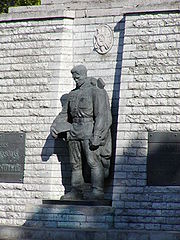
s, which were relocated to the nearby Tallinn Military Cemetery in 2007. Originally named "Monument to the Liberators of Tallinn" , later titled to its current official name "Monument To the Fallen in the Second World War", and sometimes called Alyosha, or Tõnismäe monument after its old location. The memorial was unveiled on September 22, 1947, three years after the Red Army
Red Army
The Workers' and Peasants' Red Army started out as the Soviet Union's revolutionary communist combat groups during the Russian Civil War of 1918-1922. It grew into the national army of the Soviet Union. By the 1930s the Red Army was among the largest armies in history.The "Red Army" name refers to...
reached Tallinn on September 22, 1944 during World War II
World War II
World War II, or the Second World War , was a global conflict lasting from 1939 to 1945, involving most of the world's nations—including all of the great powers—eventually forming two opposing military alliances: the Allies and the Axis...
.
The monument consists of a stonewall structure made of dolomite
Dolostone
Dolostone or dolomite rock is a sedimentary carbonate rock that contains a high percentage of the mineral dolomite. In old U.S.G.S. publications it was referred to as magnesian limestone. Most dolostone formed as a magnesium replacement of limestone or lime mud prior to lithification. It is...
and a two meter (6.5 ft) bronze
Bronze
Bronze is a metal alloy consisting primarily of copper, usually with tin as the main additive. It is hard and brittle, and it was particularly significant in antiquity, so much so that the Bronze Age was named after the metal...
statue
Statue
A statue is a sculpture in the round representing a person or persons, an animal, an idea or an event, normally full-length, as opposed to a bust, and at least close to life-size, or larger...
of a soldier
Soldier
A soldier is a member of the land component of national armed forces; whereas a soldier hired for service in a foreign army would be termed a mercenary...
in a World War II-era Red Army military uniform
Military uniform
Military uniforms comprises standardised dress worn by members of the armed forces and paramilitaries of various nations. Military dress and military styles have gone through great changes over the centuries from colourful and elaborate to extremely utilitarian...
. It was originally located in a small park (during the Soviet years called the Liberators' Square) on Tõnismägi
Tõnismägi
Tõnismägi is a 36 meter high hillock adjacent to Toompea hill in Tallinn, Estonia. From 1945 to 1996 the central portion of the hillock was called Liberators' Square...
in central Tallinn, above a small burial site of Soviet soldiers' remains reburied in April 1945.
In April 2007, the Estonian government relocated the Bronze Soldier and, after exhumation and identification, the remains of the Soviet soldiers, to the Defence Forces Cemetery of Tallinn
Defence Forces Cemetery of Tallinn
The Defence Forces Cemetery of Tallinn , sometimes called the Tallinn Military Cemetery, is one of the three cemeteries of the Tallinn City Centre Cemetery . It is situated about 3 kilometres outside the centre of Tallinn, the capital of Estonia...
. Not all remains were reburied there, as relatives were given a chance for claims, and several bodies were reburied in various locations of former Soviet Union according to the wishes of the relatives.
Political differences over interpretation of the events of the war symbolised by the monument had already led to a controversy between communities often delineated as Baltic Russians
Baltic Russians
The term Baltic Russians is usually used to refer to the Russian-speaking communities in the Baltic states: Estonia, Latvia, and Lithuania.The term "Baltic Russians" does not imply a separate ethnic subcategory among the Russians. It came into use in the context of discussions of their fate after...
and ethnic Estonians
Estonians
Estonians are a Finnic people closely related to the Finns and inhabiting, primarily, the country of Estonia. They speak a Finnic language known as Estonian...
, as well as between the Russian Federation and Estonia. The disputes surrounding the relocation peaked with two nights of riot
Riot
A riot is a form of civil disorder characterized often by what is thought of as disorganized groups lashing out in a sudden and intense rash of violence against authority, property or people. While individuals may attempt to lead or control a riot, riots are thought to be typically chaotic and...
s in Tallinn (known as the Bronze Night
Bronze Night
The Bronze Night , also known as the April Unrest and April Events refer to the controversy and riots in Estonia surrounding the 2007 relocation of the Bronze Soldier of Tallinn, the Soviet World War II memorial in Tallinn....
) and besieging of the Estonian embassy in Moscow
Moscow
Moscow is the capital, the most populous city, and the most populous federal subject of Russia. The city is a major political, economic, cultural, scientific, religious, financial, educational, and transportation centre of Russia and the continent...
for a week. The events caught international attention and led to a multitude of political reactions.
Controversy
The monument of Bronze Soldier of Tallinn was originally erected by Soviet authorities in Estonia as to the liberators of Tallinn on September 22, 1944. It is a historical fact that the German Army did not engage in any battles with the Red Army entering the city on September 22, 1944. Even though the Germans didn't engage Soviets in Tallinn, they did retreat under pressure from the advancing Red Army. Instead the National Committee of the Republic of EstoniaNational Committee of the Republic of Estonia
The National Committee of the Republic of Estonia was formed by the underground resistance movements in German-occupied Estonia in March 1944. By April 1944 a large number of the committee members were arrested by the German security agencies....
attempted to re-establish Estonian independence by taking power in Tallinn, and by proclaiming Provisional Government of Estonia and declaring re-establishment of the country's independence on September 18, 1944.
Preceding monument
The Bronze Soldier monument replaced a preceding wooden memorial — a one meter high, wooden pyramid, about 20 cm in diameter, of a plain blue color crowned by a red star — that had been blown up on the night of May 8, 1946 by two Estonian teenagers, 14 year old Aili JürgensonAili Jõgi
Aili Jõgi is an Estonian patriot who on the night of 8 May 1946, together with her school friend Ageeda Paavel, blew up a Soviet War reburial monument : the preceding monument to the Bronze Soldier in Tallinn.After the conquest of Estonia in 1944, the Soviet occupation authorities began...
and 15 year old Ageeda Paavel
Ageeda Paavel
Ageeda Paavel is an Estonian patriot who on the night of 8 May 1946, together with her school friend Aili Jürgenson, blew up a Soviet grave monument : the preceding monument to the Bronze Soldier in Tallinn.After the conquest of Estonia in 1944, the Soviet occupation authorities...
who had done this, in their own words, to avenge the Soviet destruction of war memorials to the Estonian War of Independence. Both were later arrested by the NKVD
NKVD
The People's Commissariat for Internal Affairs was the public and secret police organization of the Soviet Union that directly executed the rule of power of the Soviets, including political repression, during the era of Joseph Stalin....
and sent to the Gulag
Gulag
The Gulag was the government agency that administered the main Soviet forced labor camp systems. While the camps housed a wide range of convicts, from petty criminals to political prisoners, large numbers were convicted by simplified procedures, such as NKVD troikas and other instruments of...
.
Building and design
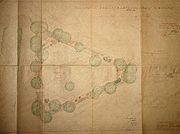
Enn Roos
Enn Roos was an Estonian Soviet sculptor.A notable work of his is the bronze sculpture from 1947 that is part of the World War II memorial ensemble in Tallinn, Estonia, nowadays usually called the Bronze Soldier, whose accompanying monumental stone structure was designed by the architect Arnold Alas...
and supervising architect Arnold Alas
Arnold Alas
Arnold Alas was an Estonian architect. A notable work is the World War II memorial ensemble in Tallinn from 1947, nowadays usually called the Bronze Soldier, including a two meter bronze statue of a soldier in a Soviet uniform and an accompanying monumental stone structure...
. It was unveiled on September 22, 1947, on the third anniversary of the Soviet Red Army
Red Army
The Workers' and Peasants' Red Army started out as the Soviet Union's revolutionary communist combat groups during the Russian Civil War of 1918-1922. It grew into the national army of the Soviet Union. By the 1930s the Red Army was among the largest armies in history.The "Red Army" name refers to...
re-entering Tallinn in 1944. Originally intended as an official war memorial to Soviet soldiers who died fighting in World War II, an eternal flame
Eternal flame
An eternal flame is a flame or torch that burns day and night for an indefinite period. The flame that burned constantly at Delphi was an archaic feature, "alien to the ordinary Greek temple"....
was added in front of the monument in 1964. The Soviet liberation theme was changed when Estonia re-established independence in 1991, now stating "For those fallen in World War II"; at the same time the eternal flame was put out.
Prototype
The prototype for the face and figure of the statue is not known. It has been suggested to have been the Estonian 1936 Olympic1936 Summer Olympics
The 1936 Summer Olympics, officially known as the Games of the XI Olympiad, was an international multi-sport event which was held in 1936 in Berlin, Germany. Berlin won the bid to host the Games over Barcelona, Spain on April 26, 1931, at the 29th IOC Session in Barcelona...
gold medal wrestler
Wrestling
Wrestling is a form of grappling type techniques such as clinch fighting, throws and takedowns, joint locks, pins and other grappling holds. A wrestling bout is a physical competition, between two competitors or sparring partners, who attempt to gain and maintain a superior position...
Kristjan Palusalu
Kristjan Palusalu
Kristjan Palusalu was an Estonian heavyweight wrestler and Olympic winner....
, as there is a resemblance. The sculptor Enn Roos denied this and instead suggested that he used "a young worker who lived nearby", and there have been claims the worker he is referring to was a carpenter named Albert Johannes Adamson.
On the other hand, Palusalu's daughter, Helle Palusalu, has claimed that her father served as a model for the statue. Roos's denial could have been motivated by Palusalu's having defected from Soviet military and thus having fallen into disfavour by the Communist Party.
Subtext
In Soviet Union artists used subtexts to escape censor or further repressions. Bronze Solder wears 8th Estonian Rifle Corps8th Estonian Rifle Corps
The 8th 'Estonian' Rifle Corps was a formation in the Soviet Army, created on 6 November 1942, during World War II. The 8th 'Estonian' Rifle Corps 1st...
. uniform probably as indication of artist's view that there should be statues to Estonians not Soviets in Estonia. Also Bronze Soldier is mourning, author probably indicating that he was unhappy of Estonian's loss of independence.
Burial site
On September 25, 1944, the remains of two Soviet soldiers were buried in the center of the TõnismägiTõnismägi
Tõnismägi is a 36 meter high hillock adjacent to Toompea hill in Tallinn, Estonia. From 1945 to 1996 the central portion of the hillock was called Liberators' Square...
hill, with additional remains of Soviet soldiers reburied there in April 1945. After the burial of the Red Army soldiers on Tõnismägi, the square was named Liberators’ Square on June 12, 1945 with the Bronze Soldier Monument added two years later. The exact number and names of the persons buried in the burial grounds under the monument had not been established with certainty before the excavations of 2007, although the Estonian Ministry of Foreign Affairs had ordered a comprehensive historical investigation in 2006. According to official records of the Military Commissariat of the Baltic Military District, however, the following 13 soldiers who fell during World War II were reburied in the grounds in April 1945:
- Lieutenant Colonel Mikhail Kulikov (Михаил Петрович Куликов) — commander of the 657th regiment, born in 1909 in MorshanskMorshanskMorshansk is a town in Tambov Oblast, Russia, located on the Tsna River north of Tambov. Population: 44,000 .-History:...
, Tambov OblastTambov OblastTambov Oblast is a federal subject of Russia . Its administrative center is the city of Tambov. Population: down from 1,178,443 recorded by the 2002 Census.Tambov Oblast is situated in forest steppe.-Birth rate:...
. Killed on 22 September, 1944. - Captain Ivan Sysoyev (Иван Михайлович Сысоев) — political commissarPolitical commissarThe political commissar is the supervisory political officer responsible for the political education and organisation, and loyalty to the government of the military...
of the 657th regiment, born in 1909 in village Topsa, Arkhangelsk OblastArkhangelsk OblastArkhangelsk Oblast is a federal subject of Russia . It includes the Arctic archipelagos of Franz Josef Land and Novaya Zemlya, as well as the Solovetsky Islands in the White Sea....
. Killed on 22 September, 1944. - Gefreiter (Senior Private) Dmitri Belov — 125th division (killed in a battle 45 km from Tallinn in September 1944)
- Colonel Konstantin Kolesnikov (Константин Павлович Колесников) — second commander of 125th division (killed on 21 September, 1944 in a battle 45 km from Tallinn). Born in 1897 in Zhilaya Kosa, Stalingrad OblastVolgograd OblastVolgograd Oblast is a federal subject of Russia . Its administrative center is the city of Volgograd. Population: -Geography:*Area: 113,900 km²;*Borders length: 2221,9 km²....
. - Captain Ivan Serkov (Иван Степанович Серков) — chief of intelligence, 79th light artillery brigade (killed on 21 September, 1944, in a battle 45 km from Tallinn). Born in 1922, Ryazan OblastRyazan OblastRyazan Oblast is a federal subject of Russia . Its administrative center is the city of Ryazan, which is the oblast's largest city. Population: -Geography:...
. - Major Vasili Kuznetsov (Василий Иванович Кузнецов) — commander of 1222nd artillery regiment. Born in 1908 in Ivanovo OblastIvanovo OblastIvanovo Oblast is a federal subject of Russia .Its three largest cities are Ivanovo , Kineshma, and Shuya.The principal center of tourism is Plyos. The Volga River flows through the northern part of the oblast....
. Killed on 22 September 1944. - Lieutenant Vasili Volkov (Василий Егорович Волков) — commander of mortar platoon (125th division). Born in 1923 in Kalinin OblastTver OblastTver Oblast is a federal subject of Russia . Its administrative center is the city of Tver. From 1935 to 1990, it was named Kalinin Oblast after Mikhail Kalinin. Population: Tver Oblast is an area of lakes, such as Seliger and Brosno...
. Killed on 22 September 1944. - Captain Aleksei Bryantsev (Алексей Матвеевич Брянцев) — 125th division. Born in 1917 in Altai KraiAltai KraiAltai Krai is a federal subject of Russia . It borders with, clockwise from the south, Kazakhstan, Novosibirsk and Kemerovo Oblasts, and the Altai Republic. The krai's administrative center is the city of Barnaul...
. Killed on 22 September 1944. - Sergeant Stepan Hapikalo (Степан Илларионович Хапикало) — tank commander of the 26th tank regiment (according to official military sources died of a disease). Born in 1920 in Poltava OblastPoltava OblastPoltava Oblast is an oblast of central Ukraine. The administrative center of the oblast is the city of Poltava.Other important cities within the oblast include: Komsomolsk, Kremenchuk, Lubny and Myrhorod.-Geography:...
. Died on 28 September 1944. - First Sergeant, medic Yelena Varshavskaya (Елена Михайловна Варшавская) — division medical assistant of 40th Guard Mortars regiment (died 22 or 23 September 1944 in Tallinn). Born in 1925 in Poltava OblastPoltava OblastPoltava Oblast is an oblast of central Ukraine. The administrative center of the oblast is the city of Poltava.Other important cities within the oblast include: Komsomolsk, Kremenchuk, Lubny and Myrhorod.-Geography:...
. - Sergeant Aleksandr Grigorov — died 7 March 1945
- Lieutenant Colonel Kotelnikov — no information available
- Lieutenant I. Lukanov — no information available
According to the Estonian Ministry of Defence, remains of 12 persons had been exhumed by May 2, 2007 and would be reburied by the end of June 2007 at the same cemetery where to the statue had been relocated. Furthermore, the archaeologists performing the digs have confirmed that no more burials have taken place on the grounds of the monument.
The Russian embassy and other former USSR states were asked to provide DNA samples for the identification of the buried bodies. Those persons who can be identified will be turned over to their relatives for reburial.
The initial DNA analysis revealed 11 male and 1 female among those 12 found at the site. DNA profiles of all 12 were turned over to the embassy of the Russian Federation in Tallinn.
Relocation
The Bronze Soldier has symbolic value to Estonia's community of ethnic Russian post-World War II immigrants, symbolising not only Soviet victory over GermanyGermany
Germany , officially the Federal Republic of Germany , is a federal parliamentary republic in Europe. The country consists of 16 states while the capital and largest city is Berlin. Germany covers an area of 357,021 km2 and has a largely temperate seasonal climate...
in the Great Patriotic War, but also their claim to rights in Estonia. Most Estonians
Estonians
Estonians are a Finnic people closely related to the Finns and inhabiting, primarily, the country of Estonia. They speak a Finnic language known as Estonian...
considered the Bronze Soldier a symbol of Soviet occupation and repression following World War II.
In 2006, the conservative Pro Patria Union
Pro Patria Union
The Pro Patria Union was a conservative political party in Estonia. The party was founded on 2 December 1995 by merging the Estonian National Independence Party and the National Coalition Party Pro Patria .On April 4, 2006, representatives of the Pro Patria Union and the representatives of Res...
petitioned the Tallinn City Council to demolish the monument, which saw the Estonian president in January 2007 vetoing a bill which would have allowed for its destruction and instead ordering its removal from the city centre. In February 2007, Estonian nationalists unsuccessfully attempted to place on the statue a wreath made of barbed wire decorated with a plaque saying "Murderers of the Estonian People". Russia Today, the official (Novosti) Russian Federation broadcast channel, reported on their web site that a swastika
Swastika
The swastika is an equilateral cross with its arms bent at right angles, in either right-facing form in counter clock motion or its mirrored left-facing form in clock motion. Earliest archaeological evidence of swastika-shaped ornaments dates back to the Indus Valley Civilization of Ancient...
had been placed on it.
Amid political controversy, in April 2007 the newly-elected Ansip
Andrus Ansip
Andrus Ansip is the current Prime Minister of Estonia, and chairman of the market liberal Estonian Reform Party .-Early life and career:...
government started final preparations for the reburial of the remains and relocation of the statue, according to the political mandate
Mandate (politics)
In politics, a mandate is the authority granted by a constituency to act as its representative.The concept of a government having a legitimate mandate to govern via the fair winning of a democratic election is a central idea of democracy...
received during the March 2007 elections
Estonian parliamentary election, 2007
Parliamentary elections took place in Estonia on Sunday, March 4, 2007 to elect members of the Riigikogu. The electoral system was a two-tier semi-open list proportional representation system with a 5% election threshold...
. The government claimed that the location of the memorial at a busy intersection in Tallinn was not a proper resting place, which led to critics to accuse the government of pandering to Estonian nationalist groups. Disagreement over the appropriateness of the action led to mass protests and riot
Riot
A riot is a form of civil disorder characterized often by what is thought of as disorganized groups lashing out in a sudden and intense rash of violence against authority, property or people. While individuals may attempt to lead or control a riot, riots are thought to be typically chaotic and...
s (accompanied by looting
Looting
Looting —also referred to as sacking, plundering, despoiling, despoliation, and pillaging—is the indiscriminate taking of goods by force as part of a military or political victory, or during a catastrophe, such as during war, natural disaster, or rioting...
) lasting 2 nights, the worst Estonia has seen.
In the early morning hours of April 27, 2007, after the first night's rioting, the government decided, at an emergency meeting, to dismantle the monument immediately, referring to security concerns. By the following afternoon the stone structure had been dismantled as well. As of the afternoon of April 30, the statue without the stone structure had been placed at the Cemetery
Defence Forces Cemetery of Tallinn
The Defence Forces Cemetery of Tallinn , sometimes called the Tallinn Military Cemetery, is one of the three cemeteries of the Tallinn City Centre Cemetery . It is situated about 3 kilometres outside the centre of Tallinn, the capital of Estonia...
of the Estonian Defence Forces in Tallinn. An opening ceremony for the relocated statue was held on May 8, VE Day
Victory in Europe Day
Victory in Europe Day commemorates 8 May 1945 , the date when the World War II Allies formally accepted the unconditional surrender of the armed forces of Nazi Germany and the end of Adolf Hitler's Third Reich. The formal surrender of the occupying German forces in the Channel Islands was not...
. (Significantly, Red Army veterans celebrate Victory Day
Victory Day (Eastern Europe)
Victory Day or 9 May marks the capitulation of Nazi Germany to the Soviet Union in the Second World War...
a day later, on May 9.) During June 2007 the stone structure was rebuilt. Relatives have made claims to bodies of four of the war dead. Unclaimed remains were reburied at the military cemetery, next to the relocated monument, on July 3, 2007.
Photos and videos
- 360º QTVR fullscreen panoramas near Bronze Soldier Monument (May 9, 2005; May 9, 2007)
- В поле зрения — Round table on Estonian State TV (ETV) 07.05.2007. in Russian with Estonian subtitles.