
|
|
|
|
Bromsgrove
|
| |
|
| |
Bromsgrove is a town in Worcestershire, West Midlands, England. The town is about 16 miles north east of Worcester and 13 miles south west of Birmingham. It had a population of 27,633 in 2001 and is in Bromsgrove District.
sgrove is first documented in the early 9th century as Bremesgraf. Later in the Anglo-Saxon Chronicle of 909 A.D. Bromsgrove is mentioned as Bremesburh. Then in the Domesday Book Bromsgrove is referenced as Bremesgrave. The Breme part of the place name is almost certainly a Saxon personal name.
Prior to 1086 Bromsgrove is known to have had a Royal chief manor, a priest and three water mills.

Discussion
Ask a question about 'Bromsgrove'
Start a new discussion about 'Bromsgrove'
Answer questions from other users
|
Encyclopedia
Bromsgrove is a town in Worcestershire, West Midlands, England. The town is about 16 miles north east of Worcester and 13 miles south west of Birmingham. It had a population of 27,633 in 2001 and is in Bromsgrove District.
History
Bromsgrove is first documented in the early 9th century as Bremesgraf. Later in the Anglo-Saxon Chronicle of 909 A.D. Bromsgrove is mentioned as Bremesburh. Then in the Domesday Book Bromsgrove is referenced as Bremesgrave. The Breme part of the place name is almost certainly a Saxon personal name.
Prior to 1086 Bromsgrove is known to have had a Royal chief manor, a priest and three water mills. It was an important royal vill astride to the Roman road linking Droitwich with the northern Midlands. It was at the centre of a very large parish and its church was certainly of minister status. Bromsgrove, along with all the towns in north Worcestershire, was committed to defending the city of Worcester and is recorded to have contributed burgesses to Droitwich in 1086. There may also have been Saxon or Norman fortifications in Bromsgrove, but other than in literature no physical archaeological evidence remains.
In the Anglo-Saxon times, Bromsgrove had a woodland economy, consisting of hunting, maintenance of haies and pig farming.
At one time, Bromsgrove was a centre for the woollen trade, which went into decline before the 17th century.
The Bromsgrove Union Workhouse, on the Birmingham Road, was opened in 1838 and closed in 1948 and is in use as offices today.
Nail making was introduced by the French Huguenots in the 17th century and became a thriving industry. At one point Bromsgrove was the world centre of nail making. Mechanisation quickly put the industry into decline.
Bromsgrove was home for many years to the world-famous "Bromsgrove Guild", a company of craftsmen who produced many fine works of sculpture, ironwork, etc., including the gates of Buckingham Palace (whose locks are stamped with the Guild's name), the lifts on the Lusitania and the famous statue adorning the Fortune Theatre in Drury Lane.
In 1841, Bromsgrove railway works was established. It was primarily a maintenance facility but also built steam locomotives. The works provided employment for people in Bromsgrove. In 1964, following a reorganisation of railway workshops, the works closed and was demolished. The site is now a housing estate. One of the turntable pits still remains.
Major restoration of the Norman and 13th century St. John the Baptist church was carried out in 1858 by Sir George Gilbert Scott. In the churchyard here are the graves of two railwaymen, Tom Scaife and Joseph Rutherford who were killed when their steam locomotive blew up while climbing the steepest mainline railway gradient in England, at the nearby Lickey Incline, on November 10th 1840. The driver and his number two died instantly.
St. Peter’s Roman Catholic Church in Worcester Road was built by Gilbert Blount in 1858.[The Buildings of England: Worcestershire, Nikolaus Pevsner, 1968 Penguin. p110]
The fish and chip shop above which Lord Lucan was rumoured to have hidden during the late 1970s has been demolished.
Governance
Bromsgrove's Member of Parliament is Julie Kirkbride. As a largely rural constituency with affluent residential areas, Bromsgrove is strongly Conservative with even more conservative seats being won in the local elections at the expense of 'other' candidates. The population has a small ethnic minority. Bromsgrove has its own youth branch of Conservatives called Bromsgrove Conservative Future.
Geography The solid geology of Bromsgrove is that of the Triassic(late Scythian to early Ladinian) Bromsgrove Sandstone. It shows red bed facies and was probably laid down by rivers flowing through an arid landscape or in ephemeral, shallow lakes. The uppermost beds were deposited by a brief marine transgression.
The soil is very good for market gardening and growing vegetables due to Marl bands.
Bromsgrove has a rainfall of between 27 and 28 inches annually and the district is at a general elevation of between 200 to 300 feet above sea level.
Landmarks
There is a statue of Alfred Edward Housman in the high street, which was erected in 1985. There is also a sculpture of a dryad and boar in the high street.
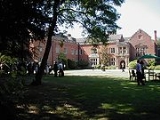
Bromsgrove is home to Grafton Manor which dates back to the 13th century. It has a rich history, with some historians believing it to be involved in the gunpowder plot.
Economy
In 2004, 33,175 people in Bromsgrove District were in employment, with mining and quarrying, manufacturing, electricity, gas and water supply, the utilities, being the biggest sector of employment.
Many of Bromsgrove's residents find employment in Birmingham, Redditch, Worcester and other places along the motorway network. MG Rover was a major employer of Bromsgrove residents until its collapse in May 2005.
Bromsgrove is still home to LG Harris Ltd, a paint brush manufacturer.
Business parks in Aston Fields and Buntsford Hill are helping to revitalise the local economy, in addition to newer developments such as Saxon and Harris Business Parks. Bromsgrove District Council is aiming to create a technology corridor along the A38 to take advantage of the area's excellent road links.
Present day
Communal facilities
Bromsgrove is now host to a new centre for the arts, "Artrix". This is a theatre and a cinema, located in School Drive. It hosts relatively recently-released films, rock concerts, stand-up comedians and classical music concerts from Bromsgrove Concerts.
Bromsgrove has a medium sized public community library situated in the centre of the town. The library offers not only books but also music CDs, spoken word, foreign language tapes and videos & DVDs for adults and children. There are 25 computers available with internet access.
Bromsgrove has a municipal park, Sanders Park. Facilities include: basketball, tennis courts, a skate park, children's play area and football pitches. A bonfire night is held annually with a large fireworks display and fair ground rides. Other events are held such as big band afternoons featuring bands playing in the bandstand.
There is a Bowls club in Charford which is immensely popular with the older residents.
There is a large public leisure centre and sports centre in the town called The Dolphin Centre. It has two swimming pools and a large sports hall. Numerous activities and clubs are held here, such as the Bromsgrove Swimming Club. It is maintained by Bromsgrove District Council.
Transport
Bromsgrove is intersected by the A38, the M5 motorway borders the west side and the M42 motorway starts at the north of the town.
Bromsgrove railway station is situated to the south of the town. It sits at the foot of the Lickey Incline which is the steepest Incline on the British mainline network meaning most freight trains require assistance from a locomotive at the rear. Between 1919 and 1956 this was operated by a purpose built locomotive known by drivers as Big Bertha. There are frequent trains to Birmingham New Street, Worcester Foregate Street and Hereford. On 4 May 2007, Network Rail announced that a new station will be built, to replace the existing structure, at a cost in the region of £10-12 million.
There is also a bus station adjacent to the high street. Buses operate to a wide area of Worcestershire and the West Midlands.
Education
State Schools
Bromsgrove schools use a three-tier education system (First School, Middle School, High School).
Bromsgrove has 12 first schools in its district. There are five middle schools: Alvechurch Middle School, Catshill Middle School, Aston Fields Middle School, St John's Middle School and Parkside Middle School.
There are two high schools, North Bromsgrove High School and South Bromsgrove High School in Charford. South Bromsgrove is a specialist school in foreign languages and I.T, noted for its extensive use of information technology. A previous headteacher, Philip McTague, was heavily involved in political action to reduce the gap in funding between Worcestershire state schools and others across the country. North Bromsgrove High School has now been classed for a specialist status in media and creative arts.
Private Schools
Bromsgrove is also home to Bromsgrove School, a co-educational independent school founded in 1553 with three campuses catering for pupils from nursery to sixth-form that offers boarding facilities. Former pupils include Digby Jones, head of the CBI for many years, and the actors Ian Carmichael and Richard Wattis.
Special Schools
There are two special schools in Bromsgrove, one is Chadsgrove School and Specialist Sports College the other Rigby Hall School.
Further Education
Bromsgrove is the main site of North East Worcestershire College, better known as NEW College. NEW College has recently built a motorcycle academy with a £1.7 million grant from Advantage West Midlands, it has been extensively equipped by Harley Davidson.
Sport
Bromsgrove is home to :
Attractions The Avoncroft Museum of Buildings has its home in Bromsgrove. This museum includes the National Telephone Kiosk Collection. There is also another museum near the centre of town, Bromsgrove Museum, which is currently closed, although the Tourist Information office in the same building remains open.
The Worcester and Birmingham Canal runs close to Bromsgrove, it is popular for leisure activities such as walking and coarse fishing. There are several narrowboat hire centres situated in villages close to Bromsgrove. The Tardebigge lock flight, with 30 locks, is the longest in the UK.
Bromsgrove is five miles away from the historic country house Hanbury Hall, which is open to the public.
Bromsgrove's nightlife scene was dominated by "Euphoria" (known to some locals as "Euph"), a nightclub featuring a mixture of styles ranging from pure pop music to commercial dance music. On 20 February 2006, Euphoria underwent refurbishing and opened 6 July 2006 under the name Aura. In 2007 it was refurbished again and was known as Love, only a few months after this refurbishment, the nightclub changed its name again to Love2Love. Popular pubs in the town centre include The Red Lion, The Golden Cross Hotel (a Wetherspoons pub), a Slug and Lettuce and the Wishing Well (formerly The Shoulder Of Mutton). A Bar called The Rousler has recently opened in the High street, taking its name from the clay figure, the Bromsgrove Rousler. Ye Olde Black Cross is another popular pub in Bromsgrove and well known as a local Rock music pub hosting live music. The Wishing Well and the Hop Pole Inn are both well known as live music venues.
Bromsgrove is close to the Lickey Hills, Clent Hills, Waseley Hills, and to rural Worcestershire and Birmingham.
Town Twinning and Friendship Links In May 1980, Bromsgrove was twinned with the German town of Gronau. A formal friendship link document was signed between Bromsgrove and the district of Saint-Sauveur-Lendelin in Normandy, France, in July 1999. Annual exchange visits are made by Bromsgrove and District Twinning Association members to each town with great success.
Twinning
Friendship Link
Energy policy
In May 2006, a report commissioned by British Gas showed that housing in Bromsgrove produced the 14th highest average carbon emissions in the country at 7,133 kg of carbon dioxide per dwelling.
- See also: Energy efficiency in British housing.
Notable Residents
- Singer/actor, Michael Ball, was born in Bromsgrove
- Some members of Beat Union were born in Bromsgrove and Redditch.
- Joyce Carpenter (1929-73) UK`s shortest ever mature human. (74cm or 29ins)
- Nicola Charles, 1969, Actor
- Jonathan Coe, author, was born in Lickey in 1961
- Fyfe Dangerfield, Musician
- Nicholas Evans, author, best known for The Horse Whisperer
- Geoffrey Hill, 1932, poet
- Alfred Edward Housman, 1859, poet
- Model, Hannah Joy Lewis, was born in Bromsgrove
- Ritchie Neville, member of boy band Five attended Bromsgrove School& St. John the Baptist church
- Richard Orford, TV Presenter
- Ernest Anthony Pratt (or Anthony E Pratt) (1903 - 1994), the inventor of the board game Cluedo, is buried in Bromsgrove Cemetery
- Matthew Priest, Musician.
- Andrew Rice (1987), Chef who has worked alongside Gordon Ramsay and is currently working with Gary Rhodes, lived in Bromsgrove and went to South Bromsgrove High School.
- Pat Roach (1937 - 2004). Wrestler and Actor is buried in Bromsgrove Cemetery .
- David Rudkin, playwright, taught at North Bromsgrove High School in the early 1960s. His play Afore Night Come (1962) was inspired by his experiences in the countryside close to Bromsgrove
- Alan M. Smith, 1962, footballer.
- Trudie Styler was born in Bromsgrove.
- Jim Swire, 1936, doctor and father of Lockerbie victim
- Singer/songwriter Clifford T. Ward, who lived in nearby Stourport, taught English language and drama in Bromsgrove before resigning to concentrate on his solo career
Bibliography
- Bromsgrove (Images of England) - ISBN 0-7524-1146-2
- Glory Gone: The Story of Nailing in Bromsgrove - ISBN 0-9513525-1-2
External links
- Local Bromsgrove weekly newspaper
-
-
-
-
-
-
-
|
| |
|
|