


Brock's Monument

Encyclopedia
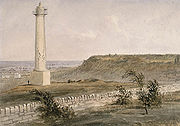
Brock's Monument is a 56-metre (185 ft) column atop Queenston Heights
, in Queenston
, Ontario
, Canada
, dedicated to Major General
Sir Isaac Brock
, one of Canada's heroes of the War of 1812
. Brock and one of his Canadian aides-de-camp
, Lieutenant-Colonel John Macdonell
, are interred at the monument's base, on the heights above the battlefield where both fell during the Battle of Queenston Heights
. The current monument was constructed between 1853 and 1856 and is the second such structure to occupy the battlefield. Parks Canada
maintains the monument, the most imposing feature of Queenston Heights
National Historic Site.
 Brock died by gunshot wound to the chest on the morning of October 13, 1812, leading a charge of British
regulars and Canadian militia up the Heights to regain the Redan Battery, earlier captured by American
infantry
forces under Captain John Wool. One of Brock's aides-de-camp, John Macdonell
was also mortally wounded while attempting to lead a subsequent abortive charge when his mount was shot from beneath him and fell on him. The combined British, Canadian, and First Nations
forces eventually won a resounding victory under the command of Major-General Roger Hale Sheaffe
.
Brock and his aide were initially buried in the north-east corner of Fort George
in nearby Niagara-on-the-Lake
, then called Newark. This corner has come to be known as Brock's Bastion and is immortalised as such by a small stone bearing that inscription. A campaign began among prominent Upper Canadians to honour Brock, whose dramatic death provided a rallying point during and after the war as a symbol of Canadian independence from the United States. This led to the erection of the first Brock's Monument, a 135-foot (41.1m) Tuscan column with a viewing platform at the top. Construction began in 1823, and the monument was inaugurated October 13, 1824.
, an anti-British agitator and participant in the 1837 Rebellion although a subsequent Assize failed to confirm this. Brock and Macdonell's remains were removed after the monument's disassemblage and reinterred in the Queenston cemetery of the Hamilton family.
A campaign to rebuild the monument began almost immediately. In 1852, Toronto
architect
William Thomas
had his design selected for a monument even grander than the first. A master stone carver named Charles Thomas Thomas
(1820–1867)supervised the construction and stone carving of Brock's Monument. He was an English-born stone carver. Thomas was employed by Worthington Brothers of Toronto, contractors for the stone work on Brock's Monument. Construction began in 1853 again using limestone
from the nearby Queenston Quarry and was completed three years later. The remains of Brock and Macdonell were led back up Queenston Heights
and interred for the fourth time. The monument was officially inaugurated on October 13, 1859. A smaller obelisk, closer to the exact site of Brock's death, was dedicated by Prince Edward (later King Edward VII
), in 1860.
On the re-interment, two oval plates were attached to Brock's coffin. They read:
A 1929 lightning strike
severely damaged Brock's statue, sending large portions crashing to the ground below.
In August 2003 the Friends of Fort George and Parks Canada
held a ceremony to commemorate the 150th anniversary of the monument's groundbreaking. Engineering inspections carried out in 2003 and 2004 revealed the need for significant restorative work to the structure's interior and exterior limestone. Parks Canada closed the monument to the public in 2005 pending repairs. An extensive restoration on the monument began in 2008 and was completed in May 2009. Improvements included relining the interior walls to protect against condensation as well as battery-powered interior emergency lights to assist with exiting the monument should there be a power loss.
trees believed to have been planted during the 1850s. Inside the monument's base are a number of brass plaques: Brock and Macdonell's epitaphs, a list of donors and builders, and a tribute to the British, Canadian, and First Nations soldiers who died at the Battle of Queenston Heights. The two bodies are interred in crypts within the limestone walls. More recent educational displays outline Brock's life, the battle, and the monument's history—including a portion of Brock's former limestone arm that collapsed in 1929.
A 235-step spiral staircase up the column leads visitors to a small indoor platform underneath Brock's statue. Porthole
windows provide views of the surrounding Niagara
region and Lake Ontario
.
The monument, illuminated at night, marks the end of an interpretive historical walking trail that leads down and then up Queenston Heights, recounting key events in the battle.
Queenston Heights
thumb|Brock's Monument|250px|Brock's Monument at Queenston HeightsThe Queenston Heights is a geographical feature of the Niagara Escarpment immediately above the village of Queenston, Ontario, Canada. Its geography is a promontory formed where the escarpment is divided by the Niagara River...
, in Queenston
Queenston, Ontario
Queenston is located 5 km north of Niagara Falls, Ontario in the Town of Niagara-on-the-Lake. The community is bordered by Highway 405 and the Niagara River; its location on the Niagara Escarpment led to the establishment of the now-defunct Queenston Quarry in the area...
, Ontario
Ontario
Ontario is a province of Canada, located in east-central Canada. It is Canada's most populous province and second largest in total area. It is home to the nation's most populous city, Toronto, and the nation's capital, Ottawa....
, Canada
Canada
Canada is a North American country consisting of ten provinces and three territories. Located in the northern part of the continent, it extends from the Atlantic Ocean in the east to the Pacific Ocean in the west, and northward into the Arctic Ocean...
, dedicated to Major General
Major General
Major general or major-general is a military rank used in many countries. It is derived from the older rank of sergeant major general. A major general is a high-ranking officer, normally subordinate to the rank of lieutenant general and senior to the ranks of brigadier and brigadier general...
Sir Isaac Brock
Isaac Brock
Major-General Sir Isaac Brock KB was a British Army officer and administrator. Brock was assigned to Canada in 1802. Despite facing desertions and near-mutinies, he commanded his regiment in Upper Canada successfully for many years...
, one of Canada's heroes of the War of 1812
War of 1812
The War of 1812 was a military conflict fought between the forces of the United States of America and those of the British Empire. The Americans declared war in 1812 for several reasons, including trade restrictions because of Britain's ongoing war with France, impressment of American merchant...
. Brock and one of his Canadian aides-de-camp
Aide-de-camp
An aide-de-camp is a personal assistant, secretary, or adjutant to a person of high rank, usually a senior military officer or a head of state...
, Lieutenant-Colonel John Macdonell
John Macdonell
Lieutenant Colonel John Macdonell of Greenfield was an aide-de-camp to British Major General Sir Isaac Brock during the War of 1812, dying in the Battle of Queenston Heights. He was born on 19 April 1785 in Scotland near Aberchalder and came to Canada when he was seven years old...
, are interred at the monument's base, on the heights above the battlefield where both fell during the Battle of Queenston Heights
Battle of Queenston Heights
The Battle of Queenston Heights was the first major battle in the War of 1812 and resulted in a British victory. It took place on 13 October 1812, near Queenston, in the present-day province of Ontario...
. The current monument was constructed between 1853 and 1856 and is the second such structure to occupy the battlefield. Parks Canada
Parks Canada
Parks Canada , also known as the Parks Canada Agency , is an agency of the Government of Canada mandated to protect and present nationally significant natural and cultural heritage, and foster public understanding, appreciation, and enjoyment in ways that ensure their ecological and commemorative...
maintains the monument, the most imposing feature of Queenston Heights
Queenston Heights
thumb|Brock's Monument|250px|Brock's Monument at Queenston HeightsThe Queenston Heights is a geographical feature of the Niagara Escarpment immediately above the village of Queenston, Ontario, Canada. Its geography is a promontory formed where the escarpment is divided by the Niagara River...
National Historic Site.
History
United Kingdom of Great Britain and Ireland
The United Kingdom of Great Britain and Ireland was the formal name of the United Kingdom during the period when what is now the Republic of Ireland formed a part of it....
regulars and Canadian militia up the Heights to regain the Redan Battery, earlier captured by American
United States
The United States of America is a federal constitutional republic comprising fifty states and a federal district...
infantry
Infantry
Infantrymen are soldiers who are specifically trained for the role of fighting on foot to engage the enemy face to face and have historically borne the brunt of the casualties of combat in wars. As the oldest branch of combat arms, they are the backbone of armies...
forces under Captain John Wool. One of Brock's aides-de-camp, John Macdonell
John Macdonell
Lieutenant Colonel John Macdonell of Greenfield was an aide-de-camp to British Major General Sir Isaac Brock during the War of 1812, dying in the Battle of Queenston Heights. He was born on 19 April 1785 in Scotland near Aberchalder and came to Canada when he was seven years old...
was also mortally wounded while attempting to lead a subsequent abortive charge when his mount was shot from beneath him and fell on him. The combined British, Canadian, and First Nations
First Nations
First Nations is a term that collectively refers to various Aboriginal peoples in Canada who are neither Inuit nor Métis. There are currently over 630 recognised First Nations governments or bands spread across Canada, roughly half of which are in the provinces of Ontario and British Columbia. The...
forces eventually won a resounding victory under the command of Major-General Roger Hale Sheaffe
Roger Hale Sheaffe
General Sir Roger Hale Sheaffe, 1st Baronet was an American-born General in the British Army in the first part of the 19th century.-Early career:...
.
Brock and his aide were initially buried in the north-east corner of Fort George
Fort George, Ontario
Fort George National Historic Site is a historic military structure at Niagara-on-the-Lake, Ontario, that was the scene of several battles during the War of 1812...
in nearby Niagara-on-the-Lake
Niagara-on-the-Lake
Niagara-on-the-Lake is a Canadian town located in Southern Ontario where the Niagara River meets Lake Ontario in the Niagara Region of the southern part of the province of Ontario. It is located across the Niagara river from Youngstown, New York, USA...
, then called Newark. This corner has come to be known as Brock's Bastion and is immortalised as such by a small stone bearing that inscription. A campaign began among prominent Upper Canadians to honour Brock, whose dramatic death provided a rallying point during and after the war as a symbol of Canadian independence from the United States. This led to the erection of the first Brock's Monument, a 135-foot (41.1m) Tuscan column with a viewing platform at the top. Construction began in 1823, and the monument was inaugurated October 13, 1824.
Second monument
On April 17, 1840, an explosive charge did serious and irreparable damage to the monument although it failed to bring it down. The attack was presumed to have been orchestrated by Benjamin LettBenjamin Lett
Benjamin Lett was an Anglo-Irish-Canadian filibusterer who was a disciple of William Lyon Mackenzie.Although he did not participate in the Upper Canada Rebellion, in 1838 he was charged with the murder of Captain Edgeworth Ussher...
, an anti-British agitator and participant in the 1837 Rebellion although a subsequent Assize failed to confirm this. Brock and Macdonell's remains were removed after the monument's disassemblage and reinterred in the Queenston cemetery of the Hamilton family.
A campaign to rebuild the monument began almost immediately. In 1852, Toronto
Toronto
Toronto is the provincial capital of Ontario and the largest city in Canada. It is located in Southern Ontario on the northwestern shore of Lake Ontario. A relatively modern city, Toronto's history dates back to the late-18th century, when its land was first purchased by the British monarchy from...
architect
Architect
An architect is a person trained in the planning, design and oversight of the construction of buildings. To practice architecture means to offer or render services in connection with the design and construction of a building, or group of buildings and the space within the site surrounding the...
William Thomas
William Thomas (architect)
William Thomas was an Anglo-Canadian architect.Thomas was apprenticed under Charles Barry and A.W. Pugin as a carpenter-joiner. His younger brother was the sculptor John Thomas .Thomas began his own practice at Leamington Spa in 1831 but in 1837 went bankrupt...
had his design selected for a monument even grander than the first. A master stone carver named Charles Thomas Thomas
Charles Thomas Thomas
Charles Thomas Thomas was a prominent Anglo-Canadian stone carver and builder in the mid 19th Century...
(1820–1867)supervised the construction and stone carving of Brock's Monument. He was an English-born stone carver. Thomas was employed by Worthington Brothers of Toronto, contractors for the stone work on Brock's Monument. Construction began in 1853 again using limestone
Limestone
Limestone is a sedimentary rock composed largely of the minerals calcite and aragonite, which are different crystal forms of calcium carbonate . Many limestones are composed from skeletal fragments of marine organisms such as coral or foraminifera....
from the nearby Queenston Quarry and was completed three years later. The remains of Brock and Macdonell were led back up Queenston Heights
Queenston Heights
thumb|Brock's Monument|250px|Brock's Monument at Queenston HeightsThe Queenston Heights is a geographical feature of the Niagara Escarpment immediately above the village of Queenston, Ontario, Canada. Its geography is a promontory formed where the escarpment is divided by the Niagara River...
and interred for the fourth time. The monument was officially inaugurated on October 13, 1859. A smaller obelisk, closer to the exact site of Brock's death, was dedicated by Prince Edward (later King Edward VII
Edward VII of the United Kingdom
Edward VII was King of the United Kingdom and the British Dominions and Emperor of India from 22 January 1901 until his death in 1910...
), in 1860.
On the re-interment, two oval plates were attached to Brock's coffin. They read:
"HERE LIE THE EARTHLY REMAINS OF A BRAVE
AND VIRTUOUS HERO,
MAJOR-GENERAL SIR ISAAC BROCK,
COMMANDER OF THE BRITISH FORCES,
AND PRESIDENT ADMINISTERING
THE GOVERNMENT OF UPPER CANADA,
WHO FELL WHEN GLORIOUSLY ENGAGING THE ENEMIES
OF HIS COUNTRY,
AT THE HEAD OF THE FLANK COMPANIES
OF THE 49TH REGIMENT
IN THE TOWN OF QUEENSTON,
ON THE MORNING OF THE 13TH OCTOBER, 1812
AGED 42 YEARS
J.B. Glegg, A.D.C"
A 1929 lightning strike
Lightning strike
Lightning strikes are electrical discharges caused by lightning, typically during thunderstorms.Humans can be hit by lightning directly when outdoors. Contrary to popular notion, there is no 'safe' location outdoors. People have been struck in sheds and makeshift shelters...
severely damaged Brock's statue, sending large portions crashing to the ground below.
In August 2003 the Friends of Fort George and Parks Canada
Parks Canada
Parks Canada , also known as the Parks Canada Agency , is an agency of the Government of Canada mandated to protect and present nationally significant natural and cultural heritage, and foster public understanding, appreciation, and enjoyment in ways that ensure their ecological and commemorative...
held a ceremony to commemorate the 150th anniversary of the monument's groundbreaking. Engineering inspections carried out in 2003 and 2004 revealed the need for significant restorative work to the structure's interior and exterior limestone. Parks Canada closed the monument to the public in 2005 pending repairs. An extensive restoration on the monument began in 2008 and was completed in May 2009. Improvements included relining the interior walls to protect against condensation as well as battery-powered interior emergency lights to assist with exiting the monument should there be a power loss.
Monument features
The main entrance is flanked by two large mulberryMulberry
Morus is a genus of flowering plants in the family Moraceae. The 10–16 species of deciduous trees it contains are commonly known as Mulberries....
trees believed to have been planted during the 1850s. Inside the monument's base are a number of brass plaques: Brock and Macdonell's epitaphs, a list of donors and builders, and a tribute to the British, Canadian, and First Nations soldiers who died at the Battle of Queenston Heights. The two bodies are interred in crypts within the limestone walls. More recent educational displays outline Brock's life, the battle, and the monument's history—including a portion of Brock's former limestone arm that collapsed in 1929.
A 235-step spiral staircase up the column leads visitors to a small indoor platform underneath Brock's statue. Porthole
Porthole
A porthole is a generally circular, window used on the hull of ships to admit light and air. Porthole is actually an abbreviated term for "port hole window"...
windows provide views of the surrounding Niagara
Niagara Peninsula
The Niagara Peninsula is the portion of Southern Ontario, Canada lying between the south shore of Lake Ontario and the north shore of Lake Erie. It stretches from the Niagara River in the east to Hamilton, Ontario in the west. The population of the peninsula is roughly 1,000,000 people...
region and Lake Ontario
Lake Ontario
Lake Ontario is one of the five Great Lakes of North America. It is bounded on the north and southwest by the Canadian province of Ontario, and on the south by the American state of New York. Ontario, Canada's most populous province, was named for the lake. In the Wyandot language, ontarío means...
.
The monument, illuminated at night, marks the end of an interpretive historical walking trail that leads down and then up Queenston Heights, recounting key events in the battle.