


British Empire Exhibition

Encyclopedia
The British Empire Exhibition was a colonial exhibition
held at Wembley
, Middlesex
in 1924 and 1925.

 It was opened by King George V
on St George's Day, 23 April 1924. The British Empire
contained 58 countries at that time, and only Gambia and Gibraltar
did not take part. It cost £12 million and was the largest exhibition ever staged anywhere in the world - it attracted 27 million visitors.
Its official aim was "to stimulate trade, strengthen bonds that bind mother Country to her Sister States and Daughters, to bring into closer contact the one with each other, to enable all who owe allegiance to the British flag to meet on common ground and learn to know each other". Maxwell Ayrton
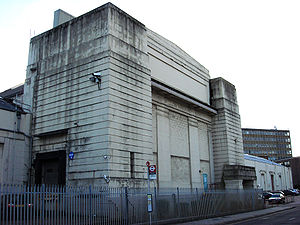
was the architect for the project. The three main buildings were the Palaces of Industry, Engineering and Arts. The Palace of Engineering was the world's largest reinforced concrete
building, a building method that allowed quick construction.
A special railway loop line and station were built, to connect the site to London Marylebone station. The various buildings of the site were linked by several 'light rail
ways', including the screw-driven 'Never-Stop Railway'.
Most of the exhibition halls were intended to be temporary and demolished afterwards, but at least the Palace of Engineering and the British Government Pavilion survived into the 1970s, if only because of the high cost of demolition of the huge concrete structures. The Empire Pool became the Wembley Arena
, and at the suggestion of the chair of the exhibition committee, Scotsman Sir James Stevenson
, the Empire Stadium was kept; it became Wembley Stadium, the home of Football in England
until 2002 when it was demolished to be replaced by a new stadium
.
The Exhibition was also the first occasion for which the British Post Office issued commemorative postage stamps. Two stamps were issued on 23 April 1924: a 1d
in scarlet
, and a d in brown, both being inscribed "British Empire Exhibition 1924"; they were designed by H. Nelson. A second printing, identical to the first apart from the year being changed to 1925, was issued on 9 May 1925. A List of Great Britain commemorative stamps gives further details of British commemorative postage stamps. Envelopes, letter cards, postcards and many other souvenirs commemorating the event were produced as well.
A grand "Pageant of Empire
" was held at the Exhibition in the Empire Stadium from 21 July 1924, for which the newly appointed Master of the King's Musick, Sir Edward Elgar
, composed an "Empire March" and the music for a series of songs
with words by Alfred Noyes
. However, a later speaking engagement by Prince Albert
at the exhibition on 31 October 1925 proved to be highly embarrassing due to the Prince's pronounced stammer
, which prompted him to consult speech therapist Lionel Logue
for treatment.
The management of the exhibition asked the Imperial Studies Committee of the Royal Colonial Institute to assist them with the educational aspect of the exhibition, which resulted in a 12-volume book "The British Empire: A survey
" with Hugh Gunn as the General Editor, and which was published in London in 1924.
The Palace of Engineering hosted the fencing
events for the 1948 Summer Olympics
.
; this was joined in 1925 by GWR 4079 Pendennis Castle. Several other railway locomotives were exhibited: in 1925, the Southern Railway
exhibited no. 866 of their N class, which was brand new, not entering service until 28 November 1925. The 1924 exhibition included a Prince of Wales class 4-6-0
locomotive of London and North Western Railway
(LNWR) design, which had been built for the exhibition by the Scottish locomotive manufacturer William Beardmore & Co. Beardmore's had previously built similar locomotives for the LNWR, which in 1923 had become a constituent of the newly formed London, Midland and Scottish Railway
(LMS); when the exhibition closed in November 1924, the LMS bought the locomotive from Beardmore. In 1924, the Metropolitan Railway
displayed one of their latest Inner Circle cars, a first class driving trailer which had been built in 1923. In 1925, in the Palace of Housing and Transport, the Metropolitan displayed electric locomotive no. 15, with some of the panelling, doors and framework removed from one side, to allow the interior to be viewed; it had been built in 1922. A few years later, it was named Wembley 1924 in honour of the exhibition.
s which were painted red for the display and fitted with white lights on the wings tail and fueselage. The display involved firing blank ammunition into the stadium crowds and dropping pyrotechnics from the aeroplanes to simulate shrapnel from guns on the ground, Explosions on the ground also produced the effect of bombs being dropped into the stadium by the Aeroplanes. One of the Pilots in the display was Flying officer C. W. A. Scott who later became famous for breaking three England Australia solo flight records and winning the MacRobertson Air Race
with co-pilot Tom Campbell Black
in 1934.
Colonial exhibition
A colonial exhibition was a type of international exhibition intended to boost trade and bolster popular support for the various colonial empires during the New Imperialism period, which started in the 1880s with the scramble for Africa....
held at Wembley
Wembley
Wembley is an area of northwest London, England, and part of the London Borough of Brent. It is home to the famous Wembley Stadium and Wembley Arena...
, Middlesex
Middlesex
Middlesex is one of the historic counties of England and the second smallest by area. The low-lying county contained the wealthy and politically independent City of London on its southern boundary and was dominated by it from a very early time...
in 1924 and 1925.
History
George V of the United Kingdom
George V was King of the United Kingdom and the British Dominions, and Emperor of India, from 6 May 1910 through the First World War until his death in 1936....
on St George's Day, 23 April 1924. The British Empire
British Empire
The British Empire comprised the dominions, colonies, protectorates, mandates and other territories ruled or administered by the United Kingdom. It originated with the overseas colonies and trading posts established by England in the late 16th and early 17th centuries. At its height, it was the...
contained 58 countries at that time, and only Gambia and Gibraltar
Gibraltar
Gibraltar is a British overseas territory located on the southern end of the Iberian Peninsula at the entrance of the Mediterranean. A peninsula with an area of , it has a northern border with Andalusia, Spain. The Rock of Gibraltar is the major landmark of the region...
did not take part. It cost £12 million and was the largest exhibition ever staged anywhere in the world - it attracted 27 million visitors.
Its official aim was "to stimulate trade, strengthen bonds that bind mother Country to her Sister States and Daughters, to bring into closer contact the one with each other, to enable all who owe allegiance to the British flag to meet on common ground and learn to know each other". Maxwell Ayrton
Maxwell Ayrton
Ormrod Maxwell Ayrton FRIBA , known as Maxwell Ayrton, was a Scottish architect. He spent most of his adult life working in London and designed houses, public buildings, and bridges.- Career :...
was the architect for the project. The three main buildings were the Palaces of Industry, Engineering and Arts. The Palace of Engineering was the world's largest reinforced concrete
Reinforced concrete
Reinforced concrete is concrete in which reinforcement bars , reinforcement grids, plates or fibers have been incorporated to strengthen the concrete in tension. It was invented by French gardener Joseph Monier in 1849 and patented in 1867. The term Ferro Concrete refers only to concrete that is...
building, a building method that allowed quick construction.
A special railway loop line and station were built, to connect the site to London Marylebone station. The various buildings of the site were linked by several 'light rail
Light rail
Light rail or light rail transit is a form of urban rail public transportation that generally has a lower capacity and lower speed than heavy rail and metro systems, but higher capacity and higher speed than traditional street-running tram systems...
ways', including the screw-driven 'Never-Stop Railway'.
Most of the exhibition halls were intended to be temporary and demolished afterwards, but at least the Palace of Engineering and the British Government Pavilion survived into the 1970s, if only because of the high cost of demolition of the huge concrete structures. The Empire Pool became the Wembley Arena
Wembley Arena
Wembley Arena is an indoor arena, at Wembley, in the London Borough of Brent. The building is opposite Wembley Stadium.-History:...
, and at the suggestion of the chair of the exhibition committee, Scotsman Sir James Stevenson
James Stevenson, 1st Baron Stevenson
James Stevenson, 1st Baron Stevenson , known as Sir James Stevenson, Bt, between 1917 and 1924, was a British businessman and civil servant.-Education:Stevenson was educated at the Kilmarnock Academy...
, the Empire Stadium was kept; it became Wembley Stadium, the home of Football in England
Football in England
Association football is a national sport in England, where the first modern set of rules for the code were established in 1863, which were a major influence on the development of the modern Laws of the Game...
until 2002 when it was demolished to be replaced by a new stadium
Wembley Stadium
The original Wembley Stadium, officially known as the Empire Stadium, was a football stadium in Wembley, a suburb of north-west London, standing on the site now occupied by the new Wembley Stadium that opened in 2007...
.
The Exhibition was also the first occasion for which the British Post Office issued commemorative postage stamps. Two stamps were issued on 23 April 1924: a 1d
Penny (British pre-decimal coin)
The penny of the Kingdom of Great Britain and later of the United Kingdom, was in circulation from the early 18th century until February 1971, Decimal Day....
in scarlet
Scarlet (color)
Scarlet is a bright red color with a hue that is somewhat toward the orange. It is redder than vermilion. It is a pure chroma on the color wheel one-fourth of the way between red and orange. Scarlet is sometimes used as the color of flame...
, and a d in brown, both being inscribed "British Empire Exhibition 1924"; they were designed by H. Nelson. A second printing, identical to the first apart from the year being changed to 1925, was issued on 9 May 1925. A List of Great Britain commemorative stamps gives further details of British commemorative postage stamps. Envelopes, letter cards, postcards and many other souvenirs commemorating the event were produced as well.
A grand "Pageant of Empire
Pageant of Empire
The Pageant of Empire was a set of historical pageants organised by the British government for the huge British Empire Exhibition held at the Empire Stadium in 1924. The Exhibition was opened on 23 April, and the Pageant was performed between 21 July and 30 August...
" was held at the Exhibition in the Empire Stadium from 21 July 1924, for which the newly appointed Master of the King's Musick, Sir Edward Elgar
Edward Elgar
Sir Edward William Elgar, 1st Baronet OM, GCVO was an English composer, many of whose works have entered the British and international classical concert repertoire. Among his best-known compositions are orchestral works including the Enigma Variations, the Pomp and Circumstance Marches, concertos...
, composed an "Empire March" and the music for a series of songs
Pageant of Empire (Elgar)
Pageant of Empire is the title given to a set of songs, to words by Alfred Noyes, written by the English composer Sir Edward Elgar and given important positions in the Pageant of Empire at the British Empire Exhibition.-Details:...
with words by Alfred Noyes
Alfred Noyes
Alfred Noyes was an English poet, best known for his ballads, "The Highwayman" and "The Barrel-Organ".-Early years:...
. However, a later speaking engagement by Prince Albert
George VI of the United Kingdom
George VI was King of the United Kingdom and the Dominions of the British Commonwealth from 11 December 1936 until his death...
at the exhibition on 31 October 1925 proved to be highly embarrassing due to the Prince's pronounced stammer
Stammer
A stammer, or stammering, is a speech disorder typified by the involuntary repetition of a sound or sounds.Stammer, Stammers and Stammmering may also refer to:* Notker of St Gall "Notker the Stammerer" * Steven Stamkos A stammer, or stammering, is a speech disorder typified by the involuntary ...
, which prompted him to consult speech therapist Lionel Logue
Lionel Logue
Lionel George Logue CVO was an Australian speech therapist and stage actor who successfully treated, among others, King George VI, who had a pronounced stammer.-Early life and family:...
for treatment.
The management of the exhibition asked the Imperial Studies Committee of the Royal Colonial Institute to assist them with the educational aspect of the exhibition, which resulted in a 12-volume book "The British Empire: A survey
The British Empire: A survey
The British Empire: A survey is a series of twelve books, each self-contained, published for educational purposes during the British Empire Exhibition in London by Collins in 1924, following the request of the Exhibition's management towards the Imperial Studies Committee of the Royal Colonial...
" with Hugh Gunn as the General Editor, and which was published in London in 1924.
The Palace of Engineering hosted the fencing
Fencing at the 1948 Summer Olympics
At the 1948 Summer Olympics, seven fencing events were contested, six for men and one for women.-Medal summary:-Medal table:-Participating nations:A total of 294 fencers from 30 nations competed at the London Games:...
events for the 1948 Summer Olympics
1948 Summer Olympics
The 1948 Summer Olympics, officially known as the Games of the XIV Olympiad, were an international multi-sport event which was held in London, England, United Kingdom. After a 12-year hiatus because of World War II, these were the first Summer Olympics since the 1936 Games in Berlin...
.
Railway exhibits
Several railway companies had display stands at the Exhibition; in some cases they exhibited their latest locomotives or coaches. Among the exhibits in the Palace of Engineering was the now famous railway locomotive, LNER no. 4472 Flying ScotsmanLNER Class A3 4472 Flying Scotsman
The LNER Class A3 Pacific locomotive No. 4472 Flying Scotsman was built in 1923 for the London and North Eastern Railway at Doncaster Works to a design of H.N. Gresley...
; this was joined in 1925 by GWR 4079 Pendennis Castle. Several other railway locomotives were exhibited: in 1925, the Southern Railway
Southern Railway (Great Britain)
The Southern Railway was a British railway company established in the 1923 Grouping. It linked London with the Channel ports, South West England, South coast resorts and Kent...
exhibited no. 866 of their N class, which was brand new, not entering service until 28 November 1925. The 1924 exhibition included a Prince of Wales class 4-6-0
LNWR Prince of Wales Class
The London and North Western Railway Prince of Wales Class was a class of express passenger passenger locomotive. It was in effect, a superheated version of the Experiment Class 4-6-0.They were introduced in 1911 by Charles Bowen-Cooke...
locomotive of London and North Western Railway
London and North Western Railway
The London and North Western Railway was a British railway company between 1846 and 1922. It was created by the merger of three companies – the Grand Junction Railway, the London and Birmingham Railway and the Manchester and Birmingham Railway...
(LNWR) design, which had been built for the exhibition by the Scottish locomotive manufacturer William Beardmore & Co. Beardmore's had previously built similar locomotives for the LNWR, which in 1923 had become a constituent of the newly formed London, Midland and Scottish Railway
London, Midland and Scottish Railway
The London Midland and Scottish Railway was a British railway company. It was formed on 1 January 1923 under the Railways Act of 1921, which required the grouping of over 120 separate railway companies into just four...
(LMS); when the exhibition closed in November 1924, the LMS bought the locomotive from Beardmore. In 1924, the Metropolitan Railway
Metropolitan railway
Metropolitan Railway can refer to:* Metropolitan line, part of the London Underground* Metropolitan Railway, the first underground railway to be built in London...
displayed one of their latest Inner Circle cars, a first class driving trailer which had been built in 1923. In 1925, in the Palace of Housing and Transport, the Metropolitan displayed electric locomotive no. 15, with some of the panelling, doors and framework removed from one side, to allow the interior to be viewed; it had been built in 1922. A few years later, it was named Wembley 1924 in honour of the exhibition.
London defended
From May 9 to June 1, 1925 No. 32 Squadron RAF flew an air display six nights a week entitled "London Defended" Similar to the display they had done the previous year when the aircraft were painted black it consisted of a night time air display over the Wembley Exhibition flying RAF Sopwith SnipeSopwith Snipe
The Sopwith 7F.1 Snipe was a British single-seat biplane fighter of the Royal Air Force . It was designed and built by the Sopwith Aviation Company during the First World War, and came into squadron service a few weeks before the end of that conflict, in late 1918.The Snipe was not a fast aircraft...
s which were painted red for the display and fitted with white lights on the wings tail and fueselage. The display involved firing blank ammunition into the stadium crowds and dropping pyrotechnics from the aeroplanes to simulate shrapnel from guns on the ground, Explosions on the ground also produced the effect of bombs being dropped into the stadium by the Aeroplanes. One of the Pilots in the display was Flying officer C. W. A. Scott who later became famous for breaking three England Australia solo flight records and winning the MacRobertson Air Race
MacRobertson Air Race
The MacRobertson Trophy Air Race took place October, 1934 as part of the Melbourne Centenary celebrations. The idea of the race was devised by the Lord Mayor of Melbourne, and a prize fund of $75,000 was put up by Sir Macpherson Robertson, a wealthy Australian confectionery manufacturer, on the...
with co-pilot Tom Campbell Black
Tom Campbell Black
Tom Campbell Black, was a famous English aviator.He was the son of Alice Jean McCullough and Hugh Milner Black. He became a world famous aviator when he and C. W. A...
in 1934.