
BristolBristol is a city, unitary authority area and ceremonial county in South West England, with an estimated population of 433,100 for the unitary authority in 2009, and a surrounding Larger Urban Zone with an estimated 1,070,000 residents in 2007...
was the fifth most
heavily bombedThe Blitz was the sustained strategic bombing of Britain by Nazi Germany between 7 September 1940 and 10 May 1941, during the Second World War. The city of London was bombed by the Luftwaffe for 76 consecutive nights and many towns and cities across the country followed...
British city of
World War IIWorld War II, or the Second World War , was a global conflict lasting from 1939 to 1945, involving most of the world's nations—including all of the great powers—eventually forming two opposing military alliances: the Allies and the Axis...
. The presence of
Bristol HarbourBristol Harbour is the harbour in the city of Bristol, England. The harbour covers an area of . It has existed since the 13th century but was developed into its current form in the early 19th century by installing lock gates on a tidal stretch of the River Avon in the centre of the city and...
and the
Bristol Aeroplane CompanyThe Bristol Aeroplane Company, originally the British and Colonial Aeroplane Company, was both one of the first and one of the most important British aviation companies, designing and manufacturing both airframes and aero engines...
made it a target for bombing by the Nazi German
LuftwaffeLuftwaffe is a generic German term for an air force. It is also the official name for two of the four historic German air forces, the Wehrmacht air arm founded in 1935 and disbanded in 1946; and the current Bundeswehr air arm founded in 1956....
who were able to trace a course up the
River AvonThe River Avon is an English river in the south west of the country. To distinguish it from a number of other River Avons in Britain, this river is often also known as the Lower Avon or Bristol Avon...
from
AvonmouthAvonmouth is a port and suburb of Bristol, England, located on the Severn Estuary, at the mouth of the River Avon.The council ward of Avonmouth also includes Shirehampton and the western end of Lawrence Weston.- Geography :...
using reflected moonlight on the waters into the heart of the city.
Between 24 November 1940 and 11 April 1941 there were six major bombing raids. In total
Bristol received 548 air raid alerts and 77 air raids with:
- 919 tons of high-explosive bombs and myriad incendiary bombs
- 1299 people killed, 1303 seriously injured, 697 rescued from debris
- 89,080 buildings damaged including 81,830 houses destroyed and over 3000 later demolished.
[Blitz over Britain by Edwin Webb and John Duncan 1990, page 90]
First raids
In a night raid on 2 November 1940, 5,000
incendiaryIncendiary weapons, incendiary devices or incendiary bombs are bombs designed to start fires or destroy sensitive equipment using materials such as napalm, thermite, chlorine trifluoride, or white phosphorus....
and 10,000 high explosive bombs were dropped on the old city.
On 24 November, 148
Luftflotte 3Luftflotte 3 was one of the primary divisions of the German Luftwaffe in World War II. It was formed on February 1, 1939 from Luftwaffengruppenkommando 3 in Munich and redesignated Luftwaffenkommando West on September 26, 1944...
bombers left Germany to bomb Bristol: the attack started at 6.30pm with waves of 2 or 3 bombers passing over Bristol dropping some 12,000 incendiary bombs and 160 tons of high-explosive bombs; within an hour 70 fires had started;
Park StreetPark Street is a main street in Bristol, England, linking the city centre to Clifton. It forms part of the A4018.The building of Park Street started in 1761 and it was Bristol's earliest example of uniformly stepped hillside terracing. The street runs from College Green up a steep incline...
was "smashed"; Bristol Museum hit; 207 people killed and thousands of houses destroyed or damaged. The area that is now
Castle ParkCastle Park is a public open space in Bristol, England, managed by Bristol City Council. It is bounded by the Floating Harbour and Castle Street to the south, Lower Castle Street to the east, and Broad Weir, Newgate and Wine Street to the north...
was extensively damaged. The Jacobean
St Peter’s HospitalSt Peter's Hospital, Bristol could be found to the rear of St Peter's church until it was destroyed in the Bristol Blitz in 1940. A house had stood on that site since approximately 1400 and the hospital was a timbered, gabled mansion. In 1607 the building was bought by a rich merchant named Robert...
was destroyed, and the 17th century
timber-framedTimber framing , or half-timbering, also called in North America "post-and-beam" construction, is the method of creating structures using heavy squared off and carefully fitted and joined timbers with joints secured by large wooden pegs . It is commonplace in large barns...
Dutch HouseThe Dutch House was a large timber-framed building situated at Nos 1 and 2, High St Bristol, England. It was a well-known local landmark until its destruction in 1940.-History:...
was damaged and subsequently demolished. Four of
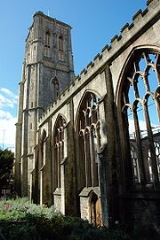
Bristol's ancient churchesThe English city of Bristol has a number of churches.The churches listed are Anglican except when otherwise noted.- External links :*...
,
St Peter’sSt Peter's was a church in what is now Castle Park, Bristol, England.The church has Saxon foundations, with a 12th century lower tower, the rest of the church being built in the 15th century. Excavations in 1975 suggest that this was the site of Bristol's first church; the 12th century city wall...
, the interior of
St NicholasSt Nicholas is a church in St Nicholas Street, Bristol, England.The first church was founded before 1154, with a chancel extending over the south gate of the city. The gate and old church were demolished to make way for the rebuilding of Bristol Bridge and the church was rebuilt in 1762-9 by James...
,
St Mary-le-PortSt Mary le Port is a ruined parish church in the centre of Bristol, England. It is said to have been founded in Saxon times, and rebuilt and enlarged between the 11th and 16th centuries....
and
Temple ChurchTemple Church is a ruined church building in central Bristol, England, which was founded in the mid 12th century by Robert of Gloucester and the Knights Templar....
were also badly damaged. The
St James' Presbyterian Church of England, BristolThe remains of the Victorian-era St James' Church are just south of the current Bristol coach station. The church was bombed on 24 November 1940 and partly restored as a chapel in 1957...
was gutted.
The Lord Mayor of Bristol, Alderman Thomas Underwood, described the effect of the raids as “The City of Churches had in one night become the city of ruins.”
Following raids
On 3 – 4 January 1941 Bristol had its longest raid lasting 12 hours; during this raid the Luftwaffe dropped their biggest bomb on the city. It was nicknamed "Satan", and weighed 2000 kilograms (4,409.2 lb), measuring 8 feet (2.4 m) long (without the tail), and 26 inches (66 cm) in diameter; it did not explode. The bomb was recovered in April 1943. The
bomb disposalBomb disposal is the process by which hazardous explosive devices are rendered safe. Bomb disposal is an all encompassing term to describe the separate, but interrelated functions in the following fields:*Military:...
crew had to dig down 29 feet (8.8 m) to get to it. “Satan” was paraded through the streets of London during the VE Day Victory Parade at the end of the war.
[http://www.bristolblitzed.org/?page_id=63]
The infamous
Good FridayGood Friday , is a religious holiday observed primarily by Christians commemorating the crucifixion of Jesus Christ and his death at Calvary. The holiday is observed during Holy Week as part of the Paschal Triduum on the Friday preceding Easter Sunday, and may coincide with the Jewish observance of...
air raids caused further damage to the
centre of the cityBristol city centre is the commercial, cultural and business centre of Bristol, England. It is the area south of the central ring road and north of the Floating Harbour, bounded north by St Pauls and Easton, east by Temple Meads and Redcliffe, and west by Clifton and Canon's Marsh...
,
KnowleKnowle is a district and council ward in the south of Bristol. It is bordered by Filwood Park to the west, Brislington to the east, Whitchurch and Hengrove to the south and Totterdown to the north....
,
HotwellsHotwells is a district of the English port city of Bristol. It is located to the south of and below the high ground of Clifton, and directly to the north of the Floating Harbour. The southern entrance to the Avon Gorge, which connects those docks to the sea, lies at the western end of Hotwells. The...
,
CothamCotham is the name of both a council ward of the city of Bristol in the United Kingdom, and a suburb of the city that falls within that ward. The ward comprises the Cotham suburb, and a small portion of Redland, which is another Bristol suburb.-Cotham:...
and
FiltonFilton is a town in South Gloucestershire, England, situated on the northern outskirts of the city of Bristol, about from the city centre. Filton lies in Bristol postcode areas BS7 and BS34. The town centres upon Filton Church, which dates back to the 12th century and is a grade II listed building...
, and caused the permanent closure of the
Bristol TramwaysBristol tramways were operated from 1875, when the Bristol Tramways Company was formed by Sir George White, until 1941 when a Luftwaffe bomb destroyed the power station.-History:...
.
Winston ChurchillSir Winston Leonard Spencer-Churchill, was a predominantly Conservative British politician and statesman known for his leadership of the United Kingdom during the Second World War. He is widely regarded as one of the greatest wartime leaders of the century and served as Prime Minister twice...
visited the ruins on 12 April 1941. The last air raid of the Blitz on Bristol was on 25 April 1941, when
BrislingtonBrislington is an area in the south east of the city of Bristol, England. It is on the edge of Bristol and from Bath. The Brislington Brook runs through the area in the woodlands of Nightingale Valley...
, Bedminster and Knowle were bombed. It is speculated that these suburbs were not the targets themselves but that bombs intended for Filton's manufacturing areas were mistakenly dropped on other areas.
One of the common types of bomb dropped on the city was a canister containing a large number of incendiaries (locally known as
Goering's Bread Basket – from the
Molotov bread basketThe RRAB-3, nicknamed the Molotov bread basket , was a Soviet-made droppable bomb dispenser that combined a large high-explosive charge with a cluster of incendiary bombs. It was used against the cities of Finland during the Winter War of 1939–1940...
device); these caused numerous fires and were designed to cause panic amongst the citizens, and stretch the fire services to their limits.
The last raid on Bristol was on 15 May 1944.
[ ]
Bristol was in danger of being hit by
V-1 flying bombThe V-1 flying bomb, also known as the Buzz Bomb or Doodlebug, was an early pulse-jet-powered predecessor of the cruise missile....
s, and by the
A4/V2The V-2 rocket , technical name Aggregat-4 , was a ballistic missile that was developed at the beginning of the Second World War in Germany, specifically targeted at London and later Antwerp. The liquid-propellant rocket was the world's first long-range combat-ballistic missile and first known...
rockets, whose launching platforms already had been built on the
Cotentin peninsulaThe Cotentin Peninsula, also known as the Cherbourg Peninsula, is a peninsula in Normandy, forming part of the north-western coast of France. It juts out north-westwards into the English Channel, towards Great Britain...
in 1944;
D-DayD-Day is a term often used in military parlance to denote the day on which a combat attack or operation is to be initiated. "D-Day" often represents a variable, designating the day upon which some significant event will occur or has occurred; see Military designation of days and hours for similar...
on 6 June 1944 put an end to this danger. The launching platforms on Cotentin were quickly overrun by the allies, so Bristol was safe from the V1 and V2.
Decoys
In the early years of
World War IIWorld War II, or the Second World War , was a global conflict lasting from 1939 to 1945, involving most of the world's nations—including all of the great powers—eventually forming two opposing military alliances: the Allies and the Axis...
there was a sophisticated system of decoy sites all over the country with the aim of diverting air attacks away from the major cities. The main decoy for
BristolBristol is a city, unitary authority area and ceremonial county in South West England, with an estimated population of 433,100 for the unitary authority in 2009, and a surrounding Larger Urban Zone with an estimated 1,070,000 residents in 2007...
was at
Black DownBlack Down is the highest hill in the Mendip Hills, Somerset, in south-western England. Black Down lies just a few miles eastward of the Bristol Channel at Weston-super-Mare, and provides a view over the Chew Valley...
on the western end of the
Mendip HillsThe Mendip Hills is a range of limestone hills to the south of Bristol and Bath in Somerset, England. Running east to west between Weston-super-Mare and Frome, the hills overlook the Somerset Levels to the south and the Avon Valley to the north...
[http://www.magic.gov.uk/rsm/33064.pdf], about 25 km southwest of
BristolBristol is a city, unitary authority area and ceremonial county in South West England, with an estimated population of 433,100 for the unitary authority in 2009, and a surrounding Larger Urban Zone with an estimated 1,070,000 residents in 2007...
. A smaller one was in the parish of
Chew MagnaChew Magna is a village and civil parish within the Chew Valley in the Unitary Authority of Bath and North East Somerset, in the Ceremonial county of Somerset, England. The parish has a population of 1,161.To the south of the village is Chew Valley Lake...
. These were known as QL sites, and were designed to simulate Bristol under blackout conditions, even to the extent of mimicking the flickering lights of railway marshalling yards.
In the event of an imminent air raid, beacons were lit at the decoy sites; these were sometimes successful in tricking the
LuftwaffeLuftwaffe is a generic German term for an air force. It is also the official name for two of the four historic German air forces, the Wehrmacht air arm founded in 1935 and disbanded in 1946; and the current Bundeswehr air arm founded in 1956....
bombers into thinking that it was Bristol, and they dropped their bombs harmlessly onto the hills.
External links