


Briseis

Encyclopedia
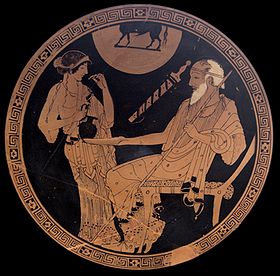
Brisēís was a mythical queen in Asia Minor
Asia Minor
Asia Minor is a geographical location at the westernmost protrusion of Asia, also called Anatolia, and corresponds to the western two thirds of the Asian part of Turkey...
at the time of the Trojan War
Trojan War
In Greek mythology, the Trojan War was waged against the city of Troy by the Achaeans after Paris of Troy took Helen from her husband Menelaus, the king of Sparta. The war is among the most important events in Greek mythology and was narrated in many works of Greek literature, including the Iliad...
. Her character lies at the center of a dispute between Achilles
Achilles
In Greek mythology, Achilles was a Greek hero of the Trojan War, the central character and the greatest warrior of Homer's Iliad.Plato named Achilles the handsomest of the heroes assembled against Troy....
and Agamemnon
Agamemnon
In Greek mythology, Agamemnon was the son of King Atreus and Queen Aerope of Mycenae, the brother of Menelaus, the husband of Clytemnestra, and the father of Electra and Orestes. Mythical legends make him the king of Mycenae or Argos, thought to be different names for the same area...
that drives the plot of Homer
Homer
In the Western classical tradition Homer , is the author of the Iliad and the Odyssey, and is revered as the greatest ancient Greek epic poet. These epics lie at the beginning of the Western canon of literature, and have had an enormous influence on the history of literature.When he lived is...
's Iliad
Iliad
The Iliad is an epic poem in dactylic hexameters, traditionally attributed to Homer. Set during the Trojan War, the ten-year siege of the city of Troy by a coalition of Greek states, it tells of the battles and events during the weeks of a quarrel between King Agamemnon and the warrior Achilles...
.
Story
In Greek MythologyGreek mythology
Greek mythology is the body of myths and legends belonging to the ancient Greeks, concerning their gods and heroes, the nature of the world, and the origins and significance of their own cult and ritual practices. They were a part of religion in ancient Greece...
, Briseis, a daughter of Briseus
Briseus
In Greek mythology, Briseus is the father of Briseis , a maiden captured by the Greeks during the Trojan War, as recorded in the Iliad. Eustathius of Thessalonica, a commentator on Homer, says Briseus and Chryses were brothers, as sons of Ardys, with Briseus dwelling in Pedasus, and Chryses...
, was a princess of Lyrnessus
Lyrnessus
In Greek mythology Lyrnessus was a town or city in Dardania , inhabited by Cilicians. It was closely associated with the nearby Cilician Thebe. At the time of the Trojan War, it was said to have been ruled by a king named Mynes. His widowed wife is Briseis, who later became a prize of Achilles....
. Briesis was said to have had blonde hair, blue eyes, and fair skin and she was considered to be very beautiful and clever. Her husband was Mynes
Mynes
Mynes is a butterfly genus in the Nymphalidae family found in Australia and Indonesia.-Species:* Mynes anemone Vane-Wright, 1976* Mynes aroensis Ribbe, 1900* Mynes doubledayi Wallace, 1869* Mynes eucosmetus Godman & Salvin, 1879...
. When Achilles
Achilles
In Greek mythology, Achilles was a Greek hero of the Trojan War, the central character and the greatest warrior of Homer's Iliad.Plato named Achilles the handsomest of the heroes assembled against Troy....
led the assault on that city during the Trojan War
Trojan War
In Greek mythology, the Trojan War was waged against the city of Troy by the Achaeans after Paris of Troy took Helen from her husband Menelaus, the king of Sparta. The war is among the most important events in Greek mythology and was narrated in many works of Greek literature, including the Iliad...
, she was captured and her family (including her father, her mother, and her three brothers) and her husband died at his hands. She was subsequently given to Achilles as a war prize to be his concubine.
Patroclus
Patroclus
In Greek mythology, as recorded in the Iliad by Homer, Patroclus, or Patroklos , was the son of Menoetius, grandson of Actor, King of Opus, and was Achilles' beloved comrade and brother-in-arms....
comforted Briesis in her fear of being alone among her enemies and her grief over the loss of her country, her family, and her freedom and did not let her weep by promising to have Achilles make her his wife and that he would give a wedding feast for them on their return to Phthia
Phthia
Phthia , Phthíē ) in ancient Greece was the southernmost region of ancient Thessaly, on both sides of Othrys Mountain. It was the homeland of the Myrmidones tribe, who took part in the Trojan War under Achilles....
after the war had ended.
According to Book 1 of the Iliad, when Agamemnon was compelled by Apollo
Apollo
Apollo is one of the most important and complex of the Olympian deities in Greek and Roman mythology...
to give up his own woman, Chryseis
Chryseis
In Greek mythology, Chryseis was a Trojan woman, the daughter of Chryses. Chryseis, her apparent name in the Iliad, means simply "Chryses' daughter"; later writers give her real name as Astynome ....
, he demanded Briseis as compensation. This prompted a quarrel with Achilles that culminated with Briseis' delivery to Agamemnon and Achilles' protracted withdrawal from battle. His absence had disastrous consequences for the Greeks. Despite Agamemnon's grand offers of treasure and women, he did not return to the fray until the death of Patroclus
Patroclus
In Greek mythology, as recorded in the Iliad by Homer, Patroclus, or Patroklos , was the son of Menoetius, grandson of Actor, King of Opus, and was Achilles' beloved comrade and brother-in-arms....
.
In the Iliad, Achilles loves Briseis (and Briseis was said to love him back), comparing their relationship with that of man and wife (he refers to her as his bride and wife often) and explicitly to that of Menelaus and Helen, which was, after all, what the war is about.
Achilles is angry at Agamemnon, and seethes with rage in his tent: understandably made furious by the thought of Agamemnon sleeping with Briseis. When Achilles returns to the fighting to avenge Patrocles' death and Agamemnon returns Briseis to him, Agamemnon swears to Achilles that he and Briseis never shared a bed.
Briesis was among those to lament and mourn over the death of Patroclus. She remained with Achilles until his death. His death plunged her into great grief and she took it upon herself to prepare Achilles for the afterlife.
In medieval romances
Romance (genre)
As a literary genre of high culture, romance or chivalric romance is a style of heroic prose and verse narrative that was popular in the aristocratic circles of High Medieval and Early Modern Europe. They were fantastic stories about marvel-filled adventures, often of a knight errant portrayed as...
, starting with the Roman de Troie, Briseis becomes Briseida and is the daughter of Calchas
Calchas
In Greek mythology, Calchas , son of Thestor, was an Argive seer, with a gift for interpreting the flight of birds that he received of Apollo: "as an augur, Calchas had no rival in the camp"...
. She loves and is loved by Troilus
Troilus
Troilus is a legendary character associated with the story of the Trojan War...
and then Diomedes
Diomedes
Diomedes or Diomed is a hero in Greek mythology, known for his participation in the Trojan War.He was born to Tydeus and Deipyle and later became King of Argos, succeeding his maternal grandfather, Adrastus. In Homer's Iliad Diomedes is regarded alongside Ajax as one of the best warriors of all...
. She is later confused with Chryseis
Chryseis
In Greek mythology, Chryseis was a Trojan woman, the daughter of Chryses. Chryseis, her apparent name in the Iliad, means simply "Chryses' daughter"; later writers give her real name as Astynome ....
and it is under variations of that name that the character is developed further, becoming Shakespeare's Cressida
Cressida
Cressida is a character who appears in many Medieval and Renaissance retellings of the story of the Trojan War. She is a Trojan woman, the daughter of Calchas a priestly defector to the Greeks...
.
Cultural references
- In OvidOvidPublius Ovidius Naso , known as Ovid in the English-speaking world, was a Roman poet who is best known as the author of the three major collections of erotic poetry: Heroides, Amores, and Ars Amatoria...
's HeroidesHeroidesThe Heroides , or Epistulae Heroidum , are a collection of fifteen epistolary poems composed by Ovid in Latin elegiac couplets, and presented as though written by a selection of aggrieved heroines of Greek and Roman mythology, in address to their heroic lovers who have in some way mistreated,...
, an apocryphal letter from Briseis to AchillesAchillesIn Greek mythology, Achilles was a Greek hero of the Trojan War, the central character and the greatest warrior of Homer's Iliad.Plato named Achilles the handsomest of the heroes assembled against Troy....
makes up the third entry, in which she reproaches him for both giving her up too easily to Agamemnon, and being tardy in gaining her return. - In The FirebrandThe FirebrandThe Firebrand is a 1986 fantasy novel by American author Marion Zimmer Bradley. Set in Ancient Greece and Troy, the novel features characters from Greek mythology, and particularly Homer's Iliad...
by Marion Zimmer BradleyMarion Zimmer BradleyMarion Eleanor Zimmer Bradley was an American author of fantasy novels such as The Mists of Avalon and the Darkover series. Many critics have noted a feminist perspective in her writing. Her first child, David R...
, Briseis fell in love with Achilles and chose to leave Troy to be with him. - The novel Daughter of Troy by Sarah B. FranklinDave Duncan (writer)David Duncan is a Canadian fantasy author. He was born in 1933 in Scotland, and educated there at the High School of Dundee and at the University of St Andrews. After graduating in 1955 he moved to Canada where he lived in Calgary, Alberta, and is currently situated on Vancouver Island in Victoria,...
is written from Briseis' point of view with a substantial pre-history before the events of the Iliad unfold http://www.amazon.com/dp/0380818302. - In Christa WolfChrista WolfChrista Wolf was a German literary critic, novelist, and essayist. She is one of the best-known writers to have emerged from the former East Germany.-Biography:...
's novel KassandraCassandra (novel)Cassandra was written by East German author Christa Wolf in 1984. It has since been translated into a number of languages...
, aspects of the Homeric and medieval versions of Briseis' story are blended so that the character is steadily degraded from being Troilus' lover to Agamemnon and Achilles' plaything. - Briseis is played by Gloria Milland in the 1962 film The Fury of AchillesThe Fury of AchillesThe Fury of Achilles is a 1962 historical drama set in the ninth year of the Trojan War, and is based primarily on Homer's Iliad...
. - Briseis is featured in the 2004 film TroyTroy (film)Troy is a 2004 epic war film written by David Benioff and directed by Wolfgang Petersen based on the events of the Trojan War. Its cast includes Brad Pitt as Achilles, Eric Bana as Hector.It was nominated for the Academy Award for Costume Design.-Plot:...
. In the film, Briseis (Rose ByrneRose ByrneMary Rose Byrne is an Australian actress.Byrne made her screen debut in 1994 with a small role in the film Dallas Doll...
) is a cousin of the Trojan princes HectorHectorIn Greek mythology, Hectōr , or Hektōr, is a Trojan prince and the greatest fighter for Troy in the Trojan War. As the first-born son of King Priam and Queen Hecuba, a descendant of Dardanus, who lived under Mount Ida, and of Tros, the founder of Troy, he was a prince of the royal house and the...
and ParisParis (mythology)Paris , the son of Priam, king of Troy, appears in a number of Greek legends. Probably the best-known was his elopement with Helen, queen of Sparta, this being one of the immediate causes of the Trojan War...
, and falls in love with Achilles (Brad PittBrad PittWilliam Bradley "Brad" Pitt is an American actor and film producer. Pitt has received two Academy Award nominations and four Golden Globe Award nominations, winning one...
). She later kills AgamemnonAgamemnonIn Greek mythology, Agamemnon was the son of King Atreus and Queen Aerope of Mycenae, the brother of Menelaus, the husband of Clytemnestra, and the father of Electra and Orestes. Mythical legends make him the king of Mycenae or Argos, thought to be different names for the same area...
(Brian Cox) during the Sack of Troy; in classical mythology Agamemnon is by his wife ClytemnestraClytemnestraClytemnestra or Clytaemnestra , in ancient Greek legend, was the wife of Agamemnon, king of the Ancient Greek kingdom of Mycenae or Argos. In the Oresteia by Aeschylus, she was a femme fatale who murdered her husband, Agamemnon – said by Euripides to be her second husband – and the Trojan princess...
and her lover AegisthusAegisthusIn Greek mythology, Aegisthus was the son of Thyestes and of Thyestes' daughter, Pelopia....
. - In Steven SaylorSteven SaylorSteven Saylor is an American author of historical novels. He is a graduate of the University of Texas at Austin, where he studied history and Classics....
's novel A Murder on the Appian Way, part of the Roma Sub RosaRoma Sub RosaRoma Sub Rosa is the title of the series of mystery novels by Steven Saylor set in, and populated by, noteworthy denizens of ancient Rome. The series is noted for its historical authenticity. The phrase "Roma Sub Rosa" means, in Latin, "Rome under the rose"...
series, Gordianus tries to insult someone by comparing her to Briseis, but the woman fails to get the allusion and is therefore not insulted. - In Orson Scott CardOrson Scott CardOrson Scott Card is an American author, critic, public speaker, essayist, columnist, and political activist. He writes in several genres, but is primarily known for his science fiction. His novel Ender's Game and its sequel Speaker for the Dead both won Hugo and Nebula Awards, making Card the...
's Shadow of the HegemonShadow of the HegemonShadow of the Hegemon is the second novel in the Ender's Shadow series by Orson Scott Card. It is also the sixth novel in the Ender's Game series. It is told mostly from the point of view of Bean, a largely peripheral character in the original novel Ender's Game...
, Briseis is the code name for Petra ArkanianPetra ArkanianPetra Arkanian is a main character of the books Shadow of the Hegemon and Shadow Puppets by Orson Scott Card. She is also a major character in Ender's Game, Ender's Shadow and Shadow of the Giant.-Ender's Game:...
while she was being held prisoner by Achilles de FlandresAchilles de FlandresAchilles de Flandres is a major character and the primary antagonist in Orson Scott Card's Shadow series . It is part of the universe created in the novel and short story Ender's Game...
.