


Brighton hotel bombing

Encyclopedia
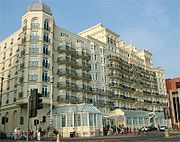

Grand Hotel (Brighton)
The Grand Hotel is a Victorian hotel in Brighton on the south coast of England. It is located on Kings Road, the main carriageway along the seafront; one of several major hotels along this road. Following the fashion to include a hotel's parent company in its name, it is also known as the De Vere...
in Brighton
Brighton
Brighton is the major part of the city of Brighton and Hove in East Sussex, England on the south coast of Great Britain...
, England
England
England is a country that is part of the United Kingdom. It shares land borders with Scotland to the north and Wales to the west; the Irish Sea is to the north west, the Celtic Sea to the south west, with the North Sea to the east and the English Channel to the south separating it from continental...
. The bomb was planted by Provisional Irish Republican Army
Provisional Irish Republican Army
The Provisional Irish Republican Army is an Irish republican paramilitary organisation whose aim was to remove Northern Ireland from the United Kingdom and bring about a socialist republic within a united Ireland by force of arms and political persuasion...
(IRA) member Patrick Magee, with the intention of assassinating Prime Minister
Prime Minister of the United Kingdom
The Prime Minister of the United Kingdom of Great Britain and Northern Ireland is the Head of Her Majesty's Government in the United Kingdom. The Prime Minister and Cabinet are collectively accountable for their policies and actions to the Sovereign, to Parliament, to their political party and...
Margaret Thatcher
Margaret Thatcher
Margaret Hilda Thatcher, Baroness Thatcher, was Prime Minister of the United Kingdom from 1979 to 1990...
and her cabinet who were staying at the hotel for the Conservative Party
Conservative Party (UK)
The Conservative Party, formally the Conservative and Unionist Party, is a centre-right political party in the United Kingdom that adheres to the philosophies of conservatism and British unionism. It is the largest political party in the UK, and is currently the largest single party in the House...
conference.
Preparation
Patrick Magee had stayed in the hotel under the false namePseudonym
A pseudonym is a name that a person assumes for a particular purpose and that differs from his or her original orthonym...
of Roy Walsh during the weekend of 14–17 September 1984. During his stay, he planted the bomb (fitted with a long-delay timer made from video recorder components) under the bath in his room, number 629.
The bombing
The bomb detonated at 2:54 a.m on 12 October. Thatcher was still awake at the time, working on her conference speech for the next day in her suite. It badly damaged her bathroom but left her sitting room and bedroom unscathed. Thatcher and her husband DenisDenis Thatcher
Major Sir Denis Thatcher, 1st Baronet, MBE, TD was a British businessman, and the husband of the former British Prime Minister, Margaret Thatcher. He was born in Lewisham, London, the elder child of a New Zealand-born British businessman, Thomas Herbert Thatcher, and his wife Kathleen, née Bird...
escaped injury. Thatcher changed her clothes, and then was escorted by the security guards to Brighton police station. She and her husband were then taken to Sussex Police Headquarters at Lewes, where they stayed for the rest of the night.
As she left the police station she gave an impromptu interview to the BBC's John Cole at around 4:00 a.m., where she said the conference would go on as usual. Alistair McAlpine persuaded Marks & Spencer
Marks & Spencer
Marks and Spencer plc is a British retailer headquartered in the City of Westminster, London, with over 700 stores in the United Kingdom and over 300 stores spread across more than 40 countries. It specialises in the selling of clothing and luxury food products...
to open early at 8:00 a.m. so those who had lost their clothes in the bombing could get new ones. Thatcher went from the conference to visit the injured at the Royal Sussex County Hospital
Royal Sussex County Hospital
The Royal Sussex County Hospital is an acute teaching hospital in Brighton, England. Together with the Princess Royal Hospital , it is administered by the Brighton and Sussex University Hospitals NHS Trust...
.
Casualties
The bomb failed to kill Thatcher or any of her government ministersMinister (government)
A minister is a politician who holds significant public office in a national or regional government. Senior ministers are members of the cabinet....
. Five people, however, were killed, including Conservative MP Anthony Berry
Anthony Berry
Sir Anthony George Berry was a British politician, the Conservative Member of Parliament for Enfield Southgate, and a Whip in Margaret Thatcher's government...
and Parliamentary Treasury Secretary John Wakeham
John Wakeham
John Wakeham, Baron Wakeham, PC, DL is a businessman and British Conservative Party politician and the current Chancellor of Brunel University.He was a director of Enron from 1994 until its bankruptcy in 2001....
's wife Roberta. Sir Donald Maclean and his wife, Muriel, were in the room in which the bomb exploded. Lady Maclean was gravely injured in the explosion and later died of her injuries while Sir Donald was seriously injured. The other people killed by the blast were Eric Taylor and Jeanne Shattock. Several more, including Margaret Tebbit—the wife of Norman Tebbit
Norman Tebbit
Norman Beresford Tebbit, Baron Tebbit, CH, PC , is a British politician. A member of the Conservative Party, he served in the Cabinet from 1981 to 1987 as Secretary of State for Employment...
, who was then President of the Board of Trade—were left permanently disabled. Thirty-four people were taken to the hospital and recovered from their injuries.
IRA statement
The IRA claimed responsibility the next day, and said that it would try again. Its statement read:Mrs. Thatcher will now realise that Britain cannot occupy our country and torture our prisoners and shoot our people in their own streets and get away with it. Today we were unlucky, but remember we only have to be lucky once. You will have to be lucky always. Give Ireland peace and there will be no more war.
Reactions
Margaret Thatcher began the next session of the conference at 9:30 a.m. the following morning as scheduled. She omitted most of her planned attacks on the Labour PartyLabour Party (UK)
The Labour Party is a centre-left democratic socialist party in the United Kingdom. It surpassed the Liberal Party in general elections during the early 1920s, forming minority governments under Ramsay MacDonald in 1924 and 1929-1931. The party was in a wartime coalition from 1940 to 1945, after...
from her speech and claimed the bombing was "an attempt to cripple Her Majesty's democratically elected Government":
That is the scale of the outrage in which we have all shared, and the fact that we are gathered here now—shocked, but composed and determined—is a sign not only that this attack has failed, but that all attempts to destroy democracy by terrorism will fail.
One of her biographers wrote that Thatcher's "coolness, in the immediate aftermath of the attack and in the hours after it, won universal admiration. Her defiance was another Churchillian moment in her premiership which seemed to encapsulate both her own steely character and the British public's stoical refusal to submit to terrorism". Immediately afterwards her popularity soared to near-Falklands levels. On the first Saturday after the attack, Thatcher said to her constituents: "We suffered a tragedy not one of us could have thought would happen in our country. And we picked ourselves up and sorted ourselves out as all good British people do, and I thought, let us stand together for we are British! They were trying to destroy the fundamental freedom that is the birth-right of every British citizen, freedom, justice and democracy".
Patrick Magee
In September 1986, Patrick Magee, then aged 35, was found guilty of planting the bomb, detonating it, and of five counts of murderMurder
Murder is the unlawful killing, with malice aforethought, of another human being, and generally this state of mind distinguishes murder from other forms of unlawful homicide...
. Magee received eight life sentences: seven for offences relating to the Brighton bombing, and the eighth for a separate bombing conspiracy. The judge recommended that he serve a minimum term of thirty-five years. Later Home Secretary
Home Secretary
The Secretary of State for the Home Department, commonly known as the Home Secretary, is the minister in charge of the Home Office of the United Kingdom, and one of the country's four Great Offices of State...
Michael Howard
Michael Howard
Michael Howard, Baron Howard of Lympne, CH, QC, PC is a British politician, who served as the Leader of the Conservative Party and Leader of the Opposition from November 2003 to December 2005...
increased this minimum to "whole life". He was released from prison, however, in 1999, having served only fourteen years (including the time before his sentencing), under the terms of the Good Friday Agreement
Belfast Agreement
The Good Friday Agreement or Belfast Agreement , sometimes called the Stormont Agreement, was a major political development in the Northern Ireland peace process...
. A Downing Street spokesman said that his release "was hard to stomach" and an appeal by then Home Secretary Jack Straw
Jack Straw (politician)
John Whitaker Straw is a British Labour Party politician who has been the Member of Parliament for Blackburn since 1979. He served as Home Secretary from 1997 to 2001, Foreign Secretary from 2001 to 2006 and Lord Privy Seal and Leader of the House of Commons from 2006 to 2007 under Tony Blair...
to prevent it was turned down by the Northern Ireland High Court.
Magee, while admitting being part of the IRA unit responsible, maintains that the fingerprint evidence on a registration card from the hotel was faked.
Sources
- Reprint of BBC television news report on the morning of the attack
- BBC News photo journal of the attack
- BBC News report on Straw's attempt to prevent the early release of Magee
- Guardian story on the release of Magee in 1999
- An Phoblacht: Interview with Pat Magee regarding the Brighton bombing
- BBC report on Magee being convicted of the bombing
- Margaret Thatcher Remembering the Brighton Bomb Attack YouTube video from uncited documentary