
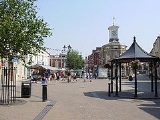
Brigg is a small
market townMarket town or market right is a legal term, originating in the medieval period, for a European settlement that has the right to host markets, distinguishing it from a village and city...
in
North LincolnshireNorth Lincolnshire is a unitary authority area in the region of Yorkshire and the Humber in England. For ceremonial purposes it is part of Lincolnshire....
, England, with a population of 5,076 in 2,213 households (
2001 UK censusA nationwide census, known as Census 2001, was conducted in the United Kingdom on Sunday, 29 April 2001. This was the 20th UK Census and recorded a resident population of 58,789,194....
). The town lies at the junction of the
River AncholmeThe River Ancholme is a river in North Lincolnshire, England, and a tributary of the Humber estuary.It rises south of Bishopbridge and passes through many Lincolnshire villages and the market town of Brigg before flowing north into the Humber at South Ferriby.North of Bishopbridge, where the River...
and east-west transport routes across northern Lincolnshire. As a formerly important local centre, the town's full name of
Glanford Brigg is reflected in the surrounding area and local government district of the
same name.Glanford was, from 1974 to 1996, a local government district with borough status in the non-metropolitan county of Humberside, England.-Creation:...
History
The town finds its roots in the granting of a Royal Charter to Hugh Nevil in 1205 for the holding of a Thursday market and a twice yearly fair. No record of a settlement is known before this, and the origin of the town's name is partly disputed. Brigg comes from
Old NorseOld Norse is a North Germanic language that was spoken by inhabitants of Scandinavia and inhabitants of their overseas settlements during the Viking Age, until about 1300....
bryggja, which although usually describes a jetty or quay here refers to a bridge. The origin of Glanford is less clear, specifically the meaning of the first element. It is possibly derived from the Old English
gleam meaning joy or revelry, and thus the full word is interpreted as "ford where sports are held". Another suggestion is that the first element refers to a 'glamping' track—a walkway formed by placing interlocking planks or logs over boggy ground—and thus describes a ford crossed in this manner.
Brigg was previously a secondary settlement in the parish of
WrawbyWrawby is a small village in North Lincolnshire east of Brigg and close to Humberside Airport on the A18. It is most notable for Wrawby Postmill....
. The town probably outgrew Wrawby early on, but ecclesiastical functions were only slowly separated. A chapel of ease was established in Bigby Street in 1699, being replaced by a full-sized
church dedicated to St John the Evangelist in 1842–43. A cemetery was established on Wrawby Road in 1857, and the parish finally separated in 1864.
The workhouse at Brigg is one of the best known and best documented of its type, probably because of the national interest that arose after
Percy GraingerGeorge Percy Aldridge Grainger , known as Percy Grainger, was an Australian-born composer, arranger and pianist. In the course of a long and innovative career he played a prominent role in the revival of interest in British folk music in the early years of the 20th century. He also made many...
collected traditional songs from the inmates. It was designed by William Adams Nicholson who also designed the similar building in Lincoln, and was built in 1835, replacing an earlier alms house dating back to 1701. The workhouse was the responsibility of the Glanford Brigg Union. An infirmary was later built attached to the workhouse, and this portion remained open as a hospital until 1991.
Geography
Brigg sits on a spur of the
Lincolnshire WoldsThe Lincolnshire Wolds is a range of hills in the county of Lincolnshire, England. It is a designated Area of Outstanding Natural Beauty , and the highest area of land in eastern England between Yorkshire and Kent...
that juts out into the Ancholme valley, historically providing a narrow crossing point of the river. The Wolds proper rise to the east, reaching a maximum of roughly 100m about 5km from the town. To the west the land gently slopes up to roughly 70m on the Lincolnshire Edge about 5km away. Between the two low ranges of hills the Ancholme River runs south to north through a flat, low-lying flood plain. The land surrounding the town was previously a semi-flooded marsh known as
carrsA carr is a type of waterlogged, wooded terrain that, typically, represents a succession stage between the original reedy swamp and the eventual formation of forest in a sub-maritime climate....
, but a series of drainage improvements from the early 1600s to the early 1800s transformed the area into arable land. The largest of the drainage channels is known as the New River Ancholme.
The town itself lies mostly on the east bank of the old river, with a small amount to the west. A portion of the west bank is cut off from the rest by the new river, forming an island–like piece of land known as Island Carr, or jokingly as "
MesopotamiaMesopotamia is a toponym for the area of the Tigris–Euphrates river system, largely corresponding to modern-day Iraq, northeastern Syria, southeastern Turkey and southwestern Iran.Widely considered to be the cradle of civilization, Bronze Age Mesopotamia included Sumer and the...
". Due to closeness of the river, the town regularly suffers minor flooding, and concerns over flood plain development are a major issue in local planning. The only other watercourse of reasonable size is Candley Beck, which runs through the very southern parts of the town. There are also about half a dozen clayponds along the riverside in Brigg where clay was formerly extracted for brick–making.
Folk Song
Brigg is the source of several early recordings of English folk song, which subsequently inspired other composers. At competitions arranged by Gervase Elwes in 1905-6, several folk singers from the surrounding area—including Joseph Taylor and George Gouldthorpe—sang for the composer
Percy GraingerGeorge Percy Aldridge Grainger , known as Percy Grainger, was an Australian-born composer, arranger and pianist. In the course of a long and innovative career he played a prominent role in the revival of interest in British folk music in the early years of the 20th century. He also made many...
songs such as
Brigg Fair and
Horkstow GrangeHorkstow Grange is an album by the English electric folk band Steeleye Span.Released in 1998, it is the band's 15th album, and the first album the band recorded without founding member Maddy Prior. Gay Woods provides most of the lead vocals, although the other three members of the band all do the...
. These songs inspired Grainger's work
Lincolnshire Posy and subsequently
Frederick Delius'sFrederick Theodore Albert Delius, CH was an English composer. Born in the north of England to a prosperous mercantile family of German extraction, he resisted attempts to recruit him to commerce...
own
Brigg Fair.
Sport
Brigg is home to Brigg Town Football Club, known locally as the Zebras for their black and white striped home kit. Established in 1863 the team is the oldest association football club in Lincolnshire and among the oldest surviving clubs in the world. The team has won the
FA VaseThe Football Association Challenge Vase is an annual football competition for teams playing below Step 4 of the English National League System...
twice—once in 1996 and again in 2003.
Nearly as old as the football club is the Ancholme Rowing Club which is based in Manley Gardens. It was founded in 1868 and still operates today.
Ancholme Leisure Centre is on
ScawbyScawby is a village and civil parish in North Lincolnshire, England. According to the 2001 census it had a population of 2,277. It is located south west of Brigg just off the A15 and A18. Scawby Brook, just outside Brigg, is also within the parish....
Road (A18) towards Scawby Brook, west of the town.
The town also holds an annual triathlon event - cycling, canoeing and running.
Entertainment
Brigg has several pubs, including the
Black Bull and
White Horse Inn on Wrawby Street, the
Exchange Hotel on
Bigby Street, the
Nelthorpe Arms,
White Hart and
Yarborough Hunt on Bridge Street, and the
Woolpack Inn and
Dying Gladiator on Bigby Street.
Economy
Brigg has been a thriving
market townMarket town or market right is a legal term, originating in the medieval period, for a European settlement that has the right to host markets, distinguishing it from a village and city...
for centuries, serving the largely rural villages on both sides of the river with a
corn exchangeA corn exchange or grain exchange was a building where farmers and merchants traded cereal grains. Such trade was common in towns and cities across Great Britain and Ireland until the 19th century, but as the trade became centralised in the 20th century many such buildings were used for other...
and livestock market. Road communications were good with the old Roman road
Ermine StreetErmine Street is the name of a major Roman road in England that ran from London to Lincoln and York . The Old English name was 'Earninga Straete' , named after a tribe called the Earningas, who inhabited a district later known as Armingford Hundred, around Arrington, Cambridgeshire and Royston,...
passing not far away. There are two surviving
coaching innIn Europe, from approximately the mid-17th century for a period of about 200 years, the coaching inn, sometimes called a coaching house or staging inn, was a vital part of the inland transport infrastructure, as an inn serving coach travelers...
s, one of which is
The Angel on the route from
LincolnLincoln is a cathedral city and county town of Lincolnshire, England.The non-metropolitan district of Lincoln has a population of 85,595; the 2001 census gave the entire area of Lincoln a population of 120,779....
via
Caenby CornerCaenby Corner is a small settlement in the West Lindsey district of Lincolnshire, England. It lies at the junction of the A15 and A631, 10 miles north of Lincoln....
to the Humber Estuary (The Angel now is home to Brigg Town Council). The
Ancholme also gave access to the Humber Estuary and the port of
Kingston upon HullKingston upon Hull , usually referred to as Hull, is a city and unitary authority area in the ceremonial county of the East Riding of Yorkshire, England. It stands on the River Hull at its junction with the Humber estuary, 25 miles inland from the North Sea. Hull has a resident population of...
and, earlier, to the historically important Medieval port of Barton-on-Humber. A significant part of Brigg town centre has been designated a Conservation Area.
Brigg became the administrative centre for the local area with a
grammar schoolA grammar school is one of several different types of school in the history of education in the United Kingdom and some other English-speaking countries, originally a school teaching classical languages but more recently an academically-oriented secondary school.The original purpose of mediaeval...
founded in 1669 by Sir John Nelthorpe, after whom the
school, a comprehensive since 1976, is named. With the coming of the railways the town grew rapidly. Indeed it could have been still more important had Brigg been selected as junction for north-south lines with the east-west link to
GrimsbyGrimsby is a seaport on the Humber Estuary in Lincolnshire, England. It has been the administrative centre of the unitary authority area of North East Lincolnshire since 1996...
. However, local opposition from the influential Carey family pushed much of the traffic through the nearby village of Barnetby-le-Wold.
Past industries included Springs jam factory and the beet sugar factory to the west of the town. The sugar factory site to the south-west now contains a
power stationGlanford Brigg Power Station is a gas-fired power station in North Lincolnshire, England. It is capable of firing diesel as a substitute of natural gas. It is situated on the River Ancholme, beside the Sheffield to Lincoln Line, outside the town of Brigg, with its name coming from the former name...
owned by
CentricaCentrica plc is a multinational utility company, based in the United Kingdom but also with interests in North America. Centrica is the largest supplier of gas to domestic customers in the UK, and one of the largest suppliers of electricity, operating under the trading names "Scottish Gas" in...
. The jam factory, and the neighbouring livestock market, have been replaced by supermarkets (
TescoTesco plc is a global grocery and general merchandise retailer headquartered in Cheshunt, United Kingdom. It is the third-largest retailer in the world measured by revenues and the second-largest measured by profits...
). The town is also home to the
Falcon CyclesFalcon Cycles is an English bicycle manufacturer based in Brigg, North Lincolnshire. The company can trace its history back over 125 years.In addition to producing bikes under its own name, Falcon produces bicycles under several brand names including Falcon, British Eagle, Coventry Eagle, Townsend,...
factory, the company having relocated to Brigg from nearby Barton on Humber in the early 20th century.
Today with the building of a bypass and the pedestrianisation of the town centre, Brigg has regained some of the qualities of a country market town with a small marketplace at its heart, with a traditional street market on Thursdays and Saturdays. In recent years a farmers' market has developed, held on the fourth Saturday each month selling local produce from pork and organic vegetables to ostrich meat, and locally produced condiments. The main shopping street is
Wrawby Street.
Education
Primary education in Brigg is provided by Brigg County primary school and St Mary's Catholic primary school. There was also previously a private Preparatory School, which closed in 2009 and was replaced by Demeter House Special school.
Secondary education in Brigg also covers the surrounding villages and is provided by two comprehensive schools:
Vale of Ancholme SchoolVale of Ancholme Technology College is an English co-educational comprehensive secondary school on Grammar School Road in the market town of Brigg, North Lincolnshire.-History:...
, and the
Sir John Nelthorpe SchoolThe Sir John Nelthorpe School is a comprehensive school on Grammar School Road in Brigg, North Lincolnshire.-Admissions:The is for ages from 11 to 18. The is on Wrawby Road.-Grammar school:...
, a former grammar school. These two schools also collaborate to provide
further educationFurther education is a term mainly used in connection with education in the United Kingdom and Ireland. It is post-compulsory education , that is distinct from the education offered in universities...
for post–16 students, although some attend colleges in nearby
ScunthorpeScunthorpe is a town within North Lincolnshire, England. It is the administrative centre of the North Lincolnshire unitary authority, and had an estimated total resident population of 72,514 in 2010. A predominantly industrial town, Scunthorpe, the United Kingdom's largest steel processing centre,...
.
Transportation
The
M180The M180 motorway is a short but major motorway in England from junction 5 on the M18 motorway in the Metropolitan Borough of Doncaster to a point close to Humberside Airport some from the ports of Immingham and Grimsby and the east coast and provides access for major routes to Cleethorpes,...
bypassed the town on 2 September 1977. The A15 Brigg & Redbourne Bypass (the extension to the M180 from
HibaldstowHibaldstow is a village and civil parish on the B1206, south of Brigg and the M180, in North Lincolnshire, England. The deserted medieval village of Gainsthorpe is situated nearby.-History:...
) opened in December 1989. The A15 south, towards Lincoln, allows access to the A1(M) near Newark. The A18 passes east-west through the town, with the A1084 (
BigbyBigby is a village and civil parish in the West Lindsey district of Lincolnshire, England. It lies about ten miles south of the Humber Bridge, and four miles east of the town of Brigg. The village lies in the Lincolnshire Wolds, a designated Area of Outstanding Natural Beauty and lies close to the...
Road) heading south-east to
CaistorSee Caistor St Edmund for the Roman settlement in Norfolk or Caister-on-Sea for the town in NorfolkCaistor is a town and civil parish situated in the West Lindsey district of Lincolnshire, England. As its name implies, it was originally a Roman castrum or fortress...
. Brigg also had the A15 north-south route passing through the town.
Much of the old and somewhat tidal River Ancholme was canalised and lock gates were constructed at South Ferribly, its confluence with the Humber. A natural looping meander of the Old River Ancholme flows through Brigg, while the canalised section of the New River Ancholme allowed for the addition of Victorian wharfage for river-side industries to develop further west from the town centre.
Brigg railway stationBrigg railway station serves the town of Brigg in North Lincolnshire, England. It was built by the Great Grimsby and Sheffield Junction Railway and opened on 1 November 1848. The GG&SJR subsequently became part of the Manchester, Sheffield and Lincolnshire Railway main line between Grimsby and...
is on a branch of the
Sheffield to Lincoln Line (Grimsby Branch)The Sheffield to Lincoln line is a railway line in England. It runs from Sheffield east to Lincoln via Worksop, Retford and Gainsborough Lea Road. The route comprises the main line of the former Manchester, Sheffield and Lincolnshire Railway, to Gainsborough, Trent Junction, where it then follows...
, receiving six trains a week, all on Saturdays. There is a
level crossingA level crossing occurs where a railway line is intersected by a road or path onone level, without recourse to a bridge or tunnel. It is a type of at-grade intersection. The term also applies when a light rail line with separate right-of-way or reserved track crosses a road in the same fashion...
over the
A1084.
Brigg has access to North Sea ferry crossings from Hull, 15 miles away.
Humberside International Airport, near the village of Kirmington, is about 5 miles away.
Brigg people
Joan PlowrightJoan Ann Plowright, Baroness Olivier, DBE , better known as Dame Joan Plowright, is an English actress, whose career has spanned over sixty years. Throughout her career she has won two Golden Globe Awards and a Tony Award and has been nominated for an Academy Award, an Emmy, and two BAFTA Awards...
, Joan Ann Olivier, The Lady Olivier, DBE (born 28 October 1929 in Brigg), known by her maiden name as Dame Joan Plowright, is a British actress, widow of
Laurence OlivierLaurence Kerr Olivier, Baron Olivier, OM was an English actor, director, and producer. He was one of the most famous and revered actors of the 20th century. He married three times, to fellow actors Jill Esmond, Vivien Leigh, and Joan Plowright...
. She was made a Dame (DBE) in the New Year's Honours for 2004. Joan was born on Central Square, Brigg. The Plowright Theatre in
ScunthorpeScunthorpe is a town within North Lincolnshire, England. It is the administrative centre of the North Lincolnshire unitary authority, and had an estimated total resident population of 72,514 in 2010. A predominantly industrial town, Scunthorpe, the United Kingdom's largest steel processing centre,...
(near Brigg) was also named after her.
Revd Richard EnraghtRichard William Enraght SSC was an Irish-born Church of England priest of the late nineteenth century. He was influenced by the Oxford Movement and was included amongst the priests commonly called “Second Generation” Anglo-Catholics.Fr...
(1837–1898), religious controversialist, Curate of St Mary's Church, Wrawby. 1866–1867.
Concert and oratorio singer
Gervase ElwesGervase Henry Cary-Elwes, DL , better known as Gervase Elwes, was an English tenor of great distinction, who exercised a powerful influence over the development of English music from the early 1900s up until his death in 1921 due to a railroad accident in Boston at the height of his...
had a family home at Brigg Manor. He and Lady Winifrede helped to establish the musical events and singing contests at which their friend
Percy GraingerGeorge Percy Aldridge Grainger , known as Percy Grainger, was an Australian-born composer, arranger and pianist. In the course of a long and innovative career he played a prominent role in the revival of interest in British folk music in the early years of the 20th century. He also made many...
collected a number of early folk-songs from the singing of Joseph Taylor of Saxby-All-Saints.
David Yelland, former editor of
The Sun from 1998–2003, went to the Sir John Nelthorpe School from 1976–81.
George Gouldthorpe (1839–1910) folksinger and workhouse inmate who provided many of the songs collected by
Percy GraingerGeorge Percy Aldridge Grainger , known as Percy Grainger, was an Australian-born composer, arranger and pianist. In the course of a long and innovative career he played a prominent role in the revival of interest in British folk music in the early years of the 20th century. He also made many...
of the
English Folk Dance and Song SocietyThe English Folk Dance and Song Society was formed in 1932 when two organisations merged: the Folk-Song Society and the English Folk Dance Society. The EFDSS, a member-based organisation, was incorporated as a Company limited by guarantee in 1935 and became a Registered Charity The English Folk...
Monty Oxy MoronMonty Oxy Moron is a keyboardist for the English punk rock group The Damned....
(born 4 April 1937 in Brigg), is a
keyboardistA keyboard instrument is a musical instrument which is played using a musical keyboard. The most common of these is the piano. Other widely used keyboard instruments include organs of various types as well as other mechanical, electromechanical and electronic instruments...
for the
BritishThe United Kingdom of Great Britain and Northern IrelandIn the United Kingdom and Dependencies, other languages have been officially recognised as legitimate autochthonous languages under the European Charter for Regional or Minority Languages...
punk rockPunk rock is a rock music genre that developed between 1974 and 1976 in the United States, the United Kingdom, and Australia. Rooted in garage rock and other forms of what is now known as protopunk music, punk rock bands eschewed perceived excesses of mainstream 1970s rock...
group The Damned.
External links