

Bride burning

Encyclopedia
- This article is about the practice of a form of domestic violence. For the American hard rockHard rockHard rock is a loosely defined genre of rock music which has its earliest roots in mid-1960s garage rock, blues rock and psychedelic rock...
band, see 'Burning BridesBurning BridesBurning Brides is an American hard rock band. They are partially known for their live performances, such as in 2000 playing selected dates as the opening band for The White Stripes...
'.
Bride-burning is a form of domestic violence
Domestic violence
Domestic violence, also known as domestic abuse, spousal abuse, battering, family violence, and intimate partner violence , is broadly defined as a pattern of abusive behaviors by one or both partners in an intimate relationship such as marriage, dating, family, or cohabitation...
practiced in India
India
India , officially the Republic of India , is a country in South Asia. It is the seventh-largest country by geographical area, the second-most populous country with over 1.2 billion people, and the most populous democracy in the world...
and Pakistan
Pakistan
Pakistan , officially the Islamic Republic of Pakistan is a sovereign state in South Asia. It has a coastline along the Arabian Sea and the Gulf of Oman in the south and is bordered by Afghanistan and Iran in the west, India in the east and China in the far northeast. In the north, Tajikistan...
. It is not the same as ancient and long abolished (formally abolished in 1829) custom of Sati
Sati (practice)
For other uses, see Sati .Satī was a religious funeral practice among some Indian communities in which a recently widowed woman either voluntarily or by use of force and coercion would have immolated herself on her husband’s funeral pyre...
, where widowed women were forcefully placed on a burning pyre of the dead husband (usually a man in his old age) and burnt to death.
This has been treated as culpable homicide and if proven, is punishable accordingly (mostly up to death sentence or life imprisonment) According to Indian National Crime Record Bureau, there were 1,948 convictions and 3,876 acquittals in dowry death
Dowry death
Dowry deaths are the deaths of young women who are murdered or driven to suicide by continuous harassment and torture by husbands and in-laws in an effort to extort an increased dowry. Dowry deaths are reported in various South Asian countries such as India, Pakistan, and Bangladesh. Dowry death...
cases in 2008.
Virendra Kumar and Sarita Kanth point out that bride burning has been recognized as an important public health problem in India. They say that it is a historical and cultural issue accounting for around 600-750 deaths per year in India alone. In 1995 Time Magazine reported that dowry deaths in India increased from around 400 a year in the early 1980s to around 5,800 a year by the middle of the 1990s. A year later CNN
CNN
Cable News Network is a U.S. cable news channel founded in 1980 by Ted Turner. Upon its launch, CNN was the first channel to provide 24-hour television news coverage, and the first all-news television channel in the United States...
ran a story saying that every year police receive more than 2,500 reports of bride burning.
In India
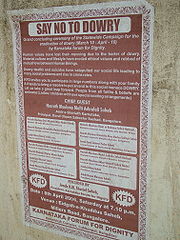
Dr. Ashley K. Jutla MD and Dr. David Heimbach MD describe bride burning by saying that "the husband and/or in-laws have determined that the dowry, a gift given from the daughter's parents to the husband, was inadequate and therefore attempt to murder the new bride to make the husband available to remarry or to punish the bride and her family." In India, dowry size is a reflection of wealth.
In 1961, the Government of India passed the Dowry Prohibition Act, making the dowry demands in wedding arrangements illegal.
In 1986, the Indian Parliament added "dowry deaths" as a new domestic violence crime. According to the new section 304-B of the Indian Penal Code, where a bride "within 7 years of her marriage is killed and it is shown that soon before her death, she was subjected to cruelty or harassment by her husband, or any relative of her husband, or in connection with any demand for dowry, such death shall be called 'dowry death' and such husband or relative shall be deemed to have caused her death."
The offenders can be sentenced for any period, from a minimum of 7 years in prison to a maximum of life. However, many cases of dowry-related domestic violence, suicides, and murders have been reported. A 1997 report claimed that at least 5,000 women die each year because of dowry deaths and at least a dozen die each day in 'kitchen fires' thought to be intentional.About 30% of reported dowry deaths result in convictions in courts, which means a large number of reported dowry deaths may actually be deaths or suicides due to other reasons, without involvement of husband or relatives of husband.
Suggestions to prevent bride burning are being developed, including:
In Pakistan
In Pakistan, the Progressive Women's Association says that "three-hundred Pakistani women are burned to death each year by their husband's families" and that bride-burning incidents are sometimes disguised as accidents, such as an 'exploding stove'. According to the Association, doctors say that victims presenting from these accidents have injuries inconsisent with stove burns. According to an Amnesty International report in 1999, although 1,600 bride-burning incidents were reported, only sixty were prosecuted and, of those, only two resulted in convictions.In Pakistan, women, including Shahnaz Bukhari
Shahnaz Bukhari
Shahnaz Bukhari is a Pakistani clinical psychologist, and activist. She is founder and director of the non-governmental organisation, Progressive Women’s Association .-Education and work:...
, have been campaigning for protective legislation, women’s shelters and hospitals with specialized burn wards. Amnesty International say that although the government of Pakistan has rejected any legal prohibition against dowry and "honor" killings, there are indications that pressure from within, as well as from international human rights groups, may be increasing the level of awareness within the Pakistani government.
See also
- DowryDowryA dowry is the money, goods, or estate that a woman brings forth to the marriage. It contrasts with bride price, which is paid to the bride's parents, and dower, which is property settled on the bride herself by the groom at the time of marriage. The same culture may simultaneously practice both...
- Eve teasingEve teasingEve teasing is a euphemism used in India and sometimes Pakistan, Bangladesh and Nepal for public sexual harassment or molestation of women by men, with use of the word "Eve" being a reference to the biblical Eve....
- Female infanticide
- Fire, a Canadian-Indian movie with bride-burning as one of the themes
- Honour killing
- SatiSati (practice)For other uses, see Sati .Satī was a religious funeral practice among some Indian communities in which a recently widowed woman either voluntarily or by use of force and coercion would have immolated herself on her husband’s funeral pyre...
- Sexism in IndiaSexism in IndiaSexism in India refers to beliefs or attitudes in India that one gender or sex is inferior to, less competent, or less valuable than the other. Discrimination and violence against women is prevalent, and sexual harassment at the workplace and lack of education continue to be identified as major...
- Watta sattaWatta sattaWatta satta is a tribal custom in Pakistan of exchanging brides between two families. At the time of marriage, both families trade brides. That is, both families must have a daughter and a son and be willing to betroth them to a daughter and son of the other family...
- Women in IndiaWomen in IndiaThe status of women in India has been subject to many great changes over the past few millennia. From equal status with men in ancient times through the low points of the medieval period, to the promotion of equal rights by many reformers, the history of women in India has been eventful...
and Women in Pakistan and Women in BangladeshWomen in BangladeshAvailable data on health, nutrition, education, and economic performance indicated that in the 1980s the status of women in Bangladesh remained considerably inferior to that of men. Women, in custom and practice, remained subordinate to men in almost all aspects of their lives; greater autonomy was...
Further reading
- Bride Burning: Crime Against Women, by A. S. Garg. Published by Marketed by the Bright Law House, 1990.
- Bride burning in India: a Socio Legal study, by Mohd Umar. Published by APH Publishing, 1998. ISBN 8170249228.
- South Asians and the Dowry Problem (Group on Ethnic Minority Studies (Gems), No. 6, ed. by Werner Menski (Trentham Books, 1999)
External links
- A man willfully charged of burning to death a woman who turned up alive
- Amnesty International's "Stop Violence Against Women" Campaign
- India's National Crime Records Bureau
- India's dowry deaths, BBC
- Anti-dowry laws India
- India Together - Dowry Section
- UN Common Library - Annotated Bibliography of Women's Issues in Pakistan
- Matrimonial website for the people who oppose dowry system
- Bride-Burning: The "Elephant in the Room” is out of Control' by Avnita Lakhani in Rutgers Conflict Resolution Law Journal
- Woman beats and burns her husband in India
- India bride