
Home      Discussion      Topics      Dictionary      Almanac
Signup       Login
Bren

Bren

Overview
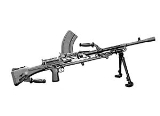
The Bren, usually called the Bren Gun, was a series of light machine gun
Light machine gun
A light machine gun is a machine gun designed to be employed by an individual soldier, with or without an assistant, as an infantry support weapon. Light machine guns are often used as squad automatic weapons.-Characteristics:...

s adopted by Britain in the 1930s and used in various roles until 1991. While best known for its role as the British
United Kingdom
The United Kingdom of Great Britain and Northern IrelandIn the United Kingdom and Dependencies, other languages have been officially recognised as legitimate autochthonous languages under the European Charter for Regional or Minority Languages...

 and Commonwealth
British Empire
The British Empire comprised the dominions, colonies, protectorates, mandates and other territories ruled or administered by the United Kingdom. It originated with the overseas colonies and trading posts established by England in the late 16th and early 17th centuries. At its height, it was the...

 forces' primary infantry light machine gun
Light machine gun
A light machine gun is a machine gun designed to be employed by an individual soldier, with or without an assistant, as an infantry support weapon. Light machine guns are often used as squad automatic weapons.-Characteristics:...

 (LMG) in World War II
World War II
World War II, or the Second World War , was a global conflict lasting from 1939 to 1945, involving most of the world's nations—including all of the great powers—eventually forming two opposing military alliances: the Allies and the Axis...

, it was also used in the Korean War
Korean War
The Korean War was a conventional war between South Korea, supported by the United Nations, and North Korea, supported by the People's Republic of China , with military material aid from the Soviet Union...

 and saw service throughout the latter half of the 20th century, including the 1982 Falklands War
Falklands War
The Falklands War , also called the Falklands Conflict or Falklands Crisis, was fought in 1982 between Argentina and the United Kingdom over the disputed Falkland Islands and South Georgia and the South Sandwich Islands...

 and the 1991 Gulf War
Gulf War
The Persian Gulf War , commonly referred to as simply the Gulf War, was a war waged by a U.N.-authorized coalition force from 34 nations led by the United States, against Iraq in response to Iraq's invasion and annexation of Kuwait.The war is also known under other names, such as the First Gulf...

. Although fitted with a bipod
Bipod
A bipod is a support device that is similar to a tripod or monopod, but with two legs. It provides significant stability along two axes of motion .-Firearms:...

, it could also be mounted on a tripod or vehicle-mounted.
Discussion
Ask a question about 'Bren'
Start a new discussion about 'Bren'
Answer questions from other users
Full Discussion Forum
 
Unanswered Questions
Encyclopedia
The Bren, usually called the Bren Gun, was a series of light machine gun
Light machine gun
A light machine gun is a machine gun designed to be employed by an individual soldier, with or without an assistant, as an infantry support weapon. Light machine guns are often used as squad automatic weapons.-Characteristics:...

s adopted by Britain in the 1930s and used in various roles until 1991. While best known for its role as the British
United Kingdom
The United Kingdom of Great Britain and Northern IrelandIn the United Kingdom and Dependencies, other languages have been officially recognised as legitimate autochthonous languages under the European Charter for Regional or Minority Languages...

 and Commonwealth
British Empire
The British Empire comprised the dominions, colonies, protectorates, mandates and other territories ruled or administered by the United Kingdom. It originated with the overseas colonies and trading posts established by England in the late 16th and early 17th centuries. At its height, it was the...

 forces' primary infantry light machine gun
Light machine gun
A light machine gun is a machine gun designed to be employed by an individual soldier, with or without an assistant, as an infantry support weapon. Light machine guns are often used as squad automatic weapons.-Characteristics:...

 (LMG) in World War II
World War II
World War II, or the Second World War , was a global conflict lasting from 1939 to 1945, involving most of the world's nations—including all of the great powers—eventually forming two opposing military alliances: the Allies and the Axis...

, it was also used in the Korean War
Korean War
The Korean War was a conventional war between South Korea, supported by the United Nations, and North Korea, supported by the People's Republic of China , with military material aid from the Soviet Union...

 and saw service throughout the latter half of the 20th century, including the 1982 Falklands War
Falklands War
The Falklands War , also called the Falklands Conflict or Falklands Crisis, was fought in 1982 between Argentina and the United Kingdom over the disputed Falkland Islands and South Georgia and the South Sandwich Islands...

 and the 1991 Gulf War
Gulf War
The Persian Gulf War , commonly referred to as simply the Gulf War, was a war waged by a U.N.-authorized coalition force from 34 nations led by the United States, against Iraq in response to Iraq's invasion and annexation of Kuwait.The war is also known under other names, such as the First Gulf...

. Although fitted with a bipod
Bipod
A bipod is a support device that is similar to a tripod or monopod, but with two legs. It provides significant stability along two axes of motion .-Firearms:...

, it could also be mounted on a tripod or vehicle-mounted.

The Bren was a modified version of Czechoslovak-designed light machine guns, the ZB vz. 26 and its descendants, which British Army
British Army
The British Army is the land warfare branch of Her Majesty's Armed Forces in the United Kingdom. It came into being with the unification of the Kingdom of England and Scotland into the Kingdom of Great Britain in 1707. The new British Army incorporated Regiments that had already existed in England...

 officials had tested during a firearms service competition in the 1930s. The later Bren featured a distinctive curved box magazine, conical flash hider and quick change barrel. The name Bren was derived from Brno
Brno
Brno by population and area is the second largest city in the Czech Republic, the largest Moravian city, and the historical capital city of the Margraviate of Moravia. Brno is the administrative centre of the South Moravian Region where it forms a separate district Brno-City District...

, the Czechoslovak city where the Zb vz. 26 was originally designed (in Zbrojovka Brno Factory
Zbrojovka Brno
Zbrojovka Brno was a firearm and vehicle manufacturer in Brno, Czech Republic. They also made other products and tools- History :The firm was established in 1918.The Czech-Slovak investment group J&T bought an areal of Zbrojovka Brno in 2007.-Firearms:...

), and Enfield
London Borough of Enfield
The London Borough of Enfield is the most northerly London borough and forms part of Outer London. It borders the London Boroughs of Barnet, Haringey and Waltham Forest...

, site of the British Royal Small Arms Factory
Royal Small Arms Factory
The Royal Small Arms Factory was a UK government-owned rifle factory in the London Borough of Enfield in an area generally known as the Lea Valley. The factory produced British military rifles, muskets and swords from 1816...

.

In the 1950s the Bren was rebarrelled to accept the 7.62×51mm NATO
7.62×51mm NATO
The 7.62×51mm NATO is a rifle cartridge developed in the 1950s as a standard for small arms among NATO countries...

 cartridge. It was replaced in the British Army as the section LMG by the L7 general-purpose machine gun (GPMG), a heavier belt-fed
Belt (firearm)
A belt or ammunition belt is a device used to retain and feed cartridges into a firearm. Belts and the associated feed systems are typically employed to feed machine guns or other automatic weapons...

 weapon. This was in turn supplemented in the 1980s by the L86 Light Support Weapon firing the 5.56×45mm NATO round, leaving the Bren in use only as a pintle mount on some vehicles.

The Bren is still sold by Indian Ordnance Factories
Ordnance Factories Organisation
The Indian Ordnance Factories Board is an industrial setup functioning under the Ministry of Defence, Government of India. It is engaged in production of arms, ammunition, and equipment for civilian as well as military applications...

 as the "Gun, Machine 7.62mm 1B".

Development


During the early 1930s, the British Army subjected several designs of light machine gun to competitive trials. Among the weapons that were submitted for the trials were the Madsen
Madsen machine gun
The Madsen was a light machine gun developed by Julius A. Rasmussen and Theodor Schoubue and proposed for adoption by Captain Vilhelm Herman Oluf Madsen, the Danish Minister of War and adopted by the Danish Army in 1902...

, Browning Automatic Rifle (BAR), the Neuhausen KE7 and the Vickers-Berthier
Vickers-Berthier
The Vickers-Berthier light machine gun manufactured by Vickers-Armstrong was based on a French design of just before World War I. In 1925 Vickers in Britain purchased licence rights for production in their Crayford factory, and as a replacement for the Lewis Gun.-History:During the 1932 British...

. The Vickers-Berthier was later adopted by the Indian Army
Indian Army
The Indian Army is the land based branch and the largest component of the Indian Armed Forces. With about 1,100,000 soldiers in active service and about 1,150,000 reserve troops, the Indian Army is the world's largest standing volunteer army...

 and also saw extensive service in World War II.

Following these trials, the British Army adopted the Czechoslovak ZB vz.26 light machine gun manufactured in Brno
Brno
Brno by population and area is the second largest city in the Czech Republic, the largest Moravian city, and the historical capital city of the Margraviate of Moravia. Brno is the administrative centre of the South Moravian Region where it forms a separate district Brno-City District...

 in 1935, although a slightly modified model the ZB vz. 27 rather than the ZB vz. 26 had actually been submitted for the trials. A licence to manufacture was sought, and the Czech design was modified to British requirements. The major changes were in the magazine and barrel. The magazine was curved in order to feed the rimmed .303 British
.303 British
.303 British, or 7.7x56mmR, is a .311 inch calibre rifle and machine gun cartridge first developed in Britain as a blackpowder round put into service in December 1888 for the Lee-Metford rifle, later adapted to use smokeless powders...

 cartridge, a change from the various rimless Mauser-design cartridges such as the 7.92 mm Mauser round previously used by Czech designs. These modifications were categorised in various numbered designations, ZB vz. 27, ZB vz. 30, ZB vz. 32, and finally the ZB vz. 33, which became the Bren.

The Bren was a gas-operated weapon, which used the same .303 ammunition as the standard British rifle, the Lee-Enfield
Lee-Enfield
The Lee-Enfield bolt-action, magazine-fed, repeating rifle was the main firearm used by the military forces of the British Empire and Commonwealth during the first half of the 20th century...

, firing at a rate of between 480 and 540 rounds per minute (rpm), depending on model. Propellant gases vented from a port towards the muzzle end of the barrel through a regulator (visible in the photo, just in front of the bipod) with four quick-adjustment apertures of different sizes, intended to tailor the gas volume to different ambient temperatures (smallest flow at high temperature, e.g. summer desert, largest at low temperature, e.g. winter Arctic). The vented gas drove a piston which in turn actuated the breech block. Each gun came with a spare barrel that could be quickly changed when the barrel became hot during sustained fire, though later guns featured a chrome
Chromium
Chromium is a chemical element which has the symbol Cr and atomic number 24. It is the first element in Group 6. It is a steely-gray, lustrous, hard metal that takes a high polish and has a high melting point. It is also odorless, tasteless, and malleable...

-lined barrel which reduced the need for a spare. To change barrels, the release catch in front of the magazine was rotated to unlock the barrel. The carrying handle above the barrel was used to grip and remove the hot barrel without risk of burning the hands.

The Bren was magazine-fed, which slowed its rate of fire and required more frequent reloading than British belt-fed machine guns such as the larger .303 Vickers machine gun
Vickers machine gun
Not to be confused with the Vickers light machine gunThe Vickers machine gun or Vickers gun is a name primarily used to refer to the water-cooled .303 inch machine gun produced by Vickers Limited, originally for the British Army...

. However, the slower rate of fire prevented more rapid overheating of the Bren's air-cooled barrel, and the Bren was several pounds lighter than belt-fed machine guns which typically had cooling jackets, often liquid filled. The magazines also prevented the ammunition from getting dirty, which was more of a problem with the Vickers with its 250-round canvas belts.

Second World War


In the British and Commonwealth armies, the Bren was generally issued on a scale of one per rifle section, with three rifle sections in each platoon. A further three Bren guns were issued to the Admin platoon of each rifle company. A infantry battalion also had a "carrier" platoon, equipped with Universal Carriers, most of which carried Bren guns. Parachute battalions from 1944 had an extra Bren in the AT platoon. The 66-man "Assault Troop" of British Commandos
British Commandos
The British Commandos were formed during the Second World War in June 1940, following a request from the British Prime Minister, Winston Churchill, for a force that could carry out raids against German-occupied Europe...

 had a nominal establishment of four Bren guns. Realising the need for additional section-level firepower, the British Army endeavoured to issue the Bren in great numbers, with a stated goal of one Bren to every four private soldiers.

The Bren was officially operated by a two-man crew, sometimes commanded by a Lance Corporal
Lance Corporal
Lance corporal is a military rank, used by many armed forces worldwide, and also by some police forces and other uniformed organizations. It is below the rank of corporal, and is typically the lowest non-commissioned officer, usually equivalent to the NATO Rank Grade OR-3.- Etymology :The presumed...

 as an infantry section's "gun group", the remainder of the section forming the "rifle group". The gunner or "Number 1" carried and fired the Bren, and a loader or "Number 2" carried extra magazines, a spare barrel and tool kit, and reloaded the gun and replaced the barrel when it overheated. During wartime however, the weapon was commonly operated by one man, the gunner (as depicted in the picture to the right).

Generally, the Bren was fired from the prone position using the attached bipod. On occasion, a Bren gunner would use his weapon on the move supported by a sling, much like an automatic rifle, and from standing or kneeling positions. Using the sling, Australian soldiers regularly fired the Bren from the hip. A Victoria Cross
Victoria Cross
The Victoria Cross is the highest military decoration awarded for valour "in the face of the enemy" to members of the armed forces of various Commonwealth countries, and previous British Empire territories....

 was awarded to Private Bruce Kingsbury for such use at Isurava, New Guinea in 1942, during the Australian's fighting retreat from Kokoda.

Each British soldier's equipment normally included two magazines for his section's Bren gun. The large ammunition pouches on the 1937 Pattern Web Equipment
1937 Pattern Web Equipment
1937 Pattern Web Equipment was an item of military load-carrying equipment. It replaced the 1908 Pattern and 1925 Pattern—on which it was based—and was standard issue for British and Commonwealth troops from its introduction in 1937, throughout World War II, and in the post-war period until it was...

 were designed around the Bren magazine. Every soldier would be trained to fire the Bren in case of an emergency, though these soldiers did not receive a Bren proficiency badge.

The Bren had an effective range of around 600 yards (548.6 m) when fired from a prone position with a bipod
Bipod
A bipod is a support device that is similar to a tripod or monopod, but with two legs. It provides significant stability along two axes of motion .-Firearms:...

. Initial versions of the weapon were sometimes considered too accurate because the cone or pattern of fire was extremely concentrated, resulting in multiple hits on one or two enemies, with other enemy soldiers going untouched. Soldiers often expressed a preference for worn-out barrels in order to spread the cone of fire among several targets. Later versions of the Bren addressed this issue by providing a wider cone of fire.

For a light machine gun of the interwar and early World War II era, the Bren was about average in weight. On long marches in non-operational areas it was often partially disassembled and its parts were carried by two soldiers. The top-mounted magazine vibrated and moved during fire, making the weapon more visible in combat, and many Bren gunners used paint or improvised canvas covers to disguise the prominent magazine.

The 30-round magazine was in practice usually filled with 27 or 28 rounds to prevent jams and avoid wearing out the magazine spring. Care needed to be taken when loading the magazine to ensure that each round went ahead of the previous round, so that the .303 cartridge rims did not overlap the wrong way, which would cause a jam. A 100-round pan magazine
Magazine (firearm)
A magazine is an ammunition storage and feeding device within or attached to a repeating firearm. Magazines may be integral to the firearm or removable . The magazine functions by moving the cartridges stored in the magazine into a position where they may be loaded into the chamber by the action...

 was available for the Bren for use in the anti-aircraft
Anti-aircraft warfare
NATO defines air defence as "all measures designed to nullify or reduce the effectiveness of hostile air action." They include ground and air based weapon systems, associated sensor systems, command and control arrangements and passive measures. It may be to protect naval, ground and air forces...

 role.

In general, the Bren was considered a reliable and effective light machine gun, though in North Africa it was reported to jam regularly unless kept very clean and free of sand or dirt. It was popular with British troops, who respected the Bren for its reliability and combat effectiveness. The quality of the materials used would generally ensure minimal jamming. When the gun did jam or had some foreign object stuck in it, the operator could adjust the four-position gas regulator to feed more gas to the piston increasing the power to operate the mechanism. The barrel needed to be unlocked and slid forward slightly to allow the regulator to be turned. It was even said that all problems with the Bren could simply be cleared by hitting the gun, turning the regulator, or doing both.

A complicated tripod mount was available to allow the Bren to be used as an indirect-fire weapon, but this was rarely used in the field. The Bren was also used on many vehicles, including on Universal Carrier
Universal Carrier
The Universal Carrier, also known as the Bren Gun Carrier is a common name describing a family of light armoured tracked vehicles built by Vickers-Armstrong. Produced between 1934 and 1960, the vehicle was used widely by British Commonwealth forces during the Second World War...

s, to which it gave the alternative name "Bren Gun Carrier", and on tanks and armoured cars. However, it could not be used as a co-axial weapon on tanks, as the magazine restricted its depression and was awkward to handle in confined spaces, and it was therefore used on a pintle mount only. (The belt fed Vickers
Vickers machine gun
Not to be confused with the Vickers light machine gunThe Vickers machine gun or Vickers gun is a name primarily used to refer to the water-cooled .303 inch machine gun produced by Vickers Limited, originally for the British Army...

 or BESA
Besa machine gun
The Besa Machine Gun was a British version of the Czechoslovak ZB-53 air-cooled, belt-fed machine-gun, which in the Czechoslovak army was marked as the TK vz. 37...

, the latter being another Czechoslovak machine gun design adopted by the British, were instead used as co-axial weapons.)

The Bren's direct ancestor, the Czechoslovak ZB vz. 26, was also used in World War II by German and Romanian forces, including units of the Waffen SS. Many 7.92 mm ZB light machine guns were shipped to China, where they were employed first against the Japanese in World War II, and later against UN forces in Korea, including British and Commonwealth units. Some ex-Chinese Czech ZB weapons were also in use in the early stages of the Vietnam War
Vietnam War
The Vietnam War was a Cold War-era military conflict that occurred in Vietnam, Laos, and Cambodia from 1 November 1955 to the fall of Saigon on 30 April 1975. This war followed the First Indochina War and was fought between North Vietnam, supported by its communist allies, and the government of...

.

Production of a 7.92 mm round model for the Far East was carried out by Inglis of Canada.

Post-war


The Bren was used by the British Army, and the armies of various countries of the Commonwealth
British Empire
The British Empire comprised the dominions, colonies, protectorates, mandates and other territories ruled or administered by the United Kingdom. It originated with the overseas colonies and trading posts established by England in the late 16th and early 17th centuries. At its height, it was the...

, in the Korean War
Korean War
The Korean War was a conventional war between South Korea, supported by the United Nations, and North Korea, supported by the People's Republic of China , with military material aid from the Soviet Union...

, the Malayan Emergency
Malayan Emergency
The Malayan Emergency was a guerrilla war fought between Commonwealth armed forces and the Malayan National Liberation Army , the military arm of the Malayan Communist Party, from 1948 to 1960....

, the Mau Mau Uprising
Mau Mau Uprising
The Mau Mau Uprising was a military conflict that took place in Kenya between 1952 and 1960...

 and the Indonesia–Malaysia confrontation, where it was preferred to its replacement, the belt-fed GPMG
FN MAG
The FN MAG is a Belgian 7.62 mm general-purpose machine gun, designed in the early 1950s at Fabrique Nationale by Ernest Vervier. It has been used by more than 80 countries, and it has been made under licence in countries such as Argentina, Egypt, India, Singapore, the United Kingdom and the...

, on account of its lighter weight. During the Falklands War
Falklands War
The Falklands War , also called the Falklands Conflict or Falklands Crisis, was fought in 1982 between Argentina and the United Kingdom over the disputed Falkland Islands and South Georgia and the South Sandwich Islands...

 in 1982, 40 Commando
40 Commando
40 Commando RM is a battalion sized formation of the British Royal Marines and subordinate unit within 3 Commando Brigade, the principal Commando formation, under the Operational Command of Commander in Chief Fleet....

 Royal Marines
Royal Marines
The Corps of Her Majesty's Royal Marines, commonly just referred to as the Royal Marines , are the marine corps and amphibious infantry of the United Kingdom and, along with the Royal Navy and Royal Fleet Auxiliary, form the Naval Service...

 carried one LMG and one GPMG per section.

When the British Army adopted the 7.62 mm
7.62×51mm NATO
The 7.62×51mm NATO is a rifle cartridge developed in the 1950s as a standard for small arms among NATO countries...

 NATO cartridge, the Bren was re-designed to 7.62 mm calibre, fitted with a new bolt, barrel and magazine. It was redesignated as the L4 Light Machine Gun (in various sub-versions) and remained in British Army service into the 1990s. The conical flash hider was replaced by the slotted type similar to that of the contemporary L1 rifle and L7 General Purpose Machine Gun. The change from a rimmed to rimless cartridge and nearly straight magazine improved feeding considerably, and allowed use of 20-round magazines from the 7.62 mm L1A1 Self-Loading Rifle
L1A1 Self-Loading Rifle
The L1A1 Self-Loading Rifle, also known by the Canadian Army designation C1, as the SLR, or as the "inch pattern" FAL,especially on the American surplus market is a British Commonwealth derivative of the Belgian FN FAL battle rifle, produced under licence...

. The 30-round magazine from the L4 also fitted the L1A1 rifle, but the magazine spring was not always strong enough to provide enough upward pressure to feed rounds correctly, this however was fixed by stretching the magazine springs.

Completion of the move to a 5.56 mm NATO cartridge led to the Bren/L4 being removed from the list of approved weapons and then withdrawn from service. The fact that Bren guns remained in service for so many years with so many different countries in so many wars says much about the quality of the basic design.

The Mark III Bren remained in limited use with the Army Reserve
Irish Army Reserve
The Army Reserve is the land component of the Reserve Defence Forces . It is the second line reserve of the Army. The Army Reserve is a part-time, fully voluntary organisation, and is one of two elements of the Reserve Defence Forces of Ireland, the other element being the Naval Service Reserve.It...

 of the Irish Defence Forces until 2006, when it was been replaced by the 7.62 mm FN MAG
FN MAG
The FN MAG is a Belgian 7.62 mm general-purpose machine gun, designed in the early 1950s at Fabrique Nationale by Ernest Vervier. It has been used by more than 80 countries, and it has been made under licence in countries such as Argentina, Egypt, India, Singapore, the United Kingdom and the...

 (GPMG). The weapon was popular with the soldiers who fired it (known as Brenners) as it was light and durable, and had a reputation for accuracy. The most notable use of the Bren by Irish forces was in the Congo
Congo Crisis
The Congo Crisis was a period of turmoil in the First Republic of the Congo that began with national independence from Belgium and ended with the seizing of power by Joseph Mobutu...

 during the 1960s, when the Bren was the regular army's standard section automatic weapon.

Mark 1


From September 1937. The original Bren based on the Czechoslovak gun.

Features:
  • Drum pattern rear aperture sight
  • Buttstrap for use over the shoulder when firing
  • Rear grip under butt
  • Telescoping bipod
  • Folding cocking handle

Mark 2


Introduced 1941. A simpler version of the Mk 1. Produced by Inglis of Canada and the Monotype Group through a number of component manufacturing factories. Sometimes known as the "Garage hands" model.

Features:
  • Folding leaf rear sight
  • Buttstrap deleted
  • Rear grip deleted
  • Fixed height bipod
  • Fixed cocking handle


The Bren Mk2 was much simplified in the body, which although still being milled from a solid billet of steel, required significantly fewer milling operations than the Mk1 which gives it a much cleaner appearance. The bipod was simplified in design as well as not having extending legs. Most Mk2 bipods resemble a simple 'A' frame and were more 'soldier proof'. The Mk2 also featured a slightly higher rate of fire than the Mk1.
The woodwork on the Mk2 was simplified by being less ornate and ergonomic, which sped up the manufacturing process. The barrel was also simplified by means of a non-stepped removable flash hider and in some cases, a barrel fore-end that was matte instead of highly polished.
The buffered buttplate of the Mk1 was omitted and replaced with a sheet metal buttplate.

Mark 3


A shorter and lighter Bren made by Enfield from 1944 for the war in the East and for Airborne Forces. This was a conversion of the Mk1 whose main distinguishing feature was a shorter barrel.

L4


A conversion of the Bren to 7.62mm NATO from 1958. Indian Army variants may be new-build, not conversions. L4 Brens can easily be identified by their different magazine. The British issue L4 magazine is of 30-round capacity and has a slight curve. The L4 magazine was interchangeable with the L1A1 SLR
L1A1 Self-Loading Rifle
The L1A1 Self-Loading Rifle, also known by the Canadian Army designation C1, as the SLR, or as the "inch pattern" FAL,especially on the American surplus market is a British Commonwealth derivative of the Belgian FN FAL battle rifle, produced under licence...

 magazine, so the L4 Bren also can be seen fitted with straight 20-round magazines from the SLR or with the straight 30-round magazine from the Australian L2A1 heavy-barrel SLR. The flash suppressor was changed from the cone type of .303 variants to a slotted type similar in appearance to that used on the SLR and L7 GPMG. All L4s are chambered for 7.62×51mm NATO
7.62×51mm NATO
The 7.62×51mm NATO is a rifle cartridge developed in the 1950s as a standard for small arms among NATO countries...

 rimless ammunition.
Designation Description
L4A1 Bren Mk III conversion, with Mk I bipod and steel barrel
L4A2 Bren Mk III conversion, lightened bipod and steel barrel
L4A3 Bren Mk II conversion
L4A4 L4A2 variant with chrome-plated steel barrel
L4A5 L4A3 with chrome-plated steel barrel for Royal Navy
Royal Navy
The Royal Navy is the naval warfare service branch of the British Armed Forces. Founded in the 16th century, it is the oldest service branch and is known as the Senior Service...

L4A6 L4A1 variant with chrome barrel
L4A9 Bren conversion with L7 dovetail

Taden gun


The Taden gun
Taden gun
The TADEN was a British experimental light machine gun firing the .280 in intermediate round. Alongside the bullpup EM-2 rifle design, it formed part of a proposal to reequip the British Army with new small arms which would use a round smaller than the .303 inch which was shown to be impractical...

 was a development of the Bren to use with the .280 British
.280 British
The .280 British was an experimental intermediate rifle cartridge. It was later designated 7 mm MK1Z, and has also been known as 7 mm NATO, .280/30, .280 Enfield, .280 NATO, 7 mm FN Short, and 7×43mm. It was designed by the British Army in the late 1940s, with subsequent help from...

 intermediate round proposed to replace the .303 in British service. The Taden was belt-fed with spade grips and would have replaced both the Bren and the Vickers machine gun. Although reliable it was not accepted due to the US-driven standardization within NATO on the larger 7.62x51mm NATO round.

World War II production


  • RSAF Enfield, UK: 400 per month.
    • 1943: 1,000 per week.
  • John Inglis and Company
    John Inglis and Company
    John Inglis and Company was a Canadian firm which made weapons for the United Kingdom and British Commonwealth military forces during the World War II era, then became a major appliance company....

    , Canada
    Canada
    Canada is a North American country consisting of ten provinces and three territories. Located in the northern part of the continent, it extends from the Atlantic Ocean in the east to the Pacific Ocean in the west, and northward into the Arctic Ocean...

    : A contract was signed with the British and Canadian governments in March 1938 to supply 5,000 Bren machine guns to Great Britain and 7,000 Bren machine guns to Canada. Both countries shared the capital
    Capital (economics)
    In economics, capital, capital goods, or real capital refers to already-produced durable goods used in production of goods or services. The capital goods are not significantly consumed, though they may depreciate in the production process...

     costs of bringing in this new production facility. Production started in 1940, and by 1943 Inglis was producing 60% of the world output of Bren machine guns.
  • Long Branch, Toronto
    Long Branch, Toronto
    The former Village of Long Branch is a neighbourhood in the south-west of Toronto, Ontario, Canada. It is located in the south-west corner of the former Township of Etobicoke and was a partially-independent municipality from 1930-1967...

    , Canada.
  • Ishapore, India.
  • Lithgow Small Arms Factory
    Lithgow Small Arms Factory
    The Lithgow Small Arms Factory is a military small arms factory located in the town of Lithgow, New South Wales in Australia.- History :Opened on 8 June 1912, the factory initially manufactured Short, Magazine, Lee-Enfield Mk III rifles for the Australian military during World War I...

    , Australia.

Users


  • Australia
    Australia
    Australia , officially the Commonwealth of Australia, is a country in the Southern Hemisphere comprising the mainland of the Australian continent, the island of Tasmania, and numerous smaller islands in the Indian and Pacific Oceans. It is the world's sixth-largest country by total area...

    : during World War II and Korean War.
  • Bangladesh
    Bangladesh
    Bangladesh , officially the People's Republic of Bangladesh is a sovereign state located in South Asia. It is bordered by India on all sides except for a small border with Burma to the far southeast and by the Bay of Bengal to the south...

  • Barbados
    Barbados
    Barbados is an island country in the Lesser Antilles. It is in length and as much as in width, amounting to . It is situated in the western area of the North Atlantic and 100 kilometres east of the Windward Islands and the Caribbean Sea; therein, it is about east of the islands of Saint...

  • Belize
    Belize
    Belize is a constitutional monarchy and the northernmost country in Central America. Belize has a diverse society, comprising many cultures and languages. Even though Kriol and Spanish are spoken among the population, Belize is the only country in Central America where English is the official...

  • Botswana
    Botswana
    Botswana, officially the Republic of Botswana , is a landlocked country located in Southern Africa. The citizens are referred to as "Batswana" . Formerly the British protectorate of Bechuanaland, Botswana adopted its new name after becoming independent within the Commonwealth on 30 September 1966...

  • Bulgaria
    Bulgaria
    Bulgaria , officially the Republic of Bulgaria , is a parliamentary democracy within a unitary constitutional republic in Southeast Europe. The country borders Romania to the north, Serbia and Macedonia to the west, Greece and Turkey to the south, as well as the Black Sea to the east...

    : during World War II.
  • Canada
    Canada
    Canada is a North American country consisting of ten provinces and three territories. Located in the northern part of the continent, it extends from the Atlantic Ocean in the east to the Pacific Ocean in the west, and northward into the Arctic Ocean...

    : during World War II and Korean War.
  • People's Republic of China
    People's Republic of China
    China , officially the People's Republic of China , is the most populous country in the world, with over 1.3 billion citizens. Located in East Asia, the country covers approximately 9.6 million square kilometres...

    : During the Chinese Civil War
    Chinese Civil War
    The Chinese Civil War was a civil war fought between the Kuomintang , the governing party of the Republic of China, and the Communist Party of China , for the control of China which eventually led to China's division into two Chinas, Republic of China and People's Republic of...

  • Republic of China
    Republic of China
    The Republic of China , commonly known as Taiwan , is a unitary sovereign state located in East Asia. Originally based in mainland China, the Republic of China currently governs the island of Taiwan , which forms over 99% of its current territory, as well as Penghu, Kinmen, Matsu and other minor...

    : Chinese National Revolutionary Army
    National Revolutionary Army
    The National Revolutionary Army , pre-1928 sometimes shortened to 革命軍 or Revolutionary Army and between 1928-1947 as 國軍 or National Army was the Military Arm of the Kuomintang from 1925 until 1947, as well as the national army of the Republic of China during the KMT's period of party rule...

     of Generalissimo Chiang Kai-shek
    Chiang Kai-shek
    Chiang Kai-shek was a political and military leader of 20th century China. He is known as Jiǎng Jièshí or Jiǎng Zhōngzhèng in Mandarin....

     of the Republic of China
    Republic of China
    The Republic of China , commonly known as Taiwan , is a unitary sovereign state located in East Asia. Originally based in mainland China, the Republic of China currently governs the island of Taiwan , which forms over 99% of its current territory, as well as Penghu, Kinmen, Matsu and other minor...

     during the Second Sino-Japanese War
    Second Sino-Japanese War
    The Second Sino-Japanese War was a military conflict fought primarily between the Republic of China and the Empire of Japan. From 1937 to 1941, China fought Japan with some economic help from Germany , the Soviet Union and the United States...

     and the Chinese Civil War
    Chinese Civil War
    The Chinese Civil War was a civil war fought between the Kuomintang , the governing party of the Republic of China, and the Communist Party of China , for the control of China which eventually led to China's division into two Chinas, Republic of China and People's Republic of...

  • Democratic Republic of Congo
  • Gambia
  • Ghana
    Ghana
    Ghana , officially the Republic of Ghana, is a country located in West Africa. It is bordered by Côte d'Ivoire to the west, Burkina Faso to the north, Togo to the east, and the Gulf of Guinea to the south...

  • Greece
    Greece
    Greece , officially the Hellenic Republic , and historically Hellas or the Republic of Greece in English, is a country in southeastern Europe....

    : Democratic Army of Greece
    Democratic Army of Greece
    This article is based on a translation of an article from the Greek Wikipedia.The Democratic Army of Greece , often simply abbreviated to its initials DSE , was the army founded by the Communist Party of Greece during the Greek Civil War, 1946–1949...

     (DSE) during the Greek Civil War
    Greek Civil War
    The Greek Civil War was fought from 1946 to 1949 between the Greek governmental army, backed by the United Kingdom and United States, and the Democratic Army of Greece , the military branch of the Greek Communist Party , backed by Bulgaria, Yugoslavia and Albania...

     (1946–1949) and Hellenic Air Force
    Hellenic Air Force
    The Hellenic Air Force, abbreviated to HAF is the air force of Greece. The mission of the Hellenic Air Force is to guard and protect Greek airspace, provide air assistance and support to the Hellenic Army and the Hellenic Navy, as well as the provision of humanitarian aid in Greece and around the...

     used until 1956.
  • Guyana
    Guyana
    Guyana , officially the Co-operative Republic of Guyana, previously the colony of British Guiana, is a sovereign state on the northern coast of South America that is culturally part of the Anglophone Caribbean. Guyana was a former colony of the Dutch and of the British...

  • India
    India
    India , officially the Republic of India , is a country in South Asia. It is the seventh-largest country by geographical area, the second-most populous country with over 1.2 billion people, and the most populous democracy in the world...

  • Indonesia
    Indonesia
    Indonesia , officially the Republic of Indonesia , is a country in Southeast Asia and Oceania. Indonesia is an archipelago comprising approximately 13,000 islands. It has 33 provinces with over 238 million people, and is the world's fourth most populous country. Indonesia is a republic, with an...

    : Brigade Mobil SOF
    Brigade Mobil SOF
    Brigade Mobil is one of the oldest Indonesian National Police special operations force units.-History:Formed in late 1945, a special corps namely 'Pasukan Polisi Istimewa' was formed with the assigned tasks of disarming remnants of the Japanese Imperial Army and protecting the chief of state and...

     of Indonesian Police still use Bren in services. After Independence War 1945-1950 TNI use Bren as machine gun squad.
  • Ireland
    Ireland
    Ireland is an island to the northwest of continental Europe. It is the third-largest island in Europe and the twentieth-largest island on Earth...

    : Irish Defence Forces
    Irish Defence Forces
    The armed forces of Ireland, known as the Defence Forces encompass the Army, Naval Service, Air Corps and Reserve Defence Force.The current Supreme Commander of the Irish Defence forces is His Excellency Michael D Higgins in his role as President of Ireland...

     replaced by the FN MAG
    FN MAG
    The FN MAG is a Belgian 7.62 mm general-purpose machine gun, designed in the early 1950s at Fabrique Nationale by Ernest Vervier. It has been used by more than 80 countries, and it has been made under licence in countries such as Argentina, Egypt, India, Singapore, the United Kingdom and the...

     in 1960s, used by the Reserve Defence Forces (RDF), until 2006.
  • Israel
    Israel
    The State of Israel is a parliamentary republic located in the Middle East, along the eastern shore of the Mediterranean Sea...

    : during its war of independence
    1948 Arab-Israeli War
    The 1948 Arab–Israeli War, known to Israelis as the War of Independence or War of Liberation The war commenced after the termination of the British Mandate for Palestine and the creation of an independent Israel at midnight on 14 May 1948 when, following a period of civil war, Arab armies invaded...

     and for some time thereafter.
  • Italy
    Italy
    Italy , officially the Italian Republic languages]] under the European Charter for Regional or Minority Languages. In each of these, Italy's official name is as follows:;;;;;;;;), is a unitary parliamentary republic in South-Central Europe. To the north it borders France, Switzerland, Austria and...

    : airdropped
    Airdrop
    An airdrop is a type of airlift, developed during World War II to resupply otherwise inaccessible troops, who themselves may have been airborne forces. In some cases, it is used to refer to the airborne assault itself. Early airdrops were conducted by dropping or pushing padded bundles from...

     to partisans and also issued to the Italian Co-Belligerent Army
    Italian Co-Belligerent Army
    The Italian Co-Belligerent Army , or the Army of the South , was the army of the Italian Royalist forces fighting on the side of the Allies during World War II....

     in the latter part of WWII. Also used by the Italian Police
    Polizia di Stato
    The Polizia di Stato is one of the national police forces of Italy.It is the main police force for providing police duties and it is also responsible for patrolling motorways , railways , airports , customs as well as certain waterways, and assisting the local police...

     in the 7.62 mm calibre.
  • Jamaica
    Jamaica
    Jamaica is an island nation of the Greater Antilles, in length, up to in width and 10,990 square kilometres in area. It is situated in the Caribbean Sea, about south of Cuba, and west of Hispaniola, the island harbouring the nation-states Haiti and the Dominican Republic...

    : still used by the Jamaica Combined Cadet Force
  • Kenya
    Kenya
    Kenya , officially known as the Republic of Kenya, is a country in East Africa that lies on the equator, with the Indian Ocean to its south-east...

  • Lesotho
    Lesotho
    Lesotho , officially the Kingdom of Lesotho, is a landlocked country and enclave, surrounded by the Republic of South Africa. It is just over in size with a population of approximately 2,067,000. Its capital and largest city is Maseru. Lesotho is a member of the Commonwealth of Nations. The name...

  • Luxembourg
    Luxembourg
    Luxembourg , officially the Grand Duchy of Luxembourg , is a landlocked country in western Europe, bordered by Belgium, France, and Germany. It has two principal regions: the Oesling in the North as part of the Ardennes massif, and the Gutland in the south...

  • Malaysia: General Operations Force
    General Operations Force
    The General Operations Force is the paramilitary arm of the Royal Malaysia Police. The General Operations Force was established in 1948 during the Malayan Emergency by the British Administration when Malaya was a Colony. The Police service was mobilised to the field role, primarily to engage...

     of the Royal Malaysian Police
    Royal Malaysian Police
    The Royal Malaysia Police is a part of the security forces structure in Malaysia. The force is a centralised organization with responsibilities ranging from traffic control to intelligence gathering. Its headquarters is located at Bukit Aman, Kuala Lumpur. The police force is led by an...

     (before replaced by the German
    Germany
    Germany , officially the Federal Republic of Germany , is a federal parliamentary republic in Europe. The country consists of 16 states while the capital and largest city is Berlin. Germany covers an area of 357,021 km2 and has a largely temperate seasonal climate...

    -made 7.62 NATO HK 11).
  • Mauritius
    Mauritius
    Mauritius , officially the Republic of Mauritius is an island nation off the southeast coast of the African continent in the southwest Indian Ocean, about east of Madagascar...

  • Nepal
    Nepal
    Nepal , officially the Federal Democratic Republic of Nepal, is a landlocked sovereign state located in South Asia. It is located in the Himalayas and bordered to the north by the People's Republic of China, and to the south, east, and west by the Republic of India...

  • Netherlands
    Netherlands
    The Netherlands is a constituent country of the Kingdom of the Netherlands, located mainly in North-West Europe and with several islands in the Caribbean. Mainland Netherlands borders the North Sea to the north and west, Belgium to the south, and Germany to the east, and shares maritime borders...

    : The Netherlands Royal Army during World War II and thereafter until 1964, the Netherlands Royal Army Reserve Corps from 1948 until 1989 and the Royal Netherlands Air Force from 1945 until 1964.
  • New Zealand
    New Zealand
    New Zealand is an island country in the south-western Pacific Ocean comprising two main landmasses and numerous smaller islands. The country is situated some east of Australia across the Tasman Sea, and roughly south of the Pacific island nations of New Caledonia, Fiji, and Tonga...

     : WW2 and L4 post war
  • Poland
    Poland
    Poland , officially the Republic of Poland , is a country in Central Europe bordered by Germany to the west; the Czech Republic and Slovakia to the south; Ukraine, Belarus and Lithuania to the east; and the Baltic Sea and Kaliningrad Oblast, a Russian exclave, to the north...

    : Poland during World War II.
  • Rhodesia
    Rhodesia
    Rhodesia , officially the Republic of Rhodesia from 1970, was an unrecognised state located in southern Africa that existed between 1965 and 1979 following its Unilateral Declaration of Independence from the United Kingdom on 11 November 1965...

  • Seychelles
    Seychelles
    Seychelles , officially the Republic of Seychelles , is an island country spanning an archipelago of 115 islands in the Indian Ocean, some east of mainland Africa, northeast of the island of Madagascar....

  • Sri Lanka
    Sri Lanka
    Sri Lanka, officially the Democratic Socialist Republic of Sri Lanka is a country off the southern coast of the Indian subcontinent. Known until 1972 as Ceylon , Sri Lanka is an island surrounded by the Indian Ocean, the Gulf of Mannar and the Palk Strait, and lies in the vicinity of India and the...

    : Sri Lanka Army
  • Suriname
    Suriname
    Suriname , officially the Republic of Suriname , is a country in northern South America. It borders French Guiana to the east, Guyana to the west, Brazil to the south, and on the north by the Atlantic Ocean. Suriname was a former colony of the British and of the Dutch, and was previously known as...

  • Swaziland
    Swaziland
    Swaziland, officially the Kingdom of Swaziland , and sometimes called Ngwane or Swatini, is a landlocked country in Southern Africa, bordered to the north, south and west by South Africa, and to the east by Mozambique...

  • Tonga
    Tonga
    Tonga, officially the Kingdom of Tonga , is a state and an archipelago in the South Pacific Ocean, comprising 176 islands scattered over of ocean in the South Pacific...

  • Trinidad and Tobago
    Trinidad and Tobago
    Trinidad and Tobago officially the Republic of Trinidad and Tobago is an archipelagic state in the southern Caribbean, lying just off the coast of northeastern Venezuela and south of Grenada in the Lesser Antilles...

  • Uganda
    Uganda
    Uganda , officially the Republic of Uganda, is a landlocked country in East Africa. Uganda is also known as the "Pearl of Africa". It is bordered on the east by Kenya, on the north by South Sudan, on the west by the Democratic Republic of the Congo, on the southwest by Rwanda, and on the south by...

  • United Kingdom
    United Kingdom
    The United Kingdom of Great Britain and Northern IrelandIn the United Kingdom and Dependencies, other languages have been officially recognised as legitimate autochthonous languages under the European Charter for Regional or Minority Languages...

    : British and Commonwealth forces, and cadet forces until the introduction of the L98 Cadet Rifle
  • Yugoslavia
    Yugoslavia
    Yugoslavia refers to three political entities that existed successively on the western part of the Balkans during most of the 20th century....

    : Yugoslav Chetniks during World War II; some remained in stockpiles until Balkan wars of '90s
  • Zimbabwe
    Zimbabwe
    Zimbabwe is a landlocked country located in the southern part of the African continent, between the Zambezi and Limpopo rivers. It is bordered by South Africa to the south, Botswana to the southwest, Zambia and a tip of Namibia to the northwest and Mozambique to the east. Zimbabwe has three...


See also

  • Taden gun
    Taden gun
    The TADEN was a British experimental light machine gun firing the .280 in intermediate round. Alongside the bullpup EM-2 rifle design, it formed part of a proposal to reequip the British Army with new small arms which would use a round smaller than the .303 inch which was shown to be impractical...

  • Charlton Automatic Rifle
    Charlton Automatic Rifle
    The Charlton Automatic Rifle was a fully automatic conversion of the Lee-Enfield rifle, designed by New Zealander Philip Charlton in 1941 to act as a substitute for the Bren and Lewis gun light machine guns which were in chronically short supply at the time....

  • Besal
    Besal
    The Besal was a light machine gun of British origin. The weapon was intended as a backup for the Bren gun as it was lighter, simpler, cheaper, and easier to manufacture, but was eventually deemed unnecessary.-References:*...

  • Sterling 7.62
    Sterling 7.62
    The Sterling 7.62 was a Battle rifle/Light machine gun variant of the Sterling submachine gun which was manufactured in the 7.62x51mm NATO calibre. It used lever-delayed blowback to handle the more powerful rounds and was fed from 30 round Bren magazines as well as 20 round magazines from L1A1 SLR's...

  • Kucher Model K1
    Kucher Model K1
    The Kucher K1 was a Hungarian box magazined submachine gun designed by József Kucher and was based on the Danuvia 44.M prototype smg....

  • FM 24/29 light machine gun
  • M1918 Browning Automatic Rifle
  • Huot Automatic Rifle
    Huot automatic rifle
    The Huot was a Canadian World War I light machine gun project.-Design and development:In 1916, the Canadian Expeditionary Force was desperately short of light machine guns. Since the Ross rifle had finally been taken out of service, there were large numbers of surplus rifles.That year, Joseph Huot,...

  • Veronica Foster, aka The Bren Gun Girl
    Veronica Foster
    Veronica Foster, popularly known as "Ronnie, the Bren Gun Girl", was a Canadian icon representing nearly one million Canadian women who worked in the manufacturing plants that produced munitions and materiel during World War II. Foster worked for John Inglis Co. Ltd producing Bren light machine...

  • Type 99 Light Machine Gun
    Type 99 Light Machine Gun
    The was a light machine gun used by the Imperial Japanese Army in World War II. -History and development:The Type 96 Light Machine Gun, an improvement over the previous Type 11 Light Machine Gun was introduced into combat service in 1936, and quickly proved to be a versatile weapon to provide...

  • ZB-530
    ZB-530
    The ZB-530 was an assault rifle chambered in the 7.62 x 45mm vz 52 round. The rifle was fed from a top mounted 30 round box magazine. After the success of the ZB vz. 26 and Bren light machine guns, the Czech government felt that a lightweight derivative of these weapons would make an effective...

  • Organization of Canadian Army rifle sections during World War II
    Organization of Canadian Army rifle sections during World War II
    During the Second World War, the Canadian Army used the Rifle Section as its smallest organized formation of combat infantry soldiers. The organization was substantially similar to that of the Australian Army and from 1944 the British Army used the same structure with 3 sections to the platoon and...

  • Universal Carrier
    Universal Carrier
    The Universal Carrier, also known as the Bren Gun Carrier is a common name describing a family of light armoured tracked vehicles built by Vickers-Armstrong. Produced between 1934 and 1960, the vehicle was used widely by British Commonwealth forces during the Second World War...

     (Bren Gun Carrier)
  • Vickers machine gun
    Vickers machine gun
    Not to be confused with the Vickers light machine gunThe Vickers machine gun or Vickers gun is a name primarily used to refer to the water-cooled .303 inch machine gun produced by Vickers Limited, originally for the British Army...

  • Vickers-Berthier
    Vickers-Berthier
    The Vickers-Berthier light machine gun manufactured by Vickers-Armstrong was based on a French design of just before World War I. In 1925 Vickers in Britain purchased licence rights for production in their Crayford factory, and as a replacement for the Lewis Gun.-History:During the 1932 British...

  • Vickers K machine gun
    Vickers K machine gun
    Not to be confused with the Vickers light machine gunThe Vickers K machine gun, known as the Vickers Gas Operated in British service, was a rapid-firing machine gun developed and manufactured for use in aircraft by Vickers-Armstrongs...


External links