


Braniewo

Encyclopedia
Braniewo b is a town
in northeastern Poland
, in the Warmian-Masurian Voivodeship
, with a population of 18,068 (2004). It is the capital of Braniewo County
. Located on the Pasłęka River, about five km from the Vistula Lagoon
, Braniewo lies about halfway between Gdańsk
and the Russia
n city of Kaliningrad
.
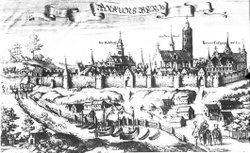 During the conquest
and Christianization
of Prussia, the Teutonic Knights
conquered an Old Prussian
settlement named Brusebergue in 1240 and built in 1242 a new castle atop it on the Passarge (Pasłęka) River. The German name of this new residence was Braunsberg (literally "Brown's Mountain"). It was probably derived from a Germanization (Brus-berg and Brunsberg) of the older Prussian name, or possibly named after Saint Bruno of Querfurt
, who had been martyred on the Kievan Rus' border in 1009.
In 1243 the settlement, together with the surrounding region of Warmia
, was given by the Order to the newly created Bishopric of Warmia
, whose bishop
built his cathedral in the town and made it his chief residence. Braunsberg was granted town privileges
based on those of Lübeck
in 1254, but was destroyed and depopulated in the second uprising of native Prussians in 1261. It was rebuilt in a new location in 1273 and settled by newcomers from Lübeck
. In 1284 Braunsberg was given a new town charter, again based on the laws of Lübeck. However, the next bishop, Heinrich Fleming (1278–1300) transferred the chapter from Braunsberg to Frauenburg (Frombork)
where it remained until the 20th century.
In 1296 a Franciscan
abbey was built in Braunsberg, and in 1342 a "new town" (still called Neustadt or Nowe Miasto) was added. Braunsberg became a prosperous member of the Hanseatic League
. The town remained a part of the monastic state of the Teutonic Knights
until 1466, when as a consequence of the Second Peace of Thorn ending the Thirteen Years' War, it passed to the Kingdom of Poland
as part of the new autonomous province of Royal Prussia
. In 1487 it withstood a siege by Polish troops during the War of the Priests
.
During the reign of Duke Albert in the neighboring Duchy of Prussia, a large part of Braunsberg's populace converted to Lutheran
Protestantism
. Albert sought to unite Warmia
with Ducal Prussia, causing the Catholics of the town to swear allegiance to the king of Poland in return for aid against Protestant Prussia. In 1526 a Polish royal commission released Braunsberg's burghers from the oath to the Polish king and handed the town back to Prince-Bishop Mauritius Ferber
. Braunsberg swore allegiance to the Prince-Bishops of Warmia, but had to denounce all Lutheran teachings and hand over Lutheran writings.
The town suffered from warfare and the church tower was not rebuilt until 1544, when Prince-Bishop Johannes Dantiscus ordered 20 zentner
copper from Anton Fugger
in Augsburg
. It could only be paid off slowly with yearly payments of 100 marks
. For many years Braunsberg was not able to directly attend Hanseatic meetings; it was not until 1557 that representatives attended session in Lübeck again.
Braunsberg was occupied by Sweden
for several years during the Livonian War
.
During Prince-Bishop Stanislaus Hosius
' government, Lutheran teachings again became popular in Braunsberg. They were suppressed when Hosius brought in the Jesuits
and founded the Collegium Hosianum
gymnasium
. The Jesuit theologian Antonius Possevinus was instrumental in enlarging the Collegium Hosianum to receive Swedes. A priest seminary was added in 1564. Pope Gregory XIII
later added a papal mission seminary for northern and eastern European countries. Regina Protmann
, a native of Braunsberg, founded the Saint Catherine
Order of Sisters in the town, recognized by the church in 1583. The Jesuit theologian Antonius Possevinus was instrumental in enlarging the Collegium Hosianum in the 1580s to educate Swedes and Ruthenians
there as well in order to counter the widespread Protestant movement.
The ethnically German, politically Polish, and primarily Catholic town was annexed by the mostly Protestant Kingdom of Prussia
in 1772 during the First Partition of Poland
and made part of the province of East Prussia
the following year. Braunsberg obtained its first railway connection in 1852. In 1871 it became part of the newly established German Empire
during the Prussian-led unification of Germany
.
Next to Königsberg
, Braunsberg was the leading academic center of the Prussian region. In 1912 the Jesuit
college became the State Academy of Braunsberg .
During World War II
, Braunsberg was occupied by the Soviet
Red Army
following the Braunsberg Offensive Operation (13 March 1945 - 22 March 1945) following the elimination of the German Heiligenbeil Pocket
, and suffered heavy destruction due to fighting and subsequent looting. The German inhabitants of the town were either evacuated
before the Red Army arrived, killed during the fighting, or expelled westward
after the war. It was placed under Polish administration according to the Potsdam Conference
in 1945. The town of Braunberg, previously known as Brunsberga in older Polish records, was then renamed to Braniewo.
In 2001 the St. Catherine Church, built in 1346, destroyed in 1945, and rebuilt after 1979, was declared a Basilica Minor (Bazylika Mniejsza). This Gothic Hall church was built on a site, which held a previous wooden Church of St. Catherine since 1280. Prince-Bishop Lucas Watzenrode
of Warmia had added extensively to the building.
with: Zelenogradsk
, Russia
Münster
, Germany
Town
A town is a human settlement larger than a village but smaller than a city. The size a settlement must be in order to be called a "town" varies considerably in different parts of the world, so that, for example, many American "small towns" seem to British people to be no more than villages, while...
in northeastern Poland
Poland
Poland , officially the Republic of Poland , is a country in Central Europe bordered by Germany to the west; the Czech Republic and Slovakia to the south; Ukraine, Belarus and Lithuania to the east; and the Baltic Sea and Kaliningrad Oblast, a Russian exclave, to the north...
, in the Warmian-Masurian Voivodeship
Warmian-Masurian Voivodeship
Warmian-Masurian Voivodeship, or Warmia-Masuria Province , is a voivodeship in northeastern Poland. Its capital and largest city is Olsztyn...
, with a population of 18,068 (2004). It is the capital of Braniewo County
Braniewo County
Braniewo County is a unit of territorial administration and local government in Warmian-Masurian Voivodeship, northern Poland, on the border with Russia. It came into being on January 1, 1999, as a result of the Polish local government reforms passed in 1998. Its administrative seat and largest...
. Located on the Pasłęka River, about five km from the Vistula Lagoon
Vistula Lagoon
The Vistula Lagoon is a fresh water lagoon on the Baltic Sea separated from Gdańsk Bay by the Vistula Spit. It is sometimes known as the Vistula Bay or Vistula Gulf. The modern German name, Frisches Haff, is derived from an earlier form, Friesisches Haff. Both this term and the earlier Polish...
, Braniewo lies about halfway between Gdańsk
Gdansk
Gdańsk is a Polish city on the Baltic coast, at the centre of the country's fourth-largest metropolitan area.The city lies on the southern edge of Gdańsk Bay , in a conurbation with the city of Gdynia, spa town of Sopot, and suburban communities, which together form a metropolitan area called the...
and the Russia
Russia
Russia or , officially known as both Russia and the Russian Federation , is a country in northern Eurasia. It is a federal semi-presidential republic, comprising 83 federal subjects...
n city of Kaliningrad
Kaliningrad
Kaliningrad is a seaport and the administrative center of Kaliningrad Oblast, the Russian exclave between Poland and Lithuania on the Baltic Sea...
.
History
Northern Crusades
The Northern Crusades or Baltic Crusades were crusades undertaken by the Christian kings of Denmark and Sweden, the German Livonian and Teutonic military orders, and their allies against the pagan peoples of Northern Europe around the southern and eastern shores of the Baltic Sea...
and Christianization
Christianization
The historical phenomenon of Christianization is the conversion of individuals to Christianity or the conversion of entire peoples at once...
of Prussia, the Teutonic Knights
Teutonic Knights
The Order of Brothers of the German House of Saint Mary in Jerusalem , commonly the Teutonic Order , is a German medieval military order, in modern times a purely religious Catholic order...
conquered an Old Prussian
Old Prussians
The Old Prussians or Baltic Prussians were an ethnic group, autochthonous Baltic tribes that inhabited Prussia, the lands of the southeastern Baltic Sea in the area around the Vistula and Curonian Lagoons...
settlement named Brusebergue in 1240 and built in 1242 a new castle atop it on the Passarge (Pasłęka) River. The German name of this new residence was Braunsberg (literally "Brown's Mountain"). It was probably derived from a Germanization (Brus-berg and Brunsberg) of the older Prussian name, or possibly named after Saint Bruno of Querfurt
Bruno of Querfurt
Saint Bruno of Querfurt , also known as Brun and Boniface, is a sainted missionary bishop and martyr, who was beheaded near the border of Kievan Rus and Lithuania while trying to spread Christianity in Eastern Europe...
, who had been martyred on the Kievan Rus' border in 1009.
In 1243 the settlement, together with the surrounding region of Warmia
Warmia
Warmia or Ermland is a region between Pomerelia and Masuria in northeastern Poland. Together with Masuria, it forms the Warmian-Masurian Voivodeship....
, was given by the Order to the newly created Bishopric of Warmia
Archbishopric of Warmia
The Prince-Bishopric of Warmia was a semi independent ecclesiastical state, a Prussian bishopric under the jurisdiction of the Archbishopric of Riga that was a protectorate of the Monastic state of the Teutonic Knights and a protectorate of Kingdom of Poland, later part of the Polish-Lithuanian...
, whose bishop
Bishops of Warmia
This is a list of Bishops and Prince-Bishops of the Diocese of Warmia The Bishopric was founded in 1243 as the Bishopric of Ermland, one of four bishoprics of Teutonic Prussia. In 1356 it became an Imperial Prince-Bishopric under Emperor Charles IV, and from 1512 until the 20th century it was an...
built his cathedral in the town and made it his chief residence. Braunsberg was granted town privileges
Town privileges
Town privileges or city rights were important features of European towns during most of the second millennium.Judicially, a town was distinguished from the surrounding land by means of a charter from the ruling monarch that defined its privileges and laws. Common privileges were related to trading...
based on those of Lübeck
Lübeck law
The Lübeck law was the constitution of a municipal form of government developed at Lübeck in Schleswig-Holstein after it was made a free city in 1226. The law provides for self-government. It replaced the personal rule of tribal monarchs descending from ancient times or the rule of the regional...
in 1254, but was destroyed and depopulated in the second uprising of native Prussians in 1261. It was rebuilt in a new location in 1273 and settled by newcomers from Lübeck
Lübeck
The Hanseatic City of Lübeck is the second-largest city in Schleswig-Holstein, in northern Germany, and one of the major ports of Germany. It was for several centuries the "capital" of the Hanseatic League and, because of its Brick Gothic architectural heritage, is listed by UNESCO as a World...
. In 1284 Braunsberg was given a new town charter, again based on the laws of Lübeck. However, the next bishop, Heinrich Fleming (1278–1300) transferred the chapter from Braunsberg to Frauenburg (Frombork)
Frombork
Frombork is a town in northern Poland, on the Vistula Lagoon, in Braniewo County, Warmian-Masurian Voivodeship. It had a population of 2,528 as of 2005....
where it remained until the 20th century.
In 1296 a Franciscan
Franciscan
Most Franciscans are members of Roman Catholic religious orders founded by Saint Francis of Assisi. Besides Roman Catholic communities, there are also Old Catholic, Anglican, Lutheran, ecumenical and Non-denominational Franciscan communities....
abbey was built in Braunsberg, and in 1342 a "new town" (still called Neustadt or Nowe Miasto) was added. Braunsberg became a prosperous member of the Hanseatic League
Hanseatic League
The Hanseatic League was an economic alliance of trading cities and their merchant guilds that dominated trade along the coast of Northern Europe...
. The town remained a part of the monastic state of the Teutonic Knights
Monastic State of the Teutonic Knights
The State of the Teutonic Order, , also Monastic State of the Teutonic Knights or Ordensstaat , was formed in 1224 during the Northern Crusades, the Teutonic Knights' conquest of the pagan West-Baltic Old Prussians in the 13th century....
until 1466, when as a consequence of the Second Peace of Thorn ending the Thirteen Years' War, it passed to the Kingdom of Poland
Kingdom of Poland (1385–1569)
The Kingdom of Poland of the Jagiellons was the Polish state created by the accession of Jogaila , Grand Duke of Lithuania, to the Polish throne in 1386. The Union of Krewo or Krėva Act, united Poland and Lithuania under the rule of a single monarch...
as part of the new autonomous province of Royal Prussia
Royal Prussia
Royal Prussia was a Region of the Kingdom of Poland and of the Polish-Lithuanian Commonwealth . Polish Prussia included Pomerelia, Chełmno Land , Malbork Voivodeship , Gdańsk , Toruń , and Elbląg . It is distinguished from Ducal Prussia...
. In 1487 it withstood a siege by Polish troops during the War of the Priests
War of the Priests
The War of the Priests was a drawn-out dispute with Poland over the independence of the Royal Prussian Prince-Bishopric of Ermland . The Second Treaty of Thorn that had been sealed in 1466 at Toruń affected also the Bishopric of Warmia, which claimed to have received Prince-Bishopric status a...
.
During the reign of Duke Albert in the neighboring Duchy of Prussia, a large part of Braunsberg's populace converted to Lutheran
Lutheranism
Lutheranism is a major branch of Western Christianity that identifies with the theology of Martin Luther, a German reformer. Luther's efforts to reform the theology and practice of the church launched the Protestant Reformation...
Protestantism
Protestantism
Protestantism is one of the three major groupings within Christianity. It is a movement that began in Germany in the early 16th century as a reaction against medieval Roman Catholic doctrines and practices, especially in regards to salvation, justification, and ecclesiology.The doctrines of the...
. Albert sought to unite Warmia
Warmia
Warmia or Ermland is a region between Pomerelia and Masuria in northeastern Poland. Together with Masuria, it forms the Warmian-Masurian Voivodeship....
with Ducal Prussia, causing the Catholics of the town to swear allegiance to the king of Poland in return for aid against Protestant Prussia. In 1526 a Polish royal commission released Braunsberg's burghers from the oath to the Polish king and handed the town back to Prince-Bishop Mauritius Ferber
Mauritius Ferber
Mauritius Ferber Mauritius Ferber Mauritius Ferber (1471 – 1 July 1537 in Heilsberg was a member of the patrician Ferber family of Danzig (Gdańsk). As Roman Catholic Prince-Bishop of Warmia (Ermeland), he prevented most towns in his diocese from converting to Protestantism while the surrounding...
. Braunsberg swore allegiance to the Prince-Bishops of Warmia, but had to denounce all Lutheran teachings and hand over Lutheran writings.
The town suffered from warfare and the church tower was not rebuilt until 1544, when Prince-Bishop Johannes Dantiscus ordered 20 zentner
Zentner
The zentner is an obsolete name for a unit of mass which was used predominantly in Germany, Austria, and Switzerland, although it was also sometimes used in the United Kingdom – for example, as a measure of the weight of certain crops including hops for beer production – and similar...
copper from Anton Fugger
Anton Fugger
Anton Fugger was a German merchant and member of the Fugger family. He was a nephew of Jacob Fugger.-Biography:...
in Augsburg
Augsburg
Augsburg is a city in the south-west of Bavaria, Germany. It is a university town and home of the Regierungsbezirk Schwaben and the Bezirk Schwaben. Augsburg is an urban district and home to the institutions of the Landkreis Augsburg. It is, as of 2008, the third-largest city in Bavaria with a...
. It could only be paid off slowly with yearly payments of 100 marks
Mark (money)
Mark was a measure of weight mainly for gold and silver, commonly used throughout western Europe and often equivalent to 8 ounces. Considerable variations, however, occurred throughout the Middle Ages Mark (from a merging of three Teutonic/Germanic languages words, Latinized in 9th century...
. For many years Braunsberg was not able to directly attend Hanseatic meetings; it was not until 1557 that representatives attended session in Lübeck again.
Braunsberg was occupied by Sweden
Swedish Empire
The Swedish Empire refers to the Kingdom of Sweden between 1561 and 1721 . During this time, Sweden was one of the great European powers. In Swedish, the period is called Stormaktstiden, literally meaning "the Great Power Era"...
for several years during the Livonian War
Livonian War
The Livonian War was fought for control of Old Livonia in the territory of present-day Estonia and Latvia when the Tsardom of Russia faced a varying coalition of Denmark–Norway, the Kingdom of Sweden, the Union of the Grand Duchy of Lithuania and the Kingdom of Poland.During the period 1558–1578,...
.
During Prince-Bishop Stanislaus Hosius
Stanislaus Hosius
Stanislaus Hosius was a cardinal, since 1551 Prince-Bishop in Bishopric of Warmia, Poland since 1558 papal legate to the Holy Roman Emperor's Imperial Court in Vienna, Austria and since 1566 a papal legate to Poland.Hosius was born in Kraków as the son of Ulrich Hos of Pforzheim and studied law...
' government, Lutheran teachings again became popular in Braunsberg. They were suppressed when Hosius brought in the Jesuits
Society of Jesus
The Society of Jesus is a Catholic male religious order that follows the teachings of the Catholic Church. The members are called Jesuits, and are also known colloquially as "God's Army" and as "The Company," these being references to founder Ignatius of Loyola's military background and a...
and founded the Collegium Hosianum
Collegium Hosianum
The Collegium Hosianum was the Jesuit collegium in Royal Prussia, Poland, founded in 1565, 1566 by Cardinal Stanislaus Hosius in Braniewo . The city of Braniewo was then part of the Diocese of Warmia , a semi-autonomous part of Poland with cardinal Hosius as its prince-bishop...
gymnasium
Gymnasium (school)
A gymnasium is a type of school providing secondary education in some parts of Europe, comparable to English grammar schools or sixth form colleges and U.S. college preparatory high schools. The word γυμνάσιον was used in Ancient Greece, meaning a locality for both physical and intellectual...
. The Jesuit theologian Antonius Possevinus was instrumental in enlarging the Collegium Hosianum to receive Swedes. A priest seminary was added in 1564. Pope Gregory XIII
Pope Gregory XIII
Pope Gregory XIII , born Ugo Boncompagni, was Pope from 1572 to 1585. He is best known for commissioning and being the namesake for the Gregorian calendar, which remains the internationally-accepted civil calendar to this date.-Youth:He was born the son of Cristoforo Boncompagni and wife Angela...
later added a papal mission seminary for northern and eastern European countries. Regina Protmann
Regina Protmann
Regina Protmann was a pioneer in the establishment of community hospitals as well as starting schools for girls. She was beatified in 1999 by Pope John Paul II....
, a native of Braunsberg, founded the Saint Catherine
Catherine of Alexandria
Saint Catherine of Alexandria, also known as Saint Catherine of the Wheel and The Great Martyr Saint Catherine is, according to tradition, a Christian saint and virgin, who was martyred in the early 4th century at the hands of the pagan emperor Maxentius...
Order of Sisters in the town, recognized by the church in 1583. The Jesuit theologian Antonius Possevinus was instrumental in enlarging the Collegium Hosianum in the 1580s to educate Swedes and Ruthenians
Ruthenians
The name Ruthenian |Rus']]) is a culturally loaded term and has different meanings according to the context in which it is used. Initially, it was the ethnonym used for the East Slavic peoples who lived in Rus'. Later it was used predominantly for Ukrainians...
there as well in order to counter the widespread Protestant movement.
The ethnically German, politically Polish, and primarily Catholic town was annexed by the mostly Protestant Kingdom of Prussia
Kingdom of Prussia
The Kingdom of Prussia was a German kingdom from 1701 to 1918. Until the defeat of Germany in World War I, it comprised almost two-thirds of the area of the German Empire...
in 1772 during the First Partition of Poland
Partitions of Poland
The Partitions of Poland or Partitions of the Polish–Lithuanian Commonwealth took place in the second half of the 18th century and ended the existence of the Polish–Lithuanian Commonwealth, resulting in the elimination of sovereign Poland for 123 years...
and made part of the province of East Prussia
East Prussia
East Prussia is the main part of the region of Prussia along the southeastern Baltic Coast from the 13th century to the end of World War II in May 1945. From 1772–1829 and 1878–1945, the Province of East Prussia was part of the German state of Prussia. The capital city was Königsberg.East Prussia...
the following year. Braunsberg obtained its first railway connection in 1852. In 1871 it became part of the newly established German Empire
German Empire
The German Empire refers to Germany during the "Second Reich" period from the unification of Germany and proclamation of Wilhelm I as German Emperor on 18 January 1871, to 1918, when it became a federal republic after defeat in World War I and the abdication of the Emperor, Wilhelm II.The German...
during the Prussian-led unification of Germany
Unification of Germany
The formal unification of Germany into a politically and administratively integrated nation state officially occurred on 18 January 1871 at the Versailles Palace's Hall of Mirrors in France. Princes of the German states gathered there to proclaim Wilhelm of Prussia as Emperor Wilhelm of the German...
.
Next to Königsberg
Königsberg
Königsberg was the capital of East Prussia from the Late Middle Ages until 1945 as well as the northernmost and easternmost German city with 286,666 inhabitants . Due to the multicultural society in and around the city, there are several local names for it...
, Braunsberg was the leading academic center of the Prussian region. In 1912 the Jesuit
Society of Jesus
The Society of Jesus is a Catholic male religious order that follows the teachings of the Catholic Church. The members are called Jesuits, and are also known colloquially as "God's Army" and as "The Company," these being references to founder Ignatius of Loyola's military background and a...
college became the State Academy of Braunsberg .
During World War II
World War II
World War II, or the Second World War , was a global conflict lasting from 1939 to 1945, involving most of the world's nations—including all of the great powers—eventually forming two opposing military alliances: the Allies and the Axis...
, Braunsberg was occupied by the Soviet
Soviet Union
The Soviet Union , officially the Union of Soviet Socialist Republics , was a constitutionally socialist state that existed in Eurasia between 1922 and 1991....
Red Army
Red Army
The Workers' and Peasants' Red Army started out as the Soviet Union's revolutionary communist combat groups during the Russian Civil War of 1918-1922. It grew into the national army of the Soviet Union. By the 1930s the Red Army was among the largest armies in history.The "Red Army" name refers to...
following the Braunsberg Offensive Operation (13 March 1945 - 22 March 1945) following the elimination of the German Heiligenbeil Pocket
Heiligenbeil Pocket
The Heiligenbeil Pocket or Heiligenbeil Cauldron was the site of a major encirclement battle on the Eastern Front during the closing weeks of World War II, in which the Wehrmacht's 4th Army was almost entirely destroyed during the Soviet Braunsberg Offensive Operation...
, and suffered heavy destruction due to fighting and subsequent looting. The German inhabitants of the town were either evacuated
Evacuation of East Prussia
The evacuation of East Prussia refers to the evacuation of the German civilian population and military personnel in East Prussia and the Klaipėda region between 20 January, and March 1945, as part of the evacuation of German civilians towards the end of World War II...
before the Red Army arrived, killed during the fighting, or expelled westward
Expulsion of Germans after World War II
The later stages of World War II, and the period after the end of that war, saw the forced migration of millions of German nationals and ethnic Germans from various European states and territories, mostly into the areas which would become post-war Germany and post-war Austria...
after the war. It was placed under Polish administration according to the Potsdam Conference
Potsdam Conference
The Potsdam Conference was held at Cecilienhof, the home of Crown Prince Wilhelm Hohenzollern, in Potsdam, occupied Germany, from 16 July to 2 August 1945. Participants were the Soviet Union, the United Kingdom, and the United States...
in 1945. The town of Braunberg, previously known as Brunsberga in older Polish records, was then renamed to Braniewo.
In 2001 the St. Catherine Church, built in 1346, destroyed in 1945, and rebuilt after 1979, was declared a Basilica Minor (Bazylika Mniejsza). This Gothic Hall church was built on a site, which held a previous wooden Church of St. Catherine since 1280. Prince-Bishop Lucas Watzenrode
Lucas Watzenrode the Younger
Lucas Watzenrode the Younger was Prince-Bishop of Warmia and patron to his nephew, astronomer Nicolaus Copernicus.-Early life:...
of Warmia had added extensively to the building.
Number of inhabitants in years
- 1900: 12.497 (including the military), 3,935 Protestants, 99 Jews
- 1925: 13,900, predominantly Catholics, 4,170 Protestants, 50 Jews, 80 others
- 2004: 18,068
Political timeline
- 1240 first mentioned as part of the Monastic State
- 1254 Lübeck lawLübeck lawThe Lübeck law was the constitution of a municipal form of government developed at Lübeck in Schleswig-Holstein after it was made a free city in 1226. The law provides for self-government. It replaced the personal rule of tribal monarchs descending from ancient times or the rule of the regional...
rights granted - 1466 Second Peace of Thorn (1466): now part of the Prince-Bishopric of WarmiaWarmiaWarmia or Ermland is a region between Pomerelia and Masuria in northeastern Poland. Together with Masuria, it forms the Warmian-Masurian Voivodeship....
and Royal PrussiaRoyal PrussiaRoyal Prussia was a Region of the Kingdom of Poland and of the Polish-Lithuanian Commonwealth . Polish Prussia included Pomerelia, Chełmno Land , Malbork Voivodeship , Gdańsk , Toruń , and Elbląg . It is distinguished from Ducal Prussia...
in Poland - 1772 First partition of Poland: now part of the Kingdom of PrussiaKingdom of PrussiaThe Kingdom of Prussia was a German kingdom from 1701 to 1918. Until the defeat of Germany in World War I, it comprised almost two-thirds of the area of the German Empire...
- 1871 German EmpireGerman EmpireThe German Empire refers to Germany during the "Second Reich" period from the unification of Germany and proclamation of Wilhelm I as German Emperor on 18 January 1871, to 1918, when it became a federal republic after defeat in World War I and the abdication of the Emperor, Wilhelm II.The German...
founded: now automatically a part of it - 1945 Occupation by Soviet Red ArmyRed ArmyThe Workers' and Peasants' Red Army started out as the Soviet Union's revolutionary communist combat groups during the Russian Civil War of 1918-1922. It grew into the national army of the Soviet Union. By the 1930s the Red Army was among the largest armies in history.The "Red Army" name refers to...
, now part of PolandPolandPoland , officially the Republic of Poland , is a country in Central Europe bordered by Germany to the west; the Czech Republic and Slovakia to the south; Ukraine, Belarus and Lithuania to the east; and the Baltic Sea and Kaliningrad Oblast, a Russian exclave, to the north...
Notable residents
- Stanislaus HosiusStanislaus HosiusStanislaus Hosius was a cardinal, since 1551 Prince-Bishop in Bishopric of Warmia, Poland since 1558 papal legate to the Holy Roman Emperor's Imperial Court in Vienna, Austria and since 1566 a papal legate to Poland.Hosius was born in Kraków as the son of Ulrich Hos of Pforzheim and studied law...
(1504–1579), prince-bishop - Regina ProtmannRegina ProtmannRegina Protmann was a pioneer in the establishment of community hospitals as well as starting schools for girls. She was beatified in 1999 by Pope John Paul II....
(1522–1613), charity pioneer - August WillichAugust WillichAugust Willich , born Johann August Ernst von Willich, was a military officer in the Prussian Army and a leading early proponent of Communism in Germany. In 1847 he discarded his title of nobility...
(1810–1878), politician and general - Karl WeierstrassKarl WeierstrassKarl Theodor Wilhelm Weierstrass was a German mathematician who is often cited as the "father of modern analysis".- Biography :Weierstrass was born in Ostenfelde, part of Ennigerloh, Province of Westphalia....
(1815–1897), mathematician - Gustavus von TempskyGustavus von TempskyMajor Gustavus Ferdinand von Tempsky was a Polish-Prussian adventurer, artist, newspaper correspondent and soldier in New Zealand, Australia, California, Mexico and the Mosquito Coast of Central America...
(1828–1868), adventurer, newspaper correspondent and soldier - Elimar KlebsElimar KlebsElimar Klebs was a German historian of ancient history. He was the brother of Georg Klebs.Klebs was born in Braunsberg , Prussia. He studied in Berlin under Theodor Mommsen and Heinrich von Treitschke, receiving his doctorate in 1876 and his habilitation in 1883. He also worked as a Privatdozent...
(1852–1918), historian - Konrad ZuseKonrad ZuseKonrad Zuse was a German civil engineer and computer pioneer. His greatest achievement was the world's first functional program-controlled Turing-complete computer, the Z3, which became operational in May 1941....
and his family, since 1912 - Rainer BarzelRainer BarzelRainer Candidus Barzel was a German politician of the CDU.Born in Braunsberg, East Prussia , Barzel served as Chairman of the CDU from 1971 and 1973 and ran as the CDU's candidate for Chancellor of Germany in the 1972 federal elections, losing to Willy Brandt's SPD.The 1972 election is commonly...
(1924–2006), politician - Hartmut BaggerHartmut BaggerHartmut Bagger is a retired German general. He served as Chief of Staff of the Army from 1994 to 1996 and Chief of Staff of the German armed forces, the Bundeswehr, from 1996 to 1999.- Biography :...
(born 1938), general
Twin towns — sister cities
Braniewo is twinnedTown twinning
Twin towns and sister cities are two of many terms used to describe the cooperative agreements between towns, cities, and even counties in geographically and politically distinct areas to promote cultural and commercial ties.- Terminology :...
with: Zelenogradsk
Zelenogradsk
Zelenogradsk, is a town and the administrative center of Zelenogradsky District of Kaliningrad Oblast, Russia, Located on the Sambian coastline near the Curonian Spit on the Baltic Sea...
, Russia
Russia
Russia or , officially known as both Russia and the Russian Federation , is a country in northern Eurasia. It is a federal semi-presidential republic, comprising 83 federal subjects...
Münster
Münster
Münster is an independent city in North Rhine-Westphalia, Germany. It is located in the northern part of the state and is considered to be the cultural centre of the Westphalia region. It is also capital of the local government region Münsterland...
, Germany
Germany
Germany , officially the Federal Republic of Germany , is a federal parliamentary republic in Europe. The country consists of 16 states while the capital and largest city is Berlin. Germany covers an area of 357,021 km2 and has a largely temperate seasonal climate...
External links
- Municipal website
- City business page
- History of Braniewo (including modern and pre-1945 photographs)
- Local community website
- Map of Braniewo
- Street plan
- Braunsberg/Ostpreussen Kreisgemeinschaft
- Braunsberg im Wandel der Jahrhunderte
