
All Topics  
Branchiura

 
Branchiura

   Email Print
   Bookmark   Link


Branchiura


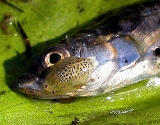
Branchiura, commonly called carp lice or fish lice are a group of parasitic crustacean
Crustacean

Crustaceans are a large group of arthropods, comprising almost 52,000 described species , and are usually treated as a subphylum . They include various familiar animals, such as crabs, lobsters, crayfish, shrimp, krill and barnacles....
s of uncertain position within the Maxillopoda
Maxillopoda

Maxillopoda is a class under the phylum Arthropoda, subphylum Crustacea, and is characterised by a reduction of the abdomen and its appendages....
. Although they are thought to be primitive
Primitive

Primitive is a subjective label used to imply that one thing is less "sophisticated" or less "advanced" than some other thing. Being a comparative word it is also relative in nature....
 forms, they have no fossil record. Almost all are ectoparasites on fish
Fish

A fish is any marine biology vertebrate animal that is typically ectothermic , covered with scale , and equipped with two sets of paired fins and several unpaired fins....
, with a few exceptions living on amphibian
Amphibian

Amphibians , such as frogs, toads, salamanders, newts and caecilians, are cold-blooded animals that metamorphose from a juvenile, water-breathing form to an adult, air-breathing form....
s .

Branchiurans have a flattened, oval
Oval

An oval is any curve resembling an egg or an ellipse but may also refer to:* A sporting arena of oval shape** a cricket field** an Australian rules football field...
 body, which is almost entirely covered by a wide carapace
Carapace

A carapace is a Dorsum section of the exoskeleton or shell in a number of animal groups, including arthropods such as crustaceans and arachnids as well as vertebrates such as chelonians, order Testudines, turtles and tortoises....
. The compound eyes are prominent, and the mouthparts
Mouthparts

The mouthparts of arthropods have evolution into a number of forms, each adaptation to a different style or mode of feeding. Most mouthparts represent modified, paired appendages, which in ancestral forms would have appeared more like legs than mouthparts....
 and antennae
Antenna (biology)

Antennae are paired appendages connected to the front-most morphogenesis of arthropods. In crustaceans, they are biramous and present on the first two segments of the head, with the smaller pair known as antennules....
 are modified to form a hooked, spiny proboscis
Proboscis

In general, a proboscis is an elongated appendage from the head of an animal, either a vertebrate or an invertebrate..The correct Greek plural is proboscides, but in English it is more common to simply add -es, forming proboscises....
 armed with sucker
Sucker

Sucker may refer to:* Lollipop or sucker, a type of confection* Basal shoot or sucker, a shoot or cane that grows from the base of a tree or shrub...
s, as an adaptation
Adaptation

Adaptation is the process, which takes place under natural selection, whereby an organism becomes better suited to its habitat. Also, the term may refer to some characteristic which stands out as being especially significant in the organism's survival....
 to parasitic life.


Discussion
Ask a question about 'Branchiura'
Start a new discussion about 'Branchiura'
Answer questions from other users
Full Discussion Forum


Encyclopedia


Branchiura, commonly called carp lice or fish lice are a group of parasitic crustacean
Crustacean

Crustaceans are a large group of arthropods, comprising almost 52,000 described species , and are usually treated as a subphylum . They include various familiar animals, such as crabs, lobsters, crayfish, shrimp, krill and barnacles....
s of uncertain position within the Maxillopoda
Maxillopoda

Maxillopoda is a class under the phylum Arthropoda, subphylum Crustacea, and is characterised by a reduction of the abdomen and its appendages....
. Although they are thought to be primitive
Primitive

Primitive is a subjective label used to imply that one thing is less "sophisticated" or less "advanced" than some other thing. Being a comparative word it is also relative in nature....
 forms, they have no fossil record. Almost all are ectoparasites on fish
Fish

A fish is any marine biology vertebrate animal that is typically ectothermic , covered with scale , and equipped with two sets of paired fins and several unpaired fins....
, with a few exceptions living on amphibian
Amphibian

Amphibians , such as frogs, toads, salamanders, newts and caecilians, are cold-blooded animals that metamorphose from a juvenile, water-breathing form to an adult, air-breathing form....
s .

Branchiurans have a flattened, oval
Oval

An oval is any curve resembling an egg or an ellipse but may also refer to:* A sporting arena of oval shape** a cricket field** an Australian rules football field...
 body, which is almost entirely covered by a wide carapace
Carapace

A carapace is a Dorsum section of the exoskeleton or shell in a number of animal groups, including arthropods such as crustaceans and arachnids as well as vertebrates such as chelonians, order Testudines, turtles and tortoises....
. The compound eyes are prominent, and the mouthparts
Mouthparts

The mouthparts of arthropods have evolution into a number of forms, each adaptation to a different style or mode of feeding. Most mouthparts represent modified, paired appendages, which in ancestral forms would have appeared more like legs than mouthparts....
 and antennae
Antenna (biology)

Antennae are paired appendages connected to the front-most morphogenesis of arthropods. In crustaceans, they are biramous and present on the first two segments of the head, with the smaller pair known as antennules....
 are modified to form a hooked, spiny proboscis
Proboscis

In general, a proboscis is an elongated appendage from the head of an animal, either a vertebrate or an invertebrate..The correct Greek plural is proboscides, but in English it is more common to simply add -es, forming proboscises....
 armed with sucker
Sucker

Sucker may refer to:* Lollipop or sucker, a type of confection* Basal shoot or sucker, a shoot or cane that grows from the base of a tree or shrub...
s, as an adaptation
Adaptation

Adaptation is the process, which takes place under natural selection, whereby an organism becomes better suited to its habitat. Also, the term may refer to some characteristic which stands out as being especially significant in the organism's survival....
 to parasitic life. They leave their hosts for up to three weeks in order to mate and lay eggs, and reattach afterwards behind the fish's operculum
Operculum (fish)

The operculum of a Osteichthyes is the hard bony flap covering and protecting the gills. In most fish, the rear edge of the operculum roughly marks the division between the head and the body....
, where they feed on mucus
Mucus

In vertebrates, mucus is a slippery secretion produced by, and covering, mucous membranes. It is a viscous colloid containing antiseptic enzymes and immunoglobulins that serves to protect Epithelium in the respiratory,...
 and sloughed-off scales
Scale (zoology)

In most biology nomenclature, a scale is a small rigid plate that grows out of an animal's skin to provide protection. In lepidopteran species, scales are plates on the surface of the insect wing, and provide coloration....
, or pierce the skin and feed on the internal fluids 

The subclass contains a single order
Order (biology)

In Biological classification used in biology, the order is a taxonomic rank between class and family . The superorder is a rank between class and order....
, Arguloida (occasionally "Arguloidea"), which contains a single family, Argulidae , with around 200 species
Species

In biology, a species is one of the basic units of biological classification and a taxonomic rank. A species is often defined as a group of organisms capable of interbreeding and producing fertile offspring....
 , although a second family, Dipteropeltidae has been proposed by some .


List of species

This is a list of species names that have been applied to species described in the Order Arguloida; however, many of the names are now considered to be invalid, or are synonyms
Synonym (taxonomy)

In scientific nomenclature, synonyms are different scientific names used for a single taxon. Usage and terminology are different for zoology and botany....
 of other species names. Only the genera Argulus, Chonopeltis and Dolops are recognised today. The taxonomy of several species, especially in the genus Argulus, continues to be studied :
  • Agenor purpureus Risso, 1826
  • Argulus africanus Thiele, 1900
  • Argulus alexandrensis WilsonCB, 1923
  • Argulus alosae Gould, 1841
  • Argulus amazonicus Malta & Santos-Silva, 1986
  • Argulus ambloplites WilsonCB, 1920
  • Argulus americanus WilsonCB, 1902
  • Argulus angusticeps Cunnington, 1913
  • Argulus annae Schuurmans StekhovenJHJr, 1951
  • Argulus appendiculosus WilsonCB, 1907
  • Argulus arcassonensis Cuénot, 1912
  • Argulus argulus Leach, 1814
  • Argulus armiger MüllerOF, 1785
  • Argulus australiensis Byrnes, 1985
  • Argulus belones Kampen, 1909
  • Argulus bengalensis Ramakrishna, 1951
  • Argulus bicolor Bere, 1936
  • Argulus biramosus Bere, 1931
  • Argulus boli Tripathi, 1975
  • Argulus borealis WilsonCB, 1912
  • Argulus brachypeltis Fryer, 1959
  • Argulus caecus WilsonCB, 1922
  • Argulus canadensis WilsonCB, 1916
  • Argulus capensis Barnard, 1955
  • Argulus carteri Cunnington, 1931
  • Argulus catostomi Dana & Herrick, 1837
  • Argulus cauveriensis Thomas & Devaraj, 1975
  • Argulus charon MüllerOF, 1785
  • Argulus chesapeakensis Cressey, 1971
  • Argulus chicomendesi Malta & Varella, 2000
  • Argulus chilensis Martinez, 1952
  • Argulus chinensis Ku & Yang, 1955
  • Argulus chromidis Kroyer, 1863
  • Argulus confuscus Rushton-Mellor, 1994
  • Argulus coregoni Thorell, 1865
  • Argulus cubensis WilsonCB, 1936
  • Argulus dactylopteri Thorell, 1865
  • Argulus dageti Dollfus, 1960
  • Argulus dartevellei Brian, 1940
  • Argulus delphinus MüllerOF, 1785
  • Argulus diversicolor Byrnes, 1985
  • Argulus diversus WilsonCB, 1944
  • Argulus ellipticaudatus WangKN, 1960
  • Argulus elongatus Heller, 1857
  • Argulus ernsti Weibezahn & Cobo, 1964
  • Argulus exiguus Cunnington, 1913
  • Argulus flavescens WilsonCB, 1916
  • Argulus floridensis Meehan, 1940
  • Argulus fluviatilis Thomas & Devaraj, 1975
  • Argulus foliaceus (Linnaeus), 1758
  • Argulus fryeri Rushton-Mellor, 1994
  • Argulus funduli Kroyer, 1863
  • Argulus fuscus Bere, 1936
  • Argulus giganteus Lucas, 1845
  • Argulus giordanii Brian, 1959
  • Argulus gracilis Rushton-Mellor, 1994
  • Argulus hylae Lemos de Castro & Gomes-Correa, 1985
  • Argulus ichesi Bouvier, 1910
  • Argulus incisus Cunnington, 1913
  • Argulus indicus Weber, 1892
  • Argulus ingens WilsonCB, 1912
  • Argulus intectus WilsonCB, 1944
  • Argulus izintwala Van AsJG & Van AsLL, 2001
  • Argulus japonicus Thiele, 1900
  • Argulus jollymani Fryer, 1956
  • Argulus juparanensis Lemos de Castro, 1950
  • Argulus kosus Avenant-Oldewage, 1994
  • Argulus kunmingensis Shen, 1948
  • Argulus kusafugu Yamaguti & Yamasu, 1959
  • Argulus laticauda SmithSI, 1874
  • Argulus latus SmithSI, 1874
  • Argulus lepidostei Kellicott, 1877
  • Argulus longicaudatus WilsonCB, 1944
  • Argulus lunatus WilsonCB, 1944
  • Argulus macropterus Heegaard, 1962
  • Argulus maculosus WilsonCB, 1902
  • Argulus major WangKN, 1960
  • Argulus mangalorensis Natarajan, 1982
  • Argulus matritensis Arevalo, 1921
  • Argulus matuii Sikama, 1938
  • Argulus meehani Cressey, 1971
  • Argulus megalops SmithSI, 1874
  • Argulus megalops spinosus WilsonCB, 1944
  • Argulus melanostictus WilsonCB, 1935
  • Argulus melita Beneden, 1891
  • Argulus mexicanus Pineda, Paramo & del Rio, 1995
  • Argulus mississippiensis WilsonCB, 1916
  • Argulus mongolianus Tokioka, 1939
  • Argulus monodi Fryer, 1959
  • Argulus multicolor Schuurmans StekhovenJHJr, 1937
  • Argulus multipocula Barnard, 1955
  • Argulus nativus Kirtisinghe, 1959
  • Argulus natterei Heller, 1857
  • Argulus niger WilsonCB, 1902
  • Argulus nobilis Thiele, 1904
  • Argulus onodai Tokioka, 1936
  • Argulus otolithi Brian, 1927
  • Argulus papuensis Rushton-Mellor, 1994
  • Argulus paranensis Ringuelet, 1943
  • Argulus parsi Tripathi, 1975
  • Argulus paulensis WilsonCB, 1924
  • Argulus pelucidus Wagler, 1935
  • Argulus personatus Cunnington, 1913
  • Argulus pestifer Ringuelet, 1948
  • Argulus petagonicus Ringuelet, 1943
  • Argulus phoxini Leydig, 1871
  • Argulus piperatus WilsonCB, 1920
  • Argulus pugettensis Dana, 1852
  • Argulus purpureus (Risso), 1826
  • Argulus puthenveliensis Ramakrishna, 1959
  • Argulus quadristriatus Devaraj & Ameer Hamsa, 1977
  • Argulus reticulatus WilsonCB, 1920
  • Argulus rhamdiae WilsonCB, 1936
  • Argulus rhipidiophorus Monod, 1931
  • Argulus rijckmansii Brian, 1940
  • Argulus rothschildi Leigh-Sharpe, 1933
  • Argulus rotundus WilsonCB, 1944
  • Argulus rubescens Cunnington, 1913
  • Argulus rubropunctatus Cunnington, 1913
  • Argulus salminei Kroyer, 1863
  • Argulus salminei argentinensis Brian, 1947
  • Argulus scutiformis Thiele, 1900
  • Argulus shoutedeni Monod, 1928
  • Argulus siamensis WilsonCB, 1926
  • Argulus silvestrii Lahille, 1926
  • Argulus smalei Avenant-Oldewage & Oldewage, 1995
  • Argulus spinulosus Silva, 1980
  • Argulus stizostethii Kellicott, 1880
  • Argulus striatus Cunnington, 1913
  • Argulus taliensis Shen, 1948
  • Argulus tientsinensis Ku & Wang, 1956
  • Argulus trachynoti Brian, 1927
  • Argulus trilineatus WilsonCB, 1904
  • Argulus varians Bere, 1936
  • Argulus versicolor WilsonCB, 1902
  • Argulus vierai Pereira-Fonseca, 1939
  • Argulus violaceus Thomsen, 1925
  • Argulus viridis Nettovich, 1900
  • Argulus vittatus (Rafinesque-Schmaltz), 1814
  • Argulus wilsoni Brian, 1940
  • Argulus yucatanus Poly, 2004
  • Argulus yucatanus Poly, 2005
  • Argulus yuii WangKN, 1958
  • Argulus yunnanensis Shen, 1948
  • Argulus zei Brian, 1924
  • Binoculus bicornutus Risso, 1816
  • Binoculus caudatus Say, 1818
  • Binoculus gasterostei Geoffroy, 1762
  • Binoculus haemisphericus Geoffroy, 1762
  • Binoculus palustris MüllerOF, 1776
  • Binoculus piscinus MüllerOF, 1776
  • Binoculus productus Nordmann, 1832
  • Binoculus salmoneus MüllerOF, 1785
  • Binoculus sexsetaceus Nordmann, 1832
  • Chonopeltis australis Boxshall, 1976
  • Chonopeltis australissumus Fryer, 1977
  • Chonopeltis brevis Fryer, 1961
  • Chonopeltis congicus Fryer, 1959
  • Chonopeltis elongatus Fryer, 1974
  • Chonopeltis flaccifrons Fryer, 1960
  • Chonopeltis fryeri Van As, 1986
  • Chonopeltis inermis Thiele, 1900
  • Chonopeltis inermis schoutedeni Brian, 1940
  • Chonopeltis koki Van As, 1992
  • Chonopeltis lisikili Van AsJG & Van AsLL, 1996
  • Chonopeltis meridionalis Fryer, 1964
  • Chonopeltis minutus Fryer, 1977
  • Chonopeltis schoutedeni Brian, 1940
  • Chonopeltis victori Avenant-Oldewage, 1991
  • Diprosia vittata Rafinsque, 1814
  • Dipteropeltis hirundo Calman, 1912
  • Dolops bidentata (Bouvier), 1899
  • Dolops carvalhoi Lemos de Castro, 1949
  • Dolops discoidalis Bouvier, 1899
  • Dolops doradis (Cornalia), 1860
  • Dolops geayi (Bouvier), 1897
  • Dolops intermedia da Silva, 1978
  • Dolops kollari (Heller), 1857
  • Dolops lacordairei Audouin, 1837
  • Dolops longicauda (Heller), 1857
  • Dolops nana Lemos de Castro, 1950
  • Dolops ranarum (Stuhlmann), 1891
  • Dolops reperta (Bouvier), 1899
  • Dolops striata (Bouvier), 1899
  • Dolops tasmanicus Fryer, 1969
  • Gyropeltis bidentata Bouvier, 1899
  • Gyropeltis doradis Cornalia, 1860
  • Gyropeltis geayi Bouvier, 1897
  • Gyropeltis kollari Heller, 1857
  • Gyropeltis lacordairei Audouin, 1837
  • Gyropeltis longicauda Heller, 1857
  • Gyropeltis ranarum Stuhlmann, 1891
  • Gyropeltis reperta Bouvier, 1899
  • Gyropeltis striata Bouvier, 1899
  • Huargulus chinensis Yü, 1938
  • Moreiriella ribeiroi (Moreira), 1913
  • Ozolus gasterostei Latreille, 1802
  • Talaus ribeiroi Moreira, 1913