


Brain-computer interface

Encyclopedia
A brain–computer interface (BCI), sometimes called a direct neural interface or a brain–machine interface (BMI), is a direct communication pathway between the brain and an external device. BCIs are often aimed at assisting, augmenting, or repairing human cognitive or sensory-motor functions.
Research on BCIs began in the 1970s at the University of California Los Angeles (UCLA) under a grant from the National Science Foundation
, followed by a contract from DARPA. The papers published after this research also mark the first appearance of the expression brain–computer interface in scientific literature.
The field of BCI research and development has since focused primarily on neuroprosthetics applications that aim at restoring damaged hearing, sight and movement. Thanks to the remarkable cortical plasticity
of the brain, signals from implanted prostheses can, after adaptation, be handled by the brain like natural sensor or effector channels.
Following years of animal experimentation, the first neuroprosthetic devices implanted in humans appeared in the mid-1990s.
's discovery of the electrical activity of human brain and the development of electroencephalography
(EEG). In 1924 Berger was the first one who recorded an EEG from a human brain. By analyzing EEGs, Berger was able to identify waves or rhythms which are present in a brain, as the Alpha Wave (8–12 Hz), also known as Berger's Wave.
Berger
's first recording device was very rudimentary. He inserted silver wires under the scalp of his patients. Those were replaced by silver foils which were attached to the patients head by rubber bandages later on.
Berger connected these sensors to a Lippmann capillary electrometer
, with disappointing results. More sophisticated measuring devices such as the Siemens double-coil recording galvanometer, which displayed electric voltages as small as one ten thousandth of a volt, led to success.
Berger analyzed the interrelation of alternations in his EEG wave diagrams with brain diseases. EEGs permitted completely new possibilities for the research of Human brain activities.
concerned with neural prostheses—using artificial devices to replace the function of impaired nervous systems and brain related problems or sensory organs. The most widely used neuroprosthetic device is the cochlear implant
, which, as of 2006, has been implanted in approximately 100,000 people worldwide. There are also several neuroprosthetic devices that aim to restore vision, including retinal implant
s.
The differences between BCIs and neuroprosthetics are mostly in the ways the terms are used: neuroprosthetics typically connect the nervous system to a device, whereas BCIs usually connect the brain (or nervous system) with a computer system. Practical neuroprosthetics can be linked to any part of the nervous system—for example, peripheral nerves—while the term "BCI" usually designates a narrower class of systems which interface with the central nervous system.
The terms are sometimes used interchangeably. Neuroprosthetics and BCIs seek to achieve the same aims, such as restoring sight, hearing, movement, ability to communicate, and even cognitive function. Both use similar experimental methods and surgical techniques.
to operate BCIs to carry out movement. Monkeys have navigated computer cursors on screen and commanded robotic arms to perform simple tasks simply by thinking about the task and without any motor output. In May 2008 photographs that showed a monkey operating a robotic arm with its mind at the Pittsburgh University Medical Center were published in a number of well known science journals and magazines. Other research on cats has decoded visual signals.
studies of Fetz and colleagues first showed that monkeys could learn to control the deflection of a biofeedback
meter arm with neural activity. Such work in the 1970s established that monkeys could quickly learn to voluntarily control the firing rates of individual and multiple neurons in the primary motor cortex
if they were rewarded for generating appropriate patterns of neural activity.
Studies that developed algorithms to reconstruct movements from motor cortex
neurons, which control movement, date back to the 1970s. In the 1980s, Apostolos Georgopoulos at Johns Hopkins University found a mathematical relationship between the electrical responses of single motor-cortex neurons in rhesus macaque monkeys
and the direction that monkeys moved their arms (based on a cosine function). He also found that dispersed groups of neurons in different areas of the brain collectively controlled motor commands but was only able to record the firings of neurons in one area at a time because of technical limitations imposed by his equipment.
There has been rapid development in BCIs since the mid-1990s. Several groups have been able to capture complex brain motor centre signals using recordings from neural ensemble
s (groups of neurons) and use these to control external devices, including research groups led by Richard Andersen, John Donoghue
, Phillip Kennedy, Miguel Nicolelis
, and Andrew Schwartz.
In 1999, researchers led by Yang Dan at University of California, Berkeley
decoded neuronal firings to reproduce images seen by cats. The team used an array of electrodes embedded in the thalamus
(which integrates all of the brain’s sensory input) of sharp-eyed cats. Researchers targeted 177 brain cells in the thalamus lateral geniculate nucleus
area, which decodes signals from the retina. The cats were shown eight short movies, and their neuron firings were recorded. Using mathematical filters, the researchers decoded the signals to generate movies of what the cats saw and were able to reconstruct recognizable scenes and moving objects. Similar results in humans have since been achieved by researchers in Japan (see below).
Miguel Nicolelis
has been a prominent proponent of using multiple electrodes spread over a greater area of the brain to obtain neuronal signals to drive a BCI. Such neural ensemble
s are said to reduce the variability in output produced by single electrodes, which could make it difficult to operate a BCI.
After conducting initial studies in rats during the 1990s, Nicolelis and his colleagues developed BCIs that decoded brain activity in owl monkeys
and used the devices to reproduce monkey movements in robotic arms. Monkeys have advanced reaching and grasping abilities and good hand manipulation skills, making them ideal test subjects for this kind of work.
By 2000, the group succeeded in building a BCI that reproduced owl monkey movements while the monkey operated a joystick or reached for food. The BCI operated in real time and could also control a separate robot remotely over Internet protocol. But the monkeys could not see the arm moving and did not receive any feedback, a so-called open-loop
BCI.
Later experiments by Nicolelis using rhesus monkeys succeeded in closing the feedback loop and reproduced monkey reaching and grasping movements in a robot arm. With their deeply cleft and furrowed brains, rhesus monkeys are considered to be better models for human neurophysiology
than owl monkeys. The monkeys were trained to reach and grasp objects on a computer screen by manipulating a joystick while corresponding movements by a robot arm were hidden. The monkeys were later shown the robot directly and learned to control it by viewing its movements. The BCI used velocity predictions to control reaching movements and simultaneously predicted hand gripping force.
Other labs that develop BCIs and algorithms that decode neuron signals include John Donoghue from Brown University, Andrew Schwartz from the University of Pittsburgh
and Richard Andersen from Caltech. These researchers were able to produce working BCIs even though they recorded signals from far fewer neurons than Nicolelis (15–30 neurons versus 50–200 neurons).
Donoghue's group reported training rhesus monkeys to use a BCI to track visual targets on a computer screen with or without assistance of a joystick (closed-loop BCI). Schwartz's group created a BCI for three-dimensional tracking in virtual reality and also reproduced BCI control in a robotic arm. The group created headlines when they demonstrated that a monkey could feed itself pieces of fruit and marshmallows using a robotic arm controlled by the animal's own brain signals.
Andersen's group used recordings of premovement activity
from the posterior parietal cortex in their BCI, including signals created when experimental animals anticipated receiving a reward.
In addition to predicting kinematic and kinetic
parameters of limb movements, BCIs that predict electromyographic
or electrical activity of muscles are being developed. Such BCIs could be used to restore mobility in paralyzed limbs by electrically stimulating muscles.
Miguel Nicolelis et al. showed that activity of large neural ensembles can predict arm position. This work made possible creation of brain–machine interfaces—electronic devices that read arm movement intentions and translate them into movements of artificial actuators. Carmena et al. programmed the neural coding in a brain–machine interface allowed a monkey to control reaching and grasping movements by a robotic arm, and Lebedev et al. argued that brain networks reorganize to create a new representation of the robotic appendage in addition to the representation of the animal's own limbs.
The biggest impediment of BCI technology at present is the lack of a sensor modality that provides safe, accurate, and robust access to brain signals. It is conceivable or even likely that such a sensor will be developed within the next twenty years. The use of such a sensor should greatly expand the range of communication functions that can be provided using a BCI.
Development and implementation of a Brain–Computer Interface (BCI) system is complex and time consuming. In response to this problem, Dr. Gerwin Schalk has been developing a general-purpose system for BCI research, called BCI2000. BCI2000 has been in development since 2000 in a project led by the Brain–Computer Interface R&D Program at the Wadsworth Center of the New York State Department of Health in Albany, New York, USA.
A new 'wireless' approach uses light-gated ion channels such as Channelrhodopsin
to control the activity of genetically defined subsets of neurons in vivo. In the context of a simple learning task, illumination of transfected cells in the somatosensory cortex influenced the decision making process of freely moving mice.
The Annual BCI Award, endowed with 3,000 USD, is an accolade to recognize outstanding and innovative research done in the field of Brain-Computer Interfaces. Each year, a renowned research laboratory is asked to judge the submitted projects and to award the prize. The jury consists of world-leading BCI experts recruited by the awarding laboratory. Cuntai Guan, Kai Keng Ang, Karen Sui Geok Chua, Beng Ti Ang from A*STAR in Singapore with the project "Motor imagery-based Brain-Computer Interface robotic rehabilitation for stroke" won the BCI Award 2010. Moritz Grosse-Wentrup, Bernhard Schölkopf from the Max Planck Institute for Intelligent Systems in Germany with the project "What are the neuro-physiological causes of performance variations in brain-computer interfacing?" won the BCI Award 2011.
of the brain during neurosurgery. As they rest in the grey matter, invasive devices produce the highest quality signals of BCI devices but are prone to scar-tissue
build-up, causing the signal to become weaker or even lost as the body reacts to a foreign object in the brain.
In vision science
, direct brain implant
s have been used to treat non-congenital (acquired) blindness. One of the first scientists to come up with a working brain interface to restore sight was private researcher William Dobelle
.
Dobelle's first prototype was implanted into "Jerry", a man blinded in adulthood, in 1978. A single-array BCI containing 68 electrodes was implanted onto Jerry’s visual cortex
and succeeded in producing phosphenes, the sensation of seeing light. The system included cameras mounted on glasses to send signals to the implant. Initially, the implant allowed Jerry to see shades of grey in a limited field of vision at a low frame-rate. This also required him to be hooked up to a two-ton mainframe, but shrinking electronics and faster computers made his artificial eye more portable and now enable him to perform simple tasks unassisted.
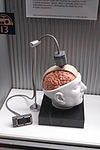 In 2002, Jens Naumann, also blinded in adulthood, became the first in a series of 16 paying patients to receive Dobelle’s second generation implant, marking one of the earliest commercial uses of BCIs. The second generation device used a more sophisticated implant enabling better mapping of phosphenes into coherent vision. Phosphenes are spread out across the visual field in what researchers call the starry-night effect. Immediately after his implant, Jens was able to use his imperfectly restored vision to drive slowly around the parking area of the research institute.
BCIs focusing on motor neuroprosthetics aim to either restore movement in individuals with paralysis or provide devices to assist them, such as interfaces with computers or robot arms.
Researchers at Emory University in Atlanta led by Philip Kennedy and Roy Bakay were first to install a brain implant in a human that produced signals of high enough quality to simulate movement. Their patient, Johnny Ray (1944–2002), suffered from ‘locked-in syndrome
’ after suffering a brain-stem stroke
in 1997. Ray’s implant was installed in 1998 and he lived long enough to start working with the implant, eventually learning to control a computer cursor; he died in 2002 of a brain aneurysm.
Tetraplegic Matt Nagle
became the first person to control an artificial hand using a BCI in 2005 as part of the first nine-month human trial of Cyberkinetics Neurotechnology’s BrainGate
chip-implant. Implanted in Nagle’s right precentral gyrus (area of the motor cortex for arm movement), the 96-electrode BrainGate
implant allowed Nagle to control a robotic arm by thinking about moving his hand as well as a computer cursor, lights and TV. One year later, professor Jonathan Wolpaw received the prize of the Altran Foundation for Innovation
to develop a Brain Computer Interface with electrodes located on the surface of the skull, instead of directly in the brain.
Electrocorticography
(ECoG) measures the electrical activity of the brain taken from beneath the skull in a similar way to non-invasive electroencephalography (see below), but the electrodes are embedded in a thin plastic pad that is placed above the cortex, beneath the dura mater
. ECoG technologies were first trialed in humans in 2004 by Eric Leuthardt and Daniel Moran from Washington University in St Louis. In a later trial, the researchers enabled a teenage boy to play Space Invaders
using his ECoG implant. This research indicates that control is rapid, requires minimal training, and may be an ideal tradeoff with regards to signal fidelity and level of invasiveness.
(Note: These electrodes were not implanted in the patients for BCI experiments. The patient was suffering from severe epilepsy
and had the electrodes temporarily implanted to help his physicians localize seizure foci; the researchers simply took advantage of this.)
Light Reactive Imaging BCI devices are still in the realm of theory. These would involve implanting a laser
inside the skull. The laser would be trained on a single neuron and the neuron's reflectance measured by a separate sensor. When the neuron fires, the laser light pattern and wavelengths it reflects would change slightly. This would allow researchers to monitor single neurons but require less contact with tissue and reduce the risk of scar-tissue build-up.
This signal can be either subdural or epidural, but is not taken from within the brain parenchyma itself. It has not been studied extensively until recently due to the limited access of subjects. Currently, the only manner to acquire the signal for study is through the use of patients requiring invasive monitoring for localization and resection of an epileptogenic focus.
ECoG is a very promising intermediate BCI modality because it has higher spatial resolution, better signal-to-noise ratio, wider frequency range, and lesser training requirements than scalp-recorded EEG, and at the same time has lower technical difficulty, lower clinical risk, and probably superior long-term stability than intracortical single-neuron recording. This feature profile and recent evidence of the high level of control with minimal training requirements shows potential for real world application for people with motor disabilities.
technologies as interfaces. Signals recorded in this way have been used to power muscle implants and restore partial movement in an experimental volunteer. Although they are easy to wear, non-invasive implants produce poor signal resolution because the skull dampens signals, dispersing and blurring the electromagnetic waves created by the neurons. Although the waves can still be detected it is more difficult to determine the area of the brain that created them or the actions of individual neurons.
(EEG) is the most studied potential non-invasive interface, mainly due to its fine temporal resolution
, ease of use, portability and low set-up cost. But as well as the technology's susceptibility to noise
, another substantial barrier to using EEG as a brain–computer interface is the extensive training required before users can work the technology. For example, in experiments beginning in the mid-1990s, Niels Birbaumer of the University of Tübingen in Germany trained severely paralysed people to self-regulate the slow cortical potentials in their EEG to such an extent that these signals could be used as a binary signal to control a computer cursor. (Birbaumer had earlier trained epileptics
to prevent impending fits by controlling this low voltage wave.) The experiment saw ten patients trained to move a computer cursor by controlling their brainwaves. The process was slow, requiring more than an hour for patients to write 100 characters with the cursor, while training often took many months.
Another research parameter is the type of waves measured. Birbaumer's later research with Jonathan Wolpaw at New York State University has focused on developing technology that would allow users to choose the brain signals they found easiest to operate a BCI, including mu
and beta
rhythms.
A further parameter is the method of feedback used and this is shown in studies of P300
signals. Patterns of P300 waves are generated involuntarily (stimulus-feedback
) when people see something they recognize and may allow BCIs to decode categories of thoughts without training patients first. By contrast, the biofeedback methods described above require learning to control brainwaves so the resulting brain activity can be detected.
Lawrence Farwell
and Emanuel Donchin developed an EEG-based brain–computer interface in the 1980s. Their "mental prosthesis" used the P300 brainwave response to allow subjects, including one paralyzed Locked-In syndrome
patient, to communicate words, letters, and simple commands to a computer and thereby to speak through a speech synthesizer driven by the computer. A number of similar devices have been developed since then. In 2000, for example, research by Jessica Bayliss at the University of Rochester showed that volunteers wearing virtual reality helmets could control elements in a virtual world using their P300 EEG readings, including turning lights on and off and bringing a mock-up car to a stop.
In the early 90s Babak Taheri, at UC DAVIS demonstrated the first single and also multichannel dry active electrode arrays using micro-machining. The single channel dry EEG electrode construction and results were published in 1994. The arrayed electrode was also demonstrated to perform well compared to Ag/AgCl electrodes. The device consisted of four sites of sensors with integrated electronics to reduce noise by impedance matching. The advantages of such electrodes are: (1) no electrolyte used, (2) no skin preparation, (3) significantly reduced sensor size, and (4) compatibility with EEG monitoring systems. The active electrode array is an integrated system made of an array of capacitive sensors with local integrated circuitry housed in a package with batteries to power the circuitry. This level of integration was required to achieve the functional performance obtained by the electrode. The electrode was tested on an electrical test bench and on human subjects in four modalities of EEG activity, namely: (1) spontaneous EEG, (2) sensory event-related potentials, (3) brain stem potentials, and (4) cognitive event-related potentials. The performance of the dry electrode compared favorably with that of the standard wet Ag/AgCl electrodes in terms of skin preparation, no gel requirements (dry), and higher signal-to-noise ratio.
In 1999, researchers at Case Western Reserve University
led by Hunter Peckham, used 64-electrode EEG skullcap to return limited hand movements to quadriplegic Jim Jatich. As Jatich concentrated on simple but opposite concepts like up and down, his beta-rhythm EEG output was analysed using software to identify patterns in the noise. A basic pattern was identified and used to control a switch: Above average activity was set to on, below average off. As well as enabling Jatich to control a computer cursor the signals were also used to drive the nerve controllers embedded in his hands, restoring some movement.
Electronic neural networks
have been deployed which shift the learning phase from the user to the computer. Experiments by scientists at the Fraunhofer Society
in 2004 using neural networks led to noticeable improvements within 30 minutes of training.
Experiments by Eduardo Miranda
aim to use EEG recordings of mental activity associated with music to allow the disabled to express themselves musically through an encephalophone
.
Ramaswamy Palaniappan has pioneered the development of BCI for use as biometrics to identify/authenticate a person. The BCI group at University of Essex has also developed analogue cursor control using thoughts.
The Emotiv
company has been selling a commercial video game controller, known as the Epoc, since December 2009. The Epoc uses electromagnetic sensors.
The first BCI session with 100% accuracy (based on 80 right hand and 80 left hand movement imaginations) was recorded in 1998 by Christoph Guger. The BCI system used 27 electrodes overlaying the sensorimotor cortex, weighted the electrodes with Common Spatial Patterns, calculated the running variance and used a linear discriminant analysis.
Research is ongoing into military use of BCIs. Since the 1970s DARPA is funding research on this topic. The current idea is user-to-user communication through analysis of neural signals. The project "Silent Talk" aims to detect and analyze the word-specific neural signals, using EEG, which occur before speech is vocalized, and to see if the patterns are generalizable.
(MEG) and functional magnetic resonance imaging
(fMRI) have both been used successfully as non-invasive BCIs. In a widely reported experiment, fMRI allowed two users being scanned to play Pong
in real-time by altering their haemodynamic response
or brain blood flow through biofeedback
techniques.
fMRI measurements of haemodynamic responses in real time have also been used to control robot arms with a seven second delay between thought and movement.
In 2008, research developed in the Advanced Telecommunications Research (ATR) Computational Neuroscience
Laboratories in Kyoto
, Japan allowed the scientists to reconstruct images directly from the brain and display them on a computer. The article announcing these achievements was the cover story
of the journal Neuron
of 10 December 2008, While the early results are limited to black and white images of 10x10 squares (pixel
s), according to the researchers further development of the technology may make it possible to achieve color images, and even view or record dreams.
In 2011, researchers from UC Berkeley
published a study reporting second-by-second reconstruction of videos watched by the study's subjects, from fMRI data. This was achieved by creating a statistical model relating visual patterns in videos shown to the subjects, to the brain activity caused by watching the videos. This model was then used to look up the 100 one-second video segments, in a database of 18 million seconds of random YouTube videos, whose visual patterns most closely matched the brain activity recorded when subjects watched a new video. These 100 one-second video extracts were then combined into a mashed-up image that resembled the video being watched.
. The company markets its electrode arrays under the BrainGate
product name and has set the development of practical BCIs for humans as its major goal. The BrainGate is based on the Utah Array developed by Dick Normann.
Philip Kennedy founded Neural Signals in 1987 to develop BCIs that would allow paralysed patients to communicate with the outside world and control external devices. As well as an invasive BCI, the company also sells an implant to restore speech. Neural Signals' Brain Communicator BCI device uses glass cones containing microelectrodes coated with proteins to encourage the electrodes to bind to neurons.
Although 16 paying patients were treated using William Dobelle's
vision BCI, new implants ceased within a year of Dobelle's death in 2004. A company controlled by Dobelle, Avery Biomedical Devices, and Stony Brook University are continuing development of the implant, which has not yet received Food and Drug Administration approval in the United States for human implantation.
Ambient, at a TI developers conference in early 2008, demoed a product they have in development call The Audeo. The Audeo is being developed to create a human–computer interface for communication without the need of physical motor control or speech production. Using signal processing, unpronounced speech representing the thought of the mind can be translated from intercepted neurological signals.
Mindball
is a product developed and commercialized by Interactive Productline in which players compete to control a ball's movement across a table by becoming more relaxed and focused. Interactive Productline is a Swedish company whose objective is to develop and sell easy understandable EEG products that train the ability to relax and focus.
An Austrian company, Guger Technologies, g.tec, has been offering Brain Computer Interface systems since 1999. The company provides base BCI models as development platforms for the research community to build upon, including the P300 Speller, Motor Imagery, and mu-rhythm. They commercialized a Steady State Visual Evoked Potiential BCI solution in 2008 with 4 degrees of machine control.
A Spanish company, Starlab, has entered this market in 2009 with a wireless 4-channel system called Enobio
. Designed for research purposes the system provides a platform for application development.
There are three main consumer-devices commercial-competitors in this area (launch date mentioned in brackets) which have launched such devices primarily for gaming- and PC-users:
2010 the world's first personal EEG-based spelling system came to the market: intendiX. It works with 8 active EEG electrodes and uses the P300 principle to type on a keyboard like matrix. Besides writing a text the patient can also use the system to trigger an alarm, let the computer speak the written text, print out or copy the text into an e-mail or to send commands to external devices.
Recently g.tec developed active dry electrodes that work for P300, SSVEP and motor imagery based BCI systems: g.SAHARA.
s.
Development of the first working neurochip was claimed by a Caltech team led by Jerome Pine and Michael Maher in 1997. The Caltech chip had room for 16 neurons.
In 2003, a team led by Theodore Berger at the University of Southern California started work on a neurochip designed to function as an artificial or prosthetic hippocampus
. The neurochip was designed to function in rat brains and is intended as a prototype for the eventual development of higher-brain prosthesis. The hippocampus was chosen because it is thought to be the most ordered and structured part of the brain and is the most studied area. Its function is to encode experiences for storage as long-term memories elsewhere in the brain.
Thomas DeMarse at the University of Florida used a culture of 25,000 neurons taken from a rat's brain to fly a F-22 fighter jet aircraft simulator. After collection, the cortical neurons were cultured in a petri dish
and rapidly began to reconnect themselves to form a living neural network. The cells were arranged over a grid of 60 electrodes and used to control the pitch and yaw functions of the simulator. The study's focus was on understanding how the human brain performs and learns computational tasks at a cellular level.
of BCIs, even though there are several commercially available systems such as brain pacemaker
s used to treat neurological conditions, and could theoretically be used to modify other behaviours.
Important topics in the neuroethical debate are:
Emory University
neuroscience professor Michael Crutcher has expressed concern about BCIs, specifically ear and eye implants: "If only the rich can afford it, it puts everyone else at a disadvantage." Clausen concluded in 2009 that “BCIs pose ethical challenges, but these are conceptually similar to those that bioethicists have addressed for other realms of therapy”. Moreover, he suggests that bioethics is well-prepared to deal with the issues that arise with BCI technologies. Haselager and colleagues pointed out that expectations of BCI efficacy and value play a great role in ethical analysis and the way BCI scientists should approach media. Furthermore, standard protocols can be implemented to ensure ethically sound informed-consent procedures with locked-in patients.
Researchers are well aware that sound ethical guidelines, appropriately moderated enthusiasm in media coverage and education about BCI systems will be of utmost importance for the societal acceptance of this technology. Thus, recently more effort is made inside the BCI community to create consensus on ethical guidelines for BCI research, development and dissemination.
. See brain implants in fiction and philosophy for a review of this literature.
Research on BCIs began in the 1970s at the University of California Los Angeles (UCLA) under a grant from the National Science Foundation
National Science Foundation
The National Science Foundation is a United States government agency that supports fundamental research and education in all the non-medical fields of science and engineering. Its medical counterpart is the National Institutes of Health...
, followed by a contract from DARPA. The papers published after this research also mark the first appearance of the expression brain–computer interface in scientific literature.
The field of BCI research and development has since focused primarily on neuroprosthetics applications that aim at restoring damaged hearing, sight and movement. Thanks to the remarkable cortical plasticity
Neuroplasticity
Neuroplasticity is a non-specific neuroscience term referring to the ability of the brain and nervous system in all species to change structurally and functionally as a result of input from the environment. Plasticity occurs on a variety of levels, ranging from cellular changes involved in...
of the brain, signals from implanted prostheses can, after adaptation, be handled by the brain like natural sensor or effector channels.
Following years of animal experimentation, the first neuroprosthetic devices implanted in humans appeared in the mid-1990s.
History
The history of brain–computer interfaces (BCIs) starts with Hans BergerHans Berger
Hans Berger was born in Neuses near Coburg, Bavaria, Germany. He is best known as the first to record human electroencephalograms in 1924, for which he invented the electroencephalogram , and the discoverer of the alpha wave rhythm known as "Berger's wave".- Biography :After attending...
's discovery of the electrical activity of human brain and the development of electroencephalography
Electroencephalography
Electroencephalography is the recording of electrical activity along the scalp. EEG measures voltage fluctuations resulting from ionic current flows within the neurons of the brain...
(EEG). In 1924 Berger was the first one who recorded an EEG from a human brain. By analyzing EEGs, Berger was able to identify waves or rhythms which are present in a brain, as the Alpha Wave (8–12 Hz), also known as Berger's Wave.
Berger
Berger
- People :Berger is a relatively common last name. It means mountaineer in German, and shepherd in French. The pronunciation of the English name is . Notable people by that name include:-Politics:*James S. Berger , U.S...
's first recording device was very rudimentary. He inserted silver wires under the scalp of his patients. Those were replaced by silver foils which were attached to the patients head by rubber bandages later on.
Berger connected these sensors to a Lippmann capillary electrometer
Lippmann electrometer
A Lippmann electrometer is a device for detecting small rushes of electric current and was invented by Gabriel Lippmann. The device consists of a tube which is thick on one end and very thin on the other. The thin end is designed to act as a capillary tube. The tube is half-filled with mercury with...
, with disappointing results. More sophisticated measuring devices such as the Siemens double-coil recording galvanometer, which displayed electric voltages as small as one ten thousandth of a volt, led to success.
Berger analyzed the interrelation of alternations in his EEG wave diagrams with brain diseases. EEGs permitted completely new possibilities for the research of Human brain activities.
BCI versus neuroprosthetics
Neuroprosthetics is an area of neuroscienceNeuroscience
Neuroscience is the scientific study of the nervous system. Traditionally, neuroscience has been seen as a branch of biology. However, it is currently an interdisciplinary science that collaborates with other fields such as chemistry, computer science, engineering, linguistics, mathematics,...
concerned with neural prostheses—using artificial devices to replace the function of impaired nervous systems and brain related problems or sensory organs. The most widely used neuroprosthetic device is the cochlear implant
Cochlear implant
A cochlear implant is a surgically implanted electronic device that provides a sense of sound to a person who is profoundly deaf or severely hard of hearing...
, which, as of 2006, has been implanted in approximately 100,000 people worldwide. There are also several neuroprosthetic devices that aim to restore vision, including retinal implant
Retinal implant
A retinal implant is a biomedical implant technology currently being developed by a number of private companies and research institutions worldwide. The implant is meant to partially restore useful vision to people who have lost theirs due to degenerative eye conditions such as retinitis...
s.
The differences between BCIs and neuroprosthetics are mostly in the ways the terms are used: neuroprosthetics typically connect the nervous system to a device, whereas BCIs usually connect the brain (or nervous system) with a computer system. Practical neuroprosthetics can be linked to any part of the nervous system—for example, peripheral nerves—while the term "BCI" usually designates a narrower class of systems which interface with the central nervous system.
The terms are sometimes used interchangeably. Neuroprosthetics and BCIs seek to achieve the same aims, such as restoring sight, hearing, movement, ability to communicate, and even cognitive function. Both use similar experimental methods and surgical techniques.
Animal BCI research
Several laboratories have managed to record signals from monkey and rat cerebral corticesCerebral cortex
The cerebral cortex is a sheet of neural tissue that is outermost to the cerebrum of the mammalian brain. It plays a key role in memory, attention, perceptual awareness, thought, language, and consciousness. It is constituted of up to six horizontal layers, each of which has a different...
to operate BCIs to carry out movement. Monkeys have navigated computer cursors on screen and commanded robotic arms to perform simple tasks simply by thinking about the task and without any motor output. In May 2008 photographs that showed a monkey operating a robotic arm with its mind at the Pittsburgh University Medical Center were published in a number of well known science journals and magazines. Other research on cats has decoded visual signals.
Early work
The operant conditioningOperant conditioning
Operant conditioning is a form of psychological learning during which an individual modifies the occurrence and form of its own behavior due to the association of the behavior with a stimulus...
studies of Fetz and colleagues first showed that monkeys could learn to control the deflection of a biofeedback
Biofeedback
Biofeedback is the process of becoming aware of various physiological functions using instruments that provide information on the activity of those same systems, with a goal of being able to manipulate them at will...
meter arm with neural activity. Such work in the 1970s established that monkeys could quickly learn to voluntarily control the firing rates of individual and multiple neurons in the primary motor cortex
Motor cortex
Motor cortex is a term that describes regions of the cerebral cortex involved in the planning, control, and execution of voluntary motor functions.-Anatomy of the motor cortex :The motor cortex can be divided into four main parts:...
if they were rewarded for generating appropriate patterns of neural activity.
Studies that developed algorithms to reconstruct movements from motor cortex
Motor cortex
Motor cortex is a term that describes regions of the cerebral cortex involved in the planning, control, and execution of voluntary motor functions.-Anatomy of the motor cortex :The motor cortex can be divided into four main parts:...
neurons, which control movement, date back to the 1970s. In the 1980s, Apostolos Georgopoulos at Johns Hopkins University found a mathematical relationship between the electrical responses of single motor-cortex neurons in rhesus macaque monkeys
Rhesus Macaque
The Rhesus macaque , also called the Rhesus monkey, is one of the best-known species of Old World monkeys. It is listed as Least Concern in the IUCN Red List of Threatened Species in view of its wide distribution, presumed large population, and its tolerance of a broad range of habitats...
and the direction that monkeys moved their arms (based on a cosine function). He also found that dispersed groups of neurons in different areas of the brain collectively controlled motor commands but was only able to record the firings of neurons in one area at a time because of technical limitations imposed by his equipment.
There has been rapid development in BCIs since the mid-1990s. Several groups have been able to capture complex brain motor centre signals using recordings from neural ensemble
Neural ensemble
A neural ensemble is a population of nervous system cells involved in a particular neural computation.- Background :The concept of neural ensemble dates back to the work of Charles Sherrington who described the functioning of the CNS as the system of reflex arcs, each composed of interconnected...
s (groups of neurons) and use these to control external devices, including research groups led by Richard Andersen, John Donoghue
Cyberkinetics
Cyberkinetics is an American company. It was cofounded by John Donoghue, Mijail Serruya, and Gerhard Friehs of Brown University and Nicho Hatsopoulos of the University of Chicago. The Braingate technology and related Cyberkinetic’s assets are now owned by privately held Braingate, LLC...
, Phillip Kennedy, Miguel Nicolelis
Miguel Nicolelis
Miguel Angelo Laporta Nicolelis, MD, PhD, is a Brazilian physician and scientist, best known for his pioneering work in "reading monkey thought". He and his colleagues implanted electrode arrays into a monkey's brain that were able to detect the monkey's motor intent and thus able to control...
, and Andrew Schwartz.
Prominent research successes
Phillip Kennedy and colleagues built the first intracortical brain–computer interface by implanting neurotrophic-cone electrodes into monkeys.In 1999, researchers led by Yang Dan at University of California, Berkeley
University of California, Berkeley
The University of California, Berkeley , is a teaching and research university established in 1868 and located in Berkeley, California, USA...
decoded neuronal firings to reproduce images seen by cats. The team used an array of electrodes embedded in the thalamus
Thalamus
The thalamus is a midline paired symmetrical structure within the brains of vertebrates, including humans. It is situated between the cerebral cortex and midbrain, both in terms of location and neurological connections...
(which integrates all of the brain’s sensory input) of sharp-eyed cats. Researchers targeted 177 brain cells in the thalamus lateral geniculate nucleus
Lateral geniculate nucleus
The lateral geniculate nucleus is the primary relay center for visual information received from the retina of the eye. The LGN is found inside the thalamus of the brain....
area, which decodes signals from the retina. The cats were shown eight short movies, and their neuron firings were recorded. Using mathematical filters, the researchers decoded the signals to generate movies of what the cats saw and were able to reconstruct recognizable scenes and moving objects. Similar results in humans have since been achieved by researchers in Japan (see below).
Miguel Nicolelis
Miguel Nicolelis
Miguel Angelo Laporta Nicolelis, MD, PhD, is a Brazilian physician and scientist, best known for his pioneering work in "reading monkey thought". He and his colleagues implanted electrode arrays into a monkey's brain that were able to detect the monkey's motor intent and thus able to control...
has been a prominent proponent of using multiple electrodes spread over a greater area of the brain to obtain neuronal signals to drive a BCI. Such neural ensemble
Neural ensemble
A neural ensemble is a population of nervous system cells involved in a particular neural computation.- Background :The concept of neural ensemble dates back to the work of Charles Sherrington who described the functioning of the CNS as the system of reflex arcs, each composed of interconnected...
s are said to reduce the variability in output produced by single electrodes, which could make it difficult to operate a BCI.
After conducting initial studies in rats during the 1990s, Nicolelis and his colleagues developed BCIs that decoded brain activity in owl monkeys
Night monkey
The night monkeys, also known as the owl monkeys or douroucoulis, are the members of the genus Aotus of New World monkeys . They are widely distributed in the forests of Central and South America, from Panama south to Paraguay and northern Argentina...
and used the devices to reproduce monkey movements in robotic arms. Monkeys have advanced reaching and grasping abilities and good hand manipulation skills, making them ideal test subjects for this kind of work.
By 2000, the group succeeded in building a BCI that reproduced owl monkey movements while the monkey operated a joystick or reached for food. The BCI operated in real time and could also control a separate robot remotely over Internet protocol. But the monkeys could not see the arm moving and did not receive any feedback, a so-called open-loop
Open-loop
Open-loop may refer to:*Open-loop controller of a dynamical system*Open-loop model in game theory*Open loop rhetorical device...
BCI.
Later experiments by Nicolelis using rhesus monkeys succeeded in closing the feedback loop and reproduced monkey reaching and grasping movements in a robot arm. With their deeply cleft and furrowed brains, rhesus monkeys are considered to be better models for human neurophysiology
Neurophysiology
Neurophysiology is a part of physiology. Neurophysiology is the study of nervous system function...
than owl monkeys. The monkeys were trained to reach and grasp objects on a computer screen by manipulating a joystick while corresponding movements by a robot arm were hidden. The monkeys were later shown the robot directly and learned to control it by viewing its movements. The BCI used velocity predictions to control reaching movements and simultaneously predicted hand gripping force.
Other labs that develop BCIs and algorithms that decode neuron signals include John Donoghue from Brown University, Andrew Schwartz from the University of Pittsburgh
University of Pittsburgh
The University of Pittsburgh, commonly referred to as Pitt, is a state-related research university located in Pittsburgh, Pennsylvania, United States. Founded as Pittsburgh Academy in 1787 on what was then the American frontier, Pitt is one of the oldest continuously chartered institutions of...
and Richard Andersen from Caltech. These researchers were able to produce working BCIs even though they recorded signals from far fewer neurons than Nicolelis (15–30 neurons versus 50–200 neurons).
Donoghue's group reported training rhesus monkeys to use a BCI to track visual targets on a computer screen with or without assistance of a joystick (closed-loop BCI). Schwartz's group created a BCI for three-dimensional tracking in virtual reality and also reproduced BCI control in a robotic arm. The group created headlines when they demonstrated that a monkey could feed itself pieces of fruit and marshmallows using a robotic arm controlled by the animal's own brain signals.
Andersen's group used recordings of premovement activity
Premovement neuronal activity
Premovement neuronal activity in neurophysiological literature refers to neuronal modulations that alter the rate at which neurons fire before a subject produces movement. Through experimentation with multiple animals, predominantly monkeys, it has been shown that several regions of the brain are...
from the posterior parietal cortex in their BCI, including signals created when experimental animals anticipated receiving a reward.
In addition to predicting kinematic and kinetic
Kinetic energy
The kinetic energy of an object is the energy which it possesses due to its motion.It is defined as the work needed to accelerate a body of a given mass from rest to its stated velocity. Having gained this energy during its acceleration, the body maintains this kinetic energy unless its speed changes...
parameters of limb movements, BCIs that predict electromyographic
Electromyography
Electromyography is a technique for evaluating and recording the electrical activity produced by skeletal muscles. EMG is performed using an instrument called an electromyograph, to produce a record called an electromyogram. An electromyograph detects the electrical potential generated by muscle...
or electrical activity of muscles are being developed. Such BCIs could be used to restore mobility in paralyzed limbs by electrically stimulating muscles.
Miguel Nicolelis et al. showed that activity of large neural ensembles can predict arm position. This work made possible creation of brain–machine interfaces—electronic devices that read arm movement intentions and translate them into movements of artificial actuators. Carmena et al. programmed the neural coding in a brain–machine interface allowed a monkey to control reaching and grasping movements by a robotic arm, and Lebedev et al. argued that brain networks reorganize to create a new representation of the robotic appendage in addition to the representation of the animal's own limbs.
The biggest impediment of BCI technology at present is the lack of a sensor modality that provides safe, accurate, and robust access to brain signals. It is conceivable or even likely that such a sensor will be developed within the next twenty years. The use of such a sensor should greatly expand the range of communication functions that can be provided using a BCI.
Development and implementation of a Brain–Computer Interface (BCI) system is complex and time consuming. In response to this problem, Dr. Gerwin Schalk has been developing a general-purpose system for BCI research, called BCI2000. BCI2000 has been in development since 2000 in a project led by the Brain–Computer Interface R&D Program at the Wadsworth Center of the New York State Department of Health in Albany, New York, USA.
A new 'wireless' approach uses light-gated ion channels such as Channelrhodopsin
Channelrhodopsin
Channelrhodopsins are a subfamily of opsin proteins that function as light-gated ion channels. They serve as sensory photoreceptors in unicellular green algae, controlling phototaxis, i.e. movement in response to light. Expressed in cells of other organisms, they enable the use of light to control...
to control the activity of genetically defined subsets of neurons in vivo. In the context of a simple learning task, illumination of transfected cells in the somatosensory cortex influenced the decision making process of freely moving mice.
The Annual BCI Award, endowed with 3,000 USD, is an accolade to recognize outstanding and innovative research done in the field of Brain-Computer Interfaces. Each year, a renowned research laboratory is asked to judge the submitted projects and to award the prize. The jury consists of world-leading BCI experts recruited by the awarding laboratory. Cuntai Guan, Kai Keng Ang, Karen Sui Geok Chua, Beng Ti Ang from A*STAR in Singapore with the project "Motor imagery-based Brain-Computer Interface robotic rehabilitation for stroke" won the BCI Award 2010. Moritz Grosse-Wentrup, Bernhard Schölkopf from the Max Planck Institute for Intelligent Systems in Germany with the project "What are the neuro-physiological causes of performance variations in brain-computer interfacing?" won the BCI Award 2011.
Invasive BCIs
Invasive BCI research has targeted repairing damaged sight and providing new functionality to persons with paralysis. Invasive BCIs are implanted directly into the grey matterGrey matter
Grey matter is a major component of the central nervous system, consisting of neuronal cell bodies, neuropil , glial cells and capillaries. Grey matter contains neural cell bodies, in contrast to white matter, which does not and mostly contains myelinated axon tracts...
of the brain during neurosurgery. As they rest in the grey matter, invasive devices produce the highest quality signals of BCI devices but are prone to scar-tissue
Scar
Scars are areas of fibrous tissue that replace normal skin after injury. A scar results from the biological process of wound repair in the skin and other tissues of the body. Thus, scarring is a natural part of the healing process. With the exception of very minor lesions, every wound results in...
build-up, causing the signal to become weaker or even lost as the body reacts to a foreign object in the brain.
In vision science
Vision science
Vision science is the science dedicated to the interdisciplinary study of visual perception and the visual system. Vision scientists study various aspects of vision from the perspectives of cognitive psychology, neuroscience, computer science, psychophysics, and ophthalmology.- See also :* Visual...
, direct brain implant
Brain implant
Brain implants, often referred to as neural implants, are technological devices that connect directly to a biological subject's brain - usually placed on the surface of the brain, or attached to the brain's cortex...
s have been used to treat non-congenital (acquired) blindness. One of the first scientists to come up with a working brain interface to restore sight was private researcher William Dobelle
William H. Dobelle
William H. Dobelle was a biomedical researcher who developed experimental technologies that restored limited sight to blind patients. In addition, Dobelle is known for the major impact that he and his company have had on the breathing pacemaker and the medical community as a whole. He was...
.
Dobelle's first prototype was implanted into "Jerry", a man blinded in adulthood, in 1978. A single-array BCI containing 68 electrodes was implanted onto Jerry’s visual cortex
Visual cortex
The visual cortex of the brain is the part of the cerebral cortex responsible for processing visual information. It is located in the occipital lobe, in the back of the brain....
and succeeded in producing phosphenes, the sensation of seeing light. The system included cameras mounted on glasses to send signals to the implant. Initially, the implant allowed Jerry to see shades of grey in a limited field of vision at a low frame-rate. This also required him to be hooked up to a two-ton mainframe, but shrinking electronics and faster computers made his artificial eye more portable and now enable him to perform simple tasks unassisted.
BCIs focusing on motor neuroprosthetics aim to either restore movement in individuals with paralysis or provide devices to assist them, such as interfaces with computers or robot arms.
Researchers at Emory University in Atlanta led by Philip Kennedy and Roy Bakay were first to install a brain implant in a human that produced signals of high enough quality to simulate movement. Their patient, Johnny Ray (1944–2002), suffered from ‘locked-in syndrome
Locked-In syndrome
Locked-in syndrome is a condition in which a patient is aware and awake but cannot move or communicate verbally due to complete paralysis of nearly all voluntary muscles in the body except for the eyes. Total locked-in syndrome is a version of locked-in syndrome where the eyes are paralyzed as...
’ after suffering a brain-stem stroke
Stroke
A stroke, previously known medically as a cerebrovascular accident , is the rapidly developing loss of brain function due to disturbance in the blood supply to the brain. This can be due to ischemia caused by blockage , or a hemorrhage...
in 1997. Ray’s implant was installed in 1998 and he lived long enough to start working with the implant, eventually learning to control a computer cursor; he died in 2002 of a brain aneurysm.
Tetraplegic Matt Nagle
Matt Nagle
Matthew Nagle was one of the first persons to use a brain-computer interface to restore functionality lost due to paralysis. He was a C3 tetraplegic, paralyzed from the neck down after being stabbed.-Biography:...
became the first person to control an artificial hand using a BCI in 2005 as part of the first nine-month human trial of Cyberkinetics Neurotechnology’s BrainGate
BrainGate
BrainGate is a brain implant system developed by the bio-tech company Cyberkinetics in 2008 in conjunction with the Department of Neuroscience at Brown University. The Braingate technology and related Cyberkinetic’s assets are now owned by privately held Braingate, LLC...
chip-implant. Implanted in Nagle’s right precentral gyrus (area of the motor cortex for arm movement), the 96-electrode BrainGate
BrainGate
BrainGate is a brain implant system developed by the bio-tech company Cyberkinetics in 2008 in conjunction with the Department of Neuroscience at Brown University. The Braingate technology and related Cyberkinetic’s assets are now owned by privately held Braingate, LLC...
implant allowed Nagle to control a robotic arm by thinking about moving his hand as well as a computer cursor, lights and TV. One year later, professor Jonathan Wolpaw received the prize of the Altran Foundation for Innovation
Altran Foundation for Innovation
The Altran Foundation for Innovation is one of the key vehicles of the societal action of the group Altran Technologies. Since its creation in 1996, it thrives to promote technological innovation for human benefit...
to develop a Brain Computer Interface with electrodes located on the surface of the skull, instead of directly in the brain.
Partially invasive BCIs
Partially invasive BCI devices are implanted inside the skull but rest outside the brain rather than within the grey matter. They produce better resolution signals than non-invasive BCIs where the bone tissue of the cranium deflects and deforms signals and have a lower risk of forming scar-tissue in the brain than fully invasive BCIs.Electrocorticography
Electrocorticography
Electrocorticography is the practice of using electrodes placed directly on the exposed surface of the brain to record electrical activity from the cerebral cortex. ECoG may be performed either in the operating room during surgery or outside of surgery...
(ECoG) measures the electrical activity of the brain taken from beneath the skull in a similar way to non-invasive electroencephalography (see below), but the electrodes are embedded in a thin plastic pad that is placed above the cortex, beneath the dura mater
Dura mater
The dura mater , or dura, is the outermost of the three layers of the meninges surrounding the brain and spinal cord. It is derived from Mesoderm. The other two meningeal layers are the pia mater and the arachnoid mater. The dura surrounds the brain and the spinal cord and is responsible for...
. ECoG technologies were first trialed in humans in 2004 by Eric Leuthardt and Daniel Moran from Washington University in St Louis. In a later trial, the researchers enabled a teenage boy to play Space Invaders
Space Invaders
is an arcade video game designed by Tomohiro Nishikado, and released in 1978. It was originally manufactured and sold by Taito in Japan, and was later licensed for production in the United States by the Midway division of Bally. Space Invaders is one of the earliest shooting games and the aim is to...
using his ECoG implant. This research indicates that control is rapid, requires minimal training, and may be an ideal tradeoff with regards to signal fidelity and level of invasiveness.
(Note: These electrodes were not implanted in the patients for BCI experiments. The patient was suffering from severe epilepsy
Epilepsy
Epilepsy is a common chronic neurological disorder characterized by seizures. These seizures are transient signs and/or symptoms of abnormal, excessive or hypersynchronous neuronal activity in the brain.About 50 million people worldwide have epilepsy, and nearly two out of every three new cases...
and had the electrodes temporarily implanted to help his physicians localize seizure foci; the researchers simply took advantage of this.)
Light Reactive Imaging BCI devices are still in the realm of theory. These would involve implanting a laser
Laser
A laser is a device that emits light through a process of optical amplification based on the stimulated emission of photons. The term "laser" originated as an acronym for Light Amplification by Stimulated Emission of Radiation...
inside the skull. The laser would be trained on a single neuron and the neuron's reflectance measured by a separate sensor. When the neuron fires, the laser light pattern and wavelengths it reflects would change slightly. This would allow researchers to monitor single neurons but require less contact with tissue and reduce the risk of scar-tissue build-up.
This signal can be either subdural or epidural, but is not taken from within the brain parenchyma itself. It has not been studied extensively until recently due to the limited access of subjects. Currently, the only manner to acquire the signal for study is through the use of patients requiring invasive monitoring for localization and resection of an epileptogenic focus.
ECoG is a very promising intermediate BCI modality because it has higher spatial resolution, better signal-to-noise ratio, wider frequency range, and lesser training requirements than scalp-recorded EEG, and at the same time has lower technical difficulty, lower clinical risk, and probably superior long-term stability than intracortical single-neuron recording. This feature profile and recent evidence of the high level of control with minimal training requirements shows potential for real world application for people with motor disabilities.
Non-invasive BCIs
As well as invasive experiments, there have also been experiments in humans using non-invasive neuroimagingNeuroimaging
Neuroimaging includes the use of various techniques to either directly or indirectly image the structure, function/pharmacology of the brain...
technologies as interfaces. Signals recorded in this way have been used to power muscle implants and restore partial movement in an experimental volunteer. Although they are easy to wear, non-invasive implants produce poor signal resolution because the skull dampens signals, dispersing and blurring the electromagnetic waves created by the neurons. Although the waves can still be detected it is more difficult to determine the area of the brain that created them or the actions of individual neurons.
EEG
ElectroencephalographyElectroencephalography
Electroencephalography is the recording of electrical activity along the scalp. EEG measures voltage fluctuations resulting from ionic current flows within the neurons of the brain...
(EEG) is the most studied potential non-invasive interface, mainly due to its fine temporal resolution
Temporal resolution
Temporal resolution refers to the precision of a measurement with respect to time. Often there is a tradeoff between temporal resolution of a measurement and its spatial resolution. This trade-off can be attributed to the finite speed of light and the fact that it takes a certain period of time...
, ease of use, portability and low set-up cost. But as well as the technology's susceptibility to noise
Noise
In common use, the word noise means any unwanted sound. In both analog and digital electronics, noise is random unwanted perturbation to a wanted signal; it is called noise as a generalisation of the acoustic noise heard when listening to a weak radio transmission with significant electrical noise...
, another substantial barrier to using EEG as a brain–computer interface is the extensive training required before users can work the technology. For example, in experiments beginning in the mid-1990s, Niels Birbaumer of the University of Tübingen in Germany trained severely paralysed people to self-regulate the slow cortical potentials in their EEG to such an extent that these signals could be used as a binary signal to control a computer cursor. (Birbaumer had earlier trained epileptics
Epilepsy
Epilepsy is a common chronic neurological disorder characterized by seizures. These seizures are transient signs and/or symptoms of abnormal, excessive or hypersynchronous neuronal activity in the brain.About 50 million people worldwide have epilepsy, and nearly two out of every three new cases...
to prevent impending fits by controlling this low voltage wave.) The experiment saw ten patients trained to move a computer cursor by controlling their brainwaves. The process was slow, requiring more than an hour for patients to write 100 characters with the cursor, while training often took many months.
Another research parameter is the type of waves measured. Birbaumer's later research with Jonathan Wolpaw at New York State University has focused on developing technology that would allow users to choose the brain signals they found easiest to operate a BCI, including mu
Mu wave
Mu waves, also known as the comb or wicket rhythm, are electromagnetic oscillations in the frequency range of 8–13 Hz and appear in bursts of at 9 – 11 Hz. Mu wave patterns arise from synchronous and coherent electrical activity of large groups of neurons in the human brain...
and beta
Beta wave
Beta wave, or beta rhythm, is the term used to designate the frequency range of human brain activity between 12 and 30 Hz . Beta waves are split into three sections: High Beta Waves ; Beta Waves ; and Low Beta Waves...
rhythms.
A further parameter is the method of feedback used and this is shown in studies of P300
P300 (neuroscience)
The P300 wave is an event related potential elicited by infrequent, task-relevant stimuli. It is considered to be an endogenous potential as its occurrence links not to the physical attributes of a stimulus but to a person's reaction to the stimulus. More specifically, the P300 is thought to...
signals. Patterns of P300 waves are generated involuntarily (stimulus-feedback
Event-related potential
An event-related potential is any measured brain response that is directly the result of a thought or perception. More formally, it is any stereotyped electrophysiological response to an internal or external stimulus....
) when people see something they recognize and may allow BCIs to decode categories of thoughts without training patients first. By contrast, the biofeedback methods described above require learning to control brainwaves so the resulting brain activity can be detected.
Lawrence Farwell
Lawrence Farwell
Dr Lawrence Farwell is the inventor of brain fingerprinting which uses a technology that he developed, MERMER. He was formerly a research associate at Harvard University and is currently the chairman and Chief Scientist of Brain Fingerprinting Laboratories, Inc.TIME Magazine named Dr...
and Emanuel Donchin developed an EEG-based brain–computer interface in the 1980s. Their "mental prosthesis" used the P300 brainwave response to allow subjects, including one paralyzed Locked-In syndrome
Locked-In syndrome
Locked-in syndrome is a condition in which a patient is aware and awake but cannot move or communicate verbally due to complete paralysis of nearly all voluntary muscles in the body except for the eyes. Total locked-in syndrome is a version of locked-in syndrome where the eyes are paralyzed as...
patient, to communicate words, letters, and simple commands to a computer and thereby to speak through a speech synthesizer driven by the computer. A number of similar devices have been developed since then. In 2000, for example, research by Jessica Bayliss at the University of Rochester showed that volunteers wearing virtual reality helmets could control elements in a virtual world using their P300 EEG readings, including turning lights on and off and bringing a mock-up car to a stop.
In the early 90s Babak Taheri, at UC DAVIS demonstrated the first single and also multichannel dry active electrode arrays using micro-machining. The single channel dry EEG electrode construction and results were published in 1994. The arrayed electrode was also demonstrated to perform well compared to Ag/AgCl electrodes. The device consisted of four sites of sensors with integrated electronics to reduce noise by impedance matching. The advantages of such electrodes are: (1) no electrolyte used, (2) no skin preparation, (3) significantly reduced sensor size, and (4) compatibility with EEG monitoring systems. The active electrode array is an integrated system made of an array of capacitive sensors with local integrated circuitry housed in a package with batteries to power the circuitry. This level of integration was required to achieve the functional performance obtained by the electrode. The electrode was tested on an electrical test bench and on human subjects in four modalities of EEG activity, namely: (1) spontaneous EEG, (2) sensory event-related potentials, (3) brain stem potentials, and (4) cognitive event-related potentials. The performance of the dry electrode compared favorably with that of the standard wet Ag/AgCl electrodes in terms of skin preparation, no gel requirements (dry), and higher signal-to-noise ratio.
In 1999, researchers at Case Western Reserve University
Case Western Reserve University
Case Western Reserve University is a private research university located in Cleveland, Ohio, USA...
led by Hunter Peckham, used 64-electrode EEG skullcap to return limited hand movements to quadriplegic Jim Jatich. As Jatich concentrated on simple but opposite concepts like up and down, his beta-rhythm EEG output was analysed using software to identify patterns in the noise. A basic pattern was identified and used to control a switch: Above average activity was set to on, below average off. As well as enabling Jatich to control a computer cursor the signals were also used to drive the nerve controllers embedded in his hands, restoring some movement.
Electronic neural networks
Neural Networks
Neural Networks is the official journal of the three oldest societies dedicated to research in neural networks: International Neural Network Society, European Neural Network Society and Japanese Neural Network Society, published by Elsevier...
have been deployed which shift the learning phase from the user to the computer. Experiments by scientists at the Fraunhofer Society
Fraunhofer Society
The Fraunhofer Society is a German research organization with 60 institutes spread throughout Germany, each focusing on different fields of applied science . It employs around 18,000, mainly scientists and engineers, with an annual research budget of about €1.65 billion...
in 2004 using neural networks led to noticeable improvements within 30 minutes of training.
Experiments by Eduardo Miranda
Eduardo Reck Miranda
Eduardo Reck Miranda, Ph.D, , is a Brazilian composer of chamber and electroacoustic pieces but is most notable in the United Kingdom for his scientific research into computer music, particularly in the field of human-machine interfaces where brain waves will replace keyboards and voice commands to...
aim to use EEG recordings of mental activity associated with music to allow the disabled to express themselves musically through an encephalophone
Electroencephalophone
An electroencephalophone or encephalophone is an experimental musical instrument or diagnostic tool which uses brain waves to generate or modulate sounds....
.
Ramaswamy Palaniappan has pioneered the development of BCI for use as biometrics to identify/authenticate a person. The BCI group at University of Essex has also developed analogue cursor control using thoughts.
The Emotiv
Emotiv Systems
Emotiv Systems is an Australian electronics company developing brain–computer interfaces based on electroencephalography technology. The company was founded in 2003 by four scientists and executives: neuroscientist Professor Allan Snyder, chip-designer Neil Weste, and technology entrepreneurs Tan...
company has been selling a commercial video game controller, known as the Epoc, since December 2009. The Epoc uses electromagnetic sensors.
The first BCI session with 100% accuracy (based on 80 right hand and 80 left hand movement imaginations) was recorded in 1998 by Christoph Guger. The BCI system used 27 electrodes overlaying the sensorimotor cortex, weighted the electrodes with Common Spatial Patterns, calculated the running variance and used a linear discriminant analysis.
Research is ongoing into military use of BCIs. Since the 1970s DARPA is funding research on this topic. The current idea is user-to-user communication through analysis of neural signals. The project "Silent Talk" aims to detect and analyze the word-specific neural signals, using EEG, which occur before speech is vocalized, and to see if the patterns are generalizable.
MEG and MRI
MagnetoencephalographyMagnetoencephalography
Magnetoencephalography is a technique for mapping brain activity by recording magnetic fields produced by electrical currents occurring naturally in the brain, using arrays of SQUIDs...
(MEG) and functional magnetic resonance imaging
Functional magnetic resonance imaging
Functional magnetic resonance imaging or functional MRI is a type of specialized MRI scan used to measure the hemodynamic response related to neural activity in the brain or spinal cord of humans or other animals. It is one of the most recently developed forms of neuroimaging...
(fMRI) have both been used successfully as non-invasive BCIs. In a widely reported experiment, fMRI allowed two users being scanned to play Pong
Pong
Pong is one of the earliest arcade video games, and is a tennis sports game featuring simple two-dimensional graphics. While other arcade video games such as Computer Space came before it, Pong was one of the first video games to reach mainstream popularity...
in real-time by altering their haemodynamic response
Haemodynamic response
Haemodynamics is a medical term for the dynamic regulation of the blood flow in the brain. It is the principle on which functional magnetic resonance imaging is based....
or brain blood flow through biofeedback
Biofeedback
Biofeedback is the process of becoming aware of various physiological functions using instruments that provide information on the activity of those same systems, with a goal of being able to manipulate them at will...
techniques.
fMRI measurements of haemodynamic responses in real time have also been used to control robot arms with a seven second delay between thought and movement.
In 2008, research developed in the Advanced Telecommunications Research (ATR) Computational Neuroscience
Computational neuroscience
Computational neuroscience is the study of brain function in terms of the information processing properties of the structures that make up the nervous system...
Laboratories in Kyoto
Kyoto
is a city in the central part of the island of Honshū, Japan. It has a population close to 1.5 million. Formerly the imperial capital of Japan, it is now the capital of Kyoto Prefecture, as well as a major part of the Osaka-Kobe-Kyoto metropolitan area.-History:...
, Japan allowed the scientists to reconstruct images directly from the brain and display them on a computer. The article announcing these achievements was the cover story
Cover story
Cover story may refer to:* a story in a magazine whose subject matter appears on its front cover* a fictitious account that is intended to hide one's real motive, e.g. when a terrorist pretends to be farmer to buy fertilizer or to provide an explanation in case it is found; the story in the case of...
of the journal Neuron
Neuron (journal)
Neuron is a neuroscience scientific journal published by Cell Press. It has been in continuous publication since 1988....
of 10 December 2008, While the early results are limited to black and white images of 10x10 squares (pixel
Pixel
In digital imaging, a pixel, or pel, is a single point in a raster image, or the smallest addressable screen element in a display device; it is the smallest unit of picture that can be represented or controlled....
s), according to the researchers further development of the technology may make it possible to achieve color images, and even view or record dreams.
In 2011, researchers from UC Berkeley
University of California, Berkeley
The University of California, Berkeley , is a teaching and research university established in 1868 and located in Berkeley, California, USA...
published a study reporting second-by-second reconstruction of videos watched by the study's subjects, from fMRI data. This was achieved by creating a statistical model relating visual patterns in videos shown to the subjects, to the brain activity caused by watching the videos. This model was then used to look up the 100 one-second video segments, in a database of 18 million seconds of random YouTube videos, whose visual patterns most closely matched the brain activity recorded when subjects watched a new video. These 100 one-second video extracts were then combined into a mashed-up image that resembled the video being watched.
Commercialization and companies
John Donoghue and fellow researchers founded CyberkineticsCyberkinetics
Cyberkinetics is an American company. It was cofounded by John Donoghue, Mijail Serruya, and Gerhard Friehs of Brown University and Nicho Hatsopoulos of the University of Chicago. The Braingate technology and related Cyberkinetic’s assets are now owned by privately held Braingate, LLC...
. The company markets its electrode arrays under the BrainGate
BrainGate
BrainGate is a brain implant system developed by the bio-tech company Cyberkinetics in 2008 in conjunction with the Department of Neuroscience at Brown University. The Braingate technology and related Cyberkinetic’s assets are now owned by privately held Braingate, LLC...
product name and has set the development of practical BCIs for humans as its major goal. The BrainGate is based on the Utah Array developed by Dick Normann.
Philip Kennedy founded Neural Signals in 1987 to develop BCIs that would allow paralysed patients to communicate with the outside world and control external devices. As well as an invasive BCI, the company also sells an implant to restore speech. Neural Signals' Brain Communicator BCI device uses glass cones containing microelectrodes coated with proteins to encourage the electrodes to bind to neurons.
Although 16 paying patients were treated using William Dobelle's
William H. Dobelle
William H. Dobelle was a biomedical researcher who developed experimental technologies that restored limited sight to blind patients. In addition, Dobelle is known for the major impact that he and his company have had on the breathing pacemaker and the medical community as a whole. He was...
vision BCI, new implants ceased within a year of Dobelle's death in 2004. A company controlled by Dobelle, Avery Biomedical Devices, and Stony Brook University are continuing development of the implant, which has not yet received Food and Drug Administration approval in the United States for human implantation.
Ambient, at a TI developers conference in early 2008, demoed a product they have in development call The Audeo. The Audeo is being developed to create a human–computer interface for communication without the need of physical motor control or speech production. Using signal processing, unpronounced speech representing the thought of the mind can be translated from intercepted neurological signals.
Mindball
Mindball
Mindball is a two person game controlled by players’ brain waves in which players compete to control a ball's movement across a table by becoming more relaxed and focused. Mindball is produced by the Swedish Company Interactive Productline...
is a product developed and commercialized by Interactive Productline in which players compete to control a ball's movement across a table by becoming more relaxed and focused. Interactive Productline is a Swedish company whose objective is to develop and sell easy understandable EEG products that train the ability to relax and focus.
An Austrian company, Guger Technologies, g.tec, has been offering Brain Computer Interface systems since 1999. The company provides base BCI models as development platforms for the research community to build upon, including the P300 Speller, Motor Imagery, and mu-rhythm. They commercialized a Steady State Visual Evoked Potiential BCI solution in 2008 with 4 degrees of machine control.
A Spanish company, Starlab, has entered this market in 2009 with a wireless 4-channel system called Enobio
Enobio
Enobio is a wearable, modular and wireless electrophysiology sensor system for the recording of* EEG * ECG and* EOG...
. Designed for research purposes the system provides a platform for application development.
There are three main consumer-devices commercial-competitors in this area (launch date mentioned in brackets) which have launched such devices primarily for gaming- and PC-users:
- Neural Impulse ActuatorNeural Impulse ActuatorThe Neural Impulse Actuator is a brain–computer interface device developed by OCZ Technology. BCI devices attempt to move away from the classic input devices like keyboard and mouse and instead read electrical activity from the head, preferably the EEG...
(April, 2008) - Emotiv SystemsEmotiv SystemsEmotiv Systems is an Australian electronics company developing brain–computer interfaces based on electroencephalography technology. The company was founded in 2003 by four scientists and executives: neuroscientist Professor Allan Snyder, chip-designer Neil Weste, and technology entrepreneurs Tan...
(December, 2009) - NeuroSkyNeuroSkyNeuroSky, Inc. is a manufacturer of Brain-Computer Interface technologies for consumer product applications. It was founded in 2004 and is a Silicon Valley based company. The company claims that their mission is to make BCI technology available to any industry...
(MindSet – June, 2009; Uncle Milton Force Trainer – Fall 2009, Mattel MindFlex – Summer, 2009)
2010 the world's first personal EEG-based spelling system came to the market: intendiX. It works with 8 active EEG electrodes and uses the P300 principle to type on a keyboard like matrix. Besides writing a text the patient can also use the system to trigger an alarm, let the computer speak the written text, print out or copy the text into an e-mail or to send commands to external devices.
Recently g.tec developed active dry electrodes that work for P300, SSVEP and motor imagery based BCI systems: g.SAHARA.
Cell-culture BCIs
Researchers have built devices to interface with neural cells and entire neural networks in cultures outside animals. As well as furthering research on animal implantable devices, experiments on cultured neural tissue have focused on building problem-solving networks, constructing basic computers and manipulating robotic devices. Research into techniques for stimulating and recording from individual neurons grown on semiconductor chips is sometimes referred to as neuroelectronics or neurochipNeurochip
A neurochip is a chip that is designed for the interaction with neuronal cells.- Formation :It is made of silicon that is doped in such a way that it contains EOSFETs that can sense the electrical activity of the neurons in the above-standing physiological electrolyte solution...
s.
Development of the first working neurochip was claimed by a Caltech team led by Jerome Pine and Michael Maher in 1997. The Caltech chip had room for 16 neurons.
In 2003, a team led by Theodore Berger at the University of Southern California started work on a neurochip designed to function as an artificial or prosthetic hippocampus
Hippocampus
The hippocampus is a major component of the brains of humans and other vertebrates. It belongs to the limbic system and plays important roles in the consolidation of information from short-term memory to long-term memory and spatial navigation. Humans and other mammals have two hippocampi, one in...
. The neurochip was designed to function in rat brains and is intended as a prototype for the eventual development of higher-brain prosthesis. The hippocampus was chosen because it is thought to be the most ordered and structured part of the brain and is the most studied area. Its function is to encode experiences for storage as long-term memories elsewhere in the brain.
Thomas DeMarse at the University of Florida used a culture of 25,000 neurons taken from a rat's brain to fly a F-22 fighter jet aircraft simulator. After collection, the cortical neurons were cultured in a petri dish
Petri dish
A Petri dish is a shallow glass or plastic cylindrical lidded dish that biologists use to culture cells or small moss plants. It was named after German bacteriologist Julius Richard Petri, who invented it when working as an assistant to Robert Koch...
and rapidly began to reconnect themselves to form a living neural network. The cells were arranged over a grid of 60 electrodes and used to control the pitch and yaw functions of the simulator. The study's focus was on understanding how the human brain performs and learns computational tasks at a cellular level.
Ethical considerations
There has not been a vigorous debate about the ethical implicationsMedical ethics
Medical ethics is a system of moral principles that apply values and judgments to the practice of medicine. As a scholarly discipline, medical ethics encompasses its practical application in clinical settings as well as work on its history, philosophy, theology, and sociology.-History:Historically,...
of BCIs, even though there are several commercially available systems such as brain pacemaker
Brain pacemaker
"Brain pacemakers" are used to treat people who suffer from epilepsy, Parkinson's disease, major depression and other diseases. The pacemaker is a medical device that is implanted into the brain to send electrical signals into the tissue. Depending on the area of the brain that is targeted, the...
s used to treat neurological conditions, and could theoretically be used to modify other behaviours.
Important topics in the neuroethical debate are:
- obtaining informed consent from people who have difficulty communicating,
- risk/benefit analysis,
- shared responsibility of BCI teams (e.g. how to ensure that responsible group decisions can be made),
- the consequences of BCI technology for the quality of life of patients and their families,
- side-effects (e.g. neurofeedback of sensorimotor rhythm training is reported to affect sleep quality),
- personal responsibility and its possible constraints (e.g. who is responsible for erroneous actions with a neuroprosthesis),
- issues concerning personality and personhood and its possible alteration,
- therapeutic applications and their possible exceedance,
- questions of research ethics that arise when progressing from animal experimentation to application in human subjects,
- mind-reading and privacy,
- mind-control,
- use of the technology in advanced interrogation techniques by governmental authorities,
- selective enhancement and social stratification, and
- communication to the media.
Emory University
Emory University
Emory University is a private research university in metropolitan Atlanta, located in the Druid Hills section of unincorporated DeKalb County, Georgia, United States. The university was founded as Emory College in 1836 in Oxford, Georgia by a small group of Methodists and was named in honor of...
neuroscience professor Michael Crutcher has expressed concern about BCIs, specifically ear and eye implants: "If only the rich can afford it, it puts everyone else at a disadvantage." Clausen concluded in 2009 that “BCIs pose ethical challenges, but these are conceptually similar to those that bioethicists have addressed for other realms of therapy”. Moreover, he suggests that bioethics is well-prepared to deal with the issues that arise with BCI technologies. Haselager and colleagues pointed out that expectations of BCI efficacy and value play a great role in ethical analysis and the way BCI scientists should approach media. Furthermore, standard protocols can be implemented to ensure ethically sound informed-consent procedures with locked-in patients.
Researchers are well aware that sound ethical guidelines, appropriately moderated enthusiasm in media coverage and education about BCI systems will be of utmost importance for the societal acceptance of this technology. Thus, recently more effort is made inside the BCI community to create consensus on ethical guidelines for BCI research, development and dissemination.
BCI-based toys
Recently a number of companies have scaled back medical grade EEG technology (and in one case, NeuroSky, rebuilt the technology from the ground up) to create inexpensive BCIs. This technology has been built into toys and gaming devices; some of these toys have been extremely commercially successful like the NeuroSky and Mattel MindFlex.- In 2006 SonySony, commonly referred to as Sony, is a Japanese multinational conglomerate corporation headquartered in Minato, Tokyo, Japan and the world's fifth largest media conglomerate measured by revenues....
patented a neural interface system allowing radio waves to affect signals in the neural cortex. - In 2007 NeuroSkyNeuroSkyNeuroSky, Inc. is a manufacturer of Brain-Computer Interface technologies for consumer product applications. It was founded in 2004 and is a Silicon Valley based company. The company claims that their mission is to make BCI technology available to any industry...
released the first affordable consumer based EEG along with the game NeuroBoy. This was also the first large scale EEG device to use dry sensor technology. - In 2008 OCZ TechnologyOCZ TechnologyOCZ Technology is a manufacturer of computer hardware based in San Jose, California, USA. Since entering the memory market in 2002, OCZ has targeted its products primarily at the computer hardware enthusiast market, first producing performance DDR RAM, Video Cards, USB drives, and various Cooling...
developed device for use in video games relying primarily on electromyographyElectromyographyElectromyography is a technique for evaluating and recording the electrical activity produced by skeletal muscles. EMG is performed using an instrument called an electromyograph, to produce a record called an electromyogram. An electromyograph detects the electrical potential generated by muscle...
. - In 2008 the Final FantasyFinal Fantasyis a media franchise created by Hironobu Sakaguchi, and is developed and owned by Square Enix . The franchise centers on a series of fantasy and science-fantasy role-playing video games , but includes motion pictures, anime, printed media, and other merchandise...
developer Square EnixSquare Enixis a Japanese video game and publishing company best known for its console role-playing game franchises, which include the Final Fantasy series, the Dragon Quest series, and the action-RPG Kingdom Hearts series...
announced that it was partnering with NeuroSky to create a game, Judecca. - In 2009 MattelMattelMattel, Inc. is the world's largest toy company based on revenue. The products it produces include Fisher Price, Barbie dolls, Hot Wheels and Matchbox toys, Masters of the Universe, American Girl dolls, board games, and, in the early 1980s, video game consoles. The company's name is derived from...
partnered with NeuroSky to release the MindflexMindflexMindflex is a toy by Mattel which uses brain waves to steer a ball through an obstacle course. The brain waves are captured with the enclosed EEG headset, which allows the user to speed up or slow down a fan, thus lifting or lowering the blue styrofoam ball. The game was released in the fall of 2009...
, a game that used an EEG to steer a ball through an obstacle course. By far the best selling consumer based EEG to date. - In 2009 Uncle Milton Industries partnered with NeuroSky to release the Star WarsStar WarsStar Wars is an American epic space opera film series created by George Lucas. The first film in the series was originally released on May 25, 1977, under the title Star Wars, by 20th Century Fox, and became a worldwide pop culture phenomenon, followed by two sequels, released at three-year...
Force TrainerForce TrainerThe Force Trainer is a Star Wars-themed toy being produced by Uncle Milton Industries that is said to allow its user to create the illusion of performing Force-powered telekinesis....
, a game designed to create the illusion of possessing the force. - In 2009 Emotiv released the EPOC, a 14 channel EEG device. The EPOC is the first commercial BCI to use dry sensor technology, which can be dampened with a saline solution for a better connection.
Fiction or speculation
The prospect of BCIs and brain implants of all kinds have been important themes in science fictionScience fiction
Science fiction is a genre of fiction dealing with imaginary but more or less plausible content such as future settings, futuristic science and technology, space travel, aliens, and paranormal abilities...
. See brain implants in fiction and philosophy for a review of this literature.
See also
- Augmented learningAugmented learningAugmented learning is an on-demand learning technique where the environment adapts to the learner. Instead of focusing on memorization, supplemental information is presented to the learner based on the current context. The augmented content can be dynamically tailored to the learner's natural...
- Emotiv SystemsEmotiv SystemsEmotiv Systems is an Australian electronics company developing brain–computer interfaces based on electroencephalography technology. The company was founded in 2003 by four scientists and executives: neuroscientist Professor Allan Snyder, chip-designer Neil Weste, and technology entrepreneurs Tan...
- Project Cyborg
- NeurostimulationNeurostimulationNeurostimulation involves modulation of the nervous system and electrically activate neurons in the body. The activation of neural elements in a part of the nervous system can be effectively facilitated by stimulation. Micro-electrodes are utilized to interface with excitable tissue in order to...
- Simulated realitySimulated realitySimulated reality is the proposition that reality could be simulated—perhaps by computer simulation—to a degree indistinguishable from "true" reality. It could contain conscious minds which may or may not be fully aware that they are living inside a simulation....
- TelepresenceTelepresenceTelepresence refers to a set of technologies which allow a person to feel as if they were present, to give the appearance of being present, or to have an effect, via telerobotics, at a place other than their true location....
- Thought identificationThought identificationThought identification refers to the empirically verified use of technology to, in some sense, read people's minds. Recent research using Neuroimaging has provided some early demonstrations of the technology's potential to recognize high-order patterns in the brain...
- Whole brain emulation
Portals
- The open-source Electroencephalography project and Programmable chip version, Sourceforge open source EEG projects
- BCI database, Team PhyPA's public hub for BCI data exchange
Articles
- The app that can read your mind: iPhone brainwave detector arrives Daily Mail, UK, January 15, 2011.
- Machine Translates Thoughts into Speech in Real Time PhysOrg.com, by Lisa Zyga, December 21, 2009.
- Monkey Neural Interfacing, Monkeys Consciously Control A Robot Arm Using Only Brain Signals
- The Next Brainiacs Wired Magazine, August 2001, article on Jim Jatich’s implant
- Controlling robots with the mind, Scientific American, 16 September 2002, article on Miguel Nicolelis
- Vision quest, Wired Magazine, September 2002, article on artificial vision
- 'Brain' in a dish flies flight simulator, CNN, 4 November 2004, article on cell-culture BCI
- How to talk when you can't speak, Slate, 10 February 2005, article on using EEG to communicate with minimally conscious patients
- Mind Control, Wired Magazine, March 2005, article on Matt Nagle
- ...a step towards neuron-based functional chips, Biosens Bioelectron, January 2006, academic paper on a cell-culture BCI
- Functional alignment of feedback effects from visual cortex to thalamus Nature Neuroscience 9, 1330–1336 (2006), 17 September 2006, recent advances in decoding LGN visual signals
- Lymnaea stagnalis and the development of neuroelectronic technologies, Journal of Neuroscience Research, 2004, academic paper on a cell-culture BCI
- Evolution of brain-computer interfaces: going beyond classic motor physiology, Journal of Neurosurgery, July 2009, a survey
Lectures and videos
- "BCI P300 speller tutorial. A tutorial on an EEG based P300 speller BCI system.
- "Brain–Computer Interfaces" video lecture by Krishna Shenoy (Stanford UniversityStanford UniversityThe Leland Stanford Junior University, commonly referred to as Stanford University or Stanford, is a private research university on an campus located near Palo Alto, California. It is situated in the northwestern Santa Clara Valley on the San Francisco Peninsula, approximately northwest of San...
) - "Brain–Computer Interfaces" video lecture by Brendan Allison (now with the Brain–Computer Interfaces Laboratory at the Technical University of Graz)
- Real-time BCI control videos (Twitter, SecondLife, robot control, spelling, smart home, virtual reality,...)
- BCI Lecture (Lecture 2: BCI) with theory, tasks and solutions for teaching.
- Send an Email using Brain Signals for disables with Neuro-muscular disorders (MS, ALS, CP and Spinal cord injury etc.) – Illustrated using reduce stress approach
- Send a Tweet with Brain activity for patients with Neuro-muscular disorders. (MS, ALS, CP and Spinal cord injury etc.)