
All Topics  
Boston Tea Party

 
Boston Tea Party

   Email Print
   Bookmark   Link


Boston Tea Party


The Boston Tea Party was an act of direct action
Direct action

Direct action is politically motivated activity undertaken by individuals, groups, or governments to achieve political goals outside of normal social/political channels....
 protest by the American colonists against the British Government
Kingdom of Great Britain

The Kingdom of Great Britain, also known as the United Kingdom of Great Britain, was a country in North-West Europe, in existence from 1707 to 1801....
 in which they destroyed many crates of tea
Tea

Tea refers to the agricultural products of the leaves, leaf buds, and internodes of the Camellia sinensis plant, prepared and cured by various methods....
 belonging to the British East India Company
East India Company

East India Company was a historical English company, founded in 1600, and chartered with the monopoly of trading with Southeast Asia, East Asia, and India....
 and dumped it into the Boston Harbor
Boston Harbor

Boston Harbor is a natural harbor located adjacent ot the city of Boston, Massachusetts. It is home to the Port of Boston, a major shipping facility in the northeast....
. The incident, which took place on December 16, 1773, was a major catalyst of the American Revolution
American Revolution

The American Revolution refers to the political upheaval during the last half of the 18th century in which the Thirteen Colonies of North America overthrew the governance of the British Empire and then rejected the British monarchy to become the sovereign United States of America....
 and remains an iconic event of American history.

uropeans developed a taste for tea
Tea

Tea refers to the agricultural products of the leaves, leaf buds, and internodes of the Camellia sinensis plant, prepared and cured by various methods....
 in the 17th century, rival companies were formed to import the product from the East Indies.


Discussion
Ask a question about 'Boston Tea Party'
Start a new discussion about 'Boston Tea Party'
Answer questions from other users
Full Discussion Forum


Recent Posts


Encyclopedia


Boston Tea Party
The Boston Tea Party was an act of direct action
Direct action

Direct action is politically motivated activity undertaken by individuals, groups, or governments to achieve political goals outside of normal social/political channels....
 protest by the American colonists against the British Government
Kingdom of Great Britain

The Kingdom of Great Britain, also known as the United Kingdom of Great Britain, was a country in North-West Europe, in existence from 1707 to 1801....
 in which they destroyed many crates of tea
Tea

Tea refers to the agricultural products of the leaves, leaf buds, and internodes of the Camellia sinensis plant, prepared and cured by various methods....
 belonging to the British East India Company
East India Company

East India Company was a historical English company, founded in 1600, and chartered with the monopoly of trading with Southeast Asia, East Asia, and India....
 and dumped it into the Boston Harbor
Boston Harbor

Boston Harbor is a natural harbor located adjacent ot the city of Boston, Massachusetts. It is home to the Port of Boston, a major shipping facility in the northeast....
. The incident, which took place on December 16, 1773, was a major catalyst of the American Revolution
American Revolution

The American Revolution refers to the political upheaval during the last half of the 18th century in which the Thirteen Colonies of North America overthrew the governance of the British Empire and then rejected the British monarchy to become the sovereign United States of America....
 and remains an iconic event of American history.

Background

As Europeans developed a taste for tea
Tea

Tea refers to the agricultural products of the leaves, leaf buds, and internodes of the Camellia sinensis plant, prepared and cured by various methods....
 in the 17th century, rival companies were formed to import the product from the East Indies. When tea became popular in the British colonies
British America

For American people of British descent, see British American.British America consisted of the British Empire in continental North America in the 17th century and 18th century....
 in North America, Parliament sought to eliminate foreign competition by passing an act in 1721 that required colonists to import their tea only from Great Britain and the East India Company. Because Parliament heavily taxed this tea and charged the East India company tariffs, both Britons and British Americans found that it was much cheaper to buy smuggled
Smuggling

Smuggling, also known as trafficking, is the clandestine transportation of goods or persons past a point where prohibited, such as out of a building, into a prison, or across an international border, in violation of the law or other rules....
 tea, which usually came from Dutch sources—tea imported into Holland was not taxed by the Dutch government. The biggest market for smuggled tea was England, but illicit tea was also smuggled into the colonies to a lesser extent.

Tensions between Great Britain and the American colonies arose in the 1760s when Parliament sought, for the first time, to directly tax the colonies for the purpose of raising revenue. Colonists argued that, according to the British Constitution, British subject
British subject

In British nationality law, the term British subject has at different times had different meanings. The current definition of the term British subject is contained in the British Nationality Act 1981....
s could be taxed only by their own representatives; because the colonies were not represented in Parliament, they could not be taxed by that body
No taxation without representation

"No taxation without representation" began as a slogan in the period 1763?1776 that summarized a primary grievance of the United Kingdom of Great Britain colonists in the Thirteen Colonies....
. Colonists organized economic boycott
Boycott

A boycott is a form of consumer activism involving the act of voluntarily abstaining from using, buying, or dealing with someone or some other organization as an expression of protest, usually of politics reasons....
s against the Stamp Act of 1765
Stamp Act 1765

The Stamp Act of 1765 was a tax imposed by the Parliament of Great Britain on the colonies of British America. The act required that many printed materials in the colonies carry a tax stamp....
 and the Townshend Acts
Townshend Acts

The Townshend Acts were a series of Act of Parliament passed beginning in 1767 by the Parliament of Great Britain relating to the British America in North America....
 of 1767. By 1773, the British East India Company was in financial distress due in part to the colonial boycotts.

Tea Act 1773


In response to this, the British government passed the Tea Act
Tea Act

The Tea Act was an Act of Parliament of the Parliament of Great Britain , passed on May 10, 1773.Previously, the British East India Company had been required to sell its tea exclusively in London on which it paid a duty which averaged two shillings and six pence per pound....
, which allowed the East India Company to sell tea to the colonies directly and without "payment of any customs or duties whatsoever" in Britain, instead paying the much lower American duty. This tax break allowed the East India Company to sell tea for half the old price and cheaper than the price of tea in England, enabling them to undercut the prices offered by the colonial merchants and smugglers granting them a virtual monopoly.

Many American colonists, particularly the wealthy smugglers, resented this favored treatment of a major company, which employed lobbyists and wielded great influence in Parliament. Protests resulted in both Philadelphia and New York, but it was those in Boston that made their mark in history. Still reeling from the Hutchinson letters
Hutchinson Letters Affair

The Hutchinson Letters Affair was an incident that increased tensions between the American colonies and the British government prior to the American Revolution....
, Bostonians suspected the selective removal of the Tea Tax was simply another attempt by the British parliament to squash American freedom. Samuel Adams
Samuel Adams

Samuel Adams was a statesman, Political philosophy, and one of the Founding Fathers of the United States. As a politician in Province of Massachusetts Bay, Adams was a leader of the movement that became the American Revolution, and was one of the architects of the principles of Republicanism in the United States that shaped the political cul...
, smugglers, and others called for agents and consignees of the East India Company
British East India Company

The East India Company was an early England joint-stock company that was formed initially for pursuing trade with the Indies, but that ended up trading with the Indian subcontinent and China....
 tea to abandon their positions; consignees who hesitated were terrorized through attacks on their warehouses and even their homes.

The first of many ships which arrived at the Boston harbor carrying the East India Company tea was Dartmouth arriving in late November 1773. A standoff ensued between the port authorities and the Sons of Liberty
Sons of Liberty

The Sons of Liberty was a secret organization of Patriot which originated in the Thirteen Colonies during the American Revolution. Kingdom of Great Britain authorities and their supporters known as Loyalist considered the Sons of Liberty as seditious rebels, referring to them as "Sons of Violence" and "Sons of Iniquity." Patriots attacked t...
. Samuel Adams whipped up the growing crowd by demanding a series of protest meetings. Coming from both the city and outlying areas, thousands attended these meetings; every meeting larger than the one before. The crowds shouted defiance not only at the British Parliament, the East India Company, and Dartmouth but at Governor Thomas Hutchinson as well, who was still struggling to have the tea landed. On the night of December 16, the protest meeting, held at Boston's Old South Meeting House
Old South Meeting House

The Old South Meeting House, in the Downtown Crossing area of Boston, Massachusetts, Massachusetts, gained fame as the organizing point for the Boston Tea Party on December 16, 1773....
, was the largest yet seen. An estimated 8,000 people were said to have tipped the tea.

The owner of the Dartmouth and its captain agreed that the tea would be returned to England and similar promises were obtained from the owners of two more vessels en route, the Eleanor and the Beaver. However, Governor Hutchinson ordered the harbor to be blocked and he would not allow any tea-bearing vessels to leave until they had been unloaded. King George III was furious.

The Event

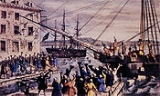
Boston Tea Party Cooper
On Thursday, December 16, 1773, the evening before the tea was due to be landed, Captain Roach appealed to Governor Hutchinson to allow his ship to leave without unloading its tea. When Roach returned and reported Hutchinson's refusal to a massive protest meeting, Samuel Adams said to the assembly "This meeting can do nothing more to save the country". As though on cue, the Sons of Liberty
Sons of Liberty

The Sons of Liberty was a secret organization of Patriot which originated in the Thirteen Colonies during the American Revolution. Kingdom of Great Britain authorities and their supporters known as Loyalist considered the Sons of Liberty as seditious rebels, referring to them as "Sons of Violence" and "Sons of Iniquity." Patriots attacked t...
 thinly disguised as either Mohawk
Mohawk nation

Mohawk are an Indigenous peoples of the Americas of North America originally from the Mohawk Valley in upstate New York to southern Quebec and eastern Ontario....
 or Narragansett
Narragansett (tribe)

The Narragansett tribe are a Native Americans in the United States tribe of the Algonquian language group. They were historically one of the leading tribes of New England, controlling the west of Narragansett Bay in present-day Rhode Island, and also portions of Connecticut and eastern Massachusetts, from the Providence River on the northea...
  Indians and armed with small hatchets and clubs, headed toward Griffin's Wharf (in Boston Harbor), where lay Dartmouth and the newly-arrived Beaver and Eleanor. Swiftly and efficiently, casks of tea were brought up from the hold to the deck, reasonable proof that some of the "Indians" were, in fact, longshoremen. The casks were opened and the tea dumped overboard; the work, lasting well into the night, was quick, thorough, and efficient. By dawn, over 342 casks or 90,000 lbs (45 tons) of tea worth an estimated £10,000 or $1.87 million USD in 2007 currency) had been consigned to waters of Boston harbor. Nothing else had been damaged or stolen, except a single padlock accidentally broken and anonymously replaced not long thereafter.

Tea washed up on the shores around Boston for weeks. Many citizens of Boston attempted to carry off this tea. In an effort to thwart this looting, people rowed several small boats out to where the tea was visible and beat it with oars, rendering it unusable.

The fourth East India Company ship carrying tea did not arrive with the other three because it had run aground in Provincetown. All fifty-eight tea chests were salvaged and put onto a fishing schooner, which arrived safely in Boston and into Bostonians' teapots.

Reaction

The tea party caused a crisis. Hutchinson had been urging London to take a hard line with the Sons of Liberty. If he had done what the other royal governors had done and let the ship owners and captains resolve the issue with the colonists, the Dartmouth, Eleanor, the "William" and the Beaver would have left without unloading any tea. Lord North said that if the colonists had stuck with nonimportation for another six months the tea tax would have been repealed. In February, 1775, Britain passed the Conciliatory Resolution
Conciliatory Resolution

The Conciliatory Resolution was a resolution passed by the British Parliament in an attempt to reach a peaceful settlement with the Thirteen Colonies immediately prior to the outbreak of the American Revolutionary War....
 which ended taxation for any colony which satisfactorily provided for the imperial defense and the upkeep of imperial officers. The Tea Act was repealed with the Taxation of Colonies Act 1778
Taxation of Colonies Act 1778

The Taxation of Colonies Act 1778 was a law passed which declared that Parliament would not impose any duty, tax, or assessment for the raising of revenue in any of the colonies....
.

In Britain, even those politicians considered friends of the colonies were appalled and this act united all parties there against the colonies. The Prime Minister Lord North said, "Whatever may be the consequence, we must risk something; if we do not, all is over". The British government felt this was an action which could not be unpunished and responded by closing the port of Boston and put in place other laws known as the "Coercive Acts".

In the colonies, Benjamin Franklin
Benjamin Franklin

Benjamin Franklin was one of the Founding Fathers of the United States of the United States. A noted polymath, Franklin was a leading author and Printer , Satire, list of political philosophers, politician, scientist, inventor, activism, statesman, and diplomacy....
 stated that the destroyed tea must be repaid, all 90,000 pounds. Robert Murray, a New York merchant went to Lord North with three other merchants and offered to pay for the losses, but the offer was turned down. A number of colonists were inspired to carry out similar acts, such as the burning of the Peggy Stewart. The Boston Tea Party eventually proved to be one of the many reactions which led to the American Revolutionary War
American Revolutionary War

The American Revolutionary War , also known as the American War of Independence, began as a war between the Kingdom of Great Britain and Thirteen Colonies on the North America, and ended in a global war between several European great powers....
. At the very least, the Boston Tea Party and the reaction that followed served to rally support for revolutionaries in the thirteen colonies
Thirteen Colonies

The Thirteen Colonies were part of what became known as British America, a name that was used by Great Britain until the Treaty of Paris recognized the independence of the original thirteen United States of America in 1783....
 who were eventually successful in their fight for independence
American Revolutionary War

The American Revolutionary War , also known as the American War of Independence, began as a war between the Kingdom of Great Britain and Thirteen Colonies on the North America, and ended in a global war between several European great powers....
.

Many colonists, in Boston and elsewhere in the country, pledged to abstain from tea drinking as a protest, turning instead to "liberty tea" (made from raspberry leaves), other herbal infusions, and coffee
Coffee

Coffee is a brewed drink prepared from roasted seeds, commonly called coffee beans, of the Coffea. Caffeinated coffee has a stimulating effect in humans....
. This social protest movement away from tea drinking, however, was not long-lived.

Influence

The Boston Tea Party is known around the world and has been inspirational to other noted activists and reform leaders. For example, Erik H. Erikson records in his book "Gandhi's Truths" that when Mahatma Gandhi
Mahatma Gandhi

Mohandas Karamchand Gandhi was a major political and spiritual leader of India and the Indian independence movement. He was the pioneer of satyagraha?resistance to tyranny through mass civil disobedience, firmly founded upon ahimsa or total non-violence?which led India to Indian independence movement and inspired movements for civi...
 met with the British viceroy in 1930 after the Indian salt protest
Salt Satyagraha

The Salt Satyagraha was a campaign of non-violent protest against the British salt tax in colonial India which began with the Salt March to Dandi on March 12, 1930....
 campaign, Gandhi took some duty-free salt from his shawl and said, with a smile, that the salt was "to remind us of the famous Boston Tea Party."

American political activists have invoked the Tea Party as a symbol of rebellion against the establishment. A political party
Boston Tea Party (political party)

The Boston Tea Party is an United States political party which espouses a libertarianism ideology. The party was founded in 2006 by a group of former Libertarian Party members led by Thomas L....
 founded in 2006 has adopted the name.

See also

  • Timeline of United States revolutionary history (1760–1789)
  • Boston Massacre
    Boston Massacre

    The Boston Massacre refers to an incident involving the deaths of five civilians at the hands of British Army on March 5, 1770, the legal aftermath of which helped spark the rebellion in some of the British colonies in America, which culminated in the American Revolution....


Works cited

  • Andrews, "Letters", Mass. Hist. Soc. Proc. VIII, pg. 325-326
  • Hawkins, A Retrospect of the Boston Tea-Party, pp. 39-31.
  • Ketchum, Richard, Divided Loyalties, How the American Revolution came to New York, 2002, ISBN 0805061207
  • Knollenberg, Bernhard. Growth of the American Revolution, 1766–1775. New York: Free Press, 1975. ISBN 0-02-917110-5.
  • Labaree, Benjamin Woods. The Boston Tea Party. Originally published 1964. Boston: Northeastern University Press, 1979. ISBN 0930350057.


External links