

Boscastle

Encyclopedia

Cornwall
Cornwall is a unitary authority and ceremonial county of England, within the United Kingdom. It is bordered to the north and west by the Celtic Sea, to the south by the English Channel, and to the east by the county of Devon, over the River Tamar. Cornwall has a population of , and covers an area of...
, England
England
England is a country that is part of the United Kingdom. It shares land borders with Scotland to the north and Wales to the west; the Irish Sea is to the north west, the Celtic Sea to the south west, with the North Sea to the east and the English Channel to the south separating it from continental...
, in the civil parish of Forrabury and Minster
Forrabury and Minster
Forrabury and Minster is a civil parish on the north coast of Cornwall. The parish was originally divided between the coastal parish of Forrabury and inland parish of Minster until they were united in 1779....
. It is situated 14 miles (23 km) south of Bude
Bude
Bude is a small seaside resort town in North Cornwall, England, at the mouth of the River Neet . It lies just south of Flexbury, north of Widemouth Bay and west of Stratton and is located along the A3073 road off the A39. Bude is twinned with Ergué-Gabéric in Brittany, France...
and 5 miles (8 km) north-east of Tintagel
Tintagel
Tintagel is a civil parish and village situated on the Atlantic coast of Cornwall, United Kingdom. The population of the parish is 1,820 people, and the area of the parish is ....
.
The name of the village derives from Botreaux Castle, a 12th century motte-and-bailey
Motte-and-bailey
A motte-and-bailey is a form of castle, with a wooden or stone keep situated on a raised earthwork called a motte, accompanied by an enclosed courtyard, or bailey, surrounded by a protective ditch and palisade...
fortress, of which few remains survive. The castle was anciently the possession of the de Botreaux family, which became under William de Botereaux
William de Botreaux, 1st Baron Botreaux
William de Botreaux was a prominent English West-Country baron during the reigns of King Edward III and King Richard II.-Origins:...
(d.1391) Barons Botreaux
Baron Botreaux
Baron Botreaux is a title in the Peerage of England, created in 1368.The title was created by writ of summons, by Edward III to William de Botreaux, 1st Baron Botreaux in 1368....
.
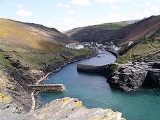
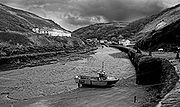
Boscastle harbour is a natural inlet protected by two stone harbour walls built in 1584 by Sir Richard Grenville
Richard Grenville
Sir Richard Grenville was an English sailor, sea captain and explorer. He took part in the early English attempts to settle the New World, and also participated in the fight against the Spanish Armada...
(of HMS Revenge
HMS Revenge (1577)
Revenge was an English race-built galleon of 46 guns, built in 1577 and captured by the Spanish in 1591, sinking soon afterwards. She was the first of thirteen English and Royal Navy ships to bear the name.Since she was built and served prior to the English Restoration of 1660, she did not carry...
). It is the only significant harbour for 20 miles (32.2 km) along the coast. As well as being a fishing harbour, Boscastle was once a small port (similar to many others on the north coast of Cornwall) importing limestone and coal and exporting slate and other local produce.
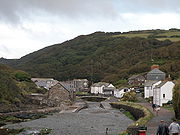
The oldest part of Boscastle surrounds the harbour; more modern residential building extends up the valleys of the River Valency
River Valency
The River Valency is located in north Cornwall with many tributaries, and after running past Lesnewth cuts a valley before entering the sea at the harbour of the village of Boscastle. One of its tributaries is the River Jordan, which it joins in Boscastle just before the B3263 road bridge.The...
and River Jordan.
Tourism
The village with its picturesque harbour is a very popular tourist destination. Among the attractions are the Museum of WitchcraftMuseum of Witchcraft
Museum of Witchcraft in Boscastle, Cornwall, England is a museum dedicated to witchcraft and has the largest collection of witchcraft and Wiccan related artifacts in the world...
and the Boscastle pottery shop. Much of the land in and around Boscastle is owned by the National Trust
National Trust for Places of Historic Interest or Natural Beauty
The National Trust for Places of Historic Interest or Natural Beauty, usually known as the National Trust, is a conservation organisation in England, Wales and Northern Ireland...
, including both sides of the harbour, Forrabury Stitches, high above the Boscastle and divided into ancient "stitchmeal" cultivation plots, and large areas of the Valency Valley, known for its connections to Thomas Hardy
Thomas Hardy
Thomas Hardy, OM was an English novelist and poet. While his works typically belong to the Naturalism movement, several poems display elements of the previous Romantic and Enlightenment periods of literature, such as his fascination with the supernatural.While he regarded himself primarily as a...
. The former harbour stables (part of the National Trust estate) are now a youth hostel run by YHA, popular with walkers on the South West Coast Path
South West Coast Path
The South West Coast Path is Britain's longest waymarked long-distance footpath and a National Trail. It stretches for , running from Minehead in Somerset, along the coasts of Devon and Cornwall, to Poole Harbour in Dorset. Since it rises and falls with every river mouth, it is also one of the more...
. The National Trust runs a shop at the harbour,
and a visitor centre in the Old Smithy.
A Seaside Parish
In 2004 British television channel BBC 2 began broadcasting A Seaside ParishA Seaside Parish
A Seaside Parish is a British television documentary made by Tiger Aspect Productions for BBC2 which was first broadcast in 2003. Following the success of A Country Parish, the programme concerns the life of a new incumbent and general parish life in the village of Boscastle and the adjoining...
, a weekly series focusing on the life of the newly-appointed Rector of Boscastle, Christine Musser.
The Rector of Boscastle is responsible for seven churches in the district: Forrabury (St Symphorian), Minster (St Merthiana), St Juliot, Lesnewth
Lesnewth
Lesnewth is a civil parish and village in Cornwall, United Kingdom. It is situated approximately six miles east of Tintagel Head and two miles east of Boscastle....
(St Michael and All Angels), Trevalga (St Petroc), Otterham (St Denis) and Davidstow
Davidstow
Davidstow is a civil parish and village in north Cornwall, United Kingdom. The village is north of Bodmin Moor straddling the A395 road about 3 miles north of Camelford....
(St David).
St Juliot is of particular interest to devotees of the works of Thomas Hardy
Thomas Hardy
Thomas Hardy, OM was an English novelist and poet. While his works typically belong to the Naturalism movement, several poems display elements of the previous Romantic and Enlightenment periods of literature, such as his fascination with the supernatural.While he regarded himself primarily as a...
since he acted as the architect for the church's restoration
Victorian restoration
Victorian restoration is the term commonly used to refer to the widespread and extensive refurbishment and rebuilding of Church of England churches and cathedrals that took place in England and Wales during the 19th-century reign of Queen Victoria...
in March 1870 and this is where he met his first wife, Emma Gifford, who was the Rector's sister-in-law. Their love affair was the inspiration for his novel A Pair of Blue Eyes
A Pair of Blue Eyes
A Pair of Blue Eyes is a novel by Thomas Hardy, published in 1873.The book describes the love triangle of a young woman, Elfride Swancourt, and her two suitors from very different backgrounds. Stephen Smith is a socially inferior but ambitious young man who adores her and with whom she shares a...
and later in life, some of his poetry.
Boscastle floods
A flash flood on 16 August 2004, caused extensive damage to the village. Residents were trapped in houses as the roads turned into rivers: people were trapped on roofs, in cars, in buildings and on the rivers' banks and the village's visitor centre was washed away.Two Royal Air Force Sea King rescue helicopters from Chivenor
Royal Marines Base Chivenor
Royal Marines Base Chivenor is a British military base used primarily by the Royal Marines. It is situated on the northern shore of the Taw estuary, adjacent to the South West Coast Path, on the north coast of Devon, England....
, three Royal Navy Sea Kings from Culdrose, one RAF Sea King from St Mawgan
RAF St. Mawgan
RAF St Mawgan is a Royal Air Force station near St Mawgan and Newquay in Cornwall. In 2008 the runway part of the site was handed over to Newquay Airport. The remainder of the station still continues to operate under the command of the RAF...
and one Coastguard S61 helicopter from Portland searched for, and assisted casualties in and around the village. The operation was coordinated by the Aeronautical Rescue Coordination Centre (ARCC
ARCC
The United Kingdom's Aeronautical Rescue Coordination Centre is based at RAF Kinloss, near Forres in Moray.-Structure:The centre is responsible for coordinating all RAF, Royal Navy and Maritime and Coastguard Agency Search and Rescue helicopters, and also the Royal Air Force Mountain Rescue Service...
) based at RAF Kinloss
RAF Kinloss
RAF Kinloss is a Royal Air Force station near Kinloss, on the Moray Firth in the north of Scotland. It opened on 1 April 1939 and served as an RAF training establishment during the Second World War. After the war it was handed over to Coastal Command to watch over Russian ships and submarines in...
in Scotland in the largest peacetime rescue operation ever launched in the UK. A total of 91 people were rescued and there were no fatalities, only one broken thumb.
Around 50 cars were swept into the harbour and the bridge was washed away, roads were submerged under 2.75 m of water, this made communication very difficult for the citizens of Boscastle. The sewerage system burst and due to the health and safety reasons Boscastle was declared inaccessible.
Boscastle was flooded again on 21 June 2007 although the scale of devastation was not nearly as bad as in 2004.