


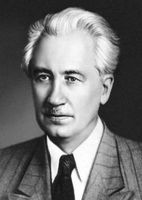
Boris Grekov

Encyclopedia
Myrhorod
Myrhorod or Mirgorod is a city in the Poltava Oblast of central Ukraine. Serving as the administrative center of the Myrhorodskyi Raion , the city itself is also designated as a separate raion within the oblast, and is located on the river Khorol.-History:The town was founded either in the 12th...
— 9 September 1953, Moscow
Moscow
Moscow is the capital, the most populous city, and the most populous federal subject of Russia. The city is a major political, economic, cultural, scientific, religious, financial, educational, and transportation centre of Russia and the continent...
) was a Soviet historian noted for his comprehensive studies of Kievan Rus and the Golden Horde
Golden Horde
The Golden Horde was a Mongol and later Turkicized khanate that formed the north-western sector of the Mongol Empire...
. He was a member of the Soviet Academy of Sciences (1934) and several foreign academies, as well as Director of the Russian History Institute in Moscow.
Grekov entered Warsaw University in 1901 but moved to the Moscow University four years later. During the pre-revolutionary years he researched the economic and social history of the Novgorod Republic
Novgorod Republic
The Novgorod Republic was a large medieval Russian state which stretched from the Baltic Sea to the Ural Mountains between the 12th and 15th centuries, centred on the city of Novgorod...
(published in 1914).
During the revolution
Russian Revolution of 1917
The Russian Revolution is the collective term for a series of revolutions in Russia in 1917, which destroyed the Tsarist autocracy and led to the creation of the Soviet Union. The Tsar was deposed and replaced by a provisional government in the first revolution of February 1917...
, Grekov participated in the White Movement
White movement
The White movement and its military arm the White Army - known as the White Guard or the Whites - was a loose confederation of Anti-Communist forces.The movement comprised one of the politico-military Russian forces who fought...
in the Crimea
Crimea
Crimea , or the Autonomous Republic of Crimea , is a sub-national unit, an autonomous republic, of Ukraine. It is located on the northern coast of the Black Sea, occupying a peninsula of the same name...
, and in 1930, his son was arrested in connection with the "Platonov Affair
Sergey Platonov
Sergey Fyodorovich Platonov was a Russian historian who led the official St Petersburg school of imperial historiography before and after the Russian Revolution.Platonov was born in Chernigov and attended a private gymnasium in St...
" and sent to the Solovki Islands Penal Colony. Both of these facts were widely known in the 1930s, and this led Grekov to make wide-ranging concessions to the official ideology during the Stalin Purges and, according to A. H. Plakhonin, to write scholarship "on order" for the regime.
At this time, he turned toward the study of Kievan Rus and became known as an opponent of the Ukrainian historian Mykhailo Hrushevsky
Mykhailo Hrushevsky
Mykhailo Serhiyovych Hrushevsky was a Ukrainian academician, politician, historian, and statesman, one of the most important figures of the Ukrainian national revival of the early 20th century...
, who claimed the heritage of Kievan Rus primarily for modern Ukraine
Ukraine
Ukraine is a country in Eastern Europe. It has an area of 603,628 km², making it the second largest contiguous country on the European continent, after Russia...
. His major work, Kievan Rus appeared in 1939 and was the first of three of his works to win the Stalin Prize. In this work, steeped in Marxist-Leninist
Marxism-Leninism
Marxism–Leninism is a communist ideology, officially based upon the theories of Marxism and Vladimir Lenin, that promotes the development and creation of a international communist society through the leadership of a vanguard party over a revolutionary socialist state that represents a dictatorship...
and Stalinist ideology, he stressed the agricultural rather than commercial basis of the economy of this polity and argued that the heritage of Kievan Rus was equally shared by modern Russia
Russia
Russia or , officially known as both Russia and the Russian Federation , is a country in northern Eurasia. It is a federal semi-presidential republic, comprising 83 federal subjects...
, Ukraine
Ukraine
Ukraine is a country in Eastern Europe. It has an area of 603,628 km², making it the second largest contiguous country on the European continent, after Russia...
, and Belarus
Belarus
Belarus , officially the Republic of Belarus, is a landlocked country in Eastern Europe, bordered clockwise by Russia to the northeast, Ukraine to the south, Poland to the west, and Lithuania and Latvia to the northwest. Its capital is Minsk; other major cities include Brest, Grodno , Gomel ,...
.
Grekov's extensive research on Kievan Rus provided insights into the economic and cultural development of medieval Rus' during the period of the Tatar domination. He summarized these findings in Culture of Kiev Rus (1944) and Russian Peasants from the Most Ancient Times to the Seventeenth Century (1946). But his most lasting work (and the one which is still regularly reprinted) was Golden Horde, written in collaboration with Alexander Yakubovsky and first published in 1937. The second (and now classical) edition appeared in 1950 under the title Golden Horde and Its Downfall.
Grekov also gave considerable attention to the collection and publication of primary sources, especially chronicles. His student, Vladimir Pashuto
Vladimir Pashuto
Vladimir Terentyevich Pashuto was a Russian Marxist historian who specialized in the history of medieval Lithuania and Russia, especially in their foreign policies....
, carried this work forward and began the collection of foreign sources for the medieval period in the history of the Eastern Slavs.