
Home      Discussion      Topics      Dictionary      Almanac
Signup       Login
Boraginaceae

Boraginaceae

Overview
Boraginaceae, the Borage
Borage
Borage, , also known as a starflower, is an annual herb originating in Syria, but naturalized throughout the Mediterranean region, as well as Asia Minor, Europe, North Africa, and South America. It grows to a height of , and is bristly or hairy all over the stems and leaves; the leaves are...

 or Forget-me-not
Forget-me-not
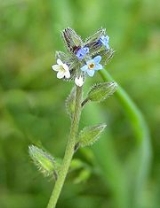
Myosotis is a genus of flowering plants in the family Boraginaceae that are commonly called Forget-me-nots. Its common name was calqued from the French, "ne m'oubliez pas" and first used in English in c. 1532. Similar names and variations are found in many languages.-Description:There are...

 family, include a variety of shrub
Shrub
A shrub or bush is distinguished from a tree by its multiple stems and shorter height, usually under 5–6 m tall. A large number of plants may become either shrubs or trees, depending on the growing conditions they experience...

s, tree
Tree
A tree is a perennial woody plant. It is most often defined as a woody plant that has many secondary branches supported clear of the ground on a single main stem or trunk with clear apical dominance. A minimum height specification at maturity is cited by some authors, varying from 3 m to...

s, and herb
Herb
Except in botanical usage, an herb is "any plant with leaves, seeds, or flowers used for flavoring, food, medicine, or perfume" or "a part of such a plant as used in cooking"...

s, totaling about 2,000 species in 146 genera
Genus
In biology, a genus is a low-level taxonomic rank used in the biological classification of living and fossil organisms, which is an example of definition by genus and differentia...

 found worldwide.
Discussion
Ask a question about 'Boraginaceae'
Start a new discussion about 'Boraginaceae'
Answer questions from other users
Full Discussion Forum
 
Unanswered Questions
Encyclopedia
Boraginaceae, the Borage
Borage
Borage, , also known as a starflower, is an annual herb originating in Syria, but naturalized throughout the Mediterranean region, as well as Asia Minor, Europe, North Africa, and South America. It grows to a height of , and is bristly or hairy all over the stems and leaves; the leaves are...

 or Forget-me-not
Forget-me-not
Myosotis is a genus of flowering plants in the family Boraginaceae that are commonly called Forget-me-nots. Its common name was calqued from the French, "ne m'oubliez pas" and first used in English in c. 1532. Similar names and variations are found in many languages.-Description:There are...

 family, include a variety of shrub
Shrub
A shrub or bush is distinguished from a tree by its multiple stems and shorter height, usually under 5–6 m tall. A large number of plants may become either shrubs or trees, depending on the growing conditions they experience...

s, tree
Tree
A tree is a perennial woody plant. It is most often defined as a woody plant that has many secondary branches supported clear of the ground on a single main stem or trunk with clear apical dominance. A minimum height specification at maturity is cited by some authors, varying from 3 m to...

s, and herb
Herb
Except in botanical usage, an herb is "any plant with leaves, seeds, or flowers used for flavoring, food, medicine, or perfume" or "a part of such a plant as used in cooking"...

s, totaling about 2,000 species in 146 genera
Genus
In biology, a genus is a low-level taxonomic rank used in the biological classification of living and fossil organisms, which is an example of definition by genus and differentia...

 found worldwide.

A number of familiar plants belong to this family.

Boraginaceae belong, according to the APG II
Angiosperm Phylogeny Group
The Angiosperm Phylogeny Group, or APG, refers to an informal international group of systematic botanists who came together to try to establish a consensus on the taxonomy of flowering plants that would reflect new knowledge about plant relationships discovered through phylogenetic studies., three...

, among the euasterid I group including the orders Gentianales
Gentianales
Gentianales are an order of flowering plants, included within the asterid group of dicotyledons.The circumscription of Gentiales in the Cronquist system included a broadly defined Loganiaceae , Retziaceae, Gentianaceae, Saccifoliaceae, Apocynaceae, and Asclepiadaceae...

, Lamiales
Lamiales
Lamiales is an order in the asterid group of dicotyledonous flowering plants. It includes approximately 11,000 species divided into about 20 families...

, and Solanales
Solanales
The Solanales are an order of flowering plants, included in the asterid group of dicotyledons. Some older sources used the name Polemoniales for this order....

, but whether they should be assigned to one of these orders or to their own (Boraginales
Boraginales
Boraginales is a valid taxonomic name at the rank of order for a group of flowering plants. When recognised, it is includes Boraginaceae and closely related asterid families....

) is still uncertain. Under the older Cronquist system
Cronquist system
The Cronquist system is a taxonomic classification system of flowering plants. It was developed by Arthur Cronquist in his texts An Integrated System of Classification of Flowering Plants and The Evolution and Classification of Flowering Plants .Cronquist's system places flowering plants into two...

 they were included in Lamiales, but it is now clear that they are no more similar to the other families in this order than they are to families in several other asterid orders. The Boraginaceae are paraphyletic with respect to Hydrophyllaceae
Hydrophyllaceae
Hydrophylloideae is a subfamily of the Boraginaceae family of flowering plants. Their taxonomic position is somewhat uncertain. Traditionally, and under the Cronquist system, they were given family rank under the name Hydrophyllaceae, and treated as part of the order Solanales...

 and the latter is included in the former in APG II
Angiosperm Phylogeny Group
The Angiosperm Phylogeny Group, or APG, refers to an informal international group of systematic botanists who came together to try to establish a consensus on the taxonomy of flowering plants that would reflect new knowledge about plant relationships discovered through phylogenetic studies., three...

 system. In some recent classifications the Boraginaceae are broken up into several families: Boraginaceae s.s., Cordiaceae, Ehretiaceae, Heliotropiaceae, Hydrophyllaceae, and Lennoaceae
Lennoaceae
Lennooideae is a subfamily of parasitic flowering plants of south-western North America and north-western South America.The relationships of this subfamily with other plants remains uncertain. Traditionally it was treated at family rank as Lennoaceae, and placed in different orders by different...

.

Most though not all members of this family have hairy leaves. The coarse character of the hairs is due to Silicon dioxide
Silicon dioxide
The chemical compound silicon dioxide, also known as silica , is an oxide of silicon with the chemical formula '. It has been known for its hardness since antiquity...

 and Calcium carbonate
Calcium carbonate
Calcium carbonate is a chemical compound with the formula CaCO3. It is a common substance found in rocks in all parts of the world, and is the main component of shells of marine organisms, snails, coal balls, pearls, and eggshells. Calcium carbonate is the active ingredient in agricultural lime,...

. These hairs can induce an adverse skin reaction (itching, rash) in some individuals, particularly among people who handle the plants regularly (e.g. gardeners). In some species, Anthocyanin
Anthocyanin
Anthocyanins are water-soluble vacuolar pigments that may appear red, purple, or blue according to pH...

s cause the flowers to change their color from red to blue when aging. This is likely used as a signal to pollinators that these old flowers are depleted of pollen and nectar (Hess, 2005).

Well-known members include:
  • Alkanet
    Alkanet
    Alkanet or dyers' bugloss is a plant in the borage family Boraginaceae with a bright blue flower, used to provide a red dye.A. tinctoria is also known as orchanet, Spanish bugloss or Languedoc bugloss...

     (Alkanna tinctoria)
  • Borage
    Borage
    Borage, , also known as a starflower, is an annual herb originating in Syria, but naturalized throughout the Mediterranean region, as well as Asia Minor, Europe, North Africa, and South America. It grows to a height of , and is bristly or hairy all over the stems and leaves; the leaves are...

     (Borago officinalis)
  • Comfrey
    Comfrey
    Comfrey is an important herb in organic gardening. It is used as a fertilizer and also has many purported medicinal uses...

     (Symphytum)
  • Fiddleneck
    Fiddleneck
    A fiddleneck is a flowering plant in the genus Amsinckia. The name derives from the flower stems, bearing many small flowers, which curl over at the top in a manner reminiscent of the head of a fiddle...

     (Amsinckia spp.)
  • Forget-me-not
    Forget-me-not
    Myosotis is a genus of flowering plants in the family Boraginaceae that are commonly called Forget-me-nots. Its common name was calqued from the French, "ne m'oubliez pas" and first used in English in c. 1532. Similar names and variations are found in many languages.-Description:There are...

     (Myosotis spp.)
  • Geiger tree
    Geiger tree
    Cordia sebestena is a species of flowering plant in the borage family, Boraginaceae.It is native to the American tropics, from southern Florida in the United States and The Bahamas southwards throughout Central America and the Greater Antilles...

     (Cordia sebestena)
  • Green alkanet
    Green alkanet
    Pentaglottis sempervirens is a bristly, perennial plant growing to approximately 60 cm to 90 cm , usually in damp or shaded places and often close to buildings. It has brilliant blue flowers, and retains its green leaves through the winter...

     (Pentaglottis sempervirens)
  • Heliotrope (Heliotropium
    Heliotropium
    Heliotropium is a genus of flowering plants in the borage family, Boraginaceae. There are 250 to 300 species in this genus, which are commonly known as heliotropes ....

    spp.)
  • Hound's Tongue (Cynoglossum)
  • Lungwort
    Lungwort
    The lungworts are the genus Pulmonaria of flowering plants in the family Boraginaceae, native to Europe and western Asia, with one species east to central Asia...

     (Pulmonaria)
  • Oyster Plant (Mertensia
    Mertensia
    Mertensia is a genus of about 40 species of perennial herbaceous plants with bell-shaped blue flowers opening from pink-tinged buds. This is one of several plants commonly called bluebell.The genus is named after the German botanist Franz Carl Mertens....

     maritima
    )
  • Patterson's Curse
    Patterson's Curse
    Echium plantagineum, commonly known as Purple Viper's Bugloss, is a species of Echium, native to western and southern Europe , northern Africa, and southwestern Asia . It has also been introduced to Australia, South Africa and United States and is an invasive plant...

     (Echium plantaginuem)
  • Siberian Bugloss
    Brunnera macrophylla
    Brunnera macrophylla is a plant in the borage family, Boraginaceae.-Description:Brunnera macrophylla is a herbaceous plant with basal, simple leaves, on slender stems. The flowers are blue, borne in spring....

     (Brunnera macrophylla)
  • Viper's Bugloss
    Viper's Bugloss
    Echium vulgare is a species of Echium native to most of Europe, and western and central Asia. It is also common in North America....

     (Echium vulgare)

Genera


  • Actinocarya
  • Adelocaryum
  • Afrotysonia
  • Alkanna
    Alkanna
    Alkanna is a genus of herbaceous plants including about 60 species of the family Boraginaceae. The original alkanna plant is a native of the Levant but is now found, wild and cultivated, throughout much of Europe and around the Mediterranean....

  • Amblynotus
  • Amphibologyne
  • Amsinckia
  • Anchusa
    Anchusa
    The genus Anchusa L. belongs to the tribe Boragineae of the borage family . It includes about 40 species.These species grow in Europe, North Africa, South Africa en Western Asia. They are introduced into the USA....

  • Ancistrocarya
  • Anoplocaryum
  • Antiotrema
  • Antiphytum
  • Arnebia
    Arnebia
    Arnebia is a genus of the family Boraginaceae.The Generic name Arnebia originates from the Arabic name sagaret el arneb. Author=Stearn, William T. Title=Stearn's Dictionary of Plant Names for Gardeners. Year=2002 Publisher=Cassell....

  • Asperugo
  • Auxemma
  • Borago
    Borago
    Borago , common name borage, is a genus of two species of herbs with large, hairy leaves that taste mildly of cucumber, and star-shaped purple-blue flowers which are prized for their flavour. The leaves are often added to teas and salads, and the flowers have been added to wine...

  • Bothriospermum
  • Bourreria
    Bourreria
    Bourreria is a genus of flowering plants in the borage family, Boraginaceae. Members of the genus are commonly known as strongbark or strongback. The generic name was chosen by Patrick Browne to honour German pharmacist Johann Ambrosius Beurer.-Selected species:* Bourreria baccata Raf.* Bourreria...

    (Strongbark)
  • Brachybotrys
  • Brunnera
    Brunnera
    Brunnera is a genus of the family Boraginaceae, which together with Myosotis form the forget-me-nots. The best known member is Brunnera macrophylla ....

  • Buglossoides
    Lithospermum
    Lithospermum is a genus of plants belonging to the family Boraginaceae. Herbs or small shrubs, they are widely distributed except in Australasia...

  • Caccinia
  • Carmona
  • Cerinthe
    Cerinthe
    Cerinthe is a genus of the botanical family Boraginaceae.-Select species:*Cerinthe major**Cerinthe major 'Purpurascens' - Honeywort*Cerinthe minor-External links:**...

  • Chionocharis
  • Choriantha
  • Cordia
    Cordia
    Cordia is a genus of flowering plants in the borage family, Boraginaceae. It contains about 300 species of shrubs and trees, which are found worldwide mostly in warmer regions. Many of the species are commonly called manjack, while bocote may refer to several Central American species in Spanish...

  • Craniospermum
  • Cryptantha
    Cryptantha
    Cryptantha is a genus of hairy plants in the borage family . Some of them are heterostylous.- Selected species :*Cryptantha abata: Abata Cryptantha, Dent-nut Catseye, Dentnut Cryptantha...

  • Cynoglossopsis
  • Cynoglossum
    Cynoglossum
    There are many species in the plant genus Cynoglossum . They are coarse-appearing, small-flowered plants of the family Boraginaceae. Cynoglossum officinale, the common hound's-tongue, is a native of Asia, Africa, and Europe. It has been introduced into North America, and it is considered to be a...

  • Cynoglottis
  • Cysostemon
  • Dasynotus
  • Decalepidanthus
  • Echiochilon
  • Echiostachys
  • Echium
    Echium
    Echium is a genus of 60 species of flowering plant in the family Boraginaceae.The type species is Echium vulgare, viper's bugloss. Species of Echium are native to North Africa, Europe, Madeira and the Canary Islands, but have also become invasive in southern Africa and Australia...

  • Ehretia
    Ehretia
    Ehretia is a genus of flowering plants in the borage family, Boraginaceae. It contains about 50 species. The generic name honors German botanical illustrator Georg Dionysius Ehret .-Selected species:*Ehretia acuminata R.Br...

  • Elizaldia
  • Embadium
  • Eritrichium
  • Gastrocotyle
  • Gyrocaryum
    Gyrocaryum
    Gyrocaryum is a genus of plant in family Boraginaceae.Species include:* Gyrocaryum oppositifolium, Valdés...

  • Hackelia
    Hackelia
    Hackelia is a genus of plants in the Borage Family, Boraginaceae. They are found in North America and southeast Asia. Of the approximately 40 species described, 10 are endemic to California....

  • Halacsya
  • Halgania
    Halgania
    Halgania is a genus of small shrubs in the family Boraginaceae which are native to Australia. The genus is named for Emmanuel Halgan, a vice-admiral in the French Navy.-Selected species:*Halgania anagalloides Endl....

  • Harpagonella
    Harpagonella
    Harpagonella is a monotypic genus of flowering plants in the borage family containing the single species Harpagonella palmeri, which is known by the common name Palmer's grappling hook. It is native to the desert and coastal regions of the US states of California and Arizona and the Mexican states...

  • Heliocarya
  • Heliotropium
    Heliotropium
    Heliotropium is a genus of flowering plants in the borage family, Boraginaceae. There are 250 to 300 species in this genus, which are commonly known as heliotropes ....

  • Heterocaryum
  • Huynhia
  • Ivanjohnstonia
  • Ixorhea
  • Lacaitaea
  • Lappula
    Lappula
    Lappula is a genus of flowering plants in the borage family known generally as stickseeds. They are native to the northern hemisphere. These are annual herbs producing funnel-shaped flowers and prickly fruits...

  • Lasiarrhenum
  • Lasiocaryum
  • Lepechiniella
  • Lepidocordia
  • Lindelophia
  • Lithodora
    Lithodora
    Lithodora is a genus of plant in family Boraginaceae.Species include:*Lithodora diffusa I.M.Johnst.*Lithodora fruticosa Griseb*Lithodora nitida, R.Fern.*Lithodora oleifolia Griseb...

  • Lithospermum
    Lithospermum
    Lithospermum is a genus of plants belonging to the family Boraginaceae. Herbs or small shrubs, they are widely distributed except in Australasia...

  • Lobostemon
  • Macromeria
  • Maharanga
  • Mairetis
  • Mattiastrum
  • Mertensia
    Mertensia
    Mertensia is a genus of about 40 species of perennial herbaceous plants with bell-shaped blue flowers opening from pink-tinged buds. This is one of several plants commonly called bluebell.The genus is named after the German botanist Franz Carl Mertens....

  • Metaeritrichium
  • Microcaryum
  • Microula
  • Mimophytum
  • Moltkia
  • Moltkiopsis
  • Moritzia
  • Myosotidium
    Myosotidium
    Myosotidium is a genus of plants belonging to the family Boraginaceae. This genus is represented by the single species Myosotidium hortensia, the Chatham Islands forget-me-not, which is endemic to the Chatham Islands, New Zealand....

  • Myosotis
  • Neatostema
  • Nesocaryum
  • Nogalia
  • Nomosa
  • Nonea
    Nonea
    Nonea is a genus of the borage family Boraginaceae. Sometimes known as monkswort, these are perennial or annual herbs.The leaves are grayish-green, and the plants are hairy all over.- External links :*...

  • Ogastemma
  • Omphalodes
    Omphalodes
    Omphalodes is a genus of flowering plants in the family Boraginaceae.The genus is widely distributed on the Northern Hemisphere, with some species in North America, and many species in East-Asia and the Meditteranean.Some species:...

  • Omphalolappula
  • Omphalotrigonotis
  • Onosma
    Onosma
    Onosma is a genus of plants that grow biennially or perennially. The group consists of about 80 species that grow in the Mediterranean and West Asia. All of the species grow in dry or moist and sunny habitats. The various species are popular as rock garden plants....

  • Onosmodium
  • Oxyosmyles
  • Paracaryum
  • Pardoglossum
  • Patagonula
  • Pectocarya
    Pectocarya
    Pectocarya is a plant genus of about 15 species in the family Boraginaceae. Plants in this genus are known generally as combseeds. They are small annual plants which bear tiny white flowers no more than 3 millimeters in diameter. Their fruits are nutlets which often have small projections that look...

  • Pentaglottis
  • Perittostema
  • Phacelia
    Phacelia
    Phacelia is a genus of about 200 species of annual or perennial herbaceous plants, native to North and South America....

  • Plagiobothrys
    Plagiobothrys
    Plagiobothrys is a genus of flowering plants known commonly as popcornflowers. These are small herbaceous plants which bear tiny white or yellow flowers. Their fruits are nutlets. Although these plants are found predominantly in western North and South America, five species are known from Australia...

  • Pseudomertensia
  • Psilolaemus
  • Pteleocarpa
    Pteleocarpa
    The plant genus Pteleocarpa has had a varied systematic history. The only member of the genus is the western Malesian tree Pteleocarpa lamponga Heyne, which has been placed within the families Icacinaceae, Cardiopteridaceae and most recently Boraginaceae...

  • Pulmonaria
  • Rindera
  • Rochefortia
    Rochefortia
    Rochefortia is a genus of plant in family Boraginaceae.Species include:* Rochefortia acrantha, Urb....

  • Rochelia
  • Rotula
  • Saccellium
  • Scapicephalus
  • Selkirkia
    Selkirkia
    Selkirkia is a genus of predatory priapulid worm known from the Middle Cambrian Burgess Shale. In the Burgess Shale, 20% of the tapering, organic-walled tubes are preserved with the worm inside them, whereas the other 80% are empty...

  • Sericostoma
  • Sinojohnstonia
  • Solenanthus
    Solenanthus
    Solenanthus is a genus of plant in family Boraginaceae.Species include:* Solenanthus reverchonii, Degen...

  • Stenosolenium
  • Stephanocaryum
  • Suchtelenia
  • Symphytum
    Symphytum
    Symphytum is a genus in the Boraginaceae family. Its species are known by the common name comfrey. Some species and hybrids, particularly S. officinale and S. × uplandicum, are used in gardening and herbal medicine.Species include:...

  • Thaumatocaryum
  • Thyrocarpus
  • Tianschaniella
  • Tiquilia
    Tiquilia
    Tiquilia is a genus of flowering plants in the borage family, Boraginaceae. The 27 species in this genus are known by the common name crinklemat. They are native to the Western Hemisphere and are mostly found in desert regions.-Selected species:...

  • Tournefortia
    Tournefortia
    Tournefortia, commonly known as Soldierbush, is a genus of flowering plants in the borage family, Boraginaceae.It was first published under the name Pittonia by Charles Plumier in 1703, in honour of Joseph Pitton de Tournefort...

  • Trachelanthus
  • Trachystemon
  • Trichodesma
    Trichodesma
    Trichodesma is a genus of plant in family Boraginaceae.Species include:* Trichodesma laxiflorum, Balf.f.* Trichodesma microcalyx, Balf.f.* Trichodesma scotti, Balf.f....

  • Trigonocaryum
  • Trigonotis
  • Ulugbekia
  • Valentiniella

  • External links