
|
|
|
|
Boombox
|
| |
|
| |
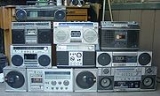
A boombox, also known as ghetto blaster, jambox, or radio-cassette, is a name given to portable stereo systems capable of playing radio stations and recorded music (usually cassettes and/or, since the early 1990s, CDs), at relatively high volume. Designed for portability, most boomboxes can be powered by batteries, as well as by line current.
boxes were introduced commercially by various companies in the late 1970s, when stereo capabilities were added to existing designs of the radio-cassette recorder, which had appeared earlier that decade; more powerful and sophisticated models were subsequently introduced.

Discussion
Ask a question about 'Boombox'
Start a new discussion about 'Boombox'
Answer questions from other users
|
Encyclopedia
A boombox, also known as ghetto blaster, jambox, or radio-cassette, is a name given to portable stereo systems capable of playing radio stations and recorded music (usually cassettes and/or, since the early 1990s, CDs), at relatively high volume. Designed for portability, most boomboxes can be powered by batteries, as well as by line current.
Origin
Boom boxes were introduced commercially by various companies in the late 1970s, when stereo capabilities were added to existing designs of the radio-cassette recorder, which had appeared earlier that decade; more powerful and sophisticated models were subsequently introduced. However, they are often associated with 1980s phenomena such as breakdancing and hip hop culture, having been introduced into the mainstream consciousness through music videos, television and documentaries. It was during this time that the major manufacturers competed as to who could produce the biggest, loudest, clearest-sounding, bassiest, flashiest and/or most novel boomboxes. As the decade progressed, manufacturers tended to compete more on price (often at the expense of quality) and smaller designs (often designed for simple background listening) became more popular.
Features
Technically a Boombox is, at its simplest, two or more loudspeakers, an amplifier, a radio tuner, and a cassette and/or CD player component, all housed in a single plastic, or metal, case, often with a handle for portability. Most units can be powered by AC or DC cables, as well as batteries.
Various boombox designs differ greatly in size. Larger, more powerful units may require 10 or more size-D batteries, may measure more than thirty inches in width, and can weigh more than 20 pounds.
Audio quality and feature sets vary widely, with high-end models providing features and sound comparable to some home stereo systems. Most models offer volume, tone and balance (Left/Right) controls.
More sophisticated models may feature dual cassette decks (often featuring high-speed dubbing), separate bass level control, five- or 10-band graphic equalizers, Dolby noise reduction, analog or LED sound level (VU) meters, larger speakers, 'soft-touch' tape deck controls, multiple shortwave (SW) band reception, auto song search functions for cassettes, Line and/or Phono inputs and outputs, microphone inputs, loudness switches and detachable speakers. A handful of models even featured an integrated vinyl record player or a (typically black and white) television screen, although the basic radio/cassette models have historically been by far the most popular.
A few of the most modern boomboxes have integrated (or removable) satellite radio tuners. Also in many cases with newer versions of the ghetto blaster, ipod docks have been put in place of cassette players, creating a fusion of new technology and old personaliity.
"Ghettoblaster"
The synonym ghettoblaster or ghetto-blaster is a term that can be considered insulting or complimentary depending on the context. The word ghettoblaster originated in the urban of the United States, apparently reflecting the belief that such systems are popular in poor inner-city neighbourhoods (ghettos), especially those populated by black Americans, whether as a sign of economic power or simply to play some music or throw a party. "Ghettoblaster" rather than "boombox" became the common term in the United Kingdom (especially among the black community in London), Canada and Australia for large portable stereos, perhaps because the pejorative connotations were not as present or apparent in those countries.
The term usually carries a connotation of power and disregard of social rules, shown in the ability to blast music to overwhelm those around you, as portrayed in the film Do the Right Thing by director Spike Lee. Dispute over a ghettoblaster plays a central role in that movie's culminating riot.
The word is racially inflammatory in some circumstances but has also been embraced as a term of black, urban pride — and, like many such terms, has been adopted by parts of the non-black American community. It is used as the name of at least one magazine and one recording company, and is also a popular stereotype element typically associated with funk, hip-hop and rap, African American culture, 1970s and 1980s culture, breakdancing and even racist jokes.
In the UK, the term, "wog box", has fallen from favour in social discourse. Another term popular in the UK was "Brixton briefcase", which referred to the suburb of south London, another example of these devices being associated with a predominantly black inner-city neighbourhood.
Virgin Games released its game Ghetto Blaster for the Commodore 64 in 1985; the protagonist walks down a street with a boombox, shooting people with music notes to make them dance.
Notable models and brands
Some notable brands and models from the early to mid-1980s include:
- Hitachi TRK series (eg: TRK-8080)
- JVC RC series (eg: )
- JVC PC series (eg: PC-5)
- Panasonic RX series (eg: , RX-7700, RX-7000)
- Crown SZ series (eg: )
- Lasonic series (eg: TRC-931,TRC-320T)
- Conion (known as Clairtone in Canada)
- Sharp GF series (eg: GF-8989, GF-9494)
- Sharp VZ series (This model included a turntable)
- Sanyo MX series (eg: )
Other manufacturers also worth mentioning include Toshiba, Pioneer, GE, Magnavox, Lloyd's, Sony, Aiwa, Philips, and Yamaha.
Evolution of design
The popularity of large portable stereos declined in the early 1990s, and few models are currently manufactured. The rectangular, angular, chrome aesthetic of many 1980s models were replaced with black plastic in the 1990s, and modern designs are dominated by curves instead of right angles. The designs of older models are a source of much interest amongst enthusiasts and collectors.
Compressed digital audio and the future of boomboxes
Even though many boomboxes had dual cassette decks and included dubbing, line, and radio recording capabilities, the rise of recordable CDs first and of high-density MP3 players later have further reduced their popularity to such an extent that it's difficult to find a new dual-decked boombox.
While modern boomboxes include a CD player compatible with CD-R and CD-RW, which allows the user to carry their own music compilations on a higher fidelity medium, most boomboxes still lack direct support for MP3 or other similar compressed digital audio formats such as AAC, Ogg Vorbis, and WMA. However JVC Kaboom Boom boxes play MP3 CDs and have a wireless MP3 connection.
The simplest way to connect an older boombox to an MP3 player is to use a cassette adapter, which interfaces an MP3 player's output directly to the cassette player's heads. The 'Line In' (also known as 'Aux In') can be used if the boombox has one.
Some modern boombox designs provide other connections for MP3 (and sometimes other digital formats) such as a USB connector for use with a removable USB drive, slots for various flash memory media such as Sony Memory Stick, SmartMedia, MMC and SD, or even a CD drive capable of reading MP3s directly from a CD, thus allowing for a relatively cheap and large music storage to be carried and played back at full volume.
Today there are new lines of boomboxes that utilized Bluetooth technology known as Stereo Bluetooth, or A2DP (Advanced Audio Distribution Profile). They use the wireless Bluetooth technology to "stream" audio to the boombox from a compatible Bluetooth device, such as a mobile phone or Bluetooth MP3 player.
Gallery
|
| |
|
|