


Book of Habakkuk

Encyclopedia
The Book of Habakkuk is the eighth book of the 12 minor prophets of the Hebrew Bible
. It is attributed to the prophet Habakkuk
, and was probably composed in the late 7th century BC. A copy of chapters 1 and 2 (of 3) is included in the Habakkuk Commentary
, found among the Dead Sea Scrolls
.
Chapters 1-2 are a dialog between Yahweh
and the prophet. The central message, that "the just shall live by his faith" (2:4), plays an important role in Christian
thought. It is used in the Epistle to the Romans
1:17, Galatians 3:11, and the Epistle to the Hebrews
10:38 as the starting point of the concept of faith
. Chapter 3 may be an independent addition, now recognized as a liturgical piece, but was possibly written by the same author as chapters 1 and 2.
in the opening verse. Due to the liturgical nature of the book of Habakkuk, there have been some scholars who think that the author may have been a temple prophet. Temple prophets are described in 1 Chronicles
25:1 as using lyre
s, harp
s and cymbal
s. Some feel that this is echoed in Habakkuk 3:19b, and that Habakkuk may have been a Levite
and singer
in the Temple
.
There is no biographical information on the prophet Habakkuk; in fact less is known about him than any other writer of the Bible. The only canonical information we have comes from the book that is named for him. His name comes either from the Hebrew
word חבק (khavak) meaning "embrace" or else from an Akkadian
word hambakuku for a kind of plant.
Although his name does not appear in any other part of the Jewish Bible, Rabbinic tradition
holds Habakkuk to be the Shunammite woman's son, who was restored to life by Elisha
in 2 Kings
4:16. The prophet Habakkuk is also mentioned in the tale of Bel and the Dragon
, part of the deuterocanonical additions
to Daniel
in a late section of that book. In the superscription of the Old Greek version, Habakkuk is called the son of Joshua of the tribe of Levi. In this book Habakkuk is lifted by an angel to Babylon to provide Daniel with some food while he is in the lion's den.
 It is unknown when Habakkuk lived and preached, but the reference to the rise and advance of the Chaldeans
in 1:6-11 places him in the middle to last quarter of the 7th century BC
. One possible period might be during the reign of Jehoiakim
, from 609-598 BC. The reasoning for this date is that during his reign that the Babylonians were growing in power. The Babylonians marched against Jerusalem in 598. Jehoiakim died while the Babylonians were marching towards Jerusalem and Jehoiakim's eight-year-old son Jehoiachin assumed the throne. Upon the Babylonians' arrival, Jehoiachin and his advisors surrendered Jerusalem after a short time. With the transition of rulers and the young age and inexperience of Jehoiachin, they were not able to stand against Chaldean forces. There is a sense of an intimate knowledge of the Babylonian brutality in 1:12-17.
) and stands eighth in a section known as the 12 Minor Prophets in the Masoretic and Greek texts. It follows Nahum and precedes Zephaniah, who are considered to be his contemporaries.
The book consists of three chapters and the book is neatly divided into three different genres:
A breakdown of the book's structure looks this way:
I. Title (1:1)
II. The Problem of Unpunished wickedness (1:2 – 4)
III. God's first response (1:5 – 11)
IV. The problem of excessive punishment (1:12 – 17)
V. Awaiting an Answer (2:1)
VI. God’s second response (2:2 – 20)
VII. Habakkuk’s Psalm (3:1 -19)
Habakkuk is unique among the prophets in that he openly questions the wisdom of God. In the first part of the first chapter, the Prophet sees the injustice among his people and asks why God does not take action. "1:2 Yahweh, how long will I cry, and you will not hear? I cry out to you “Violence!” and will you not save?" - World English Bible.
In the middle part of Chapter 1, God explains that he will send the Chaldeans to punish his people. 1:5 “Look among the nations, watch, and wonder marvelously; for I am working a work in your days, which you will not believe though it is told you. 1:6 For, behold, I raise up the Chaldeans, that bitter and hasty nation, that march through the breadth of the earth, to possess dwelling places that are not theirs. (World English Bible)
One of the "Eighteen Emendations to the Hebrew Scriptures" appears at 1:12. (Actually there were more than eighteen.) According to the professional Jewish scribes, the Sopherim, the text of 1:12 was changed from "You [God] do not die" to "We shall not die." The Sopherim considered it disrespectful of God to say "You do not die."
In the final part of the first chapter, the prophet expresses shock at God's choice of instrument for judgment. 1:13 You who have purer eyes than to see evil, and who cannot look on perversity, why do you tolerate those who deal treacherously, and keep silent when the wicked swallows up the man who is more righteous than he, (World English Bible http://www.ebible.org/web/Habakkuk.htm)
In Chapter 2, he awaits God's response to his challenge. God explains that He will also judge the Chaldeans, and much more harshly. 2:8 Because you have plundered many nations, all the remnant of the peoples will plunder you, because of men’s blood, and for the violence done to the land, to the city and to all who dwell in it. 2:9 Woe to him who gets an evil gain for his house, (World English Bible http://www.ebible.org/web/Habakkuk.htm)
Finally, in Chapter 3, Habakkuk expresses his ultimate faith in God, even if he doesn't fully understand.
3:17 For though the fig tree doesn’t flourish, nor fruit be in the vines; the labor of the olive fails, the fields yield no food; the flocks are cut off from the fold, and there is no herd in the stalls: 3:18 yet I will rejoice in Yahweh. I will be joyful in the God of my salvation! (World English Bible http://www.ebible.org/web/Habakkuk.htm)
Because of the final chapter of his book, which is a poetic praise of God, it has been assumed that Habakkuk was likely a member of the Levitical choir in the Temple. Contemporary scholars point out, however, that this chapter is missing from the Dead Sea Scrolls
and has some similarities with texts found in the Book of Daniel
. They therefore suggest that it is a later interpolation which influenced the authors of Daniel, and that it is impossible to make the assumption of Habakkuk's background based on it.
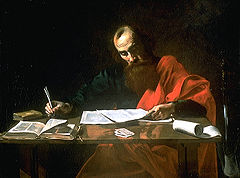 The Book of Habakkuk is the eighth book of the Twelve Prophets of the Hebrew Bible
, or of the "minor prophet
s" of the Christian Bible. It appears among the texts of the Septuagint. A copy of chapters 1 and 2 (of 3) is included in the Habakkuk Commentary
, found among the Dead Sea Scrolls
.
The second half of Habakkuk 2:4 is quoted by some of the earliest Christian
writers. Although this passage is only three words in the original Hebrew, Paul the Apostle quotes this verse twice in his epistles, in Romans
1:17 and again in Galatians
3:11. In doing so, Paul extends Habakkuk's original concept of righteous living at the present time into a future life. The same verse is quoted in Hebrews
10:37-38, where Habakkuk's vision is tied to Christ
and used to comfort the church during a period of persecution.
Chapter 3 may be an independent addition, according to some scholars, now recognized as a liturgical piece. The first two chapters are regarded by many as the work of a cult prophet attached to the Jerusalem Temple, possibly also the author of chapter 3.
"The Lord is in His Holy Temple", written in 1900 by William J. Kirkpatrick
, is based on verse 2:20.
The Hymn by William Cowper "Sometimes a Light Surprises" quotes Hab 3:17-18.
Hebrew Bible
The Hebrew Bible is a term used by biblical scholars outside of Judaism to refer to the Tanakh , a canonical collection of Jewish texts, and the common textual antecedent of the several canonical editions of the Christian Old Testament...
. It is attributed to the prophet Habakkuk
Habakkuk
Habakkuk , also spelled Habacuc, was a prophet in the Hebrew Bible. The etymology of the name of Habakkuk is not clear. The name is possibly related to the Akkadian khabbaququ, the name of a fragrant plant, or the Hebrew root חבק, meaning "embrace"...
, and was probably composed in the late 7th century BC. A copy of chapters 1 and 2 (of 3) is included in the Habakkuk Commentary
Habakkuk Commentary
The Habakkuk Commentary or Pesher Habakkuk, labelled 1QpHab was among the original seven Dead Sea Scrolls discovered in 1947 and published in 1951...
, found among the Dead Sea Scrolls
Dead Sea scrolls
The Dead Sea Scrolls are a collection of 972 texts from the Hebrew Bible and extra-biblical documents found between 1947 and 1956 on the northwest shore of the Dead Sea, from which they derive their name...
.
Chapters 1-2 are a dialog between Yahweh
Yahweh
Yahweh is the name of God in the Bible, the God of Abraham, Isaac, Jacob, Jews and Christians.The word Yahweh is a modern scholarly convention for the Hebrew , transcribed into Roman letters as YHWH and known as the Tetragrammaton, for which the original pronunciation is unknown...
and the prophet. The central message, that "the just shall live by his faith" (2:4), plays an important role in Christian
Christian
A Christian is a person who adheres to Christianity, an Abrahamic, monotheistic religion based on the life and teachings of Jesus of Nazareth as recorded in the Canonical gospels and the letters of the New Testament...
thought. It is used in the Epistle to the Romans
Epistle to the Romans
The Epistle of Paul to the Romans, often shortened to Romans, is the sixth book in the New Testament. Biblical scholars agree that it was composed by the Apostle Paul to explain that Salvation is offered through the Gospel of Jesus Christ...
1:17, Galatians 3:11, and the Epistle to the Hebrews
Epistle to the Hebrews
The Epistle to the Hebrews is one of the books in the New Testament. Its author is not known.The primary purpose of the Letter to the Hebrews is to exhort Christians to persevere in the face of persecution. The central thought of the entire Epistle is the doctrine of the Person of Christ and his...
10:38 as the starting point of the concept of faith
Faith
Faith is confidence or trust in a person or thing, or a belief that is not based on proof. In religion, faith is a belief in a transcendent reality, a religious teacher, a set of teachings or a Supreme Being. Generally speaking, it is offered as a means by which the truth of the proposition,...
. Chapter 3 may be an independent addition, now recognized as a liturgical piece, but was possibly written by the same author as chapters 1 and 2.
Background
The prophet Habakkuk is generally believed to have written his book in the mid to late 7th century BCE, not long before the Babylonians' siege and capture of Jerusalem.Author
Habakkuk identifies himself as a prophetProphet
In religion, a prophet, from the Greek word προφήτης profitis meaning "foreteller", is an individual who is claimed to have been contacted by the supernatural or the divine, and serves as an intermediary with humanity, delivering this newfound knowledge from the supernatural entity to other people...
in the opening verse. Due to the liturgical nature of the book of Habakkuk, there have been some scholars who think that the author may have been a temple prophet. Temple prophets are described in 1 Chronicles
Books of Chronicles
The Books of Chronicles are part of the Hebrew Bible. In the Masoretic Text, it appears as the first or last book of the Ketuvim . Chronicles largely parallels the Davidic narratives in the Books of Samuel and the Books of Kings...
25:1 as using lyre
Lyre
The lyre is a stringed musical instrument known for its use in Greek classical antiquity and later. The word comes from the Greek "λύρα" and the earliest reference to the word is the Mycenaean Greek ru-ra-ta-e, meaning "lyrists", written in Linear B syllabic script...
s, harp
Harp
The harp is a multi-stringed instrument which has the plane of its strings positioned perpendicularly to the soundboard. Organologically, it is in the general category of chordophones and has its own sub category . All harps have a neck, resonator and strings...
s and cymbal
Cymbal
Cymbals are a common percussion instrument. Cymbals consist of thin, normally round plates of various alloys; see cymbal making for a discussion of their manufacture. The greater majority of cymbals are of indefinite pitch, although small disc-shaped cymbals based on ancient designs sound a...
s. Some feel that this is echoed in Habakkuk 3:19b, and that Habakkuk may have been a Levite
Levite
In Jewish tradition, a Levite is a member of the Hebrew tribe of Levi. When Joshua led the Israelites into the land of Canaan, the Levites were the only Israelite tribe that received cities but were not allowed to be landowners "because the Lord the God of Israel himself is their inheritance"...
and singer
Singing
Singing is the act of producing musical sounds with the voice, and augments regular speech by the use of both tonality and rhythm. One who sings is called a singer or vocalist. Singers perform music known as songs that can be sung either with or without accompaniment by musical instruments...
in the Temple
Temple in Jerusalem
The Temple in Jerusalem or Holy Temple , refers to one of a series of structures which were historically located on the Temple Mount in the Old City of Jerusalem, the current site of the Dome of the Rock. Historically, these successive temples stood at this location and functioned as the centre of...
.
There is no biographical information on the prophet Habakkuk; in fact less is known about him than any other writer of the Bible. The only canonical information we have comes from the book that is named for him. His name comes either from the Hebrew
Hebrew language
Hebrew is a Semitic language of the Afroasiatic language family. Culturally, is it considered by Jews and other religious groups as the language of the Jewish people, though other Jewish languages had originated among diaspora Jews, and the Hebrew language is also used by non-Jewish groups, such...
word חבק (khavak) meaning "embrace" or else from an Akkadian
Akkadian language
Akkadian is an extinct Semitic language that was spoken in ancient Mesopotamia. The earliest attested Semitic language, it used the cuneiform writing system derived ultimately from ancient Sumerian, an unrelated language isolate...
word hambakuku for a kind of plant.
Although his name does not appear in any other part of the Jewish Bible, Rabbinic tradition
Rabbinic literature
Rabbinic literature, in its broadest sense, can mean the entire spectrum of rabbinic writings throughout Jewish history. However, the term often refers specifically to literature from the Talmudic era, as opposed to medieval and modern rabbinic writing, and thus corresponds with the Hebrew term...
holds Habakkuk to be the Shunammite woman's son, who was restored to life by Elisha
Elisha
Elisha is a prophet mentioned in the Hebrew Bible and the Qur'an. His name is commonly transliterated into English as Elisha via Hebrew, Eliseus via Greek and Latin, or Alyasa via Arabic.-Biblical biography:...
in 2 Kings
Books of Kings
The Book of Kings presents a narrative history of ancient Israel and Judah from the death of David to the release of his successor Jehoiachin from imprisonment in Babylon, a period of some 400 years...
4:16. The prophet Habakkuk is also mentioned in the tale of Bel and the Dragon
Bel and the Dragon
The narrative of Bel and the Dragon incorporated as chapter 14 of the extended Book of Daniel exists only in Greek in the Septuagint. This chapter, along with chapter 13, is referred to as deuterocanonical, in that it is not universally accepted among Christians as belonging to the canonical works...
, part of the deuterocanonical additions
Additions to Daniel
The Additions to Daniel comprise three chapters not found in the Hebrew/Aramaic text of Daniel. The text of these chapters is found in the Greek Septuagint and in the earlier Old Greek translation. They are accepted as canonical and translated as such in Roman Catholic, Eastern Orthodox and...
to Daniel
Book of Daniel
The Book of Daniel is a book in the Hebrew Bible. The book tells of how Daniel, and his Judean companions, were inducted into Babylon during Jewish exile, and how their positions elevated in the court of Nebuchadnezzar. The court tales span events that occur during the reigns of Nebuchadnezzar,...
in a late section of that book. In the superscription of the Old Greek version, Habakkuk is called the son of Joshua of the tribe of Levi. In this book Habakkuk is lifted by an angel to Babylon to provide Daniel with some food while he is in the lion's den.
Historical context
Neo-Babylonian Empire
The Neo-Babylonian Empire or Second Babylonian Empire was a period of Mesopotamian history which began in 626 BC and ended in 539 BC. During the preceding three centuries, Babylonia had been ruled by their fellow Akkadian speakers and northern neighbours, Assyria. Throughout that time Babylonia...
in 1:6-11 places him in the middle to last quarter of the 7th century BC
7th century BC
The 7th century BC started the first day of 700 BC and ended the last day of 601 BC.The Assyrian Empire continued to dominate the Near East during this century, exercising formidable power over neighbors like Babylon and Egypt. In the last two decades of the century, however, the empire began to...
. One possible period might be during the reign of Jehoiakim
Jehoiakim
Jehoiakim .On Josiah's death, Jehoiakim's younger brother Jehoahaz was proclaimed king, but after three months pharaoh Necho II deposed him and replaced him with the eldest son, Eliakim, who adopted the name Jehoiakim and became king at the age of twenty-five...
, from 609-598 BC. The reasoning for this date is that during his reign that the Babylonians were growing in power. The Babylonians marched against Jerusalem in 598. Jehoiakim died while the Babylonians were marching towards Jerusalem and Jehoiakim's eight-year-old son Jehoiachin assumed the throne. Upon the Babylonians' arrival, Jehoiachin and his advisors surrendered Jerusalem after a short time. With the transition of rulers and the young age and inexperience of Jehoiachin, they were not able to stand against Chaldean forces. There is a sense of an intimate knowledge of the Babylonian brutality in 1:12-17.
Overview
The book of Habakkuk is a book of Hebrew Bible (the Old TestamentOld Testament
The Old Testament, of which Christians hold different views, is a Christian term for the religious writings of ancient Israel held sacred and inspired by Christians which overlaps with the 24-book canon of the Masoretic Text of Judaism...
) and stands eighth in a section known as the 12 Minor Prophets in the Masoretic and Greek texts. It follows Nahum and precedes Zephaniah, who are considered to be his contemporaries.
The book consists of three chapters and the book is neatly divided into three different genres:
- A discussion between God and Habakkuk
- An Oracle of Woe
- A Psalm
A breakdown of the book's structure looks this way:
I. Title (1:1)
II. The Problem of Unpunished wickedness (1:2 – 4)
III. God's first response (1:5 – 11)
IV. The problem of excessive punishment (1:12 – 17)
V. Awaiting an Answer (2:1)
VI. God’s second response (2:2 – 20)
- A. A vision (2:2 -5)
- i. Announcement (2:2 -3)
- ii. Life and Death (2:4 -5)
- B. Taunting woes (2:6 – 20)
- i. The pillager (2: 6 -8)
- ii. The plotter (2:9 – 11)
- iii. The promoter of violence (2:12 -14)
- iv. The debaucher (2:15 -17)
- v. The pagan idolator (2:18 -20)
VII. Habakkuk’s Psalm (3:1 -19)
- A. Musical notes (3:1, 19b)
- B. Petition (3:2)
- C. God’s powerful presence in history (3:3 – 15)
- i. God’s coming (3:3 -7)
- ii. God’s combat (3:8 – 15)
- D. Fear and Faith (3:16 – 19a)
Themes
The major theme of Habakkuk is trying to grow from a faith of perplexity and doubt to the height of absolute trust in God. Habakkuk addresses his concerns over the fact that God will use the evil Babylonian empire to execute judgment on Judah for their sins.Habakkuk is unique among the prophets in that he openly questions the wisdom of God. In the first part of the first chapter, the Prophet sees the injustice among his people and asks why God does not take action. "1:2 Yahweh, how long will I cry, and you will not hear? I cry out to you “Violence!” and will you not save?" - World English Bible.
In the middle part of Chapter 1, God explains that he will send the Chaldeans to punish his people. 1:5 “Look among the nations, watch, and wonder marvelously; for I am working a work in your days, which you will not believe though it is told you. 1:6 For, behold, I raise up the Chaldeans, that bitter and hasty nation, that march through the breadth of the earth, to possess dwelling places that are not theirs. (World English Bible)
One of the "Eighteen Emendations to the Hebrew Scriptures" appears at 1:12. (Actually there were more than eighteen.) According to the professional Jewish scribes, the Sopherim, the text of 1:12 was changed from "You [God] do not die" to "We shall not die." The Sopherim considered it disrespectful of God to say "You do not die."
In the final part of the first chapter, the prophet expresses shock at God's choice of instrument for judgment. 1:13 You who have purer eyes than to see evil, and who cannot look on perversity, why do you tolerate those who deal treacherously, and keep silent when the wicked swallows up the man who is more righteous than he, (World English Bible http://www.ebible.org/web/Habakkuk.htm)
In Chapter 2, he awaits God's response to his challenge. God explains that He will also judge the Chaldeans, and much more harshly. 2:8 Because you have plundered many nations, all the remnant of the peoples will plunder you, because of men’s blood, and for the violence done to the land, to the city and to all who dwell in it. 2:9 Woe to him who gets an evil gain for his house, (World English Bible http://www.ebible.org/web/Habakkuk.htm)
Finally, in Chapter 3, Habakkuk expresses his ultimate faith in God, even if he doesn't fully understand.
3:17 For though the fig tree doesn’t flourish, nor fruit be in the vines; the labor of the olive fails, the fields yield no food; the flocks are cut off from the fold, and there is no herd in the stalls: 3:18 yet I will rejoice in Yahweh. I will be joyful in the God of my salvation! (World English Bible http://www.ebible.org/web/Habakkuk.htm)
Because of the final chapter of his book, which is a poetic praise of God, it has been assumed that Habakkuk was likely a member of the Levitical choir in the Temple. Contemporary scholars point out, however, that this chapter is missing from the Dead Sea Scrolls
Dead Sea scrolls
The Dead Sea Scrolls are a collection of 972 texts from the Hebrew Bible and extra-biblical documents found between 1947 and 1956 on the northwest shore of the Dead Sea, from which they derive their name...
and has some similarities with texts found in the Book of Daniel
Book of Daniel
The Book of Daniel is a book in the Hebrew Bible. The book tells of how Daniel, and his Judean companions, were inducted into Babylon during Jewish exile, and how their positions elevated in the court of Nebuchadnezzar. The court tales span events that occur during the reigns of Nebuchadnezzar,...
. They therefore suggest that it is a later interpolation which influenced the authors of Daniel, and that it is impossible to make the assumption of Habakkuk's background based on it.
Canonicity
Hebrew Bible
The Hebrew Bible is a term used by biblical scholars outside of Judaism to refer to the Tanakh , a canonical collection of Jewish texts, and the common textual antecedent of the several canonical editions of the Christian Old Testament...
, or of the "minor prophet
Minor prophet
Minor prophets is a book of the Hebrew Bible, so named because it contains twelve shorter prophetic works. In Christian Bibles the twelve are presented as individual books...
s" of the Christian Bible. It appears among the texts of the Septuagint. A copy of chapters 1 and 2 (of 3) is included in the Habakkuk Commentary
Habakkuk Commentary
The Habakkuk Commentary or Pesher Habakkuk, labelled 1QpHab was among the original seven Dead Sea Scrolls discovered in 1947 and published in 1951...
, found among the Dead Sea Scrolls
Dead Sea scrolls
The Dead Sea Scrolls are a collection of 972 texts from the Hebrew Bible and extra-biblical documents found between 1947 and 1956 on the northwest shore of the Dead Sea, from which they derive their name...
.
The second half of Habakkuk 2:4 is quoted by some of the earliest Christian
Christian
A Christian is a person who adheres to Christianity, an Abrahamic, monotheistic religion based on the life and teachings of Jesus of Nazareth as recorded in the Canonical gospels and the letters of the New Testament...
writers. Although this passage is only three words in the original Hebrew, Paul the Apostle quotes this verse twice in his epistles, in Romans
Epistle to the Romans
The Epistle of Paul to the Romans, often shortened to Romans, is the sixth book in the New Testament. Biblical scholars agree that it was composed by the Apostle Paul to explain that Salvation is offered through the Gospel of Jesus Christ...
1:17 and again in Galatians
Epistle to the Galatians
The Epistle of Paul to the Galatians, often shortened to Galatians, is the ninth book of the New Testament. It is a letter from Paul of Tarsus to a number of Early Christian communities in the Roman province of Galatia in central Anatolia...
3:11. In doing so, Paul extends Habakkuk's original concept of righteous living at the present time into a future life. The same verse is quoted in Hebrews
Epistle to the Hebrews
The Epistle to the Hebrews is one of the books in the New Testament. Its author is not known.The primary purpose of the Letter to the Hebrews is to exhort Christians to persevere in the face of persecution. The central thought of the entire Epistle is the doctrine of the Person of Christ and his...
10:37-38, where Habakkuk's vision is tied to Christ
Christ
Christ is the English term for the Greek meaning "the anointed one". It is a translation of the Hebrew , usually transliterated into English as Messiah or Mashiach...
and used to comfort the church during a period of persecution.
Chapter 3 may be an independent addition, according to some scholars, now recognized as a liturgical piece. The first two chapters are regarded by many as the work of a cult prophet attached to the Jerusalem Temple, possibly also the author of chapter 3.
Cultural influence
The Christian hymnHymn
A hymn is a type of song, usually religious, specifically written for the purpose of praise, adoration or prayer, and typically addressed to a deity or deities, or to a prominent figure or personification...
"The Lord is in His Holy Temple", written in 1900 by William J. Kirkpatrick
William J. Kirkpatrick
William J. Kirkpatrick was born in Duncannon, Pennsylvania to a schoolteacher and musician, Thomas Kirkpatrick. He was exposed to and given formal training in music at a very young age. In 1854, he moved to Philadelphia to study music and carpentry. It was here that he studied vocal music under...
, is based on verse 2:20.
The Hymn by William Cowper "Sometimes a Light Surprises" quotes Hab 3:17-18.
External links
- JewishJudaismJudaism ) is the "religion, philosophy, and way of life" of the Jewish people...
translations:- Chavakuk - Habakkuk (Judaica Press) translation [with RashiRashiShlomo Yitzhaki , or in Latin Salomon Isaacides, and today generally known by the acronym Rashi , was a medieval French rabbi famed as the author of a comprehensive commentary on the Talmud, as well as a comprehensive commentary on the Tanakh...
's commentary] at Chabad.org
- Chavakuk - Habakkuk (Judaica Press) translation [with Rashi
- ChristianChristianA Christian is a person who adheres to Christianity, an Abrahamic, monotheistic religion based on the life and teachings of Jesus of Nazareth as recorded in the Canonical gospels and the letters of the New Testament...
translations:- Online Bible at GospelHall.org (ESV, KJV, Darby, American Standard Version, Bible in Basic English)
Further information
- Introduction to the book of Habakkuk from the NIV Study BibleNIV Study BibleThe NIV Study Bible is a study Bible originally published by Zondervan in 1985 which uses the New International Version . Revisions include 1995, a full revision in 2002, an update in October 2008 for the 30th anniversary of the NIV, and a new update in 2011...
- A Brief Introduction to The Prophecy of Habakkuk for Contemporary Readers (Christian Perspective)