

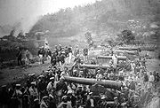
Bombardment of Shimonoseki

Encyclopedia
The Battles for Shimonoseki (Japanese:下関戦争/ 馬関戦争, Shimonoseki Sensō/ Bakan Sensō) refers to a series of military engagements in 1863 and 1864, fought to control Shimonoseki Straits by joint naval forces from the Great Britain
, France
, the Netherlands
and the United States
, against the Japan
ese feudal domain of Chōshū, which took place off and on the coast of Shimonoseki, Japan
.
to establish an atmosphere of peaceful solidarity, many feudal daimyo
s remained bitterly resentful of the shogunate's open-door policy to foreign trade. Belligerent opposition to European and American influence erupted into open conflict when the Emperor Kōmei
, breaking with centuries of imperial tradition, began to take an active role in matters of state and issued on March 11 and April 11, 1863 his "Order to expel barbarians
" (攘夷実行の勅命 – Jōi jikkō no chokumei).
The Shimonoseki-based Chōshū clan, under Lord
Mori Takachika
, began to take actions to expel all foreigners after the date fixed as a deadline of May 10, on a Lunar calendar
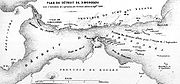
. Openly defying the shogunate, Takachika ordered his forces to fire, without warning, on all foreign ships traversing Shimonoseki Strait. This strategic but treacherous 112-meter waterway separates the islands of Honshū
and Kyūshū
and provides a passage connecting the Inland Sea with the Sea of Japan
.
Even before tensions escalated in Shimonoseki Strait, foreign diplomats and military experts, notably U.S. Foreign Minister
to Japan Robert Pruyn and Captain
David McDougal
of the U.S. Navy, were aware of the precarious state of affairs in Japan. A letter to the Secretary of the Navy, Gideon Welles
, dated June 12, 1863 written by McDougal stated, "General opinion is that the government of Japan is on the eve of revolution, the principal object of which is the expulsion of foreigners.".
s, which had been presented to Japan by the United States, and three steam warships of American construction; the bark
, Daniel Webster of six guns, the brig
Lanrick, or Kosei, with ten guns and the steamer Lancefield, or Koshin, of four guns.
The first attack occurred on June 25, 1863, soon after the Imperial "Order to expel barbarians
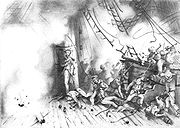
" came into effect. The U.S. merchant steamer SS Pembroke, under Captain Simon Cooper
, was riding anchor unsuspectingly outside Shimonoseki Strait when intercepted and fired upon by two Europe
an-built warships belonging to the rebel forces.
The crew of one enemy vessel taunted the frantic American seamen with a loud and unnerving cry, "Revere the Emperor and expel the barbarians!" ("尊皇攘夷", pronounced "Sonnō Jōi
"). Under incessant cannon fire, Pembroke managed to get underway, and escaped through the adjacent Bungo Strait, miraculously with only slight damage and no casualties.
 Upon arrival in Shanghai
, Cooper filed a report of the attack and dispatched it to the U.S. Consulate in Yokohama
, Japan.
Next day, June 26, the French naval dispatch steamer Kienchang was also riding anchor outside the strait, when rebel Japanese artillery
atop the bluffs surrounding Shimonoseki opened fire on her. Damaged in several places, the French vessel was lucky to get away with but one wounded sailor.
On July 11, despite warnings from the crew of the Kienchang, whom they had rendezvoused with earlier, the 16-gun Dutch warship
Medusa
cruised into Shimonoseki Strait. Her skipper, Captain François de Casembroot
, was convinced that Lord Mori would not dare fire on his vessel, due to the strength of his ship and longstanding relations between the Netherlands and Japan.
But Takachika did just that, pounding Medusa with more than thirty shells and killing or wounding nine seamen. De Casembroot returned fire and ran the rebel gauntlet at full speed, fearful of endangering the life of the Dutch Consul General, who was on board Medusa at that time. Within a short time, the Japanese warlord had managed to fire on the flags of most of the nations with consulates in Japan.
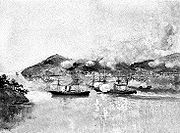
In the morning of July 16, 1863, under sanction by Minister Pruyn, in an apparent swift response to the attack on the Pembroke, the U.S. frigate
, USS Wyoming
, under Captain McDougal himself sailed into the strait and single-handedly engaged the US-built but poorly manned local fleet.
For almost two hours before withdrawing, McDougal sank two enemy vessels and severely damaged another one, along with inflicting some forty Japanese casualties, while the Wyoming suffered extensive damage with fourteen crew dead or wounded. The two Japanese steamers sunk by the Wyoming were raised again by Chōshū in 1864 and attached to the harbor of Hagi
.
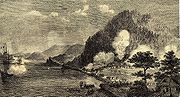 On the heels of McDougal's engagement, on July 20, the French Navy
retaliated for the attack on their merchant ship. The French force consisted of marines and two warships, the Tancrède
and the Dupleix
. With 250 men, under Captain Benjamin Jaurès
, they swept into Shimonoseki and destroyed a small town, together with at least one artillery emplacement.
The intervention was supported by the French plenipotentiary
in Japan, Duchesne de Bellecourt, but the French government, once informed, strongly criticized their representatives in Japan for taking such bellicose steps, for the reason that France had much more important military commitments to honour in other parts of the world, and could not afford a conflict in Japan. Duchesne de Bellecourt would be relieved from his position in 1864.
Jaurès was also congratulated by the Shogunal government for taking such decisive steps against anti-foreign forces, and was awarded a special banner.
, which housed Minister Robert Pruyn.
 Throughout the first half of 1864, as Shimonoseki Strait remained closed to foreign shipping, threats and rumors of war hung in the air, while diplomatic efforts remained deadlocked. Then the British Minister to Japan, Sir
Rutherford Alcock
, discussed with his treaty counterparts such as American
Minister Robert Pruyn, the feasibility of a joint military strike against Takachika.
They were soon making preparations for a combined show of force. Under the wary eyes of the Japanese, fifteen British warships rode anchor alongside four Dutch vessels, while a British regiment from Hong Kong augmented their display of military might. The French maintained a minimal naval presence, with the bulk of their forces in Mexico
trying to bolster Emperor Maximilian's
unstable regime.
The U.S., engaged in civil war, limited itself to demonstrate diplomatic and minimal military support for the Allies. In the meantime, Takachika procrastinated in negotiations by requesting additional time to respond to the allied demands, a course of action unacceptable to the treaty powers. The allies decided that the time for united action had arrived.
Despite retaliatory action from the treaty powers, another attack occurred in July, 1864, when the rebel forces fired upon the U.S. steamer Monitor after she entered a harbor for coal and water. This provoked further outrage, even after a British squadron was returning to Yokohama after delivering a multi-national ultimatum to Takachika, threatening military force if the strait was not opened.
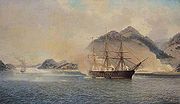
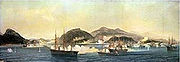
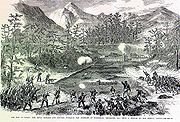 On August 17, 1864, a squadron consisting of nine British (Euryalus
, Conqueror
, Tartar, Leopard, Barrosa, Perseus, Argus, Coquette, and Bouncer), four Dutch (Amsterdam, Medusa, Metalen-Kruis, and D'Jambi), and three French warships (Tancrède, Sémiramis, and Dupleix), together with 2,000 soldier
s, marines and sailors, all under the command of Admiral
Sir Augustus Leopold Kuper
of the Royal Navy
, steamed out of Yokohama to open Shimonoseki Strait.
The U.S. chartered steamer Takiang
accompanied the operation in a token show of support. The two-day battle that followed on September 5 and 6 did what the previous operations could not; it destroyed the Prince
of Nagato's ability to wage war. Unable to match the firepower of the international fleet, and amid mounting casualties, the rebel Chōshū forces finally surrendered two days later on September 8, 1864.
Allied casualties included seventy-two killed or wounded and two severely damaged British ships. The stringent accord drawn up in the wake of the ceasefire, and negotiated by U.S. Minister Pruyn, included an indemnity of $3,000,000 from the Japanese, an amount equivalent to the purchase of about 30 steamships at that time. The Bakufu proved unable to pay such an amount, and this failure became the basis of further foreign pressure to have the Treaties ratified by the Emperor, the harbor of Hyōgo
opened to foreign trade, and the customs tariffs lowered uniformly to 5%.
A full account is contained in Sir Ernest Satow's A Diplomat in Japan. Satow was present as a young interpreter for the British admiral, Sir Augustus Kuper on the British flagship HMS Euryalus
commanded by Captain J.H.I. Alexander. It was also the action at which Duncan Gordon Boyes
won his Victoria Cross
at the age of seventeen.
Satow described Boyes as receiving the award "for conduct very plucky in one so young." Another VC winner at Shimonoseki was Thomas Pride
, and the third was the first American to win the medal, William Seeley
. De Casembroot wrote his account of the events in De Medusa in de wateren van Japan, in 1863 en 1864.
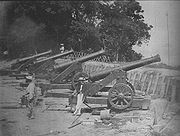
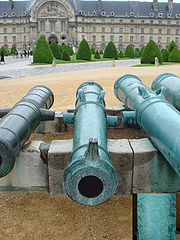
In 1883, twenty years after the first battle to reopen the strait, the United States quietly returned $750,000 to Japan, which represented its share of the reparation payment extracted under the rain of multi-national shells. Several life-size replicas of the guns used by Chōshū can now to be found at Shimonoseki in the spot where they were captured.
They were put there by the Shimonoseki city government in 2004, in recognition of the importance of the bombardment in Japanese history. The replicas are made of hollow steel and include coin-operated sound effects and smoke from the barrels.
 Right after the foreign interventions, the Shogunal government also launched its own preparations for a punitive expedition
against Chōshū, the First Chōshū expedition
. The expedition was aimed at punishing the August 20, 1864 Hamaguri rebellion
in which Chōshū forces attacked Shogunal forces in Kyōto
. The expedition was however cancelled after a compromise was brokered, involving the beheading of the leaders of the Hamaguri rebellion.
At the same time as this campaign, the British Royal Navy engaged Satsuma
samurai at the Bombardment of Kagoshima
, one of the several engagements of the Japanese conflict of 1863 and 1864.
, a prevalent tool in imperialism. Bitter resentment against foreign influence made the Chōshū clan feel justified in engaging in foolish acts of military provocation, in defiance of their own government.
The same nationalistic anger directed against foreigners demonstrated by the Japanese would flare up again in the Chinese Boxer Rebellion
. The U.S. and its European allies then felt compelled to use military force to uphold the treaty with Japan.
For the U.S., July 1863 was a momentous month for Northern arms at the battles of Gettysburg
and Vicksburg
.
 While it was bitterly embroiled in the American Civil War
, the world was carefully watching President Abraham Lincoln's
government for signs of weakness and indecision. The actions of USS Wyoming made it the first foreign warship to offensively uphold treaty rights with Japan; this fact coupled with the possibility that the events would mire the U.S. in a foreign war made the battle of Shimonoseki a significant engagement.
While the battles of Shimonoseki Strait were mere footnotes in the histories of the European powers, an interesting aspect of the affair was the resourcefulness displayed by the Japanese, something another generation of Europeans and Americans, eighty years later would come to appreciate. The feudal Japanese did not set eyes on a steam-powered ship until Commodore Perry's arrival only a decade before USS Wyoming's battle. Yet they had rapidly learned the ways of the Europeans within that brief span, purchasing foreign vessels and arming them with foreign weaponry. The quality and abundance of these armaments in 1860s Japan shocked the world.
United Kingdom of Great Britain and Ireland
The United Kingdom of Great Britain and Ireland was the formal name of the United Kingdom during the period when what is now the Republic of Ireland formed a part of it....
, France
Second French Empire
The Second French Empire or French Empire was the Imperial Bonapartist regime of Napoleon III from 1852 to 1870, between the Second Republic and the Third Republic, in France.-Rule of Napoleon III:...
, the Netherlands
Netherlands
The Netherlands is a constituent country of the Kingdom of the Netherlands, located mainly in North-West Europe and with several islands in the Caribbean. Mainland Netherlands borders the North Sea to the north and west, Belgium to the south, and Germany to the east, and shares maritime borders...
and the United States
United States
The United States of America is a federal constitutional republic comprising fifty states and a federal district...
, against the Japan
Japan
Japan is an island nation in East Asia. Located in the Pacific Ocean, it lies to the east of the Sea of Japan, China, North Korea, South Korea and Russia, stretching from the Sea of Okhotsk in the north to the East China Sea and Taiwan in the south...
ese feudal domain of Chōshū, which took place off and on the coast of Shimonoseki, Japan
Japan
Japan is an island nation in East Asia. Located in the Pacific Ocean, it lies to the east of the Sea of Japan, China, North Korea, South Korea and Russia, stretching from the Sea of Okhotsk in the north to the East China Sea and Taiwan in the south...
.
Background
Despite efforts of appeasement by the Tokugawa shogunateTokugawa shogunate
The Tokugawa shogunate, also known as the and the , was a feudal regime of Japan established by Tokugawa Ieyasu and ruled by the shoguns of the Tokugawa family. This period is known as the Edo period and gets its name from the capital city, Edo, which is now called Tokyo, after the name was...
to establish an atmosphere of peaceful solidarity, many feudal daimyo
Daimyo
is a generic term referring to the powerful territorial lords in pre-modern Japan who ruled most of the country from their vast, hereditary land holdings...
s remained bitterly resentful of the shogunate's open-door policy to foreign trade. Belligerent opposition to European and American influence erupted into open conflict when the Emperor Kōmei
Emperor Komei
was the 121st emperor of Japan, according to the traditional order of succession. Kōmei's reign spanned the years from 1846 through 1867.-Genealogy:Before Kōmei's accession to the Chrysanthemum Throne, his personal name was ;, his title was ....
, breaking with centuries of imperial tradition, began to take an active role in matters of state and issued on March 11 and April 11, 1863 his "Order to expel barbarians
Order to expel barbarians
The was an edict issued by the Japanese Emperor Kōmei in 1863 against the Westernization of Japan following the opening of the country by Commodore Perry in 1854.-The order:...
" (攘夷実行の勅命 – Jōi jikkō no chokumei).
The Shimonoseki-based Chōshū clan, under Lord
Lord
Lord is a title with various meanings. It can denote a prince or a feudal superior . The title today is mostly used in connection with the peerage of the United Kingdom or its predecessor countries, although some users of the title do not themselves hold peerages, and use it 'by courtesy'...
Mori Takachika
Mōri Takachika
was the 14th daimyo of Chōshū Domain. He was later allowed to use a character from the name of shogun Tokugawa Ieyoshi and changed his name to Yoshichika...
, began to take actions to expel all foreigners after the date fixed as a deadline of May 10, on a Lunar calendar
Lunar calendar
A lunar calendar is a calendar that is based on cycles of the lunar phase. A common purely lunar calendar is the Islamic calendar or Hijri calendar. A feature of the Islamic calendar is that a year is always 12 months, so the months are not linked with the seasons and drift each solar year by 11 to...
. Openly defying the shogunate, Takachika ordered his forces to fire, without warning, on all foreign ships traversing Shimonoseki Strait. This strategic but treacherous 112-meter waterway separates the islands of Honshū
Honshu
is the largest island of Japan. The nation's main island, it is south of Hokkaido across the Tsugaru Strait, north of Shikoku across the Inland Sea, and northeast of Kyushu across the Kanmon Strait...
and Kyūshū
Kyushu
is the third largest island of Japan and most southwesterly of its four main islands. Its alternate ancient names include , , and . The historical regional name is referred to Kyushu and its surrounding islands....
and provides a passage connecting the Inland Sea with the Sea of Japan
Sea of Japan
The Sea of Japan is a marginal sea of the western Pacific Ocean, between the Asian mainland, the Japanese archipelago and Sakhalin. It is bordered by Japan, North Korea, Russia and South Korea. Like the Mediterranean Sea, it has almost no tides due to its nearly complete enclosure from the Pacific...
.
Even before tensions escalated in Shimonoseki Strait, foreign diplomats and military experts, notably U.S. Foreign Minister
Foreign minister
A Minister of Foreign Affairs, or foreign minister, is a cabinet minister who helps form the foreign policy of a sovereign state. The foreign minister is often regarded as the most senior ministerial position below that of the head of government . It is often granted to the deputy prime minister in...
to Japan Robert Pruyn and Captain
Captain (naval)
Captain is the name most often given in English-speaking navies to the rank corresponding to command of the largest ships. The NATO rank code is OF-5, equivalent to an army full colonel....
David McDougal
David McDougal
David Stockton McDougal was an officer in the United States Navy during the American Civil War most noted for his leadership during a naval battle off of Japan.-Biography:...
of the U.S. Navy, were aware of the precarious state of affairs in Japan. A letter to the Secretary of the Navy, Gideon Welles
Gideon Welles
Gideon Welles was the United States Secretary of the Navy from 1861 to 1869. His buildup of the Navy to successfully execute blockades of Southern ports was a key component of Northern victory of the Civil War...
, dated June 12, 1863 written by McDougal stated, "General opinion is that the government of Japan is on the eve of revolution, the principal object of which is the expulsion of foreigners.".
"Revere the Emperor and expel the barbarians!"
The Chōshū clan was equipped with mostly antiquated cannons firing cannonballs, but also some modern armament, such as five 8 inches (203.2 mm) Dahlgren gunDahlgren gun
Dahlgren guns were muzzle loading naval artillery designed by Rear Admiral John A. Dahlgren USN, mostly used in the period of the American Civil War. Dahlgren's design philosophy evolved from an accidental explosion in 1849 of a 32-pounder being tested for accuracy, killing a gunner...
s, which had been presented to Japan by the United States, and three steam warships of American construction; the bark
Bark
Bark is the outermost layers of stems and roots of woody plants. Plants with bark include trees, woody vines and shrubs. Bark refers to all the tissues outside of the vascular cambium and is a nontechnical term. It overlays the wood and consists of the inner bark and the outer bark. The inner...
, Daniel Webster of six guns, the brig
Brig
A brig is a sailing vessel with two square-rigged masts. During the Age of Sail, brigs were seen as fast and manoeuvrable and were used as both naval warships and merchant vessels. They were especially popular in the 18th and early 19th centuries...
Lanrick, or Kosei, with ten guns and the steamer Lancefield, or Koshin, of four guns.
The first attack occurred on June 25, 1863, soon after the Imperial "Order to expel barbarians
Order to expel barbarians
The was an edict issued by the Japanese Emperor Kōmei in 1863 against the Westernization of Japan following the opening of the country by Commodore Perry in 1854.-The order:...
" came into effect. The U.S. merchant steamer SS Pembroke, under Captain Simon Cooper
Simon Cooper
Major-General Sir Simon Christie Cooper GCVO was Major-General commanding the Household Division and General Officer Commanding London District and later Master of the Household of the Royal Household of the Sovereign of the United Kingdom...
, was riding anchor unsuspectingly outside Shimonoseki Strait when intercepted and fired upon by two Europe
Europe
Europe is, by convention, one of the world's seven continents. Comprising the westernmost peninsula of Eurasia, Europe is generally 'divided' from Asia to its east by the watershed divides of the Ural and Caucasus Mountains, the Ural River, the Caspian and Black Seas, and the waterways connecting...
an-built warships belonging to the rebel forces.
The crew of one enemy vessel taunted the frantic American seamen with a loud and unnerving cry, "Revere the Emperor and expel the barbarians!" ("尊皇攘夷", pronounced "Sonnō Jōi
Sonno joi
is a Japanese political philosophy and a social movement derived from Neo-Confucianism; it became a political slogan in the 1850s and 1860s in the movement to overthrow the Tokugawa bakufu, during the Bakumatsu period.-Origin:...
"). Under incessant cannon fire, Pembroke managed to get underway, and escaped through the adjacent Bungo Strait, miraculously with only slight damage and no casualties.
Shanghai
Shanghai is the largest city by population in China and the largest city proper in the world. It is one of the four province-level municipalities in the People's Republic of China, with a total population of over 23 million as of 2010...
, Cooper filed a report of the attack and dispatched it to the U.S. Consulate in Yokohama
Yokohama
is the capital city of Kanagawa Prefecture and the second largest city in Japan by population after Tokyo and most populous municipality of Japan. It lies on Tokyo Bay, south of Tokyo, in the Kantō region of the main island of Honshu...
, Japan.
Next day, June 26, the French naval dispatch steamer Kienchang was also riding anchor outside the strait, when rebel Japanese artillery
Artillery
Originally applied to any group of infantry primarily armed with projectile weapons, artillery has over time become limited in meaning to refer only to those engines of war that operate by projection of munitions far beyond the range of effect of personal weapons...
atop the bluffs surrounding Shimonoseki opened fire on her. Damaged in several places, the French vessel was lucky to get away with but one wounded sailor.
On July 11, despite warnings from the crew of the Kienchang, whom they had rendezvoused with earlier, the 16-gun Dutch warship
Warship
A warship is a ship that is built and primarily intended for combat. Warships are usually built in a completely different way from merchant ships. As well as being armed, warships are designed to withstand damage and are usually faster and more maneuvrable than merchant ships...
Medusa
Medusa
In Greek mythology Medusa , " guardian, protectress") was a Gorgon, a chthonic monster, and a daughter of Phorcys and Ceto. The author Hyginus, interposes a generation and gives Medusa another chthonic pair as parents. Gazing directly upon her would turn onlookers to stone...
cruised into Shimonoseki Strait. Her skipper, Captain François de Casembroot
François de Casembroot
François de Casembroot was an officer of the Royal Netherlands Navy.Casembroot was named Commander of the ship Medusa, which patrolled the Japanese coast from 1862 to 1864...
, was convinced that Lord Mori would not dare fire on his vessel, due to the strength of his ship and longstanding relations between the Netherlands and Japan.
But Takachika did just that, pounding Medusa with more than thirty shells and killing or wounding nine seamen. De Casembroot returned fire and ran the rebel gauntlet at full speed, fearful of endangering the life of the Dutch Consul General, who was on board Medusa at that time. Within a short time, the Japanese warlord had managed to fire on the flags of most of the nations with consulates in Japan.
Battle of Shimonoseki Straits
In the morning of July 16, 1863, under sanction by Minister Pruyn, in an apparent swift response to the attack on the Pembroke, the U.S. frigate
Frigate
A frigate is any of several types of warship, the term having been used for ships of various sizes and roles over the last few centuries.In the 17th century, the term was used for any warship built for speed and maneuverability, the description often used being "frigate-built"...
, USS Wyoming
USS Wyoming (1859)
The first USS Wyoming of the United States Navy was a wooden-hulled screw sloop that fought on the Union side during the American Civil War. Sent to the Pacific Ocean to search for the CSS Alabama, Wyoming eventually came upon the shores of Japan and engaged Japanese land and sea forces...
, under Captain McDougal himself sailed into the strait and single-handedly engaged the US-built but poorly manned local fleet.
For almost two hours before withdrawing, McDougal sank two enemy vessels and severely damaged another one, along with inflicting some forty Japanese casualties, while the Wyoming suffered extensive damage with fourteen crew dead or wounded. The two Japanese steamers sunk by the Wyoming were raised again by Chōshū in 1864 and attached to the harbor of Hagi
Hagi, Yamaguchi
is a city located in Yamaguchi, Japan and was incorporated as a city on July 1, 1932. Formerly part of Abu District.On March 6, 2005, the former city of Hagi merged with the towns of Susa and Tamagawa, and the villages of Asahi, Fukue, Kawakami and Mutsumi to form the new city of Hagi.Iwami Airport...
.
First Battle, July 20, 1863
French Navy
The French Navy, officially the Marine nationale and often called La Royale is the maritime arm of the French military. It includes a full range of fighting vessels, from patrol boats to a nuclear powered aircraft carrier and 10 nuclear-powered submarines, four of which are capable of launching...
retaliated for the attack on their merchant ship. The French force consisted of marines and two warships, the Tancrède
Tancrède
Tancrède is a tragédie en musique in a prologue and five acts by composer André Campra and librettist Antoine Danchet, based on Gerusalemme liberata by Torquato Tasso....
and the Dupleix
FS Dupleix (1861)
The Dupleix was a steam and sail corvette of the French Marine Nationale. She was the first French vessel named after the 18th Century Governor of Pondichéry and Gouverneur Général of the French possessions in India marquess Joseph François Dupleix.After her commissioning, the Dupleix was sent to...
. With 250 men, under Captain Benjamin Jaurès
Benjamin Jaurès
Constant Louis Jean Benjamin Jaurès was a 19th-century French Admiral and Senator, who was active in Japan during the Bombardment of Shimonoseki and the Boshin war ....
, they swept into Shimonoseki and destroyed a small town, together with at least one artillery emplacement.
The intervention was supported by the French plenipotentiary
Plenipotentiary
The word plenipotentiary has two meanings. As a noun, it refers to a person who has "full powers." In particular, the term commonly refers to a diplomat fully authorized to represent his government as a prerogative...
in Japan, Duchesne de Bellecourt, but the French government, once informed, strongly criticized their representatives in Japan for taking such bellicose steps, for the reason that France had much more important military commitments to honour in other parts of the world, and could not afford a conflict in Japan. Duchesne de Bellecourt would be relieved from his position in 1864.
Jaurès was also congratulated by the Shogunal government for taking such decisive steps against anti-foreign forces, and was awarded a special banner.
Diplomatic Row
Meanwhile, the Americans, French, British and Dutch feverishly opened diplomatic channels in an effort to negotiate the reopening of the passage to the Inland Sea. Months dragged by with no end in sight to the growing dilemma. By May 1864, various bellicose Japanese factions had destroyed thousands of dollars in foreign property, including homes, churches and shipping. This wanton destruction included the U.S. Legation in TokyoTokyo
, ; officially , is one of the 47 prefectures of Japan. Tokyo is the capital of Japan, the center of the Greater Tokyo Area, and the largest metropolitan area of Japan. It is the seat of the Japanese government and the Imperial Palace, and the home of the Japanese Imperial Family...
, which housed Minister Robert Pruyn.
Sir
Sir is an honorific used as a title , or as a courtesy title to address a man without using his given or family name in many English speaking cultures...
Rutherford Alcock
Rutherford Alcock
Sir Rutherford Alcock KCB was the first British diplomatic representative to live in Japan.-Early life:Alcock was the son of the physician, Dr. Thomas Alcock, who practised at Ealing, near London. As he grew up, Alcock followed his father into the medical profession...
, discussed with his treaty counterparts such as American
United States
The United States of America is a federal constitutional republic comprising fifty states and a federal district...
Minister Robert Pruyn, the feasibility of a joint military strike against Takachika.
They were soon making preparations for a combined show of force. Under the wary eyes of the Japanese, fifteen British warships rode anchor alongside four Dutch vessels, while a British regiment from Hong Kong augmented their display of military might. The French maintained a minimal naval presence, with the bulk of their forces in Mexico
Mexico
The United Mexican States , commonly known as Mexico , is a federal constitutional republic in North America. It is bordered on the north by the United States; on the south and west by the Pacific Ocean; on the southeast by Guatemala, Belize, and the Caribbean Sea; and on the east by the Gulf of...
trying to bolster Emperor Maximilian's
Maximilian I of Mexico
Maximilian I was the only monarch of the Second Mexican Empire.After a distinguished career in the Austrian Navy, he was proclaimed Emperor of Mexico on April 10, 1864, with the backing of Napoleon III of France and a group of Mexican monarchists who sought to revive the Mexican monarchy...
unstable regime.
The U.S., engaged in civil war, limited itself to demonstrate diplomatic and minimal military support for the Allies. In the meantime, Takachika procrastinated in negotiations by requesting additional time to respond to the allied demands, a course of action unacceptable to the treaty powers. The allies decided that the time for united action had arrived.
Despite retaliatory action from the treaty powers, another attack occurred in July, 1864, when the rebel forces fired upon the U.S. steamer Monitor after she entered a harbor for coal and water. This provoked further outrage, even after a British squadron was returning to Yokohama after delivering a multi-national ultimatum to Takachika, threatening military force if the strait was not opened.
Final Battle, September 5–6, 1864
HMS Euryalus (1853)
HMS Euryalus was a fourth-rate wooden-hulled screw frigate of the Royal Navy, with a 400HP steam engine that could make over 12 knots. She was launched at Chatham in 1853, was 212 feet long, displaced 3125 tons and had a complement of 515...
, Conqueror
HMS Waterloo (1833)
HMS Waterloo was a 120-gun first rate ship of the line of the Royal Navy, launched on 10 June 1833 at Chatham.Waterloo was cut down to an 89-gun 2-decker and converted to steam at Chatham 1 April 1859—12 December 1859. Following the loss of the modern 101-gun steam 2-decker Conqueror in 1861,...
, Tartar, Leopard, Barrosa, Perseus, Argus, Coquette, and Bouncer), four Dutch (Amsterdam, Medusa, Metalen-Kruis, and D'Jambi), and three French warships (Tancrède, Sémiramis, and Dupleix), together with 2,000 soldier
Soldier
A soldier is a member of the land component of national armed forces; whereas a soldier hired for service in a foreign army would be termed a mercenary...
s, marines and sailors, all under the command of Admiral
Admiral
Admiral is the rank, or part of the name of the ranks, of the highest naval officers. It is usually considered a full admiral and above vice admiral and below admiral of the fleet . It is usually abbreviated to "Adm" or "ADM"...
Sir Augustus Leopold Kuper
Augustus Leopold Kuper
Admiral Sir Augustus Leopold Kuper GCB was a Royal Navy officer known for his commands in the far east.-Naval career:...
of the Royal Navy
Royal Navy
The Royal Navy is the naval warfare service branch of the British Armed Forces. Founded in the 16th century, it is the oldest service branch and is known as the Senior Service...
, steamed out of Yokohama to open Shimonoseki Strait.
The U.S. chartered steamer Takiang
USS Ta-Kiang (1862)
USS Ta-Kiang was a 510-ton steamer was chartered by the Union Navy during the American Civil War.Ta-Kiang was assigned by the Navy to be part of the Allied fleet proceeding to Japan to enforce the opening of the Shimonoseki straits in that country, in keeping with treaties already signed with...
accompanied the operation in a token show of support. The two-day battle that followed on September 5 and 6 did what the previous operations could not; it destroyed the Prince
Prince
Prince is a general term for a ruler, monarch or member of a monarch's or former monarch's family, and is a hereditary title in the nobility of some European states. The feminine equivalent is a princess...
of Nagato's ability to wage war. Unable to match the firepower of the international fleet, and amid mounting casualties, the rebel Chōshū forces finally surrendered two days later on September 8, 1864.
Allied casualties included seventy-two killed or wounded and two severely damaged British ships. The stringent accord drawn up in the wake of the ceasefire, and negotiated by U.S. Minister Pruyn, included an indemnity of $3,000,000 from the Japanese, an amount equivalent to the purchase of about 30 steamships at that time. The Bakufu proved unable to pay such an amount, and this failure became the basis of further foreign pressure to have the Treaties ratified by the Emperor, the harbor of Hyōgo
Hyogo Prefecture
is a prefecture of Japan located in the Kansai region on Honshū island. The capital is Kobe.The prefecture's name was previously alternately spelled as Hiogo.- History :...
opened to foreign trade, and the customs tariffs lowered uniformly to 5%.
A full account is contained in Sir Ernest Satow's A Diplomat in Japan. Satow was present as a young interpreter for the British admiral, Sir Augustus Kuper on the British flagship HMS Euryalus
HMS Euryalus (1853)
HMS Euryalus was a fourth-rate wooden-hulled screw frigate of the Royal Navy, with a 400HP steam engine that could make over 12 knots. She was launched at Chatham in 1853, was 212 feet long, displaced 3125 tons and had a complement of 515...
commanded by Captain J.H.I. Alexander. It was also the action at which Duncan Gordon Boyes
Duncan Gordon Boyes
Duncan Gordon Boyes VC was an English recipient of the Victoria Cross, the highest and most prestigious award for gallantry in the face of the enemy that can be awarded to British and Commonwealth forces...
won his Victoria Cross
Victoria Cross
The Victoria Cross is the highest military decoration awarded for valour "in the face of the enemy" to members of the armed forces of various Commonwealth countries, and previous British Empire territories....
at the age of seventeen.
Satow described Boyes as receiving the award "for conduct very plucky in one so young." Another VC winner at Shimonoseki was Thomas Pride
Thomas Pride (VC)
Thomas Pride VC was an English recipient of the Victoria Cross, the highest and most prestigious award for gallantry in the face of the enemy that can be awarded to a serviceman in the British and Commonwealth forces.-Details:...
, and the third was the first American to win the medal, William Seeley
William Henry Harrison Seeley
William Henry Harrison Seeley VC was an American recipient of the Victoria Cross, the highest and most prestigious award for gallantry in the face of the enemy that can be awarded to British and Commonwealth forces.-Details:...
. De Casembroot wrote his account of the events in De Medusa in de wateren van Japan, in 1863 en 1864.
In 1883, twenty years after the first battle to reopen the strait, the United States quietly returned $750,000 to Japan, which represented its share of the reparation payment extracted under the rain of multi-national shells. Several life-size replicas of the guns used by Chōshū can now to be found at Shimonoseki in the spot where they were captured.
They were put there by the Shimonoseki city government in 2004, in recognition of the importance of the bombardment in Japanese history. The replicas are made of hollow steel and include coin-operated sound effects and smoke from the barrels.
Aftermath
Punitive expedition
A punitive expedition is a military journey undertaken to punish a state or any group of persons outside the borders of the punishing state. It is usually undertaken in response to perceived disobedient or morally wrong behavior, but may be also be a covered revenge...
against Chōshū, the First Chōshū expedition
First Chōshū expedition
The First Chōshū expedition was a punitive military expedition led by the Tokugawa Shogunate against the Chōshū Domain in retaliation for the attack of Chōshū on the Imperial Palace in the Hamaguri rebellion. The First Chōshū expedition was launched on 1 September 1864.The conflict finally led to...
. The expedition was aimed at punishing the August 20, 1864 Hamaguri rebellion
Hamaguri rebellion
The rebellion at the Hamaguri Gate of the Imperial Palace in Kyōto took place on August 20, 1864 and reflected the discontent of pro-imperial and anti-alien groups...
in which Chōshū forces attacked Shogunal forces in Kyōto
Kyoto
is a city in the central part of the island of Honshū, Japan. It has a population close to 1.5 million. Formerly the imperial capital of Japan, it is now the capital of Kyoto Prefecture, as well as a major part of the Osaka-Kobe-Kyoto metropolitan area.-History:...
. The expedition was however cancelled after a compromise was brokered, involving the beheading of the leaders of the Hamaguri rebellion.
At the same time as this campaign, the British Royal Navy engaged Satsuma
Satsuma
Satsuma may refer to:* Satsuma , a citrus fruit* Satsuma , a genus of land snails-In Japan:* Satsuma, Kagoshima, a Japanese town* Satsuma District, Kagoshima, a district in Kagoshima Prefecture...
samurai at the Bombardment of Kagoshima
Bombardment of Kagoshima
The Bombardment of Kagoshima, also known as the , took place on 15–17 August 1863 during the Late Tokugawa shogunate. The British Royal Navy was fired on from the coastal batteries near town of Kagoshima and in retaliation bombarded the town...
, one of the several engagements of the Japanese conflict of 1863 and 1864.
Historical significance
Closely resembling the series of little conflicts fought by the European powers in Asia, Africa and elsewhere during the Nineteenth Century, the troubles in Japan seemed to exemplify their gunboat diplomacyGunboat diplomacy
In international politics, gunboat diplomacy refers to the pursuit of foreign policy objectives with the aid of conspicuous displays of military power — implying or constituting a direct threat of warfare, should terms not be agreeable to the superior force....
, a prevalent tool in imperialism. Bitter resentment against foreign influence made the Chōshū clan feel justified in engaging in foolish acts of military provocation, in defiance of their own government.
The same nationalistic anger directed against foreigners demonstrated by the Japanese would flare up again in the Chinese Boxer Rebellion
Boxer Rebellion
The Boxer Rebellion, also called the Boxer Uprising by some historians or the Righteous Harmony Society Movement in northern China, was a proto-nationalist movement by the "Righteous Harmony Society" , or "Righteous Fists of Harmony" or "Society of Righteous and Harmonious Fists" , in China between...
. The U.S. and its European allies then felt compelled to use military force to uphold the treaty with Japan.
For the U.S., July 1863 was a momentous month for Northern arms at the battles of Gettysburg
Battle of Gettysburg
The Battle of Gettysburg , was fought July 1–3, 1863, in and around the town of Gettysburg, Pennsylvania. The battle with the largest number of casualties in the American Civil War, it is often described as the war's turning point. Union Maj. Gen. George Gordon Meade's Army of the Potomac...
and Vicksburg
Vicksburg
Vicksburg is the name of some places in the United States of America:* Vicksburg, Florida* Vicksburg, Indiana* Vicksburg, Michigan* Vicksburg, Mississippi** The Vicksburg Campaign, an American Civil War campaign...
.
American Civil War
The American Civil War was a civil war fought in the United States of America. In response to the election of Abraham Lincoln as President of the United States, 11 southern slave states declared their secession from the United States and formed the Confederate States of America ; the other 25...
, the world was carefully watching President Abraham Lincoln's
Abraham Lincoln
Abraham Lincoln was the 16th President of the United States, serving from March 1861 until his assassination in April 1865. He successfully led his country through a great constitutional, military and moral crisis – the American Civil War – preserving the Union, while ending slavery, and...
government for signs of weakness and indecision. The actions of USS Wyoming made it the first foreign warship to offensively uphold treaty rights with Japan; this fact coupled with the possibility that the events would mire the U.S. in a foreign war made the battle of Shimonoseki a significant engagement.
While the battles of Shimonoseki Strait were mere footnotes in the histories of the European powers, an interesting aspect of the affair was the resourcefulness displayed by the Japanese, something another generation of Europeans and Americans, eighty years later would come to appreciate. The feudal Japanese did not set eyes on a steam-powered ship until Commodore Perry's arrival only a decade before USS Wyoming's battle. Yet they had rapidly learned the ways of the Europeans within that brief span, purchasing foreign vessels and arming them with foreign weaponry. The quality and abundance of these armaments in 1860s Japan shocked the world.
See also
- Military history of FranceMilitary history of FranceThe military history of France encompasses an immense panorama of conflicts and struggles extending for more than 2,000 years across areas including modern France, greater Europe, and European territorial possessions overseas....
- Military History of JapanMilitary history of JapanThe military history of Japan is characterised by a long period of feudal wars, followed by domestic stability, and then rampant imperialism. It culminates with Japan's defeat by the Allies in World War II...
- Military history of the NetherlandsMilitary history of the NetherlandsThe Dutch-speaking people have a long history; the Netherlands as a nation-state dates from 1568. Belgium became an independent state in 1830 when it seceded from the Netherlands....
- Military history of the United KingdomMilitary history of the United KingdomThe military history of the United Kingdom covers the period from the creation of the united Kingdom of Great Britain in 1707, with the political union of England and Scotland, to the present day....
- Military History of the United StatesMilitary history of the United StatesThe military history of the United States spans a period of over two centuries. During the course of those years, the United States evolved from a new nation fighting the British Empire for independence without a professional military , through a monumental American Civil War to the world's sole...
- Shimonoseki
- Treaty of ShimonosekiTreaty of ShimonosekiThe Treaty of Shimonoseki , known as the Treaty of Maguan in China, was signed at the Shunpanrō hall on April 17, 1895, between the Empire of Japan and Qing Empire of China, ending the First Sino-Japanese War. The peace conference took place from March 20 to April 17, 1895...