
Home      Discussion      Topics      Dictionary      Almanac
Signup       Login
Boeing YC-14

Boeing YC-14

Overview
Discussion
Ask a question about 'Boeing YC-14'
Start a new discussion about 'Boeing YC-14'
Answer questions from other users
Full Discussion Forum
 
Unanswered Questions
Encyclopedia


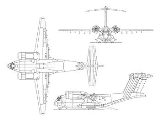
The Boeing YC-14 was a twin-engine short take-off and landing
STOL
STOL is an acronym for short take-off and landing, a term used to describe aircraft with very short runway requirements.-Definitions:There is no one accepted definition of STOL and many different definitions have been used by different authorities and nations at various times and for a myriad of...

 (STOL) tactical transport. It was Boeing
Boeing
The Boeing Company is an American multinational aerospace and defense corporation, founded in 1916 by William E. Boeing in Seattle, Washington. Boeing has expanded over the years, merging with McDonnell Douglas in 1997. Boeing Corporate headquarters has been in Chicago, Illinois since 2001...

's entrant into the United States Air Force
United States Air Force
The United States Air Force is the aerial warfare service branch of the United States Armed Forces and one of the American uniformed services. Initially part of the United States Army, the USAF was formed as a separate branch of the military on September 18, 1947 under the National Security Act of...

's Advanced Medium STOL Transport
Advanced Medium STOL Transport
The Advanced Medium STOL Transport project was intended to replace the Lockheed C-130 Hercules tactical transport in United States Air Force service with a new aircraft with improved STOL performance...

 (AMST) competition, which aimed to replace the Lockheed C-130 Hercules as the USAF's standard STOL tactical transport. Although both the YC-14 and the competing McDonnell Douglas YC-15
McDonnell Douglas YC-15
|-See also:-References:NotesBibliography* Green, William. The Observer's Book of Aircraft. London. Frederick Warne & Co. Ltd., 1976. ISBN 0-7232-1553-7....

 were successful, neither aircraft entered production. The AMST project was ended in 1979 and replaced by the C-X program.

Design and development


In mid-1970, the USAF began a paper study, the Tactical Aircraft Investigation (TAI), with Boeing, McDonnell Douglas
McDonnell Douglas
McDonnell Douglas was a major American aerospace manufacturer and defense contractor, producing a number of famous commercial and military aircraft. It formed from a merger of McDonnell Aircraft and Douglas Aircraft in 1967. McDonnell Douglas was based at Lambert-St. Louis International Airport...

, and other companies to look at possible tactical transport aircraft designs. This study was a precursor to what became the Advanced Medium STOL Transport program, and as a part of this program Boeing began to look at various high lift aircraft configurations. Boeing had earlier proposed an underwing externally-blown flap
Blown flap
Blown flaps are a powered aerodynamic high-lift device invented by the British and used on the wings of certain aircraft to improve low-speed lift during takeoff and landing. The process is sometimes called a boundary layer control system . They were a popular design feature in the 1960s, but fell...

 solution for their competitor for the C-5 Galaxy
C-5 Galaxy
The Lockheed C-5 Galaxy is a large military transport aircraft built by Lockheed. It provides the United States Air Force with a heavy intercontinental-range strategic airlift capability, one that can carry outsize and oversize cargos, including all air-certifiable cargo. The Galaxy has many...

, and had put this to good use when they modified their losing entry into the Boeing 747
Boeing 747
The Boeing 747 is a wide-body commercial airliner and cargo transport, often referred to by its original nickname, Jumbo Jet, or Queen of the Skies. It is among the world's most recognizable aircraft, and was the first wide-body ever produced...

. They had also done studies with the original Boeing 707
Boeing 707
The Boeing 707 is a four-engine narrow-body commercial passenger jet airliner developed by Boeing in the early 1950s. Its name is most commonly pronounced as "Seven Oh Seven". The first airline to operate the 707 was Pan American World Airways, inaugurating the type's first commercial flight on...

 prototype, the Boeing 367-80
Boeing 367-80
The Boeing 367-80, or "Dash 80" as it was called within Boeing, is an American prototype jet transport built to demonstrate the advantages of jet aircraft for passenger transport over piston-engine airliners....

, adding extensive leading and trailing edge devices using blown flaps. For the TAI studies, Boeing again looked at those mechanisms, as well as new mechanisms like boundary layer control
Boundary layer control
Boundary layer control refers to methods of controlling the behaviour of fluid flow boundary layers. This holds particular interest in aeronautical engineering because drag may be reduced whilst achieving high lift ....

. However none of these studied designs were particularly appealing to Boeing.

The Boeing engineers were aware that NASA
NASA
The National Aeronautics and Space Administration is the agency of the United States government that is responsible for the nation's civilian space program and for aeronautics and aerospace research...

 had carried out a series of "powered lift" studies some time earlier, including both externally-blown flaps, as well an upper-surface blowing (USB), an unusual variation. In the USB system the engine is arranged over the top surface of the wing, blowing over the flaps. When the flaps are lowered the Coandă effect
Coanda effect
The Coandă effect is the tendency of a fluid jet to be attracted to a nearby surface. The principle was named after Romanian aerodynamics pioneer Henri Coandă, who was the first to recognize the practical application of the phenomenon in aircraft development....

 makes the jet exhaust "stick" to the flaps and bend down towards the ground. They searched for additional research on the concept, and found that half-span upper-surface blowing research had been conducted in the NASA Langley 12 foot (3.7 m) tunnel. An examination of the preliminary results suggested the system was as effective as any of the other concepts previously studied. Boeing immediately started to build wind-tunnel models to verify the NASA data with layouts more closely matching their own designs. By the end of 1971 several models were being actively studied.

Another NASA project the engineers were interested in was the supercritical airfoil
Supercritical airfoil
A supercritical airfoil is an airfoil designed, primarily, to delay the onset of wave drag in the transonic speed range. Supercritical airfoils are characterized by their flattened upper surface, highly cambered aft section, and greater leading edge radius compared with traditional airfoil shapes...

, designed by Richard Whitcomb
Richard Whitcomb
Richard T. Whitcomb , was an American aeronautical engineer noted for his significant contributions to the science of aerodynamics....

. The supercritical design promised to greatly lower transonic
Transonic
Transonic speed is an aeronautics term referring to the condition of flight in which a range of velocities of airflow exist surrounding and flowing past an air vehicle or an airfoil that are concurrently below, at, and above the speed of sound in the range of Mach 0.8 to 1.2, i.e. 600–900 mph...

 drag, as much as a swept wing
Swept wing
A swept wing is a wing planform favored for high subsonic jet speeds first investigated by Germany during the Second World War. Since the introduction of the MiG-15 and North American F-86 which demonstrated a decisive superiority over the slower first generation of straight-wing jet fighters...

 in some situations. This allowed an aircraft with such a wing to have low drag in cruise while also having a wing planform more suitable to lower-speed flight — swept wings have several undesirable characteristics at low speed. Additionally the design has a larger leading edge radius that makes it particularly suitable for low-speed high-lift applications like a transport. Boeing incorporated the concept into their design, the first non-experimental aircraft to do so.
The request for proposal
Request for Proposal
A request for proposal is issued at an early stage in a procurement process, where an invitation is presented for suppliers, often through a bidding process, to submit a proposal on a specific commodity or service. The RFP process brings structure to the procurement decision and is meant to...

 (RFP) was issued in January 1972, asking for operations into a 2,000 foot (610 m) semi-prepared field at 500 nautical miles (926 km) with a 27,000 lb (12,000 kg) payload in both directions with no refueling. For comparison, the C-130 of that era required about 4,000 ft (1,200 m) for this load. Five companies submitted designs at this stage of the competition, Boeing with their Model 953 in March 1972. On 10 November 1972 the downselect was carried out, and Boeing and McDonnell Douglas
McDonnell Douglas
McDonnell Douglas was a major American aerospace manufacturer and defense contractor, producing a number of famous commercial and military aircraft. It formed from a merger of McDonnell Aircraft and Douglas Aircraft in 1967. McDonnell Douglas was based at Lambert-St. Louis International Airport...

 won development contracts for two prototypes each.

Wind tunnel tests continued through this period. In November, John K. Wimpress again visited Langley looking for an update on NASA's own USB program. Joe Johnson and Dudley Hammond both reported on testing and showed Wimpress data that verified the high-lift performance that Boeing had quoted in its proposal. By December 1975 Boeing and NASA Langley had arranged a contract for a full-scale USB testbed, which Boeing built at their Tulalip test facility consisting of a 1/4-scale wing with one JT-15D engine and a partial fuselage. Langley was particularly interested in the effectiveness of the D-shaped nozzle that directed the jet flow over the upper surface of the wing, as well as the resulting sound levels, at that time a major focus of NASA's civilian aerodynamics research.

Two major problem were found and corrected during testing. The first was a problem with air circulating around the wing when operating at low speeds close to the ground, which had a serious effect on the spreading of the jet flow though the nozzle. This led to flow separation near the flap, and a decrease in effectiveness of the USB system. In response, Boeing added a series of vortex generator
Vortex generator
A vortex generator is an aerodynamic surface, consisting of a small vane or bump that creates a vortex. Vortex generators can be found on many devices, but the term is most often used in aircraft design....

s on the upper surface of the wing, which retracted when the flap was raised above 30°. Additionally, the tail surfaces
Empennage
The empennage , also known as the tail or tail assembly, of most aircraft gives stability to the aircraft, in a similar way to the feathers on an arrow...

 were initially placed well aft in order to maximize control effectiveness. This positioning turned out to interfere with the airflow over the wings during USB operations, and a new tail with a more vertical profile was introduced to move the elevator forward.

Operational history


The first Boeing YC-14 (serial number 72-1873) flew on 9 August 1976. Two aircraft were built, the second being s/n 72-1874. The competing YC-15 had started flights almost a year earlier. Head-to-head flight testing at Edwards Air Force Base
Edwards Air Force Base
Edwards Air Force Base is a United States Air Force base located on the border of Kern County, Los Angeles County, and San Bernardino County, California, in the Antelope Valley. It is southwest of the central business district of North Edwards, California and due east of Rosamond.It is named in...

 started in early November 1976. During flight testing, the YC-14 was flown at speeds as low as 59 knots and as high as M=.78 at 38,000 feet. However, it was found that the YC-14's drag was 11% higher than originally predicted. Modifications developed in wind tunnel testing, comprising the addition of vortex generators to the upper aft portion of the nacelles, deletion of the nozzle door actuator fairing, alterations to the aft end of the landing gear pods and the addition of aft fuselage strakes, reduced this drag decrement to 7%. The YC-14 also demonstrated the capability to carry the 109,200 lb M60 Patton
M60 Patton
The 105 mm Gun Full Tracked Combat Tank, M60, also known unofficially as the M60 Patton, is a first-generation main battle tank introduced in December 1960. It was widely used by the U.S. and its Cold War allies, especially those in NATO, and remains in service throughout the world today...

 main battle tank, something that was not demonstrated with the YC-15.

At the completion of testing in the late summer of 1977, the YC-14 prototypes were returned to Boeing. The prototypes were not scrapped, and one is stored at AMARC
Aerospace Maintenance and Regeneration Center
The 309th Aerospace Maintenance and Regeneration Group , often called The Boneyard, is a United States Air Force aircraft and missile storage and maintenance facility in Tucson, Arizona, located on Davis-Monthan Air Force Base...

, located at Davis-Monthan Air Force Base
Davis-Monthan Air Force Base
Davis–Monthan Air Force Base is a United States Air Force base located within the city limits, and approximately south-southeast of downtown, Tucson, Arizona....

 and the other is on display at the nearby Pima Air & Space Museum
Pima Air & Space Museum
The Pima Air & Space Museum features a display of nearly 300 aircraft spread out over 80 acres on a campus occupying 127 acres . Located in Tucson, Arizona, it is one of the world's largest, non-government funded aerospace museums...

.
By this point the seeds of the AMST program's demise had already been sown. In March 1976 the Air Force Chief of Staff Gen. David C. Jones asked the Air Force Systems Command to see if it would be possible to use a single model of the AMST for both strategic and tactical airlift roles, or alternatively, if it would be possible to develop non-STOL derivatives of the AMST for the strategic airlift role. This led to a series of studies which basically stated that such a modification was not easy, and would require major changes to either design to produce a much larger aircraft.

Both the YC-14 and YC-15 met or exceeded the AMST specifications under most conditions. However, the increasing importance of the strategic vs. tactical mission eventually led an end of AMST program in December 1979. Then in November 1979, the C-X Task Force formed to develop the required strategic aircraft with tactical capability. The C-X program selected a proposal for an enlarged and upgraded YC-15 that was later developed into C-17 Globemaster III
C-17 Globemaster III
The Boeing C-17 Globemaster III is a large military transport aircraft. Developed for the United States Air Force from the 1980s to the early 1990s by McDonnell Douglas, the C-17 is used for rapid strategic airlift of troops and cargo to main operating bases or forward operating bases throughout...

.

USB remains a fairly rare concept in use, and has been seen only on a few other aircraft, such as the Antonov An-72
Antonov An-72
The Antonov An-72 is a transport aircraft developed by Antonov in the former Soviet Union. It was designed as a STOL transport and intended as a replacement for the Antonov An-26, but variants have found success as commercial freighters.The An-72 gets its nickname, Cheburashka, from the large...

.

Aircraft on display

  • Aircraft serial number 72-1873 is on display at the Pima Air & Space Museum
    Pima Air & Space Museum
    The Pima Air & Space Museum features a display of nearly 300 aircraft spread out over 80 acres on a campus occupying 127 acres . Located in Tucson, Arizona, it is one of the world's largest, non-government funded aerospace museums...

     in Tucson, Arizona
    Tucson, Arizona
    Tucson is a city in and the county seat of Pima County, Arizona, United States. The city is located 118 miles southeast of Phoenix and 60 miles north of the U.S.-Mexico border. The 2010 United States Census puts the city's population at 520,116 with a metropolitan area population at 1,020,200...

    .

Specifications


See also


External links