

Blemmyes

Encyclopedia
The Blemmyes were a nomadic Nubia
n tribe described in Roman
histories of the later empire. From the late third century on, along with another tribe, the Nobadae
, they repeatedly fought the Romans. They were said to live in Africa
, in Nubia
, Kush
, or Ethiopia
, generally south of Egypt
.
They also became fictionalized as a legendary race
of acephalous
(headless) monster
s who had eyes and mouths on their chest.
describes the Blemmyes as a peaceful people living in the East Desert near Meroe
.
Their cultural and military power started to enlarge to such a level that in 197 Pescennius Niger
asked a Blemmye king of Thebas to help him in the battle against the Roman Emperor
Septimius Severus
. In 250 the Roman Emperor
Decius
took a lot of effort to win over an invasion army of Blemmyes. A few years later, in 253, they attacked Lower Aegyptus (Thebais) again but were quickly defeated. In 265 they were defeated again by the Roman Prefect Firmus
who later in 273 would rebel against the Empire and the Queen of Palmyra
Zenobia
with the help of the Blemmyes themselves. The Roman general Probus took sometime to defeat the usurper and his allies but couldn't prevent the occupation of Thebais by the Blemmyes. That meant another war and the almost entire destruction of the Blemmyes army (279-280).
In the reign of Diocletian
the province of Lower Aegyptus (Thebais) was again occupied by the Blemmyes.
In 298, Diocletian made peace with the Nobatae and Blemmyes tribes, agreeing that Rome move its borders north to Philae
(South Egypt, south of Aswan) and pay the two tribes an annual gold stipend.
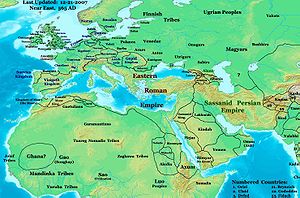 The Blemmyes occupied a considerable region in current day Sudan
. There were some important cities like Faras
, Kalabsha, Balana
and Aniba, and they were all fortified with walls and towers of a mixture of Egyptian, Helenic, Roman and Nubic elements.
Their culture had also the influence of the Meroitic
culture, and so, Blemmyes religion was centered in the temples of Kalabsha and Philae
. The former being a huge masterpiece of Nubian architecture, where a solar lion like divinity named Mandulis
was worshiped. Philae
was a place of mass pilgrimage with temples for Isis
, Mandulis
and Anhur
, and where the Roman Emperors Augustus
and Trajan
made many contributions with new temples, plazas and monumental works.
. They use clubs, spears, and blow darts as weapons.
In Shakespeare too we can find reference to the myths surrounding Blemmyes as headless beings:
«And of the Cannibals that each other eat,
The Anthropophagi, and men whose heads
Do grow beneath their shoulders.»
-Shakespeare, Othello
The Blemmyae also appear in Valerio Manfredi's novel "The Tower", where they are portrayed as the murderous desert guardians of an ancient and terrible secret.
A Blemmye appears in Bruce Sterling's 2005 short story "The Blemmye's Strategem."
Nubia
Nubia is a region along the Nile river, which is located in northern Sudan and southern Egypt.There were a number of small Nubian kingdoms throughout the Middle Ages, the last of which collapsed in 1504, when Nubia became divided between Egypt and the Sennar sultanate resulting in the Arabization...
n tribe described in Roman
Ancient Rome
Ancient Rome was a thriving civilization that grew on the Italian Peninsula as early as the 8th century BC. Located along the Mediterranean Sea and centered on the city of Rome, it expanded to one of the largest empires in the ancient world....
histories of the later empire. From the late third century on, along with another tribe, the Nobadae
Nobatia
Nobatia or Nobadia was an ancient African Christian kingdom in Lower Nubia and subsequently a region of the larger Nubian Kingdom of Makuria...
, they repeatedly fought the Romans. They were said to live in Africa
Africa
Africa is the world's second largest and second most populous continent, after Asia. At about 30.2 million km² including adjacent islands, it covers 6% of the Earth's total surface area and 20.4% of the total land area...
, in Nubia
Nubia
Nubia is a region along the Nile river, which is located in northern Sudan and southern Egypt.There were a number of small Nubian kingdoms throughout the Middle Ages, the last of which collapsed in 1504, when Nubia became divided between Egypt and the Sennar sultanate resulting in the Arabization...
, Kush
Kingdom of Kush
The native name of the Kingdom was likely kaš, recorded in Egyptian as .The name Kash is probably connected to Cush in the Hebrew Bible , son of Ham ....
, or Ethiopia
Ethiopia
Ethiopia , officially known as the Federal Democratic Republic of Ethiopia, is a country located in the Horn of Africa. It is the second-most populous nation in Africa, with over 82 million inhabitants, and the tenth-largest by area, occupying 1,100,000 km2...
, generally south of Egypt
Egypt
Egypt , officially the Arab Republic of Egypt, Arabic: , is a country mainly in North Africa, with the Sinai Peninsula forming a land bridge in Southwest Asia. Egypt is thus a transcontinental country, and a major power in Africa, the Mediterranean Basin, the Middle East and the Muslim world...
.
They also became fictionalized as a legendary race
Blemmyes (legendary creatures)
The Blemmyes was a tribe which became fictionalized as a race of creatures believed to be acephalous monsters who had eyes and mouths on their chest. Pliny the Elder writes of them that Blemmyes traduntur capita abesse, ore et oculis pectore adfixis...
of acephalous
Acephali
Acephali is a term applied to several sects as having no head or leader....
(headless) monster
Monster
A monster is any fictional creature, usually found in legends or horror fiction, that is somewhat hideous and may produce physical harm or mental fear by either its appearance or its actions...
s who had eyes and mouths on their chest.
In antiquity
The Greek geographer StraboStrabo
Strabo, also written Strabon was a Greek historian, geographer and philosopher.-Life:Strabo was born to an affluent family from Amaseia in Pontus , a city which he said was situated the approximate equivalent of 75 km from the Black Sea...
describes the Blemmyes as a peaceful people living in the East Desert near Meroe
Meroë
Meroë Meroitic: Medewi or Bedewi; Arabic: and Meruwi) is an ancient city on the east bank of the Nile about 6 km north-east of the Kabushiya station near Shendi, Sudan, approximately 200 km north-east of Khartoum. Near the site are a group of villages called Bagrawiyah...
.
Their cultural and military power started to enlarge to such a level that in 197 Pescennius Niger
Pescennius Niger
Pescennius Niger was a Roman usurper from 193 to 194 during the Year of the Five Emperors. He claimed the imperial throne in response to the murder of Pertinax and the elevation of Didius Julianus, but was defeated by a rival claimant, Septimius Severus and killed while attempting to flee from...
asked a Blemmye king of Thebas to help him in the battle against the Roman Emperor
Roman Emperor
The Roman emperor was the ruler of the Roman State during the imperial period . The Romans had no single term for the office although at any given time, a given title was associated with the emperor...
Septimius Severus
Septimius Severus
Septimius Severus , also known as Severus, was Roman Emperor from 193 to 211. Severus was born in Leptis Magna in the province of Africa. As a young man he advanced through the customary succession of offices under the reigns of Marcus Aurelius and Commodus. Severus seized power after the death of...
. In 250 the Roman Emperor
Roman Emperor
The Roman emperor was the ruler of the Roman State during the imperial period . The Romans had no single term for the office although at any given time, a given title was associated with the emperor...
Decius
Decius
Trajan Decius , was Roman Emperor from 249 to 251. In the last year of his reign, he co-ruled with his son Herennius Etruscus until they were both killed in the Battle of Abrittus.-Early life and rise to power:...
took a lot of effort to win over an invasion army of Blemmyes. A few years later, in 253, they attacked Lower Aegyptus (Thebais) again but were quickly defeated. In 265 they were defeated again by the Roman Prefect Firmus
Firmus
Firmus was a Roman usurper against Aurelian. His story is told by the often unreliable Historia Augusta twice, with the first account the most sketchy and reliable.- Life of the historical Firmus :...
who later in 273 would rebel against the Empire and the Queen of Palmyra
Palmyra
Palmyra was an ancient city in Syria. In the age of antiquity, it was an important city of central Syria, located in an oasis 215 km northeast of Damascus and 180 km southwest of the Euphrates at Deir ez-Zor. It had long been a vital caravan city for travellers crossing the Syrian desert...
Zenobia
Zenobia
Zenobia was a 3rd-century Queen of the Palmyrene Empire in Roman Syria. She led a famous revolt against the Roman Empire. The second wife of King Septimius Odaenathus, Zenobia became queen of the Palmyrene Empire following Odaenathus' death in 267...
with the help of the Blemmyes themselves. The Roman general Probus took sometime to defeat the usurper and his allies but couldn't prevent the occupation of Thebais by the Blemmyes. That meant another war and the almost entire destruction of the Blemmyes army (279-280).
In the reign of Diocletian
Diocletian
Diocletian |latinized]] upon his accession to Diocletian . c. 22 December 244 – 3 December 311), was a Roman Emperor from 284 to 305....
the province of Lower Aegyptus (Thebais) was again occupied by the Blemmyes.
In 298, Diocletian made peace with the Nobatae and Blemmyes tribes, agreeing that Rome move its borders north to Philae
Philae
Philae is an island in the Nile River and the previous site of an Ancient Egyptian temple complex in southern Egypt...
(South Egypt, south of Aswan) and pay the two tribes an annual gold stipend.
Culture
Sudan
Sudan , officially the Republic of the Sudan , is a country in North Africa, sometimes considered part of the Middle East politically. It is bordered by Egypt to the north, the Red Sea to the northeast, Eritrea and Ethiopia to the east, South Sudan to the south, the Central African Republic to the...
. There were some important cities like Faras
Faras
Faras was a major city in Lower Nubia in modern Egypt. The site of the city was flooded by Lake Nasser in the 1960s, and is now permanently underwater...
, Kalabsha, Balana
Balana
Balana is a village in Sri Lanka. It is located within Central Province.-External links:*...
and Aniba, and they were all fortified with walls and towers of a mixture of Egyptian, Helenic, Roman and Nubic elements.
Their culture had also the influence of the Meroitic
Meroitic
Meroitic is an adjective referring to things related to the kingdom of Meroë in pre-Islamic Sudan.* The Meroitic period was approximately 300 BC to 400 AD.* The Meroitic script was their writing system....
culture, and so, Blemmyes religion was centered in the temples of Kalabsha and Philae
Philae
Philae is an island in the Nile River and the previous site of an Ancient Egyptian temple complex in southern Egypt...
. The former being a huge masterpiece of Nubian architecture, where a solar lion like divinity named Mandulis
Mandulis
The Temple of Kalabsha in Nubia was dedicated to Mandulis which was a Nubian form of Horus. A cult dedicated to Mandulis can also be found in Egypt, at Philae....
was worshiped. Philae
Philae
Philae is an island in the Nile River and the previous site of an Ancient Egyptian temple complex in southern Egypt...
was a place of mass pilgrimage with temples for Isis
Isis
Isis or in original more likely Aset is a goddess in Ancient Egyptian religious beliefs, whose worship spread throughout the Greco-Roman world. She was worshipped as the ideal mother and wife as well as the matron of nature and magic...
, Mandulis
Mandulis
The Temple of Kalabsha in Nubia was dedicated to Mandulis which was a Nubian form of Horus. A cult dedicated to Mandulis can also be found in Egypt, at Philae....
and Anhur
Anhur
In early Egyptian mythology, Anhur was originally a god of war who was worshipped in the Egyptian area of Abydos, and particularly in Thinis...
, and where the Roman Emperors Augustus
Augustus
Augustus ;23 September 63 BC – 19 August AD 14) is considered the first emperor of the Roman Empire, which he ruled alone from 27 BC until his death in 14 AD.The dates of his rule are contemporary dates; Augustus lived under two calendars, the Roman Republican until 45 BC, and the Julian...
and Trajan
Trajan
Trajan , was Roman Emperor from 98 to 117 AD. Born into a non-patrician family in the province of Hispania Baetica, in Spain Trajan rose to prominence during the reign of emperor Domitian. Serving as a legatus legionis in Hispania Tarraconensis, in Spain, in 89 Trajan supported the emperor against...
made many contributions with new temples, plazas and monumental works.
In literature
Blemmyes appeared in the 2000 novel The Amazing Voyage of Azzam by Kelly Godel as cannibalistic tribesmen who guard a lost treasure of King SolomonSolomon
Solomon , according to the Book of Kings and the Book of Chronicles, a King of Israel and according to the Talmud one of the 48 prophets, is identified as the son of David, also called Jedidiah in 2 Samuel 12:25, and is described as the third king of the United Monarchy, and the final king before...
. They use clubs, spears, and blow darts as weapons.
In Shakespeare too we can find reference to the myths surrounding Blemmyes as headless beings:
«And of the Cannibals that each other eat,
The Anthropophagi, and men whose heads
Do grow beneath their shoulders.»
-Shakespeare, Othello
The Blemmyae also appear in Valerio Manfredi's novel "The Tower", where they are portrayed as the murderous desert guardians of an ancient and terrible secret.
A Blemmye appears in Bruce Sterling's 2005 short story "The Blemmye's Strategem."