

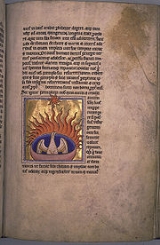
Blackletter

Encyclopedia
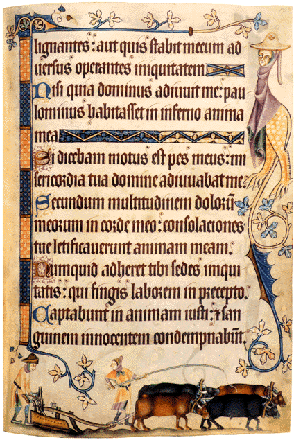
Blackletter, also known as Gothic script, Gothic minuscule, or Textura, was a script used throughout Western Europe
from approximately 1150 to well into the 17th century. It continued to be used for the German language
until the 20th century. Fraktur is a notable script of this type, and sometimes the entire group of faces is known as Fraktur. Blackletter is sometimes called Old English, but it is not to be confused with the Old English language, despite the popular, though mistaken, belief that the language was written with blackletter. The Old English (or Anglo-Saxon) language predates black letter by many centuries, and was itself written in the insular script
.
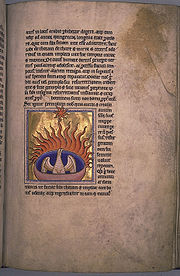
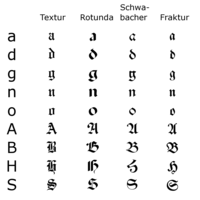
 Carolingian minuscule
was the direct ancestor of blackletter. Blackletter developed from Carolingian as an increasingly literate 12th-century Europe required new books in many different subjects. New universities
were founded, each producing books for business
, law
, grammar
, history
, and other pursuits, not solely religious works for which earlier scripts typically had been used.
These books needed to be produced quickly to keep up with demand. Carolingian, though legible, was time-consuming and labour-intensive to produce. Its large size consumed a lot of manuscript
space in a time when writing materials were very costly. As early as the 11th century, different forms of Carolingian were already being used, and by the mid-12th century, a clearly distinguishable form, able to be written more quickly to meet the demand for new books, was being used in northeastern France
and the Low Countries
.
 The term Gothic was first used to describe this script in 15th-century Italy
, in the midst of the Renaissance
, because Renaissance Humanists
believed it was barbaric. Gothic was a synonym for barbaric. Flavio Biondo
, in Italia Illustrata (1531) thought it was invented by the Lombards
after their invasion of Italy in the 6th century.
Not only were black-letter forms called Gothic script, but any other seemingly barbarian script, such as Visigothic
, Beneventan
, and Merovingian
, were also labeled "Gothic", in contrast to Carolingian minuscule
, a highly legible script which the Humanists called littera antiqua
, "the ancient letter", wrongly believing that it was the script used by the Romans
. It was invented in the reign of Charlemagne
, although only used significantly after that era.
The black letter must not be confused either with the ancient alphabet of the Gothic language
, nor with the sans-serif
typefaces that are also sometimes called Gothic.
form of black letter, and today is the form most associated with "Gothic". Johannes Gutenberg carved a textualis typeface – including a large number of ligatures
and common abbreviations – when he printed his 42-line Bible
. However, the textualis was rarely used for typefaces afterwards.
According to Dutch scholar Gerard Lieftinck, the pinnacle of black-letter use occurred in the 14th and 15th centuries. For Lieftinck, the highest form of textualis was littera textualis formata, used for de luxe manuscripts. The usual form, simply littera textualis, was used for literary works and university texts. Lieftinck's third form, littera textualis currens, was the cursive
form of black letter, extremely difficult to read and used for textual gloss
es, and less important books.
Textualis was most widely used in France, the Low Countries, England
, and Germany
. Some characteristics of the script are:
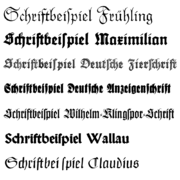
Here is the entire alphabet in Fraktur, using the TeX
\mathfrak font (see Help: Displaying a formula):


s. Cursiva developed partly because of the introduction of paper
, which was smoother than parchment
. It was therefore, easier to write quickly on paper in a cursive script
.
In cursiva, descenders are more frequent, especially in the letters f and s, and ascenders are curved and looped rather than vertical (seen especially in the letter d). The letters a, g, and s (at the end of a word) are very similar to their Carolingian forms. However, not all of these features are found in every example of cursiva, which makes it difficult to determine whether or not a script may be called cursiva at all.
Lieftinck also divided cursiva into three styles: littera cursiva formata was the most legible and calligraphic style. Littera cursiva textualis (or libraria) was the usual form, used for writing standard books, and it generally was written with a larger pen, leading to larger letters. Littera cursiva currens was used for textbooks and other unimportant books and it had very little standardization in forms.
(especially in France), and as its name suggests, refers to a hybrid form of the script. It is a mixture of textualis and cursiva, developed in the early 15th century. From textualis, it borrowed vertical ascenders, while from cursiva, it borrowed long f and ſ
, single-looped a, and g with an open descender (similar to Carolingian forms).
used in his earliest surviving printed works, dating from the early 1450s. The name is taken from two works: the Ars grammatica
of Aelius Donatus
, a Latin grammar, and the Kalender (calendar). It is a form of textura.
s and italic type
s since the 16th century French typographers, the black-letter typefaces never developed a similar distinction. Instead, they use letterspacing (German sperren) for emphasis. When using that method, black-letter ligatures like ch, ck, tz or ſt remain together without additional letterspacing (ſt is dissolved, though). The use of bold text for emphasis is also alien to black-letter typefaces.
Words from other languages, especially from Romance languages including Latin, are usually typeset in antiqua instead of black letter. Like that, single antiqua words or phrases may occur within a black-letter text. This does not apply, however, to loanwords that have been incorporated into the language.
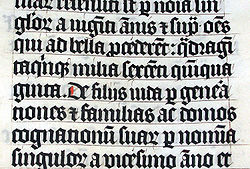 English
black letter developed from the form of Caroline minuscule used there after the Norman Conquest, sometimes called "Romanesque minuscule." Textualis forms developed after 1190 and were used most often until approximately 1300, afterward being used mainly for de luxe manuscripts. English forms of black letter have been studied extensively and may be divided into many categories. Textualis formata ("Old English" or "Black Letter"), textualis prescissa (or textualis sine pedibus, as it generally lacks feet on its minims) , textualis quadrata (or psalterialis) and semi-quadrata, and textualis rotunda are various forms of high-grade formata styles of black letter.
The University of Oxford
borrowed the littera parisiensis in the 13th century and early 14th century, and the littera oxoniensis form is almost indistinguishable from its Parisian counterpart; however, there are a few differences, such as the round final "s" forms, resembling the number 8, rather than the long "s" used in the final position in the Paris script.
and came to England by way of France. Secretary script has a somewhat haphazard appearance, and its forms of the letters a, g, r, and s are unique, unlike any forms in any other English script.
textualis was tall and narrow compared to other national forms, and was most fully developed in the late 13th century in Paris. In the 13th century there also was an extremely small version of textualis used to write miniature Bibles, known as "pearl script." Another form of French textualis in this century was the script developed at the University of Paris
, littera parisiensis, which also is small in size and designed to be written quickly, not calligraphically.
, the lettre de forme or lettre bourgouignonne, for books of hours
such as the Très Riches Heures of John, Duke of Berry
.
 Despite the frequent association of black letter with German
, the script was actually very slow to develop in German-speaking areas. It developed first in those areas closest to France and then spread to the east and south in the 13th century. However, the German-speaking areas are where black letter remained in use the longest.
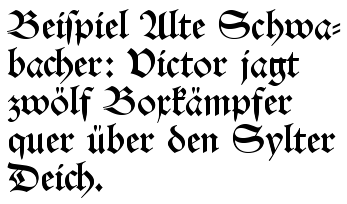
Schwabacher
typefaces dominated in Germany from about 1480 to 1530, and the style continued in use occasionally until the 20th century. Most importantly, all of the works of Martin Luther
, leading to the Protestant Reformation
, as well as the Apocalypse
of Albrecht Dürer
(1498) used this typeface. Johann Bämler
, a printer from Augsburg
, probably first used it as early as 1472. The origins of the name remain unclear; some assume that a typeface-carver from the village of Schwabach—one who worked externally and who thus became known as the Schwabacher—designed the typeface.
Johann Gutenberg used a textualis typeface
for his famous Gutenberg Bible
, possibly the first book ever to be printed with movable type, in 1455. Schwabacher
, a black letter with more rounded letters, soon became the usual printed typeface
, but it was replaced by Fraktur
in the early 17th century.
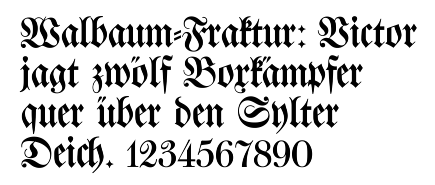 Fraktur came into use when Emperor Maximilian I
(1493–1519) established a series of books and had a new typeface created specifically for this purpose. In the 19th century, the use of antiqua alongside Fraktur increased, leading to the Antiqua-Fraktur dispute
, which lasted until the Nazis
abandoned Fraktur in 1941. Since it was so common, all kinds of black letter tend to be called Fraktur in German.
 German cursiva is similar to the cursive scripts in other areas, but forms of "a", "s" and other letters are more varied; here too, the letter "w" is often used. A hybrida form, which was basically cursiva with fewer looped letters and with similar square proportions as textualis, was used in the 15th and 16th centuries.
In the 18th century, the pointed quill was adopted for black-letter handwriting. In the early 20th century, the Sütterlin
script was introduced in the schools.
Italian
black letter also is known as rotunda
, as it was less angular than in northern centres. The most usual form of Italian rotunda was littera bononiensis, used at the University of Bologna
in the 13th century. Biting is a common feature in rotunda, but breaking is not.
Italian Rotunda also is characterized by unique abbreviations, such as q with a line beneath the bow signifying "qui", and unusual spellings, such as x for s ("milex" rather than "miles").
in France and Secretary script in England.
of the Bible
, but had otherwise become obsolete.
in the Mathematical alphanumeric symbols
range at U+1D504-1D537 and U+1D56C-1D59F (bold), except for individual letters already encoded in the Letterlike Symbols
range (plus long s
at U+017F).
The reason that these have been encoded uniquely as characters in Unicode rather than font variants is the distinctive use of black-letter fonts in mathematics. The character names use “Fraktur” for the mathematical alphanumeric symbols but “black-letter” in the letterlike symbols range.
Note: (The above may not render fully in all web browsers.)
Fonts supporting the range include Code2001.
For normal text writing, the ordinary Latin code points are used. The black-letter style is then determined by a font with black-letter glyphs. The glyphs in the SMP should only be used for mathematical typesetting, not for ordinary text. They are of limited use for writing German, as they lack umlaut diacritics
and the ligature ß
.
Western Europe
Western Europe is a loose term for the collection of countries in the western most region of the European continents, though this definition is context-dependent and carries cultural and political connotations. One definition describes Western Europe as a geographic entity—the region lying in the...
from approximately 1150 to well into the 17th century. It continued to be used for the German language
German language
German is a West Germanic language, related to and classified alongside English and Dutch. With an estimated 90 – 98 million native speakers, German is one of the world's major languages and is the most widely-spoken first language in the European Union....
until the 20th century. Fraktur is a notable script of this type, and sometimes the entire group of faces is known as Fraktur. Blackletter is sometimes called Old English, but it is not to be confused with the Old English language, despite the popular, though mistaken, belief that the language was written with blackletter. The Old English (or Anglo-Saxon) language predates black letter by many centuries, and was itself written in the insular script
Insular script
Insular script was a medieval script system originally used in Ireland, then Great Britain, that spread to continental Europe under the influence of Celtic Christianity. Irish missionaries also took the script to continental Europe, where they founded monasteries such as Bobbio. The scripts were...
.
Origins
Carolingian minuscule
Carolingian or Caroline minuscule is a script developed as a writing standard in Europe so that the Roman alphabet could be easily recognized by the literate class from one region to another. It was used in Charlemagne's empire between approximately 800 and 1200...
was the direct ancestor of blackletter. Blackletter developed from Carolingian as an increasingly literate 12th-century Europe required new books in many different subjects. New universities
Medieval university
Medieval university is an institution of higher learning which was established during High Middle Ages period and is a corporation.The first institutions generally considered to be universities were established in Italy, France, and England in the late 11th and the 12th centuries for the study of...
were founded, each producing books for business
Business
A business is an organization engaged in the trade of goods, services, or both to consumers. Businesses are predominant in capitalist economies, where most of them are privately owned and administered to earn profit to increase the wealth of their owners. Businesses may also be not-for-profit...
, law
Law
Law is a system of rules and guidelines which are enforced through social institutions to govern behavior, wherever possible. It shapes politics, economics and society in numerous ways and serves as a social mediator of relations between people. Contract law regulates everything from buying a bus...
, grammar
Grammar
In linguistics, grammar is the set of structural rules that govern the composition of clauses, phrases, and words in any given natural language. The term refers also to the study of such rules, and this field includes morphology, syntax, and phonology, often complemented by phonetics, semantics,...
, history
History
History is the discovery, collection, organization, and presentation of information about past events. History can also mean the period of time after writing was invented. Scholars who write about history are called historians...
, and other pursuits, not solely religious works for which earlier scripts typically had been used.
These books needed to be produced quickly to keep up with demand. Carolingian, though legible, was time-consuming and labour-intensive to produce. Its large size consumed a lot of manuscript
Manuscript
A manuscript or handwrite is written information that has been manually created by someone or some people, such as a hand-written letter, as opposed to being printed or reproduced some other way...
space in a time when writing materials were very costly. As early as the 11th century, different forms of Carolingian were already being used, and by the mid-12th century, a clearly distinguishable form, able to be written more quickly to meet the demand for new books, was being used in northeastern France
France
The French Republic , The French Republic , The French Republic , (commonly known as France , is a unitary semi-presidential republic in Western Europe with several overseas territories and islands located on other continents and in the Indian, Pacific, and Atlantic oceans. Metropolitan France...
and the Low Countries
Low Countries
The Low Countries are the historical lands around the low-lying delta of the Rhine, Scheldt, and Meuse rivers, including the modern countries of Belgium, the Netherlands, Luxembourg and parts of northern France and western Germany....
.
The name Gothic script
Italy
Italy , officially the Italian Republic languages]] under the European Charter for Regional or Minority Languages. In each of these, Italy's official name is as follows:;;;;;;;;), is a unitary parliamentary republic in South-Central Europe. To the north it borders France, Switzerland, Austria and...
, in the midst of the Renaissance
Renaissance
The Renaissance was a cultural movement that spanned roughly the 14th to the 17th century, beginning in Italy in the Late Middle Ages and later spreading to the rest of Europe. The term is also used more loosely to refer to the historical era, but since the changes of the Renaissance were not...
, because Renaissance Humanists
Renaissance humanism
Renaissance humanism was an activity of cultural and educational reform engaged by scholars, writers, and civic leaders who are today known as Renaissance humanists. It developed during the fourteenth and the beginning of the fifteenth centuries, and was a response to the challenge of Mediæval...
believed it was barbaric. Gothic was a synonym for barbaric. Flavio Biondo
Flavio Biondo
Flavio Biondo was an Italian Renaissance humanist historian. He was one of the first historians to used a three-period division of history and is known as one of the first archaeologists.Born in the capital city of Forlì, in the Romagna region, Flavio was well schooled from an early age,...
, in Italia Illustrata (1531) thought it was invented by the Lombards
Lombards
The Lombards , also referred to as Longobards, were a Germanic tribe of Scandinavian origin, who from 568 to 774 ruled a Kingdom in Italy...
after their invasion of Italy in the 6th century.
Not only were black-letter forms called Gothic script, but any other seemingly barbarian script, such as Visigothic
Visigothic script
Visigothic script was a type of medieval script that originated in the Visigothic kingdom in Hispania...
, Beneventan
Beneventan script
Beneventan script was a medieval script, so called because it originated in the Duchy of Benevento in southern Italy. It was also called Langobarda, Longobarda, Longobardisca , or sometimes Gothica; it was first called Beneventan by palaeographer E. A...
, and Merovingian
Merovingian script
Merovingian script was a medieval script so called because it was developed in France during the Merovingian dynasty. It was used in the 7th and 8th centuries before the Carolingian dynasty and the development of Carolingian minuscule.-Script types:...
, were also labeled "Gothic", in contrast to Carolingian minuscule
Carolingian minuscule
Carolingian or Caroline minuscule is a script developed as a writing standard in Europe so that the Roman alphabet could be easily recognized by the literate class from one region to another. It was used in Charlemagne's empire between approximately 800 and 1200...
, a highly legible script which the Humanists called littera antiqua
Humanist minuscule
Humanist minuscule is a handwriting or style of script that was invented in secular circles in Italy, at the beginning of the fifteenth century. "Few periods in Western history have produced writing of such great beauty", observes the art historian Millard Meiss...
, "the ancient letter", wrongly believing that it was the script used by the Romans
Ancient Rome
Ancient Rome was a thriving civilization that grew on the Italian Peninsula as early as the 8th century BC. Located along the Mediterranean Sea and centered on the city of Rome, it expanded to one of the largest empires in the ancient world....
. It was invented in the reign of Charlemagne
Charlemagne
Charlemagne was King of the Franks from 768 and Emperor of the Romans from 800 to his death in 814. He expanded the Frankish kingdom into an empire that incorporated much of Western and Central Europe. During his reign, he conquered Italy and was crowned by Pope Leo III on 25 December 800...
, although only used significantly after that era.
The black letter must not be confused either with the ancient alphabet of the Gothic language
Gothic alphabet
The Gothic alphabet is an alphabet for writing the Gothic language, created in the 4th century by Ulfilas for the purpose of translating the Christian Bible....
, nor with the sans-serif
Sans-serif
In typography, a sans-serif, sans serif or san serif typeface is one that does not have the small projecting features called "serifs" at the end of strokes. The term comes from the French word sans, meaning "without"....
typefaces that are also sometimes called Gothic.
Textualis
Textualis, also known as textura or Gothic bookhand, was the most calligraphicCalligraphy
Calligraphy is a type of visual art. It is often called the art of fancy lettering . A contemporary definition of calligraphic practice is "the art of giving form to signs in an expressive, harmonious and skillful manner"...
form of black letter, and today is the form most associated with "Gothic". Johannes Gutenberg carved a textualis typeface – including a large number of ligatures
Ligature (typography)
In writing and typography, a ligature occurs where two or more graphemes are joined as a single glyph. Ligatures usually replace consecutive characters sharing common components and are part of a more general class of glyphs called "contextual forms", where the specific shape of a letter depends on...
and common abbreviations – when he printed his 42-line Bible
Gutenberg Bible
The Gutenberg Bible was the first major book printed with a movable type printing press, and marked the start of the "Gutenberg Revolution" and the age of the printed book. Widely praised for its high aesthetic and artistic qualities, the book has an iconic status...
. However, the textualis was rarely used for typefaces afterwards.
According to Dutch scholar Gerard Lieftinck, the pinnacle of black-letter use occurred in the 14th and 15th centuries. For Lieftinck, the highest form of textualis was littera textualis formata, used for de luxe manuscripts. The usual form, simply littera textualis, was used for literary works and university texts. Lieftinck's third form, littera textualis currens, was the cursive
Cursive
Cursive, also known as joined-up writing, joint writing, or running writing, is any style of handwriting in which the symbols of the language are written in a simplified and/or flowing manner, generally for the purpose of making writing easier or faster...
form of black letter, extremely difficult to read and used for textual gloss
Gloss
A gloss is a brief notation of the meaning of a word or wording in a text. It may be in the language of the text, or in the reader's language if that is different....
es, and less important books.
Textualis was most widely used in France, the Low Countries, England
England
England is a country that is part of the United Kingdom. It shares land borders with Scotland to the north and Wales to the west; the Irish Sea is to the north west, the Celtic Sea to the south west, with the North Sea to the east and the English Channel to the south separating it from continental...
, and Germany
Germany
Germany , officially the Federal Republic of Germany , is a federal parliamentary republic in Europe. The country consists of 16 states while the capital and largest city is Berlin. Germany covers an area of 357,021 km2 and has a largely temperate seasonal climate...
. Some characteristics of the script are:
- tall, narrow letters, as compared to their Carolingian counterparts.
- letters formed by sharp, straight, angular lines, unlike the typically round Carolingian; as a result, there is a high degree of "breaking", i.e. lines that do not necessarily connect with each other, especially in curved letters.
- ascenders (in letters such as b, d, h) are vertical and often end in sharp finialStroke ending (typography)In typography, a stroke can end in a number of ways. Examples include:* The Serif, including:** The regular serif** The bracketed serif** The half-serif* The terminal, which is any stroke that does not end in a Serif...
s - when a letter with a bow (in b, d, p, q) is followed by another letter with a bow (such as "be" or "po"), the bows overlap and the letters are joined by a straight line (this is known as "biting").
- a related characteristic is the half r, the shape of r when attached to other letters with bows; only the bow and tail were written, connected to the bow of the previous letter. In other scripts, this only occurred in a ligatureLigature (typography)In writing and typography, a ligature occurs where two or more graphemes are joined as a single glyph. Ligatures usually replace consecutive characters sharing common components and are part of a more general class of glyphs called "contextual forms", where the specific shape of a letter depends on...
with the letter o. - similarly related is the form of the letter d when followed by a letter with a bow; its ascender is then curved to the left, like the uncialUncialUncial is a majuscule script commonly used from the 3rd to 8th centuries AD by Latin and Greek scribes. Uncial letters are written in either Greek, Latin, or Gothic.-Development:...
d. Otherwise the ascender is vertical. - the letters g, j, p, q, y, and the hook of h have descenders, but no other letters are written below the line.
- the letter a has a straight back stroke, and the top loop eventually became closed, somewhat resembling the number 8. The letter s often has a diagonal line connecting its two bows, also somewhat resembling an 8, but the long sLong sThe long, medial or descending s is a form of the minuscule letter s formerly used where s occurred in the middle or at the beginning of a word, for example "ſinfulneſs" . The modern letterform was called the terminal, round, or short s.-History:The long s is derived from the old Roman cursive...
is frequently used in the middle of words. - minimMinim (palaeography)In palaeography, a minim is a short, vertical stroke used in handwriting. The word is derived from the Latin minimum, meaning "least" or "smallest"....
s, especially in the later period of the script, do not connect with each other. This makes it very difficult to distinguish i, u, m, and n. A 14th-century example of the difficulty minims produced is, mimi numinum niuium minimi munium nimium uini muniminum imminui uiui minimum uolunt ("the smallest mimes of the gods of snow do not wish at all in their life that the great duty of the defences of the wine be diminished"). In black letter this would look like a series of single strokes. Dotted i and the letter j developed because of this. Minims may also have finials of their own. - the script has many more scribal abbreviationScribal abbreviationScribal abbreviations are the abbreviations used by ancient and mediæval scribes writing in Latin and, later, in Greek and Old Norse...
s than Carolingian, adding to the speed in which it could be written.
Schwabacher
Schwabacher was a black-letter form that was much used in early German print typefaces. It continued to be used occasionally until the 20th century. Characteristics of Schwabacher are:- The small letter o is rounded on both sides, though at the top and at the bottom, the two strokes join in an angle. Other small letters have analogous forms.
- The small letter g has a horizontal stroke at its top that forms crosses with the two downward strokes.
- The capital letter H has a peculiar form somewhat reminiscent of the small letter h.
Fraktur
Fraktur is a form of black letter that became the most common German black-letter typeface by the mid 16th century. Its use was so common that often any black-letter form is called Fraktur in Germany. Characteristics of Fraktur are:- The left side of the small letter o is formed by an angular stroke, the right side by a rounded stroke. At the top and at the bottom, both strokes join in an angle. Other small letters have analogous forms.
- The capital letters are compound of rounded c-shaped or s-shaped strokes.
Here is the entire alphabet in Fraktur, using the TeX
TeX
TeX is a typesetting system designed and mostly written by Donald Knuth and released in 1978. Within the typesetting system, its name is formatted as ....
\mathfrak font (see Help: Displaying a formula):
Cursiva
Cursiva refers to a very large variety of forms of black letter; as with modern cursive writing, there is no real standard form. It developed in the 14th century as a simplified form of textualis, with influence from the form of textualis as used for writing charterCharter
A charter is the grant of authority or rights, stating that the granter formally recognizes the prerogative of the recipient to exercise the rights specified...
s. Cursiva developed partly because of the introduction of paper
Paper
Paper is a thin material mainly used for writing upon, printing upon, drawing or for packaging. It is produced by pressing together moist fibers, typically cellulose pulp derived from wood, rags or grasses, and drying them into flexible sheets....
, which was smoother than parchment
Parchment
Parchment is a thin material made from calfskin, sheepskin or goatskin, often split. Its most common use was as a material for writing on, for documents, notes, or the pages of a book, codex or manuscript. It is distinct from leather in that parchment is limed but not tanned; therefore, it is very...
. It was therefore, easier to write quickly on paper in a cursive script
Cursive
Cursive, also known as joined-up writing, joint writing, or running writing, is any style of handwriting in which the symbols of the language are written in a simplified and/or flowing manner, generally for the purpose of making writing easier or faster...
.
In cursiva, descenders are more frequent, especially in the letters f and s, and ascenders are curved and looped rather than vertical (seen especially in the letter d). The letters a, g, and s (at the end of a word) are very similar to their Carolingian forms. However, not all of these features are found in every example of cursiva, which makes it difficult to determine whether or not a script may be called cursiva at all.
Lieftinck also divided cursiva into three styles: littera cursiva formata was the most legible and calligraphic style. Littera cursiva textualis (or libraria) was the usual form, used for writing standard books, and it generally was written with a larger pen, leading to larger letters. Littera cursiva currens was used for textbooks and other unimportant books and it had very little standardization in forms.
Hybrida
Hybrida is also called bastardaBastarda
Bastarda was a Gothic script used in France and Germany during the 14th and 15th centuries. These scripts were designed to provide a simplified letter that was appropriate for the copying of books or documents of minor value or importance.The early printers produced regional versions in type...
(especially in France), and as its name suggests, refers to a hybrid form of the script. It is a mixture of textualis and cursiva, developed in the early 15th century. From textualis, it borrowed vertical ascenders, while from cursiva, it borrowed long f and ſ
Long s
The long, medial or descending s is a form of the minuscule letter s formerly used where s occurred in the middle or at the beginning of a word, for example "ſinfulneſs" . The modern letterform was called the terminal, round, or short s.-History:The long s is derived from the old Roman cursive...
, single-looped a, and g with an open descender (similar to Carolingian forms).
Donatus-Kalender
The Donatus-Kalender (also known as Donatus-und-Kalender or D-K) is the name for the metal type design that GutenbergGutenberg
Gutenberg may refer to:People:* Johannes Gutenberg , inventor of movable type printing* Beno Gutenberg , a German-born seismologist* Erich Gutenberg , a German economistPlaces:...
used in his earliest surviving printed works, dating from the early 1450s. The name is taken from two works: the Ars grammatica
Ars grammatica
An Ars grammatica is a generic or proper title for surveys of Latin Grammar.Extant works known as Ars grammatica have been written by*Aelius Donatus*Maurus Servius Honoratus*Diomedes Grammaticus*Charisius*Pseudo-Remmius Palaemon...
of Aelius Donatus
Aelius Donatus
Aelius Donatus was a Roman grammarian and teacher of rhetoric. The only fact known regarding his life is that he was the tutor of St...
, a Latin grammar, and the Kalender (calendar). It is a form of textura.
Black-letter typesetting
While an antiqua typeface is usually compound of roman typeRoman type
In typography, roman is one of the three main kinds of historical type, alongside blackletter and italic. Roman type was modelled from a European scribal manuscript style of the 1400s, based on the pairing of inscriptional capitals used in ancient Rome with Carolingian minuscules developed in the...
s and italic type
Italic type
In typography, italic type is a cursive typeface based on a stylized form of calligraphic handwriting. Owing to the influence from calligraphy, such typefaces often slant slightly to the right. Different glyph shapes from roman type are also usually used—another influence from calligraphy...
s since the 16th century French typographers, the black-letter typefaces never developed a similar distinction. Instead, they use letterspacing (German sperren) for emphasis. When using that method, black-letter ligatures like ch, ck, tz or ſt remain together without additional letterspacing (ſt is dissolved, though). The use of bold text for emphasis is also alien to black-letter typefaces.
Words from other languages, especially from Romance languages including Latin, are usually typeset in antiqua instead of black letter. Like that, single antiqua words or phrases may occur within a black-letter text. This does not apply, however, to loanwords that have been incorporated into the language.
Textualis
English language
English is a West Germanic language that arose in the Anglo-Saxon kingdoms of England and spread into what was to become south-east Scotland under the influence of the Anglian medieval kingdom of Northumbria...
black letter developed from the form of Caroline minuscule used there after the Norman Conquest, sometimes called "Romanesque minuscule." Textualis forms developed after 1190 and were used most often until approximately 1300, afterward being used mainly for de luxe manuscripts. English forms of black letter have been studied extensively and may be divided into many categories. Textualis formata ("Old English" or "Black Letter"), textualis prescissa (or textualis sine pedibus, as it generally lacks feet on its minims) , textualis quadrata (or psalterialis) and semi-quadrata, and textualis rotunda are various forms of high-grade formata styles of black letter.
The University of Oxford
University of Oxford
The University of Oxford is a university located in Oxford, United Kingdom. It is the second-oldest surviving university in the world and the oldest in the English-speaking world. Although its exact date of foundation is unclear, there is evidence of teaching as far back as 1096...
borrowed the littera parisiensis in the 13th century and early 14th century, and the littera oxoniensis form is almost indistinguishable from its Parisian counterpart; however, there are a few differences, such as the round final "s" forms, resembling the number 8, rather than the long "s" used in the final position in the Paris script.
Cursiva
English cursiva began to be used in the 13th century, and soon replaced littera oxoniensis as the standard university script. The earliest cursive black-letter form is Anglicana, a very round and looped script, which also had a squarer and angular counterpart, Anglicana formata. The formata form was used until the 15th century and also was used to write vernacular texts. An Anglicana bastarda form developed from a mixture of Anglicana and textualis, but by the 16th century the principal cursive black letter used in England was the Secretary script, which originated in ItalyItaly
Italy , officially the Italian Republic languages]] under the European Charter for Regional or Minority Languages. In each of these, Italy's official name is as follows:;;;;;;;;), is a unitary parliamentary republic in South-Central Europe. To the north it borders France, Switzerland, Austria and...
and came to England by way of France. Secretary script has a somewhat haphazard appearance, and its forms of the letters a, g, r, and s are unique, unlike any forms in any other English script.
Textualis
FrenchFrench language
French is a Romance language spoken as a first language in France, the Romandy region in Switzerland, Wallonia and Brussels in Belgium, Monaco, the regions of Quebec and Acadia in Canada, and by various communities elsewhere. Second-language speakers of French are distributed throughout many parts...
textualis was tall and narrow compared to other national forms, and was most fully developed in the late 13th century in Paris. In the 13th century there also was an extremely small version of textualis used to write miniature Bibles, known as "pearl script." Another form of French textualis in this century was the script developed at the University of Paris
University of Paris
The University of Paris was a university located in Paris, France and one of the earliest to be established in Europe. It was founded in the mid 12th century, and officially recognized as a university probably between 1160 and 1250...
, littera parisiensis, which also is small in size and designed to be written quickly, not calligraphically.
Cursiva
French cursiva was used from the 13th to the 16th century, when it became highly looped, messy, and slanted. Bastarda, the "hybrid" mixture of cursiva and textualis, developed in the 15th century and was used for vernacular texts as well as Latin. A more angular form of bastarda was used in BurgundyDuchy of Burgundy
The Duchy of Burgundy , was heir to an ancient and prestigious reputation and a large division of the lands of the Second Kingdom of Burgundy and in its own right was one of the geographically larger ducal territories in the emergence of Early Modern Europe from Medieval Europe.Even in that...
, the lettre de forme or lettre bourgouignonne, for books of hours
Book of Hours
The book of hours was a devotional book popular in the later Middle Ages. It is the most common type of surviving medieval illuminated manuscript. Like every manuscript, each manuscript book of hours is unique in one way or another, but most contain a similar collection of texts, prayers and...
such as the Très Riches Heures of John, Duke of Berry
John, Duke of Berry
John of Valois or John the Magnificent was Duke of Berry and Auvergne and Count of Poitiers and Montpensier. He was the third son of King John II of France and Bonne of Luxemburg; his brothers were King Charles V of France, Duke Louis I of Anjou and Duke Philip the Bold of Burgundy...
.
Germany
German language
German is a West Germanic language, related to and classified alongside English and Dutch. With an estimated 90 – 98 million native speakers, German is one of the world's major languages and is the most widely-spoken first language in the European Union....
, the script was actually very slow to develop in German-speaking areas. It developed first in those areas closest to France and then spread to the east and south in the 13th century. However, the German-speaking areas are where black letter remained in use the longest.
Schwabacher
Schwabacher
The German word Schwabacher refers to a specific blackletter typeface. The term derives from the town of Schwabach.-Characteristics:The small-letter g and the capital-letter H have particularly distinctive forms.-History:...
typefaces dominated in Germany from about 1480 to 1530, and the style continued in use occasionally until the 20th century. Most importantly, all of the works of Martin Luther
Martin Luther
Martin Luther was a German priest, professor of theology and iconic figure of the Protestant Reformation. He strongly disputed the claim that freedom from God's punishment for sin could be purchased with money. He confronted indulgence salesman Johann Tetzel with his Ninety-Five Theses in 1517...
, leading to the Protestant Reformation
Protestant Reformation
The Protestant Reformation was a 16th-century split within Western Christianity initiated by Martin Luther, John Calvin and other early Protestants. The efforts of the self-described "reformers", who objected to the doctrines, rituals and ecclesiastical structure of the Roman Catholic Church, led...
, as well as the Apocalypse
Apocalypse (Dürer)
The Apocalypse, properly Apocalypse with Pictures is a famous series of fifteen woodcuts by Albrecht Dürer of scenes from the Book of Revelation, published in 1498, which rapidly brought him fame across Europe...
of Albrecht Dürer
Albrecht Dürer
Albrecht Dürer was a German painter, printmaker, engraver, mathematician, and theorist from Nuremberg. His prints established his reputation across Europe when he was still in his twenties, and he has been conventionally regarded as the greatest artist of the Northern Renaissance ever since...
(1498) used this typeface. Johann Bämler
Johann Bämler
Johann Bämler was a printer and bookseller from Augsburg.-References:...
, a printer from Augsburg
Augsburg
Augsburg is a city in the south-west of Bavaria, Germany. It is a university town and home of the Regierungsbezirk Schwaben and the Bezirk Schwaben. Augsburg is an urban district and home to the institutions of the Landkreis Augsburg. It is, as of 2008, the third-largest city in Bavaria with a...
, probably first used it as early as 1472. The origins of the name remain unclear; some assume that a typeface-carver from the village of Schwabach—one who worked externally and who thus became known as the Schwabacher—designed the typeface.
Textualis
German Textualis is usually very heavy and angular, and there are few features that are common to all occurrences of the script. One common feature is the use of the letter "w" for Latin "vu" or "uu". Textualis was used in the 13th and 14th centuries, afterward becoming more elaborate and decorated and used for liturgical works only.Johann Gutenberg used a textualis typeface
Typeface
In typography, a typeface is the artistic representation or interpretation of characters; it is the way the type looks. Each type is designed and there are thousands of different typefaces in existence, with new ones being developed constantly....
for his famous Gutenberg Bible
Gutenberg Bible
The Gutenberg Bible was the first major book printed with a movable type printing press, and marked the start of the "Gutenberg Revolution" and the age of the printed book. Widely praised for its high aesthetic and artistic qualities, the book has an iconic status...
, possibly the first book ever to be printed with movable type, in 1455. Schwabacher
Schwabacher
The German word Schwabacher refers to a specific blackletter typeface. The term derives from the town of Schwabach.-Characteristics:The small-letter g and the capital-letter H have particularly distinctive forms.-History:...
, a black letter with more rounded letters, soon became the usual printed typeface
Typeface
In typography, a typeface is the artistic representation or interpretation of characters; it is the way the type looks. Each type is designed and there are thousands of different typefaces in existence, with new ones being developed constantly....
, but it was replaced by Fraktur
Fraktur (typeface)
Fraktur is a calligraphic hand and any of several blackletter typefaces derived from this hand. The word derives from the past participle fractus of Latin frangere...
in the early 17th century.
Maximilian I, Holy Roman Emperor
Maximilian I , the son of Frederick III, Holy Roman Emperor and Eleanor of Portugal, was King of the Romans from 1486 and Holy Roman Emperor from 1493 until his death, though he was never in fact crowned by the Pope, the journey to Rome always being too risky...
(1493–1519) established a series of books and had a new typeface created specifically for this purpose. In the 19th century, the use of antiqua alongside Fraktur increased, leading to the Antiqua-Fraktur dispute
Antiqua-Fraktur dispute
The Antiqua–Fraktur dispute was a typographical dispute in 19th- and early 20th-century Germany.In most European countries, blackletter typefaces such as the Fraktur were displaced with the creation of the Antiqua typefaces in the 15th and 16th centuries...
, which lasted until the Nazis
Nazism
Nazism, the common short form name of National Socialism was the ideology and practice of the Nazi Party and of Nazi Germany...
abandoned Fraktur in 1941. Since it was so common, all kinds of black letter tend to be called Fraktur in German.
Cursiva
German cursiva is similar to the cursive scripts in other areas, but forms of "a", "s" and other letters are more varied; here too, the letter "w" is often used. A hybrida form, which was basically cursiva with fewer looped letters and with similar square proportions as textualis, was used in the 15th and 16th centuries.In the 18th century, the pointed quill was adopted for black-letter handwriting. In the early 20th century, the Sütterlin
Sütterlin
Sütterlinschrift , or Sütterlin for short, is the last widely used form of the old German blackletter handwriting . In Germany, the old German cursive script developed in the 16th century, replacing the Gothic handwriting at the same time that bookletters developed into the Fraktur typeface...
script was introduced in the schools.
Rotunda
- Full article at Rotunda (script)Rotunda (script)The Rotunda is a specific medieval blackletter script. It originates in Carolingian minuscule. Sometimes, it is not considered a blackletter script, but a script on its own. It was used mainly in southern Europe.-Characteristics:...
Italian
Italian language
Italian is a Romance language spoken mainly in Europe: Italy, Switzerland, San Marino, Vatican City, by minorities in Malta, Monaco, Croatia, Slovenia, France, Libya, Eritrea, and Somalia, and by immigrant communities in the Americas and Australia...
black letter also is known as rotunda
Rotunda (script)
The Rotunda is a specific medieval blackletter script. It originates in Carolingian minuscule. Sometimes, it is not considered a blackletter script, but a script on its own. It was used mainly in southern Europe.-Characteristics:...
, as it was less angular than in northern centres. The most usual form of Italian rotunda was littera bononiensis, used at the University of Bologna
University of Bologna
The Alma Mater Studiorum - University of Bologna is the oldest continually operating university in the world, the word 'universitas' being first used by this institution at its foundation. The true date of its founding is uncertain, but believed by most accounts to have been 1088...
in the 13th century. Biting is a common feature in rotunda, but breaking is not.
Italian Rotunda also is characterized by unique abbreviations, such as q with a line beneath the bow signifying "qui", and unusual spellings, such as x for s ("milex" rather than "miles").
Cursiva
Italian cursive developed in the 13th century from scripts used by notaries. The more calligraphic form is known as minuscola cancelleresca italiana (or simply cancelleresca, chancery script), which developed into a bookhand, a script used for writing books rather than charters, in the 14th century. Cancelleresca influenced the development of bastardaBastarda
Bastarda was a Gothic script used in France and Germany during the 14th and 15th centuries. These scripts were designed to provide a simplified letter that was appropriate for the copying of books or documents of minor value or importance.The early printers produced regional versions in type...
in France and Secretary script in England.
The Netherlands
Textualis
A textualis form, commonly known as Gotisch or 'Gothic script' was used for general publications from the fifteenth century on, but became restricted to official documents and religious publications during the seventeenth century. Its use persisted into the nineteenth century for editions of the State TranslationStatenvertaling
The Statenvertaling or Statenbijbel is the first Bible translation from the original Hebrew, Aramaic and Greek languages to the Dutch language, ordered by the government of the Protestant Dutch Republic first published in 1637.The first complete Dutch Bible was printed in Antwerp in 1526 by Jacob...
of the Bible
Bible
The Bible refers to any one of the collections of the primary religious texts of Judaism and Christianity. There is no common version of the Bible, as the individual books , their contents and their order vary among denominations...
, but had otherwise become obsolete.
Unicode
Black-letter characters are separately encoded in UnicodeUnicode
Unicode is a computing industry standard for the consistent encoding, representation and handling of text expressed in most of the world's writing systems...
in the Mathematical alphanumeric symbols
Mathematical alphanumeric symbols
Mathematical Alphanumeric Symbols is a Unicode block of Latin and Greek letters and decimal digits that enable mathematicians to denote different notions with different letter styles .Unicode now includes many such symbols Mathematical Alphanumeric Symbols is a Unicode block of Latin and Greek...
range at U+1D504-1D537 and U+1D56C-1D59F (bold), except for individual letters already encoded in the Letterlike Symbols
Letterlike Symbols
Letterlike Symbols are graphemes which are constructed mainly from the glyphs of one or more letters.In Unicode, Letterlike Symbols are placed in the block U+2100–214F, as in the following table.-See also:*Mapping of Unicode characters...
range (plus long s
Long s
The long, medial or descending s is a form of the minuscule letter s formerly used where s occurred in the middle or at the beginning of a word, for example "ſinfulneſs" . The modern letterform was called the terminal, round, or short s.-History:The long s is derived from the old Roman cursive...
at U+017F).
The reason that these have been encoded uniquely as characters in Unicode rather than font variants is the distinctive use of black-letter fonts in mathematics. The character names use “Fraktur” for the mathematical alphanumeric symbols but “black-letter” in the letterlike symbols range.
Note: (The above may not render fully in all web browsers.)
Fonts supporting the range include Code2001.
For normal text writing, the ordinary Latin code points are used. The black-letter style is then determined by a font with black-letter glyphs. The glyphs in the SMP should only be used for mathematical typesetting, not for ordinary text. They are of limited use for writing German, as they lack umlaut diacritics
Umlaut (diacritic)
The diaeresis and the umlaut are diacritics that consist of two dots placed over a letter, most commonly a vowel. When that letter is an i or a j, the diacritic replaces the tittle: ï....
and the ligature ß
ß
In the German alphabet, ß is a letter that originated as a ligature of ss or sz. Like double "s", it is pronounced as an , but in standard spelling, it is only used after long vowels and diphthongs, while ss is used after short vowels...
.
See also
- Black letter lawBlack letter lawThe black letter law refers to the basic standard elements for a particular field of law, which are generally known and free from doubt or dispute...
- Breitkopf FrakturBreitkopf FrakturBreitkopf Fraktur is a Blackletter font designed by typographer and German music publisher Johann Gottlob Immanuel Breitkopf . Breitkopf was the son of the publisher Bernhard Christoph Breitkopf, founder of the publishing house Breitkopf & Härtel, a firm that continues to the present day....
- CalligraphyCalligraphyCalligraphy is a type of visual art. It is often called the art of fancy lettering . A contemporary definition of calligraphic practice is "the art of giving form to signs in an expressive, harmonious and skillful manner"...
- Fraktur
- Gaelic scriptGaelic scriptGaelic type, sometimes called Irish character, Irish type, or Gaelic script, is a family of insular typefaces devised for printing Irish and used between the 16th and 20th centuries. Sometimes all Gaelic typefaces are called Celtic or uncial, though most Gaelic types are not uncials...
- Typefaces
- TypographyTypographyTypography is the art and technique of arranging type in order to make language visible. The arrangement of type involves the selection of typefaces, point size, line length, leading , adjusting the spaces between groups of letters and adjusting the space between pairs of letters...
Further reading
- Bernhard Bischoff, Latin Palaeography: Antiquity and the Middle Ages, Cambridge University Press, 1989.